A Comprehensive Survey on Semantic Communication in Non-Terrestrial Networks: Architectures, Methodologies, and Challenges
Pith reviewed 2026-06-29 05:38 UTC · model grok-4.3
The pith
Semantic communication properties map directly onto the core limitations of non-terrestrial networks.
A machine-rendered reading of the paper's core claim, the machinery that carries it, and where it could break.
Core claim
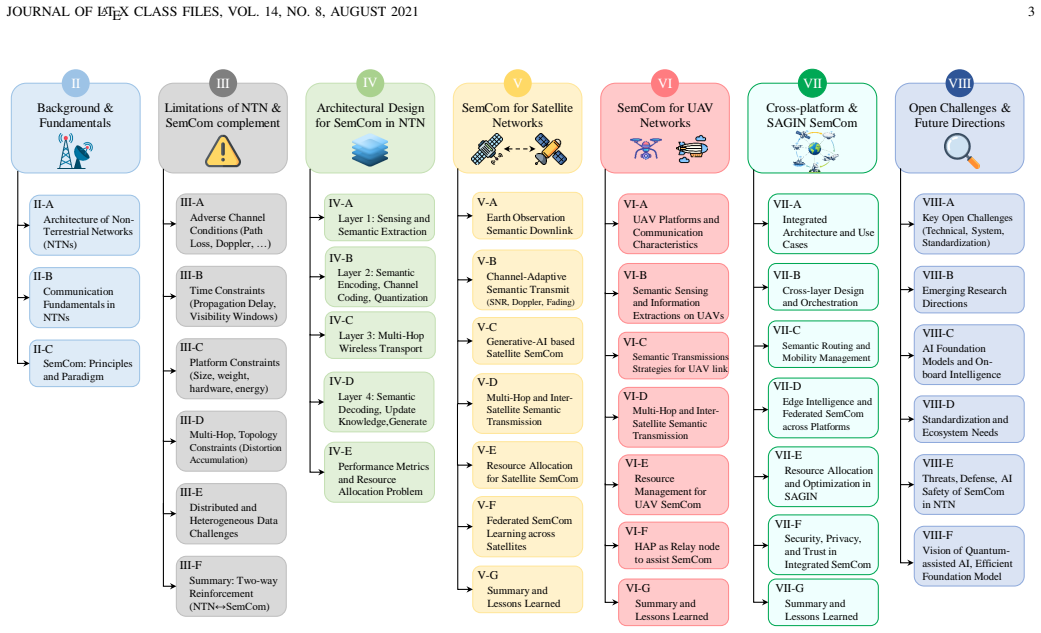
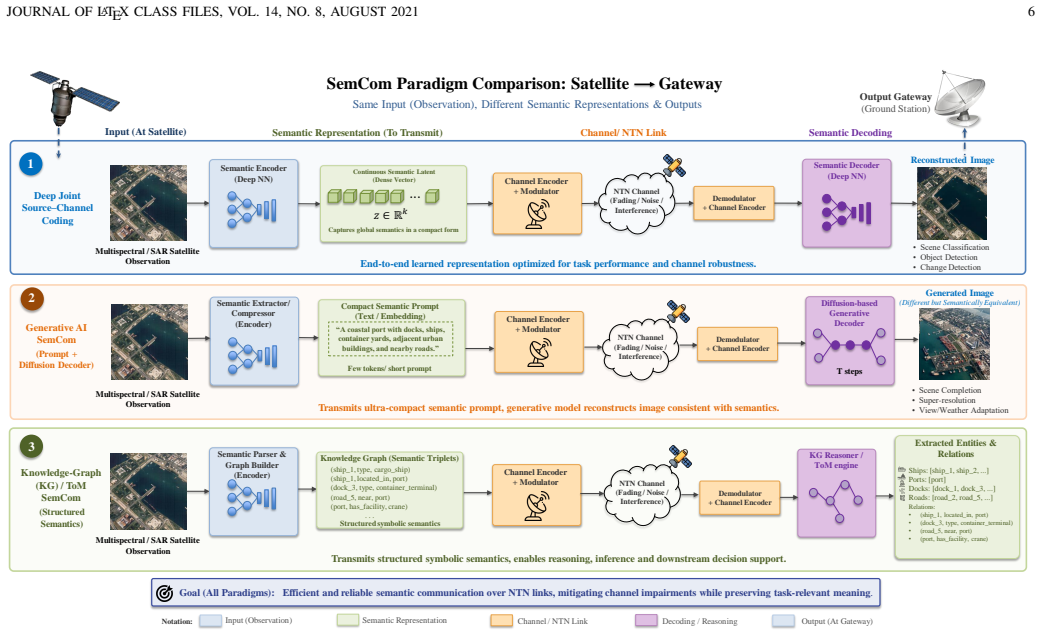
Each NTN limitation maps onto a SemCom property that addresses it: extreme task-oriented compression eases bandwidth scarcity from long distances and limited visibility, deep joint source-channel coding prevents cliff effects at low signal-to-noise ratios, and generative-AI reconstruction recovers content from the sparse cues that survive rain fade or blockage. This mapping motivates the survey's structure, which reviews the literature along the axes of NTN platform, semantic methodology, and supporting techniques, followed by platform-specific deep dives into satellite-centric, UAV/HAPS-centric, and SAGIN systems.
What carries the argument
The one-to-one mapping of each NTN limitation (severe path loss, long propagation delays, large Doppler shifts, limited visibility windows, tight energy budgets) to a corresponding SemCom property (extreme compression, deep joint source-channel coding, generative reconstruction from sparse cues).
If this is right
- Task-oriented semantic compression reduces required bandwidth in energy-limited satellite and UAV links.
- Deep joint source-channel coding maintains performance when signal-to-noise ratios drop due to distance or fading.
- Generative models enable content recovery when only partial semantic cues survive blocked or attenuated channels.
- Platform-specific designs emerge for satellites versus UAVs because their delay and visibility profiles differ.
- Standards gaps appear in how semantic encoders should interface with existing NTN physical layers.
Where Pith is reading between the lines
- Foundation models could extend the generative reconstruction step to handle entirely new NTN scenarios without retraining.
- Energy-aware scheduling at the semantic level might trade off reconstruction quality against on-board power in long-duration missions.
- Quantum-assisted semantic coding could become relevant for deep-space links where classical joint coding reaches its limits.
- The mapping approach might generalize to other constrained environments such as underwater acoustic networks.
Load-bearing premise
The selected papers accurately represent the field and the mapping of each NTN limitation to a SemCom advantage holds without major counter-examples.
What would settle it
A set of NTN experiments or deployments where semantic methods show no consistent advantage over conventional bit transmission under the listed constraints.
Figures
read the original abstract
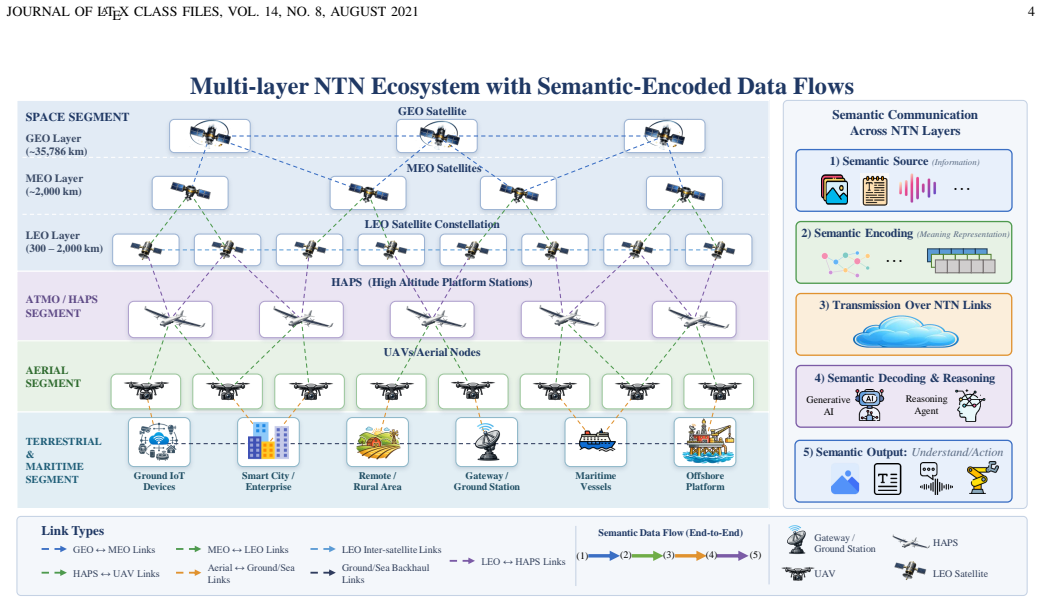
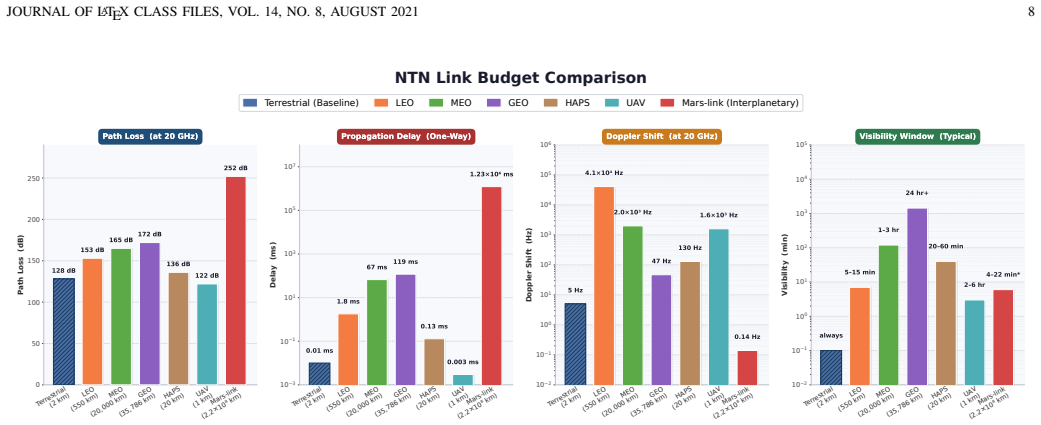
The sixth-generation wireless networks are envisioned to deliver ubiquitous, seamless, and intelligent connectivity that reaches far beyond the limits of terrestrial infrastructure. Non-terrestrial networks (NTNs) are central to this vision, extending coverage to underserved regions, remote terrain, and disaster zones that terrestrial deployment cannot economically reach. However, NTN architecture faces numerous limitations: severe path loss over long distances, long propagation delays, large and time-varying Doppler shifts, limited visibility windows, and tight on-board energy and computing budgets. Semantic communication (SemCom), which conveys the meaning of data rather than its raw bit-level representation, is unusually well matched to these conditions: extreme compression rate for task-oriented eases bandwidth scarcity, deep joint source-channel coding prevents the cliff effect due to low signal-to-noise ratio, and generative-AI reconstructs content from sparse cues that survive rain-faded or blocked links. This observation, that each NTN limitation maps onto a SemCom property that addresses it, motivates our survey. We first walk through the NTN limitations one by one, pairing each with the SemCom design choices that complement it, then we organize the literature along three axes: the NTN platform, the semantic methodology, and the supporting techniques, and follow this with platform-by-platform deep dives on satellite-centric, UAV/HAPS-centric, and integrated SAGIN systems. The survey concludes by identifying open research problems, gaps in existing standards, and future directions, including the application of foundation models, energy-aware scheduling, and quantum-assisted SemCom for deep space communication.
Editorial analysis
A structured set of objections, weighed in public.
Referee Report
Summary. The paper is a survey claiming that semantic communication (SemCom) is particularly well-suited to non-terrestrial networks (NTNs) because task-oriented compression, deep joint source-channel coding, and generative-AI reconstruction directly address NTN limitations including path loss, propagation delays, Doppler shifts, visibility windows, and energy budgets. It organizes the literature along three axes (NTN platform, semantic methodology, supporting techniques), provides platform-specific deep dives into satellite-centric, UAV/HAPS-centric, and integrated SAGIN systems, and concludes with open problems such as foundation models, energy-aware scheduling, and quantum-assisted SemCom for deep space.
Significance. If the claimed one-to-one mappings between NTN limitations and SemCom properties hold across the reviewed literature and the coverage is representative, the survey would provide a useful organizing framework and roadmap for 6G NTN design. The structured three-axis organization and explicit identification of gaps in standards constitute strengths that could guide future work.
major comments (2)
- [Abstract / NTN-limitation pairing section] Abstract and the section walking through NTN limitations one-by-one: the central premise that each limitation (path loss, delays, Doppler, visibility, energy) maps directly onto a SemCom advantage is presented as motivation without explicit discussion of offsetting costs (e.g., on-board generative inference latency or compute load exceeding satellite energy budgets) or counter-examples in the literature. This premise organizes the entire survey; its validity is therefore load-bearing.
- [Literature organization along three axes] Literature organization section: the survey states that the selected works accurately represent the state of the field and that the mappings hold, yet provides no explicit selection criteria, inclusion/exclusion rules, or systematic search protocol. Without these, it is impossible to assess whether the claimed complementarity is robust or affected by selection bias.
minor comments (1)
- [Conclusion] The abstract and conclusion mention 'gaps in existing standards' but do not name specific standards documents or working groups; adding these references would improve traceability.
Simulated Author's Rebuttal
We thank the referee for the constructive and detailed comments. We address each major comment below and outline the revisions we will make to strengthen the manuscript.
read point-by-point responses
-
Referee: [Abstract / NTN-limitation pairing section] Abstract and the section walking through NTN limitations one-by-one: the central premise that each limitation (path loss, delays, Doppler, visibility, energy) maps directly onto a SemCom advantage is presented as motivation without explicit discussion of offsetting costs (e.g., on-board generative inference latency or compute load exceeding satellite energy budgets) or counter-examples in the literature. This premise organizes the entire survey; its validity is therefore load-bearing.
Authors: We agree that the motivation section presents the NTN-SemCom mappings primarily as complementary without a dedicated discussion of offsetting costs or counter-examples. In the revised manuscript we will add a balanced subsection that explicitly addresses potential drawbacks, such as on-board inference latency, energy overhead from generative models, and any counter-examples identified in the reviewed works, while retaining the core motivation. revision: yes
-
Referee: [Literature organization along three axes] Literature organization section: the survey states that the selected works accurately represent the state of the field and that the mappings hold, yet provides no explicit selection criteria, inclusion/exclusion rules, or systematic search protocol. Without these, it is impossible to assess whether the claimed complementarity is robust or affected by selection bias.
Authors: We acknowledge that the manuscript does not currently provide explicit selection criteria or a search protocol. We will insert a new subsection in the literature organization section that details the systematic review methodology, including databases, search strings, inclusion/exclusion criteria, and the number of papers screened and retained. This will allow readers to evaluate potential bias. revision: yes
Circularity Check
No circularity: literature survey with no derivations or load-bearing self-references
full rationale
This paper is a comprehensive survey that reviews and organizes existing literature on semantic communication applied to non-terrestrial networks. It presents no equations, no predictions, no fitted parameters, and no derivation chain. The central motivation—that NTN limitations map to SemCom advantages—is framed as an organizing observation drawn from the reviewed works rather than a result derived within the paper itself. No self-citation load-bearing steps, ansatz smuggling, or renaming of known results occur. The paper is self-contained as a review and does not reduce any claim to its own inputs by construction.
Axiom & Free-Parameter Ledger
Reference graph
Works this paper leans on
-
[1]
6G internet of things: A comprehensive survey,
D. C. Nguyen, M. Ding, P. N. Pathirana, A. Seneviratne, J. Li, D. Niyato, O. Dobre, and H. V . Poor, “6G internet of things: A comprehensive survey,”IEEE Internet Things J., vol. 9, no. 1, pp. 359– 383, Jan. 2022
2022
-
[2]
Agentic satellite-augmented low-altitude economy and terrestrial networks: A survey on generative approaches,
X. Gao, Y . Wang, B. Liu, X. Zhou, R. Zhang, J. Wang, D. Niyato, D. In Kim, A. Jamalipour, C. Yuen, J. An, and K. Yang, “Agentic satellite-augmented low-altitude economy and terrestrial networks: A survey on generative approaches,”IEEE Commun. Surv. Tutor., vol. 28, pp. 4800–4841, Feb. 2026
2026
-
[3]
Revolutionizing future connectivity: A contemporary survey on AI-empowered satellite-based non-terrestrial networks in 6G,
S. Mahboob and L. Liu, “Revolutionizing future connectivity: A contemporary survey on AI-empowered satellite-based non-terrestrial networks in 6G,”IEEE Commun. Surv. Tutor., vol. 26, no. 2, pp. 1279– 1321, Jan. 2024
2024
-
[4]
Uav swarm-enabled collaborative post-disaster communications in low altitude economy via a two-stage optimization approach,
X. Zheng, G. Sun, J. Li, J. Wang, Q. Wu, D. Niyato, and A. Jamalipour, “Uav swarm-enabled collaborative post-disaster communications in low altitude economy via a two-stage optimization approach,”IEEE Trans. Mobile Comput., vol. 24, no. 11, pp. 11 833–11 851, Nov. 2025
2025
-
[5]
Ai-enabled space-air-ground integrated networks: Management and optimization,
P. Zhang, N. Chen, S. Shen, S. Yu, N. Kumar, and C.-H. Hsu, “Ai-enabled space-air-ground integrated networks: Management and optimization,”IEEE Network, vol. 38, no. 2, pp. 186–192, Apr. 2024
2024
-
[6]
Review of 5G NTN standards development and technical challenges for satellite integration with the 5G network,
M. Hosseinian, J. P. Choi, S.-H. Chang, and J. Lee, “Review of 5G NTN standards development and technical challenges for satellite integration with the 5G network,”IEEE Aerosp. Electron. Syst. Mag., vol. 36, no. 8, pp. 22–31, Aug. 2021
2021
-
[7]
A survey on resource management in joint communication and computing- embedded sagin,
Q. Chen, Z. Guo, W. Meng, S. Han, C. Li, and T. Q. S. Quek, “A survey on resource management in joint communication and computing- embedded sagin,”IEEE Commun. Surv. Tutor., vol. 27, no. 3, pp. 1911– 1954, Jun. 2025
1911
-
[8]
Recent contributions to the mathematical theory of com- munication,
W. Weaver, “Recent contributions to the mathematical theory of com- munication,” inETC: A Review of General Semantics, 1953
1953
-
[9]
Deep joint source- channel coding for wireless image transmission,
E. Bourtsoulatze, D. B. Kurka, and D. G ¨und¨uz, “Deep joint source- channel coding for wireless image transmission,”IEEE Trans. Cogn. Commun. Netw., vol. 5, no. 3, pp. 567–579, Sep. 2019
2019
-
[10]
Cross-modal generative semantic communications for mobile AIGC: Joint semantic encoding and prompt engineering,
Y . Liu, H. Du, D. Niyato, J. Kang, Z. Xiong, S. Mao, P. Zhang, and X. Shen, “Cross-modal generative semantic communications for mobile AIGC: Joint semantic encoding and prompt engineering,”IEEE Trans. Mobile Comput., vol. 23, no. 12, pp. 14 871–14 888, Dec. 2024
2024
-
[11]
Less data, more knowledge: Building next generation semantic communication networks,
C. Chaccour, W. Saad, M. Debbah, Z. Han, and H. V . Poor, “Less data, more knowledge: Building next generation semantic communication networks,”IEEE Commun. Surv. Tutor., vol. 27, no. 1, pp. 37–76, Feb. 2025
2025
-
[12]
Wireless innovations for 6g: Semantic communication, ai-driven networking, non-terrestrial systems, and emerging hardware technologies,
N. Ansari, “Wireless innovations for 6g: Semantic communication, ai-driven networking, non-terrestrial systems, and emerging hardware technologies,”IEEE Wirel. Commun., vol. 32, no. 5, pp. 4–7, Oct. 2025
2025
-
[13]
Semantic communication in non-terrestrial networks: A future-ready paradigm,
H. Peng, Z. Zhang, Y . Liu, Z. Su, T. H. Luan, and N. Cheng, “Semantic communication in non-terrestrial networks: A future-ready paradigm,” IEEE Network, vol. 38, no. 4, pp. 119–127, Jul. 2024
2024
-
[14]
On the role of semantic communication in non-terrestrial networks,
Z. Wang, Z. Weng, X. Tao, and Z. Qin, “On the role of semantic communication in non-terrestrial networks,”IEEE Communications Magazine, vol. 63, no. 10, pp. 102–109, Oct. 2025
2025
-
[15]
Semantic non-terrestrial communications with open ran-enabled 6g,
E. Zeydan, L. Blanco, C. J. Vaca-Rubio, M. Caus, and K. Dev, “Semantic non-terrestrial communications with open ran-enabled 6g,” IEEE Commun. Mag., vol. 9, no. 4, pp. 72–78, Dec. 2025
2025
-
[16]
A tutorial on non-terrestrial networks: Towards global and ubiquitous 6G connectivity,
M. A. Jamshed, A. Kaushik, S. Manzoor, M. Z. Shakir, J. Seong, M. Toka, W. Shin, and M. Schellmann, “A tutorial on non-terrestrial networks: Towards global and ubiquitous 6G connectivity,”Found. Trends Netw., vol. 14, no. 3, pp. 160–253, Feb. 2025. JOURNAL OF LATEX CLASS FILES, VOL. 14, NO. 8, AUGUST 2021 26
2025
-
[17]
A survey on semantic communication networks: Architecture, security, and privacy,
S. Guo, Y . Wang, N. Zhang, Z. Su, T. H. Luan, Z. Tian, and X. Shen, “A survey on semantic communication networks: Architecture, security, and privacy,”IEEE Commun. Surv. Tutor., vol. 27, no. 5, pp. 2860– 2894, Oct. 2025
2025
-
[18]
Generative ai for space-air-ground integrated networks,
R. Zhang, H. Du, D. Niyato, J. Kang, Z. Xiong, A. Jamalipour, P. Zhang, and D. I. Kim, “Generative ai for space-air-ground integrated networks,”IEEE Wirel. Commun., vol. 31, no. 6, pp. 10–20, Dec. 2024
2024
-
[19]
Semantic communications in 6G: Coexistence, multiple access, and satellite networks,
I. Ahmed, Y . Sun, J. Fu, A. K¨ose, L. Musavian, M. Xiao, and B. ¨Ozbek, “Semantic communications in 6G: Coexistence, multiple access, and satellite networks,”IEEE Commun. Stand. Mag., vol. 9, no. 4, pp. 58– 64, Dec. 2025
2025
-
[20]
Resource allocation in wireless semantic communications: A comprehensive survey,
C. Zhang, L. Huang, and Q. Ning, “Resource allocation in wireless semantic communications: A comprehensive survey,”IEEE Commun. Surv. Tutor., vol. 28, pp. 2965–3001, Jan. 2026
2026
-
[21]
A survey on energy-aware semantic communication in leo satellites for 6g,
T. T. Win, M. C. Ho, T. P. Truong, S. Hong, and S. Cho, “A survey on energy-aware semantic communication in leo satellites for 6g,” in Intelligent Aerial Access and Applications Towards 6G and Beyond, N.-N. Dao, Q.-D. Pham, H. A. Le, and T. N. Thinh, Eds. Cham: Springer Nature Switzerland, May 2026
2026
-
[22]
Generative AI-empowered secure communications in space–air–ground integrated networks: A survey and tutorial,
C. Hu, R. Zhang, B. Li, X. Jiang, N. Zhao, M. Di Renzo, D. Niyato, A. Nallanathan, and G. K. Karagiannidis, “Generative AI-empowered secure communications in space–air–ground integrated networks: A survey and tutorial,”IEEE Commun. Surv. Tutor., vol. 28, pp. 4156– 4194, Jan. 2026
2026
-
[23]
Artificial intelligence for satellite communication: A survey,
G. Fontanesi, F. Ort ´ız, E. Lagunas, L. M. Garc´es-Socarr´as, V . M. Baeza, M. ´A. V ´azquez, J. A. V ´asquez-Peralvo, M. Minardi, H. N. Vuet al., “Artificial intelligence for satellite communication: A survey,”IEEE Commun. Surv. Tutor., vol. 28, pp. 1381–1435, Feb. 2025
2025
-
[24]
Semantics-empowered space-air-ground-sea integrated network: New paradigm, frameworks, and challenges,
S. Meng, S. Wu, J. Zhang, J. Cheng, H. Zhou, and Q. Zhang, “Semantics-empowered space-air-ground-sea integrated network: New paradigm, frameworks, and challenges,”IEEE Commun. Surv. Tutor., vol. 27, no. 1, pp. 140–183, Feb. 2025
2025
-
[25]
Resource management, security, and privacy issues in semantic communications: A survey,
D. Won, G. Woraphonbenjakul, A. B. Wondmagegn, A.-T. Tran, D. Lee, D. S. Lakew, and S. Cho, “Resource management, security, and privacy issues in semantic communications: A survey,”IEEE Commun. Surv. Tutor., vol. 27, no. 3, pp. 1758–1797, Jun. 2025
2025
-
[26]
Semantic communications for future internet: Fundamentals, applications, and challenges,
W. Yang, H. Du, Z. Q. Liew, W. Y . B. Lim, Z. Xiong, D. Niyato, X. Chi, X. Shen, and C. Miao, “Semantic communications for future internet: Fundamentals, applications, and challenges,”IEEE Commun. Surv. Tutor., vol. 25, no. 1, pp. 213–250, Firsquater, 2023
2023
-
[27]
Making sense of meaning: A survey on metrics for semantic and goal-oriented communication,
T. M. Getu, G. Kaddoum, and M. Bennis, “Making sense of meaning: A survey on metrics for semantic and goal-oriented communication,” IEEE Access, vol. 11, pp. 45 456–45 492, May 2023
2023
-
[28]
Semantic communication empowered 6G networks: Techniques, applications, and challenges,
Y . Wang, H. Han, Y . Feng, J. Zheng, and B. Zhang, “Semantic communication empowered 6G networks: Techniques, applications, and challenges,”IEEE Access, vol. 13, pp. 28 293–28 314, Jan. 2025
2025
-
[29]
A survey on goal- oriented semantic communication: Techniques, challenges, and future directions,
T. M. Getu, G. Kaddoum, and M. Bennis, “A survey on goal- oriented semantic communication: Techniques, challenges, and future directions,”IEEE Access, vol. 12, pp. 51 223–51 274, Mar. 2024
2024
-
[30]
Semantics-empowered communications: A tutorial-cum-survey,
Z. Lu, R. Li, K. Lu, X. Chen, E. Hossain, Z. Zhao, and H. Zhang, “Semantics-empowered communications: A tutorial-cum-survey,”IEEE Commun. Surv. Tutor., vol. 26, no. 1, pp. 41–79, Firstquarter, 2024
2024
-
[31]
Evolution of non-terrestrial networks from 5g to 6g: A survey,
M. M. Azari, S. Solanki, S. Chatzinotas, O. Kodheli, H. Sallouha, A. Colpaert, J. F. Mendoza Montoya, S. Pollinet al., “Evolution of non-terrestrial networks from 5g to 6g: A survey,”IEEE Commun. Surv. Tutor., vol. 24, no. 4, pp. 2633–2672, Fourthquarter 2022
2022
-
[32]
Timeliness of information in 5g nonterrestrial net- works: A survey,
Q. T. Ngo, Z. Tang, B. Jayawickrama, Y . He, E. Dutkiewicz, and B. Senanayake, “Timeliness of information in 5g nonterrestrial net- works: A survey,”IEEE Internet Things J., vol. 11, no. 21, pp. 34 652– 34 675, Nov. 2024
2024
-
[33]
Mimo satellite communication systems: A survey from the phy layer perspective,
J. Heo, S. Sung, H. Lee, I. Hwang, and D. Hong, “Mimo satellite communication systems: A survey from the phy layer perspective,” IEEE Commun. Surv. Tutor., vol. 25, no. 3, pp. 1543–1570, Thirdquarter 2023
2023
-
[34]
A tale of two mobile generations: 5g-advanced and 6g in 3gpp release 20,
X. Lin, “A tale of two mobile generations: 5g-advanced and 6g in 3gpp release 20,”IEEE Commun. Stand. Mag., pp. 1–9, Oct. 2025
2025
-
[35]
Star- link constellation: Deployment, configuration, and dynamics,
M. Ali, U. Upadhyay, S. McCormick, J. Hill, and B. Zhang, “Star- link constellation: Deployment, configuration, and dynamics,” Preprint arXiv:2603.25835, Mar. 2026
-
[36]
Satellite visibility prediction for constrained devices in direct-to-satellite iot systems,
R. Ortigueira, S. Montejo-S ´anchez, S. Henn, J. A. Fraire, and S. C ´espedes, “Satellite visibility prediction for constrained devices in direct-to-satellite iot systems,”IEEE Sens. J., vol. 24, no. 16, pp. 26 630–26 644, Jul. 2024
2024
-
[37]
Round trip times (rtts): Comparing terrestrial and leo satellite networks,
J. Conde, G. Mart ´ınez, P. Reviriego, and J. A. Hern´andez, “Round trip times (rtts): Comparing terrestrial and leo satellite networks,” inConf. Innov. Clouds Internet Netw. (ICIN), Paris, France, Mar. 2024
2024
-
[38]
Coverage analysis of geo satellite networks,
D.-H. Jung, H.-J. Nam, and J. Choi, “Coverage analysis of geo satellite networks,” inProc. Int. Symp. Model. Optim. Mob. Ad Hoc Wirel. Netw. (WiOpt), Seoul, Korea, Republic of, Oct. 2024
2024
-
[39]
A vision and framework for the high altitude platform station (haps) networks of the future,
G. Karabulut Kurt, M. G. Khoshkholgh, S. Alfattani, A. Ibrahim, T. S. J. Darwish, M. S. Alam, H. Yanikomeroglu, and A. Yongacoglu, “A vision and framework for the high altitude platform station (haps) networks of the future,”IEEE Commun. Surv. Tutor., vol. 23, no. 2, pp. 729–779, Mar. 2021
2021
-
[40]
Zephyr High Altitude Platform Station (HAPS),
Airbus, “Zephyr High Altitude Platform Station (HAPS),” https://www. airbus.com/en/products-services/defence/uas/zephyr, 2026
2026
-
[41]
Dependency tasks offloading and communication resource allocation in collaborative uav networks: A metaheuristic approach,
L. X. Nguyen, Y . K. Tun, T. N. Dang, Y . M. Park, Z. Han, and C. S. Hong, “Dependency tasks offloading and communication resource allocation in collaborative uav networks: A metaheuristic approach,” IEEE Internet Things J., vol. 10, no. 10, pp. 9062–9076, May 2023
2023
-
[42]
A survey on space-air- ground-sea integrated network security in 6g,
H. Guo, J. Li, J. Liu, N. Tian, and N. Kato, “A survey on space-air- ground-sea integrated network security in 6g,”IEEE Commun. Surv. Tutor., vol. 24, no. 1, pp. 53–87, Firstquater-2022
2022
-
[43]
Towards energy-efficient routing in satellite networks,
Y . Yang, M. Xu, D. Wang, and Y . Wang, “Towards energy-efficient routing in satellite networks,”IEEE J. Sel. Areas Commun., vol. 34, no. 12, pp. 3869–3886, Dec. 2016
2016
-
[44]
Multi-gateway feeder link switching optimization in multi-shell leo mega-constellations,
S. Kim, I. Choi, Y . Lee, and J. P. Choi, “Multi-gateway feeder link switching optimization in multi-shell leo mega-constellations,”IEEE Trans. Commun., vol. 74, pp. 2857–2873, Dec. 2025
2025
-
[45]
Machine learning- based resource allocation in satellite networks supporting internet of remote things,
D. Zhou, M. Sheng, Y . Wang, J. Li, and Z. Han, “Machine learning- based resource allocation in satellite networks supporting internet of remote things,”IEEE Trans. Wirel. Commun., vol. 20, no. 10, pp. 6606– 6621, Oct. 2021
2021
-
[46]
A survey on direct-to-device satellite communications: Advances, challenges, and prospects,
H. B. Pasandi, J. A. Fraire, S. Ratnasamy, and H. Rivano, “A survey on direct-to-device satellite communications: Advances, challenges, and prospects,” inProc. Int. Workshop LEO Netw. Commun., Nov. 2024
2024
-
[47]
Onboard processing in satellite communications using ai accelerators,
F. Ortiz, V . Monzon Baeza, L. M. Garces-Socarras, J. A. V ´asquez- Peralvo, J. L. Gonzalez, G. Fontanesi, E. Lagunas, J. Querol, and S. Chatzinotas, “Onboard processing in satellite communications using ai accelerators,”Aerospace, vol. 10, no. 2, p. 101, Jan. 2023. [48]System Architecture for the 5G System (5GS), 3rd Generation Partner- ship Project (3GP...
2023
-
[48]
Rain fade analysis on high frequency signal: A review,
H. Basarudin, N. M. Yunus, N. Hasan, N. A. I. Aminudin, A. Ramli, B. Chung, L. Ling, H. Gan, and M. A. Abu, “Rain fade analysis on high frequency signal: A review,”J. Adv. Res. Appl. Sci. Eng. Technol., vol. 60, no. 1, pp. 299–317, 2024
2024
-
[49]
Evaluation of some rain attenuation prediction models for satellite communication at ku and ka bands,
K. Igwe, O. Oyedum, M. Ajewole, and A. Aibinu, “Evaluation of some rain attenuation prediction models for satellite communication at ku and ka bands,”J. Atmos. Sol.-Terr. Phys., vol. 188, pp. 52–61, Jul. 2019
2019
-
[50]
Channel quality predictions assisted by new algorithms for high throughput satellite and 5g sys- tems,
A. M. Al-Saegh, E. M. Ali, M. Q. Abdalrazak, N. A. Elmunim, M. Alibakhshikenari, B. S. Virdeeet al., “Channel quality predictions assisted by new algorithms for high throughput satellite and 5g sys- tems,”Scientific Reports, vol. 15, no. 1, p. 34649, Oct. 2025
2025
-
[51]
Energy efficient power allocation for delay constrained cognitive satellite terrestrial networks under interference constraints,
Y . Ruan, Y . Li, C.-X. Wang, R. Zhang, and H. Zhang, “Energy efficient power allocation for delay constrained cognitive satellite terrestrial networks under interference constraints,”IEEE Trans. Wirel. Commun., vol. 18, no. 10, pp. 4957–4969, Oct. 2019
2019
-
[52]
Multibeam high throughput satellite: Hardware founda- tion, resource allocation, and precoding,
R. Chen, W.-X. Long, B. Wang, Y . He, R. Sun, N. Cheng, G. Zheng, and D. Niyato, “Multibeam high throughput satellite: Hardware founda- tion, resource allocation, and precoding,”IEEE Commun. Surv. Tutor., vol. 28, pp. 5379–5415, Mar. 2026
2026
-
[53]
Phased antenna-array synthesis using taylor-series expansion and neural networks,
A. Kouki, R. Kheder, R. Ghayoula, I. El Gmati, L. Latrach, W. Amara, L. Ben Ayed, and J. Fattahi, “Phased antenna-array synthesis using taylor-series expansion and neural networks,” inTelecom, vol. 6, no. 2. MDPI, Jun. 2025
2025
-
[54]
Efficient resource allocation for beam- hopping-based multi-satellite communication systems,
Y . Wang, M. Zeng, and Z. Fei, “Efficient resource allocation for beam- hopping-based multi-satellite communication systems,”Electronics, vol. 12, no. 11, p. 2441, May 2023
2023
-
[55]
Modulated frequency-selective doubly curved sub-reflector for a dual-band multiple spot beam communication satellite antenna system,
A. Ericsson, M. Zhou, S. B. Sørensen, T. Rubæk, M. Riel, and N. J. G. Fonseca, “Modulated frequency-selective doubly curved sub-reflector for a dual-band multiple spot beam communication satellite antenna system,”IEEE Trans. Antennas Propag., vol. 72, no. 12, pp. 9152– 9163, Dec. 2024. JOURNAL OF LATEX CLASS FILES, VOL. 14, NO. 8, AUGUST 2021 27
2024
-
[56]
Precoding in multibeam satellite communications: Present and future challenges,
M. ´A. V ´azquez, A. Perez-Neira, D. Christopoulos, S. Chatzinotas, B. Ottersten, P.-D. Arapoglou, A. Ginesi, and G. Taricco, “Precoding in multibeam satellite communications: Present and future challenges,” IEEE Wireless Commun., vol. 23, no. 6, pp. 88–95, Dec. 2016
2016
-
[57]
Demand and interference aware adaptive resource management for high throughput geo satellite systems,
T. S. Abdu, S. Kisseleff, E. Lagunas, S. Chatzinotas, and B. Ottersten, “Demand and interference aware adaptive resource management for high throughput geo satellite systems,”IEEE Open J. Commun. Soc., vol. 3, pp. 759–775, Apr. 2022
2022
-
[58]
Flexible resource allocation with inter-beam interfer- ence in satellite communication systems with a digital channelizer,
Y . Kawamoto, T. Kamei, M. Takahashi, N. Kato, A. Miura, and M. Toyoshima, “Flexible resource allocation with inter-beam interfer- ence in satellite communication systems with a digital channelizer,” IEEE Trans. Wirel. Commun., vol. 19, no. 5, pp. 2934–2945, May 2020
2020
-
[59]
Demand-based adaptive multi-beam pattern and footprint planning for high throughput geo satellite systems,
P. J. Honnaiah, N. Maturo, S. Chatzinotas, S. Kisseleff, and J. Krause, “Demand-based adaptive multi-beam pattern and footprint planning for high throughput geo satellite systems,”IEEE Open J. Commun. Soc., vol. 2, pp. 1526–1540, Jul. 2021
2021
-
[60]
Multi-satellite beam hopping based on load balancing and interference avoidance for ngso satellite communication systems,
Z. Lin, Z. Ni, L. Kuang, C. Jiang, and Z. Huang, “Multi-satellite beam hopping based on load balancing and interference avoidance for ngso satellite communication systems,”IEEE Trans. Commun., vol. 71, no. 1, pp. 282–295, Jan. 2023
2023
-
[61]
Frequency allocation in a sdma satellite communication system with beam mov- ing,
K. Kiatmanaroj, C. Artigues, L. Houssin, and F. Messine, “Frequency allocation in a sdma satellite communication system with beam mov- ing,” inProc. IEEE Int. Conf. Commun. (ICC), ON, Canada, Jun. 2012
2012
-
[62]
Resource allocation for noma based space-terrestrial satellite networks,
L. Wang, Y . Wu, H. Zhang, S. Choi, and V . C. M. Leung, “Resource allocation for noma based space-terrestrial satellite networks,”IEEE Trans. Wirel. Commun., vol. 20, no. 2, pp. 1065–1075, Feb. 2021
2021
-
[63]
Ris-empowered satellite-aerial-terrestrial networks with pd- noma,
R. Liu, K. Guo, X. Li, K. Dev, S. Ali Khowaja, T. A. Tsiftsis, and H. Song, “Ris-empowered satellite-aerial-terrestrial networks with pd- noma,”IEEE Commun. Surv. Tutor., vol. 26, no. 4, pp. 2258–2289, Fourthquarter 2024
2024
-
[64]
Noma-based hybrid satellite-uav-terrestrial networks for 6g maritime coverage,
X. Fang, W. Feng, Y . Wang, Y . Chen, N. Ge, Z. Ding, and H. Zhu, “Noma-based hybrid satellite-uav-terrestrial networks for 6g maritime coverage,”IEEE Trans. Wirel. Commun., vol. 22, no. 1, pp. 138–152, Jan. 2023
2023
-
[65]
Secure and energy efficient transmission for rsma-based cognitive satellite- terrestrial networks,
Z. Lin, M. Lin, B. Champagne, W.-P. Zhu, and N. Al-Dhahir, “Secure and energy efficient transmission for rsma-based cognitive satellite- terrestrial networks,”IEEE Wirel. Commun. Lett., vol. 10, no. 2, pp. 251–255, Feb. 2021
2021
-
[66]
Deep reinforcement learning-based resource allocation for rsma in leo satellite-terrestrial networks,
J. Huang, Y . Yang, J. Lee, D. He, and Y . Li, “Deep reinforcement learning-based resource allocation for rsma in leo satellite-terrestrial networks,”IEEE Trans. Commun., vol. 72, no. 3, pp. 1341–1354, Mar. 2024
2024
-
[67]
Dynamic multiple access based on rsma and spectrum sharing for integrated satellite-terrestrial networks,
Z. Li, S. Han, M. Peng, C. Li, and W. Meng, “Dynamic multiple access based on rsma and spectrum sharing for integrated satellite-terrestrial networks,”IEEE Trans. Wirel. Commun., vol. 23, no. 6, pp. 5393–5408, Jun. 2024
2024
-
[68]
Reliability analysis of multi-hop routing in multi-tier leo satellite networks,
R. Wang, M. A. Kishk, and M.-S. Alouini, “Reliability analysis of multi-hop routing in multi-tier leo satellite networks,”IEEE Trans. Wirel. Commun., vol. 23, no. 3, pp. 1959–1973, Mar. 2024
1959
-
[69]
High-precision open-loop pointing for inter-orbit laser links between satellites,
H. Hu, J. Sun, H. Zhou, R. Xiu, J. Wu, T. Wang, L. Zhang, and J. Wang, “High-precision open-loop pointing for inter-orbit laser links between satellites,”Optics & Laser Technology, vol. 199, p. 114969, Jul. 2026
2026
-
[70]
Opspf: Orbit prediction shortest path first routing for resilient leo satellite networks,
T. Pan, T. Huang, X. Li, Y . Chen, W. Xue, and Y . Liu, “Opspf: Orbit prediction shortest path first routing for resilient leo satellite networks,” inProc. IEEE Int. Conf. Commun. (ICC), Shanghai, China, May 2019
2019
-
[71]
Joint satel- lite gateway placement and routing for integrated satellite-terrestrial networks,
N. Torkzaban, A. Gholami, J. S. Baras, and C. Papagianni, “Joint satel- lite gateway placement and routing for integrated satellite-terrestrial networks,” inProc. IEEE Int. Conf. Commun. (ICC), Dublin, Ireland, Jun. 2020
2020
-
[72]
A dynamic routing concept for atm-based satellite personal communication networks,
M. Werner, “A dynamic routing concept for atm-based satellite personal communication networks,”IEEE J. Sel. Areas Commun., vol. 15, no. 8, pp. 1636–1648, Oct. 1997
1997
-
[73]
Multi-dimensional traffic con- gestion detection based on fusion of visual features and convolutional neural network,
X. Ke, L. Shi, W. Guo, and D. Chen, “Multi-dimensional traffic con- gestion detection based on fusion of visual features and convolutional neural network,”IEEE Trans. Intell. Transp. Syst., vol. 20, no. 6, pp. 2157–2170, Jun. 2019
2019
-
[74]
Diffusion convolutional recurrent neural network: Data-driven traffic forecasting,
Y . Li, R. Yu, C. Shahabi, and Y . Liu, “Diffusion convolutional recurrent neural network: Data-driven traffic forecasting,” inProc. Int. Conf. Learn. Represent. (ICLR), Vancouver, Canada, May 2018
2018
-
[75]
Cooperative multi-agent deep reinforcement learning for resource management in full flexible vhts systems,
F. G. Ortiz-Gomez, D. Tarchi, R. Mart ´ınez, A. Vanelli-Coralli, M. A. Salas-Natera, and S. Landeros-Ayala, “Cooperative multi-agent deep reinforcement learning for resource management in full flexible vhts systems,”IEEE Trans. Cogn. Commun. Netw., vol. 8, no. 1, pp. 335– 349, Mar. 2022
2022
-
[76]
Gnn-enabled multi-agent drl for adaptive path selection in multi-network domains,
H. Feng, W. Zhang, Y . Liu, Y . Li, J. Yin, and J. Kang, “Gnn-enabled multi-agent drl for adaptive path selection in multi-network domains,” IEEE Trans. Netw. Sci. Eng., vol. 13, pp. 130–145, Jun. 2025
2025
-
[77]
Spaceris: Leo satellite coverage maximization in 6g sub-thz networks by mappo drl and whale optimization,
S. S. Hassan, Y . M. Park, Y . K. Tun, W. Saad, Z. Han, and C. S. Hong, “Spaceris: Leo satellite coverage maximization in 6g sub-thz networks by mappo drl and whale optimization,”IEEE J. Sel. Areas Commun., vol. 42, no. 5, pp. 1262–1278, May 2024
2024
-
[78]
Joint Semantic Coding and Routing for Multi-Hop Semantic Transmission in LEO Satellite Networks
H. Zeng, J. Luo, and Y . Ran, “Joint semantic coding and routing for multi-hop semantic transmission in LEO satellite networks,” Preprint arXiv:2604.13361, Apr. 2026
work page internal anchor Pith review Pith/arXiv arXiv 2026
-
[79]
A mathematical theory of communication,
C. E. Shannon, “A mathematical theory of communication,”Bell System Technical Journal, vol. 27, no. 3, pp. 379–423, Jul. 1948
1948
-
[80]
An outline of a theory of semantic information,
R. Carnap and Y . Bar-Hillel, “An outline of a theory of semantic information,”Research Laboratory of Electronics, MIT, 1952
1952
discussion (0)
Sign in with ORCID, Apple, or X to comment. Anyone can read and Pith papers without signing in.