Magnetic-field driven hybridization of heavy- and light-hole Rydberg excitons in GaAs quantum wells
Pith reviewed 2026-06-28 04:24 UTC · model grok-4.3
The pith
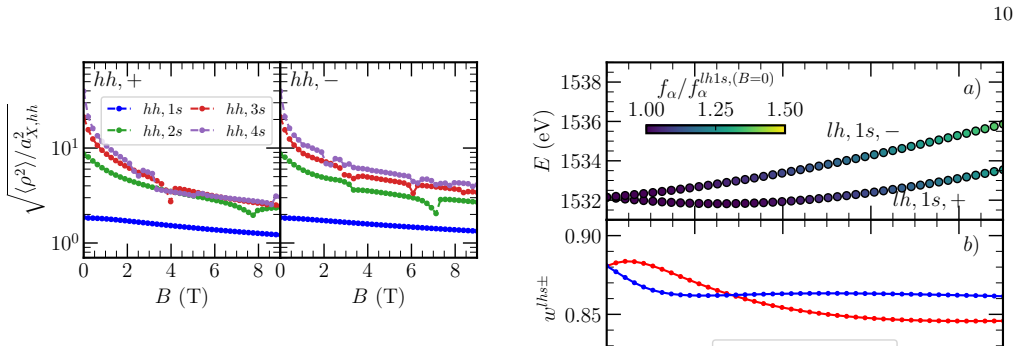
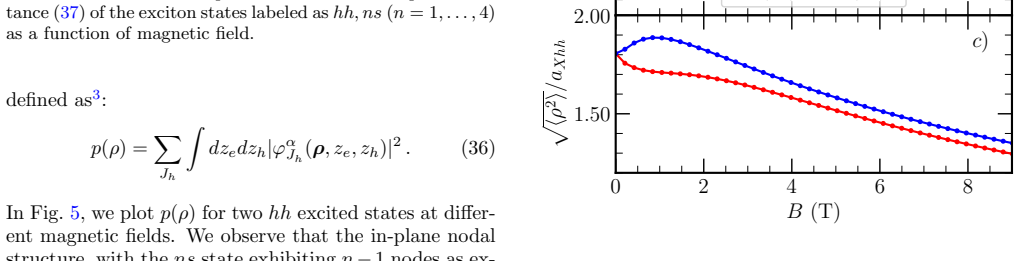
Magnetic fields induce hybridization between heavy- and light-hole Rydberg excitons in wide GaAs quantum wells, with stronger effects in excited states.
A machine-rendered reading of the paper's core claim, the machinery that carries it, and where it could break.
Core claim
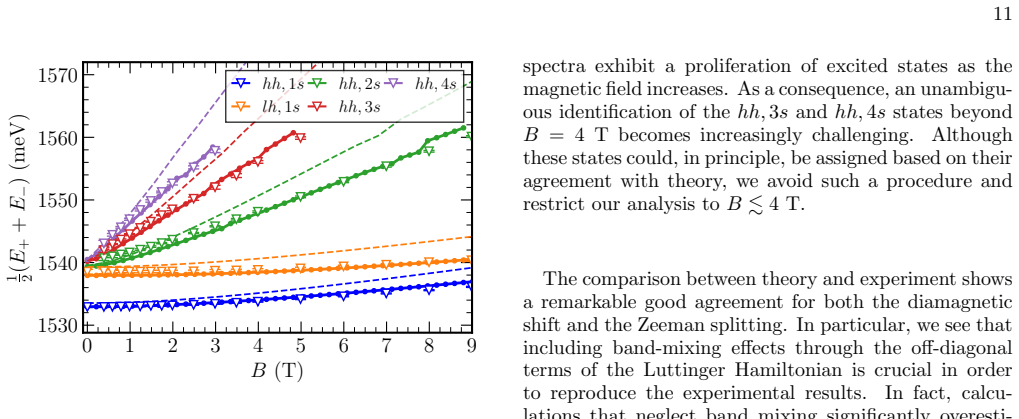
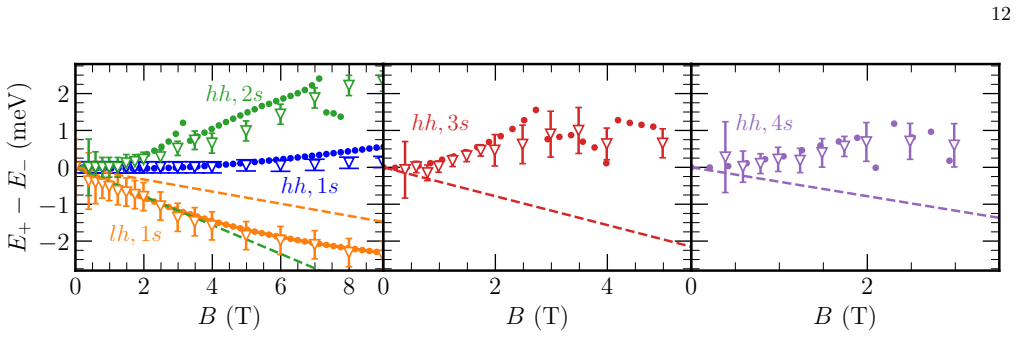
In wide GaAs quantum wells under Faraday-geometry magnetic fields, valence-band mixing captured by the Luttinger Hamiltonian drives hybridization of heavy- and light-hole Rydberg excitons. Hybridization increases with field and is markedly stronger for higher excited states, where it begins at lower fields and alters orbital composition and oscillator strengths. The multiband model, solved numerically with equal treatment of all interactions, yields energies and splittings that match polarization-resolved magneto-reflectance data for the ground state and first four Rydberg excitons up to 9 T.
What carries the argument
Multiband exciton model based on the Luttinger Hamiltonian that treats Coulomb interactions, magnetic confinement, and valence-band mixing on equal footing to compute energies, oscillator strengths, and orbital composition of ground and excited states.
If this is right
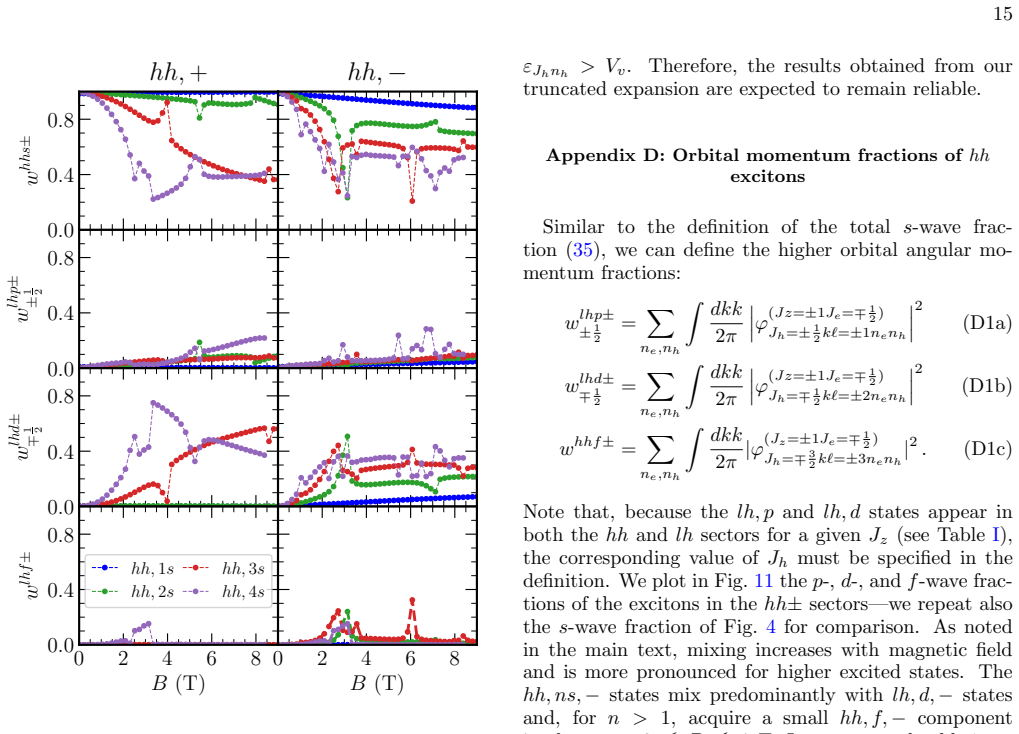
- Hybridization modifies the magnetic-field dependence of oscillator strengths and orbital character more strongly for the n=3 and n=4 Rydberg states than for the ground state.
- Diamagnetic shifts and Zeeman splittings of the first four Rydberg excitons agree with experiment only when band mixing is retained in the calculation.
- The onset field for noticeable hybridization decreases as the principal quantum number of the exciton increases.
- Polarization-resolved spectra directly reflect the field-induced change in heavy- versus light-hole character of each state.
Where Pith is reading between the lines
- Similar valence-band mixing may control magneto-exciton spectra in other wide direct-gap quantum wells once confinement and field strengths are comparable.
- Device models that ignore mixing for Rydberg states will mispredict optical response under modest laboratory fields.
- Extending the same numerical treatment to tilted fields or strained wells would test whether hybridization can be tuned independently of total field strength.
Load-bearing premise
The numerical solution of the multiband Luttinger model captures every dominant interaction without higher-order corrections or material parameters that would shift the field where hybridization begins.
What would settle it
Measurement of excited-state energies or oscillator strengths in 20 nm GaAs wells that deviate systematically from the model's predictions for fields between 2 T and 9 T while the ground state remains consistent.
Figures
read the original abstract
We present a combined theoretical and experimental study of ground and excited Rydberg exciton states in wide GaAs quantum wells exposed to a magnetic field in the Faraday geometry. We employ a multiband exciton model based on the Luttinger Hamiltonian, which captures valence-band mixing between heavy- and light-hole states induced by both the quantum well confinement and the magnetic field, and we develop an efficient numerical approach to solve for both ground- and excited-state excitons. The method treats Coulomb interactions, magnetic confinement, and band mixing on an equal footing, enabling a systematic characterization of exciton energies, oscillator strengths, and orbital composition. We show that band hybridization increases with magnetic field and is significantly more pronounced for higher excited states, where it sets in at lower fields and strongly modifies their properties. The theoretical predictions are validated by polarization-resolved magneto-reflectance measurements up to 9 T on GaAs/Al$_{0.4}$Ga$_{0.6}$As quantum wells of 20 nm width. We find excellent agreement for both the diamagnetic shift and Zeeman splitting of the ground state and the first four Rydberg excitons. Our results demonstrate that valence-band mixing plays a crucial role in determining the magnetic-field dependence of excited exciton states and must be properly included for a quantitative description of magneto-excitons in wide GaAs quantum wells.
Editorial analysis
A structured set of objections, weighed in public.
Referee Report
Summary. The manuscript presents a combined theoretical and experimental study of ground and excited Rydberg exciton states in 20 nm wide GaAs quantum wells under magnetic fields in the Faraday geometry. The authors employ a multiband exciton model based on the Luttinger Hamiltonian that treats Coulomb interactions, magnetic confinement, and valence-band mixing between heavy- and light-hole states on equal footing, developing an efficient numerical solver for both ground and excited states. They show that hybridization increases with field strength and is more pronounced for higher Rydberg states, modifying their energies, oscillator strengths, and orbital composition. Polarization-resolved magneto-reflectance measurements up to 9 T validate the model, with excellent agreement reported for diamagnetic shifts and Zeeman splittings of the ground state and first four Rydberg excitons.
Significance. If the central results hold, the work establishes that valence-band mixing must be included for quantitative modeling of the magnetic-field dependence of excited exciton states in wide GaAs quantum wells. The equal-footing treatment of all interaction terms and direct experimental validation for multiple Rydberg states provide a clear advance over single-band approximations, with implications for magneto-optics in semiconductor heterostructures and 2D exciton systems. The numerical method for solving the multiband problem is noted as an enabling technical contribution.
minor comments (3)
- [§3] §3 (numerical method): the description of the basis expansion and truncation criteria for the excited-state solutions should include explicit convergence tests with respect to basis size to allow independent reproduction of the reported energies.
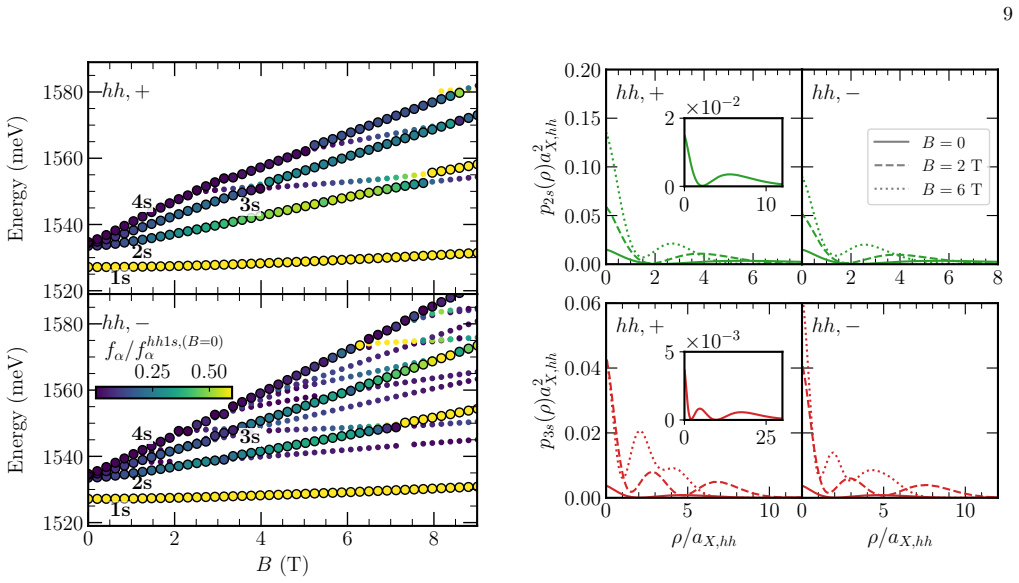
- [Fig. 4] Fig. 4 and associated text: the orbital composition plots would benefit from a quantitative breakdown (e.g., heavy-hole vs. light-hole percentages) at selected field values to support the hybridization-onset claim.
- [Experimental section] The experimental section should report the uncertainty in the extracted diamagnetic coefficients and g-factors to substantiate the 'excellent agreement' statement beyond visual comparison.
Simulated Author's Rebuttal
We thank the referee for their positive summary and significance assessment of our combined theoretical and experimental study on magnetic-field-driven heavy-light hole hybridization in Rydberg excitons. The recommendation of minor revision is noted; however, no specific major comments were provided in the report.
Circularity Check
No significant circularity; derivation self-contained via external experiment
full rationale
The paper solves the standard Luttinger Hamiltonian numerically for the multiband exciton model, treating Coulomb, magnetic, and mixing terms on equal footing, then compares the resulting energies, oscillator strengths, and orbital compositions directly to independent polarization-resolved magneto-reflectance measurements up to 9 T. Excellent agreement for diamagnetic shifts and Zeeman splittings of ground and first four Rydberg states is reported as validation, not as a fit. No step reduces a prediction to its own input by construction, no load-bearing self-citation chain is invoked to justify the central claim, and the hybridization conclusion follows from the numerical output rather than from renaming or self-definition. The derivation chain is therefore externally grounded.
Axiom & Free-Parameter Ledger
Reference graph
Works this paper leans on
-
[1]
By marking in gray the region 13 FIG
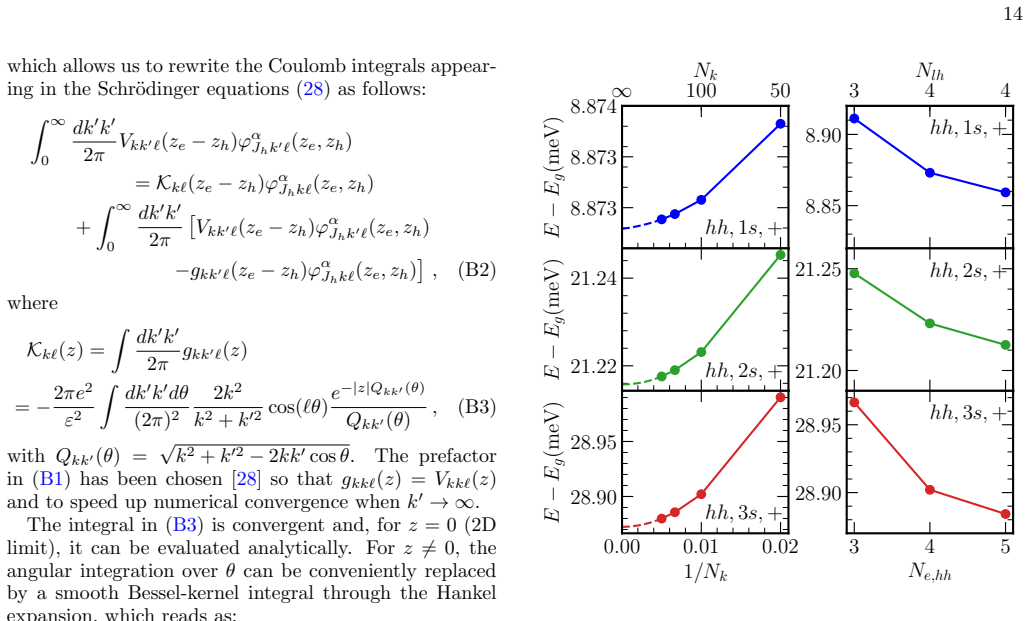
and light-hole (Jh =± 1 2) states, reflecting their different effective masses near the Γ point. In bulk GaAs, the heavy- and light-hole bands are degenerate at the Γ point, however this degeneracy is lifted in QWs due to the confinement. Within the envelope-function approximation, the exciton wave func- tion near Γ is expanded in terms of lattice-periodi...
-
[2]
Miura,Physics of Semiconductors in High Magnetic Fields(Oxford University Press, 2007)
N. Miura,Physics of Semiconductors in High Magnetic Fields(Oxford University Press, 2007)
2007
-
[3]
Tarucha, H
S. Tarucha, H. Okamoto, Y. Iwasa, and N. Miura,Exci- ton binding energy in GaAs quantum wells deduced from magneto-optical absorption measurement, Solid State Communications52, 815 (1984)
1984
-
[4]
Bugajski, W
M. Bugajski, W. Kuszko, and K. Regi´ nski,Diamagnetic shift of exciton energy levels in GaAs-Ga1-xAlxAs quan- tum wells, Solid State Communications60, 669 (1986)
1986
-
[5]
D. C. Rogers, J. Singleton, R. J. Nicholas, C. T. Foxon, and K. Woodbridge,Magneto-optics in GaAs- Ga1−xAlxAs quantum wells, Phys. Rev. B34, 4002 (1986)
1986
-
[6]
A. S. Plaut, J. Singleton, R. J. Nicholas, R. T. Harley, S. R. Andrews, and C. T. B. Foxon,Observation of de- coupled heavy and light holes in GaAs-Ga1−xAlxAs quan- tum wells by magnetoreflectivity, Phys. Rev. B38, 1323 (1988)
1988
-
[7]
Shields, J
A. Shields, J. Osborne, M. Simmons, M. Pepper, and D. Ritchie,Magneto-optical spectroscopy of positively charged excitons in GaAs quantum wells, Phys. Rev. B 52, R5523 (1995)
1995
-
[8]
Warnock, A
J. Warnock, A. Petrou, R. N. Bicknell, N. C. Giles- Taylor, D. K. Blanks, and J. F. Schetzina,Photolu- minescence ofCd 1−xMnxTe-CdTe multiple-quantum-well structures and superlattices in a magnetic field, Phys. Rev. B32, 8116 (1985)
1985
-
[9]
E. L. Ivchenko, A. V. Kavokin, V. P. Kochereshko, G. R. Posina, I. N. Uraltsev, D. R. Yakovlev, R. N. Bicknell- Tassius, A. Waag, and G. Landwehr,Exciton oscilla- tor strength in magnetic-field-induced spin superlattices CdTe/(Cd,Mn)Te, Phys. Rev. B46, 7713 (1992)
1992
-
[10]
Kheng, R
K. Kheng, R. T. Cox, M. Y. d’ Aubign´ e, F. Bassani, K. Saminadayar, and S. Tatarenko,Observation of neg- atively charged excitons X − in semiconductor quantum wells, Phys. Rev. Lett.71, 1752 (1993)
1993
-
[11]
G. V. Astakhov, D. R. Yakovlev, V. P. Kochereshko, W. Ossau, W. Faschinger, J. Puls, F. Henneberger, S. A. Crooker, Q. McCulloch, D. Wolverson, N. A. Gip- pius, and A. Waag,Binding energy of charged excitons in ZnSe-based quantum wells, Phys. Rev. B65, 165335 (2002)
2002
-
[12]
Arora,Magneto-optics of layered two-dimensional semiconductors and heterostructures: Progress and 16 prospects, Journal of Applied Physics129, 120902 (2021)
A. Arora,Magneto-optics of layered two-dimensional semiconductors and heterostructures: Progress and 16 prospects, Journal of Applied Physics129, 120902 (2021)
2021
-
[13]
N. J. Traynor, R. J. Warburton, M. J. Snelling, and R. T. Harley,Highly nonlinear Zeeman splitting of excitons in semiconductor quantum wells, Phys. Rev. B55, 15701 (1997)
1997
-
[14]
Y. H. Chen, X. L. Ye, B. Xu, Z. G. Wang, and Z. Yang, Large g factors of higher-lying excitons detected with re- flectance difference spectroscopy in GaAs-based quantum wells, Applied Physics Letters89, 051903 (2006)
2006
-
[15]
Arora, A
A. Arora, A. Mandal, S. Chakrabarti, and S. Ghosh, Magneto-optical Kerr effect spectroscopy based study of Land´ e g-factor for holes in GaAs/AlGaAs single quan- tum wells under low magnetic fields, Journal of Applied Physics113, 213505 (2013)
2013
-
[16]
P. S. Grigoryev, O. A. Yugov, S. A. Eliseev, Y. P. Efimov, V. A. Lovtcius, V. V. Petrov, V. F. Sapega, and I. V. Ig- natiev,Inversion of Zeeman splitting of exciton states in InGaAs quantum wells, Phys. Rev. B93, 205425 (2016)
2016
-
[17]
Edelstein, H
W. Edelstein, H. N. Spector, and R. Marasas,Two- dimensional excitons in magnetic fields, Phys. Rev. B39, 7697 (1989)
1989
-
[18]
Stafford, S
C. Stafford, S. Schmitt-Rink, and W. Schaefer,Nonlin- ear optical response of two-dimensional magnetoexcitons, Phys. Rev. B41, 10000 (1990)
1990
-
[19]
X. L. Yang, S. H. Guo, F. T. Chan, K. W. Wong, and W. Y. Ching,Analytic solution of a two-dimensional hy- drogen atom. I. Nonrelativistic theory, Phys. Rev. A43, 1186 (1991)
1991
-
[20]
S. R. E. Yang and L. J. Sham,Theory of magnetoexcitons in quantum wells, Phys. Rev. Lett.58, 2598 (1987)
1987
-
[21]
Ancilotto, A
F. Ancilotto, A. Fasolino, and J. Maan,Effect of band mixing of the hole subbands in quantum wells on the opti- cal transition intensities in a magnetic field, Superlattices and Microstructures3, 187 (1987)
1987
-
[22]
G. E. W. Bauer and T. Ando,Exciton mixing in quantum wells, Phys. Rev. B38, 6015 (1988)
1988
-
[23]
G. E. W. Bauer and T. Ando,Theory of magnetoexcitons in quantum wells, Phys. Rev. B37, 3130 (1988)
1988
-
[24]
Potemski, L
M. Potemski, L. Via, G. E. W. Bauer, J. C. Maan, K. Ploog, and G. Weimann,Magnetoexcitons in nar- row GaAs/Ga1−xAlx As quantum wells, Phys. Rev. B43, 14707 (1991)
1991
-
[25]
M. N. Bataev, M. A. Chukeev, M. M. Sharipova, P. A. Belov, P. S. Grigoryev, E. S. Khramtsov, I. V. Ignatiev, S. A. Eliseev, V. A. Lovtcius, and Y. P. Efimov,Heavy- hole–light-hole exciton system in GaAs/AlGaAs quantum wells, Phys. Rev. B106, 085407 (2022)
2022
-
[26]
P. S. Grigoryev, M. A. Chukeev, V. A. Lovtcius, Y. P. Efimov, and S. A. Eliseev,Zeeman Splitting of Excitons in GaAs/AlGaAs Quantum Wells in the Faraday Geom- etry, Journal of Experimental and Theoretical Physics 137, 656 (2023)
2023
-
[27]
P. S. Grigoryev, M. A. Chukeev, V. A. Lovtcius, Y. P. Efimov, and S. A. Eliseev,Experimental and theoretical investigation of nonradiative broadening excitation spec- tra of GaAs/AlGaAs quantum wells under magnetic field in Faraday geometry, Journal of Applied Physics138, 104306 (2025)
2025
-
[28]
L. Via, G. E. W. Bauer, M. Potemski, J. C. Maan, E. E. Mendez, and W. I. Wang,Term spectrum of magnetoex- citons in quasi-two-dimensional systems, Phys. Rev. B 41, 10767 (1990)
1990
-
[29]
Laird, F
E. Laird, F. M. Marchetti, D. K. Efimkin, M. M. Parish, and J. Levinsen,Rydberg exciton-polaritons in a mag- netic field, Phys. Rev. B106, 125407 (2022)
2022
-
[30]
de la Fuente Pico, J
D. de la Fuente Pico, J. Levinsen, E. Laird, M. M. Parish, and F. M. Marchetti,Rydberg excitons and polaritons in monolayer transition metal dichalcogenides in a magnetic field, Phys. Rev. B111, 035432 (2025)
2025
-
[31]
S. S. Kumar, B. C. Mulkerin, A. Tiene, F. M. Marchetti, M. M. Parish, and J. Levinsen,Efficient calculation of trion energies in monolayer transition metal dichalco- genides, Phys. Rev. B111, 085404 (2025)
2025
-
[32]
Haug and S
H. Haug and S. W. Koch,Quantum Theory of the Opti- cal and Electronic Properties of Semiconductors, 5th ed. (WORLD SCIENTIFIC, 2009)
2009
-
[33]
Ivchenko,Optical Spectroscopy of Semiconductor Nanostructures(Alpha Science, 2005)
E. Ivchenko,Optical Spectroscopy of Semiconductor Nanostructures(Alpha Science, 2005)
2005
-
[34]
J. M. Luttinger,Quantum Theory of Cyclotron Reso- nance in Semiconductors: General Theory, Phys. Rev. 102, 1030 (1956)
1956
-
[35]
Bastard,Wave Mechanics Applied to Semiconduc- tor Heterostructures, Monographies de physique (Wiley, 1988)
G. Bastard,Wave Mechanics Applied to Semiconduc- tor Heterostructures, Monographies de physique (Wiley, 1988)
1988
-
[36]
Shuvayev, L
V. Shuvayev, L. Deych, I. Ponomarev, and A. Lisyansky, Self-consistent Hartree method for calculations of exciton binding energy in quantum wells, Superlattices and Mi- crostructures40, 77 (2006)
2006
-
[37]
L. P. Gor’kov and I. E. Dzyaloshinski ˇi,Contribution to the Theory of the Mott Exciton in a Strong Magnetic Field, Soviet Journal of Experimental and Theoretical Physics26, 449 (1968)
1968
-
[38]
W. E. Lamb,Fine Structure of the Hydrogen Atom. III, Phys. Rev.85, 259 (1952)
1952
-
[39]
P. Y. Yu and M. Cardona,Fundamentals of Semiconduc- tors: Physics and Materials Properties, 4th ed. (Springer, Berlin, Heidelberg, 2010)
2010
-
[40]
Vurgaftman, J
I. Vurgaftman, J. R. Meyer, and L. R. Ram-Mohan, Band parameters for III–V compound semiconductors and their alloys, Journal of Applied Physics89, 5815 (2001)
2001
-
[41]
L. C. Andreani and A. Pasquarello,Effect of Subband Coupling on Exciton Binding Energies and Oscillator Strengths in GaAs-Ga1-xAlxAs Quantum Wells, Euro- physics Letters6, 259 (1988)
1988
-
[42]
L. C. Andreani and A. Pasquarello,Accurate theory of excitons in GaAs-Ga1−xAlx As quantum wells, Phys. Rev. B42, 8928 (1990)
1990
-
[43]
Bastard and J
G. Bastard and J. Brum,Electronic states in semicon- ductor heterostructures, IEEE Journal of Quantum Elec- tronics22, 1625 (1986)
1986
-
[44]
Ekenberg and M
U. Ekenberg and M. Altarelli,Exciton binding energy in a quantum well with inclusion of valence-band coupling and nonparabolicity, Phys. Rev. B35, 7585 (1987)
1987
-
[45]
Zhu and K
B. Zhu and K. Huang,Effect of valence-band hybridiza- tion on the exciton spectra in GaAs-Ga 1−xAlxAs quan- tum wells, Phys. Rev. B36, 8102 (1987)
1987
-
[46]
de la Fuente Pico, J
D. de la Fuente Pico, J. B¨ urger, A. Gianfrate, J. Levin- sen, M. M. Parish, D. Sanvitto, F. M. Marchetti, and D. Ballarini,Very strong light-matter coupling in pat- terned GaAs heterostructures(2026), accompanying pa- per
2026
-
[47]
J. D. Berger, O. Lyngnes, H. M. Gibbs, G. Khitrova, T. R. Nelson, E. K. Lindmark, A. V. Kavokin, M. A. Kaliteevski, and V. V. Zapasskii,Magnetic-field en- hancement of the exciton-polariton splitting in a semi- conductor quantum-well microcavity: The strong coupling threshold, Phys. Rev. B54, 1975 (1996). 17
1975
-
[48]
Pietka, D
B. Pietka, D. Zygmunt, M. Kr´ ol, M. R. Molas, A. A. L. Nicolet, F. Morier-Genoud, J. Szczytko, J. Lusakowski, P. Zieba, I. Tralle, P. Stepnicki, M. Matuszewski, M. Potemski, and B. Deveaud,Magnetic field tuning of exciton-polaritons in a semiconductor microcavity, Phys. Rev. B91, 075309 (2015)
2015
-
[49]
Pietka, M
B. Pietka, M. R. Molas, N. Bobrovska, M. Kr´ ol, R. Mirek, K. Lekenta, P. Stepnicki, F. Morier-Genoud, J. Szczytko, B. Deveaud, M. Matuszewski, and M. Potemski, 2s exciton-polariton revealed in an external magnetic field, Phys. Rev. B96, 081402 (2017)
2017
-
[50]
Brodbeck, S
S. Brodbeck, S. De Liberato, M. Amthor, M. Klaas, M. Kamp, L. Worschech, C. Schneider, and S. H¨ ofling, Experimental Verification of the Very Strong Coupling Regime in a GaAs Quantum Well Microcavity, Phys. Rev. Lett.119, 027401 (2017)
2017
-
[51]
J. B. Khurgin,Excitonic radius in the cavity polariton in the regime of very strong coupling, Solid State Commu- nications117, 307 (2001)
2001
-
[52]
Zhang, N
H. Zhang, N. Y. Kim, Y. Yamamoto, and N. Na, Very strong coupling in GaAs-based optical microcavities, Phys. Rev. B87, 115303 (2013)
2013
-
[53]
M.-J. Yang, N. Y. Kim, Y. Yamamoto, and N. Na,Veri- fication of very strong coupling in a semiconductor optical microcavity, New Journal of Physics17, 023064 (2015)
2015
-
[54]
Bar-Joseph,Trions in GaAs quantum wells, Semicon- ductor Science and Technology20, R29 (2005)
I. Bar-Joseph,Trions in GaAs quantum wells, Semicon- ductor Science and Technology20, R29 (2005)
2005
-
[55]
S. Jain, M. Glazov, and A. Arora,Excited-State Trions in a Quantum Well, Phys. Rev. Lett.134, 246902 (2025)
2025
-
[56]
A. V. Stier, N. P. Wilson, K. A. Velizhanin, J. Kono, X. Xu, and S. A. Crooker,Magnetooptics of Exciton Ry- dberg States in a Monolayer Semiconductor, Phys. Rev. Lett.120, 057405 (2018)
2018
-
[57]
G. N. Watson,A Treatise on the Theory of Bessel Func- tions, 2nd ed. (Cambridge University Press, Cambridge, England, 1944)
1944
discussion (0)
Sign in with ORCID, Apple, or X to comment. Anyone can read and Pith papers without signing in.