REVIEW 4 major objections 2 minor 1 cited by
Online Safety Regulation Increases Privacy Risk: Evidence from the UK Online Safety Act
T0 review · 4 major / 2 minor · reviewed 2026-06-28 · grok-4.3
Pith's one-line read UK Online Safety Act enforcement triggered stepwise rises in VPN discussions of 100%, 217%, and 415% among UK users.
desk verdict The paper documents clear spikes in UK Reddit VPN and privacy talk after the OSA rollout dates, but the causal attribution still rests on raw before-after counts without controls. read the letter →
The pith
A machine-rendered reading of the paper's core claim, the machinery that carries it, and where it could break.
The reading
What carries the argument
Stepwise comparison of Reddit discourse volume in VPN and UK Politics subreddits before and after each OSA enforcement date, paired with a privacy-policy risk scoring of 69 VPN services and Google Trends data on UK VPN searches.
What would settle it
A dataset of actual UK VPN subscription or traffic volumes showing no corresponding increase around the March or July 2025 enforcement dates, or a timeline analysis showing the Reddit spikes align more closely with unrelated news events.
Extended reading notes
Core claim
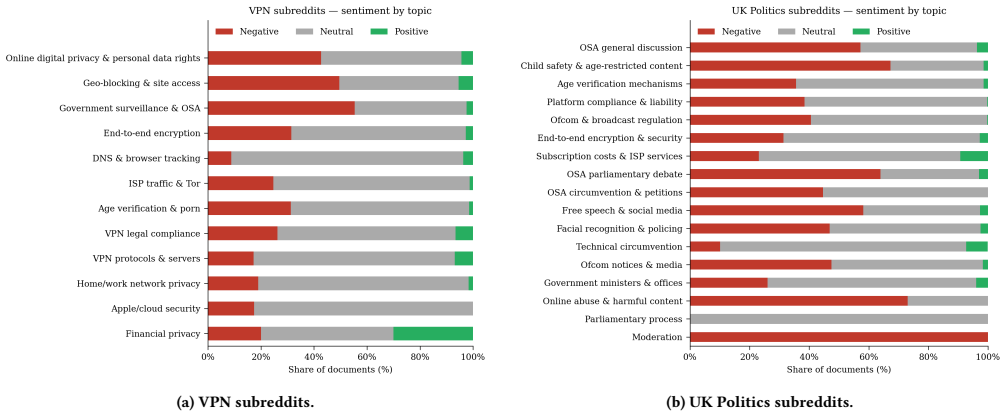
The central claim is that the three OSA enforcement milestones each produced significant stepwise increases in VPN-related discussion on Reddit among UK-based users, rising by 100%, 217%, and 415% respectively in regulatory or privacy contexts, with larger effects in UK Politics communities; users framed responses around privacy and surveillance concerns, and demand for VPN services increased across all risk levels while the proportional distribution remained stable.
Load-bearing premise
The observed jumps in Reddit posts are caused by the OSA enforcement dates rather than concurrent events, media coverage, or platform changes, and that the discussions accurately reflect shifts in actual VPN adoption and privacy risk exposure.
Editorial extensions
If this is right
- Online safety rules can prompt users to adopt privacy tools even when the rules target harms to children.
- Age-verification mandates may increase user distrust of intermediaries and heighten perceived surveillance risks.
- Increased VPN demand occurs across all risk tiers without skewing toward higher-risk providers.
- Google search interest in VPNs rises sharply at regulatory deadlines.
- Political communities amplify the volume of privacy-related discourse compared with topic-specific communities.
Reading between the lines
- Policymakers could monitor social-media discussion spikes as an early signal of unintended privacy costs from new rules.
- Comparable regulations in other jurisdictions may generate similar behavioral shifts toward privacy tools.
- Longer-term studies could test whether the observed discussion increases translate into sustained changes in actual VPN usage or data exposure.
- Designers of age-assurance systems might reduce backlash by addressing surveillance framing directly in public communications.
Signed reviews
Editorial analysis
A structured set of objections, weighed in public.
Referee Report
Summary. The paper claims that the phased enforcement of the UK Online Safety Act (illegal content duties in March 2025, age verification in July 2025) produced large stepwise increases in UK-user Reddit discourse about VPNs in regulatory/privacy contexts (+100%, +217%, +415% at the three milestones), larger effects in UK Politics communities, and an +89% rise in Google VPN search interest, with users framing responses around privacy and surveillance rather than access; it concludes that such regulation can create secondary privacy costs without shifting demand toward higher-risk VPNs.
Significance. If the causal link holds, the work provides timely evidence on unintended behavioral responses to online safety regulation, using the phased rollout for observational leverage and combining discourse analysis with a risk assessment of 69 VPN services. This angle on privacy externalities is relevant to policy debates in digital regulation, though the absence of causal identification tools limits its contribution relative to stronger quasi-experimental designs in the field.
major comments (4)
- [Methods] Methods: the manuscript supplies no information on how UK-based Reddit users were geolocated or identified (self-report, IP, subreddit membership, or other proxy), which is load-bearing for attributing the observed increases specifically to UK OSA enforcement rather than global trends.
- [Results] Results: the reported percentage increases (+100%, +217%, +415%) are presented without statistical significance tests, confidence intervals, sample sizes, or variance estimates, preventing assessment of whether the stepwise changes exceed baseline fluctuation.
- [Analysis] Analysis: no difference-in-differences, synthetic control, or placebo tests are reported comparing UK VPN/regulatory discourse trends against non-UK users, unrelated topics, or pre-OSA periods, leaving the attribution to the March/July 2025 milestones open to confounding by media coverage or platform changes.
- [Methods] Methods: details on post classification (how content was coded as 'explicitly about VPN use in a regulatory or privacy context') and any inter-rater reliability metrics are absent, undermining the reliability of the discourse counts that drive the central claim.
minor comments (2)
- [Abstract] Abstract: the Google Trends +89% figure is stated without the corresponding time window or baseline comparison, reducing clarity.
- [Results] The privacy-policy risk analysis of 69 VPN services is mentioned but not linked quantitatively to the discourse findings (e.g., no table showing risk distribution shifts), leaving the 'proportional distribution remained broadly stable' claim underspecified.
Simulated Author's Rebuttal
We thank the referee for their constructive comments, which highlight important areas for strengthening the manuscript's methods and analysis. We address each point below and commit to revisions where appropriate.
read point-by-point responses
-
Referee: [Methods] Methods: the manuscript supplies no information on how UK-based Reddit users were geolocated or identified (self-report, IP, subreddit membership, or other proxy), which is load-bearing for attributing the observed increases specifically to UK OSA enforcement rather than global trends.
Authors: We agree that explicit details on user identification are necessary. The revised manuscript will add a Methods subsection explaining that UK-based users were identified via a combination of subreddit membership in UK-focused communities (e.g., r/unitedkingdom) and self-reported location indicators in posts and comments. We will also note limitations of this proxy and any robustness checks performed. revision: yes
-
Referee: [Results] Results: the reported percentage increases (+100%, +217%, +415%) are presented without statistical significance tests, confidence intervals, sample sizes, or variance estimates, preventing assessment of whether the stepwise changes exceed baseline fluctuation.
Authors: This omission weakens the presentation of results. We will revise the Results section to include statistical tests (such as Poisson regression or interrupted time series models), p-values, 95% confidence intervals, sample sizes per period, and variance estimates to demonstrate that the increases are statistically distinguishable from baseline trends. revision: yes
-
Referee: [Analysis] Analysis: no difference-in-differences, synthetic control, or placebo tests are reported comparing UK VPN/regulatory discourse trends against non-UK users, unrelated topics, or pre-OSA periods, leaving the attribution to the March/July 2025 milestones open to confounding by media coverage or platform changes.
Authors: We recognize the value of additional robustness checks for causal attribution. The revised version will incorporate placebo tests on non-UK subreddits and unrelated topics, as well as pre-OSA trend analysis. A full synthetic control analysis will be explored but may be constrained by data availability; we will report what is feasible. revision: partial
-
Referee: [Methods] Methods: details on post classification (how content was coded as 'explicitly about VPN use in a regulatory or privacy context') and any inter-rater reliability metrics are absent, undermining the reliability of the discourse counts that drive the central claim.
Authors: We will expand the Methods section to detail the classification pipeline, including keyword filtering for relevant terms followed by manual review against explicit criteria for regulatory/privacy context. Inter-rater reliability metrics (e.g., Cohen's kappa) from a double-coded subsample will be reported. revision: yes
Circularity Check
No circularity: empirical observation of discourse spikes with no derivations or self-referential fits
full rationale
The paper presents an empirical analysis of Reddit posts, comments, and Google Trends data around OSA enforcement dates, reporting raw percentage increases in VPN-related discussions among UK users. No equations, parameters, predictions derived from fits, or uniqueness theorems appear in the provided text. The central claim rests on temporal correlations in public discourse rather than any self-definitional loop, fitted-input-as-prediction, or load-bearing self-citation chain. Attribution to OSA is presented as an inference from the data, not a mathematical reduction to inputs. This is a standard observational study whose validity hinges on external controls (absent here per the skeptic note) but not on internal circularity.
Assumptions & free parameters
Cite this review
Pith. "Pith review of Online Safety Regulation Increases Privacy Risk: Evidence from the UK Online Safety Act." pith.science (2026). https://pith.science/paper/IGR4XOBL
@misc{pith2026260605273,
  author       = {Pith},
  title        = {Pith review of: Online Safety Regulation Increases Privacy Risk: Evidence from the UK Online Safety Act},
  year         = {2026},
  howpublished = {\url{https://pith.science/paper/IGR4XOBL}},
  note         = {Machine review of arXiv:2606.05273}
}
read the original abstract
Governments worldwide are increasingly regulating digital platforms to reduce online harms, particularly those affecting children. However, access restrictions can alter user behaviour and introduce new privacy and security risks. The UK Online Safety Act (OSA), passed in October 2023, illustrates this trend: it extends age-assurance and safety requirements to social media, search, and pornography services, and rolled out in phases. Ofcom's illegal content enforcement duties came into force in March 2025, and mandatory age verification for adult content took effect in July 2025. This phased rollout enables real-time observation of behavioural responses to regulation. To address this, we analyse Reddit discourse across VPN and UK Politics communities and conduct a privacy-policy risk analysis of 69 unique VPN services. We find that each of these three milestones produced significant stepwise increases in VPN-related discussion on Reddit: among UK-based users, posts and comments explicitly about VPN use in a regulatory or privacy context rose by +100%, +217%, and +415% respectively. UK Politics communities showed even larger effects, with OSA-related political discourse rising by +213%, +545%, and +464%, respectively, among UK-based users. UK VPN search interest on Google rose by +89% at the age-verification deadline. Users primarily framed this response around privacy, surveillance, and distrust of age-verification intermediaries rather than simple access-seeking. Demand increased across low, medium, and high-risk VPNs, but the proportional distribution remained broadly stable. These findings suggest that online safety regulation can create secondary privacy costs even when it does not disproportionately shift attention toward higher-risk providers.
Figures


Figures from the paper (6 more)



Forward citations
Cited by 1 Pith paper
-
Credible, Not Always Correct: How Reddit Users Verify AI-Generated Legal Advice
Most lay users on Reddit act on AI-generated legal advice without reported verification, and the advice gains force from its credible form rather than from any check on its accuracy.
Reference graph
Works this paper leans on
-
[1]
Jason Baumgartner, Savvas Zannettou, Brian Keegan, Megan Squire, and Jeremy Blackburn. 2020. The Pushshift Reddit Dataset. InProceedings of the Fourteenth International AAAI Conference on Web and Social Media (ICWSM 2020). 830–839
2020
-
[2]
Commonwealth of Australia. 2024. Online Safety Amendment (Social Media Minimum Age) Act 2024. Act No. 127 of 2024, Commonwealth of Australia. https://www.legislation.gov.au/C2024A00127/latest/text Accessed 12 May 2026
2024
-
[3]
Department for Digital, Culture, Media & Sport and Home Office. 2019. Online Harms White Paper. Consultation outcome. https://www.gov.uk/government/ consultations/online-harms-white-paper Last updated 15 December 2020. Ac- cessed 12 May 2026
2019
-
[4]
Department for Science, Innovation and Technology. 2023. UK chil- dren and adults to be safer online as world-leading bill becomes law. https://www.gov.uk/government/news/uk-children-and-adults-to-be-safer- online-as-world-leading-bill-becomes-law. 26 October 2023. Accessed 12 May 2026
2023
-
[5]
Department for Science, Innovation and Technology. 2026. Growing up in the online world: a national consultation. GOV.UK consulta- tion. https://www.gov.uk/government/consultations/growing-up-in-the-online- world-a-national-consultation Published 2 March 2026. Accessed 12 May 2026
2026
-
[6]
Casey Fiesler, Michael Zimmer, Nicholas Proferes, Sarah A. Gilbert, and Naiyan Jones. 2024. Remember the Human: A Systematic Review of Ethical Considera- tions in Reddit Research.Proceedings of the ACM on Human-Computer Interaction 8, GROUP (2024), 1–33. doi:10.1145/3633070
-
[7]
Freedom House. 2024. Iran: Freedom on the Net 2024 Country Report. https: //freedomhouse.org/country/iran/freedom-net/2024. Accessed: 2026-05-26
2024
-
[8]
Freedom House. 2024. Russia: Freedom on the Net 2024 Country Report. https: //freedomhouse.org/country/russia/freedom-net/2024. Accessed: 2026-05-26
2024
Show all 30 references
-
[9]
Hobbs and Margaret E
William R. Hobbs and Margaret E. Roberts. 2018. How Sudden Censorship Can Increase Access to Information.American Political Science Review112, 3 (2018), 621–636. doi:10.1017/S0003055418000084
2018 doi
-
[10]
Internet Infrastructure Coalition. 2022. VPN Trust Initiative Principles, Ver- sion 2.0. i2Coalition. https://i2coalition.com/wp-content/uploads/2022/05/ i2Coalitions-VTI-Principles-2.0-FINAL-2.pdf Accessed 12 May 2026
2022
-
[11]
Internet Society Pulse. 2024. Censorship and Sanctions Impacting Iran’s Inter- net, Report. https://pulse.internetsociety.org/en/blog/2024/07/censorship-and- sanctions-impacting-irans-internet-report/. Accessed: 2026-05-26
2024
-
[12]
IranWire. 2025. Survey: Half of Iranian Internet Users Expect No Censorship Re- lief. https://prod.iranwire.com/en/news/139360-survey-half-of-iranian-internet- users-expect-no-censorship-relief-under-pezeshkian/. Accessed: 2026-05-26
2025
-
[13]
Maksim Kalameyets, Rebecca Owens, Chi Fai David Lam, Shola Olabode, Vasilis Vlachokyriakos, Ben Farrand, Stergios Aidinlis, and Lei Shi. 2026. Playing with Privacy: Uncovering Everyday Judgments of Data Sensitivity Through an Arcade Machine Interface. InProceedings of the 31st...
2026
-
[14]
Michael Kan. 2020. 7 VPN Services Found Recording User Logs, Despite ‘No-Log’ Pledge. https://www.pcmag.com/news/7-vpn-services-found-recording-user- logs-despite-no-log-pledge. Accessed 30 May 2026
2020
-
[15]
Rachel Kim, Veniamin Veselovsky, and Ashton Anderson. 2025. Capturing Dy- namics in Online Public Discourse: A Case Study of Universal Basic Income Discussions on Reddit. InProceedings of the International AAAI Conference on Web and Social Media
2025
-
[16]
Stephanie Law. 2024. Effective Enforcement of the Online Safety Act and Digital Services Act: Unpacking the Compliance and Enforcement Regimes of the UK and EU’s Online Safety Legislation.Journal of Media Law16, 2 (2024), 263–300
2024
-
[17]
Levada Center. 2024. The Audience of Internet Users, Social Networks, Mes- sengers and VPN Services. https://www.levada.ru/en/2024/06/14/the-audience- of-internet-users-social-networks-messengers-and-vpn-services/. Accessed: 2026-05-26
2024
-
[18]
Levada Center. 2025. Problems with Access to Internet Resources and Using VPN: March 2025. https://www.levada.ru/en/2025/05/12/problems-with-access- to-internet-resources-and-using-vpn-march-2025/. Accessed: 2026-05-26
2025
-
[19]
Sonia Livingstone, Abhilash Nair, Mariya Stoilova, Simone van der Hof, and Cansu Caglar. 2024. Children’s rights and online age assurance systems: The way forward.The International Journal of Children’s Rights32, 3 (2024), 721–747
2024
-
[20]
Clare McGlynn, Lorna Woods, and Alexandros Antoniou. 2024. Pornography, the Online Safety Act 2023 and the need for further reform.Journal of Media Law16, 2 (2024), 211–239
2024
-
[21]
Jen Persson. 2024. Age as a Gatekeeper in the UK Online Safety Agenda. In Children, Young People and Online Harms: Conceptualisations, Experiences and Responses. Springer, 169–181
2024
-
[22]
Nicholas Proferes, Naiyan Jones, Sarah Gilbert, Casey Fiesler, and Michael Zim- mer. 2021. Studying Reddit: A Systematic Overview of Disciplines, Approaches, Methods, and Ethics.Social Media + Society7, 2 (2021)
2021
-
[23]
Reuters. 2022. Demand for VPNs in Russia, Ukraine Leaps as Internet Con- trol Tightens. https://www.reuters.com/markets/europe/demand-vpns-russia- ukraine-leaps-internet-control-tightens-2022-02-28/. Accessed: 2026-05-26
2022
-
[24]
Reuters. 2022. Russians’ Demand for VPNs Skyrockets after Meta Block. https://www.reuters.com/technology/russians-demand-vpns-skyrockets- after-meta-block-2022-03-14/. Accessed: 2026-05-26
2022
-
[25]
Koustuv Saha, Pranshu Gupta, Gloria Mark, Emre Kıcıman, and Munmun De Choudhury. 2024. Observer Effect in Social Media Use. InProceedings of the CHI Conference on Human Factors in Computing Systems (CHI ’24)
2024
-
[26]
UK Parliament. 2026. Children’s Wellbeing and Schools Act 2026: Consideration of Lords amendments, Session 2024–26. Parliamentary Bills: Records, motions and amendments. https://bills.parliament.uk/bills/3909/stages/20498 Accessed 12 May 2026
2026
-
[27]
United Kingdom Parliament. 2023. Online Safety Act 2023. UK Public General Act, 2023 c. 50. https://www.legislation.gov.uk/ukpga/2023/50/contents Accessed 12 May 2026
2023
-
[28]
See, Brian O’Neill, Lelia Green, Elisabeth Staksrud, and Paul Haskell-Dowland
Giselle Woodley, Harrison W. See, Brian O’Neill, Lelia Green, Elisabeth Staksrud, and Paul Haskell-Dowland. 2025. Australian Teen Voices on Age Verification and Age Assurance Measures.Policy & Internet17, 4 (2025), e70019
2025
-
[29]
Zhaoxiang Xu, Qingguo Fang, Yanbo Huang, and Mingjian Xie. 2024. The public attitude towards ChatGPT on Reddit: A study based on unsupervised learning from sentiment analysis and topic modeling.PLOS ONE19, 5 (2024), e0302502. doi:10.1371/journal.pone.0302502
2024 doi
-
[30]
negative
Diwen Xue, Anna Ablove, Reethika Ramesh, Grace Kwak Danciu, and Roya Ensafi. 2024. Bridging Barriers: A Survey of Challenges and Priorities in the Censorship Circumvention Landscape. InProceedings of the 33rd USENIX Security Symposium. USENIX Association. 13 Appendix A Additio...
2024
Reviewed June 28, 2026 · model on record in the stance chip above.
Discussion (0). Continue with ORCID to comment.