Continuous-variable ADAPT-VQE for bosonic lattice models
Pith reviewed 2026-06-28 05:37 UTC · model grok-4.3
The pith
Continuous-variable ADAPT-VQE produces shallower circuits for bosonic lattice models than standard VQE.
A machine-rendered reading of the paper's core claim, the machinery that carries it, and where it could break.
Core claim
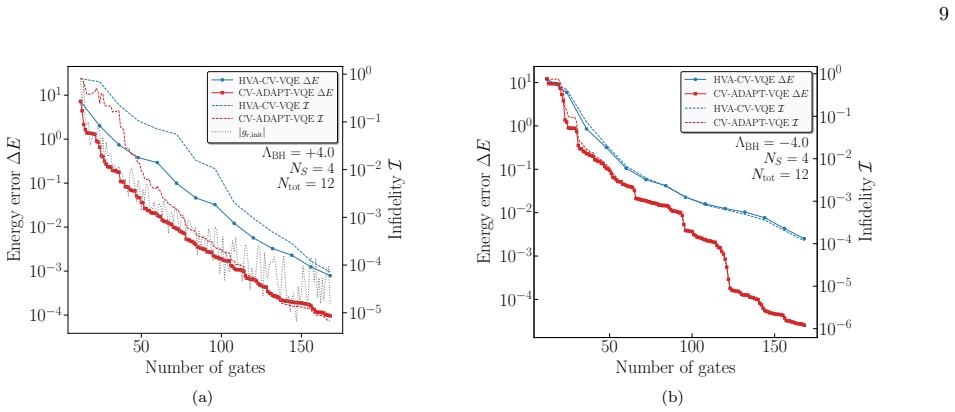
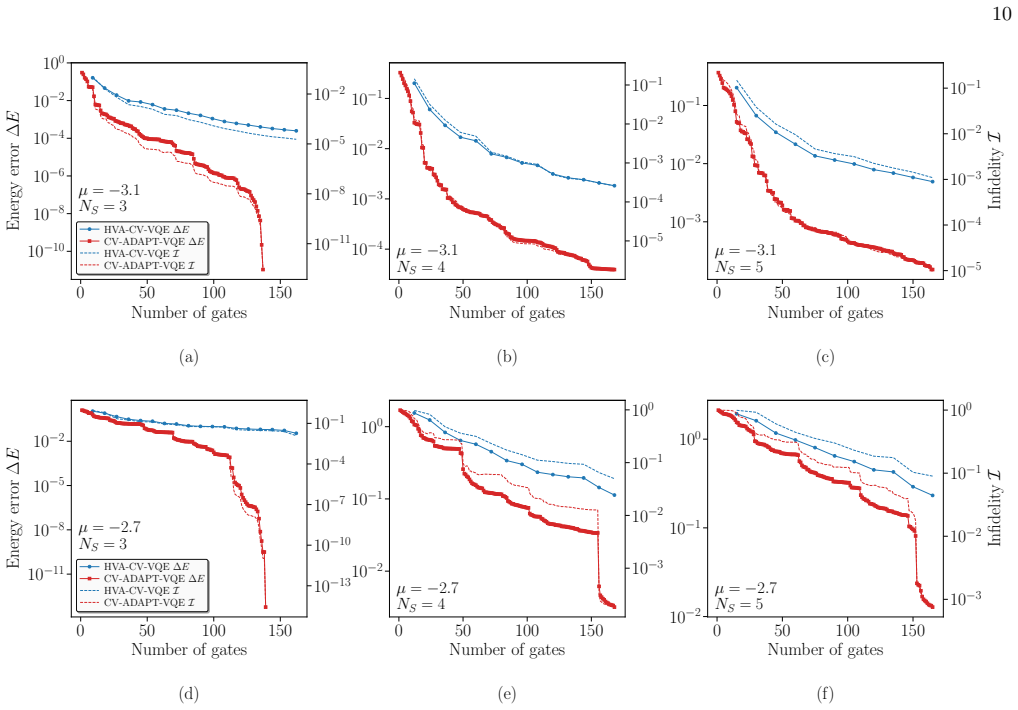
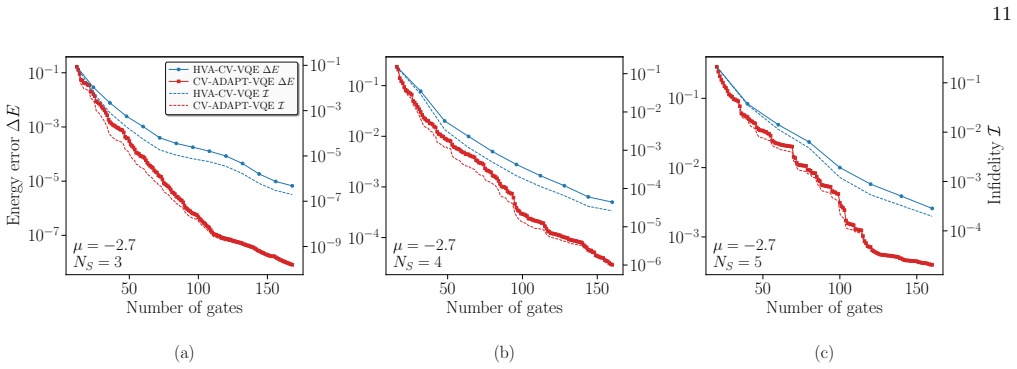
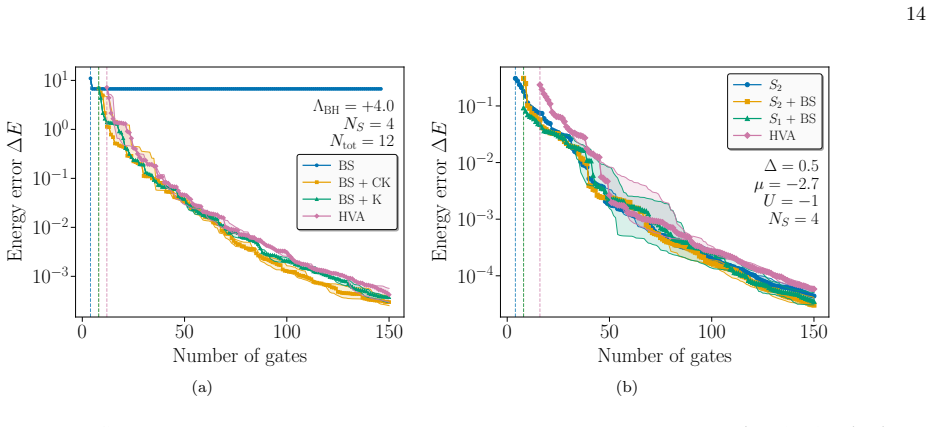
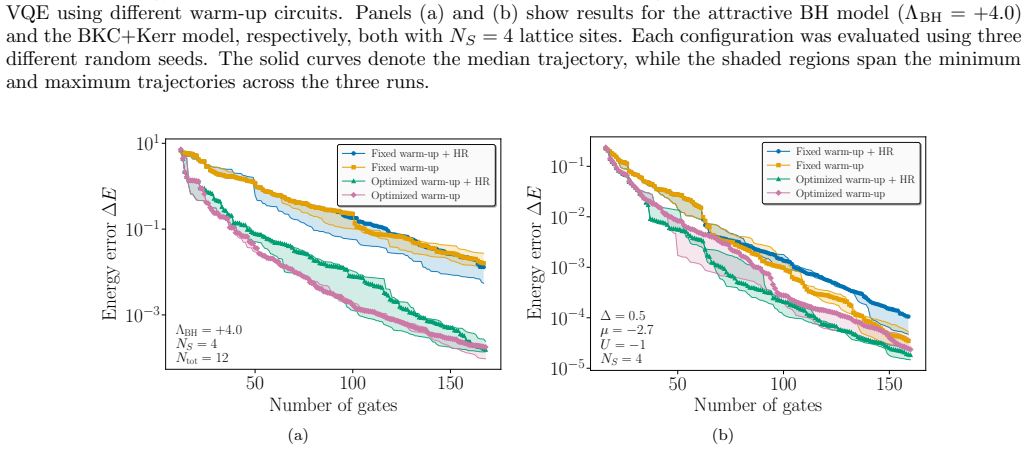
We present a continuous-variable adaptive variational quantum eigensolver (CV-ADAPT-VQE) that constructs symmetry-preserving operator pools for bosonic models and, via GPU simulations, achieves significantly shallower circuits for ground-state preparation of the Bose-Hubbard model and the bosonic Kitaev chain than Hamiltonian-based VQE approaches.
What carries the argument
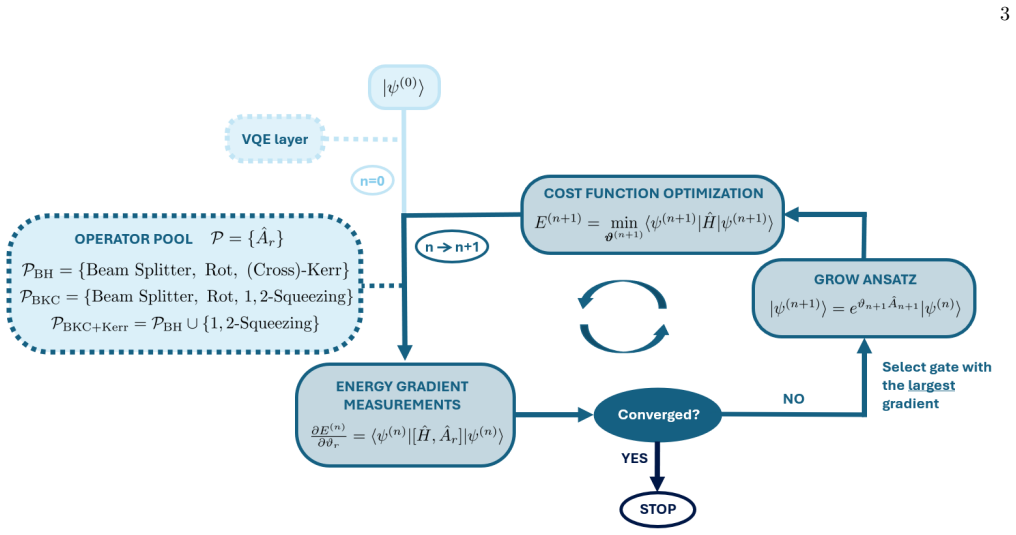
CV-ADAPT-VQE with symmetry-preserving operator pools that iteratively select operators to build a variational ansatz while respecting conserved quantities such as boson number or parity.
If this is right
- Shallow circuits from CV-ADAPT-VQE enable simulation of larger bosonic lattice sizes on current quantum hardware.
- The method directly supports ground-state studies in condensed-matter systems that conserve particle number or parity.
- Extension to models with on-site interactions, such as Kerr terms, remains compatible with the symmetry-preserving pools.
- The approach opens pathways for quantum simulations in quantum chemistry and high-energy physics involving bosonic degrees of freedom.
Where Pith is reading between the lines
- The adaptive selection may reduce the total number of two-mode gates needed compared with fixed-pool methods even when the final energy accuracy is held constant.
- Testing the same pools on discrete-variable encodings of the same bosonic models could reveal whether the depth advantage is specific to continuous-variable hardware.
- If the operator pools prove complete for a wider class of bosonic Hamiltonians, the technique could serve as a template for symmetry-aware ansatz construction in other variational algorithms.
Load-bearing premise
The symmetry-preserving operator pools are sufficient for the adaptive selection to converge to the ground state, and the classical GPU simulations correctly forecast performance gains on physical quantum hardware.
What would settle it
Executing the CV-ADAPT-VQE circuits on an actual continuous-variable quantum device and measuring whether the achieved circuit depth and energy accuracy match or exceed the reductions predicted by the classical simulations relative to standard VQE.
Figures

read the original abstract
We present a continuous-variable adaptive variational quantum eigensolver (CV-ADAPT-VQE). As concrete examples, we consider the ground-state preparation for (i) the Bose-Hubbard model and (ii) the bosonic Kitaev chain, including its extension with an on-site Kerr interaction. The former conserves the total boson number, while the latter conserves global parity. We construct symmetry-preserving operator pools tailored to each case and show, using GPU-based classical simulations, that CV-ADAPT-VQE results in significantly shallower circuits compared to Hamiltonian-based VQE approaches. Our results point toward direct applications in quantum simulations of condensed-matter systems, quantum chemistry, and high-energy physics.
Editorial analysis
A structured set of objections, weighed in public.
Referee Report
Summary. The paper introduces continuous-variable ADAPT-VQE (CV-ADAPT-VQE) for ground-state preparation in bosonic lattice models, specifically the Bose-Hubbard model (particle-number conserving) and the bosonic Kitaev chain (parity conserving, with optional Kerr term). It constructs model-specific symmetry-preserving operator pools and reports GPU-based classical simulations showing that the adaptive method produces significantly shallower circuits than standard Hamiltonian-based VQE approaches.
Significance. If the central claim holds, the work could be significant for quantum simulation of bosonic condensed-matter systems, as shallower circuits are advantageous on near-term hardware. The explicit construction of symmetry-preserving pools and the use of GPU simulations for classical verification are strengths that provide a concrete, reproducible starting point for further development.
major comments (2)
- [Numerical simulations / results section] The central claim that CV-ADAPT-VQE yields shallower circuits for ground-state preparation rests on the assumption that the adaptive procedure converges to the true ground state. No comparison to exact diagonalization (or other high-accuracy benchmarks) for small system sizes is reported to confirm that the symmetry-preserving pools generate a sufficiently expressive ansatz within the relevant symmetry sector.
- [Abstract] The abstract states that simulations demonstrate 'significantly shallower circuits' but the manuscript supplies no quantitative metrics (e.g., circuit depth values with error bars, convergence thresholds, or direct comparison tables) that would allow assessment of the magnitude or statistical significance of the reported advantage.
minor comments (1)
- [Methods] Notation for the continuous-variable operators and the precise definition of the symmetry-preserving pools could be clarified with an explicit listing or table in the methods section.
Simulated Author's Rebuttal
We are grateful to the referee for their thorough review and valuable comments on our manuscript. We believe the suggested additions will improve the clarity and rigor of our presentation. Below we provide point-by-point responses to the major comments.
read point-by-point responses
-
Referee: [Numerical simulations / results section] The central claim that CV-ADAPT-VQE yields shallower circuits for ground-state preparation rests on the assumption that the adaptive procedure converges to the true ground state. No comparison to exact diagonalization (or other high-accuracy benchmarks) for small system sizes is reported to confirm that the symmetry-preserving pools generate a sufficiently expressive ansatz within the relevant symmetry sector.
Authors: We agree that verifying convergence to the true ground state is important. Our symmetry-preserving operator pools are designed to be expressive within the conserved symmetry sector (particle number for the Bose-Hubbard model and parity for the bosonic Kitaev chain), allowing the ansatz to represent the ground state. In the simulations, we track the variational energy, which stabilizes at a value consistent with the expected ground-state energy for the models considered. To directly address the referee's concern, we will add comparisons with exact diagonalization for small system sizes (such as 2 and 3 sites) in the revised results section, confirming that the final energies match the exact values. revision: yes
-
Referee: [Abstract] The abstract states that simulations demonstrate 'significantly shallower circuits' but the manuscript supplies no quantitative metrics (e.g., circuit depth values with error bars, convergence thresholds, or direct comparison tables) that would allow assessment of the magnitude or statistical significance of the reported advantage.
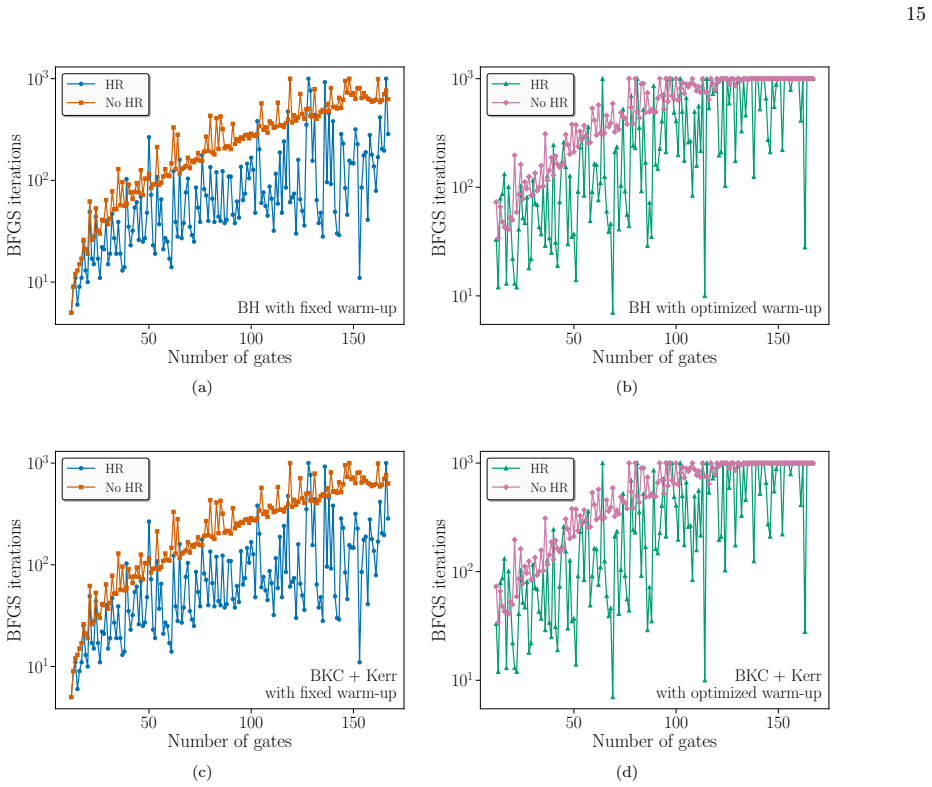
Authors: The main text includes detailed simulation results with figures displaying circuit depths for CV-ADAPT-VQE versus standard VQE across different system sizes and models. These figures provide the quantitative comparison, including the depths achieved. However, we acknowledge that the abstract could be more specific. We will revise the abstract to include quantitative examples of the depth reduction and add a table in the results section summarizing key metrics such as final circuit depths, energy convergence thresholds, and direct comparisons. revision: yes
Circularity Check
No circularity; results rest on new simulations of proposed method
full rationale
The paper introduces CV-ADAPT-VQE with tailored symmetry-preserving operator pools for the Bose-Hubbard model and bosonic Kitaev chain, then reports GPU simulation results showing shallower circuits than Hamiltonian-based VQE. No equations, derivations, or first-principles claims are presented that reduce by construction to fitted inputs, self-citations, or renamed known results. The central claim is an empirical observation from independent classical simulations rather than a closed mathematical chain, so the derivation is self-contained against external benchmarks.
Axiom & Free-Parameter Ledger
axioms (1)
- domain assumption The Bose-Hubbard model conserves total boson number and the bosonic Kitaev chain conserves global parity.
Reference graph
Works this paper leans on
-
[1]
warm-start
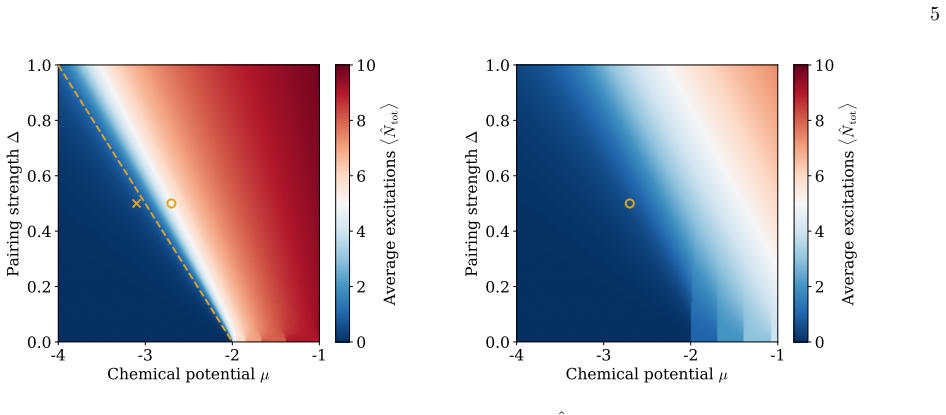
However, the system retains a residualZ 2 symme- try corresponding to the conservation of global boson- number parity, ˆP= (−1) ˆNtot. The global ground state resides in the even-parity sector, a property that fol- lows from its adiabatic continuity when starting from the vacuum state, which is the ground state of the non- interacting theory (∆→0). Due to...
-
[2]
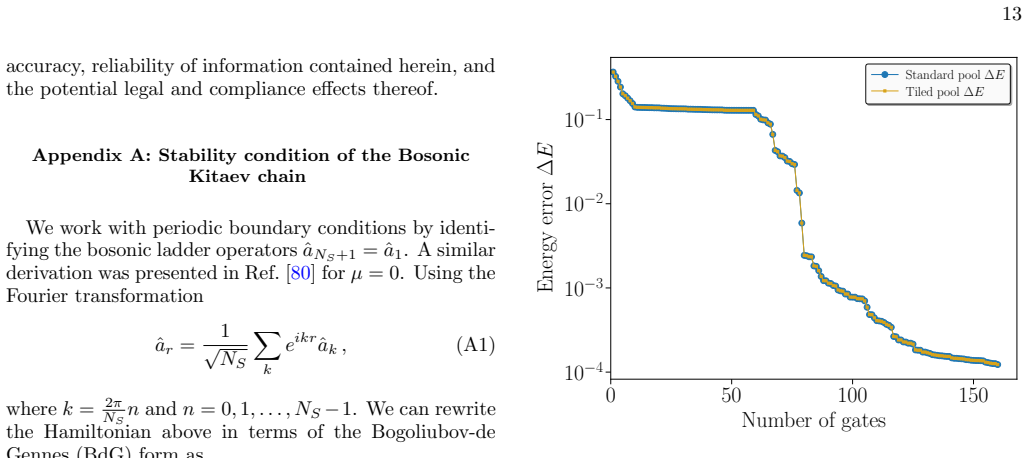
0 50 100 150 Number of gates 10−4 10−3 10−2 10−1 Energy error ∆ E Standard pool ∆ E Tiled pool ∆ E FIG
Run CV-ADAPT-VQE for a classically tractable simulation of the system on a small, non-trivial lat- tice of sizeN small using an expressive operator pool. 0 50 100 150 Number of gates 10−4 10−3 10−2 10−1 Energy error ∆ E Standard pool ∆ E Tiled pool ∆ E FIG. 7: Energy difference with respect to exact diagonal- ization (left axis) and infidelity (right axis...
-
[3]
Collect the operators that ADAPT chooses
-
[4]
Repeat step 1-2 until the different operators with degenerate gradients are collected
-
[5]
This forms the operator pool for the larger system
Tile these “small” operators along the lattice, padding with identity operators to match the size of the larger, target system,N large. This forms the operator pool for the larger system. In Fig. 7, we show a comparison between using this tiled pool and the regular pool used in the main text for the BKC model withN S = 5,∆ = 0.5, µ=−3.1, D= 6. The operato...
-
[6]
Photonic quantum information processing: a concise review,
S. Slussarenko and G. J. Pryde, “Photonic quantum information processing: a concise review,”Applied Physics Reviews6no. 4, (Dec., 2019) 041303. http://arxiv.org/abs/1907.06331. arXiv:1907.06331 [quant-ph]
arXiv 2019
-
[7]
Superconducting Qubits: Current State of Play,
M. Kjaergaard, M. E. Schwartz, J. Braum¨ uller, P. Krantz, J. I.-J. Wang, S. Gustavsson, and W. D. Oliver, “Superconducting Qubits: Current State of Play,”Annual Review of Condensed Matter Physics11 no. 1, (Mar., 2020) 369–395. http://arxiv.org/abs/1905.13641. arXiv:1905.13641 [quant-ph]
arXiv 2020
-
[8]
Trapped-Ion Quantum Computing: Progress and Challenges,
C. D. Bruzewicz, J. Chiaverini, R. McConnell, and J. M. Sage, “Trapped-Ion Quantum Computing: Progress and Challenges,”Applied Physics Reviews6 no. 2, (June, 2019) 021314. http://arxiv.org/abs/1904.04178. arXiv:1904.04178 [quant-ph]
arXiv 2019
-
[9]
Many-Body Physics with Individually-Controlled Rydberg Atoms,
A. Browaeys and T. Lahaye, “Many-Body Physics with Individually-Controlled Rydberg Atoms,”Nature Physics16no. 2, (Feb., 2020) 132–142. http://arxiv.org/abs/2002.07413. arXiv:2002.07413 [cond-mat]
arXiv 2020
-
[10]
Quantum simulations with ultracold atoms in optical lattices,
C. Gross and I. Bloch, “Quantum simulations with ultracold atoms in optical lattices,”Science357 no. 6355, (Sept., 2017) 995–1001.https://www. science.org/doi/full/10.1126/science.aal3837
-
[11]
So(3) “nuclear physics
E. Rico, M. Dalmonte, P. Zoller, D. Banerjee, M. B¨ ogli,et al., “So(3) “nuclear physics” with ultracold gases,”Annals of Physics393(2018) 466–483.https://www.sciencedirect.com/science/ article/pii/S0003491618300757
2018
-
[12]
Asymptotically optimal quantum circuits ford-level systems,
S. Bullock, D. O’Leary, and G. Brennen, “Asymptotically optimal quantum circuits ford-level systems,”Physical Review Letters94no. 23, (June,
-
[13]
http: //dx.doi.org/10.1103/PhysRevLett.94.230502
-
[14]
Continuous variables quantum algorithm for solving ordinary differential equations,
A. Barthe, M. Grossi, J. Tura, and V. Dunjko, “Continuous variables quantum algorithm for solving ordinary differential equations,” in2023 IEEE International Conference on Quantum Computing and Engineering (QCE), vol. 02, pp. 48–53. 2023
2023
-
[15]
Quantum computation over continuous variables,
S. Lloyd and S. L. Braunstein, “Quantum computation over continuous variables,”Phys. Rev. Lett.82(Feb,
-
[16]
1784–1787.https: //link.aps.org/doi/10.1103/PhysRevLett.82.1784
-
[17]
Universal quantum computation with continuous-variable cluster states,
N. C. Menicucci, P. van Loock, M. Gu, C. Weedbrook, T. C. Ralph, and M. A. Nielsen, “Universal quantum computation with continuous-variable cluster states,” Physical Review Letters97no. 11, (Sept., 2006) . http: //dx.doi.org/10.1103/PhysRevLett.97.110501
-
[18]
Quantum computing with continuous-variable clusters,
M. Gu, C. Weedbrook, N. C. Menicucci, T. C. Ralph, and P. van Loock, “Quantum computing with continuous-variable clusters,”Physical Review A79 no. 6, (June, 2009) . http://dx.doi.org/10.1103/PhysRevA.79.062318
-
[19]
C. Weedbrook, S. Pirandola, R. Garc´ ıa-Patr´ on, N. J. Cerf, T. C. Ralph, J. H. Shapiro, and S. Lloyd, “Gaussian quantum information,”Reviews of Modern Physics84no. 2, (May, 2012) 621–669. http://dx.doi.org/10.1103/RevModPhys.84.621
-
[20]
Continuous-variable quantum computation with spatial degrees of freedom of photons,
D. S. Tasca, “Continuous-variable quantum computation with spatial degrees of freedom of photons,”Physical Review A83no. 5, (2011)
2011
-
[21]
Universal continuous-variable quantum 17 computation: Requirement of optical nonlinearity for photon counting,
S. D. Bartlett, “Universal continuous-variable quantum 17 computation: Requirement of optical nonlinearity for photon counting,”Physical Review A65no. 4, (2002)
2002
-
[22]
One-Way Quantum Computing in the Optical Frequency Comb,
N. C. Menicucci, “One-Way Quantum Computing in the Optical Frequency Comb,”Physical Review Letters 101no. 13, (2008)
2008
-
[23]
Native three-body interactions in a superconducting lattice gauge quantum simulator,
J. H. Busnaina, Z. Shi, J. M. Alcaine-Cuervo, C. X. Yang, I. Nsanzineza, E. Rico, and C. M. Wilson, “Native three-body interactions in a superconducting lattice gauge quantum simulator,”Physical Review B 112no. 13, (Oct., 2025) 134514. https://link.aps.org/doi/10.1103/6prx-zmdz
-
[24]
Implementing a universal gate set on a logical qubit encoded in an oscillator,
R. W. Heeres, P. Reinhold, N. Ofek, L. Frunzio, L. Jiang, M. H. Devoret, and R. J. Schoelkopf, “Implementing a universal gate set on a logical qubit encoded in an oscillator,”Nature Communications8 no. 1, (July, 2017) 94.https: //www.nature.com/articles/s41467-017-00045-1
2017
-
[25]
Efficient Multiphoton Sampling of Molecular Vibronic Spectra on a Superconducting Bosonic Processor,
C. S. Wang, J. C. Curtis, B. J. Lester, Y. Zhang, Y. Y. Gao, J. Freeze, V. S. Batista, P. H. Vaccaro, I. L. Chuang, L. Frunzio, L. Jiang, S. Girvin, and R. J. Schoelkopf, “Efficient Multiphoton Sampling of Molecular Vibronic Spectra on a Superconducting Bosonic Processor,”Physical Review X10no. 2, (June, 2020) 021060.https: //link.aps.org/doi/10.1103/Phys...
-
[26]
Circuit quantum electrodynamics,
A. Blais, A. L. Grimsmo, S. M. Girvin, and A. Wallraff, “Circuit quantum electrodynamics,” Reviews of Modern Physics93no. 2, (May, 2021) 025005.https://link.aps.org/doi/10.1103/ RevModPhys.93.025005
2021
-
[27]
Encoding a qubit in a trapped-ion mechanical oscillator,
C. Fl¨ uhmann, T. L. Nguyen, M. Marinelli, V. Negnevitsky, K. Mehta, and J. P. Home, “Encoding a qubit in a trapped-ion mechanical oscillator,”Nature 566no. 7745, (Feb., 2019) 513–517.https: //www.nature.com/articles/s41586-019-0960-6
2019
-
[28]
Quantum dynamics of single trapped ions,
D. Leibfried, R. Blatt, C. Monroe, and D. Wineland, “Quantum dynamics of single trapped ions,”Reviews of Modern Physics75no. 1, (Mar., 2003) 281–324. https: //link.aps.org/doi/10.1103/RevModPhys.75.281
-
[29]
Robust and Deterministic Preparation of Bosonic Logical States in a Trapped Ion,
V. G. Matsos, C. H. Valahu, T. Navickas, A. D. Rao, M. J. Millican,et al., “Robust and Deterministic Preparation of Bosonic Logical States in a Trapped Ion,”Physical Review Letters133no. 5, (July, 2024) 050602.https://link.aps.org/doi/10.1103/ PhysRevLett.133.050602
2024
-
[30]
Universal hybrid quantum computing in trapped ions,
R. T. Sutherland and R. Srinivas, “Universal hybrid quantum computing in trapped ions,”Physical Review A104no. 3, (Sept., 2021) 032609.https: //link.aps.org/doi/10.1103/PhysRevA.104.032609
-
[31]
Proposal for a scalable universal bosonic simulator using individually trapped ions,
H.-K. Lau and D. F. V. James, “Proposal for a scalable universal bosonic simulator using individually trapped ions,”Physical Review A85no. 6, (June,
-
[32]
062329.https: //link.aps.org/doi/10.1103/PhysRevA.85.062329
-
[33]
Neutral atoms prepared in Fock states of a one-dimensional harmonic potential,
I. Bouchoule, H. Perrin, A. Kuhn, M. Morinaga, and C. Salomon, “Neutral atoms prepared in Fock states of a one-dimensional harmonic potential,”Physical Review A59no. 1, (Jan., 1999) R8–R11.https: //link.aps.org/doi/10.1103/PhysRevA.59.R8
-
[34]
Bosonic Quantum Error Correction with Neutral Atoms in Optical Dipole Traps,
L. H. Bohnmann, D. F. Locher, J. Zeiher, and M. M¨ uller, “Bosonic Quantum Error Correction with Neutral Atoms in Optical Dipole Traps,”Physical Review A111no. 2, (Feb., 2025) 022432. http://arxiv.org/abs/2408.14251. arXiv:2408.14251 [quant-ph]
arXiv 2025
-
[35]
Erasure-cooling, control, and hyper-entanglement of motion in optical tweezers,
A. L. Shaw, P. Scholl, R. Finkelstein, R. B.-S. Tsai, J. Choi, and M. Endres, “Erasure-cooling, control, and hyper-entanglement of motion in optical tweezers,” Science388no. 6749, (May, 2025) 845–849. http://arxiv.org/abs/2311.15580. arXiv:2311.15580 [quant-ph]
arXiv 2025
-
[36]
Deterministic generation of highly squeezed GKP states in ultracold atoms,
H. C. P. Kendell, G. Ferranti, and C. A. Weidner, “Deterministic generation of highly squeezed GKP states in ultracold atoms,”APL Quantum1no. 2, (May, 2024) 026109. https://doi.org/10.1063/5.0197119
-
[37]
Y. Liuet al., “Hybrid Oscillator-Qubit Quantum Processors: Instruction Set Architectures, Abstract Machine Models, and Applications,”PRX Quantum7 no. 1, (2026) 010201,arXiv:2407.10381 [quant-ph]
arXiv 2026
-
[38]
Toward hybrid quantum simulations with qubits and qumodes on trapped-ion platforms,
J. Y. Araz, M. Grau, J. Montgomery, and F. Ringer, “Toward hybrid quantum simulations with qubits and qumodes on trapped-ion platforms,”Physical Review A112no. 1, (July, 2025) 012620. http://arxiv.org/abs/2410.07346. arXiv:2410.07346 [quant-ph]
arXiv 2025
-
[39]
Programmable generation of arbitrary continuous-variable anharmonicities and nonlinear couplings,
T. Chalermpusitarak, K. Schwennicke, I. Kassal, and T. R. Tan, “Programmable generation of arbitrary continuous-variable anharmonicities and nonlinear couplings,”arXiv:2511.22286 [quant-ph]
-
[40]
Trigonometric continuous-variable gates and hybrid quantum simulations of the sine-Gordon model,
T. Rainaldi, V. Ale, M. Grau, D. Kharzeev, E. Rico, F. Ringer, P. Shome, and G. Siopsis, “Trigonometric continuous-variable gates and hybrid quantum simulations of the sine-Gordon model,”JHEP03 (2026) 125,arXiv:2512.19582 [quant-ph]
arXiv 2026
-
[41]
Programmable quantum simulation of anharmonic dynamics,
C. McGarryet al., “Programmable quantum simulation of anharmonic dynamics,” arXiv:2603.04744 [quant-ph]
-
[42]
Coherent-state propagation: A computational framework for simulating bosonic quantum systems,
N. Guseynov, Z. Holmes, and A. Angrisani, “Coherent-state propagation: A computational framework for simulating bosonic quantum systems,” 2026.https://arxiv.org/abs/2604.19625
Pith/arXiv arXiv 2026
-
[43]
Quantum Simulation for High-Energy Physics,
C. W. Baueret al., “Quantum Simulation for High-Energy Physics,”PRX Quantum4no. 2, (2023) 027001,arXiv:2204.03381 [quant-ph]
arXiv 2023
-
[44]
Quantum simulation of quantum field theory using continuous variables,
K. Marshall, R. Pooser, G. Siopsis, and C. Weedbrook, “Quantum simulation of quantum field theory using continuous variables,”Phys. Rev. A92no. 6, (2015) 063825,arXiv:1503.08121 [quant-ph]
Pith/arXiv arXiv 2015
-
[45]
Toward simulating quantum field theories with controlled phonon-ion dynamics: A hybrid analog-digital approach,
Z. Davoudi, N. M. Linke, and G. Pagano, “Toward simulating quantum field theories with controlled phonon-ion dynamics: A hybrid analog-digital approach,”Physical Review Research3no. 4, (Oct.,
-
[46]
043072.https://link.aps.org/doi/10.1103/ PhysRevResearch.3.043072
-
[47]
S. Saner, O. B˘ az˘ avan, D. J. Webb, G. Araneda, C. J. Ballance, R. Srinivas, D. M. Lucas, and A. Berm´ udez, “Real-Time Observation of Aharonov-Bohm Interference in aZ 2 Lattice Gauge Theory on a Hybrid Qubit-Oscillator Quantum Computer,” arXiv:2507.19588 [quant-ph]
-
[48]
R. A. Brice˜ no, R. G. Edwards, M. Eaton, C. Gonz´ alez-Arciniegas, O. Pfister, and G. Siopsis, “Toward coherent quantum computation of scattering amplitudes with a measurement-based photonic quantum processor,”arXiv:2312.12613 [quant-ph]
-
[49]
Quantum computation of SU(2) lattice gauge theory with continuous variables,
V. Ale, N. M. Bauer, R. G. Jha, F. Ringer, and 18 G. Siopsis, “Quantum computation of SU(2) lattice gauge theory with continuous variables,”JHEP06 (2025) 084,arXiv:2410.14580 [hep-lat]
arXiv 2025
-
[50]
Hybrid Oscillator-Qubit Quantum Processors: Simulating Fermions, Bosons, and Gauge Fields,
E. Craneet al., “Hybrid Oscillator-Qubit Quantum Processors: Simulating Fermions, Bosons, and Gauge Fields,”arXiv:2409.03747 [quant-ph]
-
[51]
Simulating quantum field theories on continuous-variable quantum computers,
S. Abel, M. Spannowsky, and S. Williams, “Simulating quantum field theories on continuous-variable quantum computers,”Phys. Rev. A110no. 1, (2024) 012607, arXiv:2403.10619 [quant-ph]
arXiv 2024
-
[52]
Simulating quantum electrodynamics in 2+1 dimensions with qubits and qumodes,
V. Ale, T. Rainaldi, E. Rico, F. Ringer, and G. Siopsis, “Simulating quantum electrodynamics in 2+1 dimensions with qubits and qumodes,” arXiv:2511.14506 [quant-ph]
-
[53]
Real-time scattering processes with continuous-variable quantum computers,
S. Abel, M. Spannowsky, and S. Williams, “Real-time scattering processes with continuous-variable quantum computers,”Phys. Rev. A112no. 1, (2025) 012614, arXiv:2502.01767 [quant-ph]
arXiv 2025
-
[54]
N. Gupta, C. D. White, and Z. Davoudi, “Euclidean-Monte-Carlo-informed ground-state preparation for quantum simulation of scalar field theory,”arXiv:2506.02313 [quant-ph]
-
[55]
and Aspuru-Guzik, Alán and O’Brien, Jeremy L
A. Peruzzo, J. McClean, P. Shadbolt, M.-H. Yung, X.-Q. Zhou, P. J. Love, A. Aspuru-Guzik, and J. L. O’Brien, “A variational eigenvalue solver on a photonic quantum processor,”Nature Communications5no. 1, (July, 2014) . http://dx.doi.org/10.1038/ncomms5213
-
[56]
A. Kandala, A. Mezzacapo, K. Temme, M. Takita, M. Brink, J. M. Chow, and J. M. Gambetta, “Hardware-efficient variational quantum eigensolver for small molecules and quantum magnets,”Nature 549no. 7671, (Sept., 2017) 242–246. http://dx.doi.org/10.1038/nature23879
-
[57]
and Tennyson, Jonathan , month = nov, year =
J. Tilly, H. Chen, S. Cao, D. Picozzi, K. Setia,et al., “The variational quantum eigensolver: A review of methods and best practices,”Physics Reports986 (Nov., 2022) 1–128.http: //dx.doi.org/10.1016/j.physrep.2022.08.003
-
[58]
Variational quantum state eigensolver,
M. Cerezo, K. Sharma, A. Arrasmith, and P. J. Coles, “Variational quantum state eigensolver,”npj Quantum Information8no. 1, (Sept., 2022) . http://dx.doi.org/10.1038/s41534-022-00611-6
-
[59]
Theory of variational quantum simulation,
X. Yuan, S. Endo, Q. Zhao, Y. Li, and S. C. Benjamin, “Theory of variational quantum simulation,”Quantum 3(Oct., 2019) 191. https://doi.org/10.22331/q-2019-10-07-191
-
[60]
A quantum approximate optimization algorithm,
E. Farhi, J. Goldstone, and S. Gutmann, “A quantum approximate optimization algorithm,” 2014. https://arxiv.org/abs/1411.4028
Pith/arXiv arXiv 2014
-
[61]
Barren plateaus in quantum neural network training landscapes,
J. R. McClean, S. Boixo, V. N. Smelyanskiy, R. Babbush, and H. Neven, “Barren plateaus in quantum neural network training landscapes,”Nature Communications9no. 1, (Nov, 2018) . https://doi.org/10.1038%2Fs41467-018-07090-4
2018
-
[62]
A lie algebraic theory of barren plateaus for deep parameterized quantum circuits,
M. Ragone, B. N. Bakalov, F. Sauvage, A. F. Kemper, C. Ortiz Marrero, M. Larocca, and M. Cerezo, “A lie algebraic theory of barren plateaus for deep parameterized quantum circuits,”Nature Communications15no. 1, (Aug., 2024) . http://dx.doi.org/10.1038/s41467-024-49909-3
-
[63]
Characterizing barren plateaus in quantum ans¨ atze with the adjoint representation,
E. Fontana, D. Herman, S. Chakrabarti, N. Kumar, R. Yalovetzky,et al., “Characterizing barren plateaus in quantum ans¨ atze with the adjoint representation,” Nature Communications15no. 1, (Aug., 2024) . http://dx.doi.org/10.1038/s41467-024-49910-w
-
[64]
Barren plateaus in variational quantum computing,
M. Larocca, S. Thanasilp, S. Wang, K. Sharma, J. Biamonte,et al., “Barren plateaus in variational quantum computing,” 2025. https://arxiv.org/abs/2405.00781
arXiv 2025
-
[65]
An adaptive variational algorithm for exact molecular simulations on a quantum computer,
H. R. Grimsley, S. E. Economou, E. Barnes, and N. J. Mayhall, “An adaptive variational algorithm for exact molecular simulations on a quantum computer,” Nature Commun.10(2019) 3007,arXiv:1812.11173 [quant-ph]
Pith/arXiv arXiv 2019
-
[66]
ADAPT-VQE is insensitive to rough parameter landscapes and barren plateaus,
G. et al., “ADAPT-VQE is insensitive to rough parameter landscapes and barren plateaus,”npj Quantum Information9no. 1, (Mar., 2023) . http://arxiv.org/abs/2204.07179
arXiv 2023
-
[67]
Qubit-adapt-vqe: An adaptive algorithm for constructing hardware-efficient ans¨ atze on a quantum processor,
H. L. Tang, V. Shkolnikov, G. S. Barron, H. R. Grimsley, N. J. Mayhall, E. Barnes, and S. E. Economou, “Qubit-adapt-vqe: An adaptive algorithm for constructing hardware-efficient ans¨ atze on a quantum processor,”PRX Quantum2no. 2, (Apr.,
-
[68]
http://dx.doi.org/10.1103/PRXQuantum.2.020310
-
[69]
TETRIS-ADAPT-VQE: An adaptive algorithm that yields shallower, denser circuit ans¨ atze,
P. G. Anastasiou, Y. Chen, N. J. Mayhall, E. Barnes, and S. E. Economou, “TETRIS-ADAPT-VQE: An adaptive algorithm that yields shallower, denser circuit ans¨ atze,”Phys. Rev. Res.6(Mar, 2024) 013254. https://link.aps.org/doi/10.1103/ PhysRevResearch.6.013254
2024
-
[70]
Avoiding symmetry roadblocks and minimizing the measurement overhead of adaptive variational quantum eigensolvers,
V. O. Shkolnikov, N. J. Mayhall, S. E. Economou, and E. Barnes, “Avoiding symmetry roadblocks and minimizing the measurement overhead of adaptive variational quantum eigensolvers,”Quantum7(June,
-
[71]
https://doi.org/10.22331/q-2023-06-12-1040
1040. https://doi.org/10.22331/q-2023-06-12-1040
-
[72]
Symmetry breaking slows convergence of the adapt variational quantum eigensolver,
L. W. Bertels, H. R. Grimsley, S. E. Economou, E. Barnes, and N. J. Mayhall, “Symmetry breaking slows convergence of the adapt variational quantum eigensolver,” in2023 IEEE International Conference on Quantum Computing and Engineering (QCE), vol. 02, pp. 94–95. 2023
2023
-
[73]
J. Liu, Z. Li, and J. Yang, “An efficient adaptive variational quantum solver of the schr¨ odinger equation based on reduced density matrices,”The Journal of Chemical Physics154no. 24, (06, 2021) 244112. https://doi.org/10.1063/5.0054822
-
[74]
H. R. Grimsley, G. S. Barron, E. Barnes, S. E. Economou, and N. J. Mayhall, “Adaptive, problem-tailored variational quantum eigensolver mitigates rough parameter landscapes and barren plateaus,”npj Quantum Information9no. 1, (2023) 19.https://doi.org/10.1038/s41534-023-00681-0
-
[75]
R. C. Farrell, M. Illa, A. N. Ciavarella, and M. J. Savage, “Scalable Circuits for Preparing Ground States on Digital Quantum Computers: The Schwinger Model Vacuum on 100 Qubits,”PRX Quantum5 no. 2, (2024) 020315,arXiv:2308.04481 [quant-ph]
arXiv 2024
-
[76]
Surrogate Constructed Scalable Circuits ADAPT-VQE in the Schwinger model,
E. Gustafson, K. Sherbert, A. Florio, K. Shirali, Y. Chen,et al., “Surrogate Constructed Scalable Circuits ADAPT-VQE in the Schwinger model,” Aug., 2024.http://arxiv.org/abs/2408.12641. arXiv:2408.12641 [quant-ph]
arXiv 2024
-
[77]
M. Ramˆ oa, P. G. Anastasiou, L. P. Santos, N. J. Mayhall, E. Barnes, and S. E. Economou, “Reducing the resources required by ADAPT-VQE using coupled 19 exchange operators and improved subroutines,”npj Quantum Information11no. 1, (2025) 86. https://doi.org/10.1038/s41534-025-01039-4
-
[78]
B. Sambasivam, K. Sherbert, K. Shirali, N. J. Mayhall, A. W. Harrow, E. Barnes, and S. E. Economou, “TEPID-ADAPT: Adaptive variational method for simultaneous preparation of low-temperature Gibbs and low-lying eigenstates,”arXiv:2503.14490 [quant-ph]
-
[79]
S. Yalouz, B. Senjean, F. Miatto, and V. Dunjko, “Encoding strongly-correlated many-boson wavefunctions on a photonic quantum computer: application to the attractive Bose-Hubbard model,” Quantum5(2021) 572,arXiv:2103.15021 [quant-ph]
arXiv 2021
-
[80]
M. Kanget al., “Seeking a quantum advantage with trapped-ion quantum simulations of condensed-phase chemical dynamics,”arXiv:2305.03156 [quant-ph]
discussion (0)
Sign in with ORCID, Apple, or X to comment. Anyone can read and Pith papers without signing in.