Building a Roadmap for Hubble science into the 2030s: Crucial UV spectroscopy of Oe stars in nearby galaxies
Pith reviewed 2026-06-28 03:35 UTC · model grok-4.3
The pith
Hubble's unique UV spectrographs are required to study Oe stars across metallicities and understand massive binaries in galaxy evolution.
A machine-rendered reading of the paper's core claim, the machinery that carries it, and where it could break.
Core claim
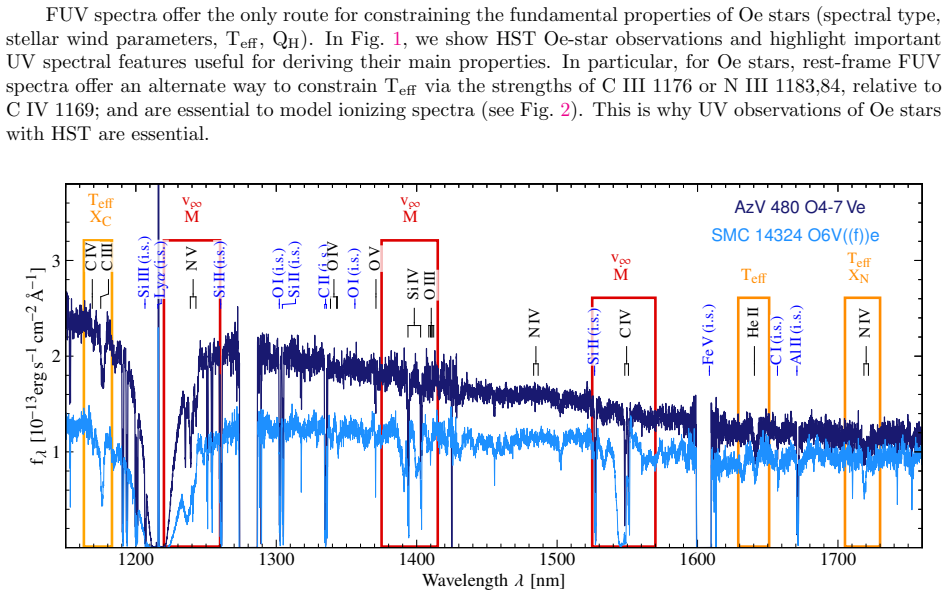
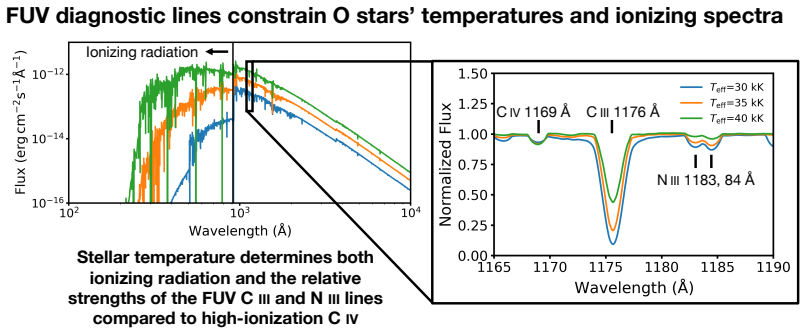
Hubble's COS G130M+G160M and STIS E140M UV spectral capabilities are essential for characterizing and understanding fundamental properties of main-sequence Oe stars; UV medium-resolution observations of these stars are crucial for understanding massive binaries and their role in galaxy evolution, with data required at all metallicities because Oe stars are more prevalent at low metallicity where they remain highly under-studied.
What carries the argument
Hubble's COS G130M+G160M and STIS E140M UV spectral capabilities, which deliver the medium-resolution spectra needed to access diagnostic lines in Oe stars at varying metallicities.
If this is right
- These spectra will clarify how binary interactions produce the rapid rotation observed in Oe stars.
- The data will improve models of how massive binaries drive chemical enrichment and feedback in galaxies.
- Results will directly inform the design and target selection for ultraviolet observations with the Habitable Worlds Observatory.
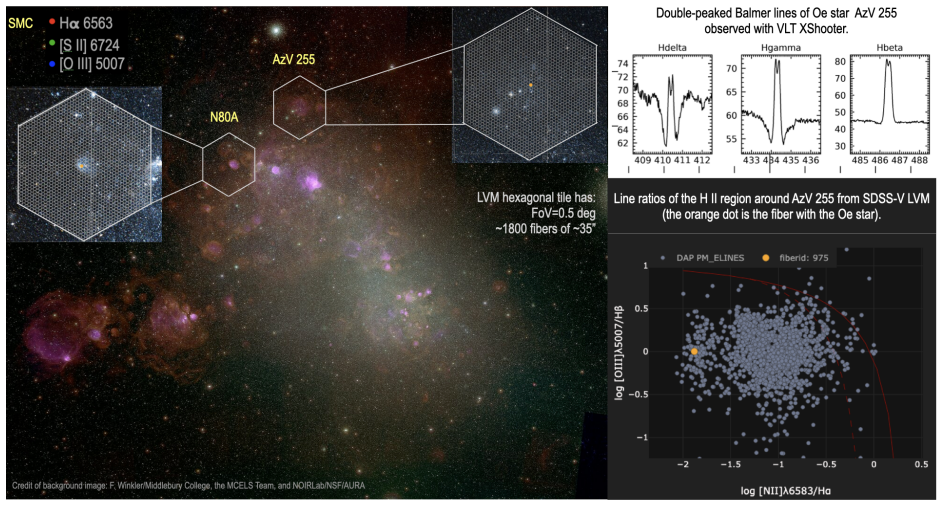
- The observations will supply context for interpreting results from ultra wide-field IFU optical and transient astronomy surveys.
Where Pith is reading between the lines
- Allocating Hubble time to these targets in the 2030s would shift observing priorities toward low-metallicity galaxies.
- The same logic may apply to other rapidly rotating massive-star classes whose UV diagnostics remain inaccessible from the ground.
- If the spectra reveal unexpected line-profile behavior at low metallicity, current binary-evolution tracks would require revision.
Load-bearing premise
That medium-resolution UV spectra of Oe stars at all metallicities are required to understand massive binaries and galaxy evolution and cannot be adequately obtained by other current or near-term facilities.
What would settle it
Demonstration that another existing or approved instrument can deliver equivalent medium-resolution UV spectra of Oe stars in nearby galaxies at multiple metallicities would remove the claimed necessity for Hubble observations.
Figures
read the original abstract
Hubble's unique COS G130M+G160M and STIS E140M UV spectral capabilities are essential for characterizing and understanding fundamental properties of main-sequence O-type emission-line (Oe) stars. These are fast rotators, and some are believed to be spun up in binaries. UV medium resolution observations of these stars are crucial for understanding massive binaries and their role in galaxy evolution. Oe stars are more prevalent at low metallicity, where they are highly under-studied, but UV spectra of these stars at all metallicities are needed. Observations of these stars in the 2030's with Hubble are particularly important in the era of ultra wide-field IFU optical and transient astronomy surveys. Ultimately, these observations will inform future UV observations with the Habitable Worlds Observatory.
Editorial analysis
A structured set of objections, weighed in public.
Referee Report
Summary. The manuscript is a science-case white paper arguing that Hubble's COS G130M+G160M and STIS E140M UV spectroscopic modes are uniquely required to characterize main-sequence Oe stars (fast rotators, some spun up via binaries) across metallicities. Medium-resolution UV spectra are presented as essential for understanding massive binary evolution and its contribution to galaxy evolution; the case is framed as particularly urgent at low metallicity, in the era of wide-field optical/transient surveys, and as input to planning for the Habitable Worlds Observatory.
Significance. If the uniqueness of the stated Hubble capabilities and the necessity of the proposed observations are accepted, the white paper supplies a focused rationale for allocating Hubble time in the 2030s to a targeted massive-star population. It connects a specific instrumental capability to questions of binary spin-up and chemical evolution that are relevant to galaxy-scale models.
Simulated Author's Rebuttal
We thank the referee for their positive review, recognition of the science case, and recommendation to accept the manuscript without requested changes.
Circularity Check
No significant circularity
full rationale
The document is a science-case white paper whose central claim is an advocacy statement for Hubble UV observations of Oe stars. It contains no equations, derivations, fitted parameters, quantitative predictions, or load-bearing self-citations that reduce to the paper's own inputs. The argument rests on stated observational needs and domain knowledge about instrument capabilities, with no internal loop or self-referential structure.
Axiom & Free-Parameter Ledger
Reference graph
Works this paper leans on
-
[1]
2023, A&A, 669, L11, doi: 10.1051/0004-6361/202245653 (back to page 1)
Abdul-Masih, M. 2023, A&A, 669, L11, doi: 10.1051/0004-6361/202245653 (back to page 1)
-
[2]
Baldwin, J. A., Phillips, M. M., & Terlevich, R. 1981, PASP, 93, 5, doi: 10.1086/130766 (back to page 4)
-
[3]
Bestenlehner, J. M., Crowther, P. A., Hawcroft, C., et al. 2025, arXiv e-prints, arXiv:2501.17931, doi: 10. 48550/arXiv.2501.17931 (back to page 2)
arXiv 2025
-
[4]
2020, A&A, 641, A42, doi: 10.1051/0004-6361/202037640 (back to page 1)
Bodensteiner, J., Shenar, T., & Sana, H. 2020, A&A, 641, A42, doi: 10.1051/0004-6361/202037640 (back to page 1)
-
[5]
Brott, I., de Mink, S. E., Cantiello, M., et al. 2011, A&A, 530, A115, doi: 10.1051/0004-6361/201016113 (back to page 1)
-
[6]
Drory, N., Blanc, G. A., Kreckel, K., et al. 2024, AJ, 168, 198, doi: 10.3847/1538-3881/ad6de9 (back to page 2)
-
[7]
2008, PhD thesis, University of Geneva, Astronomical Observatory (back to page 1)
Ekstr¨ om, S. 2008, PhD thesis, University of Geneva, Astronomical Observatory (back to page 1)
2008
-
[8]
B., Oey, M
Golden-Marx, J. B., Oey, M. S., Lamb, J. B., Graus, A. S., & White, A. S. 2016, ApJ, 819, 55, doi: 10. 3847/0004-637X/819/1/55 (cited on pages 1 and 3)
2016
-
[9]
Klement, R., Carciofi, A. C., Rivinius, T., et al. 2019, ApJ, 885, 147, doi: 10.3847/1538-4357/ab48e7 (back to page 1)
-
[11]
Krumholz, M. R., & Matzner, C. D. 2009, ApJ, 703, 1352, doi: 10.1088/0004-637X/703/2/1352 (back to page 3)
-
[12]
Langer, N., Sch¨ urmann, C., Stoll, K., et al. 2020, A&A, 638, A39, doi: 10.1051/0004-6361/201937375 (back to page 3)
-
[13]
Marchant, P., & Bodensteiner, J. 2024, ARA&A, 62, 21, doi: 10.1146/annurev-astro-052722-105936 (cited on pages 1 and 3)
-
[14]
R., Cote, J., Waters, L
Pols, O. R., Cote, J., Waters, L. B. F. M., & Heise, J. 1991, A&A, 241, 419 (back to page 4)
1991
-
[15]
Rivinius, T., Carciofi, A. C., & Martayan, C. 2013, A&A Rev., 21, 69, doi: 10.1007/s00159-013-0069-0 (back to page 1)
-
[16]
Roman-Duval, J., Proffitt, C. R., Taylor, J. M., et al. 2020, Research Notes of the American Astronom- ical Society, 4, 205, doi: 10.3847/2515-5172/abca2f (back to page 2)
-
[18]
2025, Nature Astronomy, 9, 1337, doi: 10.1038/ s41550-025-02610-x (back to page 1) 5
Sana, H., Shenar, T., Bodensteiner, J., et al. 2025, Nature Astronomy, 9, 1337, doi: 10.1038/ s41550-025-02610-x (back to page 1) 5
2025
-
[19]
2025, A&A, 704, A219, doi: 10.1051/0004-6361/202554874 (cited on pages 3 and 4)
Sch¨ urmann, C., Xu, X.-T., Langer, N., et al. 2025, A&A, 704, A219, doi: 10.1051/0004-6361/202554874 (cited on pages 3 and 4)
-
[20]
2024, A&A, 690, A289, doi: 10.1051/0004-6361/202451586 (back to page 1)
Shenar, T., Bodensteiner, J., Sana, H., et al. 2024, A&A, 690, A289, doi: 10.1051/0004-6361/202451586 (back to page 1)
-
[22]
Sim´ on-D´ ıaz, S., & Stasi´ nska, G. 2008, MNRAS, 389, 1009, doi: 10.1111/j.1365-2966.2008.13444.x (back to page 3)
-
[23]
Telford, O. G., McQuinn, K. B. W., Chisholm, J., & Berg, D. A. 2023, The Astrophysical Journal, 943, 65, doi: 10.3847/1538-4357/aca896 (back to page 3)
-
[24]
Vink, J. S., Mehner, A., Crowther, P. A., et al. 2023, A&A, 675, A154, doi: 10.1051/0004-6361/ 202245650 (back to page 4) 6
discussion (0)
Sign in with ORCID, Apple, or X to comment. Anyone can read and Pith papers without signing in.