Monte Carlo Steklov Operators for Large-Scale Geometry Processing in the Wild
Pith reviewed 2026-06-27 23:11 UTC · model grok-4.3
The pith
A Monte Carlo method estimates the Dirichlet-to-Neumann operator to compute Steklov spectra orders of magnitude faster on arbitrary meshes.
A machine-rendered reading of the paper's core claim, the machinery that carries it, and where it could break.
Core claim
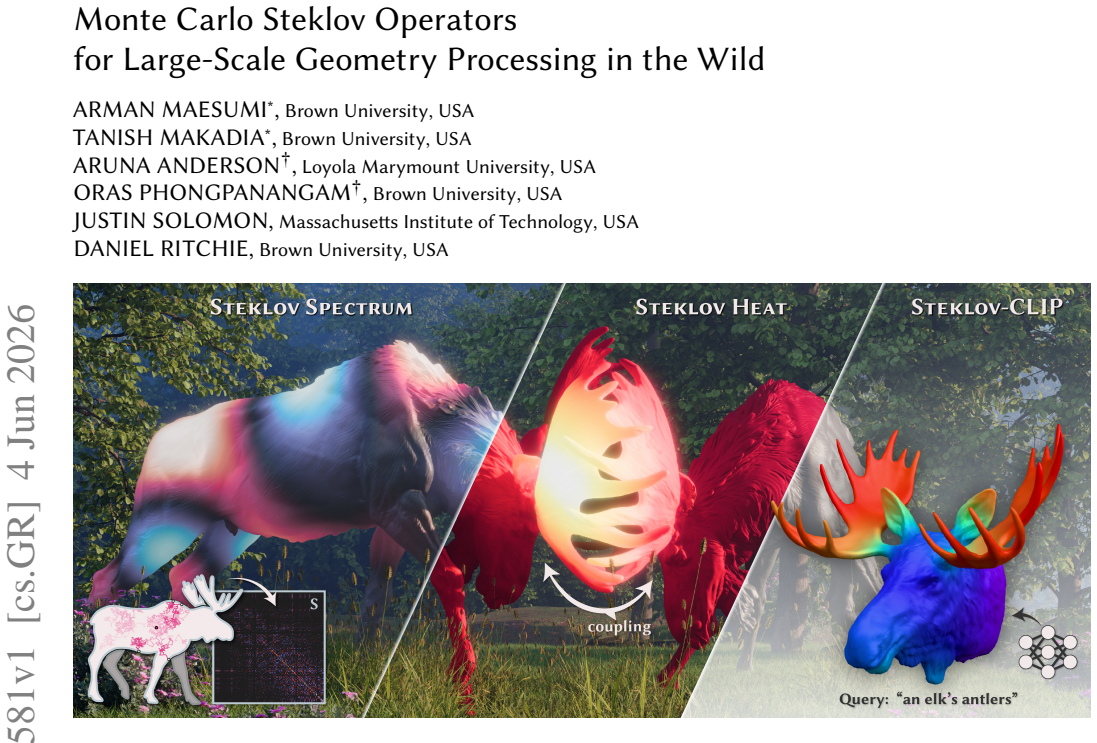
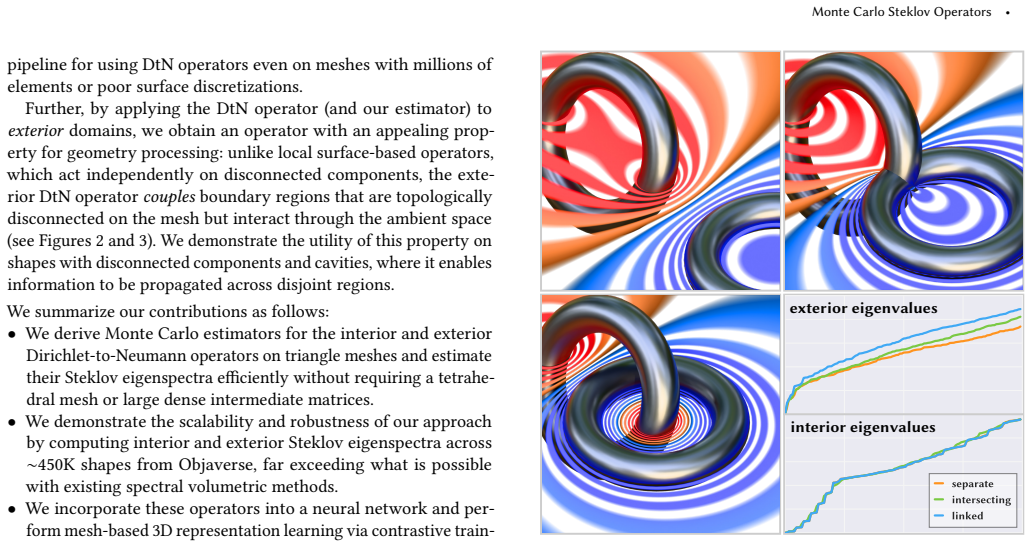
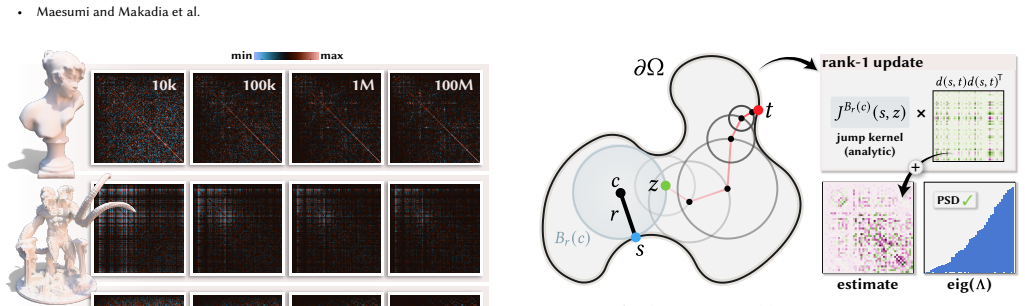
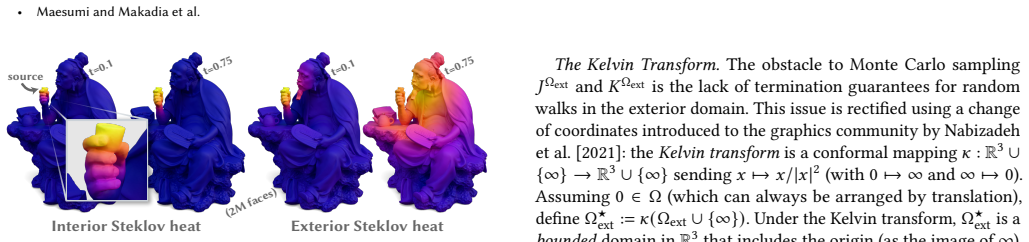
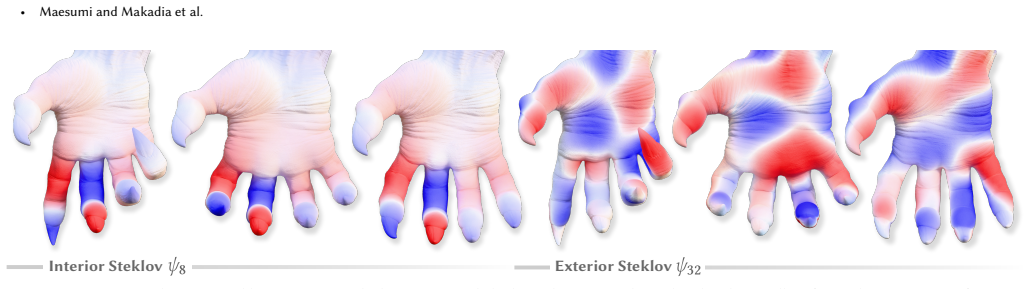
The Dirichlet-to-Neumann operator is estimated by Monte Carlo sampling of a volumetric stochastic process and generalized to the exterior domain, where it couples disconnected components through ambient space. This produces Steklov eigenmodes that remain accurate on poor triangulations, high-resolution meshes, and multi-component geometry. The resulting spectra support computation across approximately 450,000 shapes from the Objaverse dataset and their use inside a mesh-based contrastive learning model called Steklov-CLIP.
What carries the argument
Monte Carlo sampling of the volumetric stochastic process to estimate the Dirichlet-to-Neumann operator.
If this is right
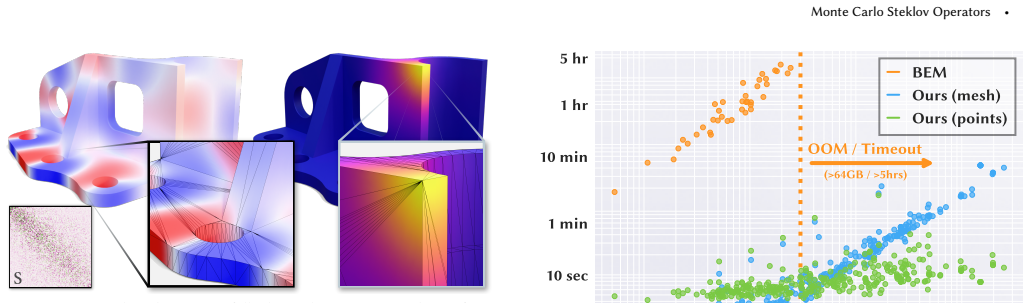
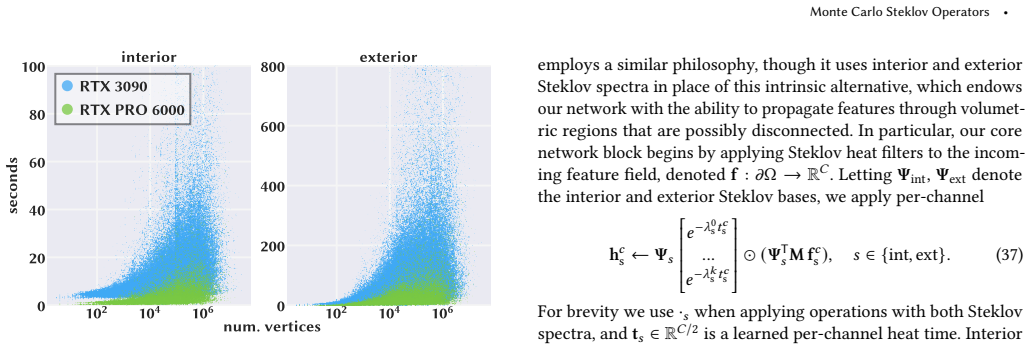
- Steklov spectra computation becomes orders of magnitude faster than boundary-element methods while preserving accuracy.
- The operator handles poor triangulations, high-resolution meshes, and multi-component geometry without special preprocessing.
- Interior and exterior Steklov eigenspectra can be extracted at the scale of uncurated datasets containing hundreds of thousands of shapes.
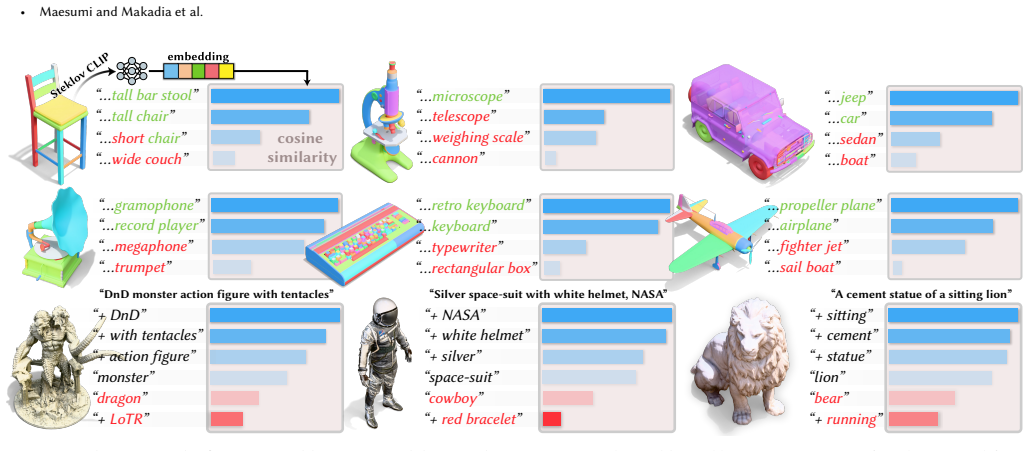
- Volumetric spectral features can be fed directly into mesh-based neural networks for contrastive 3D representation learning that captures semantic properties.
Where Pith is reading between the lines
- The same sampling strategy could be applied to other boundary-to-boundary volumetric operators beyond the Dirichlet-to-Neumann map.
- Large-scale 3D learning pipelines might shift from surface-only features toward volumetric spectral descriptors without requiring clean manifold meshes.
- The exterior-domain coupling suggests a route to consistent shape descriptors for scenes containing multiple separate objects.
Load-bearing premise
The Monte Carlo sampling of the volumetric stochastic process produces an accurate approximation to the true Dirichlet-to-Neumann operator across arbitrary mesh qualities and topologies without large bias or variance that would invalidate the spectra or downstream learning results.
What would settle it
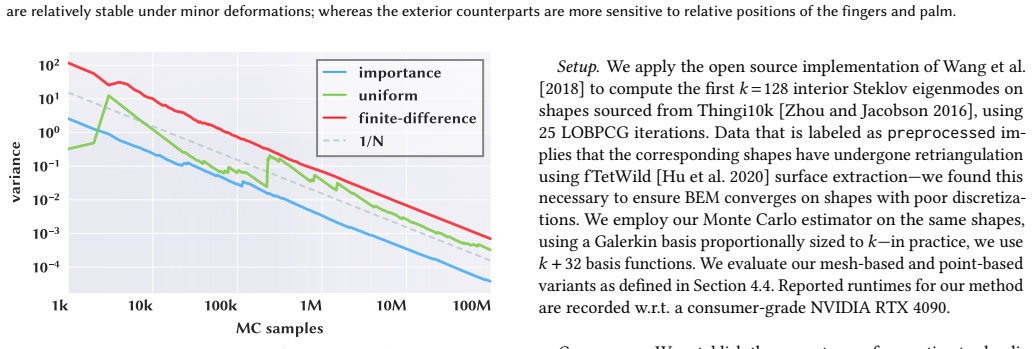
Computing the approximated Steklov eigenvalues on a sphere with known analytical spectrum and checking whether they converge to the exact values within sampling error as the number of Monte Carlo paths grows.
Figures
read the original abstract
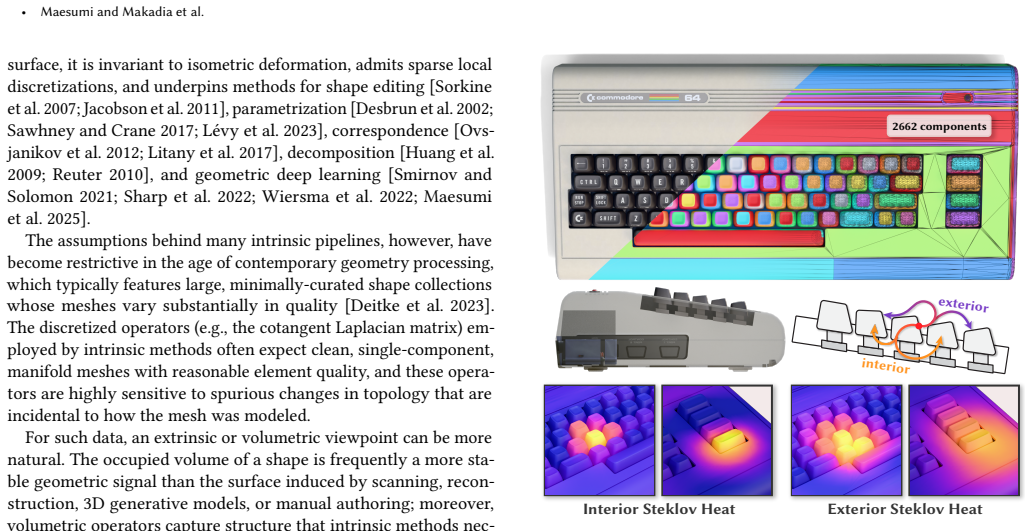
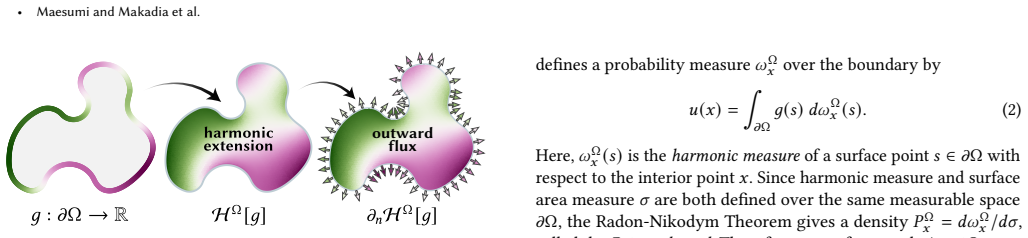
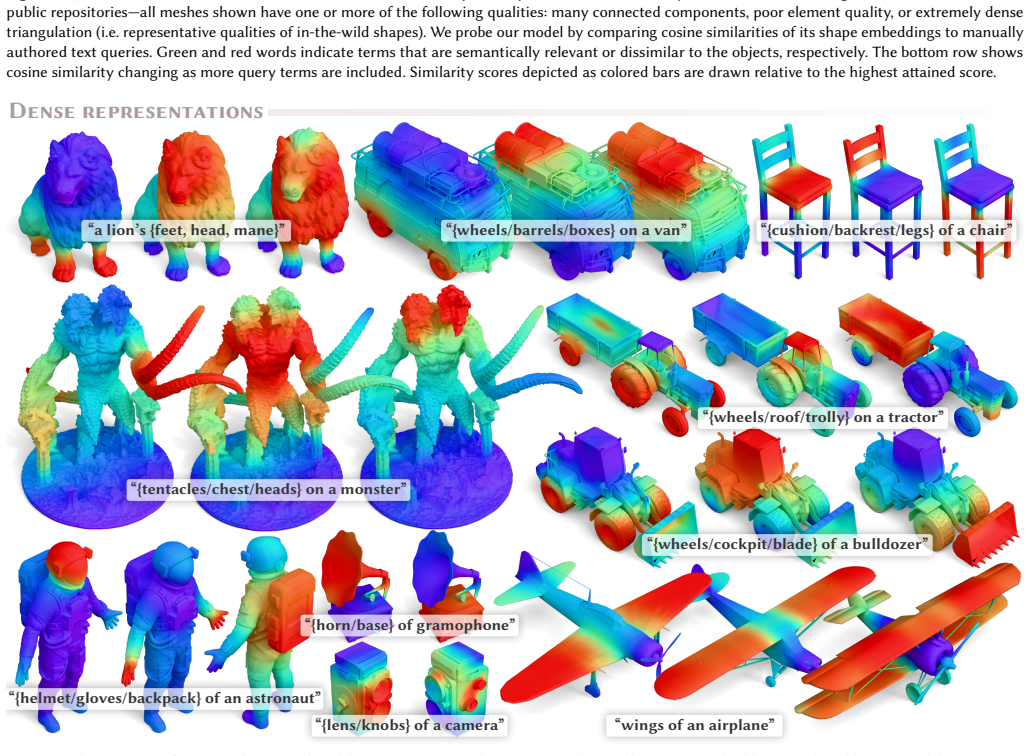
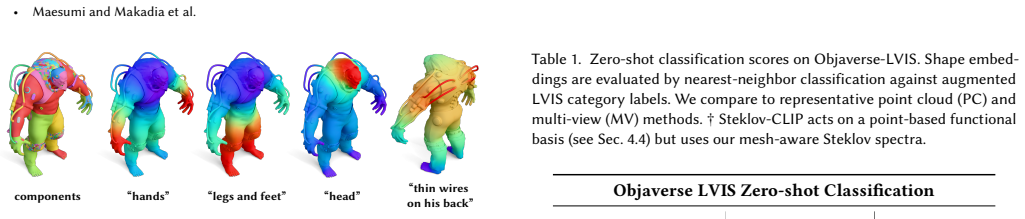
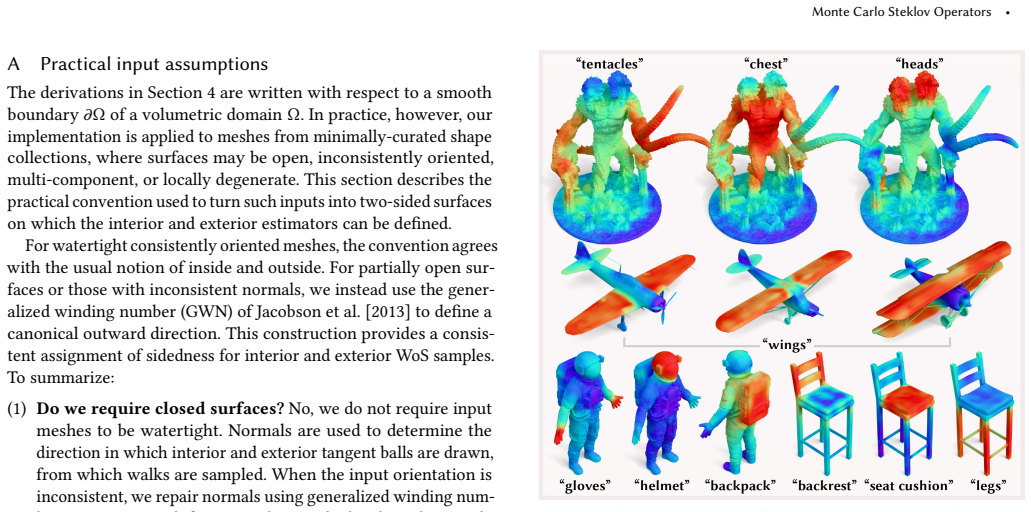
Intrinsic methods fill the default toolbox for geometry processing on meshes. Intrinsic operators, in particular the Laplacian, underlie methods that require invariance to isometry and have hence been employed in many algorithms for shape analysis, learning, and editing. However, intrinsic methods are predicated on assumptions that quickly become brittle when working with in-the-wild geometry, where (i) mesh quality is not guaranteed, and (ii) many meshes are modeled with multiple connected components. In such settings, volumetric constructions are better-defined, since restrictions on surface topology can be relaxed. This paper presents a Monte Carlo method for estimating the Dirichlet-to-Neumann (DtN) operator -- a boundary-to-boundary volumetric operator -- and its associated Steklov eigenmodes. We build on recent developments in Monte Carlo geometry processing by casting this boundary operator itself as the subject of estimation. The DtN operator, defined through a volumetric stochastic process, is then generalized to the exterior domain, where it couples disconnected components through the surrounding ambient space. We show that our method is orders of magnitude faster than existing boundary-element approaches for computing Steklov spectra while remaining robust to poor triangulations, high-resolution meshes, and multi-component geometry. To demonstrate this scalability, we compute interior and exterior Steklov eigenspectra for approximately 450,000 shapes from the uncurated Objaverse dataset. We incorporate these operators into Steklov-CLIP, a mesh-based neural network that uses volumetric spectral operators for large-scale contrastive 3D representation learning. The resulting network learns semantically meaningful global and dense shape representations, illustrating that geometrically-principled volumetric operators can be made practical at the scale of modern 3D datasets.
Editorial analysis
A structured set of objections, weighed in public.
Referee Report
Summary. The paper introduces a Monte Carlo method to estimate the Dirichlet-to-Neumann operator and associated Steklov eigenmodes by casting the boundary operator as the target of a volumetric stochastic process. It extends the construction to exterior domains to couple disconnected components, claims orders-of-magnitude speedups over boundary-element methods, demonstrates robustness on poor triangulations and high-resolution multi-component meshes, computes spectra for ~450k Objaverse shapes, and incorporates the operators into Steklov-CLIP for contrastive 3D representation learning.
Significance. If the Monte Carlo estimator is shown to be sufficiently accurate, the approach would make volumetric spectral operators practical at dataset scale, offering a principled alternative to intrinsic methods when mesh quality or topology assumptions fail. The scale of the Objaverse experiment and the downstream learning application are notable strengths.
major comments (3)
- [§4] §4 (Monte Carlo DtN estimation): the central claim that the volumetric stochastic process yields an accurate approximation to the true DtN operator (and thus faithful Steklov spectra) on arbitrary mesh qualities rests on the sampling regime, yet no quantitative bias/variance bounds, convergence rates, or mesh-quality ablation are provided for the exterior-domain case; this directly affects the robustness assertion for poor triangulations and disconnected components.
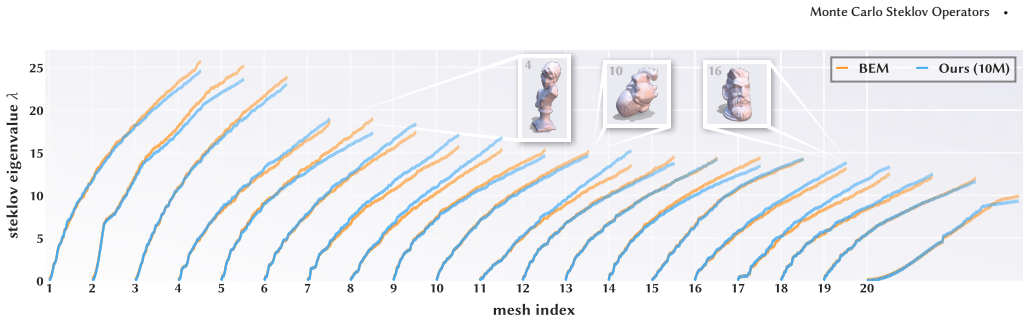
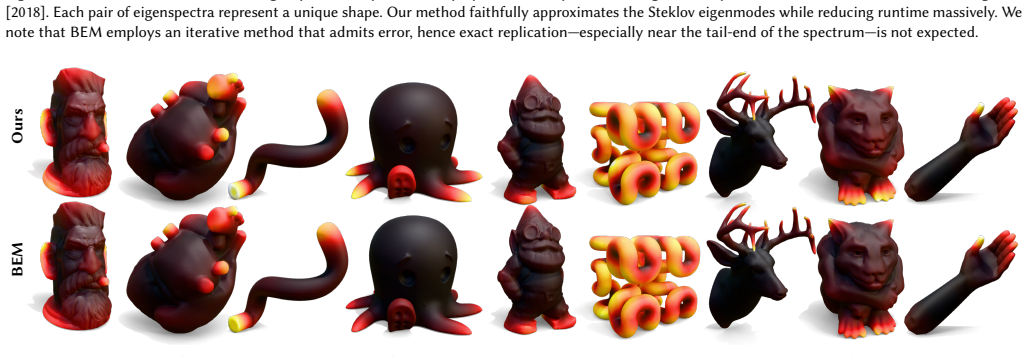
- [§5.2] §5.2 (validation protocol): the comparison to boundary-element methods reports runtime but does not include spectral error metrics (e.g., eigenvalue relative error or eigenfunction L2 discrepancy) against a reference solution on controlled poor-quality meshes, leaving the "orders of magnitude faster while remaining robust" claim without load-bearing numerical support.
- [§6] §6 (Steklov-CLIP experiments): downstream embedding quality is evaluated via contrastive learning, but no ablation isolates the effect of Monte Carlo approximation error versus exact DtN; if the spectra contain systematic bias on low-quality meshes, the reported semantic meaningfulness could be confounded.
minor comments (2)
- [§3] Notation for the stochastic process (e.g., the definition of the hitting-time distribution) should be made fully self-contained in §3 rather than relying on citations to prior Monte Carlo geometry processing work.
- [Figures 4-7] Figure captions for the Objaverse spectra visualizations should explicitly state mesh resolution, number of samples per vertex, and whether exterior or interior operators are shown.
Simulated Author's Rebuttal
We thank the referee for the detailed and constructive report. We address each major comment below, agreeing where additional evidence or experiments would strengthen the claims, and outlining targeted revisions.
read point-by-point responses
-
Referee: [§4] §4 (Monte Carlo DtN estimation): the central claim that the volumetric stochastic process yields an accurate approximation to the true DtN operator (and thus faithful Steklov spectra) on arbitrary mesh qualities rests on the sampling regime, yet no quantitative bias/variance bounds, convergence rates, or mesh-quality ablation are provided for the exterior-domain case; this directly affects the robustness assertion for poor triangulations and disconnected components.
Authors: We agree that explicit bias/variance bounds and convergence rates for the exterior-domain estimator are absent from the manuscript. Deriving tight theoretical guarantees for the infinite exterior stochastic process is technically involved and was deprioritized in favor of demonstrating practical scalability. The current validation relies on empirical convergence behavior and robustness tests across mesh qualities. In revision we will add a dedicated mesh-quality ablation for the exterior case, including empirical bias and variance estimates on controlled examples with varying triangulation quality and component separation. revision: partial
-
Referee: [§5.2] §5.2 (validation protocol): the comparison to boundary-element methods reports runtime but does not include spectral error metrics (e.g., eigenvalue relative error or eigenfunction L2 discrepancy) against a reference solution on controlled poor-quality meshes, leaving the "orders of magnitude faster while remaining robust" claim without load-bearing numerical support.
Authors: This observation is correct. The existing §5.2 comparison prioritizes runtime scaling on large and multi-component meshes where BEM becomes prohibitive, but does not report quantitative spectral fidelity on poor-quality examples. We will augment the validation section with controlled experiments on synthetic poor-quality meshes, reporting relative eigenvalue errors and eigenfunction L2 discrepancies against BEM reference solutions, thereby providing the requested numerical support for the robustness claim. revision: yes
-
Referee: [§6] §6 (Steklov-CLIP experiments): downstream embedding quality is evaluated via contrastive learning, but no ablation isolates the effect of Monte Carlo approximation error versus exact DtN; if the spectra contain systematic bias on low-quality meshes, the reported semantic meaningfulness could be confounded.
Authors: We acknowledge the potential confounding issue. Exact DtN computation is intractable for the low-quality, multi-component Objaverse meshes that motivate the method. To isolate approximation effects we will add a small-scale controlled ablation on a curated subset of high-quality meshes (where both exact BEM and Monte Carlo spectra are computable), measuring the impact of Monte Carlo error on the resulting contrastive embeddings. This will be reported in the revised §6. revision: partial
Circularity Check
No circularity: Monte Carlo DtN estimation is a direct stochastic construction grounded in prior literature
full rationale
The derivation casts the Dirichlet-to-Neumann operator as the target of a volumetric Monte Carlo stochastic process and generalizes it to the exterior domain for multi-component coupling. This is presented as an application of existing Monte Carlo geometry processing techniques rather than a self-referential fit, prediction, or ansatz whose validity is imported solely via self-citation. No equation reduces by construction to its own inputs, no fitted parameter is relabeled as a prediction, and the central claims rest on the statistical properties of the estimator rather than definitional equivalence. The method is therefore self-contained against external benchmarks in stochastic estimation.
Axiom & Free-Parameter Ledger
Reference graph
Works this paper leans on
-
[1]
ACM Transactions on Graphics (TOG) , volume=
Robust inside-outside segmentation using generalized winding numbers , author=. ACM Transactions on Graphics (TOG) , volume=. 2013 , publisher=
2013
-
[2]
arXiv preprint arXiv:1807.03748 , year=
Representation learning with contrastive predictive coding , author=. arXiv preprint arXiv:1807.03748 , year=
-
[3]
Walk on Decomposed Subdomains: A Hybrid Monte Carlo–Deterministic Solver for Elliptic PDEs , year =
Jambon, Cl\'. Walk on Decomposed Subdomains: A Hybrid Monte Carlo–Deterministic Solver for Elliptic PDEs , year =. doi:10.1145/3811340 , journal =
-
[4]
Computer Graphics Forum , volume=
Shape decomposition using modal analysis , author=. Computer Graphics Forum , volume=. 2009 , organization=
2009
-
[5]
Seminal Graphics Papers: Pushing the Boundaries, Volume 2 , pages=
Least squares conformal maps for automatic texture atlas generation , author=. Seminal Graphics Papers: Pushing the Boundaries, Volume 2 , pages=
-
[6]
International Journal of Computer Vision , volume=
Hierarchical shape segmentation and registration via topological features of Laplace-Beltrami eigenfunctions , author=. International Journal of Computer Vision , volume=. 2010 , publisher=
2010
-
[7]
ACM Transactions on Graphics (ToG) , volume=
Deltaconv: anisotropic operators for geometric deep learning on point clouds , author=. ACM Transactions on Graphics (ToG) , volume=. 2022 , publisher=
2022
-
[8]
Computer graphics forum , volume=
Intrinsic parameterizations of surface meshes , author=. Computer graphics forum , volume=. 2002 , organization=
2002
-
[9]
, author=
Bounded biharmonic weights for real-time deformation. , author=. ACM Trans. Graph. , volume=
-
[10]
ACM Transactions on Graphics (ToG) , volume=
Boundary first flattening , author=. ACM Transactions on Graphics (ToG) , volume=. 2017 , publisher=
2017
-
[11]
Journal of Fourier Analysis and Applications , volume=
The SVD of the Poisson kernel , author=. Journal of Fourier Analysis and Applications , volume=. 2017 , publisher=
2017
-
[12]
Advances in neural information processing systems , volume=
Random features for large-scale kernel machines , author=. Advances in neural information processing systems , volume=
-
[13]
International conference on machine learning , pages=
Learning transferable visual models from natural language supervision , author=. International conference on machine learning , pages=. 2021 , organization=
2021
-
[14]
International Conference on Learning Representations , volume=
Uni3d: Exploring unified 3d representation at scale , author=. International Conference on Learning Representations , volume=
-
[15]
Proceedings of the IEEE/CVF conference on computer vision and pattern recognition , pages=
Ulip: Learning a unified representation of language, images, and point clouds for 3d understanding , author=. Proceedings of the IEEE/CVF conference on computer vision and pattern recognition , pages=
-
[16]
Proceedings of the IEEE/CVF Conference on Computer Vision and Pattern Recognition , pages=
Vit-lens: Towards omni-modal representations , author=. Proceedings of the IEEE/CVF Conference on Computer Vision and Pattern Recognition , pages=
-
[17]
, author=
Fast Poisson disk sampling in arbitrary dimensions. , author=. SIGGRAPH sketches , volume=
-
[18]
Proceedings of the IEEE/CVF International Conference on Computer Vision , pages=
From one to more: Contextual part latents for 3d generation , author=. Proceedings of the IEEE/CVF International Conference on Computer Vision , pages=
-
[19]
arXiv preprint arXiv:2502.14786 , year=
Siglip 2: Multilingual vision-language encoders with improved semantic understanding, localization, and dense features , author=. arXiv preprint arXiv:2502.14786 , year=
-
[20]
Proceedings of the IEEE/CVF conference on computer vision and pattern recognition , pages=
Regionclip: Region-based language-image pretraining , author=. Proceedings of the IEEE/CVF conference on computer vision and pattern recognition , pages=
-
[21]
Proceedings of the IEEE/CVF Conference on Computer Vision and Pattern Recognition , pages=
Open vocabulary semantic segmentation with patch aligned contrastive learning , author=. Proceedings of the IEEE/CVF Conference on Computer Vision and Pattern Recognition , pages=
-
[22]
ACM Transactions on Graphics (TOG) , volume=
PoissonNet: A Local-Global Approach for Learning on Surfaces , author=. ACM Transactions on Graphics (TOG) , volume=. 2025 , publisher=
2025
-
[23]
Zenodo , year=
Openclip , author=. Zenodo , year=
-
[24]
Advances in neural information processing systems , volume=
Openshape: Scaling up 3d shape representation towards open-world understanding , author=. Advances in neural information processing systems , volume=
-
[25]
International Conference on Learning Representations , volume=
Duoduo CLIP: Efficient 3D understanding with multi-view images , author=. International Conference on Learning Representations , volume=
-
[26]
ACM Transactions on Graphics , volume=
Robust biharmonic skinning using geometric fields , author=. ACM Transactions on Graphics , volume=. 2025 , publisher=
2025
-
[27]
ACM Transactions on Graphics (TOG) , volume=
HodgeNet: Learning spectral geometry on triangle meshes , author=. ACM Transactions on Graphics (TOG) , volume=. 2021 , publisher=
2021
-
[28]
arXiv preprint arXiv:2406.09648 , year=
An intrinsic vector heat network , author=. arXiv preprint arXiv:2406.09648 , year=
-
[29]
ACM Transactions on Graphics (ToG) , volume=
Diffusionnet: Discretization agnostic learning on surfaces , author=. ACM Transactions on Graphics (ToG) , volume=. 2022 , publisher=
2022
-
[30]
Proceedings of the IEEE international conference on computer vision , pages=
Deep functional maps: Structured prediction for dense shape correspondence , author=. Proceedings of the IEEE international conference on computer vision , pages=
-
[31]
ACM Transactions on Graphics (ToG) , volume=
Functional maps: a flexible representation of maps between shapes , author=. ACM Transactions on Graphics (ToG) , volume=. 2012 , publisher=
2012
-
[32]
Li, Zilu and Yang, Guandao and Zhao, Qingqing and Deng, Xi and Guibas, Leonidas and Hariharan, Bharath and Wetzstein, Gordon , title =. 2024 , isbn =. doi:10.1145/3641519.3657395 , booktitle =
-
[33]
Proceedings of the Special Interest Group on Computer Graphics and Interactive Techniques Conference Conference Papers , pages=
Guiding-Based Importance Sampling for Walk on Stars , author=. Proceedings of the Special Interest Group on Computer Graphics and Interactive Techniques Conference Conference Papers , pages=
-
[34]
arXiv preprint arXiv:2302.11825 , year=
Boundary value caching for walk on spheres , author=. arXiv preprint arXiv:2302.11825 , year=
-
[35]
ACM Transactions on Graphics (TOG) , volume=
Differential walk on spheres , author=. ACM Transactions on Graphics (TOG) , volume=. 2024 , publisher=
2024
-
[36]
1994 , publisher=
Random walks on boundaries for solving PDES , author=. 1994 , publisher=
1994
-
[37]
ACM Transactions on Graphics (TOG) , volume=
A practical walk-on-boundary method for boundary value problems , author=. ACM Transactions on Graphics (TOG) , volume=. 2023 , publisher=
2023
-
[38]
ACM Transactions on Graphics , volume=
Walkin’robin: Walk on stars with robin boundary conditions , author=. ACM Transactions on Graphics , volume=. 2024 , publisher=
2024
-
[39]
arXiv preprint arXiv:2302.11815 , year=
Walk on stars: A grid-free monte carlo method for pdes with neumann boundary conditions , author=. arXiv preprint arXiv:2302.11815 , year=
-
[40]
ACM Transactions on Graphics (TOG) , volume=
Grid-free Monte Carlo for PDEs with spatially varying coefficients , author=. ACM Transactions on Graphics (TOG) , volume=. 2022 , publisher=
2022
-
[41]
ACM Transactions on Graphics , volume=
Monte Carlo geometry processing: A grid-free approach to PDE-based methods on volumetric domains , author=. ACM Transactions on Graphics , volume=
-
[42]
2011 IEEE international conference on computer vision workshops (ICCV workshops) , pages=
The wave kernel signature: A quantum mechanical approach to shape analysis , author=. 2011 IEEE international conference on computer vision workshops (ICCV workshops) , pages=. 2011 , organization=
2011
-
[43]
2010 IEEE computer society conference on computer vision and pattern recognition , pages=
Scale-invariant heat kernel signatures for non-rigid shape recognition , author=. 2010 IEEE computer society conference on computer vision and pattern recognition , pages=. 2010 , organization=
2010
-
[44]
Computer graphics forum , volume=
A concise and provably informative multi-scale signature based on heat diffusion , author=. Computer graphics forum , volume=. 2009 , organization=
2009
-
[45]
Handbook of numerical analysis , volume=
Intrinsic and extrinsic operators for shape analysis , author=. Handbook of numerical analysis , volume=. 2019 , publisher=
2019
-
[46]
ACM Transactions on Graphics (TOG) , volume=
Functional characterization of intrinsic and extrinsic geometry , author=. ACM Transactions on Graphics (TOG) , volume=. 2017 , publisher=
2017
-
[47]
Computer Graphics Forum , volume=
A unified discrete framework for intrinsic and extrinsic Dirac operators for geometry processing , author=. Computer Graphics Forum , volume=. 2018 , organization=
2018
-
[48]
Computer Graphics Forum , volume=
A Dirac operator for extrinsic shape analysis , author=. Computer Graphics Forum , volume=. 2017 , organization=
2017
-
[49]
GitHub repository , howpublished =
Ingo Wald , title =. GitHub repository , howpublished =. 2026 , publisher =
2026
-
[50]
Computer Graphics Forum , volume=
A laplacian for nonmanifold triangle meshes , author=. Computer Graphics Forum , volume=. 2020 , organization=
2020
-
[51]
Proceedings of the IEEE/CVF conference on computer vision and pattern recognition , pages=
Objaverse: A universe of annotated 3d objects , author=. Proceedings of the IEEE/CVF conference on computer vision and pattern recognition , pages=
-
[52]
arXiv preprint arXiv:1605.04797 , year=
Thingi10k: A dataset of 10,000 3d-printing models , author=. arXiv preprint arXiv:1605.04797 , year=
-
[53]
ACM Transactions on Graphics (ToG) , volume=
Fast tetrahedral meshing in the wild , author=. ACM Transactions on Graphics (ToG) , volume=. 2020 , publisher=
2020
-
[54]
Advances in neural information processing systems , volume=
Choose a transformer: Fourier or galerkin , author=. Advances in neural information processing systems , volume=
-
[55]
Agoshkov, Valeri I , booktitle=. Poincar
-
[56]
Muller , title =
Mervin E. Muller , title =. The Annals of Mathematical Statistics , number =. 1956 , doi =
1956
-
[57]
2022 , eprint=
Generalizing Dirichlet-to-Neumann operators , author=. 2022 , eprint=
2022
-
[58]
Symmetric Markov Processes, Time Change, and Boundary Theory (LMS-35) , urldate =
Zhen-Qing Chen and Masatoshi Fukushima , publisher =. Symmetric Markov Processes, Time Change, and Boundary Theory (LMS-35) , urldate =
-
[59]
ORNSTEIN-UHLENBECK ON TREES 25
Dirichlet Forms and Symmetric Markov Processes , author =. 1994 , lastchecked =. doi:doi:10.1515/9783110889741 , isbn =
-
[60]
Wang, Yu and Ben-Chen, Mirela and Polterovich, Iosif and Solomon, Justin , title =. 2018 , issue_date =. doi:10.1145/3152156 , journal =
-
[61]
Two-dimensional Brownian Motion and Harmonic Functions , author=
143. Two-dimensional Brownian Motion and Harmonic Functions , author=. Proceedings of the Imperial Academy , volume=. 1944 , doi=
1944
-
[62]
The rate of convergence of the Walk on Spheres Algorithm , url =
Binder, Ilia and Braverman, Mark , date =. The rate of convergence of the Walk on Spheres Algorithm , url =. Geometric and Functional Analysis , number =. 2012 , bdsk-url-1 =. doi:10.1007/s00039-012-0161-z , id =
-
[63]
Yu, Zihan and Wu, Lifan and Zhou, Zhiqian and Zhao, Shuang , title =. 2024 , isbn =. doi:10.1145/3641519.3657460 , booktitle =
-
[64]
Beurling, A. and Deny, J. , date =. Espaces de dirichlet , url =. Acta Mathematica , number =. 1958 , bdsk-url-1 =. doi:10.1007/BF02392426 , id =
-
[65]
Nabizadeh, Mohammad Sina and Ramamoorthi, Ravi and Chern, Albert , title =. 2021 , issue_date =. doi:10.1145/3450626.3459809 , journal =
-
[66]
2011 , publisher=
Green's Functions and Boundary Value Problems , author=. 2011 , publisher=
2011
-
[67]
2006 , publisher=
Harmonic Function Theory , author=. 2006 , publisher=
2006
-
[68]
Symposium on Geometry processing , volume=
As-rigid-as-possible surface modeling , author=. Symposium on Geometry processing , volume=
-
[69]
Journal of Spectral Theory , volume=
Spectral geometry of the Steklov problem (survey article) , author=. Journal of Spectral Theory , volume=
discussion (0)
Sign in with ORCID, Apple, or X to comment. Anyone can read and Pith papers without signing in.