BCS-BEC crossover driven by small Fermi pockets of a high-Tc cuprate superconductor
Pith reviewed 2026-06-27 23:39 UTC · model grok-4.3
The pith
Small Fermi pockets in a cuprate carry a superconducting gap large enough to mark the BCS-BEC crossover.
A machine-rendered reading of the paper's core claim, the machinery that carries it, and where it could break.
Core claim
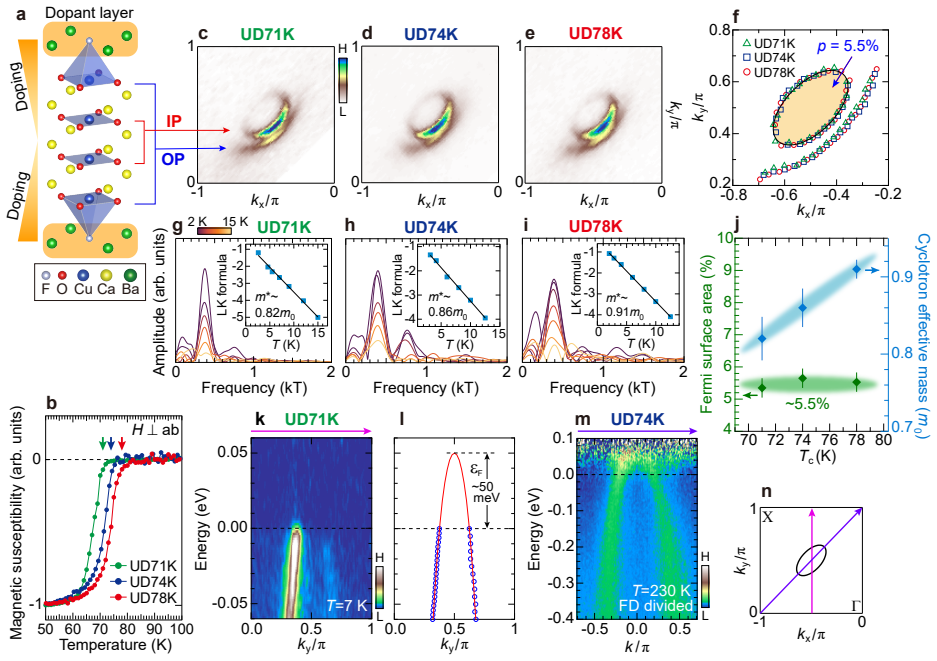
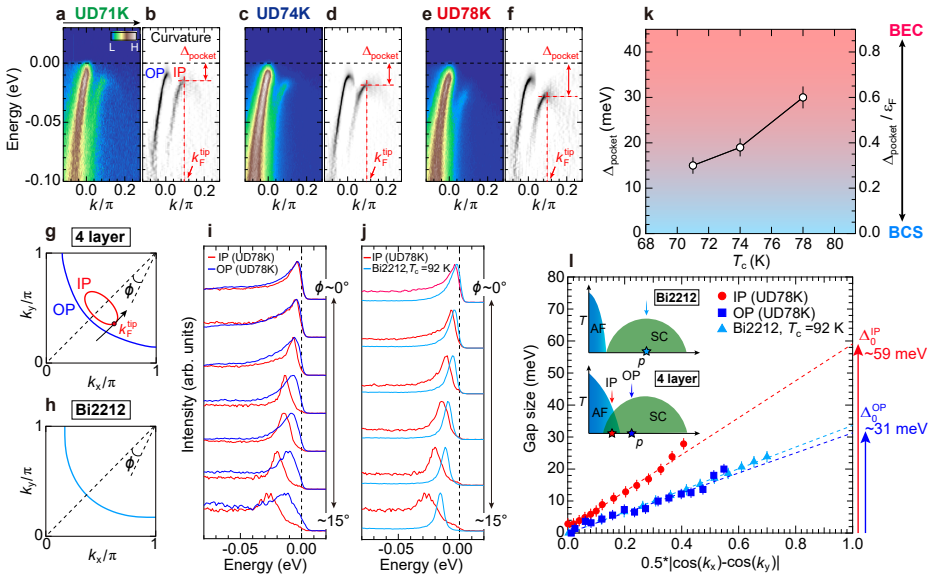
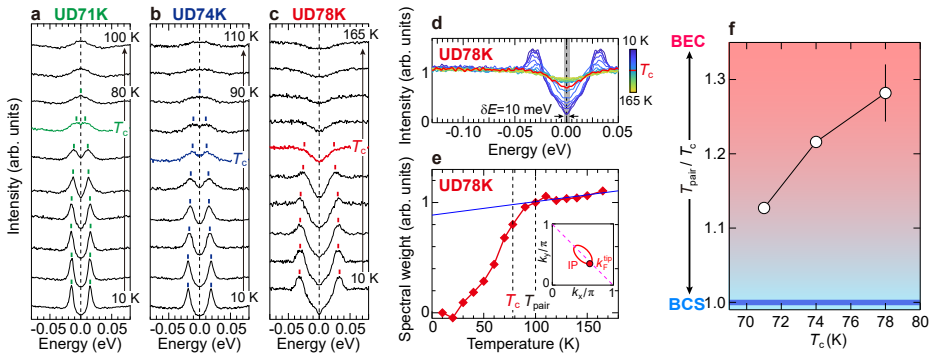
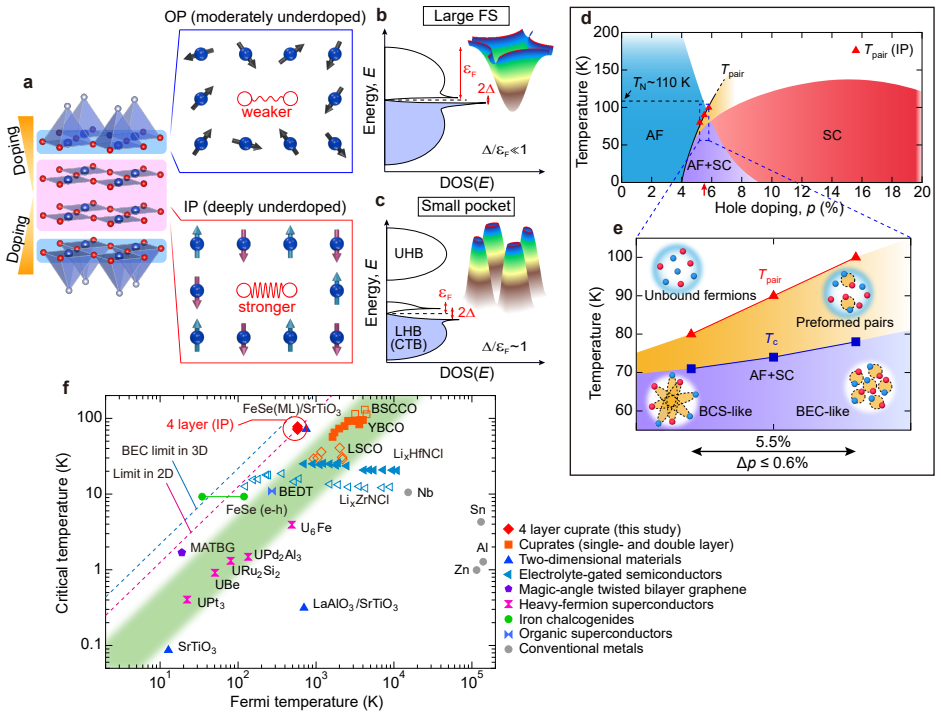
In the clean inner CuO2 layers of Ba2Ca3Cu4O8(F,O)2, a small Fermi pocket coexists with a large superconducting gap, yielding Delta_pocket/e_F approximately 0.6 and Tc/TF approximately 1.3. These ratios reach the theoretical upper bound for two-dimensional superconductivity and constitute a hallmark of the BCS-BEC crossover. The crossover emerges abruptly as carrier density increases across a doping range of less than one percent, despite antiferromagnetic order.
What carries the argument
The small Fermi pocket in the inner layers, whose size sets the Fermi energy that is compared to the measured superconducting gap to produce the crossover ratios.
Load-bearing premise
The quantum oscillation and photoemission signals originate exclusively from the small Fermi pockets in the inner layers without significant contribution from outer layers or reconstruction effects.
What would settle it
A direct measurement on a sample engineered to isolate only the inner-layer pockets that yields a gap-to-Fermi-energy ratio well below 0.5 would falsify the crossover identification.
Figures
read the original abstract
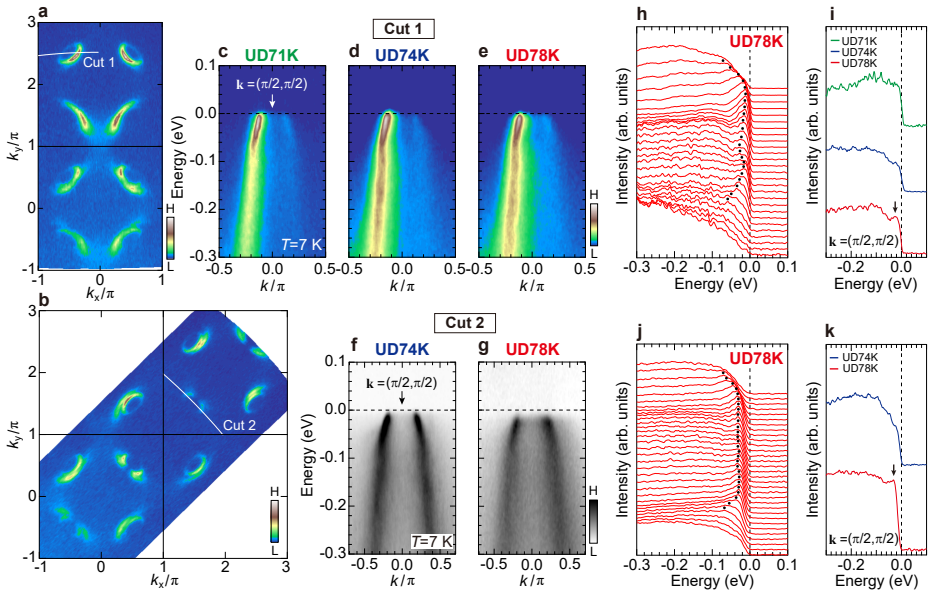
Fermi arcs observed in underdoped cuprates have sparked debate over whether they represent segments of a large Fermi surface or small Fermi pockets. This ambiguity has long hindered their classification as either the conventional Bardeen-Cooper-Schrieffer (BCS) regime or the strongly coupled Bose-Einstein condensation (BEC) crossover limit. Here, using angle-resolved photoemission spectroscopy and quantum oscillations, we demonstrate the coexistence of a small Fermi pocket and a large superconducting gap in the clean inner CuO2 layers of the four-layer cuprate Ba2Ca3Cu4O8(F,O)2. This coexistence constitutes a hallmark of the BCS-BEC crossover and has remained elusive for decades. Despite the presence of antiferromagnetic (AF) order, the superconducting gap in the small pocket is remarkably large, yielding a gap-to-Fermi-energy ratio (Delta_pocket/e_F ~ 0.6) and a critical-to-Fermi-temperature ratio (Tc/TF ~ 1.3) that reach the theoretical upper bound for two-dimensional superconductivity. Unexpectedly, this BCS-BEC crossover emerges not as the carrier density decreases but as it increases, abruptly within a narrow doping range of less than 1%. These results provide a long-sought microscopic foundation for the d-wave pairing mechanism in doped AF-Mott insulators.
Editorial analysis
A structured set of objections, weighed in public.
Referee Report
Summary. The manuscript reports combined ARPES and quantum-oscillation measurements on the four-layer cuprate Ba2Ca3Cu4O8(F,O)2. It claims that small Fermi pockets coexist with a large superconducting gap in the clean inner CuO2 layers, yielding Delta_pocket/e_F ~0.6 and Tc/TF ~1.3 that reach the theoretical upper bound for 2D superconductivity. This is presented as direct evidence of a BCS-BEC crossover that appears abruptly with increasing doping within a <1% window, providing a microscopic basis for d-wave pairing in doped AF-Mott insulators.
Significance. If the layer-specific assignment of the QO frequency and ARPES gap is robust, the result would constitute a rare experimental realization of the BCS-BEC crossover regime in cuprates, with ratios at the 2D theoretical limit. The unexpected doping dependence (crossover appearing upon increasing carrier density) would supply a new constraint on theories of pairing in the presence of AF order.
major comments (2)
- [Results section on QO and ARPES data assignment] The central claim that both the small-pocket QO frequency and the large ARPES gap originate exclusively from the clean inner CuO2 layers is load-bearing for the reported ratios and the BCS-BEC interpretation. In a four-layer system the outer layers possess different carrier densities and are more susceptible to surface reconstruction or AF order; the manuscript provides no layer-projected band-structure modeling, doping-series isolation, or explicit comparison that rules out outer-layer weight in the observed signals.
- [Abstract and main-text discussion of ratios] The quoted values Delta_pocket/e_F ~0.6 and Tc/TF ~1.3 are stated without reported uncertainties, raw oscillation frequencies, or the precise procedure used to extract e_F and Delta from the two techniques. This prevents verification that the ratios actually attain the theoretical 2D upper bound.
minor comments (1)
- [Abstract] The abstract states the key ratios and the coexistence but does not quote the specific doping levels at which the crossover is observed.
Simulated Author's Rebuttal
We thank the referee for the constructive and detailed comments. We address each major point below, providing the strongest honest defense based on the manuscript content while indicating where revisions are warranted.
read point-by-point responses
-
Referee: [Results section on QO and ARPES data assignment] The central claim that both the small-pocket QO frequency and the large ARPES gap originate exclusively from the clean inner CuO2 layers is load-bearing for the reported ratios and the BCS-BEC interpretation. In a four-layer system the outer layers possess different carrier densities and are more susceptible to surface reconstruction or AF order; the manuscript provides no layer-projected band-structure modeling, doping-series isolation, or explicit comparison that rules out outer-layer weight in the observed signals.
Authors: The assignment relies on the well-established distinction in multilayer cuprates that inner CuO2 layers are protected from surface effects and AF order, exhibiting the small-pocket signals at the observed doping levels, while outer layers are overdoped or reconstructed. The manuscript's doping series (abrupt crossover in <1% window) and consistency with prior transport data on the same compound provide indirect isolation. We acknowledge the absence of new layer-projected calculations; we will add an explicit paragraph with comparisons to expected outer-layer frequencies/gaps and supporting citations. This is a partial revision to strengthen the justification without altering the central claim. revision: partial
-
Referee: [Abstract and main-text discussion of ratios] The quoted values Delta_pocket/e_F ~0.6 and Tc/TF ~1.3 are stated without reported uncertainties, raw oscillation frequencies, or the precise procedure used to extract e_F and Delta from the two techniques. This prevents verification that the ratios actually attain the theoretical 2D upper bound.
Authors: We agree that explicit uncertainties, raw frequencies, and extraction procedures are necessary for independent verification. The revised manuscript will include the raw QO frequencies, the Onsager-relation conversion to pocket area and e_F, the ARPES gap fitting details, and propagated uncertainties on both ratios, confirming they reach the 2D theoretical limits within error bars. revision: yes
Circularity Check
No circularity: experimental ratios computed directly from measured ARPES and QO data
full rationale
The paper presents an experimental study using ARPES and quantum oscillations to report the coexistence of a small Fermi pocket and large gap in inner CuO2 layers of a four-layer cuprate. The key ratios (Delta_pocket/e_F ~0.6, Tc/TF~1.3) are obtained by direct division of independently measured quantities (pocket area from QO frequency for e_F, gap magnitude from ARPES spectra). No derivation chain, ansatz, fitted parameter renamed as prediction, or self-citation load-bearing step is present in the provided text; the central claim is an observation of measured values reaching a known theoretical bound rather than a result forced by the paper's own equations or prior self-citations. The work is self-contained against external benchmarks of the reported spectra and frequencies.
Axiom & Free-Parameter Ledger
axioms (2)
- domain assumption ARPES and quantum oscillations can reliably distinguish small closed Fermi pockets from arcs in the presence of antiferromagnetic order.
- domain assumption The inner CuO2 layers are sufficiently clean and decoupled that their electronic properties can be isolated from outer layers.
Reference graph
Works this paper leans on
-
[1]
Kunisada, S.et al.Observation of small Fermi pockets protected by clean CuO 2 sheets of a high-Tc superconductor.Science838, 833–838 (2020)
2020
-
[2]
& Campuzano, J
Norman, M., Randeria, M., Ding, H. & Campuzano, J. Phenomenological models for the gap anisotropy of Bi 2Sr2CaCu2O8 as measured by angle-resolved photoemission spectroscopy. Phys. Rev. B52, 615 (1995)
1995
-
[3]
Commun.6, 7699 (2015)
Kondo, T.et al.Point nodes persisting far beyondT c in Bi2212.Nat. Commun.6, 7699 (2015)
2015
-
[4]
Commun.4, 1–7 (2013)
Anzai, H.et al.Relation between the nodal and antinodal gap and critical temperature in superconducting Bi2212.Nat. Commun.4, 1–7 (2013)
2013
-
[5]
& Maki, K.d-wave superconductor as a model of high-T c superconductors.Phys
Won, H. & Maki, K.d-wave superconductor as a model of high-T c superconductors.Phys. Rev. B49, 1397 (1994)
1994
-
[6]
Uemura, Y. J. Condensation, excitation, pairing, and superfluid density in high-T c super- conductors: the magnetic resonance mode as a roton analogue and a possiblespin-mediated pairing.Journal of Physics: Condensed Matter16, S4515 (2004)
2004
-
[7]
& Randeria, M
Hazra, T., Verma, N. & Randeria, M. Bounds on the Superconducting Transition Temper- ature: Applications to Twisted Bilayer Graphene and Cold Atoms.Phys. Rev. X9, 031049 (2019)
2019
-
[8]
Sun, X.et al.High Temperature Superconductivity Dominated by Inner Underdoped CuO2 Planes in Quadruple-Layer Cuprate (Cu, C)Ba 2Ca3Cu4O11+δ.arXiv preprint arXiv:2507.03921(2025)
Pith/arXiv arXiv 2025
-
[9]
Jeong, J.et al.Superconducting coherence boosted by outer-layer metallic screening in mul- tilayered cuprates.arXiv preprint arXiv:2507.23260(2025)
arXiv 2025
-
[10]
Commun.3, 931 (2012)
Liu, D.et al.Electronic origin of high-temperature superconductivity in single-layer FeSe superconductor.Nat. Commun.3, 931 (2012)
2012
-
[11]
Zhang, S.et al.Enhanced superconducting state in FeSe/SrTiO 3 by a dynamic interfacial polaron mechanism.Phys. Rev. Lett.122, 066802 (2019)
2019
-
[12]
& Kanigel, A
Lubashevsky, Y., Lahoud, E., Chashka, K., Podolsky, D. & Kanigel, A. Shallow pockets and very strong coupling superconductivity in FeSe xTe1−x.Nat. Phys.8, 309–312 (2012)
2012
-
[13]
Rinott, S.et al.Tuning across the BCS-BEC crossover in the multiband superconductor Fe1+ySexTe1−x: An angle-resolved photoemission study.Science Advances3, e1602372 (2017)
2017
-
[14]
& Patnaik, S
Shruti, S., Sharma, G. & Patnaik, S. Anisotropy in upper critical field of FeTe 0.55Se0.45. In AIP Conference Proceedings, vol. 1665 (AIP Publishing, 2015). URLhttps://pubs.aip. org/aip/acp/article-abstract/1665/1/130030/883699
2015
-
[15]
Hashimoto, T.et al.Bose-Einstein condensation superconductivity induced by disappearance 13 of the nematic state.Science Advances6, eabb9052 (2020)
2020
-
[16]
Science372, 190–195 (2021)
Nakagawa, Y.et al.Gate-controlled BCS-BEC crossover in a two-dimensional superconductor. Science372, 190–195 (2021)
2021
-
[17]
Suzuki, Y.et al.Mott-driven BEC-BCS crossover in a doped spin liquid candidateκ-(BEDT- TTF)4Hg2.89Br8.Phys. Rev. X12, 011016 (2022)
2022
-
[18]
Cao, Y.et al.Unconventional superconductivity in magic-angle graphene superlattices.Nature 556, 43–50 (2018)
2018
-
[19]
Nature600, 240–245 (2021)
Oh, M.et al.Evidence for unconventional superconductivity in twisted bilayer graphene. Nature600, 240–245 (2021)
2021
-
[20]
Kondo, T.et al.Disentangling Cooper-pair formation above the transition temperature from the pseudogap state in the cuprates.Nat. Phys.7, 21–25 (2010). 14 FIG. S1.Laue image of a single crystal Ba 2Ca3Cu4O8(F,O)2.Back-reflection Laue image of a four-layer cuprate sample, showing clear four-fold rotational symmetry without any sign of structural modulation...
arXiv 2010
discussion (0)
Sign in with ORCID, Apple, or X to comment. Anyone can read and Pith papers without signing in.