DexFuture: Hierarchical Future-State Visuomotor Targeting for Bimanual Dexterous Tool Use
Reviewed by Pith T0 review T1 audit T2 compute T3 formal T4 kernel 2026-06-28 01:31 UTCgrok-4.3pith:ZUPL7YIPrecord.jsonopen to challenge →
The pith
A two-level visuomotor hierarchy generates future targets from camera history and tracks them to reach near-oracle bimanual tool performance at real-time speed.
A machine-rendered reading of the paper's core claim, the machinery that carries it, and where it could break.
Core claim
DexFuture is a hierarchical system consisting of a high-level Future-State Visuomotor Target Predictor that builds structured hand-tool-object embeddings from egocentric RGB, proprioceptive and geometric history and uses a horizon-conditioned transformer to output multi-step future target trajectories, coupled with a low-level Target-Conditioned Structured Dexterous Policy that uses a target-conditioned per-link transformer to track those targets. On OakInk2 bimanual tool-use tasks this yields 90 percent of privileged-oracle performance at 60 Hz, which is about 250 times faster than CEM planning with a future action-conditioned world model.
What carries the argument
The hierarchical coupling of the Future-State Visuomotor Target Predictor for coarse multi-step reference generation and the Target-Conditioned Structured Dexterous Policy for fine-grained tracking, which decouples semantic prediction from high-frequency control.
If this is right
- The system performs bimanual dexterous tasks near oracle level without access to privileged demonstration states.
- Control runs at 60 Hz, enabling real-time execution far faster than planning-based methods.
- Future target trajectories generated from history alone suffice for dynamic consistency in tool use.
- Structured visuomotor embeddings support prediction of hand-tool-object interactions over multiple steps.
Where Pith is reading between the lines
- Similar hierarchies could apply to other high-dimensional control problems where future references are costly to obtain.
- Combining this with learned world models might further improve long-horizon consistency without increasing computation.
- Validation on physical hardware would test whether the predicted targets transfer beyond simulation.
Load-bearing premise
The targets predicted by the high-level component stay close enough to feasible dynamics that the low-level policy can follow them without causing instability or failure.
What would settle it
Running the low-level policy on targets generated by the predictor and measuring whether success rate drops significantly below the oracle on held-out OakInk2 sequences.
Figures


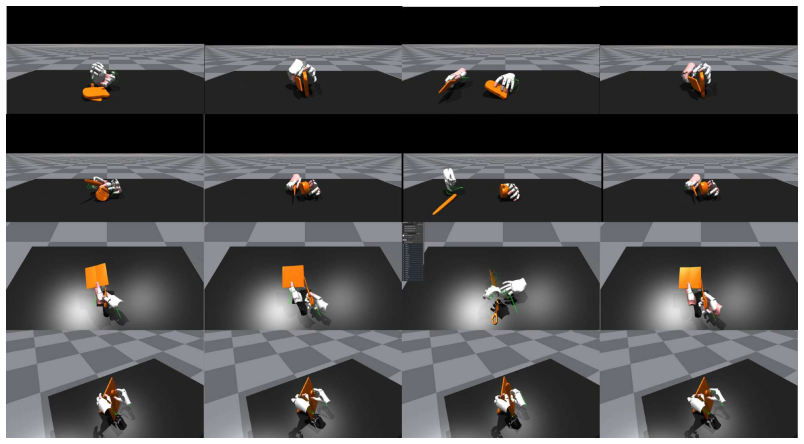

read the original abstract
Bimanual dexterous tool use remains challenging for robots due to high-dimensional hand configurations and complex hand-tool-object dynamics and contact. Most existing control policies depend on future configuration references provided from demonstrations, while future action-conditioned world models require slow online planning over high-dimensional action sequences. A significant challenge is generating a dynamically consistent future reference trajectory without relying on privileged states from demonstrations or slow counterfactual planning. We propose DexFuture, a hierarchical system that couples a high-level Future-State Visuomotor Target Predictor with a low-level Target-Conditioned Structured Dexterous Policy. Conditioned on egocentric RGB, proprioceptive and geometric history, the high-level predictor constructs structured hand-tool-object visuomotor embeddings and uses a horizon-conditioned transformer to generate a multi-step future target trajectory. Then, the low-level policy tracks them with a target-conditioned per-link transformer. This hierarchy decouples coarse future reference generation from fine-grained action control, and slow long-horizon semantic prediction from high-frequency execution. On OakInk2 bimanual tool-use tasks, DexFuture achieves 90% of the privileged-oracle performance, compared to 7% for a no-reference policy. DexFuture operates at 60 Hz, approximately 250 times faster than DexWM-style Cross-Entropy Method (CEM) planning with a future action-conditioned world model.
Editorial analysis
A structured set of objections, weighed in public.
Referee Report
Summary. The manuscript proposes DexFuture, a hierarchical visuomotor architecture for bimanual dexterous tool use. A high-level Future-State Visuomotor Target Predictor, conditioned on egocentric RGB, proprioceptive and geometric history, employs a horizon-conditioned transformer to output multi-step hand-tool-object target trajectories. These are tracked by a low-level Target-Conditioned Structured Dexterous Policy using a per-link transformer. On OakInk2 bimanual tool-use tasks the system is reported to reach 90% of privileged-oracle performance (versus 7% for a no-reference baseline) while executing at 60 Hz, approximately 250 times faster than DexWM-style CEM planning with a future action-conditioned world model.
Significance. If the reported performance holds under rigorous validation, the work provides a concrete demonstration that decoupling coarse future-reference generation from high-frequency tracking can deliver near-oracle dexterous manipulation at real-time rates without privileged states or online counterfactual planning. This architectural separation addresses a central tension in high-DoF control and supplies an empirical baseline that subsequent methods can be measured against.
major comments (2)
- [Abstract] Abstract: the central claim that the high-level predictor produces dynamically consistent trajectories rests on the 90%-of-oracle result, yet no trajectory-level metrics (penetration, velocity-limit violations, contact maintenance) or ablations isolating the predictor’s contribution are referenced; without these the performance gap versus the 7% no-reference policy cannot be attributed to predictor quality rather than low-level compensation or task leniency.
- [Abstract] The 250× speed advantage over DexWM-style CEM is load-bearing for the real-time claim, but the abstract supplies neither the precise CEM implementation details (horizon, number of samples, world-model architecture) nor confirmation that the same low-level policy is used in the baseline, preventing direct attribution of the speedup to the hierarchical design.
minor comments (1)
- [Abstract] The term “DexWM-style” appears without an accompanying citation or definition; a reference to the original DexWM work should be supplied on first use.
Simulated Author's Rebuttal
We thank the referee for the constructive feedback on the abstract. We address each major comment below and will revise the manuscript accordingly to strengthen the presentation of results.
read point-by-point responses
-
Referee: [Abstract] Abstract: the central claim that the high-level predictor produces dynamically consistent trajectories rests on the 90%-of-oracle result, yet no trajectory-level metrics (penetration, velocity-limit violations, contact maintenance) or ablations isolating the predictor’s contribution are referenced; without these the performance gap versus the 7% no-reference policy cannot be attributed to predictor quality rather than low-level compensation or task leniency.
Authors: We agree that trajectory-level metrics and an explicit ablation would more directly attribute the performance gap to the predictor. The current 90% vs. 7% comparison already uses an identical low-level policy for both the full system and the no-reference baseline, which provides some isolation. To fully address the concern we will add trajectory quality metrics (penetration, velocity violations, contact maintenance) and a dedicated ablation on the predictor in the revised experiments section, and update the abstract to reference these supporting results. revision: yes
-
Referee: [Abstract] The 250× speed advantage over DexWM-style CEM is load-bearing for the real-time claim, but the abstract supplies neither the precise CEM implementation details (horizon, number of samples, world-model architecture) nor confirmation that the same low-level policy is used in the baseline, preventing direct attribution of the speedup to the hierarchical design.
Authors: The manuscript already specifies in Section 3.4 that the CEM baseline uses the identical low-level policy and the same future action-conditioned world model architecture. To improve clarity we will revise the abstract to include the key CEM parameters (horizon, sample count) and explicitly state that the low-level policy is shared, thereby making the attribution to the hierarchical design direct. revision: yes
Circularity Check
No circularity: empirical results on OakInk2 are measured outcomes, not quantities derived by construction
full rationale
The paper's central claims consist of an architectural hierarchy (high-level horizon-conditioned transformer predictor + low-level per-link tracker) and measured task success rates (90% of oracle vs. 7% baseline) obtained by training and evaluating on OakInk2 data. No equations, predictions, or uniqueness arguments in the abstract reduce a claimed output to its own fitted inputs or to a self-citation chain. The performance numbers are external benchmarks rather than tautological re-statements of model parameters or prior self-work. The hierarchy is presented as an explicit design choice whose validity is tested empirically, not asserted by definition.
Axiom & Free-Parameter Ledger
free parameters (1)
- transformer architecture and training hyperparameters
axioms (1)
- domain assumption Predicted future targets are dynamically consistent with robot and object physics
Reference graph
Works this paper leans on
-
[1]
DexMachina: Functional Retargeting for Bimanual Dexterous Manipulation
Z. Mandi, Y . Hou, D. Fox, Y . Narang, A. Mandlekar, and S. Song. Dexmachina: Functional retargeting for bimanual dexterous manipulation, 2025. URLhttps://arxiv.org/abs/ 2505.24853
work page Pith review arXiv 2025
-
[2]
X. Liu, J. Adalibieke, Q. Han, Y . Qin, and L. Yi. DexTrack: Towards generalizable neural tracking control for dexterous manipulation from human references. InICLR, 2025
2025
-
[3]
Z. Luo, J. Cao, S. Christen, A. Winkler, K. Kitani, and W. Xu. Omnigrasp: Grasping diverse objects with simulated humanoids. InNeuRIPS, 2024
2024
-
[4]
K. Li, P. Li, T. Liu, Y . Li, and S. Huang. ManipTrans: Efficient dexterous bimanual manipula- tion transfer via residual learning. 2025
2025
- [5]
- [6]
-
[7]
X. Zhan, L. Yang, Y . Zhao, K. Mao, H. Xu, Z. Lin, K. Li, and C. Lu. OAKINK2: A dataset of bimanual hands-object manipulation in complex task completion. InCVPR, pages 445–456, June 2024
2024
-
[8]
Handa, K
A. Handa, K. Van Wyk, W. Yang, J. Liang, Y .-W. Chao, Q. Wan, S. Birchfield, N. D. Ratliff, and D. Fox. Dexpilot: Vision-based teleoperation of dexterous robotic hand-arm system. In IEEE International Conference on Robotics and Automation (ICRA), pages 9164–9170, 2020
2020
-
[9]
Qin, Y .-H
Y . Qin, Y .-H. Wu, S. Liu, H. Jiang, R. Yang, Y . Fu, and X. Wang. Dexmv: Imitation learning for dexterous manipulation from human videos.European Conference on Computer Vision (ECCV), 2022
2022
-
[10]
Y . Chen, T. Wu, S. Wang, X. Feng, J. Jiang, S. McAleer, Y . Geng, H. Dong, Z. Lu, S.-C. Zhu, and Y . Yang. Towards human-level bimanual dexterous manipulation with reinforcement learning.NeuRIPS, 2022
2022
-
[11]
Y . Qin, B. Huang, Z.-H. Yin, H. Su, and X. Wang. Dexpoint: Generalizable point cloud reinforcement learning for sim-to-real dexterous manipulation.Conference on Robot Learning (CoRL), 2022
2022
-
[12]
Y . Xu, W. Wan, J. Zhang, H. Liu, Z. Shan, H. Shen, R. Wang, H. Geng, Y . Weng, J. Chen, et al. Unidexgrasp: Universal robotic dexterous grasping via learning diverse proposal generation and goal-conditioned policy.CVPR, 2023
2023
-
[13]
Jiang, Y
Z. Jiang, Y . Xie, K. Lin, Z. Xu, W. Wan, A. Mandlekar, L. Fan, and Y . Zhu. Dexmimicgen: Automated data generation for bimanual dexterous manipulation via imitation learning. In 2025 IEEE International Conference on Robotics and Automation (ICRA), 2025
2025
-
[14]
Y .-W. Chao, W. Yang, Y . Xiang, P. Molchanov, A. Handa, J. Tremblay, Y . S. Narang, K. Van Wyk, U. Iqbal, S. Birchfield, J. Kautz, and D. Fox. DexYCB: A benchmark for capturing hand grasping of objects. InIEEE/CVF Conference on Computer Vision and Pattern Recognition (CVPR), 2021
2021
-
[15]
Z. Fan, O. Taheri, D. Tzionas, M. Kocabas, M. Kaufmann, M. J. Black, and O. Hilliges. ARC- TIC: A dataset for dexterous bimanual hand-object manipulation. InProceedings IEEE Con- ference on Computer Vision and Pattern Recognition (CVPR), 2023. 9
2023
-
[16]
Taheri, N
O. Taheri, N. Ghorbani, M. J. Black, and D. Tzionas. GRAB: A dataset of whole-body human grasping of objects. InEuropean Conference on Computer Vision (ECCV), 2020
2020
-
[17]
Y . Liu, Y . Liu, C. Jiang, K. Lyu, W. Wan, H. Shen, B. Liang, Z. Fu, H. Wang, and L. Yi. Hoi4d: A 4d egocentric dataset for category-level human-object interaction. InProceedings of the IEEE/CVF Conference on Computer Vision and Pattern Recognition (CVPR), pages 21013–21022, June 2022
2022
-
[18]
EgoDex: Learning Dexterous Manipulation from Large-Scale Egocentric Video
R. Hoque, P. Huang, D. J. Yoon, M. Sivapurapu, and J. Zhang. Egodex: Learning dexter- ous manipulation from large-scale egocentric video, 2025. URLhttps://arxiv.org/abs/ 2505.11709
work page internal anchor Pith review Pith/arXiv arXiv 2025
-
[19]
Hafner, J
D. Hafner, J. Pasukonis, J. Ba, and T. Lillicrap. Mastering diverse control tasks through world models.Nature, pages 1–7, 2025
2025
-
[20]
Hansen, X
N. Hansen, X. Wang, and H. Su. Temporal difference learning for model predictive control. In International Conference on Machine Learning (ICML), 2022
2022
-
[21]
Hansen, H
N. Hansen, H. Su, and X. Wang. Td-mpc2: Scalable, robust world models for continuous control. InInternational Conference on Learning Representations (ICLR), 2024
2024
-
[22]
Y . Seo, D. Hafner, H. Liu, F. Liu, S. James, K. Lee, and P. Abbeel. Masked world models for visual control. InConference on Robot Learning (CoRL), 2022
2022
-
[23]
Y . Seo, J. Kim, S. James, K. Lee, J. Shin, and P. Abbeel. Multi-view masked world models for visual robotic manipulation.ICML, 2023
2023
-
[24]
Assran, Q
M. Assran, Q. Duval, I. Misra, P. Bojanowski, P. Vincent, M. Rabbat, Y . LeCun, and N. Bal- las. Self-supervised learning from images with a joint-embedding predictive architecture. In IEEE/CVF Conference on Computer Vision and Pattern Recognition (CVPR), 2023
2023
-
[25]
Revisiting Feature Prediction for Learning Visual Representations from Video
A. Bardes, Q. Garrido, J. Ponce, X. Chen, M. Rabbat, Y . LeCun, M. Assran, and N. Ballas. Revisiting feature prediction for learning visual representations from video.arXiv preprint arXiv:2404.08471, 2024
work page internal anchor Pith review Pith/arXiv arXiv 2024
-
[26]
A. Bar, G. Zhou, D. Tran, T. Darrell, and Y . LeCun. Navigation world models.Proceedings of the IEEE/CVF Conference on Computer Vision and Pattern Recognition (CVPR), 2025
2025
-
[27]
Peebles and S
W. Peebles and S. Xie. Scalable diffusion models with transformers. InIEEE/CVF Interna- tional Conference on Computer Vision (ICCV), 2023
2023
-
[28]
R. Y . Rubinstein. The cross-entropy method for combinatorial and continuous optimization. Methodology and Computing in Applied Probability, pages 127–190, 1999
1999
- [29]
-
[30]
Schulman, F
J. Schulman, F. Wolski, P. Dhariwal, A. Radford, and O. Klimov. Proximal policy optimization algorithms, 2017. 10 7 Appendix 7.1 Comparison with Action-Conditioned Planning In this section, we complete the comparison in Section 4.5. We compare DexFuture against an action-conditioned world-model planning baseline following DexWM [6]. The original DexWM pla...
2017
discussion (0)
Sign in with ORCID, Apple, or X to comment. Anyone can read and Pith papers without signing in.