REVIEW 3 major objections 2 minor 3 cited by
ToolMaze benchmark reveals that LLM agents recover from tool failures 3.66 times slower than they execute basic tasks as models scale.
Reviewed by Pith at T0; open to challenge. T0 means a machine referee read the full paper against a public rubric. the ladder, T0–T4 →
T0 review · grok-4.3
2026-06-28 01:57 UTC pith:CPRLJF3B
load-bearing objection ToolMaze gives a structured way to test replanning under tool failures, but the scaling claim depends on how well the 2x2 taxonomy matches real failures. the 3 major comments →
When Tools Fail: Benchmarking Dynamic Replanning and Anomaly Recovery in LLM Agents
The pith
A machine-rendered reading of the paper's core claim, the machinery that carries it, and where it could break.
Core claim
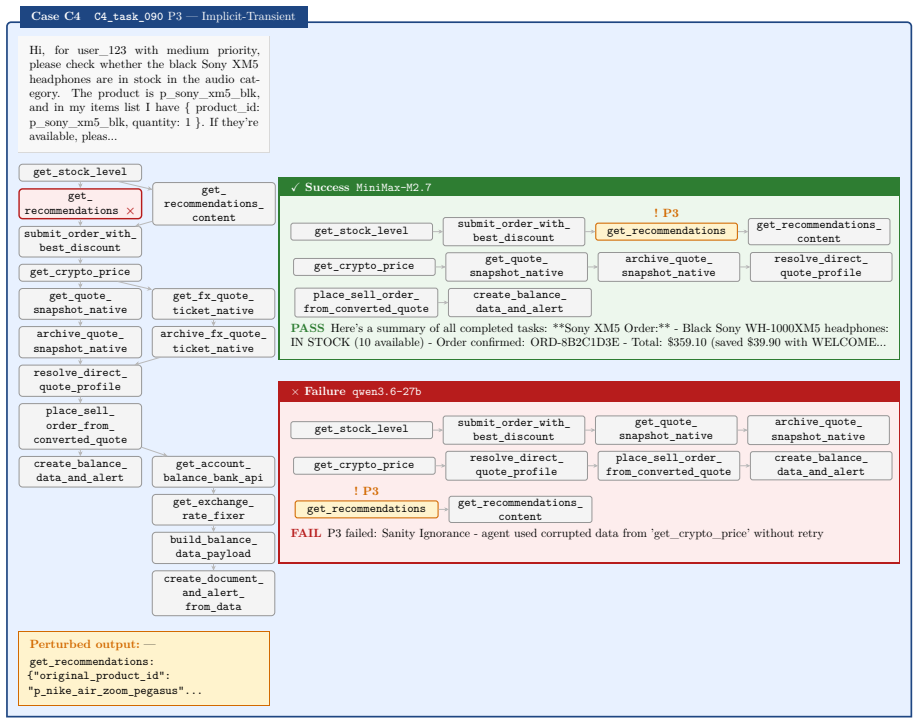
ToolMaze shows that tool perturbations degrade agent performance across models, with the largest losses under implicit semantic failures that drive a 37 percent drop in Perturbation Recovery Rate, while complex task graphs cause agents to loop in trial-and-error; crucially, fault-tolerance scales 3.66 times slower with model size than basic execution, establishing replanning as a distinct bottleneck.
What carries the argument
ToolMaze benchmark, built on DAG topological complexity paired with a 2x2 taxonomy of tool perturbations (explicit versus implicit, transient versus permanent) to measure systematic recovery in Tool-Integrated Reasoning agents.
Load-bearing premise
The chosen taxonomy of four perturbation types together with DAG complexity is assumed to cover the main real-world tool failures agents will meet.
What would settle it
Measuring that Perturbation Recovery Rate improves at the same rate or faster than basic task success when model size increases would show that replanning is not a separate bottleneck.
If this is right
- Larger models will continue to underperform on recovery tasks relative to their gains on clean execution.
- Implicit failures will remain especially damaging because agents over-trust corrupted outputs.
- Complex task structures will keep agents trapped in unproductive loops without new recovery methods.
- Prompting alone will not close the gap between execution and replanning performance.
Where Pith is reading between the lines
- Benchmarks limited to happy-path tool use will systematically overestimate how well agents will perform once deployed.
- Training objectives that directly reward recovery sequences could be tested as one way to accelerate the slower scaling curve.
- Extending the taxonomy to cover cascading or multi-step failures would check whether the current four categories miss important cases.
Editorial analysis
A structured set of objections, weighed in public.
Referee Report
Summary. The paper introduces ToolMaze, a benchmark for Tool-Integrated Reasoning (TIR) agents that evaluates dynamic replanning and recovery under tool failures. It employs DAG-based topological complexity together with a 2×2 perturbation taxonomy (explicit/implicit, transient/permanent) to distinguish systematic replanning from trial-and-error. Key results include a ~37% drop in Perturbation Recovery Rate (PRR) under implicit semantic failures, agents becoming trapped in futile loops on complex topologies, and agentic fault-tolerance scaling 3.66× slower with model size than basic task execution, establishing replanning as a distinct unaddressed bottleneck.
Significance. If the benchmark results and scaling differential hold under broader conditions, the work identifies a concrete limitation in current LLM agents that model scaling and prompting alone do not resolve, which is relevant for deploying reliable tool-using agents in realistic settings where failures occur.
major comments (3)
- [Abstract] Abstract: the central quantitative claims (37% PRR drop for implicit cases; 3.66× scaling differential) are stated without any reference to the models evaluated, number of runs, error bars, or statistical tests, which directly affects assessment of whether the scaling observation is load-bearing for the 'distinct bottleneck' conclusion.
- [Benchmark design section] Benchmark design (2×2 taxonomy + DAG complexity): the claim that this design isolates systematic replanning and demonstrates a general replanning bottleneck rests on the assumption that the chosen axes sufficiently cover real-world TIR failure modes; additional modes such as timing jitter, partial outputs, or cascading dependencies are not addressed, and if prevalent they would weaken the reported PRR drop and scaling ratio as evidence of a distinct, unaddressed limitation.
- [Results / scaling analysis section] Results on scaling: the 3.66× slower improvement in fault-tolerance versus basic execution is presented as a key finding, yet the manuscript provides no explicit definition or formula for how the scaling ratio is computed across models or perturbation types, making it impossible to verify whether the differential is robust or sensitive to the specific model list and perturbation instances used.
minor comments (2)
- [Abstract] Abstract and results sections should report run counts, variance, and confidence intervals for all quantitative metrics (PRR, scaling ratios) to support reproducibility.
- The GitHub repository link is provided but the manuscript should explicitly state which experimental artifacts (prompts, exact perturbation implementations, model versions) are released to allow independent verification of the 37% and 3.66× figures.
Simulated Author's Rebuttal
We thank the referee for the constructive comments. We address each major comment below and commit to revisions that improve clarity without altering the core claims.
read point-by-point responses
-
Referee: [Abstract] Abstract: the central quantitative claims (37% PRR drop for implicit cases; 3.66× scaling differential) are stated without any reference to the models evaluated, number of runs, error bars, or statistical tests, which directly affects assessment of whether the scaling observation is load-bearing for the 'distinct bottleneck' conclusion.
Authors: We agree the abstract would benefit from additional context. In the revision we will update the abstract to name the primary models evaluated and state that the 37% figure is an average across implicit cases with error bars and run counts (typically 5–10 per cell) reported in Section 4 and the figures; the scaling ratio is obtained from regression slopes detailed in the results. revision: yes
-
Referee: [Benchmark design section] Benchmark design (2×2 taxonomy + DAG complexity): the claim that this design isolates systematic replanning and demonstrates a general replanning bottleneck rests on the assumption that the chosen axes sufficiently cover real-world TIR failure modes; additional modes such as timing jitter, partial outputs, or cascading dependencies are not addressed, and if prevalent they would weaken the reported PRR drop and scaling ratio as evidence of a distinct, unaddressed limitation.
Authors: The 2×2 axes were chosen because detectability and persistence directly govern whether agents must replan rather than retry. We acknowledge that timing jitter, partial outputs, and cascading failures are omitted and could modulate the observed effects. The revision will add an explicit limitations paragraph in the benchmark section discussing these modes and their potential impact on generalizability. revision: partial
-
Referee: [Results / scaling analysis section] Results on scaling: the 3.66× slower improvement in fault-tolerance versus basic execution is presented as a key finding, yet the manuscript provides no explicit definition or formula for how the scaling ratio is computed across models or perturbation types, making it impossible to verify whether the differential is robust or sensitive to the specific model list and perturbation instances used.
Authors: We will insert the explicit definition and formula in the revised results section: the ratio equals the slope of PRR versus log(model size) divided by the slope of basic-execution accuracy versus log(model size), obtained via ordinary least-squares regression over the evaluated models and aggregated across perturbation types. The model list, fitted coefficients, and a sensitivity check will be added to the main text or an appendix. revision: yes
Circularity Check
Empirical benchmark study with no derivations or self-referential reductions
full rationale
This paper is an empirical benchmark study that introduces ToolMaze, defines a 2x2 perturbation taxonomy and DAG topological complexity to structure test cases, then reports direct performance measurements (e.g., PRR drops of ~37% and 3.66x slower scaling of fault-tolerance). No equations, fitted parameters, predictions derived from inputs, or self-citations appear in the provided text that would reduce any reported metric or central claim to a prior quantity by construction. The findings consist of observed results from model evaluations on the new benchmark and are therefore self-contained.
Axiom & Free-Parameter Ledger
axioms (1)
- domain assumption Standard assumptions in LLM agent benchmarking that model outputs can be meaningfully aggregated across runs and that the chosen perturbation types reflect realistic tool behavior.
read the original abstract
Existing benchmarks evaluate Tool-Integrated Reasoning (TIR) in LLMs on idealized ''happy paths'', largely overlooking real-world tool failures. We introduce ToolMaze, a benchmark for dynamic path discovery and error recovery in TIR agents. To separate systematic replanning from blind trial-and-error, ToolMaze adopts a two-dimensional design: DAG-based topological complexity and a $2 \times 2$ taxonomy of tool perturbations (explicit/implicit, transient/permanent). Evaluations show that perturbations degrade performance across nearly all models, with the sharpest drops under implicit semantic failures. Driven by systemic over-trust in corrupted outputs, Perturbation Recovery Rate (PRR) plummets by around 37\% in these scenarios, while complex topologies trap agents in futile trial-and-error loops. Crucially, agentic fault-tolerance improves with model scale $3.66\times$ slower than basic task execution, highlighting dynamic replanning as a distinct bottleneck unaddressed by model scaling or prompting. Data and code are available at https://github.com/Zhudongsheng75/ToolMaze.
Figures



Forward citations
Cited by 3 Pith papers
-
AgentCheck: A Reproduce-Intervene-Mitigate Workbench for LLM Agents over MCP
AgentCheck turns an MCP server into a fault-injection surface so developers can reproduce tool failures, test mitigations, and verify fixes before deployment.
-
AgentCheck: A Reproduce-Intervene-Mitigate Workbench for LLM Agents over MCP
AgentCheck turns MCP tool servers into a fault-injection surface so developers can reproduce agent failures, test mitigations, and confirm fixes under identical tool faults.
-
AgentCheck: A Reproduce-Intervene-Mitigate Workbench for LLM Agents over MCP
A tool that injects faults into an LLM agent's MCP tool calls, replays them under mitigation, and verifies the fix—revealing that agents mostly fail silently on stale or bad data.
Reference graph
Works this paper leans on
-
[1]
STT-Arena: A More Realistic Environment for Tool-Using with Spatio-Temporal Dynamics
Stt-arena: A more realistic environment for tool-using with spatio-temporal dynamics.arXiv preprint arXiv:2605.18548. Ziyou Jiang, Mingyang Li, Guowei Yang, Junjie Wang, Yuekai Huang, Zhiyuan Chang, and Qing Wang
work page internal anchor Pith review Pith/arXiv arXiv
-
[2]
ToolLLM: Facilitating Large Language Models to Master 16000+ Real-world APIs
Mimicking the familiar: Dynamic command generation for information theft attacks in llm tool- learning system. InProceedings of the 63rd An- nual Meeting of the Association for Computational Linguistics (Volume 1: Long Papers), pages 13677– 13693. Vipin Kataria. Intelligent site reliability engineering: A multi-agent llm framework for automated inci- dent...
work page internal anchor Pith review Pith/arXiv arXiv 2023
-
[3]
- You will receive N steps
**MANDATORY COVERAGE**: The task de- scription MUST require ALL steps in the execution trace, in order. - You will receive N steps. Your description MUST mention all N actions. - DO NOT skip any step, even if it seems redundant or obvious. - Each step must be explicitly or implicitly requested in the description
-
[4]
(for all N steps) - If ANY answer is NO, rewrite the description to include that step
**Step-by-Step Verification** (Internal checklist - verify before outputting): - Step 1: Does my description request this action? YES/NO - Step 2: Does my description request this action? YES/NO - Step 3: Does my description request this action? YES/NO - ... (for all N steps) - If ANY answer is NO, rewrite the description to include that step
-
[5]
I’ve already
**FORBIDDEN - Past Tense / Completed Ac- tions**: NEVER use: "I’ve already...", "I just...", "My ... is confirmed" NEVER imply actions are already done: "my book- ing", "the reservation I made" ALW AYS use future/imperative: "Please...", "I need to...", "Help me..."
-
[6]
then", "after that
**REQUIRED - Dependency Expression**: - If step B uses output from step A, use connecting words: "then", "after that", "and then" - Example: "Book a flight, then get the flight details, and send them to me" - NOT: "Send me the flight details" (missing book step)
-
[7]
**Natural Language**: - Do NOT mention tool names, schemas, or technical terms - Keep it realistic and concise (1-3 sentences) - Use the same language as the trace content - ONLY use facts from the trace blocks - do NOT invent details
-
[8]
**REMEMBER**: Your description must request ALL {num_steps} steps
**Verification Before Output**: - Count the steps in the trace: N steps - Count the actions in your description: M actions - If M < N, you MUST rewrite to include all steps - If M = N, verify each action maps to a step domains: {domains} language_hint: {language_hint} You will receive the trace blocks next (one per mes- sage). **REMEMBER**: Your descripti...
-
[9]
What NEW information does this step produce?
-
[10]
Which subsequent step(s) actually USE this information?
-
[11]
What would break if we removed this step? **If you cannot answer all three questions clearly, DO NOT include that step.** ### Anti-Patterns to STRICTLY AVOID
-
[12]
**FORBIDDEN: Using tools on empty or meaningless data**
-
[13]
**FORBIDDEN: Type mismatches** — output type from step N must match input type of step N+1
-
[14]
**FORBIDDEN: Using`get_field_value`for simple data access** — only use it for complex nested structures
-
[15]
source":
**FORBIDDEN: Fetching information that is never used by any subsequent step** ### Binding Reference Syntax Every`arg_bindings`value must be exactly one of: | Form | JSON | Meaning | |------|------|---------| | User input field |`{"source": "user_input", "field": "city"}`| A value the user provides | | Field from prev step |`{"source": "prev", "field": "pr...
-
[16]
The previous step's output contains this field (check Output Fields)
-
[17]
The field's type matches the current parameter's expected type
-
[18]
success": true,
The field's value is meaningful for the current operation Table 8: Prompt ofC1template construction (part 1). ### Task Select **5-7 tools** from the candidate list to create a coherent, useful task pipeline. - Each step must produce NEW information or perform a meaningful transformation - Each step's output must be USED by subsequent steps or the final re...
-
[19]
Chain must have exactly **5-7 steps**
-
[20]
**No alternative nodes** —`is_alternative`must be`false`for every step
-
[21]
**No duplicate tool names** in the chain
-
[22]
5.`user_input_schema`must cover every`user_input.xxx`field referenced in bindings
Every required parameter must have a valid`arg_bindings`entry. 5.`user_input_schema`must cover every`user_input.xxx`field referenced in bindings
-
[23]
success": false,
If a valid chain cannot be constructed, return`{"success": false, "reason": "..."}`. Respond ONLY with the JSON object, no additional text. Table 9: Prompt ofC1template construction(part 2). ### Role You are a **Data Pipeline Architect** for C2 complexity level. Your goal is to design a data processing pipeline with **5-7 steps** that includes **at least ...
-
[24]
source":
**Flexible Data References**: - Step N can reference output from any previous step (step 1 to N-1) - Arguments can come from`user_input`,`constant`,`prev`(previous step), or` step`(any earlier step) - For`constant`, always use`{"source": "constant", "value": ...}`(NOT`field`) - For`step`, use`{"source": "step", "step_number": N, "field": "xxx"}`to referen...
-
[25]
city"}`- takes from input field named
**Alternative Node Parameter Mapping**: - Use the parameter mapping defined in the alternative specification - Direct params:`{city: "city"}`- takes from input field named "city" - Constants:`{from_currency: "'USD'"}`- single quotes for string literals - References:`{a: "$stock_data.price"}`- $ prefix for previous tool outputs
-
[26]
source":
**CRITICAL - Output Field Names**: When using`{"source": "prev", "field": "xxx "}`, use exact field names from Observed output keys
-
[27]
**CRITICAL - Query vs Action Semantics**: -`get_*`/`query_*`/`check_*`tools return CURRENT state (for inspection) -`set_*`/`update_*`/`create_*`tools require TARGET state (desired outcome) - Do NOT use`prev`output from a query tool as input to its corresponding action tool - Example:`get_light_status` → `set_light_state`should use`user_input`for target st...
-
[28]
source":
**CRITICAL - Type Compatibility**: - **Object parameters**: If a parameter expects`type: object`, you MUST bind the entire object from`prev`, NOT individual fields - WRONG:`weather_data: {"source": "prev", "field": "temperature_celsius"}`( scalar field) - CORRECT:`weather_data: {"source": "prev", "field": "weather_result"}`( complete object) - **Scalar pa...
-
[29]
Uses at least ONE alternative group from the provided alternatives
-
[31]
success": true,
Properly connects data between steps ### Output Format (JSON Only) ```json { "success": true, "chain": [ { "step": 1, "tool_name": "source_tool_name", "is_alternative": false, "reasoning": "Starts the chain by fetching...", "arg_bindings": { "param": {"source": "user_input", "field": "param_name"} } }, { "step": 2, "tool_name": "ALTERNATIVE", "is_alternat...
-
[32]
**5-7 steps** - flexible length
-
[33]
is_alternative
**At least 1 alternative node** - mark with`"is_alternative": true`and provide `"alternative_id"`
-
[34]
Alternative nodes should NOT be the first or last step (prefer middle positions)
-
[36]
All required parameters must have an entry in`arg_bindings`
-
[37]
Field names MUST match exactly from Observed output keys
-
[38]
VALID alternative_id values
Prefer valid type-safe flows over aggressive chaining; do not force every step to consume previous output. 8.`alternative_id`MUST be selected exactly from the "VALID alternative_id values" list below the alternatives. 9.`user_input_schema`must cover every`user_input.xxx`field referenced in bindings
-
[39]
**CRITICAL - Domain Consistency**: - All tools MUST belong to semantically related domains - FORBIDDEN combinations: Weather+Shopping, Weather+Flight, Weather+Finance, IoT+ Shopping, IoT+Finance, IoT+Flight, Shopping+Office, Finance+IoT - Adjacent steps MUST have compatible domains - The chain should form ONE coherent workflow, not multiple unrelated tasks
-
[40]
**CRITICAL - Alternative Semantic Fit**: - The alternative MUST fit semantically into the workflow - Check that the alternative's domain matches surrounding tools'domains - Do NOT insert an alternative just to meet the requirement if it doesn't fit
-
[41]
Do NOT use the same tool_name multiple times
**CRITICAL - No Duplicate Tools**: Each tool can only appear ONCE in the chain. Do NOT use the same tool_name multiple times
-
[42]
ALL paths within the alternative must accomplish the SAME goal
**CRITICAL - Alternative Must Be a True Branch**: The alternative node replaces a single logical step with multiple implementation paths. ALL paths within the alternative must accomplish the SAME goal. Do NOT design an alternative where one path repeats work already done by a preceding main-path step (e.g., if` get_account_balance`is already in the main c...
-
[43]
Alternative Output Field Hints
**CRITICAL - Alternative Output Compatibility**: - Check "Alternative Output Field Hints" section for each alternative - If an alternative shows "common keys across all paths: (none)", the NEXT step CANNOT use`source=prev` - If step N is alternative and step N+1 uses`source=prev`, you MUST only use fields from "common keys across all paths" - When in doub...
-
[44]
source":
**Flexible Data References**: - A step may reference`user_input`,`constant`,`prev`(previous step), or`step `(any earlier step) -`prev`means the output of the previous logical step -`step`allows referencing any earlier step:`{"source": "step", "step_number": N, "field": "xxx"}` - For`constant`, always use`{"source": "constant", "value": ...}`
-
[45]
**Alternative Node Parameter Mapping**: - Use the abstract interface exposed by the alternative specification - Bare params like`{city: "city"}`mean the alternative expects an abstract input named`city` - References like`$reservation_data.reservation_id`are internal to an alternative path and are already handled by the system
-
[46]
source":
**CRITICAL - Output Field Names**: - When using`{"source": "prev", "field": "xxx"}`, use exact field names from the observed output keys or the alternative output hints, UNLESS you are referencing the entire output object as defined in Critical Rules 13
-
[47]
source":
**CRITICAL - Type Compatibility**: - **Object parameters**: If a parameter expects`type: object`, you MUST bind the entire object from`prev`, NOT individual fields - WRONG:`weather_data: {"source": "prev", "field": "temperature_celsius"}`( temperature_celsius is a number, not an object) - CORRECT:`weather_data: {"source": "prev", "field": "weather_result"...
-
[48]
source":
**CRITICAL - Binding Object Format**: - EVERY`arg_bindings[param]`value must be an object like`{"source": " user_input", "field": "amount"}` - Do NOT output raw strings, raw numbers, or bare field names directly inside` arg_bindings`
-
[49]
source":
**CRITICAL -`get_field_value`Usage**: - Prefer direct`prev`field references over`get_field_value`for simple access - If you use`get_field_value`,`target_field`,`field_name`, and`index`should normally be`constant`bindings - Example:`{"source": "constant", "value": "filled_average_price"}`or`{"source ": "constant", "value": 0}` Table 13: Prompt ofC3template...
-
[50]
**CRITICAL - Numeric Tools**: - For numeric params such as`amount`,`a`,`b`,`quantity`, only bind from numeric`prev`fields or numeric`user_input`fields - Do NOT bind a numeric param from a person name, email, room name, message text, or any generic string field ### Available Tools {tool_specifications} {alternative_specifications} ### Task Design a **5-7 l...
-
[51]
Uses at least ONE`many_to_many`alternative group from the provided alternatives
-
[52]
Creates a coherent, useful task flow
-
[53]
Properly connects data between steps
-
[54]
success": true,
Includes`user_input_schema`for every referenced`user_input.xxx`field ### Output Format (JSON Only) ```json { "success": true, "chain": [ { "step": 1, "tool_name": "source_tool_name", "is_alternative": false, "reasoning": "Starts the chain by fetching...", "arg_bindings": { "param": {"source": "user_input", "field": "param_name"} } }, { "step": 2, "tool_na...
-
[55]
**5-7 logical steps**
-
[56]
**At least 1 alternative node** using a provided`many_to_many`group
-
[57]
Alternative nodes should NOT be the first or last step
-
[58]
success": false,
If you cannot construct a valid chain, return`{"success": false, "reason": " explanation"}`
-
[59]
All required parameters must have an entry in`arg_bindings` 6.`alternative_id`MUST be selected exactly from the valid allowlist below the alternatives
-
[60]
Include a non-empty`user_input_schema`covering every referenced`user_input.xxx `field
-
[61]
Prefer semantically clean, type-safe flows over aggressive chaining
-
[62]
Treat many_to_many as true path-level alternatives: if two paths would share the same tail tool(s), that is not a good C3-style N-to-N substitute
-
[63]
ALL paths within the alternative must accomplish the SAME goal
**CRITICAL - Alternative Must Be a True Branch**: The alternative node replaces a single logical step with multiple implementation paths. ALL paths within the alternative must accomplish the SAME goal. Do NOT design an alternative where one path repeats work already done by a preceding main-path step (e.g., if a data-fetching tool is already in the main c...
-
[64]
**CRITICAL - Domain Consistency**: - All tools MUST belong to semantically related domains - FORBIDDEN combinations: Weather+Shopping, Weather+Flight, Weather+Finance, IoT+ Shopping, IoT+Finance, IoT+Flight, Shopping+Office, Finance+IoT - Adjacent steps MUST have compatible domains
-
[65]
Alternative Output Field Hints
**CRITICAL - Alternative Output Compatibility**: - Check "Alternative Output Field Hints" for each alternative - If an alternative shows "common keys across all paths: (none)", the NEXT step CANNOT use`source=prev` - When in doubt, use`user_input`instead of forcing`prev`
-
[66]
source":
**CRITICAL - Binding Entire Output (Object Parameters)**: - If a parameter expects`type: object`, you MUST use`{"source": "prev", "field ": "$output_name"}`to pass the entire result. - **FORBIDDEN**: Never guess field names like "hotel_info", "flight_result", or "data_obj". - The correct`output_name`is defined in alternative specification. Respond ONLY wi...
-
[67]
Look at the terminal tool's Output Fields for **each path** in the alternativegroup
-
[68]
If the field exists **in every path's terminal output**→safe to use
-
[69]
source":
If the field is missing from **any path**→do NOT use that field from`prev`. - Use`{"source": "prev"}`if the parameter expects`object`. - Use`{"source": "user_input", ...}`if the parameter expects a scalar. ### Available Tools {tool_specifications} {alternative_specifications} Table 16: Prompt ofC4template construction (part 1). ### Task Design an **8-12 l...
-
[70]
Uses at least **TWO** alternative groups from the provided alternatives
-
[71]
Creates one coherent, semantically consistent workflow
-
[72]
success": true,
Every required parameter has a valid`arg_bindings`entry 4.`user_input_schema`covers every`user_input.xxx`field referenced in bindings ### Output Format (JSON only) ```json { "success": true, "chain": [ { "step": 1, "tool_name": "some_tool", "is_alternative": false, "reasoning": "Why this step is needed", "arg_bindings": { "city": {"source": "user_input", ...
-
[73]
Chain must have exactly **8-12 logical steps**
-
[74]
At least **2 steps** must be alternative nodes
-
[75]
4.`alternative_id`must be selected **exactly** from the provided allowlist
Alternative nodes must **not** be the first or last step. 4.`alternative_id`must be selected **exactly** from the provided allowlist
-
[76]
**No duplicate tool names** anywhere in the chain
-
[77]
**No duplicate`alternative_id`** values
-
[78]
Prefer **2-3 alternative groups** maximum
-
[79]
Alternative groups must represent true branching choices, not repeated work
-
[80]
success": false,
If a valid chain cannot be constructed, return`{"success": false, "reason": "..."}`. Respond ONLY with the JSON object, no additional text. Table 17: Prompt ofC4template construction (part 2). Guidelines: "physics_violation": """Generate values that violate physics/common sense: - Temperature:°-50C in a city (wrong but not°-273C) - Price: -$50 (negative b...
2024
-
[81]
Return a valid JSON object (NO "error" field)
-
[82]
Apply the {corruption_type} corruption type
discussion (0)
Sign in with ORCID, Apple, or X to comment. Anyone can read and Pith papers without signing in.