Odd-parity magnons in the Haldane-Hubbard model from topological exciton condensation
Pith reviewed 2026-06-27 23:42 UTC · model grok-4.3
The pith
Condensation of topological excitons drives the paramagnetic phase into a collinear Néel state that realizes an odd-wave magnet with odd-parity magnons showing f-wave splitting.
A machine-rendered reading of the paper's core claim, the machinery that carries it, and where it could break.
Core claim
The condensation of topological excitons in the paramagnetic phase drives the transition into the collinear Néel state that realizes an odd-wave magnet with odd-parity magnons displaying a characteristic f-wave splitting. An electron bandgap closing ensures magnon bandgap closing causing a change in odd-parity magnon topology, as well as a drastically enlarged spin splitting.
What carries the argument
Topological exciton condensation that links the paramagnetic phase to the collinear Néel state and fixes the odd-parity magnon spectrum.
Load-bearing premise
Exciton condensation is the main driver of the transition to Néel order and the magnon spectrum follows directly from this process without other interaction channels or finite-size effects changing the reported parity and splitting.
What would settle it
A calculation of the magnon dispersion relations inside the Néel phase that shows neither f-wave splitting nor the predicted change in odd-parity magnon topology when the electron gap closes would falsify the claim.
Figures
read the original abstract
Odd-wave magnets are the counterparts to even-wave altermagnets realizing odd-parity spin splitting. Normally discussed for noncollinear systems, they have recently been shown to appear in collinear magnetic states in the presence of loop currents. Here we study collective excitations of the paramagnetic and magnetic phase of the seminal Haldane-Hubbard model. We identify the existence topological excitons in the paramagnetic phase, and their condensation as the driving mechanism into the collinear N\'{e}el state. The latter realizes an odd-wave magnet with odd-parity magnons displaying a characteristic $f$-wave splitting. We further uncover that an electron bandgap closing ensures magnon bandgap closing causing a change in odd-parity magnon topology, as well as a drastically enlarged spin splitting. Our results establish the presence of topological excitons and odd-parity magnons in the Haldane-Hubbard, with potential realizations in Floquet-driven materials and cold atomic gases.
Editorial analysis
A structured set of objections, weighed in public.
Referee Report
Summary. The paper claims that in the Haldane-Hubbard model, topological excitons exist in the paramagnetic phase and their condensation drives the transition to a collinear Néel state. This state realizes an odd-wave magnet featuring odd-parity magnons with a characteristic f-wave splitting. Additionally, an electron bandgap closing is shown to cause a magnon bandgap closing, leading to a change in the topology of odd-parity magnons and a drastically enlarged spin splitting. The results suggest potential realizations in Floquet-driven materials and cold atomic gases.
Significance. If the results hold, the work provides a mechanism linking topological exciton condensation to the emergence of odd-parity magnons in collinear systems, extending the concept of odd-wave magnets. It offers insights into the interplay between electronic topology and magnetic excitations in a paradigmatic model, with relevance to experimental platforms like Floquet engineering and ultracold atoms.
major comments (2)
- [Paramagnetic phase analysis] The claim that exciton condensation drives the Néel transition requires demonstration that it is the dominant instability; the manuscript should include comparisons of susceptibilities or critical points for competing orders to substantiate this.
- [Magnon spectrum extraction] The reported f-wave splitting and topology change in magnons tied to electron gap closing may be affected by omitted interaction channels or finite-size effects; the paper should specify the method (e.g., RPA, Bethe-Salpeter) and provide convergence checks or error estimates.
minor comments (2)
- Ensure consistent use of terminology such as 'odd-wave magnet' and 'odd-parity magnons' throughout the text.
- [Abstract] The abstract mentions 'loop currents' in the introduction to odd-wave magnets; a brief reference to prior work on this would help contextualize.
Simulated Author's Rebuttal
We thank the referee for their constructive comments and positive assessment of the significance of our work. We address each major comment point by point below.
read point-by-point responses
-
Referee: [Paramagnetic phase analysis] The claim that exciton condensation drives the Néel transition requires demonstration that it is the dominant instability; the manuscript should include comparisons of susceptibilities or critical points for competing orders to substantiate this.
Authors: We agree that explicitly comparing the exciton instability to competing channels would strengthen the claim that condensation drives the transition. The manuscript identifies topological excitons in the paramagnetic phase and links their condensation to the Néel state, but does not present a full comparison of susceptibilities. In the revised manuscript we will add RPA calculations of the critical points (or susceptibilities) for the leading competing orders, such as charge-density-wave instabilities, within the same framework to demonstrate dominance. revision: yes
-
Referee: [Magnon spectrum extraction] The reported f-wave splitting and topology change in magnons tied to electron gap closing may be affected by omitted interaction channels or finite-size effects; the paper should specify the method (e.g., RPA, Bethe-Salpeter) and provide convergence checks or error estimates.
Authors: The magnon spectrum is obtained from the poles of the transverse spin susceptibility evaluated in the random-phase approximation (RPA) in the Néel phase (see Sec. III and the methods). We will make this explicit in the revision. While the presented results are robust across the parameter range studied, we acknowledge that additional finite-size scaling and estimates of neglected channels would be valuable; the revised version will include these checks and error estimates. revision: partial
Circularity Check
No circularity: claims rest on model calculations without definitional reduction or fitted predictions
full rationale
The abstract and provided context describe identifying topological excitons in the paramagnetic phase of the Haldane-Hubbard model and their condensation as the mechanism into the collinear Néel state, followed by analysis of odd-parity magnons. No equations are presented that would allow checking for self-definitional loops (e.g., order parameter defined via the condensation it is claimed to drive) or for a fitted parameter being relabeled as a prediction. No self-citations are invoked as load-bearing uniqueness theorems. The derivation chain therefore remains self-contained against external benchmarks such as the standard Haldane-Hubbard Hamiltonian and standard many-body techniques, with no reduction of outputs to inputs by construction.
Axiom & Free-Parameter Ledger
Forward citations
Cited by 1 Pith paper
-
Composite Quantum Geometry and Semiclassical Dynamics
Semiclassical dynamics of neutral and charged composite excitations in insulators introduce a generalized quantum geometric dipole and require careful selection among inequivalent composite Berry curvatures based on s...
Reference graph
Works this paper leans on
-
[1]
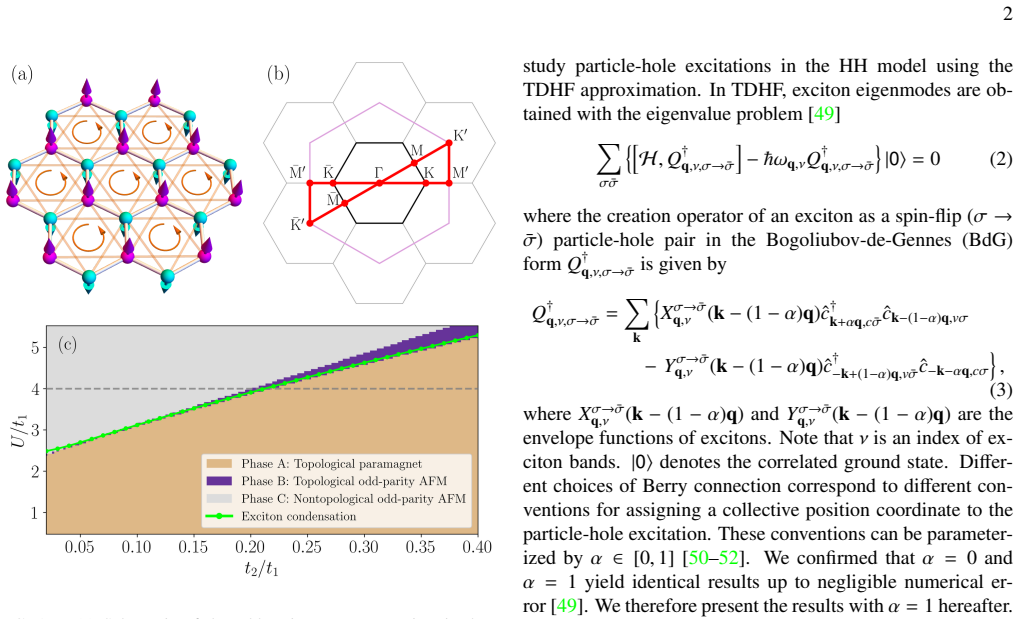
Before studying the dynamical properties of the HH model, we revisit its Hartree-Fock (HF) phase diagram originally pre- sented about a decade ago [6], see Fig. 1(c). Whent2/t1 ≲0.4, the system exhibits three distinct phases: (A) a topological paramagnetic phase withC v↑ =C v↓ =−C c↑ =−C c↓ = +1, (B) a topological collinear antiferromagnetic (AFM) phase i...
-
[2]
The RPA susceptibility tensor is obtained by resumming the bare susceptibility tensor as χRPA ±∓ (q,iω n)= χ0 ±∓(q,iω n) 1−Uχ 0 ±∓(q,iω n) ,(17) where1denotes an identity
denote internal co- ordinates of sublattices within a unit cell.0 + denotes an in- finitesimal positive number. The RPA susceptibility tensor is obtained by resumming the bare susceptibility tensor as χRPA ±∓ (q,iω n)= χ0 ±∓(q,iω n) 1−Uχ 0 ±∓(q,iω n) ,(17) where1denotes an identity. This formula is valid for arbitrary onsite Hubbard models with spin-σz co...
-
[3]
F. D. M. Haldane, Model for a quantum hall effect with- out landau levels: Condensed-matter realization of the ”parity anomaly”, Phys. Rev. Lett.61, 2015 (1988)
2015
-
[4]
K. v. Klitzing, G. Dorda, and M. Pepper, New method for high- accuracy determination of the fine-structure constant based on quantized hall resistance, Phys. Rev. Lett.45, 494 (1980)
1980
-
[5]
C. L. Kane and E. J. Mele,Z2 topological order and the quantum spin hall effect, Phys. Rev. Lett.95, 146802 (2005)
2005
-
[6]
C. L. Kane and E. J. Mele, Quantum spin hall effect in graphene, Phys. Rev. Lett.95, 226801 (2005)
2005
-
[7]
Neupert, L
T. Neupert, L. Santos, C. Chamon, and C. Mudry, Fractional quantum hall states at zero magnetic field, Phys. Rev. Lett.106, 236804 (2011)
2011
-
[8]
V . S. Arun, R. Sohal, C. Hickey, and A. Paramekanti, Mean field study of the topological haldane-hubbard model of spin- 1 2 fermions, Phys. Rev. B93, 115110 (2016)
2016
-
[9]
Hickey, L
C. Hickey, L. Cincio, Z. Papi ´c, and A. Paramekanti, Haldane- hubbard mott insulator: From tetrahedral spin crystal to chiral spin liquid, Phys. Rev. Lett.116, 137202 (2016)
2016
-
[10]
T. I. Vanhala, T. Siro, L. Liang, M. Troyer, A. Harju, and P. T¨orm¨a, Topological phase transitions in the repulsively in- teracting haldane-hubbard model, Phys. Rev. Lett.116, 225305 (2016)
2016
-
[11]
E. Alba, J. K. Pachos, and J. J. Garc ´ıa-Ripoll, Winding number order in the haldane model with interactions, New Journal of Physics18, 033022 (2016)
2016
-
[12]
L. S. G. Leite and R. L. Doretto, Flat-band ferromagnetism and spin waves in the haldane-hubbard model, Phys. Rev. B104, 155129 (2021)
2021
-
[13]
Yi, H.-Q
T.-C. Yi, H.-Q. Lin, and R. Mondaini, Higher-order topological insulator in a modified haldane-hubbard model, Phys. Rev. B 107, 165135 (2023)
2023
-
[14]
B.-Q. Wang, C. Shao, T. Tohyama, H.-G. Luo, and H. Lu, Topological phase in the extended haldane-hubbard model with sublattice-dependent repulsion, Phys. Rev. B110, 035107 (2024)
2024
-
[15]
W.-X. He, R. Mondaini, H.-G. Luo, X. Wang, and S. Hu, Phase transitions in the haldane-hubbard model, Phys. Rev. B109, 035126 (2024)
2024
- [16]
-
[17]
ˇSmejkal, J
L. ˇSmejkal, J. Sinova, and T. Jungwirth, Beyond conventional ferromagnetism and antiferromagnetism: A phase with nonrel- ativistic spin and crystal rotation symmetry, Phys. Rev. X12, 031042 (2022)
2022
-
[18]
ˇSmejkal, J
L. ˇSmejkal, J. Sinova, and T. Jungwirth, Emerging research landscape of altermagnetism, Phys. Rev. X12, 040501 (2022)
2022
-
[19]
Mazin (The PRX Editors), Editorial: Altermagnetism—a new punch line of fundamental magnetism, Phys
I. Mazin (The PRX Editors), Editorial: Altermagnetism—a new punch line of fundamental magnetism, Phys. Rev. X12, 040002 (2022)
2022
-
[20]
A. B. Hellenes, T. Jungwirth, R. Jaeschke-Ubiergo, A. Chakraborty, J. Sinova, and L. ˇSmejkal, P-wave mag- nets (2024), arXiv:2309.01607 [cond-mat.mes-hall]. 7
Pith/arXiv arXiv 2024
-
[21]
Brekke, P
B. Brekke, P. Sukhachov, H. G. Giil, A. Brataas, and J. Linder, Minimal models and transport properties of unconventionalp- wave magnets, Phys. Rev. Lett.133, 236703 (2024)
2024
-
[22]
Y . Yu, M. B. Lyngby, T. Shishidou, M. Roig, A. Kreisel, M. Weinert, B. M. Andersen, and D. F. Agterberg, Odd-parity magnetism driven by antiferromagnetic exchange, Phys. Rev. Lett.135, 046701 (2025)
2025
-
[23]
N. A. A. Pari, R. Jaeschke-Ubiergo, A. Chakraborty, L. ˇSmejkal, and J. Sinova, Nonrelativistic linear edelstein ef- fect in helical euin2as2, Phys. Rev. B112, 024404 (2025)
2025
-
[24]
Chakraborty, A
A. Chakraborty, A. Birk Hellenes, R. Jaeschke-Ubiergo, T. Jungwirth, L. ˇSmejkal, and J. Sinova, Highly efficient non- relativistic edelstein effect in nodal p-wave magnets, Nature Communications16, 7270 (2025)
2025
-
[25]
Q. Song, S. Stavri ´c, P. Barone, A. Droghetti, D. S. Antonenko, J. W. F. Venderbos, C. A. Occhialini, B. Ilyas, E. Ergec ¸en, N. Gedik, S.-W. Cheong, R. M. Fernandes, S. Picozzi, and R. Comin, Electrical switching of a p-wave magnet , Nature 642, 64 (2025)
2025
-
[26]
Yamada, M
R. Yamada, M. T. Birch, P. R. Baral, S. Okumura, R. Nakano, S. Gao, M. Ezawa, T. Nomoto, J. Masell, Y . Ishihara, K. K. Kolincio, I. Belopolski, H. Sagayama, H. Nakao, K. Ohishi, T. Ohhara, R. Kiyanagi, T. Nakajima, Y . Tokura, T.-h. Arima, Y . Motome, M. M. Hirschmann, and M. Hirschberger, A metal- lic p-wave magnet with commensurate spin helix, Nature64...
2025
-
[27]
V . Leeb and J. Knolle, Collinearp-wave magnetism and hid- den orbital ferrimagnetism (2026), arXiv:2601.07418 [cond- mat.str-el]
arXiv 2026
- [28]
-
[29]
S. A. A. Ghorashi and Q. Li, Dynamical generation of higher- order spin-orbit coupling, topology, and persistent spin texture in light-irradiated altermagnets, Phys. Rev. Lett.135, 236702 (2025)
2025
-
[30]
P.-H. Fu, S. Mondal, J.-F. Liu, Y . Tanaka, and J. Cayao, Floquet engineering spin triplet states in unconventional magnets, Phys. Rev. Lett.136, 066703 (2026)
2026
-
[31]
Huang, Z
S. Huang, Z. Qin, F. Zhan, D.-H. Xu, D.-S. Ma, and R. Wang, Light-induced odd-parity magnetism in conventional antiferro- magnetism, Phys. Rev. Lett.136, 126703 (2026)
2026
-
[32]
T. Zhu, D. Zhou, H. Wang, S.-H. Wei, and J. Ruan, Floquet odd- parity collinear magnets, Phys. Rev. Lett.136, 126704 (2026)
2026
-
[33]
Li, D.-F
B. Li, D.-F. Shao, and A. A. Kovalev, Floquet spin splitting and spin generation in antiferromagnets, Phys. Rev. Lett.136, 166701 (2026)
2026
-
[34]
Zhang, Z
T. Zhang, Z. Xiao, T. Fang, and Z. Wang, Light-induced switch- able odd-parity altermagnetism in one- and two-dimensional triangulene crystals, Nano Letters26, 4889 (2026)
2026
-
[35]
Liu, Z.-Y
D. Liu, Z.-Y . Zhuang, D. Zhu, Z. Wu, and Z. Yan, Light-induced odd-parity altermagnets on dimerized lattices, Phys. Rev. B 113, L060409 (2026)
2026
-
[36]
Y . Tian, C.-H. Zhao, C.-B. Wang, B. Zhang, X. Kong, and W.- J. Gong, Optically driven orbital hall transport in floquet odd- parity collinear altermagnets with high chern numbers (2026), arXiv:2603.11483 [cond-mat.mes-hall]
arXiv 2026
-
[37]
T. A. Maier and S. Okamoto, Weak-coupling theory of neu- tron scattering as a probe of altermagnetism, Phys. Rev. B108, L100402 (2023)
2023
-
[38]
ˇSmejkal, A
L. ˇSmejkal, A. Marmodoro, K.-H. Ahn, R. Gonz ´alez- Hern´andez, I. Turek, S. Mankovsky, H. Ebert, S. W. D’Souza, O. c. v. ˇSipr, J. Sinova, and T. c. v. Jungwirth, Chiral magnons in altermagnetic ruo2, Phys. Rev. Lett.131, 256703 (2023)
2023
-
[39]
A. T. Costa, J. C. G. Henriques, and J. Fern´andez-Rossier, Giant spatial anisotropy of magnon Landau damping in altermagnets, SciPost Phys.18, 125 (2025)
2025
-
[40]
Garcia-Gaitan, A
F. Garcia-Gaitan, A. Kefayati, J. Q. Xiao, and B. K. Nikoli ´c, Magnon spectrum of altermagnets beyond linear spin wave the- ory: Magnon-magnon interactions via time-dependent matrix product states versus atomistic spin dynamics, Phys. Rev. B 111, L020407 (2025)
2025
-
[41]
Y . Liu, S. Shao, S. He, Z. Y . Xie, J.-W. Mei, H.-G. Luo, and J. Zhao, Quantum dynamics in a spin- 1 2 square latticeJ 1−J2−δ altermagnet, Phys. Rev. B111, 245117 (2025)
2025
-
[42]
R. Eto, M. Gohlke, J. Sinova, M. Mochizuki, A. L. Chernyshev, and A. Mook, Spontaneous magnon decays from nonrelativistic time-reversal symmetry breaking in altermagnets, Phys. Rev. B 112, 094442 (2025)
2025
-
[43]
R. R. Neumann, R. Jaeschke-Ubiergo, R. Zarzuela, L. ˇSmejkal, J. Sinova, and A. Mook, Odd-parity-wave magnons and non- relativistic thermal edelstein effect (2026), arXiv:2603.05415 [cond-mat.mes-hall]
arXiv 2026
-
[44]
V . P. Kravchuk, K. V . Yershov, B. Pradenas, R. R. Neu- mann, R. Jaeschke-Ubiergo, R. Zarzuela, J. Sinova, J. van den Brink, and A. Mook, Nonlinear magnon magnetic moment transport in triangular-lattice f-wave antialtermagnets (2026), arXiv:2605.22614 [cond-mat.str-el]
Pith/arXiv arXiv 2026
-
[45]
Thouless, Stability conditions and nuclear rotations in the hartree-fock theory, Nuclear Physics21, 225 (1960)
D. Thouless, Stability conditions and nuclear rotations in the hartree-fock theory, Nuclear Physics21, 225 (1960)
1960
-
[46]
Thouless, Vibrational states of nuclei in the random phase approximation, Nuclear Physics22, 78 (1961)
D. Thouless, Vibrational states of nuclei in the random phase approximation, Nuclear Physics22, 78 (1961)
1961
-
[47]
A. D. McLACHLAN and M. A. BALL, Time-dependent hartree—fock theory for molecules, Rev. Mod. Phys.36, 844 (1964)
1964
-
[48]
J. W. Negele, The mean-field theory of nuclear structure and dynamics, Rev. Mod. Phys.54, 913 (1982)
1982
-
[49]
Nalabothula, D
M. Nalabothula, D. Sangalli, F. Paleari, S. Reichardt, and L. Wirtz, Symmetries of excitons, Phys. Rev. B113, 205130 (2026)
2026
-
[50]
T. Tan, P. J. Ledwith, and T. Devakul, The ideal limit of rhom- bohedral graphene: Interaction-induced layer-skyrmion lat- tices and their collective excitations (2025), arXiv:2511.07402 [cond-mat.mes-hall]
arXiv 2025
-
[51]
M. R. Hirsbrunner, F. Desrochers, J. Huxford, and Y . B. Kim, Topological phonons in anomalous hall crystals (2026), arXiv:2601.06246 [cond-mat.mes-hall]
arXiv 2026
-
[52]
Y . H. Kwan, Y . Hu, S. H. Simon, and S. A. Parameswaran, Ex- citon band topology in spontaneous quantum anomalous hall insulators: Applications to twisted bilayer graphene, Phys. Rev. Lett.126, 137601 (2021)
2021
-
[53]
Davenport, J
H. Davenport, J. Knolle, and F. Schindler, Exciton berryology, Phys. Rev. B113, 045125 (2026)
2026
-
[54]
Davenport, F
H. Davenport, F. Schindler, and J. Knolle, Berry curvature of low-energy excitons in rhombohedral graphene, Phys. Rev. B 113, 115102 (2026)
2026
-
[55]
Zhou, Z.-Y
W.-T. Zhou, Z.-Y . Dong, Z.-L. Gu, and J.-X. Li, Itinerant topo- logical magnons and spin excitons in twisted transition metal dichalcogenides: mapping electron topology to its spin coun- terpart, National Science Review13, nwaf354 (2026)
2026
-
[56]
Colpa, Diagonalization of the quadratic boson hamiltonian, Physica A: Statistical Mechanics and its Applications93, 327 (1978)
J. Colpa, Diagonalization of the quadratic boson hamiltonian, Physica A: Statistical Mechanics and its Applications93, 327 (1978)
1978
-
[57]
T. Fukui, Y . Hatsugai, and H. Suzuki, Chern numbers in dis- cretized brillouin zone: Efficient method of computing (spin) hall conductances, Journal of the Physical Society of Japan74, 1674 (2005), https://doi.org/10.1143/JPSJ.74.1674. 8
-
[58]
Olsen, Unified treatment of magnons and excitons in mono- layer cri3 from many-body perturbation theory, Phys
T. Olsen, Unified treatment of magnons and excitons in mono- layer cri3 from many-body perturbation theory, Phys. Rev. Lett. 127, 166402 (2021)
2021
-
[59]
H.-Y . Xie, P. Ghaemi, M. Mitrano, and B. Uchoa, Theory of topological exciton insulators and condensates in flat chern bands, Proceedings of the National Academy of Sciences121, e2401644121 (2024)
2024
-
[60]
Davenport, J
H. Davenport, J. Knolle, and F. Schindler, Interaction-induced crystalline topology of excitons, Phys. Rev. Lett.133, 176601 (2024)
2024
-
[61]
Y . Hwang, H. Davenport, and F. Schindler, Stable wave-function zeros indicate exciton topology (2026), arXiv:2604.21643 [cond-mat.mes-hall]
Pith/arXiv arXiv 2026
-
[62]
X. Cai, A. Consiglio, D. Di Sante, R. Thomale, and W. Hanke, Continuum theory for topological phase transitions in exciton systems, Phys. Rev. B113, 205121 (2026)
2026
-
[63]
Verresen, R
R. Verresen, R. Moessner, and F. Pollmann, Avoided quasiparti- cle decay from strong quantum interactions, Nature Physics15, 750 (2019)
2019
-
[64]
X. Wang, R. Moessner, and D. Chowdhury, Interaction- mitigated landau damping, Phys. Rev. B109, L121102 (2024)
2024
-
[65]
J. Issing, M. D ¨urrnagel, S. Mazumdar, A. Lorenz, N. Witt, G. Sangiovanni, M. Klett, L. Klebl, R. Thomale, and J. Seufert, Altermagnons at the metal-insulator transition (2026), arXiv:2605.11669 [cond-mat.str-el]
Pith/arXiv arXiv 2026
-
[66]
Oka and H
T. Oka and H. Aoki, Photovoltaic hall effect in graphene, Phys. Rev. B79, 081406(R) (2009)
2009
-
[67]
M. A. Sentef, M. Claassen, A. F. Kemper, B. Moritz, T. Oka, J. K. Freericks, and T. P. Devereaux, Theory of floquet band formation and local pseudospin textures in pump-probe photoe- mission of graphene, Nature Communications6, 7047 (2015)
2015
-
[68]
Sch ¨uler, U
M. Sch ¨uler, U. De Giovannini, H. H ¨ubener, A. Rubio, M. A. Sentef, T. P. Devereaux, and P. Werner, How circular dichroism in time- and angle-resolved photoemission can be used to spec- troscopically detect transient topological states in graphene, Phys. Rev. X10, 041013 (2020)
2020
-
[69]
Merboldt, M
M. Merboldt, M. Sch¨uler, D. Schmitt, J. P. Bange, W. Bennecke, K. Gadge, K. Pierz, H. W. Schumacher, D. Momeni, D. Steil, S. R. Manmana, M. A. Sentef, M. Reutzel, and S. Mathias, Ob- servation of floquet states in graphene, Nature Physics21, 1093 (2025)
2025
-
[70]
M. A. Sentef and M. Reutzel, A floquet gap finally opens in graphene, Nature Materials 10.1038/s41563-026-02548-z (2026)
-
[71]
Jotzu, M
G. Jotzu, M. Messer, R. Desbuquois, M. Lebrat, T. Uehlinger, D. Greif, and T. Esslinger, Experimental realization of the topo- logical haldane model with ultracold fermions, Nature515, 237 (2014)
2014
-
[72]
Aidelsburger, M
M. Aidelsburger, M. Lohse, C. Schweizer, M. Atala, J. T. Bar- reiro, S. Nascimb`ene, N. R. Cooper, I. Bloch, and N. Goldman, Measuring the chern number of hofstadter bands with ultracold bosonic atoms, Nature Physics11, 162 (2015)
2015
-
[73]
P. Zhang, S.-B. Xie, J. Yu, Y . Liu, and C.-C. Liu, Odd-parity magnons (2026), arXiv:2605.31411 [cond-mat.mtrl-sci]
Pith/arXiv arXiv 2026
-
[74]
J. R. Schrieffer, X.-G. Wen, and S.-C. Zhang, Spin-bag mech- anism of high-temperature superconductivity, Phys. Rev. Lett. 60, 944 (1988)
1988
-
[75]
J. R. Schrieffer, X. G. Wen, and S. C. Zhang, Dynamic spin fluc- tuations and the bag mechanism of high-T c superconductivity, Phys. Rev. B39, 11663 (1989)
1989
-
[76]
Knolle, I
J. Knolle, I. Eremin, A. V . Chubukov, and R. Moessner, Theory of itinerant magnetic excitations in the spin-density-wave phase of iron-based superconductors, Phys. Rev. B81, 140506(R) (2010)
2010
-
[77]
Knolle, I
J. Knolle, I. Eremin, and R. Moessner, Multiorbital spin suscep- tibility in a magnetically ordered state: Orbital versus excitonic spin density wave scenario, Phys. Rev. B83, 224503 (2011)
2011
-
[78]
Willsher, H.-K
J. Willsher, H.-K. Jin, and J. Knolle, Magnetic excita- tions, phase diagram, and order-by-disorder in the extended triangular-lattice hubbard model, Phys. Rev. B107, 064425 (2023)
2023
discussion (0)
Sign in with ORCID, Apple, or X to comment. Anyone can read and Pith papers without signing in.