Coupled simulation of plasma-surface interactions during early stages of vacuum arcing
Pith reviewed 2026-06-27 23:32 UTC · model grok-4.3
The pith
Coupled simulations of copper nanoprotrusions reveal two routes to thermal runaway in early vacuum arcing
A machine-rendered reading of the paper's core claim, the machinery that carries it, and where it could break.
Core claim
The paper establishes that fully coupled simulations combining molecular dynamics for the cathode surface, finite element electrothermal calculations, electron emission, and particle-in-cell plasma methods via dynamic particle transfer show two routes to thermal runaway for Cu nanoprotrusions: direct Joule heating-driven instability and a nanoparticle-assisted mechanism where detached nanoparticles generate neutral vapor that becomes ionized.
What carries the argument
dynamic transfer of particles between the molecular dynamics surface domain and the particle-in-cell plasma domain that couples atomistic cathode changes to plasma formation
If this is right
- Direct Joule heating produces instability in nanoprotrusions without needing detached particles.
- Detached nanoparticles create neutral vapor that ionizes and contributes to plasma formation.
- The coupled model tracks evolution from surface atom dynamics through to early plasma.
- Both the direct-heating and nanoparticle-assisted routes appear in simulations of copper cathodes.
Where Pith is reading between the lines
- If nanoparticle detachment proves common in real devices, surface coatings or textures that limit particle release could delay arcing onset.
- The same coupling method could be applied to other metals to rank their resistance to the vapor-ionization route.
- Early detection of neutral vapor or free nanoparticles might allow intervention before thermal runaway completes.
Load-bearing premise
The dynamic transfer of particles between the molecular dynamics surface domain and the particle-in-cell plasma domain accurately represents the physical coupling without introducing dominant numerical artifacts or omitting key surface-plasma interaction physics.
What would settle it
A simulation run with particle transfer between domains disabled that still produces the nanoparticle-assisted thermal runaway route would indicate the coupling step is not required for the second mechanism.
Figures
read the original abstract
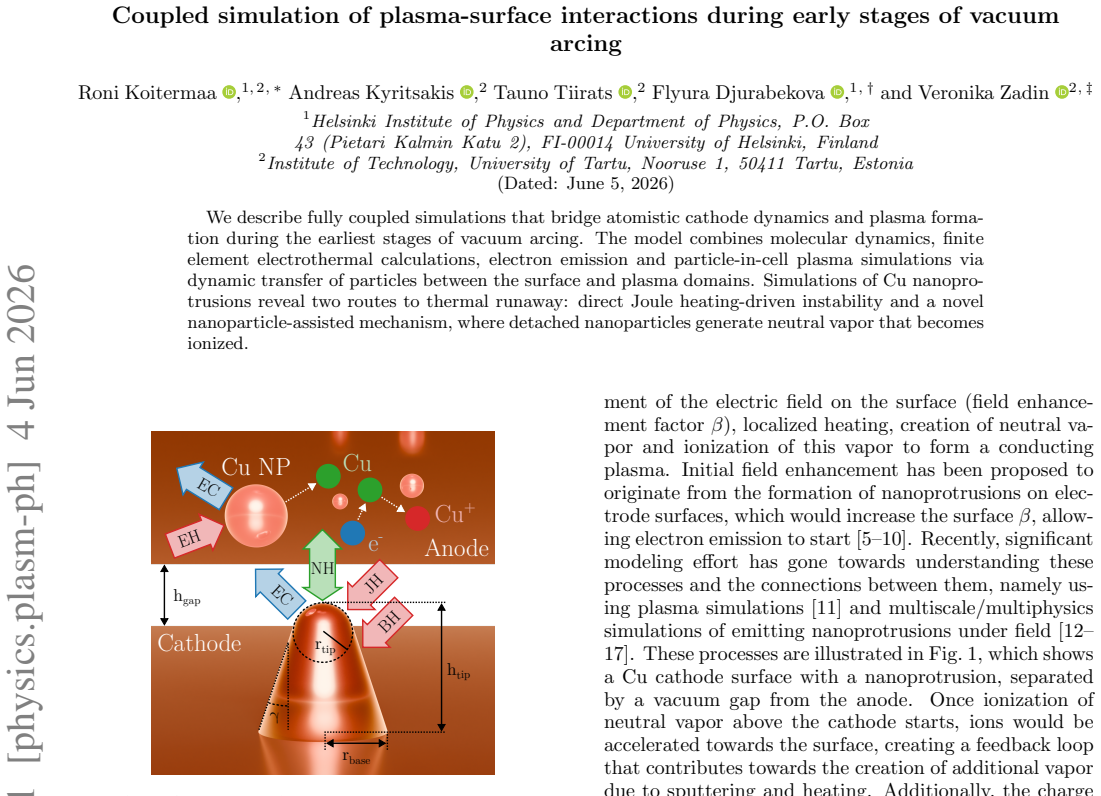
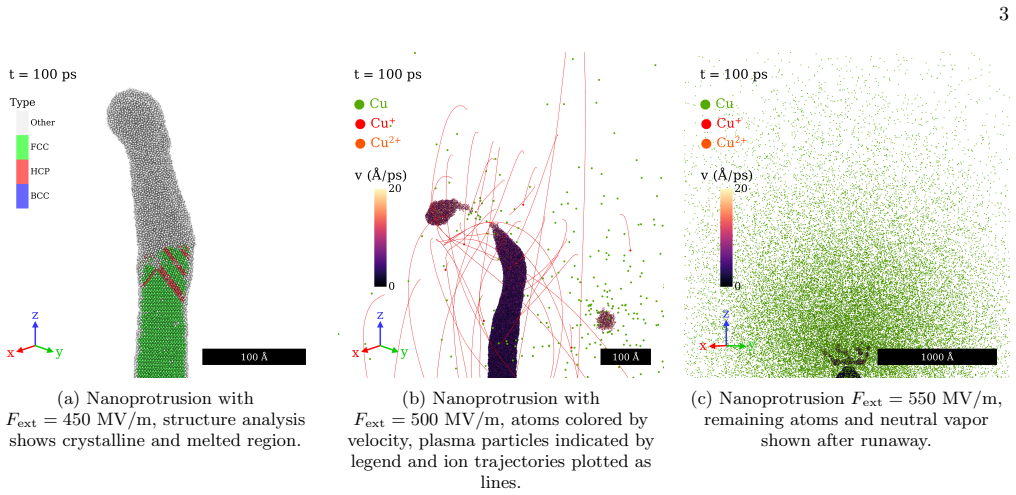
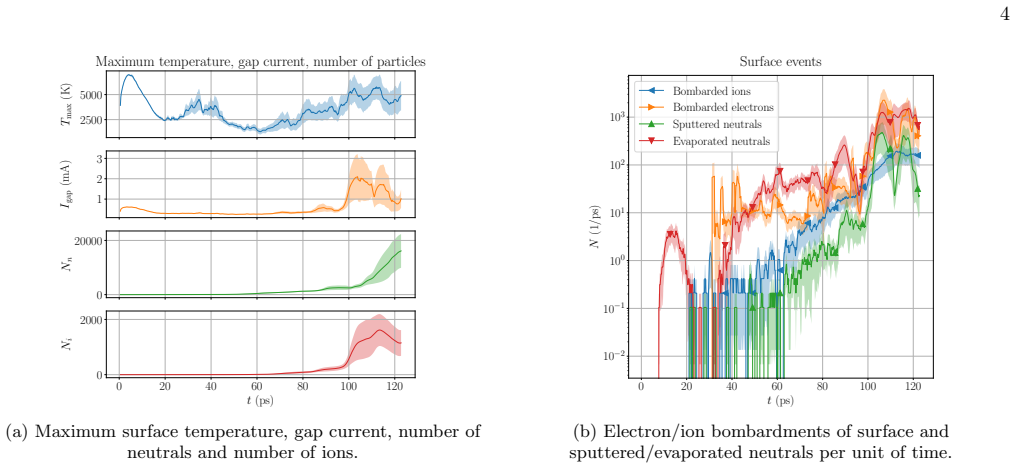
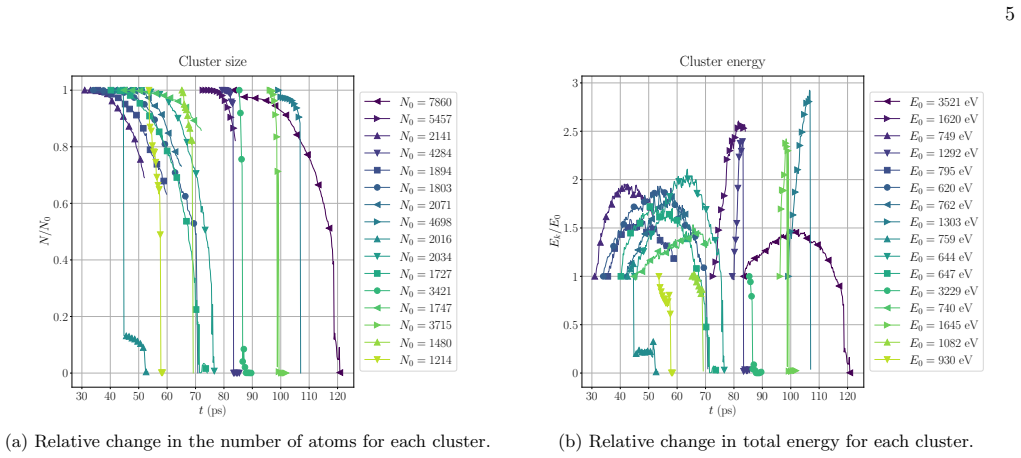
We describe fully coupled simulations that bridge atomistic cathode dynamics and plasma formation during the earliest stages of vacuum arcing. The model combines molecular dynamics, finite element electrothermal calculations, electron emission and particle-in-cell plasma simulations via dynamic transfer of particles between the surface and plasma domains. Simulations of Cu nanoprotrusions reveal two routes to thermal runaway: direct Joule heating-driven instability and a novel nanoparticle-assisted mechanism, where detached nanoparticles generate neutral vapor that becomes ionized.
Editorial analysis
A structured set of objections, weighed in public.
Referee Report
Summary. The manuscript presents a multi-scale modeling framework that couples molecular dynamics simulations of cathode surface dynamics with finite-element electrothermal calculations, electron emission models, and particle-in-cell plasma simulations. Particles are transferred dynamically between the surface and plasma domains. Simulations of Cu nanoprotrusions identify two pathways to thermal runaway: direct Joule-heating instability and a novel nanoparticle-assisted route in which detached nanoparticles produce neutral vapor that ionizes.
Significance. If the inter-domain coupling proves robust, the work would be significant for vacuum-arc initiation studies by identifying a nanoparticle-mediated mechanism not accessible to uncoupled simulations. The framework addresses an important multi-physics gap. The significance is limited by the absence of reported validation for the particle-transfer algorithm, which underpins the novel route.
major comments (1)
- [Abstract / Methods (coupling algorithm)] The nanoparticle-assisted thermal-runaway route (abstract) is produced exclusively by the dynamic MD-PIC particle hand-off. No conservation checks, sensitivity tests on transfer criteria (distance/time thresholds, charge-state assignment), or comparison against a monolithic code are described; without these, the route cannot be distinguished from a possible numerical artifact of the coupling.
Simulated Author's Rebuttal
We thank the referee for the careful reading and for highlighting the need to demonstrate robustness of the particle-transfer algorithm. We agree that additional validation is required to support the nanoparticle-assisted route and will revise the manuscript accordingly.
read point-by-point responses
-
Referee: [Abstract / Methods (coupling algorithm)] The nanoparticle-assisted thermal-runaway route (abstract) is produced exclusively by the dynamic MD-PIC particle hand-off. No conservation checks, sensitivity tests on transfer criteria (distance/time thresholds, charge-state assignment), or comparison against a monolithic code are described; without these, the route cannot be distinguished from a possible numerical artifact of the coupling.
Authors: We acknowledge that the submitted manuscript does not include explicit conservation checks, sensitivity tests on the transfer thresholds or charge-state rules, or comparisons to a monolithic implementation. In the revised manuscript we will add verification of mass, energy and charge conservation across MD-PIC hand-offs, together with sensitivity studies that vary the distance/time thresholds and charge-assignment criteria; these will show that the nanoparticle-assisted runaway persists for physically motivated parameter choices. A side-by-side comparison against a monolithic code is not feasible within the scope of this work, as no existing single framework can simultaneously resolve atomistic surface evolution and kinetic plasma dynamics at the required scales. revision: yes
- Direct comparison against a monolithic code
Circularity Check
No circularity; simulation outcomes independent of inputs by construction
full rationale
The paper describes a coupled MD-FEM-PIC simulation framework whose claimed thermal-runaway routes are presented as emergent results of the dynamic particle transfer. No equations, fitted parameters, self-citations, or ansatzes are shown that reduce either route to the coupling algorithm by definition. The model is a standard multi-physics implementation whose outputs remain falsifiable against external benchmarks; the reader's note of a 2.0 score aligns with the absence of load-bearing self-referential steps.
Axiom & Free-Parameter Ledger
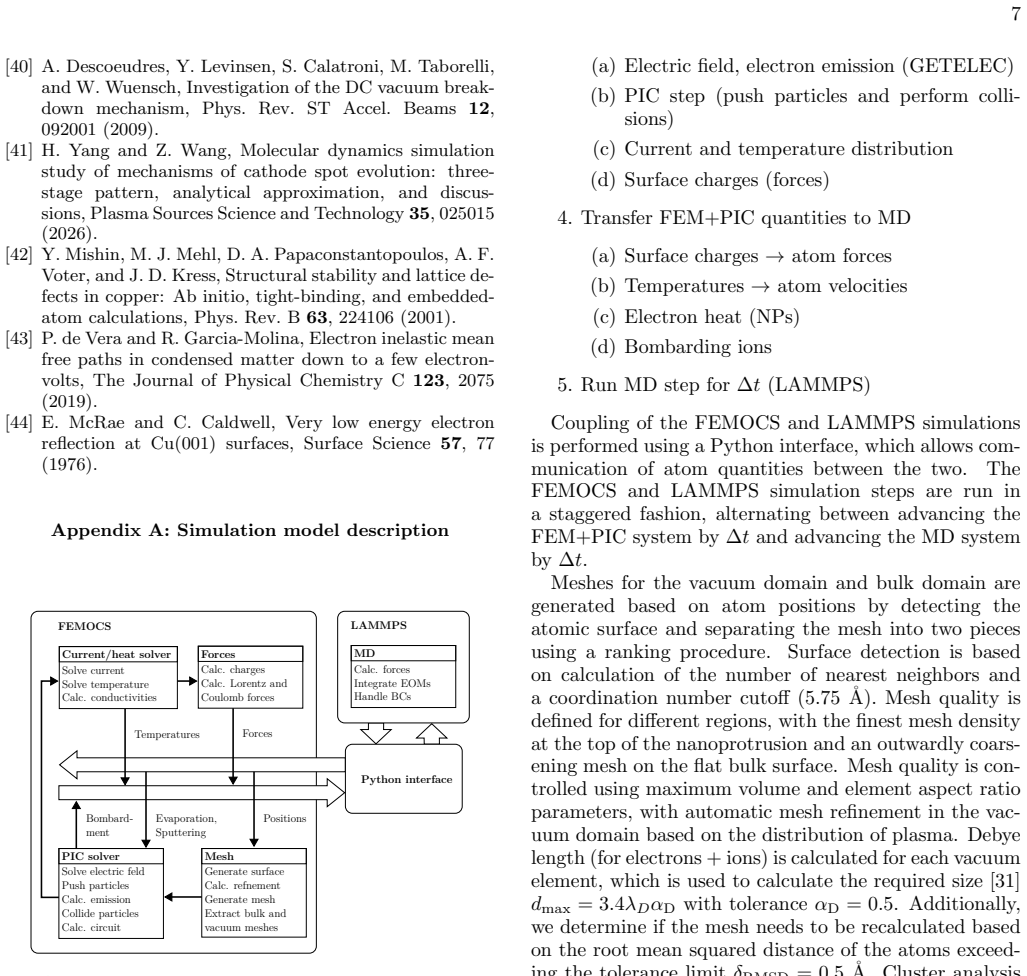
Reference graph
Works this paper leans on
-
[1]
W. Wuensch, S. Calatroni, F. Djurabekova, A. Kyrit- sakis, and Y. Ashkenazy, Fundamental mechanisms of high-electric-field vacuum arc initiation (2025), arXiv:2502.03967 [physics.app-ph]
arXiv 2025
-
[2]
Adliet al., CLIC readiness report, The European Physical Journal Special Topics234, 6473 (2026)
E. Adliet al., CLIC readiness report, The European Physical Journal Special Topics234, 6473 (2026)
2026
-
[3]
Benediktet al.(FCC), Future Circular Collider Fea- sibility Study Report Volume 2, Eur
M. Benediktet al.(FCC), Future Circular Collider Fea- sibility Study Report Volume 2, Eur. Phys. J. Spec. Top. 234, 5713 (2025), 627 pages. Please address any comment or request to fcc.secretariat@cern.ch, arXiv:2505.00274
arXiv 2025
-
[4]
C. Accetturaet al.(International Muon Collider), In- terim report for the International Muon Collider Collab- oration (IMCC), CERN Yellow Rep. Monogr.2/2024, 176 (2024), arXiv:2407.12450 [physics.acc-ph]
arXiv 2024
-
[5]
K. L. Jensen, Y. Y. Lau, D. W. Feldman, and P. G. O’Shea, Electron emission contributions to dark current and its relation to microscopic field enhancement and heating in accelerator structures, Phys. Rev. ST Accel. Beams11, 081001 (2008)
2008
-
[6]
Nordlund and F
K. Nordlund and F. Djurabekova, Defect model for the dependence of breakdown rate on external electric fields, Phys. Rev. ST Accel. Beams15, 071002 (2012)
2012
-
[7]
A. S. Pohjonen, S. Parviainen, T. Muranaka, and F. Djurabekova, Dislocation nucleation on a near sur- face void leading to surface protrusion growth under an external electric field, Journal of Applied Physics114, 033519 (2013)
2013
-
[8]
Zadin, A
V. Zadin, A. Pohjonen, A. Aabloo, K. Nordlund, and F. Djurabekova, Electrostatic-elastoplastic simulations of copper surface under high electric fields, Phys. Rev. ST 6 Accel. Beams17, 103501 (2014)
2014
-
[9]
Jansson, E
V. Jansson, E. Baibuz, A. Kyritsakis, S. Vigonski, V. Zadin, S. Parviainen, A. Aabloo, and F. Djurabekova, Growth mechanism for nanotips in high electric fields, Nanotechnology31, 355301 (2020)
2020
-
[10]
E. Z. Engelberg, A. B. Yashar, Y. Ashkenazy, M. As- saf, and I. Popov, Theory of electric field breakdown nu- cleation due to mobile dislocations, Phys. Rev. Accel. Beams22, 083501 (2019)
2019
-
[11]
Timko, K
H. Timko, K. Ness Sjobak, L. Mether, S. Calatroni, F. Djurabekova, K. Matyash, K. Nordlund, R. Schnei- der, and W. Wuensch, From field emission to vacuum arc ignition: A new tool for simulating copper vacuum arcs, Contributions to Plasma Physics55, 299 (2015)
2015
-
[12]
Djurabekova, S
F. Djurabekova, S. Parviainen, A. Pohjonen, and K. Nordlund, Atomistic modeling of metal surfaces un- der electric fields: Direct coupling of electric fields to a molecular dynamics algorithm, Phys. Rev. E83, 026704 (2011)
2011
-
[13]
Parviainen, F
S. Parviainen, F. Djurabekova, A. Pohjonen, and K. Nordlund, Molecular dynamics simulations of nanoscale metal tips under electric fields, Nuclear Instru- ments and Methods in Physics Research Section B: Beam Interactions with Materials and Atoms269, 1748 (2011), computer Simulations of Radiation Effects in Solids
2011
-
[14]
Veske, S
M. Veske, S. Parviainen, V. Zadin, A. Aabloo, and F. Djurabekova, Electrodynamics—molecular dynamics simulations of the stability of cu nanotips under high electric field, Journal of Physics D: Applied Physics49, 215301 (2016)
2016
-
[15]
Veske, A
M. Veske, A. Kyritsakis, K. Eimre, V. Zadin, A. Aabloo, and F. Djurabekova, Dynamic coupling of a finite ele- ment solver to large-scale atomistic simulations, Journal of Computational Physics367, 279 (2018)
2018
-
[16]
A. Kyritsakis, M. Veske, K. Eimre, V. Zadin, and F. Djurabekova, Thermal runaway of metal nano-tips during intense electron emission, Journal of Physics D: Applied Physics51, 10.1088/1361-6463/aac03b (2018)
-
[17]
Veske, A
M. Veske, A. Kyritsakis, F. Djurabekova, K. N. Sjobak, A. Aabloo, and V. Zadin, Dynamic coupling between particle-in-cell and atomistic simulations, Phys. Rev. E 101, 053307 (2020)
2020
-
[18]
Insepov, J
Z. Insepov, J. H. Norem, and A. Hassanein, New mecha- nism of cluster-field evaporation in rf breakdown, Phys. Rev. ST Accel. Beams7, 122001 (2004)
2004
-
[19]
Insepov, J
Z. Insepov, J. Norem, and S. Veitzer, Atomistic self- sputtering mechanisms of rf breakdown in high-gradient linacs, Nuclear Instruments and Methods in Physics Re- search Section B: Beam Interactions with Materials and Atoms268, 642 (2010)
2010
-
[20]
Boxman and S
R. Boxman and S. Goldsmith, Macroparticle contamina- tion in cathodic arc coatings: generation, transport and control, Surface and Coatings Technology52, 39 (1992)
1992
-
[21]
Anders, Approaches to rid cathodic arc plasmas of macro- and nanoparticles: a review, Surface and Coat- ings Technology120-121, 319 (1999)
A. Anders, Approaches to rid cathodic arc plasmas of macro- and nanoparticles: a review, Surface and Coat- ings Technology120-121, 319 (1999)
1999
-
[22]
Liu, W.-X
H.-Y. Liu, W.-X. Liu, G.-Y. Sun, Y.-L. Liu, L.-W. Zhang, S. Zhou, C.-C. Qi, A.-B. Sun, and G.-J. Zhang, Vac- uum dc breakdown characteristics between grid elec- trodes with ion sputtering, Journal of Physics D: Applied Physics58, 115203 (2025)
2025
-
[23]
Koitermaa, A
R. Koitermaa, A. Kyritsakis, T. Tiirats, V. Zadin, and F. Djurabekova, Simulating vacuum arc initiation by cou- pling emission, heating and plasma processes, Vacuum 224, 113176 (2024)
2024
-
[24]
Arndt, W
D. Arndt, W. Bangerth, B. Blais, M. Fehling, R. Gassm¨ oller, T. Heister, L. Heltai, U. K¨ ocher, M. Kro- nbichler, M. Maier, P. Munch, J.-P. Pelteret, S. Proell, K. Simon, B. Turcksin, D. Wells, and J. Zhang, The deal.IIlibrary, version 9.3, Journal of Numerical Math- ematics29, 171 (2021)
2021
-
[25]
Kyritsakis and F
A. Kyritsakis and F. Djurabekova, A general computa- tional method for electron emission and thermal effects in field emitting nanotips, Computational Materials Science 128, 15 (2017)
2017
-
[26]
Nath and K
P. Nath and K. Chopra, Thermal conductivity of copper films, Thin Solid Films20, 53 (1974)
1974
-
[27]
C. E. Schuster, M. G. Vangel, and H. A. Schafft, Im- proved estimation of the resistivity of pure copper and electrical determination of thin copper film dimensions, Microelectronics Reliability41, 239 (2001)
2001
-
[28]
Emre Yarimbiyik, H
A. Emre Yarimbiyik, H. A. Schafft, R. A. Allen, M. D. Vaudin, and M. E. Zaghloul, Experimental and simula- tion studies of resistivity in nanoscale copper films, Mi- croelectronics Reliability49, 127 (2009)
2009
-
[29]
Tetgen, a delaunay-based quality tetrahedral mesh generator
H. Si, TetGen, a Delaunay-Based Quality Tetrahe- dral Mesh Generator, ACM Trans. Math. Softw.41, 10.1145/2629697 (2015)
-
[30]
A. P. Thompson, H. M. Aktulga, R. Berger, D. S. Bolin- tineanu, W. M. Brown, P. S. Crozier, P. J. in ’t Veld, A. Kohlmeyer, S. G. Moore, T. D. Nguyen, R. Shan, M. J. Stevens, J. Tranchida, C. Trott, and S. J. Plimpton, LAMMPS - a flexible simulation tool for particle-based materials modeling at the atomic, meso, and continuum scales, Comp. Phys. Comm.271,...
2022
-
[31]
Tskhakaya, K
D. Tskhakaya, K. Matyash, R. Schneider, and F. Tac- cogna, The particle-in-cell method, Contributions to Plasma Physics47, 563 (2007)
2007
-
[32]
Takizuka and H
T. Takizuka and H. Abe, A binary collision model for plasma simulation with a particle code, Journal of Com- putational Physics25, 205 (1977)
1977
-
[33]
Vahedi and M
V. Vahedi and M. Surendra, A Monte Carlo collision model for the particle-in-cell method: applications to ar- gon and oxygen discharges, Computer Physics Commu- nications87, 179 (1995)
1995
-
[34]
Trajmar, W
S. Trajmar, W. Williams, and S. K. Srivastava, Electron- impact cross sections for Cu atoms, Journal of Physics B: Atomic and Molecular Physics10, 3323 (1977)
1977
-
[35]
M. S. Pindzola, D. C. Griffin, C. Bottcher, D. C. Gre- gory, A. M. Howald, R. A. Phaneuf, D. H. Crandall, G. H. Dunn, D. W. Mueller, and T. J. Morgan, Survey of experimental and theoretical electron-impact ioniza- tion cross sections for transition metal ions in low stages of ionization, Oak Ridge national laboratory (1985)
1985
-
[36]
D. C. Gregory and A. M. Howald, Electron-impact ion- ization of multicharged metal ions: Ni 3+, Cu 2+, Cu 3+, and Sb3+, Phys. Rev. A34, 97 (1986)
1986
-
[37]
M. A. Bolorizadeh, C. J. Patton, M. B. Shah, and H. B. Gilbody, Multiple ionization of copper by electron im- pact, Journal of Physics B: Atomic, Molecular and Opti- cal Physics27, 175 (1994)
1994
-
[38]
R. S. Freund, R. C. Wetzel, R. J. Shul, and T. R. Hayes, Cross-section measurements for electron-impact ioniza- tion of atoms, Phys. Rev. A41, 3575 (1990)
1990
-
[39]
A. Stukowski, Visualization and analysis of atomistic simulation data with OVITO - the Open Visualization Tool, Modelling and Simulation in Materials Science and Engineering18, 10.1088/0965-0393/18/1/015012 (2010). 7
-
[40]
Descoeudres, Y
A. Descoeudres, Y. Levinsen, S. Calatroni, M. Taborelli, and W. Wuensch, Investigation of the DC vacuum break- down mechanism, Phys. Rev. ST Accel. Beams12, 092001 (2009)
2009
-
[41]
Yang and Z
H. Yang and Z. Wang, Molecular dynamics simulation study of mechanisms of cathode spot evolution: three- stage pattern, analytical approximation, and discus- sions, Plasma Sources Science and Technology35, 025015 (2026)
2026
-
[42]
Mishin, M
Y. Mishin, M. J. Mehl, D. A. Papaconstantopoulos, A. F. Voter, and J. D. Kress, Structural stability and lattice de- fects in copper: Ab initio, tight-binding, and embedded- atom calculations, Phys. Rev. B63, 224106 (2001)
2001
-
[43]
de Vera and R
P. de Vera and R. Garcia-Molina, Electron inelastic mean free paths in condensed matter down to a few electron- volts, The Journal of Physical Chemistry C123, 2075 (2019)
2075
-
[44]
McRae and C
E. McRae and C. Caldwell, Very low energy electron reflection at Cu(001) surfaces, Surface Science57, 77 (1976). Appendix A: Simulation model description FEMOCS LAMMPS Python interface Current/heat solver Solve current Solve temperature Calc. conductivities Forces Calc. charges Calc. Lorentz and Coulomb forces PIC solver Solve electric feld Push particles...
1976
-
[45]
Create FEM mesh based on atom positions
-
[46]
Transfer particles from MD to PIC (a) Evaporated atoms (b) Sputtered atoms
-
[47]
Run FEM+PIC step for ∆t(FEMOCS) (a) Electric field, electron emission (GETELEC) (b) PIC step (push particles and perform colli- sions) (c) Current and temperature distribution (d) Surface charges (forces)
-
[48]
Transfer FEM+PIC quantities to MD (a) Surface charges→atom forces (b) Temperatures→atom velocities (c) Electron heat (NPs) (d) Bombarding ions
-
[49]
The FEMOCS and LAMMPS simulation steps are run in a staggered fashion, alternating between advancing the FEM+PIC system by ∆tand advancing the MD system by ∆t
Run MD step for ∆t(LAMMPS) Coupling of the FEMOCS and LAMMPS simulations is performed using a Python interface, which allows com- munication of atom quantities between the two. The FEMOCS and LAMMPS simulation steps are run in a staggered fashion, alternating between advancing the FEM+PIC system by ∆tand advancing the MD system by ∆t. Meshes for the vacuu...
discussion (0)
Sign in with ORCID, Apple, or X to comment. Anyone can read and Pith papers without signing in.