The mesoscopic foundations of non equilibrium thermodynamics and the arrow of time in the Dual Model of Liquids
Pith reviewed 2026-06-27 23:13 UTC · model grok-4.3
The pith
The Dual Model of Liquids identifies a mesoscopic time arrow through interactions between solidlike aggregates and lattice excitations.
A machine-rendered reading of the paper's core claim, the machinery that carries it, and where it could break.
Core claim
The interaction in the Dual Model of Liquids between the solidlike molecule aggregates and the lattice excitations is appropriate to represent the link between the behaviour at macroscopic scale of normal liquids and the physical processes characterizing those systems at mesoscopic scale. The duality allows identifying a time arrow on the mesoscopic scale in liquids. The interaction of quanta of elastic energy with the molecular clusters introduces a privileged direction, which is relevant in time dependent and dissipative macroscopic processes, although the interaction remains temporally reversible.
What carries the argument
The Dual Model of Liquids, specifically the interaction between solidlike molecule aggregates and lattice excitations, which connects macroscopic liquid behavior to mesoscopic processes and introduces a privileged time direction.
If this is right
- The model grounds non-equilibrium thermodynamics in mesoscopic liquid dynamics.
- A time arrow emerges at the mesoscopic scale due to elastic energy quanta interacting with clusters.
- This arrow affects dissipative and time-dependent processes at larger scales.
- The underlying interaction remains reversible despite the directionality.
Where Pith is reading between the lines
- This suggests potential applications in modeling irreversible processes in other condensed matter systems.
- Simulations of liquid flows could test for the predicted privileged direction under varying conditions.
- Connections may exist to broader questions of time asymmetry in statistical mechanics.
Load-bearing premise
The interaction between solidlike molecule aggregates and lattice excitations in the Dual Model of Liquids accurately represents the connection from mesoscopic processes to macroscopic liquid behavior.
What would settle it
A simulation or experiment demonstrating that elastic energy quanta interactions with molecular clusters produce no privileged direction in time-dependent liquid processes would falsify the claim of a mesoscopic time arrow.
Figures

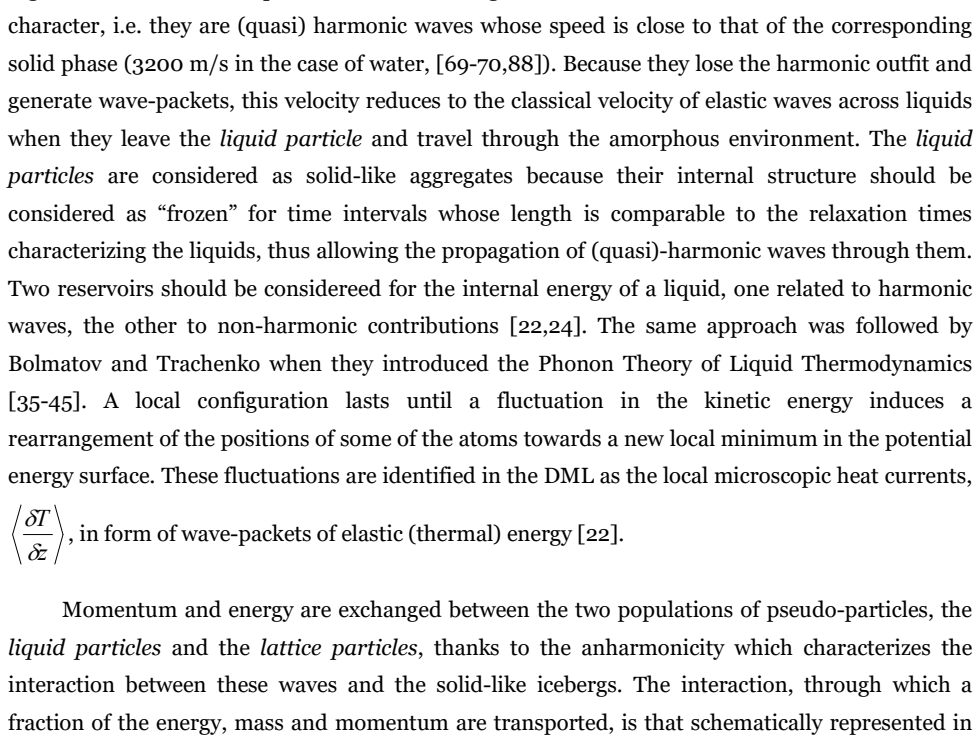
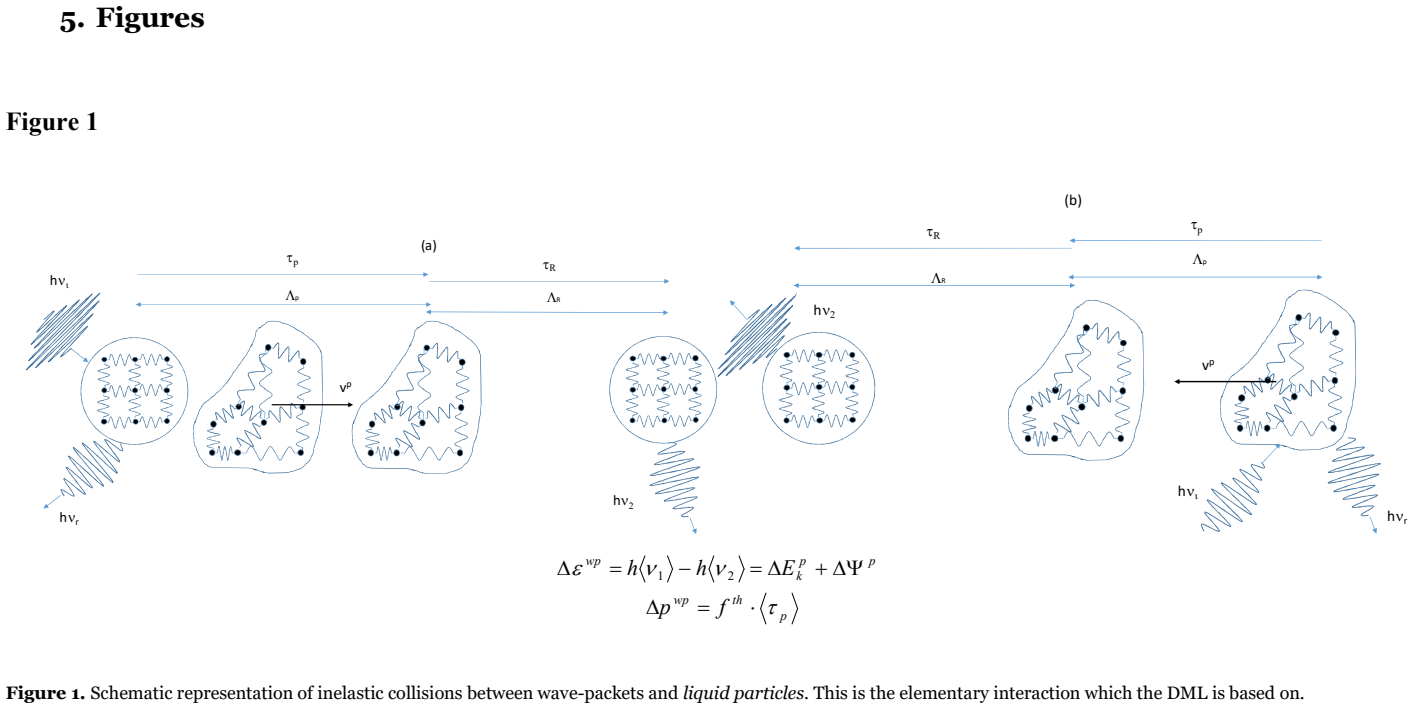
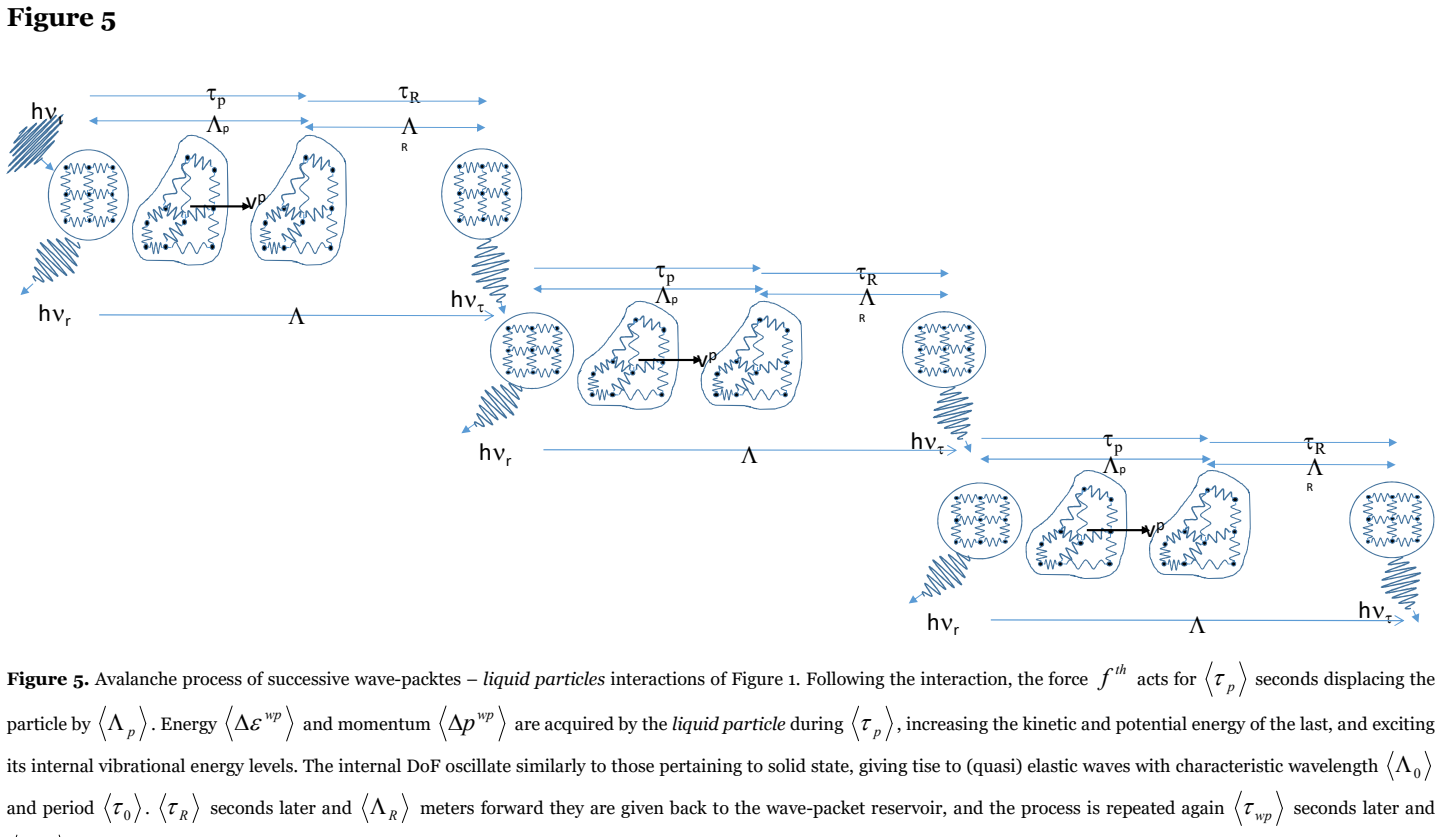
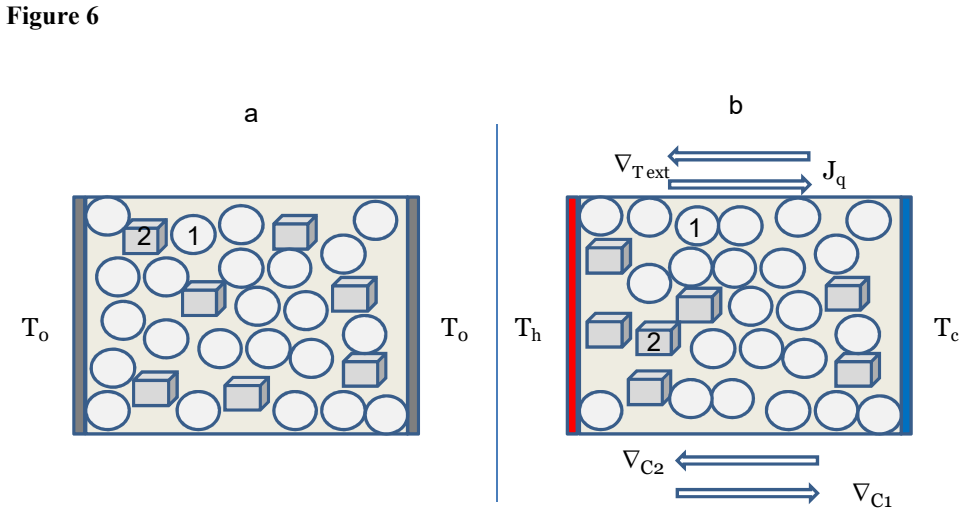
read the original abstract
This manuscripts has two goals. The first goal is to show that the interaction in the Dual Model of Liquids between the solidlike molecule aggregates and the lattice excitations is appropriate to represent the link between the behaviour at macroscopic scale of normal liquids and the physical processes characterizing those systems at mesoscopic scale. The second goal is to show that the duality allows identifying a time arrow on the mesoscopic scale in liquids. The interaction of quanta of elastic energy with the molecular clusters introduces a privileged direction, which is relevant in time dependent and dissipative macroscopic processes, although the interaction remains temporally reversible
Editorial analysis
A structured set of objections, weighed in public.
Referee Report
Summary. The manuscript claims two results within the Dual Model of Liquids: first, that the interaction between solidlike molecule aggregates and lattice excitations provides an appropriate link between macroscopic behavior of normal liquids and mesoscopic processes; second, that the duality identifies a mesoscopic time arrow because the interaction of elastic-energy quanta with molecular clusters introduces a privileged direction relevant to dissipative processes, even though the underlying interaction remains temporally reversible.
Significance. If the claims were supported by explicit derivations mapping the dual-model dynamics to an emergent time asymmetry, the work could contribute a mesoscopic perspective on non-equilibrium thermodynamics and the arrow of time. As presented, however, the assertions are made without derivations, symmetry-breaking terms, or verifiable mappings, so the potential significance cannot be realized.
major comments (2)
- [Abstract] Abstract: the two goals are stated, yet the text supplies no derivations, Hamiltonian, equations, or explicit mechanism showing how reversible elastic-quanta interactions with molecular clusters produce a privileged direction or time arrow.
- [Abstract] Abstract (time-arrow claim): the statement that the interaction 'introduces a privileged direction... although the interaction remains temporally reversible' is asserted without a symmetry-breaking term, explicit mapping from the dual-model dynamics, or independent benchmark, rendering the central claim unverifiable.
Simulated Author's Rebuttal
We thank the referee for the careful reading of our manuscript. The work is conceptual in nature, identifying links within the established Dual Model of Liquids rather than deriving new dynamical equations. We respond point by point to the major comments below.
read point-by-point responses
-
Referee: [Abstract] Abstract: the two goals are stated, yet the text supplies no derivations, Hamiltonian, equations, or explicit mechanism showing how reversible elastic-quanta interactions with molecular clusters produce a privileged direction or time arrow.
Authors: The manuscript's objectives are to demonstrate the conceptual appropriateness of the solidlike aggregates-lattice excitations interaction for connecting macroscopic liquid behavior to mesoscopic processes, and to identify the emergent time arrow from the duality. These are achieved by reference to the structure of the Dual Model (detailed in prior literature) without introducing new Hamiltonians here, as the focus is on the interpretive link rather than re-derivation. The mechanism is the interaction's role in dissipative contexts, which supplies the privileged direction while remaining reversible at the fundamental level. revision: no
-
Referee: [Abstract] Abstract (time-arrow claim): the statement that the interaction 'introduces a privileged direction... although the interaction remains temporally reversible' is asserted without a symmetry-breaking term, explicit mapping from the dual-model dynamics, or independent benchmark, rendering the central claim unverifiable.
Authors: The privileged direction is not imposed by an added symmetry-breaking term but arises intrinsically from the mesoscopic duality: the reversible elastic-quanta interaction couples to molecular clusters in a manner that aligns with the directionality of dissipative macroscopic processes. This constitutes the explicit mapping provided by the model structure itself. While a fully formal dynamical derivation would strengthen the presentation, the current identification is verifiable within the Dual Model framework and does not require new benchmarks beyond the model's established consistency with liquid phenomenology. revision: no
Circularity Check
Time arrow asserted as property of Dual Model duality without independent derivation
specific steps
-
self definitional
[Abstract (second goal)]
"the duality allows identifying a time arrow on the mesoscopic scale in liquids. The interaction of quanta of elastic energy with the molecular clusters introduces a privileged direction, which is relevant in time dependent and dissipative macroscopic processes, although the interaction remains temporally reversible"
The privileged direction (time arrow) is claimed to be introduced by the interaction, but the interaction and duality are defined within the Dual Model of Liquids; the arrow is therefore identified by construction as a feature of the model rather than derived from external equations, benchmarks, or symmetry analysis.
full rationale
The paper's second goal and central claim state that the duality in the Dual Model of Liquids allows identifying a mesoscopic time arrow via elastic quanta interacting with molecular clusters. This is presented as following directly from the model's defined interaction, which is asserted to introduce a privileged direction relevant to dissipative processes (while remaining reversible). No explicit mapping, symmetry-breaking term, or derivation from the model's Hamiltonian or equations is supplied in the abstract or goals; the result therefore reduces to a restatement of the model's own assumptions rather than an independent derivation. This matches the self-definitional pattern exactly.
Axiom & Free-Parameter Ledger
axioms (1)
- domain assumption The interaction in the Dual Model of Liquids between the solidlike molecule aggregates and the lattice excitations is appropriate to represent the link between macroscopic and mesoscopic scales.
invented entities (1)
-
Dual Model of Liquids
no independent evidence
Reference graph
Works this paper leans on
-
[1]
In the general case i n which 0 , Eq.(71) becomes:
T m TC C H V 1 1 V , We discover that m and are connected to each other. In the general case i n which 0 , Eq.(71) becomes:
-
[2]
This conclusion is in line with the hypothesis of the DML
0 , 1 1 V m TC C H V while the lower limit goes to zero with H VC . This conclusion is in line with the hypothesis of the DML. In fact, at high temperature icebergs melt and d isappear from the liquid, and with them also the collective DoF contributing to H VC . Remembering that it holds 0dT dm , an interesting expression can be deduced abo...
-
[3]
0 ; 11 dT dm C CmT H V V Because usually it is also 0 , we get the following relation:
-
[4]
Incidentally, this is in line also with the limits imposed to the total specific heat wp VC [23]
V H V mC C which represents an upper limit for H VC , providing the maximum thermal energy that can be stored into harmonic DoF of icebergs. Incidentally, this is in line also with the limits imposed to the total specific heat wp VC [23]. Compiling the above expressions, we get 75. dT dm m m 2 * , as a lower limit for . We observe that the second me...
-
[5]
instantaneity
11 2 * H V V C CmT dT dm m m . By definition, m accounts for the collective DoF actually participa ting to the energy distribution within a liquid. In a solid, the incre ase of VC upon temperature ( 3T CV Debye law) is due to the fact that the number of DoF which bec omes excited, increases with T. In the DML, the liquid mesoscopic...
1967
-
[6]
Loschmidt's Reversibility Objection
The Time’s Arrow paradox in the DML. A dedicated paper is in preparation [113] where the entropy calculation for a dual system as the DML, especially in non-equilibrium configuration s, will be analyzed in detail. Nevertheless, we want anticipate here that the DML, thanks to its duality, provides a possible physical interpretation of the apparent contradi...
1900
-
[7]
solid-like
Summary, conclusions, and perspectives for theoreti cal developments and experimental verifications. The DML is based on a simple yet profound observation: a liquid is neither a molten solid nor a condensed gas. It is both, depending on the time a nd spatial scale on which it is observed. The mesoscopic framework of DML overcomes the limitations o f class...
-
[8]
spontaneous
Figures Figure 1 p R (a) R p hi vp h2 hr hi h2 p R (b) R p vp hr p th wp p p k wp f p E h h 2 1 Figure 1. Schematic representation of inelastic collisions between wave-packets and liquid particles . This is the elementary interaction which the DML is based on. 57 Figure 2 Figure 2. Frequency spectrum of the elastic...
-
[9]
Termodinamica
Fermi, E., 1972, “Termodinamica”, Boringhieri, Torino
1972
-
[10]
Treatise on Thermodynamics
Planck, M., 1945, “Treatise on Thermodynamics”, Dover, Translated by A. Ogg
1945
-
[11]
Reciprocal relations in irrever sible processes I
Onsager, L., 1931, “Reciprocal relations in irrever sible processes I”, Phys. Rev. 37 , pp. 405- 426
1931
-
[12]
Rev, 38 , pp
Onsager, L., 1931, Reciprocal relations in irrevers ible processes II”, Phys. Rev, 38 , pp. 2265- 2279
1931
-
[13]
De Groot, S.R., Mazur, P., 1984, Non-equilibrum thermodynamics , New York, Dover pub. Inc
1984
-
[14]
Haase, R., Thermodynamics of Irreversible Processes , 1969, Addison-Wesley, Reading, MA
1969
-
[15]
Thermodynamics and an Introduction to Thermostatics , 2nd ed.; Wiley: Philadelphia, PA, USA, 1991; ISBN: 978-0-471-86256-7
Callen, H.B. Thermodynamics and an Introduction to Thermostatics , 2nd ed.; Wiley: Philadelphia, PA, USA, 1991; ISBN: 978-0-471-86256-7
1991
-
[16]
Fitts, D.D., 1962, Nonequilibrium Thermodynamics , McGraw-Hill Book Company, Inc., New York, USA
1962
-
[17]
Irreversibility and Generalized Noise
Callen, H.B., Welton, T.A., 1951, “Irreversibility and Generalized Noise”, Phys. Rev., 83 , 34- 40
1951
-
[18]
Bernard, W., Callen, H.B., 1959, Irreversible Thermo dynamics on Nonlinear processes and Noise in Driven Systems, Rev. Mod. Phys., 31 , 1017
1959
-
[19]
Lax, M., 1960, Fluctuations from the Non-Equilibrium Steady-State, Rev. Mod. Phys, 32 , 25, DOI: https://doi.org/10.1103/RevModPhys.32.25
-
[20]
Unexpected thermoelastic effects in liquid glycerol by mechanical deformation
Kume, E., Zaccone, A., Noirez, L., 2021, “Unexpected thermoelastic effects in liquid glycerol by mechanical deformation”, Phys. Flu., 33 , 072007, doi: 10.1063/5.0051587
-
[21]
Kume, E., Noirez, L., 2021, “Identification of therma l response of mesoscopic liquids under mechanical excitations: from harmonic to nonharmonic t hermal wave”, J. Phys. Chem. B, 125 , pp. 8652-8658, doi: 10.1021/acs.jpcb.1c04362
-
[22]
Thermal Shear Waves Induced in Mesoscopic Liquids at Low Frequency Mechanical Deformation
Kume, E.; Noirez, L. “Thermal Shear Waves Induced in Mesoscopic Liquids at Low Frequency Mechanical Deformation” J. Non-Equilib. Thermodyn. 2 022, 47 , 155–163 DOI: 10.1515/jnet- 2021-0091
-
[23]
Revealing the solid- like nature of glycerol at ambient temperature
Noirez, L., Baroni, P., 2010, “Revealing the solid- like nature of glycerol at ambient temperature”, Journal of Molecular Structure, 972 , 16-21 doi:10.1016/j.molstruc.2010.02.013
-
[24]
Mesoscopic Liquids Emit Thermal Waves Under Shear Strain or Microflow
Noirez, L., Kume, E., Baroni, P., 2025, “Mesoscopic Liquids Emit Thermal Waves Under Shear Strain or Microflow”, Liquids, 5, 27-38
2025
-
[25]
2024, “The Viscosity of Liquids in the Dual Model, Thermo , 4, 508-539
Peluso, F. 2024, “The Viscosity of Liquids in the Dual Model, Thermo , 4, 508-539
2024
-
[26]
Peluso, F. 2023, “Thermo-Mechanical and Mechano-Thermal Effects in Liquids Explained by means of the Dual Model of Liquids”, Thermo, 3, 625-656, doi.org/10.3390/thermo3040037
-
[27]
Über den Zustand des Wärmegleichgewicht es eines Systems von Körpern mit Rücksicht auf die Schwerkraft, Sitzungsber
Loschmidt, J. Über den Zustand des Wärmegleichgewicht es eines Systems von Körpern mit Rücksicht auf die Schwerkraft, Sitzungsber. Kais. A kad. Wiss. Wien, Math. Naturwiss. Classe 1876, 73 , 128–142. 68
-
[28]
Mathematical Problems
Hilbert, D., 1901, “Mathematical Problems”, Bulletin of the American Mathematical Society, 8, 437-479
1901
-
[29]
Long-range collective dynamics and relaxation phenomena in a dual model of liquids
Peluso, F., 2003, “Long-range collective dynamics and relaxation phenomena in a dual model of liquids”, proceedings of JETC8 International con ference on Thermodynamics, Barcelona, Spain, Sept. 2nd -5th 2003, pp. 113-122
2003
-
[30]
Mesoscopic collective dynamics in liquids and the Dual Model
Peluso, F. 2022, “Mesoscopic collective dynamics in liquids and the Dual Model” ASME J. Heat Transf., 144 , 112502. https://doi.org/10.1115/1.4054988
-
[31]
Isochoric specific heat in the D ual Model of Liquids
Peluso, F., 2021, “Isochoric specific heat in the D ual Model of Liquids”, Liquids 2021, 1, 77–
2021
-
[32]
https://doi.org/10.3390/liquids1010007
-
[33]
How Does Heat Propagate in Liqui ds?
Peluso, F., 2023, “How Does Heat Propagate in Liqui ds?”, Liquids, 3, 92-117, DOI: 10.3390/liquids3010009
-
[34]
Chen, G., 2022, “Perspectives on Molecular-Level Un derstanding of Thermophysics of Liquids and Future Research Directions”, ASME J. He at Transfer, 144(1) : 010801. doi: https://doi.org/10.1115/1.4052657
-
[35]
On the dynamical theory of gas es
Maxwell, J.C., 1867, “On the dynamical theory of gas es”, Ph. Trans. Royal Soc. London, 157, pp. 49-88
-
[36]
Zur Theorie des specifische Wärmer
Debye, P., 1912, “Zur Theorie des specifische Wärmer” Ann. der Physik, 344(14), pp. 798-839
1912
-
[37]
Debye, P., 1914, Vorträge über die Kinetische Gastheorie, pp 46-60, Leipzig, B.G. Teubner
1914
-
[38]
Diffusion de la lumière wet de s rayon X par un corps transaparent homogéne – Influence de l’agitation thermique
Brillouin, L., 1922, “Diffusion de la lumière wet de s rayon X par un corps transaparent homogéne – Influence de l’agitation thermique”, Ann. de Phys., 9-17, pp. 88-120
1922
-
[39]
La chaleur spécifique des liq uides et leur constitution
Brillouin, L., 1936, “La chaleur spécifique des liq uides et leur constitution”, J. Phys. Rad, Serie VII, Tome VII, N. 4, pp. 153-157
1936
-
[40]
Frenkel, J., 1946, Kinetic theory of liquids, Oxford, Oxford University Press
1946
-
[41]
Rev., 156/1, 190-195
Zwanzig, R., 1967, Elementary Excitation in Classical Liquids, Phys. Rev., 156/1, 190-195
1967
-
[42]
Phonon-particle interactions and transport processes in liquids
Gaeta, F.S., Peluso, F., Mita, D.G., Albanese, C., Castagnolo, D., 1993, “Phonon-particle interactions and transport processes in liquids”, Phys. Rev. E, 47 , pp. 1066-1077
1993
-
[43]
Phonons in liquids, Onsager’s reciprocal relations and the heats of transport
Gaeta, F.S., Albanese, C., Mita, D.G., Peluso, F., 1994, “Phonons in liquids, Onsager’s reciprocal relations and the heats of transport”, Phys. Rev. E, 49 , pp. 433-444
1994
-
[44]
Liquid heat capacity in the approach from the solid state: Anharmonic theory
Bolmatov, D., Trachenko, K., 2011, “Liquid heat capacity in the approach from the solid state: Anharmonic theory”, Phys. Rev. B, 84, 054106(1-7)
2011
-
[45]
The phonon theory of liquid thermodynamics
Bolmatov, D., Brazhkin, V.V., Trachenko, K., 2012, “ The phonon theory of liquid thermodynamics”, Scientific Reports, 2, 431-427, DOI:10.1038/srep00421
-
[46]
What separate s a liquid from a gas?
Brazhkin, V.V., Trachenko, K., 2012, “What separate s a liquid from a gas?”, Phys. Today, 65(11), 68-69; doi:10.1063/PT.3.1796
-
[47]
S ymmetry breaking gives rise to energy spectra of three states of matter
Bolmatov, D., Musaev, E. T., Trachenko, K., 2013, “S ymmetry breaking gives rise to energy spectra of three states of matter”, Scientific Reports, 3, 2794-2798
2013
-
[48]
Collective mod es and thermodynamics of the liquid state
Trachenko, K., Brazhkin, V.V., 2016, “Collective mod es and thermodynamics of the liquid state”, Rep. Prog. Phys. 79, 016502-016538. 69
2016
-
[49]
Evidence for structural crossover in the supercritical state
Bolmatov, D., Brazhkin, V. V., Fomin, Yu. D., Ryzhov , V. N., Trachenko, K., 2013, “Evidence for structural crossover in the supercritical state”, J. of Chem. Phys., 139, 234501(1-5)
2013
-
[50]
Trachenko, K., Brazhkin, V.V., 2013, “Duality of li quids”, Scientific Reports, 3, 2188-2193 DOI: 10.1038/srep02188
-
[51]
The Frenkel Line: a direct experimental evidence fo r the new thermodynamic boundary
Bolmatov, D., Zhernenkov, M., Zav’yalov, D., Tkachev , S. N., Cunsolo, A., Cai, Y. Q., 2015, “The Frenkel Line: a direct experimental evidence fo r the new thermodynamic boundary”, Scientific Reports, 5, 15850(1-10)
2015
-
[52]
Thermally triggered phononic gaps in liquids at THz scale
Bolmatov, D., Zhernenkov, M., Zav’yalov, D., Stoupin , S., Cunsolo, A., Cai, Y. Q., 2016, “Thermally triggered phononic gaps in liquids at THz scale”, Scientific Reports, 6, 19469(1-7)
2016
-
[53]
Unified phonon- based approach to the thermodynamics of solid, liquid and gas states
Bolmatov, D., Zav’yalov, D., Zhernenkov, M., Musaev, E.T., Cai, Y.Q., 2015, “Unified phonon- based approach to the thermodynamics of solid, liquid and gas states”, Ann. Phys., 363, 221- 242
2015
-
[54]
Revealing the mechanism of the viscous-to-elastic crossover in liquids
Bolmatov, D., Zhernenkov, M., Zav’yalov, D., Stoupin , S., Cai, Y.Q., Cunsolo, A., 2015, “Revealing the mechanism of the viscous-to-elastic crossover in liquids”, J. Phys. Chem. Lett., 6, 3048-3053 (doi: 10.1021/acs.jpclett.5b01338)
-
[55]
Statistical Ph ysics
Landau, L.D., Lifshitz, E.M., 1969, “Statistical Ph ysics”, 2 nd Edition, Volume V, Pergamon Press, Oxford, UK
1969
-
[56]
The Thermodynamics of Irreversible Processes. IV: The Theory of Elasticity and Anelasticity,
Eckart, C., 1948, “The Thermodynamics of Irreversible Processes. IV: The Theory of Elasticity and Anelasticity,” Phys. Rev., 73(4), 373–382
1948
-
[57]
The Theory of Anelastic Fluid,
Eckart, C., 1948, “The Theory of Anelastic Fluid,” Rev. Mod. Phys., 20-1, 232–235
1948
-
[58]
Trachenko, K., 2023, J. Phys.: Condens. Matter, 35, 085101; DOI 10.1088/1361-648X/acaba3
-
[59]
Universal Law for the Vibrational Density of States of Liquids,
Zaccone, A., and Baggioli, M., 2021, “Universal Law for the Vibrational Density of States of Liquids,” PNAS, 118(5), pp. 1–3
2021
-
[60]
Experimental Confirmation of the Universal Law for the Vibrational Density of States of Liquids,
Stamper, C., 2022, “Experimental Confirmation of the Universal Law for the Vibrational Density of States of Liquids,” J. Phys. Chem., 13, pp. 3105–3111
2022
-
[61]
Explaining th e Specific Heat of Liquids Based on the Instantaneous Normal Modes,
Baggioli, M., and Zaccone, A., 2021, “Explaining th e Specific Heat of Liquids Based on the Instantaneous Normal Modes,” Phys. Rev. E, 104(1), p. 014103
2021
-
[62]
D eformations, Relaxations and Broken Symmetries in Liquids, Solids and Glasses: A Unified Topological Theory,
Baggioli, M., Landry, M., and Zaccone, A., 2022, “D eformations, Relaxations and Broken Symmetries in Liquids, Solids and Glasses: A Unified Topological Theory,” Phys. Rev. E, 105(2), p. 024602
2022
-
[63]
The Instantaneous Normal Modes of Liquids
Stratt, R.M., 1995, “The Instantaneous Normal Modes of Liquids”, Acc. Chem. Res., 28/5 , 201-207
1995
-
[64]
Theory of superfluidity of Helium II
Landau, L.D. Theory of superfluidity of Helium II. P hys. Rev. 1941, 60, 356–358. https://doi.org/10.1103/PhysRev.60.356
-
[65]
On simple gas reactions
Eyring, H.; Polanyi, M. On simple gas reactions. Z. Phys. Chem. Abt. B 1931, 12, 279–311
1931
-
[66]
The activated complex in chemical reactions
Eyring, H. The activated complex in chemical reactions. J. Chem. Phys. 1935, 3, 107–115
1935
-
[67]
On the thermodiffusion mechanism in fluids
Fiks, V.B. On the thermodiffusion mechanism in fluids . Sov. Phys. Solid State 1961, 3, 724– 726. 70
1961
-
[68]
Electron drag and thermal diffusion in met als
Fiks, V.B. Electron drag and thermal diffusion in met als. Sov. Phys. Solid State 1964, 5, 2549–2552
1964
-
[69]
Two-Liquid effects in a normal liquid
Andreev, A.F. Two-Liquid effects in a normal liquid. JEPT 1971, 32, 987–990
1971
-
[70]
Compressional relaxation in liquids
Nettleton, R.E., 1959, “Compressional relaxation in liquids”, J. Acoust. Soc. Am., 31, pp. 557- 567
1959
-
[71]
Thermodynamics of transport processes in liquids
Nettleton, R.E, 1959, “Thermodynamics of transport processes in liquids”, Trans. Soc. Rheol., 3, pp. 95-99
1959
-
[72]
Relaxation theory of thermal conduction in liquids
Nettleton, R.E., 1960, “Relaxation theory of thermal conduction in liquids”, Phys. Fluids, 3, pp. 216-225
1960
-
[73]
Small Energy Transfer Scattering o f Cold Neutrons From Liquid Argon
Sköld, K., 1967, “Small Energy Transfer Scattering o f Cold Neutrons From Liquid Argon” Phys. Rev. Lett., 19(18), pp. 1023–1025
1967
-
[74]
2, §, 5, Plenum Press, New York
Fabelinskii, I., 1968, Molecular Scattering of Light, Chap. 2, §, 5, Plenum Press, New York
1968
-
[75]
The Heat Capacity of Liquid Metals,
Grimwall, G., 1975, “The Heat Capacity of Liquid Metals,” Phys. Scr., 11(6), pp. 381–382
1975
-
[76]
The Terahertz Spectrum of Densi ty Fluctuations of Water: The Viscoelastic Regime,
Cunsolo, A., 2015, “The Terahertz Spectrum of Densi ty Fluctuations of Water: The Viscoelastic Regime,” Adv Cond. Matt. Phys., 2015, pp. 137435–137459
2015
-
[77]
Transverse Dynamics of Water Across the Melting Point: A Parallel Neutron and X-ray Inelastic Scattering Study,
Cunsolo, A., Kodituwakku, C. N., Bencivenga, F., Fr ontzek, M., Leu, B. M., and Said, A. H., 2012, “Transverse Dynamics of Water Across the Melting Point: A Parallel Neutron and X-ray Inelastic Scattering Study,” Phys. Rev. B, 85, p. 174305
2012
-
[78]
Equivalence of the Sound Velocity in Water and Ice at Mesoscopic Lengths,
Ruocco, G., Sette, F., Bergmann, U., Krisch, M., Mas ciovecchlo, C., Mazzacurati, V., Signorelli, G., and Verbeni, R., 1996, “Equivalence of the Sound Velocity in Water and Ice at Mesoscopic Lengths,” Nature, 379(6565), pp. 521–523
1996
-
[79]
The History of Fa st Sound in Liquid Water
Ruocco, G., and Sette, F., 2008, “The History of Fa st Sound in Liquid Water” Cond. Matt. Phys., 11(1), pp. 29–46
2008
-
[80]
Onset of a Transverse Dynamics in the THz Spectrum of Liquid Water,
Cunsolo, A., 2013, “Onset of a Transverse Dynamics in the THz Spectrum of Liquid Water,” Mol. Phys., 111(3), pp. 455–463
2013
discussion (0)
Sign in with ORCID, Apple, or X to comment. Anyone can read and Pith papers without signing in.