A micronova burst in the intermediate polar IGR J17014-4306
Pith reviewed 2026-06-28 00:23 UTC · model grok-4.3
The pith
A detected optical burst in IGR J17014-4306 matches the energy expected for a micronova thermonuclear eruption in its white dwarf accretion column.
A machine-rendered reading of the paper's core claim, the machinery that carries it, and where it could break.
Core claim
The authors identify a short optical burst in the intermediate polar IGR J17014-4306 as a micronova eruption caused by thermonuclear runaway in the magnetically-confined accretion column. The total radiated energy of 3.25 × 10^38 erg corresponds to a burned column mass of ∼1.6×10⁻¹¹ M⊙, which implies a recurrence time of ∼20 d. The white-dwarf spin period remains stable before and after the burst, but the power spectrum becomes more complex during the event. Search of long-term light curves reveals 16 possible fast brightenings over ∼11 yr, bringing the total number of confirmed micronova systems to eight. The system's extreme orbital period and eclipsing nature make it an ideal test-bed for
What carries the argument
micronova eruption understood as thermonuclear runaway in the magnetically-confined accretion column
If this is right
- The inferred burned column mass is ∼1.6×10⁻¹¹ M⊙
- The recurrence time is ∼20 d
- 16 possible fast brightenings appear over ∼11 yr, suggesting frequent events
- The white-dwarf spin period remains stable before and after the burst but the power spectrum shows multiple peaks during it
- The system joins seven other confirmed micronova hosts and serves as a test-bed due to its long orbital period and eclipsing geometry
Where Pith is reading between the lines
- Repeated monitoring at 20-day intervals could confirm periodicity and test whether each event burns a similar column mass
- The change in power spectrum during the burst may reflect temporary disruption of the accretion flow that could be modeled with existing timing data
- The eclipsing geometry offers a direct way to map the physical location and size of the burning column in future events
- Archival survey data for other intermediate polars could be searched for overlooked micronova candidates using the same energy and duration criteria
Load-bearing premise
The optical burst is produced by thermonuclear burning in the accretion column rather than by an accretion-disk instability or other non-nuclear mechanism, and the total radiated energy directly traces the burned mass without large unobserved losses or additional power sources.
What would settle it
Detection of a burst with identical optical energy and duration but no accompanying X-ray or UV signatures of nuclear fusion, or a measured recurrence interval that deviates significantly from the 20-day prediction based on the burned mass.
Figures
read the original abstract
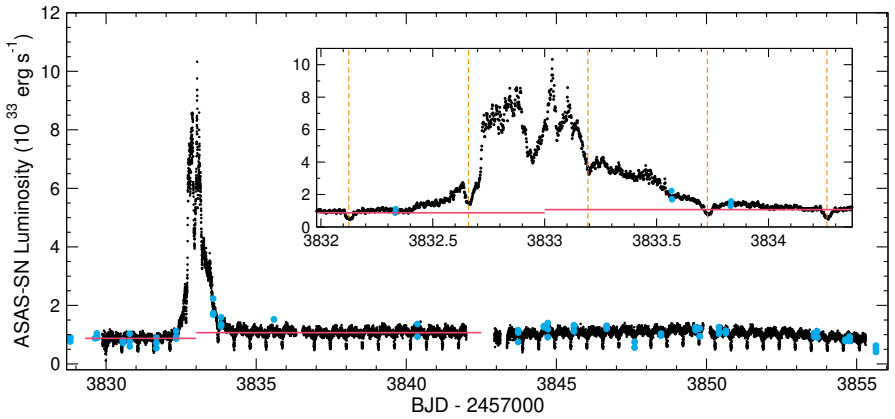
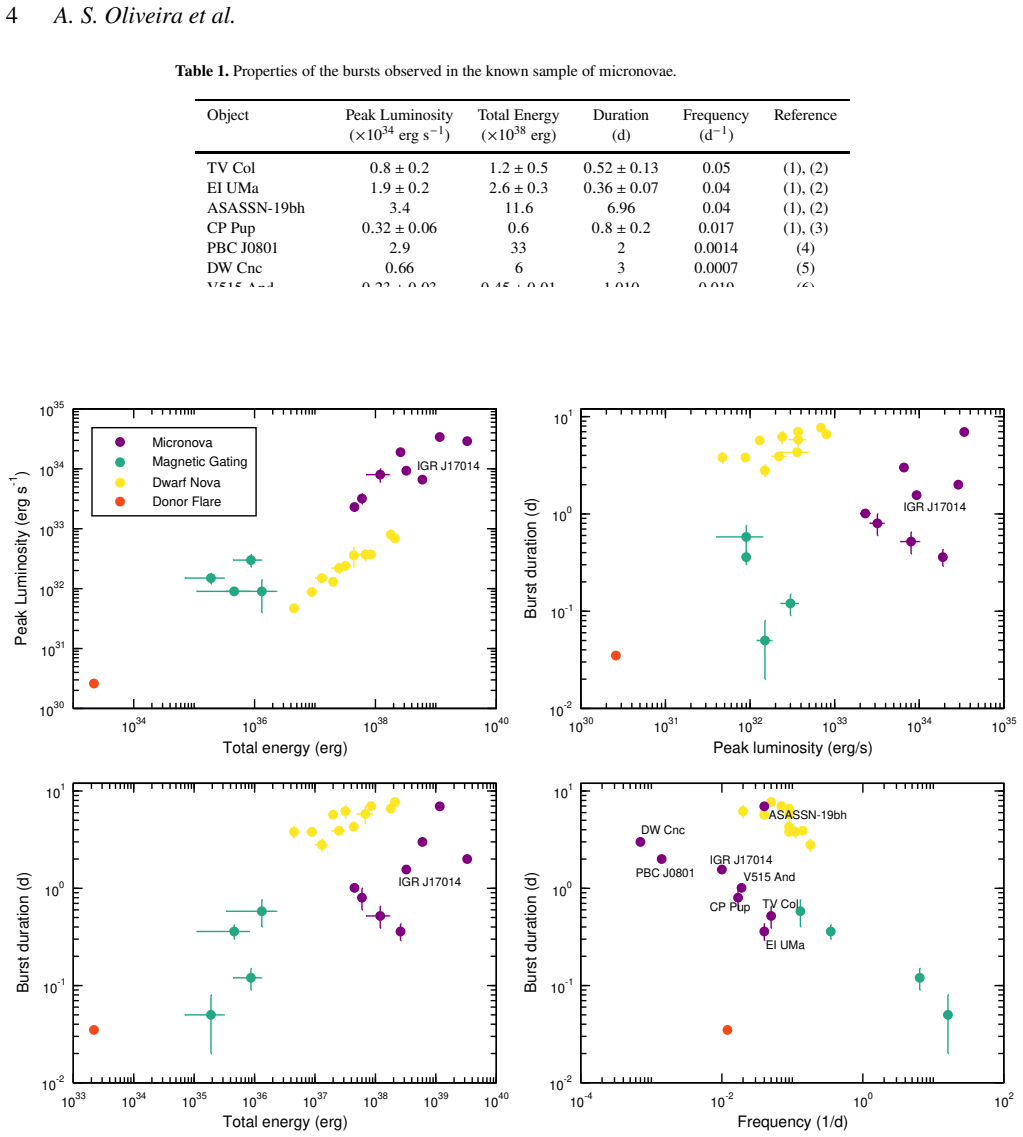
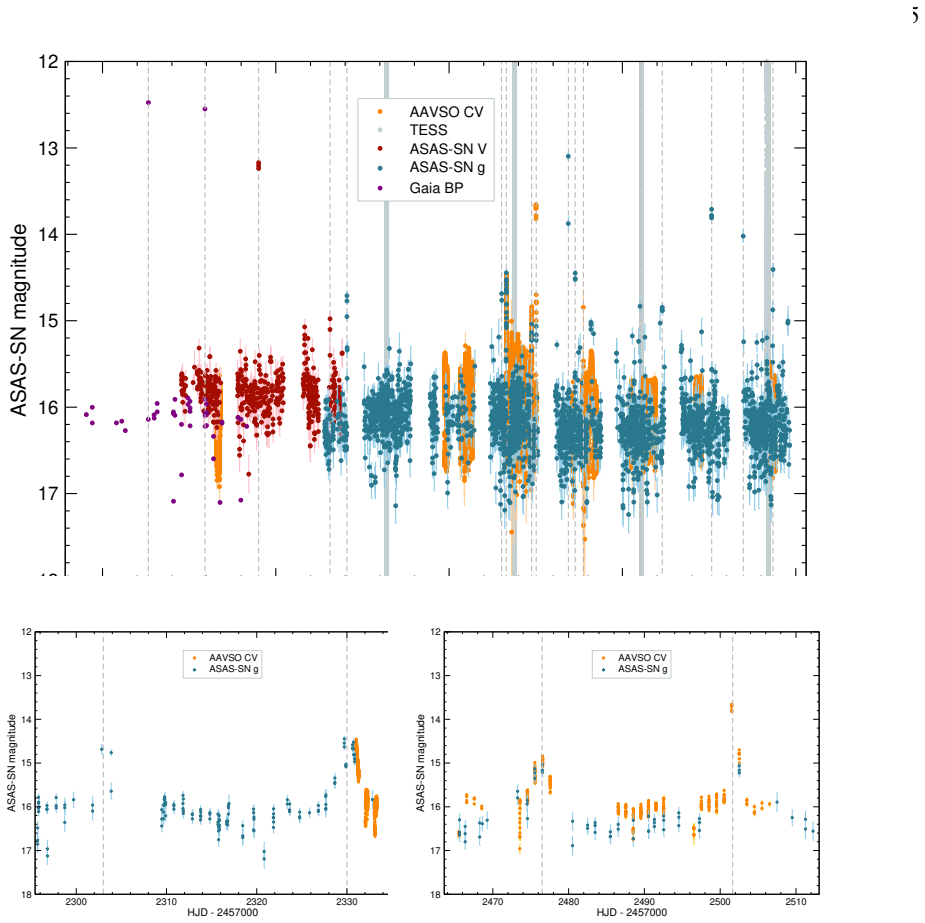
We report the detection of a short optical burst in TESS data of IGR J17014-4306, the eclipsing intermediate polar with the longest known orbital period. The burst lasts 1.56 d and shows multiple peaks, reaching $(9.3 \pm 0.2) \times 10^{33}$ erg s$^{-1}$, and releases a total energy of $(3.25 \pm 0.01) \times 10^{38}$ erg. The burst parameters are consistent with those of a micronova eruption, currently understood as a thermonuclear runaway in the magnetically-confined accretion column. From its energy, we infer a burned column mass of $\sim 1.6 \times 10^{-11}$ M$_\odot$, which implies a recurrence time of $\sim 20$ d. Our search for similar events in long-term Gaia, ASAS-SN, and AAVSO light curves reveals 16 possible fast brightenings over $\sim 11$ yr, suggesting that micronova events may be frequent in IGR J17014-4306. Timing analysis of the TESS data shows that the white-dwarf spin period remains stable before and after the burst. During the burst, however, the power spectrum becomes more complex and exhibits multiple peaks. The classification of IGR J17014-4306 as a micronova brings the total number of confirmed systems to eight. Its extreme orbital period and eclipsing nature make it an ideal test-bed for further studies of magnetically confined thermonuclear burning on white dwarfs.
Editorial analysis
A structured set of objections, weighed in public.
Referee Report
Summary. The paper reports the detection of a 1.56-day optical burst in TESS data of the eclipsing intermediate polar IGR J17014-4306, reaching a peak luminosity of (9.3 ± 0.2) × 10^33 erg s^{-1} and releasing a total energy of (3.25 ± 0.01) × 10^38 erg. The burst parameters are stated to be consistent with a micronova (thermonuclear runaway in the magnetically confined accretion column). From the energy the authors infer a burned column mass of ∼1.6 × 10^{-11} M_⊙ implying a recurrence time of ∼20 d. Archival searches in Gaia, ASAS-SN and AAVSO data yield 16 candidate fast brightenings over ∼11 yr. Timing analysis shows the white-dwarf spin period remains stable outside the burst but the power spectrum becomes complex during the event. The work brings the number of confirmed micronova systems to eight and highlights the system's long orbital period and eclipsing geometry as advantageous for future study.
Significance. If the thermonuclear classification holds, the result adds an important system with the longest known orbital period among micronovae and an eclipsing configuration that enables detailed geometric constraints on the accretion column. The archival search suggesting multiple events and a short recurrence time would imply that micronovae occur more frequently in intermediate polars than previously recognized. The reported stability of the spin period combined with the altered power spectrum during the burst provides a concrete observational handle on how the thermonuclear event couples to the magnetic accretion flow. These elements, together with the multi-survey candidate list, constitute a useful data point for models of magnetically confined burning on white dwarfs.
major comments (2)
- [Abstract and energy-to-mass inference] Abstract and energy-to-mass inference section: the conversion of the measured energy (3.25 ± 0.01) × 10^38 erg into a burned mass of ∼1.6 × 10^{-11} M_⊙ is presented without the explicit nuclear yield per unit mass, bolometric correction, or radiative-efficiency assumptions used. Because this step is load-bearing for both the micronova classification and the ∼20 d recurrence-time claim, the lack of a quantitative justification or sensitivity test to alternative mechanisms (disk instability, magnetic reconnection) constitutes a central gap.
- [Timing analysis] Timing-analysis section: while the stability of the spin period before/after the burst is reported, the manuscript does not quantify how the increased complexity of the power spectrum during the burst (multiple peaks) is or is not consistent with expectations for a thermonuclear column event versus an accretion-disk instability. A direct comparison to simulated power spectra or to the other seven confirmed micronovae would be required to make the timing evidence load-bearing.
minor comments (2)
- [Abstract] The abstract states the burst 'lasts 1.56 d' but does not specify whether this duration is measured at a particular flux threshold or is the full width at half-maximum; a precise definition would aid reproducibility.
- [Archival search] The search for 16 candidate events in Gaia/ASAS-SN/AAVSO is summarized only by count and time baseline; providing the selection criteria (amplitude, duration, color if available) in a dedicated table or subsection would strengthen the frequency claim.
Simulated Author's Rebuttal
We thank the referee for their constructive comments on our manuscript. We address each major point below and indicate the revisions we will make.
read point-by-point responses
-
Referee: Abstract and energy-to-mass inference section: the conversion of the measured energy (3.25 ± 0.01) × 10^38 erg into a burned mass of ∼1.6 × 10^{-11} M_⊙ is presented without the explicit nuclear yield per unit mass, bolometric correction, or radiative-efficiency assumptions used. Because this step is load-bearing for both the micronova classification and the ∼20 d recurrence-time claim, the lack of a quantitative justification or sensitivity test to alternative mechanisms (disk instability, magnetic reconnection) constitutes a central gap.
Authors: We agree that explicit assumptions are needed. The mass was derived using a nuclear yield of 5.6 × 10^18 erg g^{-1} (standard for H→He burning in the literature), a bolometric correction of ~1.2 based on the TESS bandpass and blackbody temperature during the burst, and unit radiative efficiency. In the revised manuscript we will state these values explicitly in the energy-to-mass section, add a short sensitivity table showing the range of masses for yields between 4–7 × 10^18 erg g^{-1}, and briefly compare the observed 1.56-day duration and luminosity to typical disk-instability timescales to support the thermonuclear interpretation. revision: yes
-
Referee: Timing-analysis section: while the stability of the spin period before/after the burst is reported, the manuscript does not quantify how the increased complexity of the power spectrum during the burst (multiple peaks) is or is not consistent with expectations for a thermonuclear column event versus an accretion-disk instability. A direct comparison to simulated power spectra or to the other seven confirmed micronovae would be required to make the timing evidence load-bearing.
Authors: We note that no published hydrodynamic simulations of the power spectrum during a micronova exist, so a direct simulated comparison cannot be provided. We will, however, expand the timing section to include a qualitative comparison of the observed multi-peak structure to the power spectra reported for the other seven confirmed micronovae (where spin-period stability outside the burst is also seen) and will cite the relevant observational papers. This constitutes a partial revision. revision: partial
Circularity Check
No circularity: inferences are direct conversions from observed quantities using external nuclear yields.
full rationale
The paper measures burst energy directly from TESS photometry ((3.25 ± 0.01) × 10^38 erg) and converts it to burned mass (~1.6 × 10^{-11} M_⊙) via the standard relation E = M × (nuclear energy release per unit mass). This is a one-step arithmetic inference under the thermonuclear interpretation, not a fit, self-definition, or parameter renamed as prediction. Recurrence time (~20 d) follows by dividing by an adopted accretion rate. No equations, self-citations, or uniqueness theorems are invoked that reduce the central claims to the inputs by construction. Classification as micronova rests on consistency with external literature parameters rather than internal tautology.
Axiom & Free-Parameter Ledger
free parameters (1)
- burned column mass
axioms (2)
- domain assumption The observed optical burst is produced by thermonuclear runaway rather than accretion instability or other mechanism
- domain assumption Radiated energy equals the nuclear energy released by the burned column mass with negligible unobserved losses
Reference graph
Works this paper leans on
-
[1]
Estimating Distances from Parallaxes. V. Geometric and Photogeometric Distances to 1.47 Billion Stars in Gaia Early Data Release 3. , keywords =. doi:10.3847/1538-3881/abd806 , archivePrefix =. 2012.05220 , primaryClass =
work page internal anchor Pith review Pith/arXiv arXiv doi:10.3847/1538-3881/abd806 2012
-
[2]
Rapid Change in the Orbital Period of the Remnant of Nova Scorpii AD 1437 (IGR J17014-4306). , keywords =. doi:10.3847/1538-4357/ade788 , adsurl =
-
[3]
Confirmation of the planetary nebula nature of HaTr 5: Not a remnant of Nova Sco 1437. , keywords =. doi:10.1051/0004-6361/202452816 , archivePrefix =. 2412.12813 , primaryClass =
-
[4]
Unveiling the nature of INTEGRAL objects through optical spectroscopy. X. A new multi-year, multi-observatory campaign. , keywords =. doi:10.1051/0004-6361/201322026 , archivePrefix =. 1307.2898 , primaryClass =
work page internal anchor Pith review Pith/arXiv arXiv doi:10.1051/0004-6361/201322026
-
[5]
Proceedings of the Astronomical Society of Australia , keywords =
A catalogue of symbiotic stars. Proceedings of the Astronomical Society of Australia , keywords =
-
[6]
Abundances of the elements - Meteoritic and solar. , keywords =. doi:10.1016/0016-7037(89)90286-X , adsurl =
-
[7]
A catalogue of symbiotic stars. , eprint =. doi:10.1051/aas:2000280 , adsurl =
-
[8]
, archivePrefix = "arXiv", eprint =
TW Hya: Spectral Variability, X-Rays, and Accretion Diagnostics. , archivePrefix = "arXiv", eprint =. doi:10.1088/0004-637X/750/1/73 , adsurl =
-
[9]
AAS/High Energy Astrophysics Division \#11 , year = 2010, series =
The Impact of Accretion on Young Stellar Atmospheres. AAS/High Energy Astrophysics Division \#11 , year = 2010, series =
2010
-
[10]
doi:10.1088/0004-637X/710/2/1835 , eprint =
A Deep Chandra X-Ray Spectrum of the Accreting Young Star TW Hydrae. , archivePrefix = "arXiv", eprint =. doi:10.1088/0004-637X/710/2/1835 , adsurl =
-
[11]
American Astronomical Society Meeting Abstracts \#215 , year = 2010, series =
Discovery of an Accretion-Fed Corona in an Accreting Young Star. American Astronomical Society Meeting Abstracts \#215 , year = 2010, series =
2010
-
[12]
American Astronomical Society Meeting Abstracts \#215 , year = 2010, series =
TW Hya: A Simultaneous Optical and X-Ray Campaign. American Astronomical Society Meeting Abstracts \#215 , year = 2010, series =
2010
-
[13]
Chandra's First Decade of Discovery , year = 2009, editor =
Discovery of an Accretion-Fed Corona in an Accreting Young Star. Chandra's First Decade of Discovery , year = 2009, editor =
2009
-
[14]
The X-ray Universe 2008 , year = 2008, month = jul, adsurl =
Accretion and Corona: HETG Chandra observations of TW Hya. The X-ray Universe 2008 , year = 2008, month = jul, adsurl =
2008
-
[15]
AAS/High Energy Astrophysics Division \#10 , year = 2008, series =
TW Hya: The X-ray Environment of a Planet-hosting T Tauri Star. AAS/High Energy Astrophysics Division \#10 , year = 2008, series =
2008
-
[16]
, keywords =
Search for pulsed gamma-ray emission from radio pulsars in the COS-B data. , keywords =
-
[17]
Orbital elements of seven new spectroscopic binaries
Contribution to the study of F-G-K-M binaries: XII. Orbital elements of seven new spectroscopic binaries. Astronomische Nachrichten , keywords =. doi:10.1002/asna.200710829 , adsurl =
-
[18]
The Astronomer's Telegram , keywords =
INTEGRAL discovery of the new source IGR J12349-6434. The Astronomer's Telegram , keywords =
-
[19]
, archivePrefix = "arXiv", eprint =
The imprint of a symbiotic binary progenitor on the properties of Kepler's supernova remnant. , archivePrefix = "arXiv", eprint =. doi:10.1051/0004-6361/201014754 , adsurl =
-
[20]
Shock fronts in the symbiotic system BI Crucis. , archivePrefix = "arXiv", eprint =. doi:10.1111/j.1365-2966.2009.14792.x , adsurl =
-
[21]
, keywords =
Bipolar nebulae and binary stars - The family of crabs He 2-104, BI Crucis, and MyCn 18. , keywords =
-
[22]
, keywords =
The optical nebulae around the symbiotic Miras He 2-147, HM Sagittae and V1016 Cygni. , keywords =
-
[23]
Science , archivePrefix = "arXiv", eprint =
PTF 11kx: A Type Ia Supernova with a Symbiotic Nova Progenitor. Science , archivePrefix = "arXiv", eprint =. doi:10.1126/science.1219164 , adsurl =
-
[24]
The Progenitors of Type Ia Supernovae. II. Are they Double-degenerate Binaries? The Symbiotic Channel. , archivePrefix = "arXiv", eprint =. doi:10.1088/0004-637X/719/1/474 , adsurl =
-
[25]
, archivePrefix = "arXiv", eprint =
A New 626 s periodic X-ray source in the direction of the Galactic center. , archivePrefix = "arXiv", eprint =. doi:10.1051/0004-6361/201014074 , adsurl =
-
[26]
A new method for the detection of a periodic signal of unknown shape and period. , keywords =. doi:10.1086/171844 , adsurl =
-
[27]
, year = 1971, month = jan, volume = 163, pages =
A Brightening of the Ultraviolet Spectrum of the Carbon Star HD 59643. , year = 1971, month = jan, volume = 163, pages =. doi:10.1086/150770 , adsurl =
-
[28]
, archivePrefix = "arXiv", eprint =
XID II: Statistical Cross-Association of ROSAT Bright Source Catalog X-ray Sources with 2MASS Point Source Catalog Near-Infrared Sources. , archivePrefix = "arXiv", eprint =. doi:10.1088/0067-0049/184/1/138 , adsurl =
-
[29]
The Carbon Mira UV Aurigae and its Companion. , keywords =. doi:10.1088/0004-6256/138/5/1502 , adsurl =
-
[30]
Information Bulletin on Variable Stars , archivePrefix = "arXiv", eprint =
Updated spin ephemeris for the cataclysmic variable EX Hydrae. Information Bulletin on Variable Stars , archivePrefix = "arXiv", eprint =
-
[31]
The High-Excitation Planetary Nebula NGC 246. II. FUSE and Chandra Observations. , keywords =. doi:10.1086/521637 , adsurl =
-
[32]
AAS/High Energy Astrophysics Division \#9 , year = 2006, series =
Studying Magnetic Accretion on EX Hya Using the Chandra HETG. AAS/High Energy Astrophysics Division \#9 , year = 2006, series =
2006
-
[33]
Accretion Column Structure of Magnetic Cataclysmic Variables from X-Ray Spectroscopy. , eprint =. doi:10.1086/505029 , adsurl =
-
[34]
X-Ray Light Curves and Accretion Disk Structure of EX Hydrae. , eprint =. doi:10.1086/431211 , adsurl =
-
[35]
Lost and Found: A New Position and Infrared Counterpart for the X-Ray Binary Scutum X-1. , eprint =. doi:10.1086/513712 , adsurl =
-
[36]
A Large X-Ray Outburst in Mira A. , eprint =. doi:10.1086/430111 , adsurl =
-
[37]
Colliding Winds in Symbiotic Binary Systems. I. Analytic and Numerical Solutions. , keywords =. doi:10.1086/426309 , adsurl =
-
[38]
Cambridge and New York, Cambridge University Press, 1986, 295 p
The symbiotic stars. Cambridge and New York, Cambridge University Press, 1986, 295 p. , year = 1986, adsurl =
1986
-
[39]
INTEGRAL/IBIS all-sky survey in hard X-rays. , eprint =. doi:10.1051/0004-6361:20077191 , adsurl =
-
[40]
X-ray and UV radiation from accreting nonmagnetic degenerate dwarfs. II. , keywords =. doi:10.1086/190777 , adsurl =
-
[41]
, archivePrefix = "arXiv", eprint =
Is CGCS 5926 a symbiotic X-ray binary?. , archivePrefix = "arXiv", eprint =. doi:10.1051/0004-6361/201117260 , adsurl =
-
[42]
, archivePrefix = "arXiv", eprint =
IGR J16194-2810: a new symbiotic X-ray binary. , archivePrefix = "arXiv", eprint =. doi:10.1051/0004-6361:20077509 , adsurl =
-
[43]
X-ray broad-band study of the symbiotic X-ray binary 4U 1954+31. , eprint =. doi:10.1051/0004-6361:20066517 , adsurl =
-
[44]
M-type giants as optical counterparts of X-ray sources 4U 1700+24 and 4U 1954+319. , eprint =. doi:10.1051/0004-6361:20065025 , adsurl =
-
[45]
The Astronomer's Telegram , keywords =
The symbiotic star CD-57 3057 is the likely counterpart of IGR J10109-5746. The Astronomer's Telegram , keywords =
-
[46]
The Astronomer's Telegram , keywords =
Igr J12349-6434 = RT Cru ?. The Astronomer's Telegram , keywords =
-
[47]
X-ray and optical monitoring of the peculiar source 4U 1700+24/V934 Her. , eprint =. doi:10.1051/0004-6361:20011543 , adsurl =
-
[48]
A Large Infrared Shell Associated with BI Crucis. , keywords =. doi:10.1086/589137 , adsurl =
-
[49]
, keywords =
Search for Resolved H Nebulae around Symbiotic Stars and Their Formation Mechanisms. , keywords =
-
[50]
Baltic Astronomy , keywords =
Symbiotic Stars: Continually Embarrassing Binaries. Baltic Astronomy , keywords =
-
[51]
, eprint =
An Apparent Hard X-Ray Decline of CH Cygni. , eprint =
-
[52]
Two Types of X-Ray Spectra in Cataclysmic Variables. , eprint =. doi:10.1086/374583 , adsurl =
-
[53]
X-ray properties of symbiotic stars. II. Systems with colliding winds. , keywords =
-
[54]
, keywords =
Temperature and luminosity of hot components in symbiotic stars. , keywords =
-
[55]
NATO ASIC Proc
Einstein Observatory solid state detector observations of cooling flows in clusters of galaxies. NATO ASIC Proc. 229: Cooling Flows in Clusters and Galaxies , year = 1988, editor =
1988
-
[56]
Hard X-rays from accretion disk boundary layers. , keywords =. doi:10.1038/362820a0 , adsurl =
-
[57]
Discovery of Rapid Hard X-Ray Variability and New Jet Activity in the Symbiotic Binary R Aquarii. , eprint =. doi:10.1086/512138 , adsurl =
-
[58]
, archivePrefix = "arXiv", eprint =
XMM observation of 1RXS J180431.1-273932: a new M-type X-ray binary with a 494 s-pulse period neutron star?. , archivePrefix = "arXiv", eprint =. doi:10.1051/0004-6361:20078005 , adsurl =
-
[59]
, keywords =
Relative C, N, O abundances in red giants, planetary nebulae, novae and symbiotic stars. , keywords =
-
[60]
An asymmetric shock wave in the 2006 outburst of the recurrent nova RS Ophiuchi. , eprint =. doi:10.1038/nature04949 , adsurl =
-
[61]
Two SMC Symbiotic Stars Undergoing Steady Hydrogen Burning. , eprint =. doi:10.1086/514806 , adsurl =
-
[62]
Science , archivePrefix = "arXiv", eprint =
Detection of Circumstellar Material in a Normal Type Ia Supernova. Science , archivePrefix = "arXiv", eprint =. doi:10.1126/science.1143005 , adsurl =
-
[63]
A Possible Magnetar Nature for IGR J16358-4726. , eprint =. doi:10.1086/510374 , adsurl =
-
[64]
X-Ray Observations of the Boundary Layer in Dwarf Novae at Low Accretion Rates. , eprint =. doi:10.1086/429983 , adsurl =
-
[65]
Spectroscopic Observations of Seven Suspected Symbiotic Stars. , keywords =. doi:10.1086/300564 , adsurl =
-
[66]
Baltic Astronomy , keywords =
The Origin and Evolution of Symbiotic Binaries. Baltic Astronomy , keywords =
-
[67]
2007, MNRAS, 377, 352, doi: 10.1111/j.1365-2966.2007.11611.x
Photometric calibration of the Swift ultraviolet/optical telescope. , archivePrefix = "arXiv", eprint =. doi:10.1111/j.1365-2966.2007.12563.x , adsurl =
-
[68]
, archivePrefix = "arXiv", eprint =
Statistical Characterization of the Chandra Source Catalog. , archivePrefix = "arXiv", eprint =. doi:10.1088/0067-0049/194/2/37 , adsurl =
-
[69]
Fluorescent iron lines as a probe of astrophysical black hole systems. , eprint =. doi:10.1016/S0370-1573(02)00584-7 , adsurl =
-
[70]
, archivePrefix = "arXiv", eprint =
An Expanding Shell and Synchrotron Jet in RS Ophiuchi. , archivePrefix = "arXiv", eprint =. doi:10.1086/525555 , adsurl =
-
[71]
New York, Wiley-Interscience, 1979
Radiative processes in astrophysics. New York, Wiley-Interscience, 1979. 393 p. , year = 1979, adsurl =
1979
-
[72]
Its nebular dynamics, its Mira variable and its distance
HST and VLT observations of the symbiotic star Hen 2-147. Its nebular dynamics, its Mira variable and its distance. , keywords =. doi:10.1051/0004-6361:20065875 , adsurl =
-
[73]
, archivePrefix = "arXiv", eprint =
The Symbiotic System SS73 17 Seen with Suzaku. , archivePrefix = "arXiv", eprint =
-
[74]
, archivePrefix = "arXiv", eprint =
Evidence for the White Dwarf Nature of Mira B. , archivePrefix = "arXiv", eprint =. doi:10.1088/0004-637X/723/2/1188 , adsurl =
-
[75]
Uncovering the Nature of Nova Jets: A Radio Image of Highly Collimated Outflows from RS Ophiuchi. , keywords =. doi:10.1086/592602 , adsurl =
-
[76]
An X-ray-emitting blast wave from the recurrent nova RS Ophiuchi. , eprint =. doi:10.1038/nature04893 , adsurl =
-
[77]
A ``Combination Nova'' Outburst in Z Andromedae: Nuclear Shell Burning Triggered by a Disk Instability. , eprint =. doi:10.1086/498206 , adsurl =
-
[78]
CH Cygni. II. Optical Flickering from an Unstable Disk. , eprint =. doi:10.1086/345902 , adsurl =
-
[79]
Symbiotic Stars Probing Stellar Evolution , year = 2003, series =
Rapid Variability as a Diagnostic of Accretion and Nuclear Burning in Symbiotic Stars and Supersoft X-Ray Sources (invited review talks). Symbiotic Stars Probing Stellar Evolution , year = 2003, series =. arXiv:astro-ph/0209101 , editor =
Pith/arXiv arXiv 2003
-
[80]
2001, MNRAS, 322, 247, doi: 10.1046/j.1365-8711.2001.04072.x 14E
A search for rapid photometric variability in symbiotic binaries. , eprint =. doi:10.1046/j.1365-8711.2001.04582.x , adsurl =
discussion (0)
Sign in with ORCID, Apple, or X to comment. Anyone can read and Pith papers without signing in.