Quantum enhanced rare event discovery and sampling
Pith reviewed 2026-06-28 01:09 UTC · model grok-4.3
The pith
A quantum algorithm discovers and samples rare events without first identifying them
A machine-rendered reading of the paper's core claim, the machinery that carries it, and where it could break.
Core claim
The central claim is that a quantum algorithm for rare-event discovery and sampling exists which operates via an oracle permitting sampling and amplitude operations on the underlying probability distribution without any prior identification of the rare events. This algorithm attains optimal quantum scaling with the rarity threshold, quadratic speedup for heavy-tailed systems whose tail has nonvanishing total mass, and robust polynomial speedup for stationary stochastic processes whose exponent is set by the entropy-rate structure.
What carries the argument
Quantum oracle access model that supplies sampling and amplitude operations directly on the probability distribution, enabling amplification of unknown rare-event subsets.
If this is right
- The algorithm attains optimal quantum scaling with the rarity threshold.
- Quadratic speedup holds for heavy-tailed systems whose tail has nonvanishing total mass.
- Polynomial speedup holds for stationary stochastic processes, with the exponent fixed by entropy-rate structure.
- Rare-event sampling becomes feasible for applications such as financial crashes and infrastructure failures using quantum resources instead of exhaustive classical trials.
Where Pith is reading between the lines
- The same oracle model could be applied to estimate tail probabilities in Monte Carlo simulations of physical or engineered systems.
- Near-term quantum hardware tests on small heavy-tailed distributions would directly check the predicted query scaling.
- Hybrid classical-quantum workflows could use the quantum subroutine only for the rare-event amplification step.
Load-bearing premise
The algorithm can be realized with a quantum oracle or access model that permits sampling and amplitude operations on the underlying probability distribution without any prior identification or flagging of the rare events.
What would settle it
Run the algorithm on a quantum simulator for a concrete heavy-tailed distribution such as a power-law tail, count the oracle queries needed to collect samples below a chosen rarity threshold, and check whether the observed scaling matches the claimed optimal quantum dependence rather than the classical 1/p scaling.
Figures
read the original abstract
Financial crashes, cascading failures in infrastructure, and critical errors in AI systems are frequently triggered by events that occur with extremely small probability. Efficiently discovering and sampling events with probability below a threshold is therefore of critical interest. Yet this task is highly non-trivial using existing classical or quantum methods. Being rare, such events require an immense sampling overhead to collect sufficient data samples. Moreover, because the rare events are not known in advance, they cannot be flagged for amplification using standard techniques. Here, we introduce a quantum algorithm for rare-event discovery and sampling without first learning which events are rare. The algorithm achieves the optimal quantum scaling with the rarity threshold. We further demonstrate that this can achieve a quadratic speedup for heavy-tailed systems whose tail has nonvanishing total mass, and translates into a robust polynomial speedup for stationary stochastic processes, with the exponent determined by its entropy-rate structure.
Editorial analysis
A structured set of objections, weighed in public.
Referee Report
Summary. The paper introduces a quantum algorithm for rare-event discovery and sampling that does not require prior identification or flagging of the rare events. It claims to achieve the optimal quantum scaling with the rarity threshold, a quadratic speedup for heavy-tailed systems whose tail has nonvanishing total mass, and a robust polynomial speedup for stationary stochastic processes whose exponent is set by the entropy-rate structure.
Significance. If the central claims hold and the required oracle can be realized, the work would constitute a meaningful contribution to quantum algorithms for rare-event problems, with potential relevance to applications in risk analysis and stochastic modeling. The absence of any derivation, oracle definition, or proof sketch in the manuscript prevents confirmation that the stated speedups follow from the assumptions.
major comments (1)
- [Abstract] Abstract, paragraph 3: the algorithm is asserted to achieve optimal quantum scaling and the listed speedups, yet no oracle model, amplitude amplification construction, or complexity analysis is supplied; without these the central claims cannot be verified or shown to be non-circular with respect to the sampling access assumed.
Simulated Author's Rebuttal
We thank the referee for their review and for identifying the absence of explicit technical details supporting the central claims. We address the comment below and will revise the manuscript to incorporate the requested elements.
read point-by-point responses
-
Referee: [Abstract] Abstract, paragraph 3: the algorithm is asserted to achieve optimal quantum scaling and the listed speedups, yet no oracle model, amplitude amplification construction, or complexity analysis is supplied; without these the central claims cannot be verified or shown to be non-circular with respect to the sampling access assumed.
Authors: We agree that the submitted manuscript lacks an explicit oracle definition, amplitude amplification construction, and complexity analysis. In the revised version we will add a dedicated technical section that (i) defines the oracle as a standard quantum sampling oracle providing coherent access to the underlying probability distribution (without any prior flagging of rare events), (ii) presents the amplitude amplification construction that marks and amplifies events below a rarity threshold on the fly, and (iii) supplies the query-complexity analysis establishing the optimal O(1/sqrt(p)) scaling with rarity threshold p. The analysis will demonstrate that the quadratic speedup for heavy-tailed distributions and the polynomial speedup for stationary processes follow directly from this construction without circularity in the assumed access model. revision: yes
Circularity Check
No significant circularity detected
full rationale
The supplied material consists solely of an abstract with no equations, derivation steps, fitted parameters, or self-citations. No load-bearing claim reduces by construction to its own inputs, and the oracle model is stated without internal definitions that would create self-definitional or fitted-input circularity. The derivation chain cannot be walked because no technical sections or equations are present; the central claims therefore remain self-contained against external benchmarks with no evidence of the enumerated circularity patterns.
Axiom & Free-Parameter Ledger
axioms (1)
- domain assumption Quantum access to the probability distribution is available via an oracle that supports sampling and amplitude amplification without event pre-identification.
Reference graph
Works this paper leans on
-
[1]
J. van Apeldoorn, Quantum probability oracles & mul- tidimensional amplitude estimation, in16th Conference on the Theory of Quantum Computation, Communica- tion and Cryptography (TQC 2021), Leibniz International Proceedings in Informatics (LIPIcs), Vol. 197, edited by M.-H. Hsieh (Schloss Dagstuhl – Leibniz-Zentrum f¨ ur Informatik, Dagstuhl, Germany, 202...
2021
-
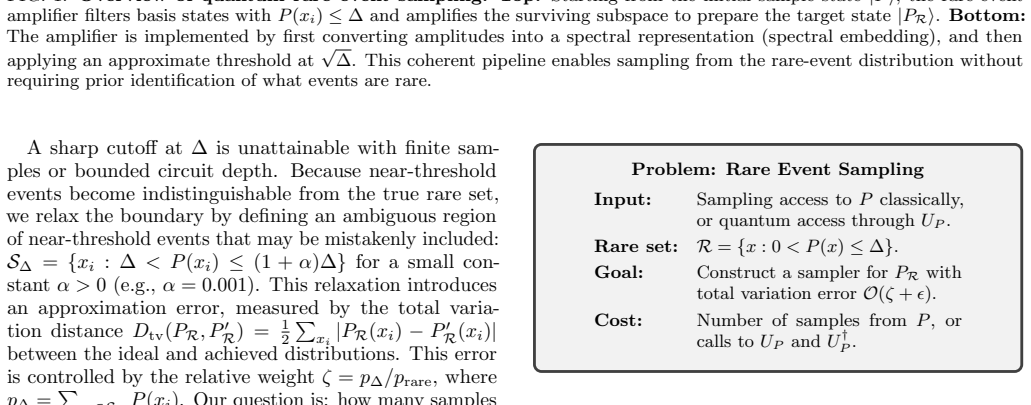
[2]
Bar-Yossef,The Complexity of Massive Data Set Com- putations, Ph.D
Z. Bar-Yossef,The Complexity of Massive Data Set Com- putations, Ph.D. thesis, University of California, Berkeley (2002)
2002
-
[3]
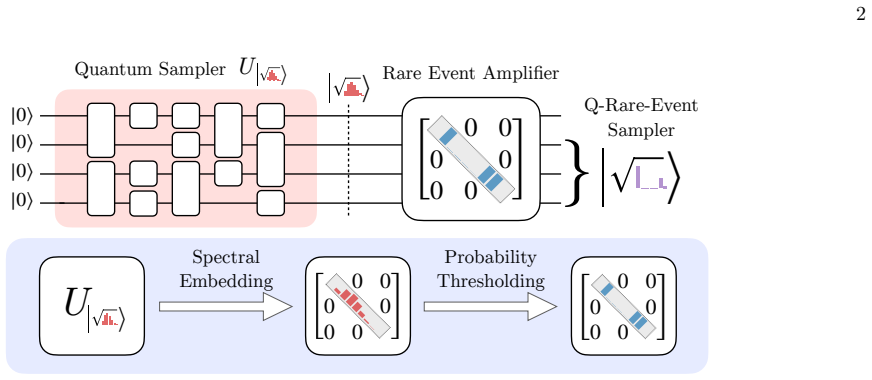
Brassard, P
G. Brassard, P. Høyer, M. Mosca, and A. Tapp, Quantum amplitude amplification and estimation, inQuantum com- putation and information, Contemporary Mathematics, Vol. 305 (American Mathematical Society, Providence, RI, USA, 2002) pp. 53–74
2002
-
[4]
N. Guo, K. Mitarai, and K. Fujii, Nonlinear transforma- tion of complex amplitudes via quantum singular value transformation, Phys. Rev. Res.6, 043227 (2024)
2024
-
[5]
A. G. Rattew and P. Rebentrost, Non-linear transforma- tions of quantum amplitudes: Exponential improvement, generalization, and applications (2023), arXiv:2309.09839 [quant-ph]
arXiv 2023
-
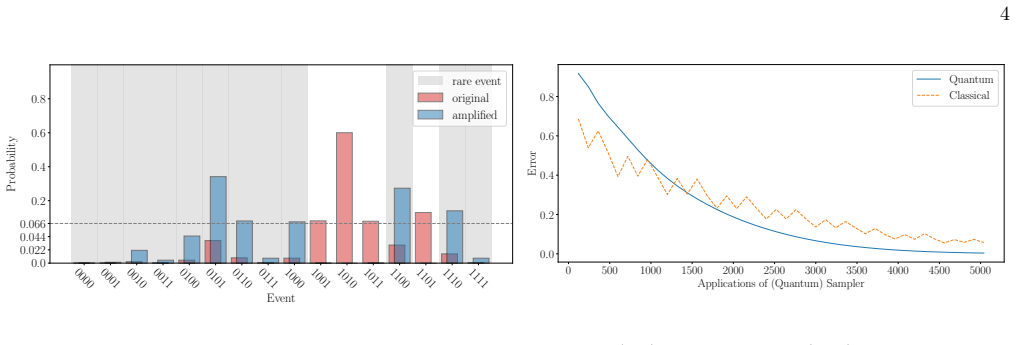
[6]
N. Guo, Z. Yu, M. Choi, Y. Han, A. Agrawal, K. Nakaji, A. Aspuru-Guzik, and P. Rebentrost, Quantum trans- former: Accelerating model inference via quantum linear algebra (2024), arXiv:2402.16714 [quant-ph]
arXiv 2024
-
[7]
A. G. Rattew, P.-W. Huang, N. Guo, L. Pira, and P. Rebentrost, Accelerating inference for multilayer neu- ral networks with quantum computers, inThe Fourteenth International Conference on Learning Representations 8 (2026)
2026
-
[8]
Y. Du, X. Wang, N. Guo, Z. Yu, Y. Qian, K. Zhang, M. Hsieh, P. Rebentrost, and D. Tao,A Gentle Introduc- tion to Quantum Machine Learning, Artificial Intelligence (R0) (Springer Nature Singapore, 2025)
2025
-
[9]
C. H. Bennett, E. Bernstein, G. Brassard, and U. Vazirani, Strengths and weaknesses of quantum computing, SIAM J. Comput.26, 1510 (1997)
1997
-
[10]
A. Belovs, Quantum algorithms for classical probability distributions, in27th Annual European Symposium on Algorithms (ESA 2019), Leibniz International Proceedings in Informatics (LIPIcs), Vol. 144, edited by M. A. Bender, O. Svensson, and G. Herman (Schloss Dagstuhl – Leibniz- Zentrum f¨ ur Informatik, Dagstuhl, Germany, 2019) pp. 16:1–16:11
2019
-
[11]
Bollerslev, V
T. Bollerslev, V. Todorov, and S. Z. Li, Jump tails, ex- treme dependencies, and the distribution of stock returns, J. Econom.172, 307–324 (2013)
2013
-
[12]
Dobson, B
I. Dobson, B. A. Carreras, V. E. Lynch, and D. E. New- man, Complex systems analysis of series of blackouts: Cascading failure, critical points, and self-organization, Chaos17(2007)
2007
-
[13]
C. E. Shannon, A mathematical theory of communication, Bell Syst. Tech. J.27, 379 (1948)
1948
-
[14]
Aghamohammadi, S
C. Aghamohammadi, S. P. Loomis, J. R. Mahoney, and J. P. Crutchfield, Extreme quantum memory advantage for rare-event sampling, Phys. Rev. X8, 011025 (2018)
2018
-
[15]
Blanchet, F
J. Blanchet, F. He, and K. Murthy, On distributionally robust extreme value analysis, Extremes23, 317–347 (2020)
2020
-
[16]
F. C. Binder, J. Thompson, and M. Gu, Practical unitary simulator for non-Markovian complex processes, Phys. Rev. Lett.120, 240502 (2018)
2018
-
[17]
C. Yang, F. C. Binder, V. Narasimhachar, and M. Gu, Matrix product states for quantum stochastic modeling, Phys. Rev. Lett.121, 260602 (2018)
2018
- [18]
-
[19]
C. Yang, M. Florido-Llin` as, M. Gu, and T. J. Elliott, Dimension reduction in quantum sampling of stochastic processes, npj Quantum Inf.11(2025)
2025
-
[20]
G. H. Low and I. L. Chuang, Optimal Hamiltonian sim- ulation by quantum signal processing, Phys. Rev. Lett. 118, 010501 (2017)
2017
-
[21]
Gily´ en, Y
A. Gily´ en, Y. Su, G. H. Low, and N. Wiebe, Quantum singular value transformation and beyond: Exponential improvements for quantum matrix arithmetics, inPro- ceedings of the 51st Annual ACM SIGACT Symposium on Theory of Computing, STOC 2019 (Association for Computing Machinery, New York, NY, USA, 2019) pp. 193–204
2019
-
[22]
Chakraborty, A
S. Chakraborty, A. Gily´ en, and S. Jeffery, The power of block-encoded matrix powers: Improved regression tech- niques via faster Hamiltonian simulation, in46th Interna- tional Colloquium on Automata, Languages, and Program- ming (ICALP 2019), Leibniz International Proceedings in Informatics (LIPIcs), Vol. 132, edited by C. Baier, I. Chatzigiannakis, P. ...
2019
-
[23]
C. W. Helstrom, Detection theory and quantum mechan- ics, Inf. Control10, 254–291 (1967)
1967
-
[24]
Holevo, Statistical decision theory for quantum sys- tems, J
A. Holevo, Statistical decision theory for quantum sys- tems, J. Multivar. Anal.3, 337–394 (1973)
1973
-
[25]
Watrous,The Theory of Quantum Information(Cam- bridge University Press, 2018)
J. Watrous,The Theory of Quantum Information(Cam- bridge University Press, 2018)
2018
-
[26]
Lin and Y
L. Lin and Y. Tong, Near-optimal ground state prepara- tion, Quantum4, 372 (2020)
2020
-
[27]
Y. Dong, X. Meng, K. B. Whaley, and L. Lin, Efficient phase-factor evaluation in quantum signal processing, Phys. Rev. A103, 042419 (2021)
2021
-
[28]
C. Durr and P. Høyer, A quantum algorithm for finding the minimum (1999), arXiv:quant-ph/9607014 [quant-ph]
Pith/arXiv arXiv 1999
-
[29]
van Apeldoorn and A
J. van Apeldoorn and A. Gily´ en, Improvements in quan- tum SDP-solving with applications, in46th International Colloquium on Automata, Languages, and Programming (ICALP 2019), Leibniz International Proceedings in In- formatics (LIPIcs), Vol. 132, edited by C. Baier, I. Chatzi- giannakis, P. Flocchini, and S. Leonardi (Schloss Dagstuhl – Leibniz-Zentrum f...
2019
-
[30]
A. Ahuja and S. Kapoor, A quantum algorithm for finding the maximum (1999), arXiv:quant-ph/9911082 [quant- ph]
Pith/arXiv arXiv 1999
-
[31]
Y. Dong, L. Lin, and Y. Tong, Ground-state preparation and energy estimation on early fault-tolerant quantum computers via quantum eigenvalue transformation of uni- tary matrices, PRX Quantum3, 040305 (2022)
2022
-
[32]
Buhrman, S
H. Buhrman, S. Gharibian, Z. Landau, F. Le Gall, N. Schuch, and S. Tamaki, Beating the natural Grover bound for low-energy estimation and state preparation, Phys. Rev. Lett.135, 030601 (2025)
2025
-
[33]
Rabiner and B
L. Rabiner and B. Juang, An introduction to hidden Markov models, IEEE ASSP Mag.3, 4 (1986)
1986
-
[34]
P. H. Algoet and T. M. Cover, A sandwich proof of the Shannon–McMillan–Breiman theorem, Ann. Probab.16, 899 (1988)
1988
-
[35]
Aghamohammadi and J
C. Aghamohammadi and J. P. Crutchfield, Minimum memory for generating rare events, Phys. Rev. E95, 032101 (2017)
2017
-
[36]
R. Chao, D. Ding, A. Gilyen, C. Huang, and M. Szegedy, Finding angles for quantum signal processing with ma- chine precision (2020), arXiv:2003.02831 [quant-ph]
arXiv 2020
-
[37]
J. M. Martyn, Z. M. Rossi, A. K. Tan, and I. L. Chuang, Grand unification of quantum algorithms, PRX Quantum 2, 040203 (2021)
2021
-
[38]
G. H. Low and I. L. Chuang, Hamiltonian simulation by qubitization, Quantum3, 163 (2019)
2019
-
[39]
Quantum enhanced rare event discovery and sampling
J. Wang, Y. Dong, and L. Lin, On the energy landscape of symmetric quantum signal processing, Quantum6, 850 (2022). 9 Appendices for “Quantum enhanced rare event discovery and sampling” CONTENTS A. Notations 9 B. Problem definition of rare event sampling 10 C. Preliminary to quantum linear algebra 11 D. Quantum and classical algorithm for rare event sampling 12
2022
-
[40]
Classical algorithm 12
-
[41]
Discussion 21
Quantum algorithm 16 E. Discussion 21
-
[42]
Polynomial approximation 21
-
[43]
Phase transition of quantum advantages in power-law tails 23
Related works 22 F. Phase transition of quantum advantages in power-law tails 23
-
[44]
Rank-frequency power-law model 23
-
[45]
Evaluation of the rare-event mass 24
-
[46]
Application to stochastic process 29
Summary of quantum advantages and interpretations 29 G. Application to stochastic process 29
-
[47]
Stochastic processes and the Asymptotic Equipartition Property 29
-
[48]
Thermodynamic mapping for rare events 31
-
[49]
Quantum rare event sampling for stochastic processes 32
-
[50]
Numerical results 34
Quantum stochastic modeling 33 H. Numerical results 34
-
[51]
Give me samples fromQ, but only if they are unlikely underP
Perturbed coin model 35 Appendix A: Notations In this appendix, we collect the notation used throughout the paper. When we need to distinguish them, we reserve Ω for a generic finite sample space and X for the alphabet of a stochastic process. A generic finite distribution is written asP, Q: Ω→[0,1], with Ω ={x 1, . . . , xN }and X x∈Ω P(x) = 1, X x∈Ω Q(x...
-
[52]
If prare ≥p 1, then construct a sampler for a distribution that isΘ( ϵ + ζ)-close to QR in total variation distance, whereζ=q ∆/prare and QR = ( Q(xi)/prare, x i ∈ R, 0, x i /∈ R. (B.2)
-
[53]
Impossible
Ifp rare ≤p 2, then output “Impossible”. The rare-event sampling problem considered in the main text is recovered as a special case of Problem S1. In the generalized formulation, the distribution P defines which events are rare, while the distribution Q defines how these rare events should be sampled. The main text focuses on the natural self-sampling cas...
-
[54]
Impossible
Classical algorithm Theorem S2(Classical algorithm for general rare event sampling).There exists a classical algorithm that solves Problem S1 using O min 1 ∆ log N ϵ , 1 ∆2 log 1 ϵ (D.1) samples fromPandO(max{1/(p 1 −p 2 −q ∆)2,1/p rare})samples fromQ. Proof. We first construct a set of candidate rare events, which will be used to distinguish between the ...
-
[55]
impossible
Quantum algorithm Theorem S4(Quantum algorithm for rare event sampling).There exists a quantum algorithm that solves Problem S1 using O max 1√p1 − √p2 , 1√prare 1√ ∆ log 1 ϵ (D.28) queries to UP and O max n 1√p1−√p2 , 1√prare o queries to UQ with O(n)ancilla qubits. Here, UP and UQ denote the quantum samplers forPandQ, respectively. Proof. By Theorem S1, ...
-
[56]
By Theorem S1, use c- UP /U † P a constant number of times to construct the diagonal block encoding of amplitudes UA
-
[57]
Implement a polynomial approximation of the rectangle function f(x) via Lemma S1, using O(1/ √ ∆ log(1/ϵ)) applications ofU A
-
[58]
Impossible
Feed the quantum sample state |P⟩ into the constructed quantum circuit, and use amplitude amplification to boost the success probability and prepare the target state |PR⟩. This further uses O(1/√prare) applications of the constructed quantum circuit. In total, the algorithm usesO(1/ √∆prare log(1/ϵ)) applications of c-U P /U † P . FIG. S1. Description of ...
-
[59]
In this paper, we focus on the stochastic process, which implies that all quantum amplitudes (corresponding to the square root of the classical distribution) are real and positive
Polynomial approximation Here, we provide some discussions of the polynomial approximation used in the quantum algorithm. In this paper, we focus on the stochastic process, which implies that all quantum amplitudes (corresponding to the square root of the classical distribution) are real and positive. To achieve the rare event-related tasks, we need a goo...
-
[60]
Our quantum algorithm achieves efficiency by performing these steps coherently, thereby avoiding the need to explicitly read out or measure the rare events
Related works The rare event sampling problem can be decomposed into two distinct tasks: first, identifying the rare events, and second, sampling from them. Our quantum algorithm achieves efficiency by performing these steps coherently, thereby avoiding the need to explicitly read out or measure the rare events. In contrast, relying on the standard amplit...
-
[61]
The events are ordered so that P (x1) ≥P (x2) ≥ · · · ≥P (xN)
Rank-frequency power-law model We consider a rank-ordered family of distributions overNevents, P(x k) = k−γ ZN,γ ,(F.4) 24 where γ≥ 0 is the tail exponent and ZN,γ := PN j=1 j−γ is the generalized harmonic number (also the partition function). The events are ordered so that P (x1) ≥P (x2) ≥ · · · ≥P (xN). Since the probabilities are monotone decreasing, t...
-
[62]
The case γ = 0 is the uniform case, and one cannot reasonably distinguish which event is rare
Evaluation of the rare-event mass We now evaluate prare in the three tail regimes γ > 1, γ = 1, and 0 < γ < 1. The case γ = 0 is the uniform case, and one cannot reasonably distinguish which event is rare. Regime 1:γ >1.In this regime, the generalized harmonic number converges: ZN,γ =ζ(γ) +O(N 1−γ) = Θ(1),(F.11) whereζ(·) is the zeta function. Therefore, ...
-
[63]
the rare set is non-empty, and
-
[64]
The first requirement is that at least one state lies below the threshold
the rare set does not coincide with the entire support. The first requirement is that at least one state lies below the threshold. Because P (xk) decreases with k, this is equivalent to demanding that the least probable state be rare: P(x N)≤∆.(F.39) Using Eq. (F.33) atk=N, we find P(x N) = N −γ ZN,γ = 1−γ N 1 +o(1) .(F.40) Hence, the rare set is non-empt...
-
[65]
The quantum algorithm always pays the thresholding cost Θ(∆ −1/2), but it pays an additional amplification factorp −1/2 rare
Summary of quantum advantages and interpretations The preceding case analysis shows that the critical quantity is not merely the number of rare states, but the total probability mass carried by those states. The quantum algorithm always pays the thresholding cost Θ(∆ −1/2), but it pays an additional amplification factorp −1/2 rare . Thus: •ifp rare vanish...
-
[66]
A consecutive L output sequence xt:t+L := xt, xt+1,· · ·x t+L−1 is governed by the joint probability distribution Pr(x t:t+L)
Stochastic processes and the Asymptotic Equipartition Property A discrete stochastic process generates a random output Xt at each time step t, which takes value xt from an alphabet X of finite alphabet size. A consecutive L output sequence xt:t+L := xt, xt+1,· · ·x t+L−1 is governed by the joint probability distribution Pr(x t:t+L). Stochastic processes c...
-
[67]
energy density
Thermodynamic mapping for rare events By definition, rare events are events that are less likely to happen than typical events. The AEP theorem, per Lemma S6, claims that all of the typical sequences happen with probability roughly 2 −LH(X). Definition S6(Rare event for stochastic process).For a stochastic process X with entropy rate H(X), we define the s...
-
[68]
This corresponds to a special case of Theorem S4 when Q = P and p1 −p 2 =O(1)
Quantum rare event sampling for stochastic processes In the following, we detail the applications of our algorithm to stochastic processes, which have additional properties provided by the AEP theorem and β-mapping. This corresponds to a special case of Theorem S4 when Q = P and p1 −p 2 =O(1). Given sampling access to a stochastic process, our goal is to ...
-
[69]
The ε-machine consists of a set of hidden memory states Siwith transition probability Pr(Sj, x|Si)
Quantum stochastic modeling Given a stochastic process governed by distribution Pr(x0:L), we can always find a unifilar hidden Markov model, called ε-machine. The ε-machine consists of a set of hidden memory states Siwith transition probability Pr(Sj, x|Si). At each time step, the memory state updates to Sj from Si and outputs x with probability Pr(Sj, x|...
-
[70]
Setup We simulate the results of our algorithm using numpy by directly obtaining the matrix representation of the block-encoding unitaries and operating on them. For simulations on small-scale systems, we first construct a (1 , (L + χ) log|X | + 2, 0)-block encoding where diagonal encodes the amplitudes of the output quantum state of the recurrent quantum...
-
[71]
At each time step, the coin flips with probability p, otherwise remains at its original state, as shown in Fig
Perturbed coin model We apply our example to a simple Markovian process that can be generated by a perturbed coin. At each time step, the coin flips with probability p, otherwise remains at its original state, as shown in Fig. S4. As time evolves, one may 0000 0001 0010 0011 0100 0101 0110 0111 1000 1001 1010 1011 1100 1101 1110 1111 Event 0.0 0.019 0.038...
2000
discussion (0)
Sign in with ORCID, Apple, or X to comment. Anyone can read and Pith papers without signing in.