Smooth horizons from topology change in canonical quantum gravity
Pith reviewed 2026-06-28 00:03 UTC · model grok-4.3
The pith
Topology change under the gravitational Hamiltonian eliminates the firewall branch in black hole interiors, leaving a smooth horizon.
A machine-rendered reading of the paper's core claim, the machinery that carries it, and where it could break.
Core claim
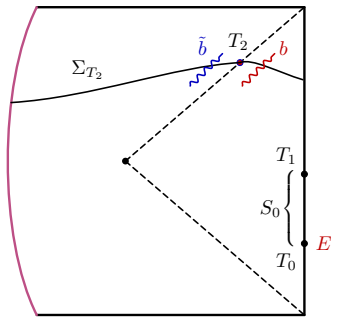
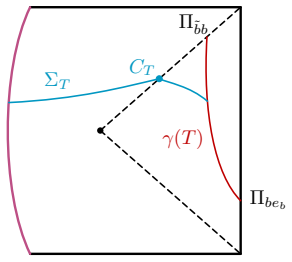
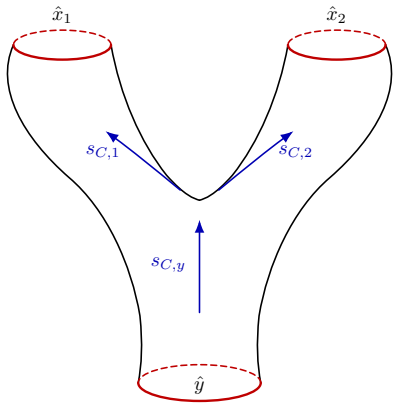
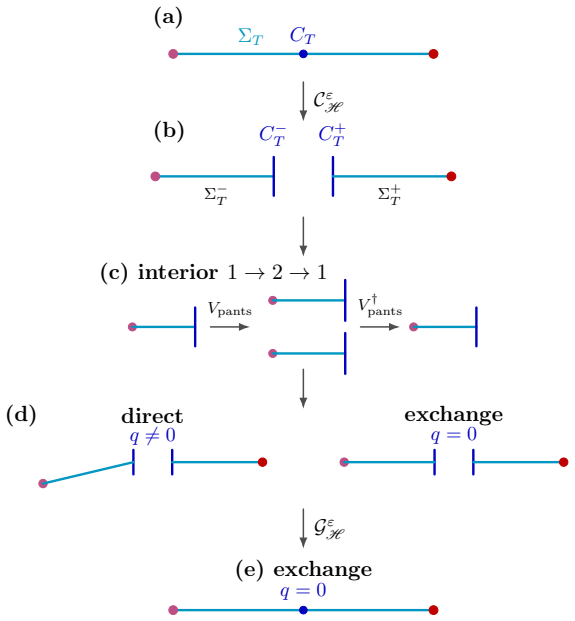
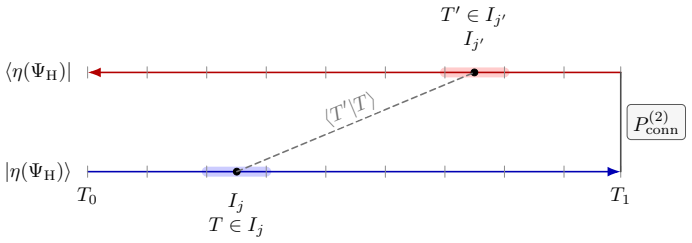
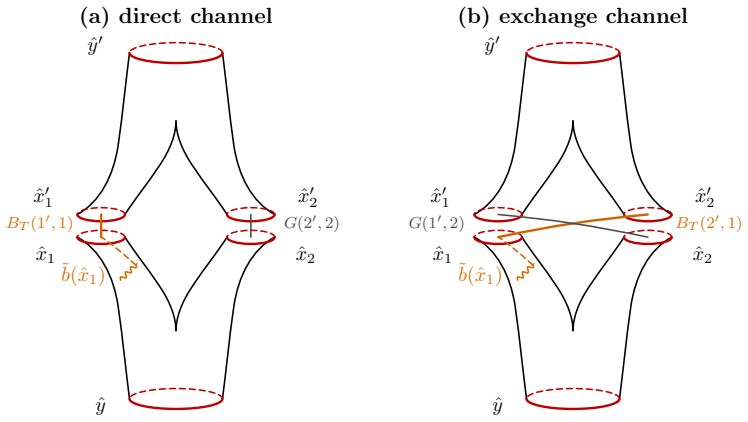
The gravitational Hamiltonian acts on the black hole interior through a pair of pants interaction, mapping between a single interior sector and a connected two interior sector. Evolution over a Page time causes the connected two interior branch to dominate. One of these is the naive semiclassical interior, which carries a nontrivial one sided boost upon gluing the interior back to the exterior, and hence a firewall. The other interior is a zero mode of the one sided boost generator. Gluing the interior back to the exterior quotients by the gravitational constraints, which annihilates the firewall branch. On the surviving branch, the horizon vacuum measurement and the early radiation purity m
What carries the argument
The pair of pants interaction in the gravitational Hamiltonian on the split Hilbert space with boost edge modes at the horizon, whose covariance in the crossed product algebra realizes the firewall as a one-sided boost.
If this is right
- The firewall branch is annihilated upon gluing the interior back to the exterior via the gravitational constraints.
- The horizon vacuum measurement and the early radiation purity measurement become the same Dirac observable on the surviving branch.
- Page time dynamics induces a large diffeomorphism under which the operator algebra of the interior Hawking partner is identified with that of the decoded early radiation.
- Covariance of the crossed product algebra provides a gravitational realization of the firewall as a one sided boost of the interior edge mode.
Where Pith is reading between the lines
- The mechanism may extend to other models of black hole evaporation where relational time evolution is used.
- Similar topology-changing processes could affect other interior observables beyond the boost generator.
- The dominance of the connected branch after Page time suggests a dynamical selection rule that could be checked in numerical simulations of JT gravity.
- The identification of measurements as Dirac observables implies that certain interior and exterior operators commute after the transition.
Load-bearing premise
The pair of pants interaction is the relevant topology changing process under the gravitational Hamiltonian and evolution over Page time causes the connected two interior branch to dominate.
What would settle it
An explicit calculation in the JT gravity model of whether the one-sided boost generator annihilates the firewall-carrying branch after Page time evolution and constraint quotienting.
Figures
read the original abstract
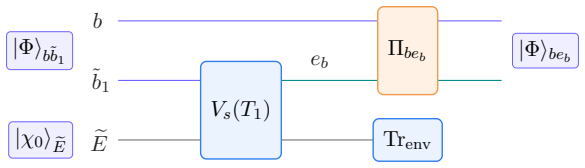
We propose a resolution of the firewall paradox in JT gravity by incorporating topology change into canonical quantization under relational time evolution. The gravitational Hamiltonian acts on the black hole interior through a pair of pants interaction, mapping between a single interior sector and a connected two interior sector. To describe dynamics in the interior while keeping track of the exterior, we pass to an extended phase space description obtained by splitting the bulk Hilbert space across the event horizon. The split introduces boost edge modes at the horizon, which the Hawking modes become gravitationally dressed to. Covariance of the resulting crossed product algebra provides a precise gravitational realization of the firewall: a one sided boost of the interior edge mode relative to the exterior holding the matter fixed, or equivalently, a relative phase between the interior and exterior Hawking partners holding the edge modes fixed. Although each topology changing transition is exponentially suppressed, evolution over a Page time causes the connected two interior branch to dominate. One of these is the naive semiclassical interior, which we show carries a nontrivial one sided boost upon gluing the interior back to the exterior, and hence a firewall. The other interior is shown to be a zero mode of the one sided boost generator. Gluing the interior back to the exterior quotients by the gravitational constraints, which annihilates the firewall branch. On the surviving branch, we show the horizon vacuum measurement and the early radiation purity measurement become the same Dirac observable. Equivalently, we show that Page time dynamics induces a large diffeomorphism on the connected branch under which the operator algebra of the interior Hawking partner and that of the decoded early radiation are identified.
Editorial analysis
A structured set of objections, weighed in public.
Referee Report
Summary. The manuscript proposes a resolution of the firewall paradox in JT gravity by incorporating topology change into canonical quantization under relational time evolution. The gravitational Hamiltonian is argued to act on the black hole interior via a pair-of-pants interaction that maps the single-interior sector to a connected two-interior sector. An extended phase space with boost edge modes at the horizon is introduced, leading to a crossed-product algebra whose covariance realizes the firewall as a one-sided boost. After Page time the connected branch is claimed to dominate; one sub-branch carries a nontrivial boost (firewall) while the other is a zero mode of the boost generator. Gluing the interior back to the exterior quotients by the gravitational constraints, annihilating the firewall component and identifying the horizon vacuum measurement with the early-radiation purity measurement as the same Dirac observable.
Significance. If the central identifications hold, the work supplies a concrete mechanism by which topology change plus constraint quotienting can eliminate firewalls while preserving unitarity, offering a new angle on the black-hole information problem within canonical quantum gravity. The construction of boost edge modes and the crossed-product realization of gravitational dressing are technically novel and could be useful beyond the present application.
major comments (3)
- [Page-time dominance argument (abstract and § on dynamics)] The claim that 'evolution over a Page time causes the connected two interior branch to dominate' is load-bearing yet unsupported by any explicit matrix-element calculation or balance between the exponential suppression of each topology-changing transition and the growth in the dimension of the connected sector; without this step the subsequent dominance argument cannot be assessed.
- [Gluing and constraint quotient (abstract and § on extended phase space)] The statement that gluing the interior back to the exterior 'quotients by the gravitational constraints, which annihilates the firewall branch' while preserving the zero mode of the one-sided boost generator is presented without an explicit operator-level demonstration or check that the zero-mode state lies in the kernel of the constraints after gluing; this identification is central to the resolution.
- [Hamiltonian action on interior (abstract and § on topology change)] The assertion that the gravitational Hamiltonian induces a pair-of-pants interaction mapping single-interior to connected two-interior sectors is introduced as an axiom without derivation from the JT action or explicit form of the interaction term in the canonical theory; this assumption underpins the entire topology-change framework.
minor comments (2)
- [Extended phase space construction] The definition of the crossed-product algebra and the precise action of the boost edge modes on the Hawking partners should be written out explicitly rather than left at the level of covariance statements.
- [Throughout] Notation for the 'connected two interior sector' and 'naive semiclassical interior' is introduced without a clear diagram or Hilbert-space decomposition that would help the reader track the branches.
Simulated Author's Rebuttal
We thank the referee for their careful reading and constructive comments on our manuscript. We respond to each major comment below, providing clarifications from the existing arguments while acknowledging where additional explicit details can strengthen the presentation. We plan revisions accordingly.
read point-by-point responses
-
Referee: [Page-time dominance argument (abstract and § on dynamics)] The claim that 'evolution over a Page time causes the connected two interior branch to dominate' is load-bearing yet unsupported by any explicit matrix-element calculation or balance between the exponential suppression of each topology-changing transition and the growth in the dimension of the connected sector; without this step the subsequent dominance argument cannot be assessed.
Authors: In the dynamics section we argue that the exponential growth of the dimension of the connected two-interior Hilbert space overcomes the per-transition suppression after Page time, based on the known scaling of JT gravity state spaces. We agree an explicit matrix-element estimate would make the balance more rigorous and will add a sketch of the relevant amplitudes (drawing on standard JT transition results) in the revised manuscript. revision: partial
-
Referee: [Gluing and constraint quotient (abstract and § on extended phase space)] The statement that gluing the interior back to the exterior 'quotients by the gravitational constraints, which annihilates the firewall branch' while preserving the zero mode of the one-sided boost generator is presented without an explicit operator-level demonstration or check that the zero-mode state lies in the kernel of the constraints after gluing; this identification is central to the resolution.
Authors: The extended phase space section shows that after gluing the constraints identify the horizon vacuum with the early-radiation purity observable, with the nontrivial boost component annihilated because it fails to be invariant. We acknowledge that a fully explicit operator-level verification of the zero-mode kernel membership is not written out and will include this calculation in the revision. revision: partial
-
Referee: [Hamiltonian action on interior (abstract and § on topology change)] The assertion that the gravitational Hamiltonian induces a pair-of-pants interaction mapping single-interior to connected two-interior sectors is introduced as an axiom without derivation from the JT action or explicit form of the interaction term in the canonical theory; this assumption underpins the entire topology-change framework.
Authors: The pair-of-pants term is motivated as the canonical generator of topology change allowed by diffeomorphism invariance in the JT model with an interior boundary. While the manuscript presents it as the natural implementation, we agree a more explicit derivation from the JT action and canonical constraints would be valuable and will supply this derivation in the revised version. revision: partial
Circularity Check
No significant circularity; derivation relies on model assumptions without reducing claims to self-definition or fitted inputs by construction.
full rationale
The paper's central steps invoke the gravitational Hamiltonian inducing pair-of-pants topology change, Page-time dominance of the connected branch, and constraint quotienting that annihilates the firewall branch while identifying observables. These are presented as consequences of the extended phase space and crossed-product construction in JT gravity, but the provided text supplies no equations or self-citations that make any final observable (e.g., the Dirac equivalence of horizon vacuum and radiation purity) tautologically identical to the input assumptions by construction. No fitted parameters are renamed as predictions, no uniqueness theorems are imported from prior self-work, and no ansatz is smuggled via citation. The framework is therefore self-contained against external benchmarks within the scope of the given material, consistent with a normal non-circular outcome.
Axiom & Free-Parameter Ledger
axioms (2)
- domain assumption Relational time evolution governs the dynamics in the interior while keeping track of the exterior.
- ad hoc to paper The gravitational Hamiltonian acts on the black hole interior through a pair of pants interaction mapping between single interior and connected two interior sectors.
invented entities (2)
-
Boost edge modes at the horizon
no independent evidence
-
Connected two interior sector
no independent evidence
Reference graph
Works this paper leans on
-
[1]
A. Almheiri, D. Marolf, J. Polchinski and J. Sully,Black holes: Complementarity or firewalls?,JHEP02(2013) 062 [1207.3123]. 54
Pith/arXiv arXiv 2013
-
[2]
A. Almheiri, D. Marolf, J. Polchinski, D. Stanford and J. Sully,An apologia for firewalls, JHEP09(2013) 018 [1304.6483]
Pith/arXiv arXiv 2013
-
[3]
P. Hayden and J. Preskill,Black holes as mirrors: quantum information in random subsystems,JHEP09(2007) 120 [0708.4025]
Pith/arXiv arXiv 2007
-
[4]
D. Harlow and P. Hayden,Quantum computation vs. firewalls,JHEP06(2013) 085 [1301.4504]
Pith/arXiv arXiv 2013
-
[5]
D. Marolf and J. Polchinski,Gauge-gravity duality and the black hole interior,Phys. Rev. Lett.111(2013) 171301 [1307.4706]
Pith/arXiv arXiv 2013
-
[6]
Bousso,Firewalls from double purity,Phys
R. Bousso,Firewalls from double purity,Phys. Rev. D88(2013) 084035 [1308.2665]
Pith/arXiv arXiv 2013
-
[7]
Susskind,String theory and the principle of black hole complementarity,Phys
L. Susskind,String theory and the principle of black hole complementarity,Phys. Rev. Lett. 71(1993) 2367 [hep-th/9307168]
Pith/arXiv arXiv 1993
-
[8]
L. Susskind, L. Thorlacius and J. Uglum,The stretched horizon and black hole complementarity,Phys. Rev. D48(1993) 3743 [hep-th/9306069]
Pith/arXiv arXiv 1993
-
[9]
D. A. Lowe, J. Polchinski, L. Susskind, L. Thorlacius and J. Uglum,Black hole complementarity versus locality,Phys. Rev. D52(1995) 6997 [hep-th/9506138]
Pith/arXiv arXiv 1995
-
[10]
Bousso,Complementarity is not enough,Phys
R. Bousso,Complementarity is not enough,Phys. Rev. D87(2013) 124023 [1207.5192]
Pith/arXiv arXiv 2013
-
[11]
K. Papadodimas and S. Raju,An infalling observer in AdS/CFT,JHEP10(2013) 212 [1211.6767]
Pith/arXiv arXiv 2013
-
[12]
K. Papadodimas and S. Raju,Black hole interior in the holographic correspondence and the information paradox,Phys. Rev. Lett.112(2014) 051301 [1310.6334]
Pith/arXiv arXiv 2014
-
[13]
K. Papadodimas and S. Raju,State-dependent bulk-boundary maps and black hole complementarity,Phys. Rev. D89(2014) 086010 [1310.6335]
Pith/arXiv arXiv 2014
-
[14]
K. Papadodimas and S. Raju,Remarks on the necessity and implications of state-dependence in the black hole interior,Phys. Rev. D93(2016) 084049 [1503.08825]
Pith/arXiv arXiv 2016
-
[15]
D. Harlow,Aspects of the papadodimas-raju proposal for the black hole interior,JHEP11 (2014) 055 [1405.1995]
Pith/arXiv arXiv 2014
-
[16]
J. Maldacena and L. Susskind,Cool horizons for entangled black holes,Fortschr. Phys.61 (2013) 781 [1306.0533]
Pith/arXiv arXiv 2013
-
[17]
Raju,Lessons from the information paradox,Phys
S. Raju,Lessons from the information paradox,Phys. Rept.943(2022) 1 [2012.05770]
arXiv 2022
- [18]
-
[19]
C. Chowdhury, O. Papadoulaki and S. Raju,A physical protocol for observers near the boundary to obtain bulk information in quantum gravity,SciPost Phys.10(2021) 106 [2008.01740]
arXiv 2021
-
[20]
Raju,Failure of the split property in gravity and the information paradox,Class
S. Raju,Failure of the split property in gravity and the information paradox,Class. Quant. Grav.39(2022) 064002 [2110.05470]
arXiv 2022
-
[21]
A. Almheiri, X. Dong and D. Harlow,Bulk locality and quantum error correction in AdS/CFT,JHEP04(2015) 163 [1411.7041]. 55
Pith/arXiv arXiv 2015
-
[22]
X. Dong, D. Harlow and A. C. Wall,Reconstruction of bulk operators within the entanglement wedge in gauge-gravity duality,Phys. Rev. Lett.117(2016) 021601 [1601.05416]
Pith/arXiv arXiv 2016
-
[23]
C.-F. Chen, G. Penington and G. Salton,Entanglement wedge reconstruction using the Petz map,JHEP01(2020) 168 [1902.02844]
arXiv 2020
-
[24]
E. Bahiru and N. Vardian,Explicit reconstruction of the entanglement wedge via the Petz map,JHEP07(2023) 025 [2210.00602]
arXiv 2023
-
[25]
D. L. Jafferis and L. Lamprou,Inside the hologram: reconstructing the bulk observer’s experience,JHEP03(2022) 084 [2009.04476]
arXiv 2022
-
[26]
de Boer, D
J. de Boer, D. L. Jafferis and L. Lamprou,On black hole interior reconstruction, singularities and the emergence of time, 2022
2022
-
[27]
A. Almheiri, N. Engelhardt, D. Marolf and H. Maxfield,The entropy of bulk quantum fields and the entanglement wedge of an evaporating black hole,JHEP12(2019) 063 [1905.08762]
Pith/arXiv arXiv 2019
-
[28]
A. Almheiri, R. Mahajan, J. Maldacena and Y. Zhao,The page curve of hawking radiation from semiclassical geometry,JHEP03(2020) 149 [1908.10996]
Pith/arXiv arXiv 2020
-
[29]
A. Almheiri, T. Hartman, J. Maldacena, E. Shaghoulian and A. Tajdini,Replica wormholes and the entropy of hawking radiation,JHEP05(2020) 013 [1911.12333]
Pith/arXiv arXiv 2020
-
[30]
G. Penington,Entanglement wedge reconstruction and the information paradox,JHEP09 (2020) 002 [1905.08255]
Pith/arXiv arXiv 2020
-
[31]
G. Penington, S. H. Shenker, D. Stanford and Z. Yang,Replica wormholes and the black hole interior,JHEP03(2022) 205 [1911.11977]
Pith/arXiv arXiv 2022
-
[32]
Stanford and Z
D. Stanford and Z. Yang,Firewalls from wormholes, 2022
2022
-
[33]
L. V. Iliesiu, A. Levine, H. W. Lin, H. Maxfield and M. Mezei,On the non-perturbative bulk hilbert space of JT gravity,JHEP10(2024) 220 [2403.08696]
arXiv 2024
-
[34]
A. Blommaert, C.-H. Chen and Y. Nomura,Firewalls at exponentially late times,JHEP10 (2024) 131 [2403.07049]
arXiv 2024
-
[35]
C. Akers and G. Penington,Quantum minimal surfaces from quantum error correction, SciPost Phys.12(2022) 157 [2109.14618]
arXiv 2022
- [36]
-
[37]
Almheiri,Measurements with probabilities in the final state proposal, 2025
A. Almheiri,Measurements with probabilities in the final state proposal, 2025
2025
-
[38]
Marolf,Refined algebraic quantization: Systems with a single constraint, 1995
D. Marolf,Refined algebraic quantization: Systems with a single constraint, 1995
1995
-
[39]
D. Marolf and H. Maxfield,Transcending the ensemble: baby universes, spacetime wormholes, and the order and disorder of black hole information,JHEP08(2020) 044 [2002.08950]
arXiv 2020
-
[40]
Casali, D
E. Casali, D. Marolf, H. Maxfield and M. Rangamani,Baby universes and worldline field theories, 2021
2021
-
[41]
Maxfield,Bit models of replica wormholes,2211.04513
H. Maxfield,Bit models of replica wormholes,2211.04513. 56
- [42]
-
[43]
P. Gao, D. L. Jafferis and D. K. Kolchmeyer,An effective matrix model for dynamical end of the world branes in jackiw–teitelboim gravity,JHEP01(2022) 038 [2104.01184]
arXiv 2022
-
[44]
W. Donnelly and L. Freidel,Local subsystems in gauge theory and gravity,JHEP09(2016) 102 [1601.04744]
Pith/arXiv arXiv 2016
-
[45]
V. Chandrasekaran, R. Longo, G. Penington and E. Witten,An algebra of observables for de Sitter space,JHEP02(2023) 082 [2206.10780]
Pith/arXiv arXiv 2023
-
[46]
D. N. Page and W. K. Wootters,Evolution without evolution: Dynamics described by stationary observables,Phys. Rev. D27(1983) 2885
1983
-
[47]
J. E. Marsden and A. Weinstein,Reduction of symplectic manifolds with symmetry,Reports on Mathematical Physics5(1974) 121
1974
-
[48]
V. Chandrasekaran, G. Penington and E. Witten,Large N algebras and generalized entropy, JHEP04(2023) 009 [2209.10454]
arXiv 2023
-
[49]
V. Chandrasekaran and É. É. Flanagan,Subregion algebras in classical and quantum gravity, 2601.07915
-
[50]
B. Yoshida and A. Kitaev,Efficient decoding for the Hayden-Preskill protocol,1710.03363
- [51]
-
[52]
A. I. Abdalla, S. Antonini, L. V. Iliesiu and A. Levine,The gravitational path integral from an observer’s point of view,JHEP05(2025) 059 [2501.02632]
arXiv 2025
-
[53]
G. T. Horowitz and J. Maldacena,The black hole final state,JHEP02(2004) 008 [hep-th/0310281]
Pith/arXiv arXiv 2004
-
[54]
D. Gottesman and J. Preskill,Comment on “the black hole final state”,JHEP03(2004) 026 [hep-th/0311269]
Pith/arXiv arXiv 2004
-
[55]
S. Lloyd and J. Preskill,Unitarity of black hole evaporation in final-state projection models, JHEP08(2014) 126 [1308.4209]
Pith/arXiv arXiv 2014
-
[56]
R. Bousso and D. Stanford,Measurements without probabilities in the final state proposal, Phys. Rev. D89(2014) 044038 [1310.7457]
Pith/arXiv arXiv 2014
-
[57]
Held and H
J. Held and H. Maxfield,The hilbert space of de sitter JT: a case study for canonical methods in quantum gravity, 2024
2024
-
[58]
Rovelli,What is observable in classical and quantum gravity?,Class
C. Rovelli,What is observable in classical and quantum gravity?,Class. Quant. Grav.8 (1991) 297
1991
-
[59]
D. Giulini and D. Marolf,A uniqueness theorem for constraint quantization,Class. Quant. Grav.16(1999) 2489 [gr-qc/9902045]
Pith/arXiv arXiv 1999
-
[60]
Dittrich,Partial and complete observables for canonical general relativity,Class
B. Dittrich,Partial and complete observables for canonical general relativity,Class. Quant. Grav.23(2006) 6155 [gr-qc/0507106]
Pith/arXiv arXiv 2006
-
[61]
Dittrich,Partial and complete observables for hamiltonian constrained systems,Gen
B. Dittrich,Partial and complete observables for hamiltonian constrained systems,Gen. Rel. Grav.39(2007) 1891 [gr-qc/0411013]
Pith/arXiv arXiv 2007
-
[62]
Rovelli,Time in quantum gravity: An hypothesis,Phys
C. Rovelli,Time in quantum gravity: An hypothesis,Phys. Rev. D43(1991) 442. 57
1991
-
[63]
Marolf,Almost ideal clocks in quantum cosmology: A brief derivation of time,Class
D. Marolf,Almost ideal clocks in quantum cosmology: A brief derivation of time,Class. Quant. Grav.12(1995) 2469 [gr-qc/9412016]
Pith/arXiv arXiv 1995
-
[64]
Rovelli,Partial observables,Phys
C. Rovelli,Partial observables,Phys. Rev. D65(2002) 124013
2002
-
[65]
R. P. Geroch,Topology in general relativity,J. Math. Phys.8(1967) 782
1967
-
[66]
F. J. Tipler,Singularities and causality violation,Annals Phys.108(1977) 1
1977
-
[67]
G. T. Horowitz,Topology change in classical and quantum gravity,Class. Quant. Grav.8 (1991) 587 [hep-th/9109030]
Pith/arXiv arXiv 1991
-
[68]
Borde,Topology change in classical general relativity, 1994
A. Borde,Topology change in classical general relativity, 1994
1994
-
[69]
F. Dowker and S. Surya,Topology change and causal continuity,Phys. Rev. D58(1998) 124019 [gr-qc/9711070]
Pith/arXiv arXiv 1998
-
[70]
B. Post, J. van der Heijden and E. Verlinde,A universe field theory for jt gravity,JHEP05 (2022) 118 [2201.08859]
arXiv 2022
-
[71]
Usatyuk,Comments on Lorentzian topology change in JT gravity,2210.04906
M. Usatyuk,Comments on Lorentzian topology change in JT gravity,2210.04906
-
[72]
A. J. Speranza,Local phase space and edge modes for diffeomorphism-invariant theories, JHEP02(2018) 021 [1706.05061]
Pith/arXiv arXiv 2018
-
[73]
J. Maldacena, D. Stanford and Z. Yang,Conformal symmetry and its breaking in two-dimensional nearly anti-de-sitter space,Prog. Theor. Exp. Phys.2016(2016) 12C104 [1606.01857]
Pith/arXiv arXiv 2016
-
[74]
Y. Sekino and L. Susskind,Fast scramblers,JHEP10(2008) 065 [0808.2096]
Pith/arXiv arXiv 2008
-
[75]
F. Dupuis, M. Berta, J. Wullschleger and R. Renner,One-shot decoupling,Commun. Math. Phys.328(2014) 251 [1012.6044]
Pith/arXiv arXiv 2014
-
[76]
Szehr, F
O. Szehr, F. Dupont-Dupuis, M. Tomamichel and R. Renner,Decoupling with unitary approximate two-designs,New J. Phys.15(2013) 053022
2013
-
[77]
W. Brown and O. Fawzi,Decoupling with random quantum circuits,Commun. Math. Phys. 340(2015) 867 [1307.0632]
Pith/arXiv arXiv 2015
-
[78]
D. A. Roberts and B. Yoshida,Chaos and complexity by design,JHEP04(2017) 121 [1610.04903]. 58
Pith/arXiv arXiv 2017
discussion (0)
Sign in with ORCID, Apple, or X to comment. Anyone can read and Pith papers without signing in.