1/3 Fractional and Gapless Integer Quantum Anomalous Hall States in Rhombohedral Graphene
Pith reviewed 2026-06-27 23:52 UTC · model grok-4.3
The pith
Rhombohedral five-layer graphene on boron nitride hosts a 1/3 fractional Chern insulator that transitions to a charge density wave.
A machine-rendered reading of the paper's core claim, the machinery that carries it, and where it could break.
Core claim
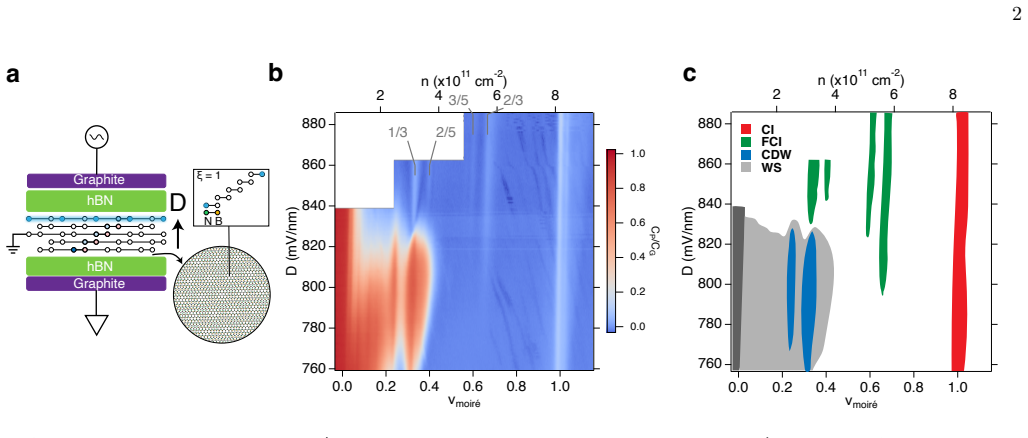
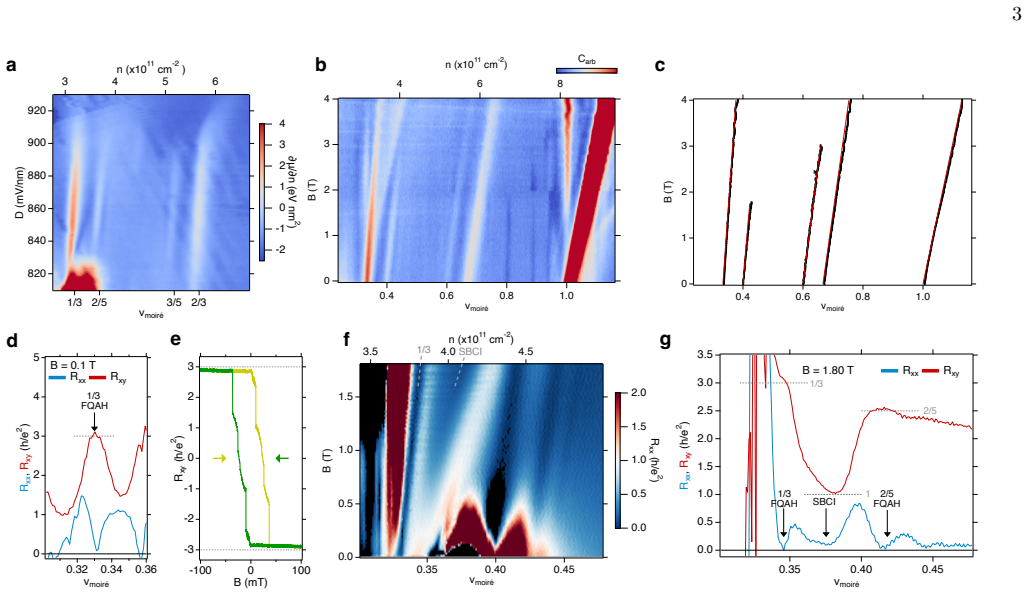
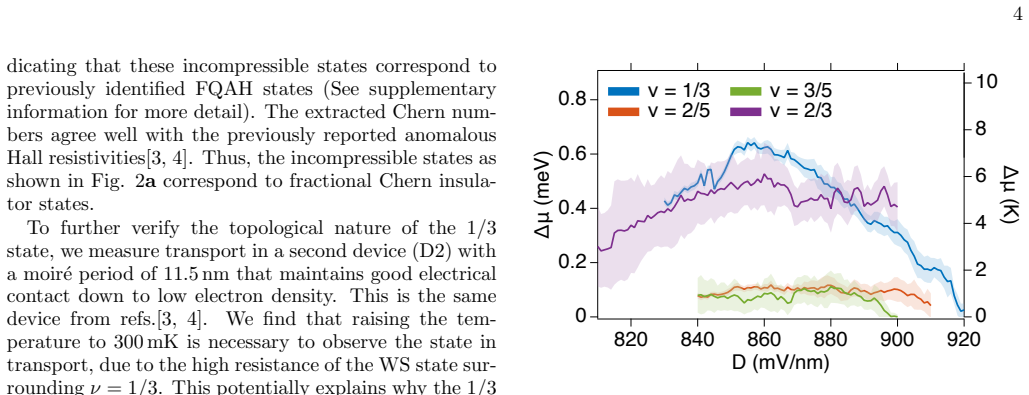
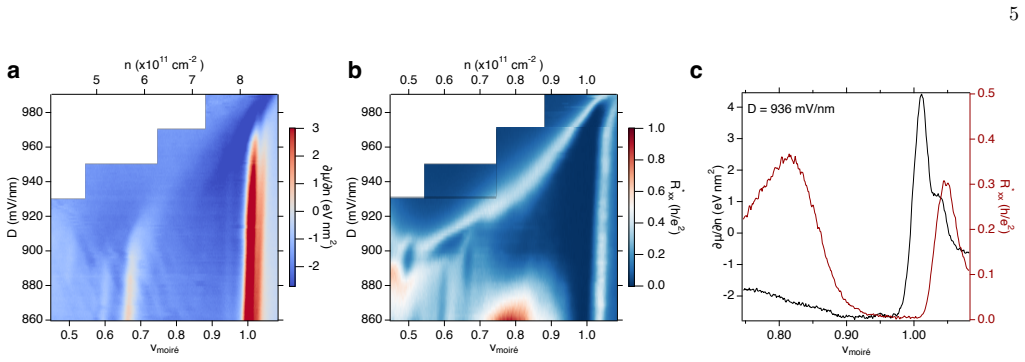
We report the FQAH effect at moiré filling factor ν = 1/3 in R5G/hBN moiré superlattice devices, through a combination of quantum capacitance and transport measurements. By tuning the displacement field, we observed a topological phase transition from a 1/3 fractional Chern insulator (FCI) to a trivial charge density wave state. With the inclusion of the 1/3 state, the FQAH states in R5G/hBN now exhibit a surprising level of particle-hole symmetry about half-filling, closely resembling the behavior of FQH states in the lowest Landau level. Compressibility measurements at ν=1 reveal a distinct transition from a gapped IQAH state to a gapless and highly compressible EQAH state.
What carries the argument
Moiré superlattice in rhombohedral five-layer graphene aligned to hBN, read out by quantum capacitance for thermodynamic compressibility combined with transport Hall response.
If this is right
- FQAH states in this system display particle-hole symmetry about half filling.
- A displacement-field-tuned transition separates the 1/3 fractional Chern insulator from a trivial charge density wave.
- At ν=1 the extended quantum anomalous Hall regime is thermodynamically gapless while the integer state remains gapped.
- Direct thermodynamic access to the phase diagram opens routes to anyon braiding studies at zero magnetic field.
Where Pith is reading between the lines
- The observed symmetry suggests the underlying interaction and topology mechanism may be closer to conventional Landau-level physics than previously thought for graphene moiré systems.
- The gapless character at ν=1 could imply metallic or critical behavior that might host different quasiparticle statistics if further tuned.
- Similar capacitance-plus-transport protocols could be applied to other moiré platforms to map full thermodynamic phase diagrams.
Load-bearing premise
Quantum capacitance data directly reflect intrinsic thermodynamic compressibility of the fractional state without significant masking by disorder, contact effects, or competing orders.
What would settle it
No dip in compressibility at ν=1/3 or no displacement-field-driven transition from incompressible to compressible behavior at that filling.
Figures
read the original abstract
The fractional quantum anomalous Hall (FQAH) effect occurs in moir\'e superlattices in both twisted bilayer MoTe$_2$ and rhombohedral $n$-layer graphene aligned to hexagonal boron nitride (R$n$G/hBN) as a novel quantum phase driven by intertwined electron correlation and topology. Although several fractional states in the Jain sequence have been identified, the $1/3$ state, the most robust and fundamental state in conventional fractional quantum Hall (FQH) systems, was missing in either FQAH system. Determining whether it exists would have a major impact on understanding the mechanism of FQAH, especially in the theoretically still-debated R$n$G/hBN system. Here we report the FQAH effect at moir\'e filling factor $\nu = 1/3$ in R$5$G/hBN moir\'e superlattice devices, through a combination of quantum capacitance and transport measurements. By tuning the displacement field, we observed a topological phase transition from a $1/3$ fractional Chern insulator (FCI) to a trivial charge density wave state. With the inclusion of the $1/3$ state, the FQAH states in R$5$G/hBN now exhibit a surprising level of particle-hole symmetry about half-filling, closely resembling the behavior of FQH states in the lowest Landau level. Additionally, we perform compressibility and transport measurements at a filling of one electron per moir\'e unit cell, $\nu =1$, and also for $\nu \lesssim 1$, where previous transport measurements displayed the extended quantum anomalous Hall (EQAH) effect. While our transport measurements show no change between the integer quantum anomalous Hall state (IQAH) and the EQAH region, compressibility measurements reveal a distinct transition from a gapped IQAH state to a gapless and highly compressible EQAH state. Our direct thermodynamic characterization of the rich phase diagram paves the way to engineering of anyon braiding and non-Abelian quasiparticles at zero magnetic field.
Editorial analysis
A structured set of objections, weighed in public.
Referee Report
Summary. The manuscript reports the experimental observation of the 1/3 fractional quantum anomalous Hall (FQAH) state at moiré filling ν=1/3 in rhombohedral 5-layer graphene aligned to hBN, using quantum capacitance and transport measurements. It describes a displacement-field-driven topological transition from a fractional Chern insulator to a trivial charge density wave, notes an apparent particle-hole symmetry in the FQAH sequence around half-filling, and identifies at ν=1 a transition from a gapped integer quantum anomalous Hall (IQAH) state to a gapless, highly compressible extended QAH (EQAH) state via compressibility data.
Significance. If the central observations hold after additional controls, the work would complete the Jain-sequence FQAH states in the R n G/hBN platform, establish a direct analogy to lowest-Landau-level fractional quantum Hall physics, and supply thermodynamic evidence distinguishing gapped versus gapless phases at integer filling. This would strengthen the case for correlation-driven topology in zero-field moiré systems and support future efforts toward anyon manipulation.
major comments (2)
- [Abstract and Results (capacitance data)] Abstract and main text description of capacitance measurements at ν=1/3: the interpretation that capacitance minima directly demonstrate a thermodynamic gap of a fractional Chern insulator (rather than broadened features from inhomogeneity or contacts) is load-bearing for the central claim, yet the manuscript provides no explicit discussion of background subtraction, contact calibration, or electrostatic modeling to exclude these confounds.
- [Results (ν=1 compressibility and transport)] Results on ν=1 and ν≲1: transport data are stated to show no change across the IQAH-to-EQAH boundary while compressibility reveals a distinct transition, but without reported error bars, sample-to-sample statistics, or quantitative gap values the distinction between gapped and gapless states remains difficult to assess quantitatively.
minor comments (1)
- Notation for device labeling (R5G/hBN versus rhombohedral 5-layer graphene) should be standardized in the main text and figure captions for clarity.
Simulated Author's Rebuttal
We thank the referee for their careful reading of the manuscript and for highlighting these important points regarding data analysis and quantitative assessment. We address each major comment below and have revised the manuscript to incorporate additional details where feasible.
read point-by-point responses
-
Referee: [Abstract and Results (capacitance data)] Abstract and main text description of capacitance measurements at ν=1/3: the interpretation that capacitance minima directly demonstrate a thermodynamic gap of a fractional Chern insulator (rather than broadened features from inhomogeneity or contacts) is load-bearing for the central claim, yet the manuscript provides no explicit discussion of background subtraction, contact calibration, or electrostatic modeling to exclude these confounds.
Authors: We agree that an explicit discussion of these analysis procedures would strengthen the presentation. In the revised manuscript we will add a dedicated paragraph in the main text (and expanded details in the supplement) describing the background subtraction method applied to the quantum capacitance traces, the contact resistance calibration procedure, and a simple electrostatic model used to estimate the scale of inhomogeneity broadening. These additions will directly address the possibility of artifacts and support the interpretation of the ν=1/3 minima as thermodynamic gaps of the fractional Chern insulator. revision: yes
-
Referee: [Results (ν=1 compressibility and transport)] Results on ν=1 and ν≲1: transport data are stated to show no change across the IQAH-to-EQAH boundary while compressibility reveals a distinct transition, but without reported error bars, sample-to-sample statistics, or quantitative gap values the distinction between gapped and gapless states remains difficult to assess quantitatively.
Authors: We acknowledge the value of quantitative error bars and statistics. The revised manuscript will include error bars on the compressibility data (derived from measurement noise and repeated sweeps) and will report consistency across the devices measured in this study. However, extracting precise numerical gap values from compressibility requires additional modeling assumptions about the density of states; we will clarify these limitations in the text. Full temperature-dependent transport gap extraction across the transition lies outside the present dataset and would require new measurements. revision: partial
Circularity Check
Purely experimental observations; no derivation chain present
full rationale
The paper reports direct experimental measurements of quantum capacitance and transport in R5G/hBN moiré devices at fillings ν=1/3 and ν=1. No equations, fitted parameters, or predictions are derived from prior results within the paper. Claims rest on observed capacitance minima, phase transitions under displacement field, and transport features, without any self-referential reduction or ansatz smuggling. The reader's assessment of 0.0 circularity is confirmed; this is a standard experimental report with no load-bearing derivations to inspect.
Axiom & Free-Parameter Ledger
axioms (2)
- domain assumption Quantum capacitance measurements faithfully report the thermodynamic density of states and compressibility of the moiré superlattice.
- standard math Standard quantum mechanics and band topology apply to the R5G/hBN system under displacement field tuning.
Forward citations
Cited by 2 Pith papers
-
Valley Valves at Domain Walls in Symmetry-Broken Rhombohedral Graphene
Valley domain walls act as impenetrable barriers to transport in metallic rhombohedral graphene unless intervalley interactions mediate transmission, and intervalley mixing is required for appreciable supercurrent in ...
-
Superconductivity and non-Fermi liquid metals in a charge-1/3 anyon fluid
Doping a fractional Chern insulator yields an anyon fluid that can form an SC* superconductor with residual Z2 order or a non-Fermi liquid Z3 orthogonal metal.
Reference graph
Works this paper leans on
-
[1]
H. Park, J. Cai, E. Anderson, Y. Zhang, J. Zhu, X. Liu, C. Wang, W. Holtzmann, C. Hu, Z. Liu, T. Taniguchi, K. Watanabe, J.-H. Chu, T. Cao, L. Fu, W. Yao, C.-Z. Chang, D. Cobden, D. Xiao, and X. Xu, Nature622, 74 (2023)
2023
-
[2]
F. Xu, Z. Sun, T. Jia, C. Liu, C. Xu, C. Li, Y. Gu, K. Watanabe, T. Taniguchi, B. Tong, J. Jia, Z. Shi, S. Jiang, Y. Zhang, X. Liu, and T. Li, Physical Review X13, 031037 (2023)
2023
-
[3]
Z. Lu, T. Han, Y. Yao, A. P. Reddy, J. Yang, J. Seo, K. Watanabe, T. Taniguchi, L. Fu, and L. Ju, Nature626, 759 (2024)
2024
-
[4]
Z. Lu, T. Han, Y. Yao, Z. Hadjri, J. Yang, J. Seo, L. Shi, S. Ye, K. Watanabe, T. Taniguchi, and L. Ju, Nature637, 1090 (2025)
2025
-
[5]
J. Xie, Z. Huo, X. Lu, Z. Feng, Z. Zhang, W. Wang, Q. Yang, K. Watanabe, T. Taniguchi, K. Liu, Z. Song, X. C. Xie, J. Liu, and X. Lu, Nature Materials24, 1042 (2025)
2025
-
[6]
J. K. Jain, Physical Review Letters63, 199 (1989)
1989
-
[7]
R. B. Laughlin, Physical Review Letters50, 1395 (1983)
1983
-
[8]
M. Uzan, W. Zhi, M. Bocarsly, J. Dong, S. Dutta, N. Auerbach, N. S. Kander, M. Labendik, Y. Myasoedov, M. E. Huber, K. Watanabe, T. Taniguchi, D. E. Parker, and E. Zeldov, hBN alignment orientation controls moir´ e strength in rhombohedral graphene (2025), version Num- ber: 1
2025
-
[9]
F. Xu, Z. Sun, J. Li, C. Zheng, C. Xu, J. Gao, T. Jia, K. Watanabe, T. Taniguchi, B. Tong, L. Lu, J. Jia, Z. Shi, S. Jiang, Y. Zhang, Y. Zhang, S. Lei, X. Liu, and T. Li, Signatures of unconventional superconductivity near reen- trant and fractional quantum anomalous Hall insulators (2025), version Number: 1
2025
-
[10]
F. Wu, T. Lovorn, E. Tutuc, I. Martin, and A. MacDon- ald, Physical Review Letters122, 086402 (2019)
2019
-
[11]
H. Li, U. Kumar, K. Sun, and S.-Z. Lin, Physical Review Research3, L032070 (2021)
2021
-
[12]
H. Yu, M. Chen, and W. Yao, National Science Review 7, 12 (2020)
2020
-
[13]
Devakul, V
T. Devakul, V. Cr´ epel, Y. Zhang, and L. Fu, Nature Communications12, 6730 (2021)
2021
-
[14]
T. Tan, P. J. Ledwith, and T. Devakul, The ideal limit of rhombohedral graphene: Interaction-induced layer- skyrmion lattices and their collective excitations (2025), version Number: 1
2025
-
[15]
H. Li, B. A. Bernevig, and N. Regnault, Physical Review B112, 075130 (2025)
2025
-
[16]
J. Yu, J. Herzog-Arbeitman, Y. H. Kwan, N. Regnault, and B. A. Bernevig, Physical Review B112, 075110 (2025)
2025
-
[17]
Huang, S
K. Huang, S. Das Sarma, and X. Li, Physical Review B 111, 075130 (2025)
2025
-
[18]
B. Zhou, H. Yang, and Y.-H. Zhang, Physical Review Letters133, 10.1103/physrevlett.133.206504 (2024)
-
[19]
Z. Dong, A. S. Patri, and T. Senthil, Physical Review Letters133, 206502 (2024)
2024
-
[20]
K. Huang, X. Li, S. Das Sarma, and F. Zhang, Physical Review B110, 10.1103/physrevb.110.115146 (2024)
-
[21]
Z. Guo, X. Lu, B. Xie, and J. Liu, Physical Review B 110, 075109 (2024)
2024
-
[22]
M. Xie and S. Das Sarma, Physical Review B109, 10.1103/physrevb.109.l241115 (2024)
-
[23]
Song, C.-M
X.-Y. Song, C.-M. Jian, L. Fu, and C. Xu, Physical Re- view B109, 115116 (2024)
2024
-
[24]
J. P. Eisenstein, L. N. Pfeiffer, and K. W. West, Physical Review Letters68, 674 (1992)
1992
-
[25]
J. P. Eisenstein, L. N. Pfeiffer, and K. W. West, Physical Review B50, 1760 (1994)
1994
-
[26]
R. K. Goodall, R. J. Higgins, and J. P. Harrang, Physical Review B31, 6597 (1985)
1985
-
[27]
S. C. Dultz and H. W. Jiang, Physical Review Letters 84, 4689 (2000)
2000
-
[28]
A. A. Zibrov, C. Kometter, H. Zhou, E. M. Spanton, T. Taniguchi, K. Watanabe, M. P. Zaletel, and A. F. Young, Nature549, 360 (2017)
2017
-
[29]
T. Han, J. P. Butler, S. Ye, Z. Hua, S. Dutta, Z. Had- jri, Z. Wu, J. Yang, J. Seo, P. Pattanakanvijit, E. Aitken, K. Watanabe, T. Taniguchi, P. Xiong, E. Zeldov, Z. Lu, R. Ashoori, and L. Ju, Evidence of Metallic Wigner Crys- tal in Rhombohedral Graphene (2026), version Number: 1
2026
-
[31]
Streda, Journal of Physics C: Solid State Physics15, L1299 (1982)
P. Streda, Journal of Physics C: Solid State Physics15, L1299 (1982). 7
1982
-
[32]
Streda, Journal of Physics C: Solid State Physics15, L717 (1982)
P. Streda, Journal of Physics C: Solid State Physics15, L717 (1982)
1982
-
[33]
Y. Xie, A. T. Pierce, J. M. Park, D. E. Parker, E. Khalaf, P. Ledwith, Y. Cao, S. H. Lee, S. Chen, P. R. Forrester, K. Watanabe, T. Taniguchi, A. Vishwanath, P. Jarillo- Herrero, and A. Yacoby, Nature600, 439 (2021)
2021
-
[34]
E. M. Spanton, A. A. Zibrov, H. Zhou, T. Taniguchi, K. Watanabe, M. P. Zaletel, and A. F. Young, Science 360, 62 (2018)
2018
-
[35]
M. He, J. Cai, Y.-H. Zhang, Y. Liu, Y. Li, T. Taniguchi, K. Watanabe, D. H. Cobden, M. Yankowitz, and X. Xu, Nano Letters23, 11066 (2023)
2023
-
[36]
Saito, J
Y. Saito, J. Ge, L. Rademaker, K. Watanabe, T. Taniguchi, D. A. Abanin, and A. F. Young, Nature Physics17, 478 (2021)
2021
-
[37]
L. Wang, Y. Gao, B. Wen, Z. Han, T. Taniguchi, K. Watanabe, M. Koshino, J. Hone, and C. R. Dean, Sci- ence350, 1231 (2015)
2015
-
[38]
Waters, A
D. Waters, A. Okounkova, R. Su, B. Zhou, J. Yao, K. Watanabe, T. Taniguchi, X. Xu, Y.-H. Zhang, J. Folk, and M. Yankowitz, Physical Review X15, 011045 (2025)
2025
-
[39]
Assouline, T
A. Assouline, T. Wang, H. Zhou, L. A. Cohen, F. Yang, R. Zhang, T. Taniguchi, K. Watanabe, R. S. Mong, M. P. Zaletel, and A. F. Young, Physical Review Letters132, 046603 (2024)
2024
-
[40]
S. I. Dorozhkin, R. J. Haug, K. von Klitzing, and K. Ploog, Physical Review B51, 14729 (1995)
1995
-
[41]
Hu, Y.-C
Y. Hu, Y.-C. Tsui, M. He, U. Kamber, T. Wang, A. S. Mohammadi, K. Watanabe, T. Taniguchi, Z. Papi´ c, M. P. Zaletel, and A. Yazdani, Nature Physics21, 716 (2025)
2025
-
[42]
Y. Choi, Y. Choi, M. Valentini, C. L. Patterson, L. F. W. Holleis, O. I. Sheekey, H. Stoyanov, X. Cheng, T. Taniguchi, K. Watanabe, and A. F. Young, Nature639, 342 (2025)
2025
-
[43]
Polshyn, H
H. Polshyn, H. Zhou, E. Spanton, T. Taniguchi, K. Watanabe, and A. Young, Physical Review Letters121, 226801 (2018)
2018
-
[44]
R. R. Du, H. L. Stormer, D. C. Tsui, L. N. Pfeiffer, and K. W. West, Physical Review Letters70, 2944 (1993)
1993
-
[45]
R. Xiao, F. Tasn´ adi, K. Koepernik, J. W. F. Venderbos, M. Richter, and M. Taut, Physical Review B84, 165404 (2011)
2011
-
[46]
H. Park, W. Li, C. Hu, C. Beach, M. Gon¸ calves, J. F. Mendez-Valderrama, J. Herzog-Arbeitman, T. Taniguchi, K. Watanabe, D. Cobden, L. Fu, B. A. Bernevig, N. Reg- nault, J.-H. Chu, D. Xiao, and X. Xu, Observation of High-Temperature Dissipationless Fractional Chern Insu- lator (2025), version Number: 1
2025
-
[47]
Redekop, C
E. Redekop, C. Zhang, H. Park, J. Cai, E. Anderson, O. Sheekey, T. Arp, G. Babikyan, S. Salters, K. Watan- abe, T. Taniguchi, M. E. Huber, X. Xu, and A. F. Young, Nature635, 584 (2024)
2024
-
[48]
A. S. Patri, Z. Dong, and T. Senthil, Physical Review B 110, 245115 (2024)
2024
-
[49]
J. Dong, T. Wang, T. Wang, T. Soejima, M. P. Zaletel, A. Vishwanath, and D. E. Parker, Physical Review Letters 133, 206503 (2024)
2024
-
[50]
J. Jang, B. M. Hunt, L. N. Pfeiffer, K. W. West, and R. C. Ashoori, Nature Physics13, 340 (2017)
2017
-
[51]
Y. Chen, R. M. Lewis, L. W. Engel, D. C. Tsui, P. D. Ye, L. N. Pfeiffer, and K. W. West, Physical Review Letters 91, 016801 (2003)
2003
-
[52]
Lewis, Y
R. Lewis, Y. Chen, L. Engel, D. Tsui, P. Ye, L. Pfeiffer, and K. West, Physica E: Low-dimensional Systems and Nanostructures22, 104 (2004)
2004
-
[53]
H. Zhou, H. Polshyn, T. Taniguchi, K. Watanabe, and A. F. Young, Nature Physics16, 154 (2020)
2020
-
[54]
M. P. Lilly, K. B. Cooper, J. P. Eisenstein, L. N. Pfeiffer, and K. W. West, Physical Review Letters82, 394 (1999)
1999
-
[55]
M. M. Fogler, A. A. Koulakov, and B. I. Shklovskii, Phys- ical Review B54, 1853 (1996)
1996
-
[56]
A. A. Koulakov, M. M. Fogler, and B. I. Shklovskii, Phys- ical Review Letters76, 499 (1996)
1996
-
[57]
J. P. Eisenstein, K. B. Cooper, L. N. Pfeiffer, and K. W. West, Physical Review Letters88, 076801 (2002)
2002
-
[58]
R. M. Lewis, Y. P. Chen, L. W. Engel, D. C. Tsui, L. N. Pfeiffer, and K. W. West, Physical Review B71, 081301 (2005)
2005
-
[59]
N. Deng, A. Kumar, M. J. Manfra, L. N. Pfeiffer, K. W. West, and G. A. Cs´ athy, Physical Review Letters108, 086803 (2012)
2012
-
[60]
S. Chen, R. Ribeiro-Palau, K. Yang, K. Watanabe, T. Taniguchi, J. Hone, M. O. Goerbig, and C. R. Dean, Physical Review Letters122, 026802 (2019)
2019
-
[61]
Gr¨ uner, A
G. Gr¨ uner, A. Zettl, W. G. Clark, and A. H. Thompson, Physical Review B23, 6813 (1981)
1981
-
[62]
R. M. Fleming and C. C. Grimes, Physical Review Let- ters42, 1423 (1979)
1979
-
[63]
Xiang, H
Z. Xiang, H. Li, J. Xiao, M. H. Naik, Z. Ge, Z. He, S. Chen, J. Nie, S. Li, Y. Jiang, R. Sailus, R. Banerjee, T. Taniguchi, K. Watanabe, S. Tongay, S. G. Louie, M. F. Crommie, and F. Wang, Science388, 736 (2025)
2025
-
[64]
Y.-C. Tsui, M. He, Y. Hu, E. Lake, T. Wang, K. Watan- abe, T. Taniguchi, M. P. Zaletel, and A. Yazdani, Nature 628, 287 (2024). 8 VI. METHODS A. Device Fabrication The graphene and hBN flakes were prepared by me- chanical exfoliation onto SiO 2/Si substrates. The rhom- bohedral domains of pentalayer graphene were identified and confirmed using IR camera, ...
2024
-
[66]
S. C. De La Barrera, S. Aronson, Z. Zheng, K. Watanabe, T. Taniguchi, Q. Ma, P. Jarillo-Herrero, and R. Ashoori, Nature Physics18, 771 (2022)
2022
-
[67]
Aronson, The Electronic Compressibility of Rhombohedral Graphene Multilayers, PhD Thesis, Massachusetts Institute of Technology (2025)
Samuel H. Aronson, The Electronic Compressibility of Rhombohedral Graphene Multilayers, PhD Thesis, Massachusetts Institute of Technology (2025)
2025
-
[68]
Spencer Louis Tomarken, Thermodynamic and Tunneling Measurements of van der Waals Heterostructures, PhD Thesis, Massachusetts Institute of Technology (2019)
2019
-
[69]
#/"n (eV nm 2 ) 4.44.03.63.22.8 n (x10 11 cm -2 ) $ = 1/3 %# = 0.59 ± 0.02 meV 4 3 2 1 0 -1 6.56.05.55.0 n (x10 11 cm -2 ) !
Raymond C. Ashoori, The Density of States in The Two-Dimensional Electron Gas and Quantum Dots, PhD Thesis, Cornell University (1991). 10 11 Extended Data 8006004002000-200-400-600D (mV/nm) 43210νmoiré 0123n (x1012 cm-2) 1.00.80.60.40.20.0CP/CG FIG. Extended 1: Full phase diagram as measured by penetration capacitance atf= 3.78 MHz andT= 320 mK. We identi...
1991
-
[70]
(meV) 860855850845840835830 D (mV/nm) 10 5 10 6 f (Hz) # = 1/3 1.0 0.8 0.6 0.4 0.2 0.0 !
Error Analysis of Compressibility and the Thermodynamic Gap Each of the values used to determine the compressibility carries some uncertainty that must be propagated through to the final gap value. First, we derive the uncertainty of ∂µ ∂n . We defineK= χ−χband χgap−χ . σ2 ∂µ ∂n =e 2 1 ctg +c bg " ∂K ∂χband 2 σ2 χband + ∂K ∂χgap 2 σ2 χgap + ∂K ∂χp 2 σ2 χp...
-
[71]
S. H. Aronson, T. Han, Z. Lu, Y. Yao, J. P. Butler, K. Watanabe, T. Taniguchi, L. Ju, and R. C. Ashoori, Physical Review X15, 031026 (2025)
2025
-
[72]
Aronson, The Electronic Compressibility of Rhombohedral Graphene Multilayers, PhD Thesis, Massachusetts Institute of Technology (2025)
Samuel H. Aronson, The Electronic Compressibility of Rhombohedral Graphene Multilayers, PhD Thesis, Massachusetts Institute of Technology (2025). 25 5 μm V FIG. SI 1: Picture of device and configuration of the four-terminal transport measurement on sample D1. The drain contact here is kept grounded in the refrigerator
2025
discussion (0)
Sign in with ORCID, Apple, or X to comment. Anyone can read and Pith papers without signing in.