Valley Valves at Domain Walls in Symmetry-Broken Rhombohedral Graphene
Pith reviewed 2026-06-27 04:19 UTC · model grok-4.3
The pith
Valley domain walls in rhombohedral graphene are impenetrable to transport without intervalley mixing.
A machine-rendered reading of the paper's core claim, the machinery that carries it, and where it could break.
Core claim
Valley domain walls are impenetrable barriers to transport in the metallic regime of symmetry-broken rhombohedral graphene. Transmission must therefore be mediated by intervalley interactions, which the authors derive from symmetry and confirm with microscopic simulations. In the superconducting phase, intervalley mixing is crucial for supporting an appreciable supercurrent through an SNS' Josephson junction connecting opposite-chirality superconducting regions.
What carries the argument
Symmetry-allowed intervalley interaction terms that mediate electron transmission across valley domain walls.
Load-bearing premise
The symmetry-broken valley-polarized phase with domain walls is realized and the microscopic Hamiltonian accurately captures the relevant intervalley processes.
What would settle it
Direct measurement showing finite transmission across a domain wall in the metallic phase even when intervalley coupling is suppressed, or zero supercurrent in an opposite-chirality Josephson junction despite the presence of intervalley mixing.
Figures
read the original abstract
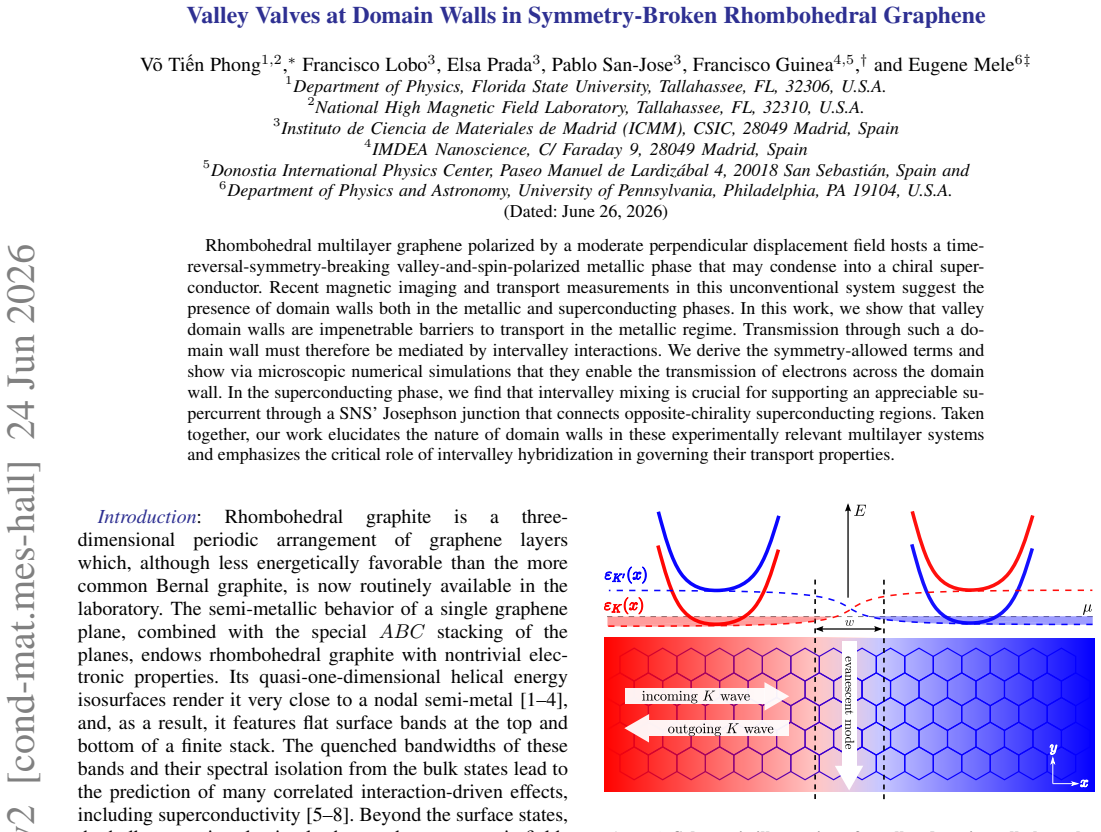
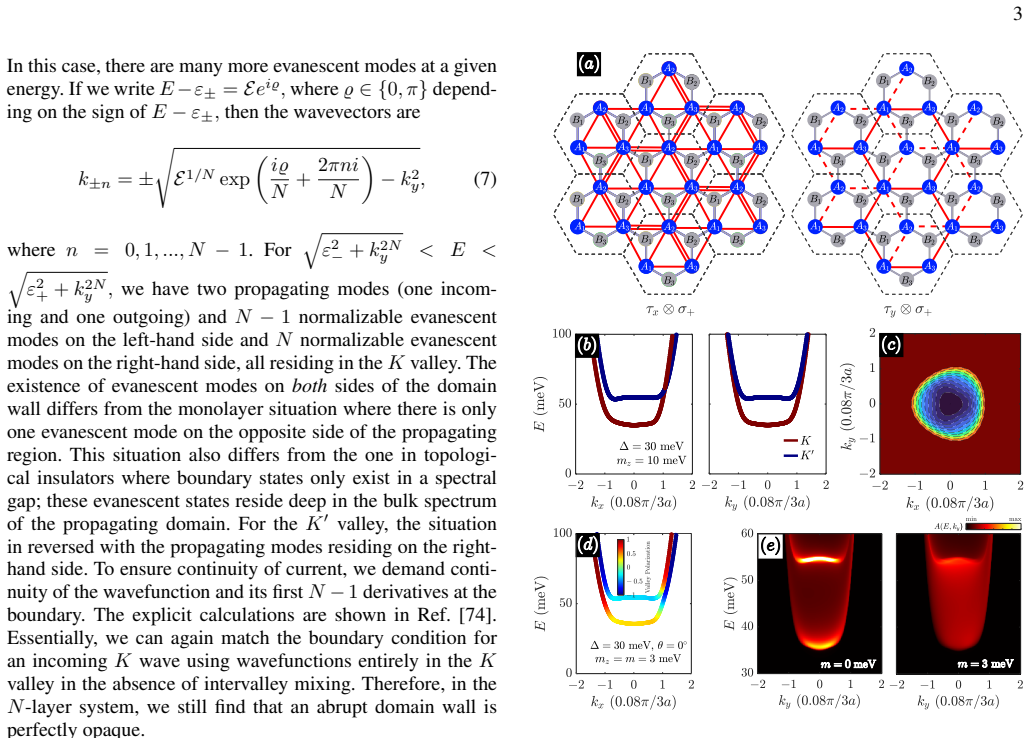
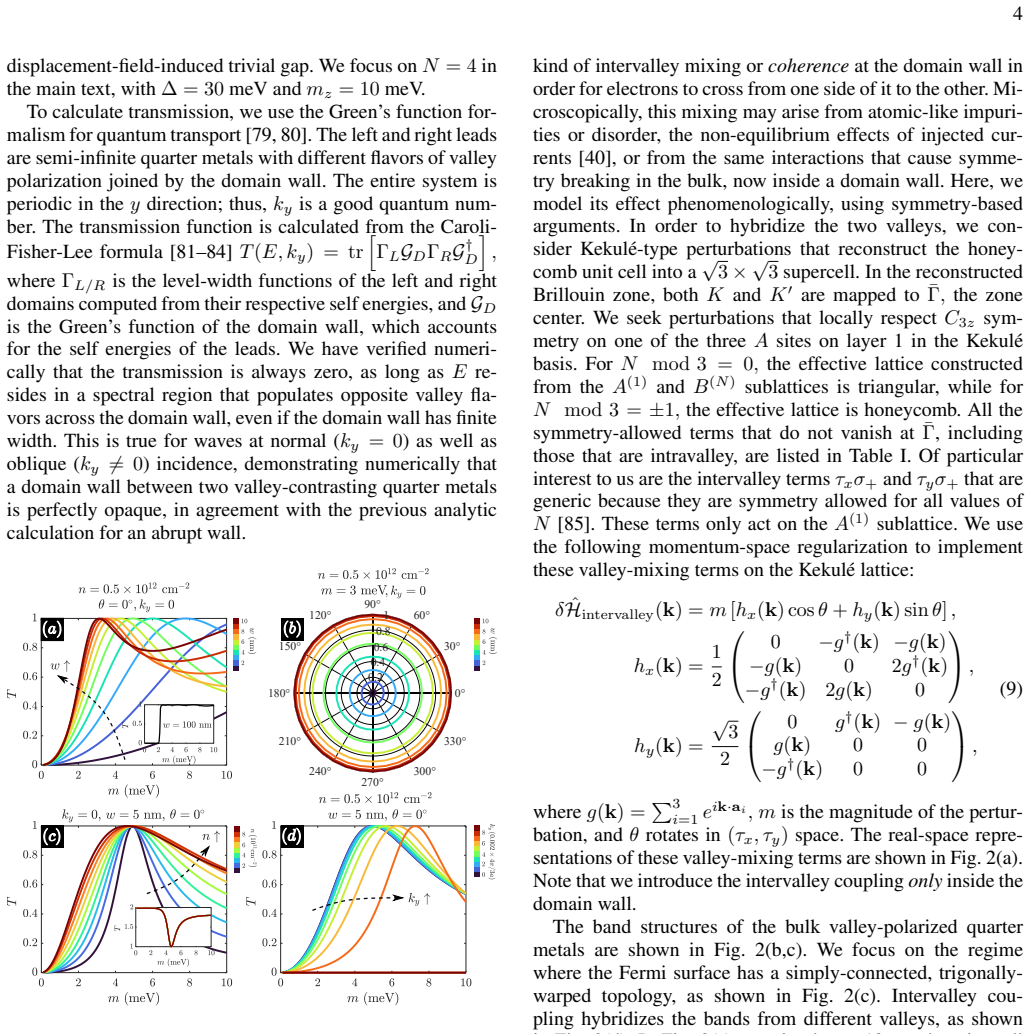
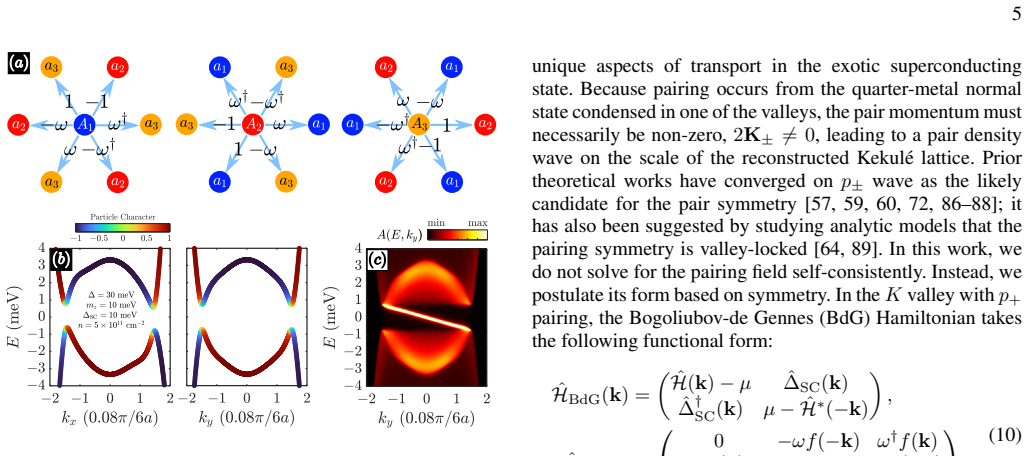
Rhombohedral multilayer graphene polarized by a moderate perpendicular displacement field hosts a time-reversal-symmetry-breaking valley-and-spin-polarized metallic phase that may condense into a chiral superconductor. Recent magnetic imaging and transport measurements in this unconventional system suggest the presence of domain walls both in the metallic and superconducting phases. In this work, we show that valley domain walls are impenetrable barriers to transport in the metallic regime. Transmission through such a domain wall must therefore be mediated by intervalley interactions. We derive the symmetry-allowed terms and show via microscopic numerical simulations that they enable the transmission of electrons across the domain wall. In the superconducting phase, we find that intervalley mixing is crucial for supporting an appreciable supercurrent through a SNS' Josephson junction that connects opposite-chirality superconducting regions. Taken together, our work elucidates the nature of domain walls in these experimentally relevant multilayer systems and emphasizes the critical role of intervalley hybridization in governing their transport properties.
Editorial analysis
A structured set of objections, weighed in public.
Referee Report
Summary. The manuscript examines valley domain walls in rhombohedral multilayer graphene in a valley-and-spin-polarized metallic phase that may become a chiral superconductor. It argues that these domain walls act as impenetrable barriers to transport in the metallic regime due to valley conservation, requiring intervalley interactions for any transmission. The authors derive symmetry-allowed intervalley terms and use microscopic numerical simulations to demonstrate that these terms permit electron transmission across the walls. In the superconducting phase, they show that intervalley mixing is necessary for significant supercurrent in SNS' Josephson junctions linking superconducting regions with opposite chirality.
Significance. Should the central results be confirmed, this work would clarify the transport characteristics of domain walls in experimentally relevant rhombohedral graphene systems and underscore the importance of intervalley hybridization for both normal and superconducting transport. It connects to recent magnetic imaging and transport experiments suggesting domain walls in both phases, potentially informing models of superconductivity in these materials. The symmetry-based derivation of intervalley terms is a strength.
major comments (2)
- [Microscopic numerical simulations section] The claim that domain walls are impenetrable (valley conservation) and that transmission requires intervalley interactions rests on the microscopic Hamiltonian accurately capturing the relevant intervalley matrix elements without missing higher-order corrections. The manuscript does not address the sensitivity of the reported transmission or supercurrent to variations in these terms or to neglected disorder.
- [Superconducting phase] § on Josephson junction: the assertion that intervalley mixing is crucial for appreciable supercurrent in opposite-chirality SNS' junctions is model-dependent; the paper should quantify the supercurrent suppression in the absence of these terms to establish that the effect is not an artifact of the chosen parameters.
minor comments (2)
- [Introduction] Notation for the displacement field and valley polarization could be defined more explicitly at first use.
- [Figures] Figure captions for transmission plots should include the system size and boundary conditions used in the numerics.
Simulated Author's Rebuttal
We thank the referee for their careful reading of the manuscript and for the constructive comments. We respond to each major comment below.
read point-by-point responses
-
Referee: [Microscopic numerical simulations section] The claim that domain walls are impenetrable (valley conservation) and that transmission requires intervalley interactions rests on the microscopic Hamiltonian accurately capturing the relevant intervalley matrix elements without missing higher-order corrections. The manuscript does not address the sensitivity of the reported transmission or supercurrent to variations in these terms or to neglected disorder.
Authors: Valley conservation (and thus impenetrability) follows from the symmetries of the low-energy Hamiltonian in the absence of intervalley terms; this symmetry argument is independent of higher-order corrections or the precise values of matrix elements. The intervalley terms themselves are derived from symmetry considerations that apply generally. We agree that the manuscript does not examine sensitivity to parameter variations or include disorder. In revision we will add a brief discussion noting that small changes in intervalley coupling strength do not alter the requirement for such terms, and that disorder would be expected to facilitate transmission but would not remove the need for intervalley mixing. revision: partial
-
Referee: [Superconducting phase] § on Josephson junction: the assertion that intervalley mixing is crucial for appreciable supercurrent in opposite-chirality SNS' junctions is model-dependent; the paper should quantify the supercurrent suppression in the absence of these terms to establish that the effect is not an artifact of the chosen parameters.
Authors: The suppression arises because opposite-chirality regions are connected by a junction that conserves valley index in the absence of intervalley mixing, leading to vanishing (or exponentially small) supercurrent. We will add explicit quantification—either numerical values or an additional panel—comparing the supercurrent with and without the intervalley terms to make this suppression quantitative and to confirm it is not an artifact of parameter choice. revision: yes
Circularity Check
No circularity: derivation relies on independent microscopic numerics and symmetry analysis
full rationale
The paper derives symmetry-allowed intervalley terms from first principles and demonstrates transmission via explicit numerical simulations on a microscopic Hamiltonian. No step reduces a claimed prediction to a fitted parameter or self-citation by construction. The central claims (impenetrable domain walls, intervalley-mediated transmission, supercurrent in SNS' junctions) follow from the model equations without tautological redefinition. Self-citations, if present, are not load-bearing for the uniqueness or ansatz of the result. This is the expected non-finding for a model-based transport study.
Axiom & Free-Parameter Ledger
Reference graph
Works this paper leans on
-
[1]
We start with a few examples
General Transformation Between Valley-Orbital Basis and Kekul ´e Basis Here, we provide a prescription to transform between the two basis sets by classifying every possible perturbation without any symmetry constraint in the valley-orbital basis. We start with a few examples. Let us write down tight-binding Hamiltonians that realizeτ 1 ⊗σ 0, τ1 ⊗σ 3, τ2 ⊗...
-
[2]
Let us first study the example in Eq
Band Structures for Example Models In this section, we study the band structures of various example models in the vicinity of Γof the Kekul ´e Brillouin zone. Let us first study the example in Eq. (S19) witha=t 1eiφ1andb=−c=t 2eiφ2 / √ 3.With this minor relabeling, we have ˆHτi⊗σj(k) = ˆH0(k)+ 0t 1eiφ1 eik·δ1 0 t2eiφ2 √ 3 eik·δ2 0− t2eiφ2 √ ...
-
[3]
I A toN-layer rhombohedral graphene, we first rewrite the tight-binding Hamiltonian in the reconstructed Kekul´e zone
General Symmetry Considerations To generalize our results in Sec. I A toN-layer rhombohedral graphene, we first rewrite the tight-binding Hamiltonian in the reconstructed Kekul´e zone. We use the same lattice structure for layer 1 as shown in Fig. S2(a). Layer 2 has exactly the same lattice structure as layer 1 but shifted by 0, a/ √ 3 laterally in they-d...
-
[4]
0 ˆU † 1(k) ˆK(k) ˆU1(k) ˆU2
FullN-Layer Models in the Kekul ´e Basis The full Hamiltonian is built from sub-Hamiltonians in the following way ˆH(k) = ˆK(k) ˆU1(k) ˆU2 0. . .0 ˆU † 1(k) ˆK(k) ˆU1(k) ˆU2 . . .0 ˆU † 2 ˆU † 1(k) ˆK(k) ˆU1(k). . .0 0 ˆU † 2 ˆU † 1(k) ˆK(k). . .0 ... ... ... ... . . . ... 0 0 0 0. . . ˆK(k) + ∆ N−1 2 0 0 0. . .0 0 N−3 2...
-
[5]
We first examine the single-valley Fermi topology without any perturbation
Band Structures for Realistic Systems In this section, we study the band structures of realistic models ofN-layer rhombohedral graphene. We first examine the single-valley Fermi topology without any perturbation. We use the parameters listed in Table SIV for all of our simulations. Using the non-interacting band structures using Eq. (S50), we compute the ...
-
[6]
+r(−ik +0)m + N−1X n=1 an (iκ−n)m # [εK +E]−
Continuum Description We consider the continuum description of an armchair termination for monolayer graphene where the bulk extends to the negativexdirection. This calculation will naturally extend to the domain-wall scenario that we will show later. In the bulk, the 27 continuum Hamiltonian is ˆHeff(k) = ˆHK(k) 0 0 ˆHK′(k) = εK ℏv0 (kx −ik y) 0 0 ℏ...
-
[7]
For q ε2 K +k 2Ny < E < q ε2 K′ +k 2Ny ,we have total intravalley reflection: an incomingKwave is reflected entirely into an outgoingKwave
-
[8]
The evanescent modes can carry current in the direction parallel to the armchair edge even fork y = 0
-
[9]
For q ε2 K +k 2Ny < q ε2 K′ +k 2Ny < E,we have partial intravalley reflection and partial intervalley reflection: an incom- ingKwave is reflected into both an outgoingKwave and an outgoingK ′ wave
-
[10]
ForE→ ∞,we have total intervalley reflection: an incomingKwave is reflected entirely into an outgoingK ′ wave
-
[11]
Semi-Infinite Plane We employ the standard iterative Green’s function method to calculate the surface Green’s function [83, 84]. We partition the Hamiltonian in “layers” (this isnotthe same as the number of layers in a rhombohedral stack) that are coupled to each other in the following way ˆH= H0,0 V0 0 0. . . V † 0 H1,1 V0. . . 0V † H2,2 V. . . ...
-
[12]
II A to study transmission and reflection due to an abrupt domain wall that switches the sense of valley polarization
Continuum Description of a Step-Function Domain Wall Here, we extend the results of Sec. II A to study transmission and reflection due to an abrupt domain wall that switches the sense of valley polarization. The domain wall is located atx= 0and runs along the armchair direction. To model this system, we first consider the Hamiltonian of a monolayer graphe...
-
[13]
The domain Hamiltonian is written asH D,while the left and right leads have block form,H L and HR connected byV L andV R
Green’s Function Calculation of a Finite-Width Domain Wall To calculate transmission through a domain connected to semi-infinite right and left leads, we use the equilibrium Green’s function method [79, 80]. The domain Hamiltonian is written asH D,while the left and right leads have block form,H L and HR connected byV L andV R. The hoppings from the leads...
-
[14]
N. P. Armitage, E. J. Mele, and A. Vishwanath, Weyl and Dirac semimetals in three-dimensional solids, Rev. Mod. Phys.90, 015001 (2018)
2018
-
[15]
M. Rudi, A. De Martino, K. Moors, D. Giuliano, and F. Buccheri, Interfaces of nodal-line semimetals: Drum states, transport, and electronic trajectories, Phys. Rev. B109, 195144 (2024)
2024
-
[16]
Slizovskiy, E
S. Slizovskiy, E. McCann, M. Koshino, and V . I. Fal’ko, Films of rhombohedral graphite as two-dimensional topological semimetals, Commun. Phys.2, 164 (2019)
2019
-
[17]
R. Weht, A. A. Aligia, and M. N ´u˜nez-Regueiro, Topological flat bands emerging at the inversion of stacking order in rhombohedral graphite, arXiv preprint arXiv:2605.01115 (2026)
Pith/arXiv arXiv 2026
-
[18]
T. T. Heikkil¨a and G. E. V olovik, Dimensional crossover in topological matter: Evolution of the multiple Dirac point in the layered system to the flat band on the surface, JETP Letters93, 59 (2011)
2011
-
[19]
T. T. Heikkil¨a, N. B. Kopnin, and G. E. V olovik, Flat bands in topological media, JETP Letters94, 233 (2011). 42
2011
-
[20]
N. B. Kopnin, T. T. Heikkil¨a, and G. E. V olovik, High-temperature surface superconductivity in topological flat-band systems, Phys. Rev. B83, 220503 (2011)
2011
-
[21]
Jiang, T
G. Jiang, T. T. Heikkil ¨a, and P. T ¨orm¨a, Ideal quantum geometry of the surface states of rhombohedral graphite and its effects on the surface superconductivity, Phys. Rev. B113, L041111 (2026)
2026
-
[22]
D. P. Arovas and F. Guinea, Stacking faults, bound states, and quantum Hall plateaus in crystalline graphite, Phys. Rev. B78, 245416 (2008)
2008
-
[23]
Pierucci, H
D. Pierucci, H. Sediri, M. Hajlaoui, J.-C. Girard, T. Brumme, M. Calandra, E. Velez-Fort, G. Patriarche, M. G. Silly, G. Ferro, V . Souli`ere, M. Marangolo, F. Sirotti, F. Mauri, and A. Ouerghi, Evidence for flat bands near the fermi level in epitaxial rhombohedral multilayer graphene, ACS Nano9, 5432 (2015)
2015
-
[24]
Henck, J
H. Henck, J. Avila, Z. Ben Aziza, D. Pierucci, J. Baima, B. Pamuk, J. Chaste, D. Utt, M. Bartos, K. Nogajewski, B. A. Piot, M. Or- lita, M. Potemski, M. Calandra, M. C. Asensio, F. Mauri, C. Faugeras, and A. Ouerghi, Flat electronic bands in long sequences of rhombohedral-stacked graphene, Phys. Rev. B97, 245421 (2018)
2018
-
[25]
Hagym ´asi, M
I. Hagym ´asi, M. S. M. Isa, Z. Tajkov, K. M ´arity, L. Oroszl ´any, J. Koltai, A. Alassaf, P. Kun, K. Kandrai, A. P ´alink´as, P. Vancs ´o, L. Tapaszt´o, and P. Nemes-Incze, Observation of competing, correlated ground states in the flat band of rhombohedral graphite, Sci. Adv.8, eabo6879 (2022)
2022
-
[26]
Zhang, Q
H. Zhang, Q. Li, M. G. Scheer, R. Wang, C. Tuo, N. Zou, W. Chen, J. Li, X. Cai, C. Bao, M.-R. Li, K. Deng, K. Watanabe, T. Taniguchi, M. Ye, P. Tang, Y . Xu, P. Yu, J. Avila, P. Dudin, J. D. Denlinger, H. Yao, B. Lian, W. Duan, and S. Zhou, Correlated topological flat bands in rhombohedral graphite, Proc. Natl. Acad. Sci. U.S.A.121, e2410714121 (2024)
2024
-
[27]
E. J. Seifert, E. Akyuz, R. M. Feenstra, and B. M. Hunt, Increasing flatness of surface bands of multilayer rhombohedral graphite with crystal thickness, Phys. Rev. B110, L241407 (2024)
2024
-
[28]
Y . Lee, D. Tran, K. Myhro, J. Velasco, N. Gillgren, J. M. Poumirol, D. Smirnov, Y . Barlas, and C. N. Lau, Multicomponent Quantum Hall Ferromagnetism and Landau Level Crossing in Rhombohedral Trilayer Graphene, Nano Lett.16, 227 (2016)
2016
-
[29]
Y . Shi, S. Xu, Y . Yang, S. Slizovskiy, S. V . Morozov, S.-K. Son, S. Ozdemir, C. Mullan, J. Barrier, J. Yin, A. I. Berdyugin, B. A. Piot, T. Taniguchi, K. Watanabe, V . I. Fal’ko, K. S. Novoselov, A. K. Geim, and A. Mishchenko, Electronic phase separation in multilayer rhombohedral graphite, Nature584, 210 (2020)
2020
-
[30]
H. Zhou, T. Xie, A. Ghazaryan, T. Holder, J. R. Ehrets, E. M. Spanton, T. Taniguchi, K. Watanabe, E. Berg, M. Serbyn, and A. F. Young, Half- and quarter-metals in rhombohedral trilayer graphene, Nature598, 429 (2021)
2021
-
[31]
H. Zhou, T. Xie, T. Taniguchi, K. Watanabe, and A. F. Young, Superconductivity in rhombohedral trilayer graphene, Nature598, 434 (2021)
2021
-
[32]
T. Arp, O. Sheekey, H. Zhou, C. L. Tschirhart, C. L. Patterson, H. M. Yoo, L. Holleis, E. Redekop, G. Babikyan, T. Xie, J. Xiao, Y . Vituri, T. Holder, T. Taniguchi, K. Watanabe, M. E. Huber, E. Berg, and A. F. Young, Intervalley coherence and intrinsic spin–orbit coupling in rhombohedral trilayer graphene, Nat. Phys.20, 1413 (2024)
2024
-
[33]
T. Han, Z. Lu, Y . Yao, J. Yang, J. Seo, C. Yoon, K. Watanabe, T. Taniguchi, L. Fu, F. Zhang, and L. Ju, Large quantum anomalous Hall effect in spin-orbit proximitized rhombohedral graphene, Science384, 647 (2024)
2024
-
[34]
K. Liu, J. Zheng, Y . Sha, B. Lyu, F. Li, Y . Park, Y . Ren, K. Watanabe, T. Taniguchi, J. Jia, W. Luo, Z. Shi, J. Jung, and G. Chen, Spontaneous broken-symmetry insulator and metals in tetralayer rhombohedral graphene, Nat. Nanotechnol.19, 188 (2024)
2024
-
[35]
T. Han, Z. Lu, G. Scuri, J. Sung, J. Wang, T. Han, K. Watanabe, T. Taniguchi, H. Park, and L. Ju, Correlated insulator and Chern insulators in pentalayer rhombohedral-stacked graphene, Nat. Nanotechnol.19, 181 (2024)
2024
-
[36]
Winterer, F
F. Winterer, F. R. Geisenhof, N. Fernandez, A. M. Seiler, F. Zhang, and R. T. Weitz, Ferroelectric and spontaneous quantum Hall states in intrinsic rhombohedral trilayer graphene, Nat. Phys.20, 422 (2024)
2024
-
[37]
Zheng, S
J. Zheng, S. Wu, K. Liu, B. Lyu, S. Liu, Y . Sha, Z. Li, K. Watanabe, T. Taniguchi, J. Jia, Z. Shi, and G. Chen, Switchable Chern Insulators and Competing Quantum Phases in Rhombohedral Graphene Moir´e Superlattices, Phys. Rev. Lett.135, 136302 (2025)
2025
-
[38]
J. Yang, X. Shi, S. Ye, C. Yoon, Z. Lu, V . Kakani, T. Han, J. Seo, L. Shi, K. Watanabe, T. Taniguchi, F. Zhang, and L. Ju, Impact of spin–orbit coupling on superconductivity in rhombohedral graphene, Nat. Mater.24, 1058 (2025)
2025
-
[39]
J. Xie, Z. Huo, X. Lu, Z. Feng, Z. Zhang, W. Wang, Q. Yang, K. Watanabe, T. Taniguchi, K. Liu, Z. Song, X. C. Xie, J. Liu, and X. Lu, Tunable fractional Chern insulators in rhombohedral graphene superlattices, Nat. Mater.24, 1042 (2025)
2025
-
[40]
Kumar, D
M. Kumar, D. Waleffe, A. Okounkova, R. Tejani, V . T. Phong, K. Watanabe, T. Taniguchi, C. Lewandowski, J. Folk, and M. Yankowitz, Superconductivity from dual-surface carriers in rhombohedral graphene, Nat. Phys. (2026)
2026
-
[41]
L. Holleis, T. Xie, S. Xu, H. Zhou, C. L. Patterson, A. Panigrahi, T. Taniguchi, K. Watanabe, L. S. Levitov, C. Jin, E. Berg, and A. F. Young, Fluctuating magnetism and Pomeranchuk effect in multilayer graphene, arXiv preprint arXiv:2407.13763 (2025)
arXiv 2025
-
[42]
J. Deng, J. Xie, H. Li, T. Taniguchi, K. Watanabe, J. Shan, K. F. Mak, and X. Liu, Superconductivity and Ferroelectric Orbital Magnetism in Semimetallic Rhombohedral Hexalayer Graphene, arXiv preprint arXiv:2508.15909 (2025)
arXiv 2025
-
[43]
J. Yang, O. S. Sedeh, C. Yoon, S. Ye, H. Weldeyesus, A. Cotten, T. Han, Z. Lu, Z. Hadjri, J. Seo, L. Shi, E. Aitken, P. P. Liong, Z. Wu, M. Xu, C. Scheller, M. Zheng, R. Gazizulin, K. Watanabe, T. Taniguchi, D. Laroque, M. Li, F. Zhang, D. M. Zumb ¨uhl, and L. Ju, Magnetic Field-Enhanced Graphene Superconductivity with Record Pauli-Limit Violation, arXiv ...
arXiv 2025
-
[45]
T. Han, Z. Lu, Z. Hadjri, L. Shi, Z. Wu, W. Xu, Y . Yao, A. A. Cotten, O. S. Sedeh, H. Weldeyesus, J. Yang, J. Seo, S. Ye, M. Zhou, H. Liu, G. Shi, Z. Hua, K. Watanabe, T. Taniguchi, P. Xiong, D. M. Zumb¨uhl, L. Fu, and L. Ju, Signatures of chiral superconductivity in rhombohedral graphene, Nature643, 654 (2025)
2025
-
[46]
E. Morissette, P. Qin, K. Watanabe, T. Taniguchi, and J. I. A. Li, Evidence of Momentum Space Condensation in Rhombohedral Hexalayer Graphene, arXiv preprint arXiv:2503.09954 (2025)
arXiv 2025
-
[47]
Z. Li, W. Wang, F. Wang, Z. Zhang, Q. Yang, K. Watanabe, T. Taniguchi, X. C. Xie, J. Wang, K. Liu, Z. Song, and X. Lu, Fractional High-Chern Insulator in Twisted Rhombohedral Graphene, arXiv preprint arXiv:2512.21612 . 43
-
[48]
R. Q. Nguyen, H.-T. Wu, E. Morissette, N. J. Zhang, P. Qin, K. Watanabe, T. Taniguchi, A. W. Hui, D. E. Feldman, and J. I. A. Li, A Hier- archy of Superconductivity and Topological Charge Density Wave States in Rhombohedral Graphene, arXiv preprint arXiv:2507.22026 (2025)
arXiv 2025
-
[49]
J. Seo, A. A. Cotten, M. Xu, O. S. Sedeh, H. Weldeyesus, T. Han, Z. Lu, Z. Wu, S. Ye, W. Xu, J. Yang, E. Aitken, P. P. Liong, Z. Hadjri, R. Gazizulin, K. Watanabe, T. Taniguchi, M. Li, D. M. Zumb¨uhl, and L. Ju, Family of Unconventional Superconductivities in Crystalline Graphene, arXiv preprint arXiv:2509.03295 (2025)
arXiv 2025
-
[50]
P. Qin, H.-T. Wu, R. Q. Nguyen, E. Morissette, N. J. Zhang, K. Watanabe, T. Taniguchi, and J. I. A. Li, Stripe order in the metallic and superconducting phases of rhombohedral hexalayer graphene, arXiv preprint arXiv:2504.05129 (2026)
Pith/arXiv arXiv 2026
-
[51]
T. Han, J. P. Butler, S. Ye, Z. Hua, S. Dutta, Z. Hadjri, Z. Wu, J. Yang, J. Seo, P. Pattanakanvijit, E. Aitken, K. Watanabe, T. Taniguchi, P. Xiong, E. Zeldov, Z. Lu, R. Ashoori, and L. Ju, Evidence of Metallic Wigner Crystal in Rhombohedral Graphene, arXiv preprint arXiv:2604.00113 (2026)
arXiv 2026
-
[52]
S. S. Kalantre, B. H. Alexander, J. May-Mann, J. Herzog-Arbeitman, M. Hocking, Q. Cao, K. Watanabe, T. Taniguchi, D. Goldhaber- Gordon, A. J. Mannix, T. Devakul, Y . H. Kwan, D. E. Parker, and A. Sharpe, Fermiology and the Candidate Chiral Superconductor in Rhombohedral Tetralayer Graphene, arXiv preprint arXiv:2606.05356 (2026)
Pith/arXiv arXiv 2026
-
[53]
S. Dutta, N. Auerbach, T. Han, Y . Zhou, G. Shavit, N.-S. Kander, Y . Myasoedov, M. E. Huber, K. Watanabe, T. Taniguchi, L. Ju, and E. Zeldov, Reconfigurable chiral superconductivity, arXiv preprint arXiv:2605.13303v1 (2026)
Pith/arXiv arXiv 2026
-
[54]
J. P. Butler, T. Han, A. DiFabbio, Z. Hadjri, E. Aitken, K. Watanabe, T. Taniguchi, L. Ju, and R. C. Ashoori, 1/3 Fractional and Gapless Integer Quantum Anomalous Hall States in Rhombohedral Graphene, arXiv preprint arxiv:2606.06450 (2026)
Pith/arXiv arXiv 2026
-
[55]
Ghazaryan, T
A. Ghazaryan, T. Holder, M. Serbyn, and E. Berg, Unconventional Superconductivity in Systems with Annular Fermi Surfaces: Applica- tion to Rhombohedral Trilayer Graphene, Phys. Rev. Lett.127, 247001 (2021)
2021
-
[56]
J. H. Muten, A. J. Copeland, and E. McCann, Exchange interaction, disorder, and stacking faults in rhombohedral graphene multilayers, Phys. Rev. B104, 035404 (2021)
2021
-
[57]
T. Cea, P. A. Pantale´on, V . T. Phong, and F. Guinea, Superconductivity from repulsive interactions in rhombohedral trilayer graphene: A Kohn-Luttinger-like mechanism, Phys. Rev. B105, 075432 (2022)
2022
-
[58]
Y .-Z. Chou, F. Wu, J. D. Sau, and S. Das Sarma, Acoustic-phonon-mediated superconductivity in moir´eless graphene multilayers, Phys. Rev. B106, 024507 (2022)
2022
-
[59]
Chatterjee, T
S. Chatterjee, T. Wang, E. Berg, and M. P. Zaletel, Inter-valley coherent order and isospin fluctuation mediated superconductivity in rhombohedral trilayer graphene, Nat. Commun.13, 6013 (2022)
2022
-
[60]
Y . Park, Y . Kim, B. L. Chittari, and J. Jung, Topological flat bands in rhombohedral tetralayer and multilayer graphene on hexagonal boron nitride moir´e superlattices, Phys. Rev. B108, 155406 (2023)
2023
-
[61]
W. Qin, C. Huang, T. Wolf, N. Wei, I. Blinov, and A. H. MacDonald, Functional Renormalization Group Study of Superconductivity in Rhombohedral Trilayer Graphene, Phys. Rev. Lett.130, 146001 (2023)
2023
-
[62]
Davydova, M
M. Davydova, M. Geier, and L. Fu, Nonreciprocal superconductivity, Sci. Adv.10, eadr4817 (2024)
2024
-
[63]
Z. Dong, A. S. Patri, and T. Senthil, Theory of Quantum Anomalous Hall Phases in Pentalayer Rhombohedral Graphene Moir´e Structures, Phys. Rev. Lett.133, 206502 (2024)
2024
-
[64]
J. M. Koh, J. Alicea, and E. Lantagne-Hurtubise, Correlated phases in spin-orbit-coupled rhombohedral trilayer graphene, Phys. Rev. B 109, 035113 (2024)
2024
- [65]
-
[66]
Z. Dong, A. S. Patri, and T. Senthil, Stability of anomalous Hall crystals in multilayer rhombohedral graphene, Phys. Rev. B110, 205130 (2024)
2024
-
[67]
T. Wang and M. P. Zaletel, Chiral superconductivity near a fractional Chern insulator, arXiv preprint arXiv:2507.07921 (2025)
arXiv 2025
-
[68]
Z. D. Shi and T. Senthil, Doping a Fractional Quantum Anomalous Hall Insulator, Phys. Rev. X15, 031069 (2025)
2025
-
[69]
Huang, S
K. Huang, S. Das Sarma, and X. Li, Fractional quantum anomalous Hall effect in rhombohedral multilayer graphene with a strong displacement field, Phys. Rev. B111, 075130 (2025)
2025
-
[70]
Geier, M
M. Geier, M. Davydova, and L. Fu, Chiral and topological superconductivity in isospin polarized multilayer graphene, Nat. Comms.17, 232 (2026)
2026
-
[71]
T. Wolf, N. Wei, H. Zhou, and C. Huang, Magnetism in the Dilute Electron Gas of Rhombohedral Multilayer Graphene, arXiv preprint arXiv:2408.15884 (2024)
arXiv 2024
-
[72]
Qin and C
Q. Qin and C. Wu, Chiral finite-momentum superconductivity in the tetralayer graphene, Chin. Phys. Lett.43, 030708 (2026)
2026
-
[73]
Parra-Mart ´ınez, A
G. Parra-Mart ´ınez, A. Jimeno-Pozo, V . T. Phong, H. Sainz-Cruz, D. Kaplan, P. Emanuel, Y . Oreg, P. A. Pantale´on, J. A. Silva-Guill ´en, and F. Guinea, Band Renormalization, Quarter Metals, and Chiral Superconductivity in Rhombohedral Tetralayer Graphene, Phys. Rev. Lett.135, 136503 (2025)
2025
-
[74]
Z. Han, J. Herzog-Arbeitman, Q. Gao, and E. Khalaf, Exact models of chiral flat-band superconductors, arXiv preprint arXiv:2508.21127 (2025)
arXiv 2025
-
[75]
D. Lee, W. Yang, Y .-W. Son, and J. Jung, Self-consistent tight-binding calculations with extended Hubbard interactions in rhombohedral multilayer graphene, arXiv preprint arXiv:2403.00530 (2025)
arXiv 2025
-
[76]
M.-R. Li, Y . H. Kwan, H. Yao, and B. A. Bernevig, Berry Trashcan With Short Range Attraction:Exact $px+i p y$ Superconductivity in Rhombohedral Graphene, arXiv preprint arXiv:2509.16312 (2025)
arXiv 2025
-
[77]
J. May-Mann, T. Helbig, and T. Devakul, How pairing mechanism dictates topology in valley-polarized superconductors with Berry curvature, arXiv preprint arXiv:2503.05697 (2025)
arXiv 2025
-
[78]
Divic, V
S. Divic, V . Cr´epel, T. Soejima, X.-Y . Song, A. J. Millis, M. P. Zaletel, and A. Vishwanath, Anyon superconductivity from topological criticality in a Hofstadter–Hubbard model, Proc. Natl. Acad. Sci. U. S. A.122, e2426680122 (2025). 44
2025
-
[79]
P. A. Nosov, Z. Han, and E. Khalaf, Anyon superconductivity and plateau transitions in doped fractional quantum anomalous Hall insulators, arXiv preprint arXiv:2506.02108 (2025)
Pith/arXiv arXiv 2025
-
[80]
Z. D. Shi and T. Senthil, Anyon delocalization transitions out of a disordered fqah insulator, arXiv preprint arXiv:2506.02128 (2025)
arXiv 2025
-
[81]
F. Pichler, C. Kuhlenkamp, M. Knap, and A. Vishwanath, Microscopic Mechanism of Anyon Superconductivity Emerging from Fractional Chern Insulators, arXiv preprint arXiv:2506.08000 (2025)
arXiv 2025
discussion (0)
Sign in with ORCID, Apple, or X to comment. Anyone can read and Pith papers without signing in.