Structural gradients and strain partitioning across the mouse Achilles tendon enthesis revealed by in situ X-ray scattering
Pith reviewed 2026-06-29 23:13 UTC · model grok-4.3
The pith
Load transfer at the tendon-bone enthesis is spatially heterogeneous and drops by orders of magnitude across hierarchical levels.
A machine-rendered reading of the paper's core claim, the machinery that carries it, and where it could break.
Core claim
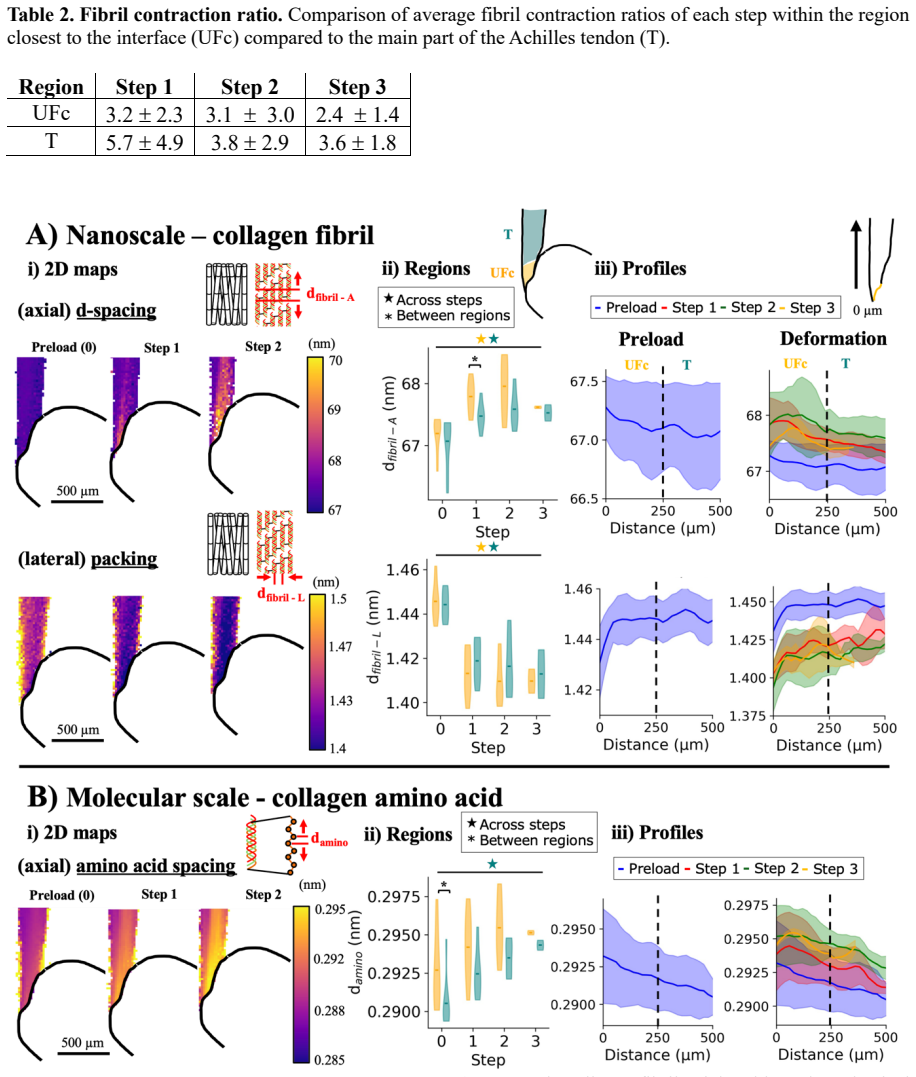
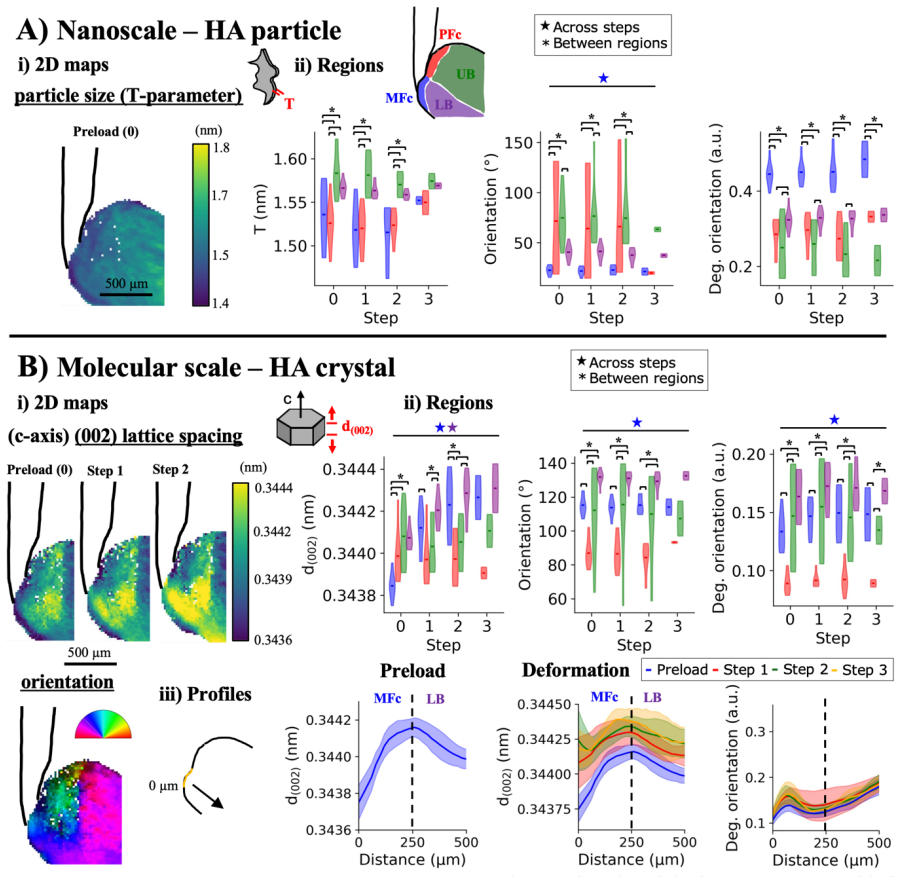
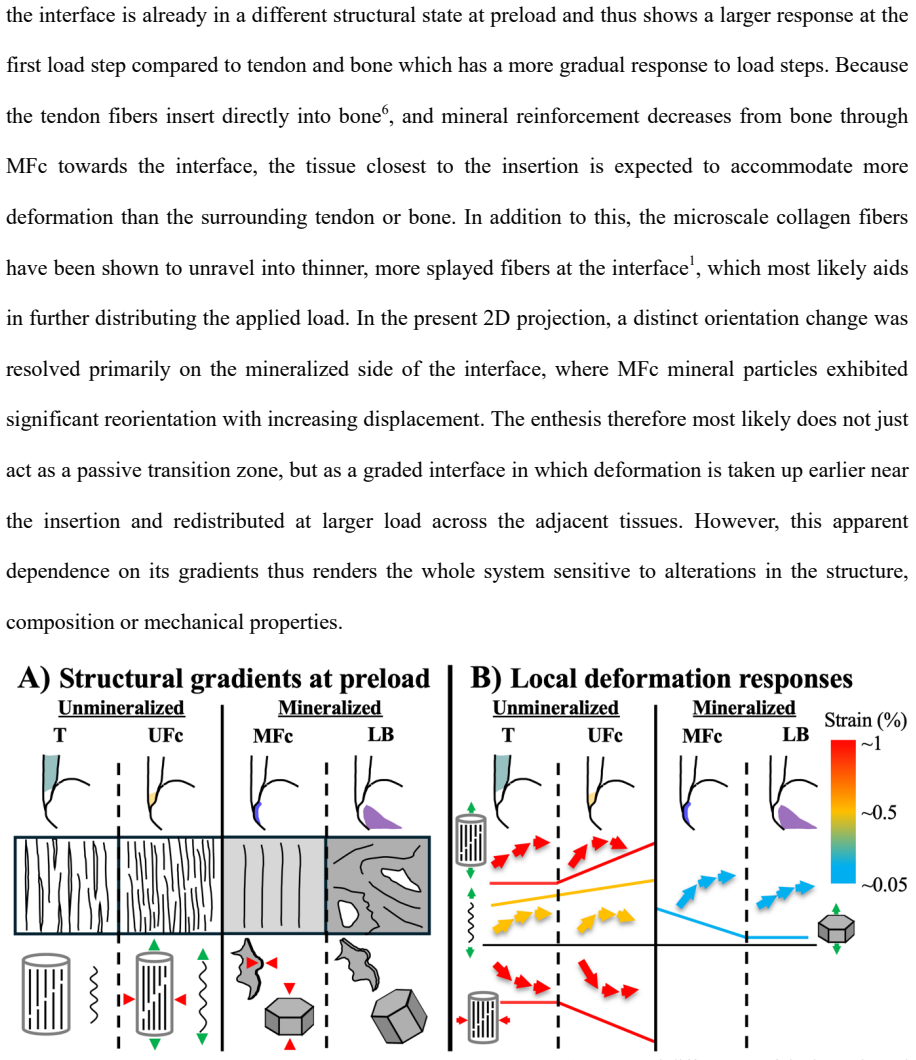
Load transfer across the enthesis is both spatially heterogeneous and hierarchy-dependent. With an applied tissue strain of 20 percent the nanoscale fibrils were strained by ~1-2 percent, the collagen molecules by ~0.5 percent and the hydroxyapatite crystals by ~0.05 percent, thus following an approximate ratio of 1:0.1:0.01:0.001. These results show that the graded attachment accommodates deformation through region-specific load sharing and hierarchical strain partitioning, consistent with a contribution from dissipation within the non-collagenous matrix.
What carries the argument
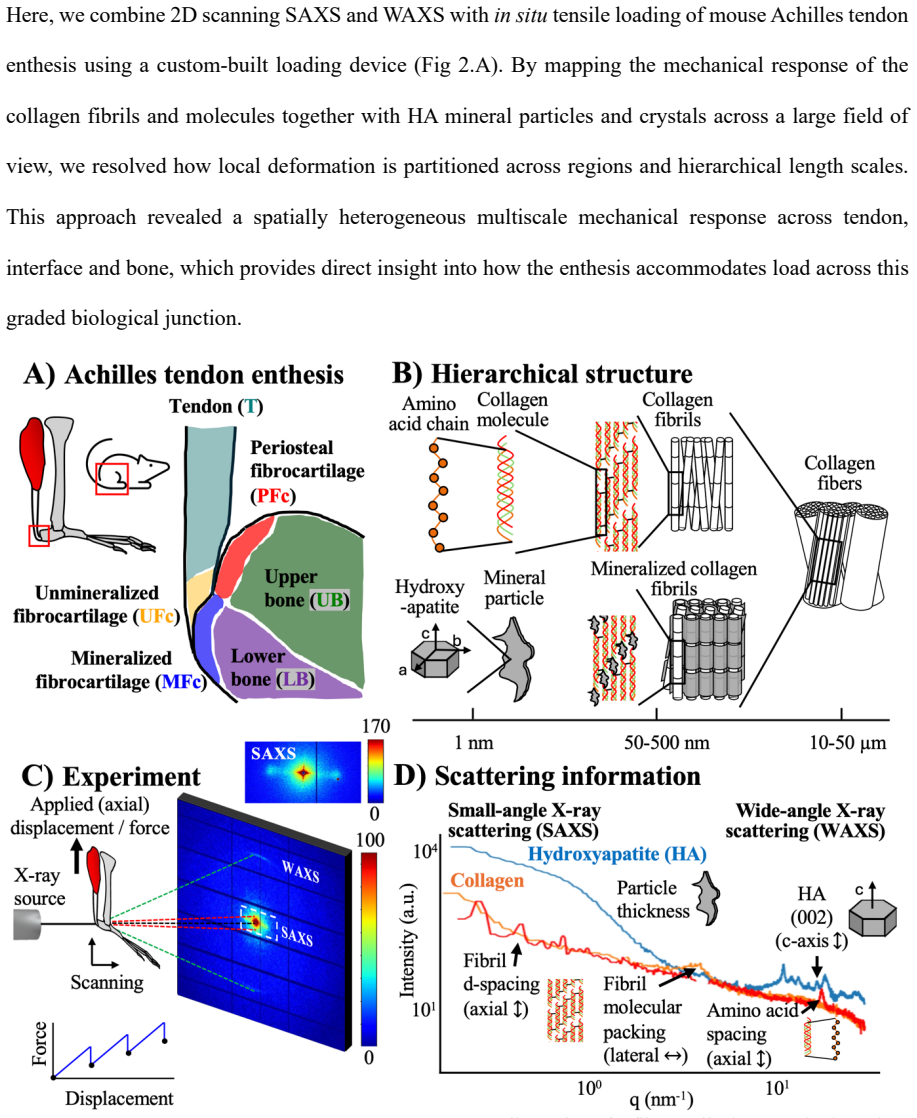
Synchrotron scanning small- and wide-angle X-ray scattering during in situ tensile testing, which converts local scattering patterns into strain values for collagen fibrils, molecules, and hydroxyapatite crystals across multiple positions in the enthesis.
If this is right
- The enthesis mitigates stress concentrations at the interface by sharing load differently in different regions.
- Each hierarchical level experiences a sharply reduced fraction of the applied tissue strain.
- Dissipation in the non-collagenous matrix contributes to the observed strain reduction.
- Mechanical integrity across the tendon-to-bone transition is preserved through the combination of spatial gradients and hierarchical partitioning.
Where Pith is reading between the lines
- The same partitioning pattern may appear in other biological attachments that join dissimilar materials.
- Synthetic graded interfaces could be designed to copy the observed strain ratios for improved durability.
- Tissue-level models of tendon mechanics will need to include spatial heterogeneity rather than assume uniform strain.
- Varying the loading rate in similar experiments could test whether the partitioning ratios remain constant.
Load-bearing premise
The X-ray scattering signals from selected regions accurately reflect local fibril, molecular, and crystal strains without significant artifacts from beam damage, sample hydration, or orientation averaging.
What would settle it
Repeating the tensile tests at higher spatial resolution or with rotated samples and obtaining uniform strain values instead of the observed progressive drop from tissue to crystal level would falsify the claim of hierarchy-dependent partitioning.
Figures
read the original abstract
The enthesis is the insertion site of tendon into bone and exhibits a high mechanical durability despite the large mismatch in material properties between the two tissues. This durability stems from gradients in composition, structure and organization on multiple hierarchical length scales. Despite extensive research on enthesis structure and mechanics, the local deformation mechanisms are poorly understood. Synchrotron scanning small- and wide-angle X-ray scattering was combined with in situ tensile testing of the mouse Achilles tendon enthesis to extensively map the mechanical response of the collagen fibrils and molecules as well as the hydroxyapatite mineral particles and crystals. Gradients in nano- and molecular scale structure and a stronger and more immediate deformation response towards the interface compared to further away were observed in both the soft and mineralized tissue. The strain decreased progressively across hierarchical levels; with an applied tissue strain of 20% the nanoscale fibrils were strained by ~1-2%, the collagen molecules by ~0.5% and the hydroxyapatite crystals by ~0.05%, thus following an approximate ratio of 1 : 0.1 : 0.01 : 0.001. These results show that load transfer across the enthesis is both spatially heterogeneous and hierarchy-dependent. This indicates that the graded attachment accommodates deformation through region-specific load sharing and hierarchical strain partitioning, consistent with a contribution from dissipation within the non-collagenous matrix. In doing so, the enthesis can mitigate stress concentrations and maintain mechanical integrity across the tendon-to-bone transition.
Editorial analysis
A structured set of objections, weighed in public.
Referee Report
Summary. The manuscript reports synchrotron scanning SAXS/WAXS measurements during in situ tensile testing of the mouse Achilles tendon enthesis. It maps gradients in nano- and molecular-scale structure and deformation, finding stronger and more immediate responses near the interface. At 20% applied tissue strain, it reports local strains of ~1-2% in fibrils (SAXS D-period), ~0.5% in collagen molecules (WAXS), and ~0.05% in hydroxyapatite crystals (WAXS (002)), yielding an approximate 1:0.1:0.01:0.001 partitioning ratio across tissue-fibril-molecule-crystal levels. The central claim is that load transfer is both spatially heterogeneous and hierarchy-dependent, consistent with dissipation in the non-collagenous matrix mitigating stress concentrations.
Significance. If the strain values are free of systematic artifacts, the work supplies direct, multi-scale experimental evidence of hierarchical strain partitioning and spatial gradients in a graded biological attachment. This would strengthen mechanistic understanding of enthesis durability and could guide constitutive models or tissue-engineering strategies that exploit region-specific load sharing.
major comments (1)
- [Abstract / Results] Abstract and Results (strain extraction pipeline): the reported fibril, molecular, and crystal strains are obtained by tracking meridional peak positions in scanning SAXS/WAXS patterns. In the enthesis transition zone the manuscript itself notes continuous variation in fibril and crystal orientation plus changing mineral content; the analysis does not appear to model the resulting distribution of local q-values within each beam footprint or to test for radiation-induced peak broadening/shift during the strain ramp. This leaves open the possibility that the progressive attenuation (and the 1:0.1:0.01:0.001 ratio) partly reflects orientation averaging rather than true hierarchical partitioning.
minor comments (2)
- [Methods] Methods: region-selection criteria, number of independent samples, and error propagation from peak fitting to strain values are not stated in the provided abstract; these details are required to assess reproducibility of the spatial trends.
- [Figures] Figure clarity: the spatial maps of local strain would benefit from explicit indication of beam footprint size relative to the width of the transition zone.
Simulated Author's Rebuttal
We thank the referee for their careful review and constructive feedback. We address the single major comment on the strain extraction pipeline below.
read point-by-point responses
-
Referee: [Abstract / Results] Abstract and Results (strain extraction pipeline): the reported fibril, molecular, and crystal strains are obtained by tracking meridional peak positions in scanning SAXS/WAXS patterns. In the enthesis transition zone the manuscript itself notes continuous variation in fibril and crystal orientation plus changing mineral content; the analysis does not appear to model the resulting distribution of local q-values within each beam footprint or to test for radiation-induced peak broadening/shift during the strain ramp. This leaves open the possibility that the progressive attenuation (and the 1:0.1:0.01:0.001 ratio) partly reflects orientation averaging rather than true hierarchical partitioning.
Authors: We agree that the transition zone exhibits continuous variation in fibril and crystal orientation as well as mineral content, as stated in the manuscript, and that our analysis tracks the positions of the dominant meridional peaks without explicit modeling of the intra-beam q-value distribution. This is a standard approach for extracting effective strains in such scanning experiments, but the referee correctly identifies that it leaves open the possibility of contributions from orientation averaging. We did not perform dedicated modeling of local q-distributions or radiation-dose tests during the ramp. We will revise the manuscript (Methods and Discussion sections) to explicitly discuss this limitation, clarify that the reported strains are effective averages, and note the absence of radiation-effect controls while referencing the low total exposure used. We will also emphasize that the observed hierarchical ratio is consistent with prior tendon literature but represents an effective partitioning that may include matrix dissipation effects. revision: partial
Circularity Check
No circularity: all reported strains and ratios are direct experimental measurements from SAXS/WAXS peak shifts during in situ tensile testing.
full rationale
The paper's central claims rest on synchrotron scanning small- and wide-angle X-ray scattering combined with in situ tensile testing. Strain values at each hierarchical level (tissue, fibril D-period, collagen helix, HA (002)) are obtained by converting observed meridional peak positions to local strain; the reported approximate ratio 1:0.1:0.01:0.001 follows directly from those measured peak shifts at 20% applied tissue strain. No equations, fitted parameters, self-citations, or ansatzes are invoked that would reduce any result to its own inputs by construction. The analysis pipeline is therefore self-contained against external benchmarks and receives the default non-circularity finding.
Axiom & Free-Parameter Ledger
axioms (1)
- domain assumption Scattering peak shifts can be converted directly to fibril, molecular, and crystal strains without correction for local orientation or hydration effects
Reference graph
Works this paper leans on
-
[1]
#$"%&') and lateral molecular packing (𝑑!
Most such studies however, have relied on single spot measurements39–42,45,46,56–58 which allows high time resolution within a given radiation damage budget, but sacrifices spatial information. More recently, 2D scanning SAXS approaches have begun to resolve the spatially heterogeneous nanoscale collagen mechanics in the cartilage-bone unit of the knee59,...
-
[2]
Structural Interfaces and Attachments in Biology [Internet]
Thomopoulos S, Birman V , Genin GM, editors. Structural Interfaces and Attachments in Biology [Internet]. New York, NY: Springer New York; 2013 [cited 2025 Dec 11]. Available from: https://link.springer.com/10.1007/978-1-4614-3317-0 doi:10.1007/978-1-4614-3317-0 6. Golman M, Abraham AC, Kurtaliaj I, Marshall BP, Hu YJ, Schwartz AG, et al. Toughening mecha...
-
[3]
Fractal-like hierarchical organization of bone begins at the nanoscale
Reznikov N, Bilton M, Lari L, Stevens MM, Kröger R. Fractal-like hierarchical organization of bone begins at the nanoscale. Science. 2018;360:1–10. doi:10.1126/science.aao2189 19. Schwarcz HP, Binkley DM, Luo L, Grandfield K. A search for apatite crystals in the gap zone of collagen fibrils in bone using dark-field illumination. Bone. 2020;135(December 20...
-
[4]
Imaging the Nanostructure of Bone and Dentin Through Small- and Wide-Angle X-Ray Scattering
Pabisch S, Wagermaier W, Zander T, Li C, Fratzl P. Imaging the Nanostructure of Bone and Dentin Through Small- and Wide-Angle X-Ray Scattering. In: Methods in Enzymology [Internet]. Elsevier; 2013 [cited 2019 Feb 7]. p. 391–413. Available from: https://linkinghub.elsevier.com/retrieve/pii/B9780124166172000187 doi:10.1016/B978-0-12-416617-2.00018-7 31. Frø...
-
[5]
Szczesny SE, Caplan JL, Pedersen P, Elliott DM. Quantification of interfibrillar shear stress in aligned soft collagenous tissues via notch tension testing. Scientific Reports. 2015;5:14649. doi:10.1038/srep14649 PubMed PMID: 26469396. 53. Lee AH, Szczesny SE, Santare MH, Elliott DM. Investigating mechanisms of tendon damage by measuring multi-scale recov...
-
[6]
Sevick JL, Abusara Z, Andrews SH, Xu M, Khurshid S, Chatha J, et al. Fibril deformation under load of the rabbit Achilles tendon and medial collateral ligament femoral entheses. Journal of Orthopaedic Research. 2018;36(9):2506–15. doi:10.1002/jor.23912 66. Ganji E, Lamia SN, Stepanovich M, Whyte N, Goulet RW, Abraham AC, et al. Optogenetic-induced muscle ...
-
[7]
Microstructural stress relaxation mechanics in functionally different tendons
Screen HRC, Toorani S, Shelton JC. Microstructural stress relaxation mechanics in functionally different tendons. Medical Engineering and Physics. 2013;35(1):96–102. doi:10.1016/j.medengphy.2012.04.004 PubMed PMID: 22652381. 78. Thorpe CT, Godinho MSC, Riley GP, Birch HL, Clegg PD, Screen HRC. The interfascicular matrix enables fascicle sliding and recove...
discussion (0)
Sign in with ORCID, Apple, or X to comment. Anyone can read and Pith papers without signing in.