Higher-order Symmetric Quantum Mpemba Effect in Fragmented Systems
Pith reviewed 2026-06-28 00:26 UTC · model grok-4.3
The pith
Charge and dipole asymmetries in fragmented systems each exhibit Mpemba-like crossings on parametrically distinct timescales.
A machine-rendered reading of the paper's core claim, the machinery that carries it, and where it could break.
Core claim
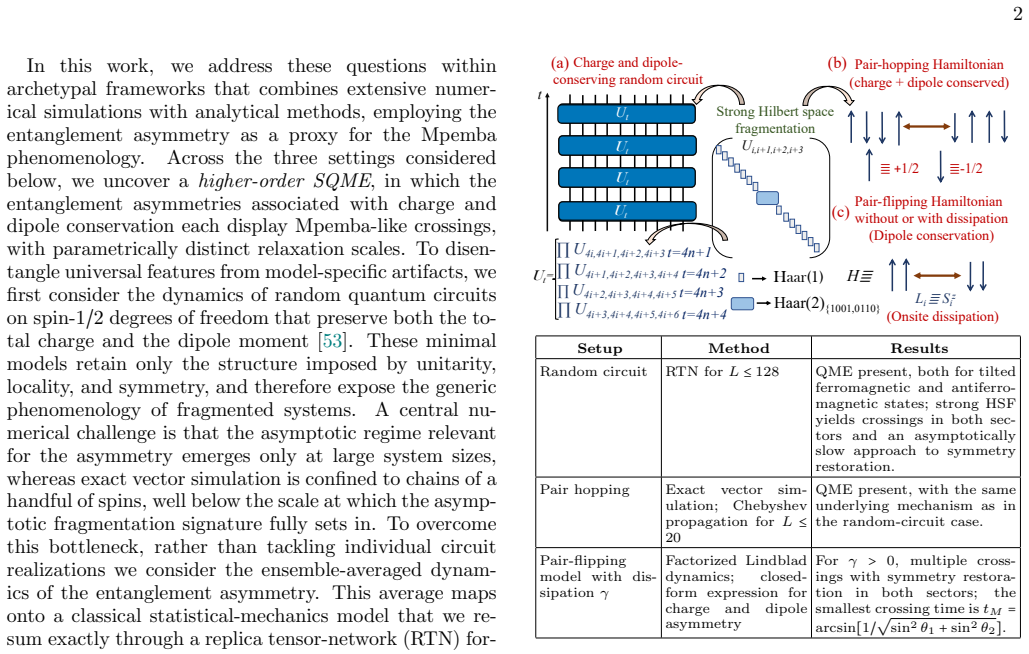
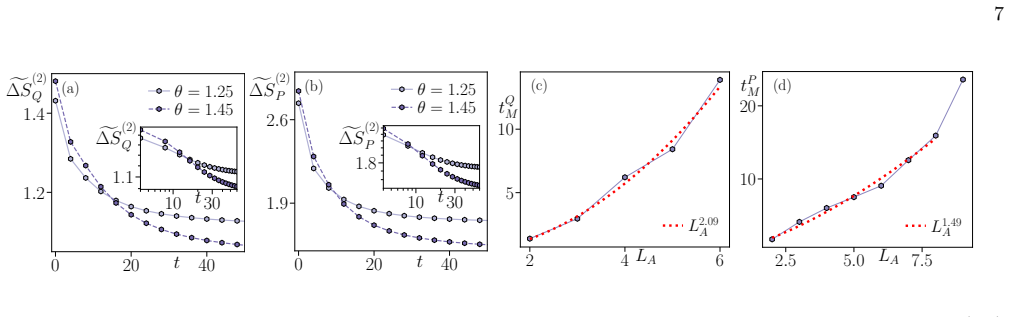
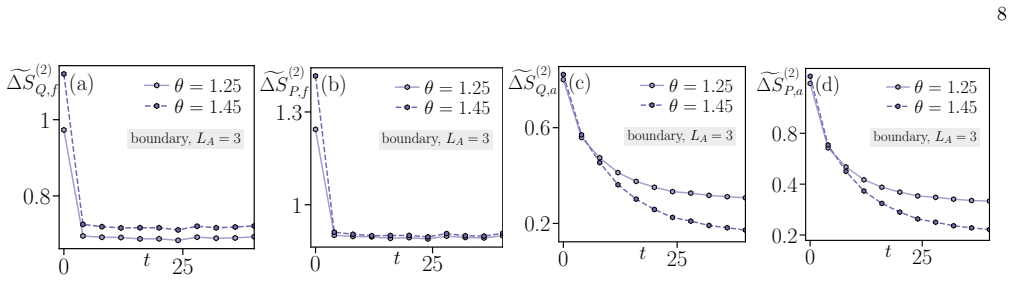
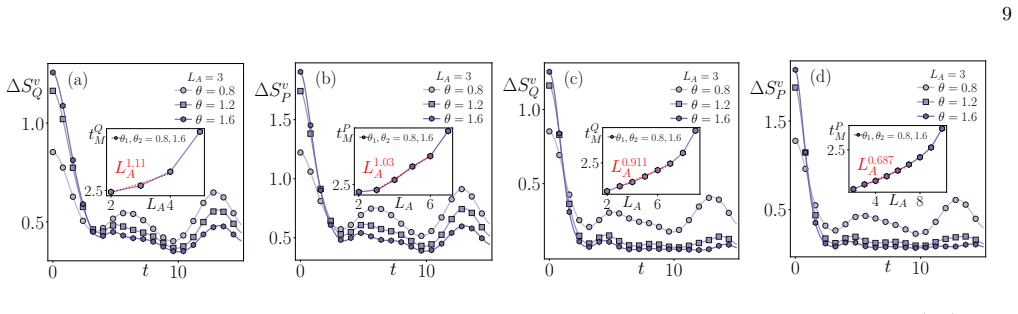
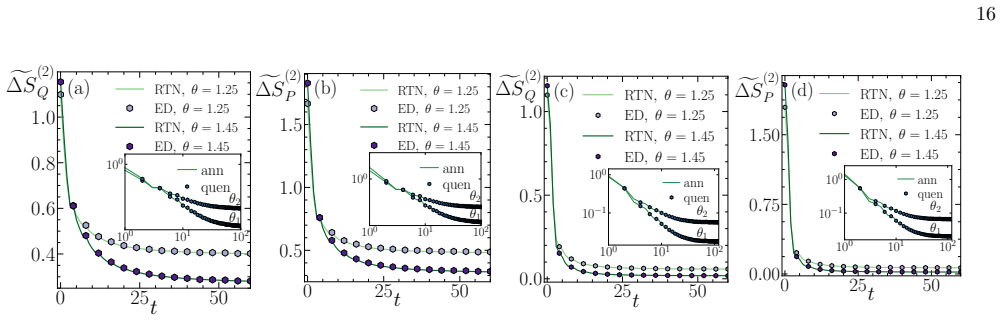
The authors uncover a higher-order symmetric quantum Mpemba effect: the charge and dipole asymmetries each display Mpemba-like crossings on parametrically distinct timescales. Resolving the state into frozen and active Krylov sectors reveals the mechanism: frozen fragments retain a finite asymmetry that obstructs full restoration, while active fragments host the relaxation responsible for the crossings. Fragmentation thus does not preclude the quantum Mpemba effect but reshapes it into frozen memory and active-fragment relaxation, providing a framework for the Mpemba phenomenology of higher-moment symmetries.
What carries the argument
The split into frozen and active Krylov sectors set by charge and dipole conservation, which keeps persistent asymmetry in one subset of sectors while allowing relaxation-driven crossings in the other.
If this is right
- The quantum Mpemba effect persists under strong Hilbert-space fragmentation but appears separately for each conserved moment.
- Frozen sectors leave a permanent memory of the initial asymmetry while active sectors produce the Mpemba crossing.
- The same phenomenology appears in both unitary circuits, Hamiltonians, and an exactly solvable dissipative model.
- Higher-moment symmetries acquire their own Mpemba timescales set by the fragmentation structure.
Where Pith is reading between the lines
- Similar higher-order crossings could appear whenever multiple independent conservation laws fragment the space.
- The separation of timescales might allow selective control of relaxation for different multipole moments in experiments.
- Exact solutions in small fragmented systems could be used to test whether the active-sector relaxation rate matches the observed crossing time.
Load-bearing premise
The split between frozen and active Krylov sectors fully explains the observed crossings and that the replica tensor-network and Hamiltonian calculations capture the true long-time dynamics without large finite-size artifacts.
What would settle it
A calculation or simulation in which active sectors are removed or suppressed yet the asymmetry crossings still appear, or one in which the crossings disappear when frozen sectors are eliminated.
Figures
read the original abstract
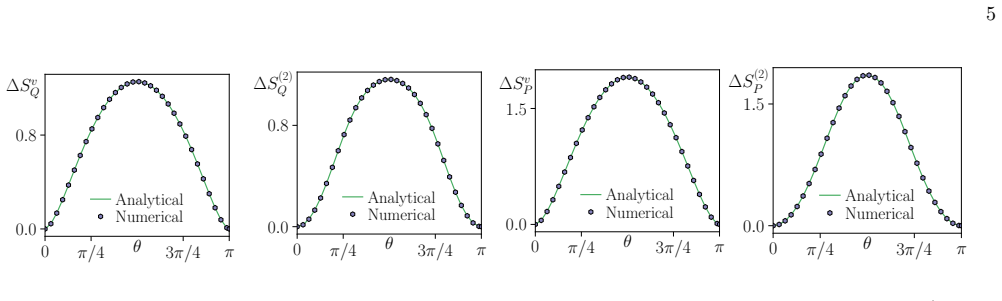
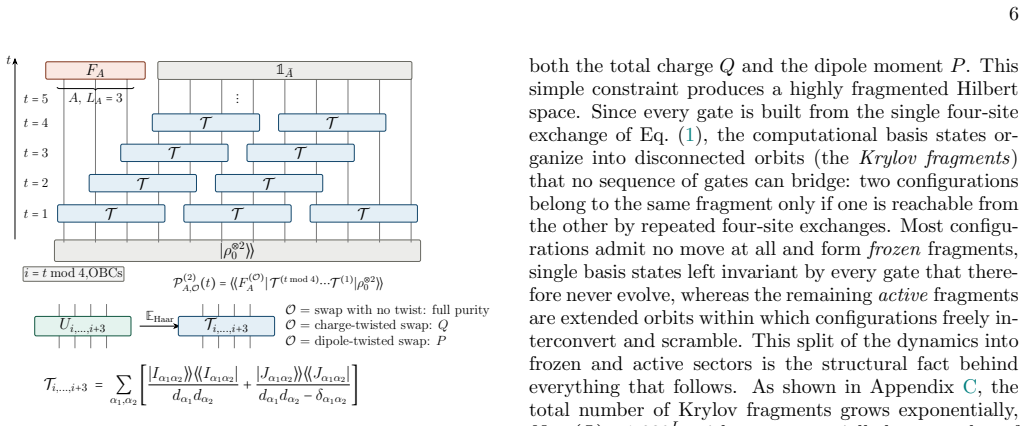
A quantum system can restore a broken symmetry faster the more strongly it initially breaks it, an anomaly known as the quantum Mpemba effect. Whether this effect survives once conservation laws fragment the Hilbert space into exponentially many disconnected Krylov sectors has remained open. We address this question for circuits and Hamiltonians with simultaneous charge and dipole conservation, the paradigmatic setting for strong Hilbert-space fragmentation. Combining a replica tensor-network formulation for charge and dipole-conserving gates, which reaches the annealed R\'enyi-2 entanglement asymmetry up to $L=128$, with Hamiltonian simulations and an exactly solvable dissipative model, we uncover a higher-order symmetric quantum Mpemba effect: the charge and dipole asymmetries each display Mpemba-like crossings on parametrically distinct timescales. Resolving the state into frozen and active Krylov sectors reveals the mechanism: frozen fragments retain a finite asymmetry that obstructs full restoration, while active fragments host the relaxation responsible for the crossings. Fragmentation thus does not preclude the quantum Mpemba effect but reshapes it into frozen memory and active-fragment relaxation, providing a framework for the Mpemba phenomenology of higher-moment symmetries.
Editorial analysis
A structured set of objections, weighed in public.
Referee Report
Summary. The manuscript claims that Hilbert-space fragmentation due to simultaneous charge and dipole conservation does not preclude the quantum Mpemba effect but reshapes it into a higher-order symmetric version: charge and dipole asymmetries each exhibit Mpemba-like crossings on parametrically distinct timescales. This is demonstrated via a replica tensor-network method for the annealed Rényi-2 entanglement asymmetry (reaching L=128), direct Hamiltonian evolution, and an exactly solvable dissipative model. The mechanism is identified by decomposing the state into frozen and active Krylov sectors, where frozen fragments retain finite asymmetry while active fragments drive the relaxation.
Significance. If the results hold, the work supplies a concrete framework for Mpemba phenomenology under higher-moment conservation laws by showing how fragmentation converts the effect into frozen memory plus active-sector relaxation. The combination of three independent lines of evidence—large-scale replica tensor networks, Hamiltonian simulations, and exact solvability—constitutes a clear methodological strength that directly ties the observed crossings to the defining conservation laws without additional dynamical assumptions.
minor comments (3)
- [Abstract] Abstract: the claim that the replica tensor-network computation reaches L=128 would be strengthened by a brief statement on convergence checks or error estimates, even if these appear in the main text.
- The distinction between frozen and active sectors is derived directly from the charge and dipole conservation laws, but a short explicit statement confirming that the sector decomposition is exhaustive (i.e., no additional sectors are needed) would improve clarity in the mechanism section.
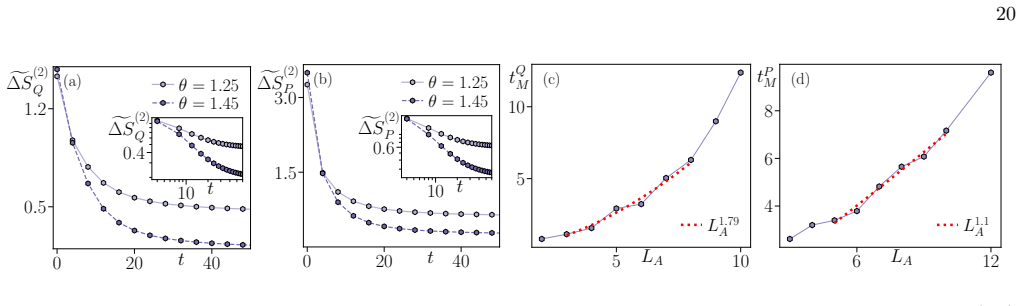
- Figure captions for the asymmetry crossings should explicitly label the parametrically distinct timescales for charge versus dipole to make the higher-order character immediately visible.
Simulated Author's Rebuttal
We thank the referee for the positive evaluation of our manuscript, the accurate summary of our results on the higher-order symmetric quantum Mpemba effect, and the recommendation for minor revision. The combination of replica tensor networks, Hamiltonian simulations, and exact solvability is indeed a methodological strength.
Circularity Check
No significant circularity detected
full rationale
The paper supports its claims via three independent lines of evidence—replica tensor-network computation of annealed Rényi-2 asymmetry (up to L=128), direct Hamiltonian evolution, and an exactly solvable dissipative model—none of which reduce the reported charge/dipole crossings to a fitted parameter or self-defined quantity. The frozen/active Krylov sector decomposition follows directly from the defining charge and dipole conservation laws that generate the fragmentation, without additional dynamical postulates or self-citation chains. No equation equates a prediction to its own input by construction, and the mechanism is a direct consequence of the Hilbert-space structure rather than an ansatz or renamed empirical pattern.
Axiom & Free-Parameter Ledger
axioms (2)
- domain assumption The replica tensor-network formulation reaches the annealed Rényi-2 entanglement asymmetry up to L=128 without uncontrolled approximations.
- domain assumption Krylov sectors can be cleanly partitioned into frozen and active classes whose asymmetry dynamics are independent.
Forward citations
Cited by 1 Pith paper
-
Unitary Designs from Doped Matchgate Circuits
Doped matchgate circuits achieve approximate parity-preserving 2-designs in polylogarithmic depth using a sparse number of non-Gaussian gates, with the design formation mapped exactly to a birth-death Markov chain.
Reference graph
Works this paper leans on
-
[1]
To count Nfrag analytically, we construct a transfer matrix [55–57, 115–117] on the eight three-site configurations {000,001,010,011,100,101,110,111}
Total number of fragments LetN frag(L)denotes the total number of Krylov fragments for a chain of lengthLin OBCs. To count Nfrag analytically, we construct a transfer matrix [55–57, 115–117] on the eight three-site configurations {000,001,010,011,100,101,110,111}. The matrix elementT frag(ci, cj)connects the row state(s j, sj+1, sj+2)to the column state(s...
-
[2]
Frozen fragments In classically fragmented systems, a basis configuration is frozen if and only if it contains neither 1001 nor 0110 on any contiguous four-site block. The corresponding transfer matrixT fr is constructed in the same way asT frag, but nowbothpatterns are forbidden: Tfr = ⎛ ⎜⎜⎜⎜⎜⎜⎜⎜⎜⎜⎜⎜⎜⎜⎜ ⎝ 1 1 0 0 0 0 0 0 0 0 1 1 0 0 0 0 0 0 0 0 1 1 0 0 0...
-
[3]
Grouping the chain into two-site blocks and defining 10→Aand 01→B, the local move 1001↔0110 becomesAB↔BA
Dimension of largest fragment and strong fragmentation The dimension of the largest fragment can be obtained analytically by mapping the local move to a permutation problem. Grouping the chain into two-site blocks and defining 10→Aand 01→B, the local move 1001↔0110 becomesAB↔BA. Within a fully connected fragment the dynamics therefore simply permutes a wo...
-
[4]
The constrainty L/2 enforcesQ=0 (equal number of+ 1 2 and−1 2 spins), whilex L(L+1)/4 enforcesP=0 (the sum of site indices carryings i =+ 1 2 equals L(L+1)/4)
sites and a variablexconjugate to the dipole moment, one has D0,0(L)= [xL(L+1)/4 yL/2] L ∏ j=1 (1+x j y),(C8) where[x ayb]f(x, y)denotes the coefficient ofx ayb in the Taylor expansion off. The constrainty L/2 enforcesQ=0 (equal number of+ 1 2 and−1 2 spins), whilex L(L+1)/4 enforcesP=0 (the sum of site indices carryings i =+ 1 2 equals L(L+1)/4). Equival...
-
[5]
Derivation of asymmetries We consider an odd chain of lengthL=2m+1, with sites paired by reflection about the central site. The coherent dynamics is generated by the mirror-pair Hamiltonian H= M ∑ j=1 (S+ j S+ L+1−j+S − j S− L+1−j) ,(F1) and the dissipative dynamics is due to local dephasing jumps Li =S z i , i=1, . . . , L.(F2) The density matrix evolves...
-
[6]
, L A}of arbitrary size, including the macroscopic caseLA =100 used in the main text
Crossing time for a general one-sided subsystem The closed-form charged moments derived above admit a perturbative analysis of the QME crossing time that extends naturally to a one-sided subsystemA={1,2, . . . , L A}of arbitrary size, including the macroscopic caseLA =100 used in the main text. We show below that the analysis is intrinsically tied to the ...
-
[7]
(F52), due to the residual oscillatory factor 1−sin 2 θsin 2 tinB(t)
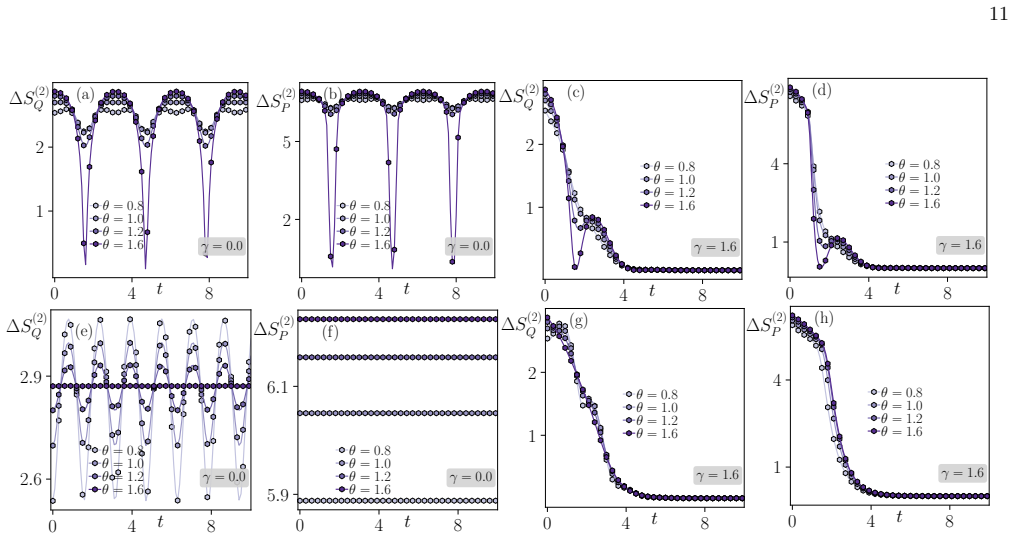
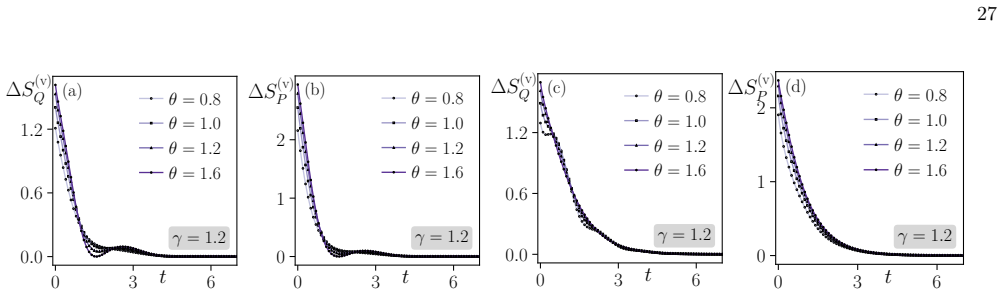
Multiple crossings and the role of dissipation The asymmetry curves atγ=1.6 exhibitmultiplecrossings att M and at the periodic images of Eq. (F52), due to the residual oscillatory factor 1−sin 2 θsin 2 tinB(t). The Mpemba time corresponds to thefirstsuch crossing; the 27 0 3 6t 0.0 0.6 1.2 ¢S(v) Q ∞=1.2 (c) µ=0.8 µ=1.0 µ=1.2 µ=1.6 0 3 6t 0 1 2 ¢S(v) P ∞=1...
-
[8]
E. B. Mpemba and D. G. Osborne, Cool?, Phys. Educ.4, 172 (1969)
1969
-
[9]
Lasanta, F
A. Lasanta, F. V. Reyes, A. Prados, and A. Santos, When the hotter cools more quickly: Mpemba effect in granular fluids, Phys. Rev. Lett.119, 148001 (2017)
2017
-
[10]
Lu and O
Z. Lu and O. Raz, Nonequilibrium thermodynamics of the markovian mpemba effect and its inverse, Proc. Natl. Acad. Sci. U.S.A.114, 5083 (2017)
2017
-
[11]
Klich, O
I. Klich, O. Raz, O. Hirschberg, and M. Vucelja, Mpemba index and anomalous relaxation, Phys. Rev. X9, 021060 (2019)
2019
-
[12]
Kumar and J
A. Kumar and J. Bechhoefer, Exponentially faster cooling in a colloidal system, Nature584, 64 (2020)
2020
-
[13]
Bechhoefer, A
J. Bechhoefer, A. Kumar, and R. Ch´ etrite, A fresh understanding of the mpemba effect, Nat. Rev. Phys.3, 534 (2021)
2021
-
[14]
Kumar, R
A. Kumar, R. Ch´ etrite, and J. Bechhoefer, Anomalous heating in a colloidal system, Proc. Natl. Acad. Sci. U.S.A.119, e2118484119 (2022)
2022
-
[15]
Polkovnikov, K
A. Polkovnikov, K. Sengupta, A. Silva, and M. Vengalattore, Colloquium: Nonequilibrium dynamics of closed interacting quantum systems, Reviews of Modern Physics83, 863–883 (2011)
2011
-
[16]
Rigol, V
M. Rigol, V. Dunjko, and M. Olshanii, Thermalization and its mechanism for generic isolated quantum systems, Nature 452, 854 (2008)
2008
-
[17]
D’Alessio, Y
L. D’Alessio, Y. Kafri, A. Polkovnikov, and M. Rigol, From quantum chaos and eigenstate thermalization to statistical mechanics and thermodynamics, Advances in Physics65, 239–362 (2016)
2016
-
[18]
Carollo, A
F. Carollo, A. Lasanta, and I. Lesanovsky, Exponentially accelerated approach to stationarity in markovian open quantum systems through the mpemba effect, Phys. Rev. Lett.127, 060401 (2021)
2021
-
[19]
Summer, M
A. Summer, M. Moroder, L. P. Bettmann, X. Turkeshi, I. Marvian, and J. Goold, Resource-theoretical unification of mpemba effects: Classical and quantum, Phys. Rev. X16, 011065 (2026)
2026
- [20]
-
[21]
Z. Xiao, H.-K. Zhang, and S. Liu, Nonstabilizerness mpemba effects (2026), arXiv:2605.04155 [quant-ph]
Pith/arXiv arXiv 2026
-
[22]
Y. Kusuki, S. Pal, and H. Tajima, Resource-theoretic quantifiers of weak and strong symmetry breaking: Strong entan- glement asymmetry and beyond (2026), arXiv:2601.20924 [hep-th]
Pith/arXiv arXiv 2026
-
[23]
R. Travaglino and P. Calabrese, A Gaussian asymmetry measure (2026), arXiv:2604.26878 [quant-ph]
Pith/arXiv arXiv 2026
-
[24]
F. Ares, S. Murciano, and P. Calabrese, Entanglement asymmetry as a probe of symmetry breaking, Nature Communi- cations14, 2036 (2023)
2036
-
[25]
F. Ares, S. Murciano, E. Vernier, and P. Calabrese, Lack of symmetry restoration after a quantum quench: An entangle- ment asymmetry study, SciPost Phys.15, 089 (2023)
2023
-
[26]
Yamashika, F
S. Yamashika, F. Ares, and P. Calabrese, Entanglement asymmetry and quantum mpemba effect in two-dimensional free-fermion systems, Phys. Rev. B110, 085126 (2024)
2024
-
[27]
Chalas, F
K. Chalas, F. Ares, C. Rylands, and P. Calabrese, Multiple crossings during dynamical symmetry restoration and impli- cations for the quantum mpemba effect, J. Stat. Mech.2024, 103101 (2024)
2024
-
[28]
Bertini, K
B. Bertini, K. Klobas, M. Collura, P. Calabrese, and C. Rylands, Dynamics of charge fluctuations from asymmetric initial states, Phys. Rev. B109, 184312 (2024)
2024
-
[29]
Turkeshi, P
X. Turkeshi, P. Calabrese, and A. D. Luca, Quantum mpemba effect in random circuits, Phys. Rev. Lett.135, 040403 (2025)
2025
-
[30]
Liu, H.-K
S. Liu, H.-K. Zhang, S. Yin, and S.-X. Zhang, Symmetry restoration and quantum mpemba effect in symmetric random circuits, Phys. Rev. Lett.133, 140405 (2024)
2024
-
[31]
F. Ares, V. Vitale, and S. Murciano, Quantum mpemba effect in free-fermionic mixed states, Phys. Rev. B111, 104312 (2025)
2025
-
[32]
J. A. Vaccaro, F. Anselmi, H. M. Wiseman, and K. Jacobs, Tradeoff between extractable mechanical work, accessible entanglement, and ability to act as a reference system, under arbitrary superselection rules, Phys. Rev. A77, 032114 (2008)
2008
-
[33]
G. Gour, I. Marvian, and R. W. Spekkens, Measuring the quality of a quantum reference frame: The relative entropy of frameness, Phys. Rev. A80, 012307 (2009)
2009
-
[34]
Rylands, K
C. Rylands, K. Klobas, F. Ares, P. Calabrese, S. Murciano, and B. Bertini, Microscopic origin of the quantum mpemba effect in integrable systems, Phys. Rev. Lett.133, 010401 (2024)
2024
-
[35]
F. Ares, S. Murciano, E. Vernier, and P. Calabrese, Lack of symmetry restoration after a quantum quench: an entanglement asymmetry study, SciPost Phys.15, 089 (2023)
2023
-
[36]
S. Murciano, F. Ares, I. Klich, and P. Calabrese, Entanglement asymmetry and quantum Mpemba effect in the XY spin chain, Journal of Statistical Mechanics: Theory and Experiment , 013103 (2024), arXiv:2310.07513 [cond-mat.stat-mech]
arXiv 2024
-
[37]
Russotto, F
A. Russotto, F. Ares, P. Calabrese, and V. Alba, Journal of Statistical Mechanics: Theory and Experiment2026, 033103 (2026)
2026
-
[38]
Rylands, E
C. Rylands, E. Vernier, and P. Calabrese, Dynamical symmetry restoration in the heisenberg spin chain, J. Stat. Mech. , 123102 (2024)
2024
-
[39]
Yamashika, P
S. Yamashika, P. Calabrese, and F. Ares, Quenching from superfluid to free bosons in two dimensions: Entanglement, 29 symmetries, and the quantum mpemba effect, Phys. Rev. A111, 043304 (2025)
2025
-
[40]
Benini, V
F. Benini, V. Godet, and A. H. Singh, Entanglement asymmetry in conformal field theory and holography, Progress of Theoretical and Experimental Physics2025, 063B05 (2025)
2025
-
[41]
Caceffo, S
F. Caceffo, S. Murciano, and V. Alba, Entangled multiplets, asymmetry, and quantum mpemba effect in dissipative systems, J. Stat. Mech. , 063103 (2024)
2024
-
[42]
G. D. Giulio, X. Turkeshi, and S. Murciano, Measurement-induced symmetry restoration and quantum mpemba effect, Entropy27, 407 (2025)
2025
-
[43]
Y. Zeng, J. Son, M. Gu, and X. Yuan, Theory of Quantum Imaginary-Time Mpemba Effect (2026), arXiv:2604.17412 [quant-ph]
Pith/arXiv arXiv 2026
-
[44]
H.-Z. Li, C. H. Lee, S. Liu, S.-X. Zhang, and J.-X. Zhong, Quantum mpemba effect in long-ranged u(1)-symmetric random circuits, Phys. Rev. B113, 134310 (2026)
2026
-
[45]
Foligno, P
A. Foligno, P. Calabrese, and B. Bertini, Nonequilibrium dynamics of charged dual-unitary circuits, PRX Quantum6, 010324 (2025)
2025
-
[46]
Yamashika and F
S. Yamashika and F. Ares, Quantum mpemba effect in long-range spin systems, Phys. Rev. Lett.136, 090402 (2026)
2026
-
[47]
Yu, T.-R
Y.-H. Yu, T.-R. Jin, L. Zhang, K. Xu, and H. Fan, Tuning the quantum Mpemba effect in an isolated system by initial-state engineering, Physical Review B112, 094315 (2025)
2025
- [48]
-
[49]
L. K. Joshi, J. Franke, A. Rath, F. Ares, S. Murciano, F. Kranzl, R. Blatt, P. Zoller, B. Vermersch, P. Calabrese, C. F. Roos, and M. K. Joshi, Observing the quantum mpemba effect in quantum simulations, Phys. Rev. Lett.133, 010402 (2024)
2024
-
[50]
Bhore, L
T. Bhore, L. Su, I. Martin, A. A. Clerk, and Z. Papi´ c, Quantum mpemba effect without global symmetries, Phys. Rev. B112, L121109 (2025)
2025
-
[51]
T. M. M¨ uller, S. Pappalardi, and R. Fazio, Quantum mpemba effect in chaotic systems with conservation laws (2026), arXiv:2604.11876 [quant-ph]
Pith/arXiv arXiv 2026
-
[52]
F. Ares, P. Calabrese, and S. Murciano, The quantum Mpemba effects, Nature Reviews Physics7, 451 (2025), arXiv:2502.08087 [cond-mat.stat-mech]
arXiv 2025
-
[53]
G. Teza, J. Bechhoefer, A. Lasanta, O. Raz, and M. Vucelja, Speedups in nonequilibrium thermal relaxation: Mpemba and related effects (2025), arXiv:2502.01758 [cond-mat.stat-mech]
arXiv 2025
-
[54]
Calabrese, The quantum mpemba effect in closed systems: from theory to experiment, Journal of Statistical Mechanics: Theory and Experiment2026, 034002 (2026)
P. Calabrese, The quantum mpemba effect in closed systems: from theory to experiment, Journal of Statistical Mechanics: Theory and Experiment2026, 034002 (2026)
2026
-
[55]
Moudgalya, B
S. Moudgalya, B. A. Bernevig, and N. Regnault, Quantum many-body scars and hilbert space fragmentation: a review of exact results, Reports on Progress in Physics85, 086501 (2022)
2022
-
[56]
Pretko, Subdimensional particle structure of higher ranku(1)spin liquids, Phys
M. Pretko, Subdimensional particle structure of higher ranku(1)spin liquids, Phys. Rev. B95, 115139 (2017)
2017
-
[57]
Moudgalya, B
S. Moudgalya, B. A. Bernevig, and N. Regnault, Quantum many-body scars in a landau level on a thin torus, Phys. Rev. B102, 195150 (2020)
2020
-
[58]
P. Sala, T. Rakovszky, R. Verresen, M. Knap, and F. Pollmann, Ergodicity breaking arising from hilbert space fragmen- tation in dipole-conserving hamiltonians, Phys. Rev. X10, 011047 (2020)
2020
-
[59]
Rakovszky, P
T. Rakovszky, P. Sala, R. Verresen, M. Knap, and F. Pollmann, Statistical localization: From strong fragmentation to strong edge modes, Phys. Rev. B101, 125126 (2020)
2020
-
[60]
Khemani, M
V. Khemani, M. Hermele, and R. Nandkishore, Localization from Hilbert space shattering: From theory to physical realizations, Phys. Rev. B101, 174204 (2020)
2020
-
[61]
Aditya and D
S. Aditya and D. Sen, Dynamical localization and slow thermalization in a class of disorder-free periodically driven one-dimensional interacting systems, SciPost Phys. Core6, 083 (2023)
2023
-
[62]
Aditya, D
S. Aditya, D. Dhar, and D. Sen, Subspace-restricted thermalization in a correlated-hopping model with strong Hilbert Space Fragmentation characterized by irreducible strings, Phys. Rev. B110, 045418 (2024)
2024
-
[63]
Ganguli, S
M. Ganguli, S. Aditya, and D. Sen, Aspects of Hilbert Space Fragmentation in the quantum East model: Fragmentation, subspace-restricted quantum scars, and effects of density-density interactions, Phys. Rev. B111, 045411 (2025)
2025
-
[64]
Aditya, Diagnostics of hilbert space fragmentation, freezing transition, and its effects in the family of quantum east models involving varying range of constraints, Phys
S. Aditya, Diagnostics of hilbert space fragmentation, freezing transition, and its effects in the family of quantum east models involving varying range of constraints, Phys. Rev. B112, 195413 (2025)
2025
-
[65]
Mukherjee, D
B. Mukherjee, D. Banerjee, K. Sengupta, and A. Sen, Minimal model for Hilbert Space Fragmentation with local con- straints, Phys. Rev. B104, 155117 (2021)
2021
-
[66]
Zadnik and J
L. Zadnik and J. P. Garrahan, Slow heterogeneous relaxation due to constraints in dual XXZ models, Phys. Rev. B108, L100304 (2023)
2023
-
[67]
Causer, M
L. Causer, M. C. Ba˜ nuls, and J. P. Garrahan, Nonthermal eigenstates and slow relaxation in quantum fredkin spin chains, Phys. Rev. B110, 134322 (2024)
2024
-
[68]
Mari´ c, L
V. Mari´ c, L. Paljk, and L. Zadnik, Slow dynamics from a nested hierarchy of frozen states, Phys. Rev. B113, 024313 (2026)
2026
-
[69]
Rakovszky, F
T. Rakovszky, F. Pollmann, and C. W. von Keyserlingk, Sub-ballistic growth of r´ enyi entropies due to diffusion, Phys. Rev. Lett.122, 250602 (2019)
2019
-
[70]
Khemani, A
V. Khemani, A. Vishwanath, and D. A. Huse, Operator spreading and the emergence of dissipative hydrodynamics under unitary evolution with conservation laws, Phys. Rev. X8, 031057 (2018)
2018
-
[71]
Rakovszky, F
T. Rakovszky, F. Pollmann, and C. W. von Keyserlingk, Diffusive hydrodynamics of out-of-time-ordered correlators with charge conservation, Physical Review X8, 031058 (2018). 30
2018
-
[72]
S. Aditya, E. Tirrito, P. Sierant, and X. Turkeshi, Coherence dynamics in quantum many-body systems with conservation laws (2026), arXiv:2604.23192 [quant-ph]
Pith/arXiv arXiv 2026
- [73]
-
[74]
Tirrito, X
E. Tirrito, X. Turkeshi, and P. Sierant, Anticoncentration and nonstabilizerness spreading under ergodic quantum dy- namics, Phys. Rev. Lett.135, 220401 (2025)
2025
-
[75]
Turkeshi, E
X. Turkeshi, E. Tirrito, and P. Sierant, Magic spreading in random quantum circuits, Nature Communications16, 2575 (2025)
2025
-
[76]
Tal-Ezer and R
H. Tal-Ezer and R. Kosloff, An accurate and efficient scheme for propagating the time dependent Schr¨ odinger equation, The Journal of Chemical Physics81, 3967 (1984)
1984
-
[77]
Sierant and J
P. Sierant and J. Zakrzewski, Challenges to observation of many-body localization, Physical Review B105, 224203 (2022)
2022
-
[78]
Breuer and F
H.-P. Breuer and F. Petruccione,The Theory of Open Quantum Systems(Oxford University Press, Oxford, 2002)
2002
-
[79]
Holzhey, F
C. Holzhey, F. Larsen, and F. Wilczek, Geometric and renormalized entropy in conformal field theory, Nuclear Physics B 424, 443 (1994)
1994
-
[80]
Calabrese and J
P. Calabrese and J. Cardy, Entanglement entropy and quantum field theory, Journal of Statistical Mechanics: Theory and Experiment , P06002 (2004)
2004
discussion (0)
Sign in with ORCID, Apple, or X to comment. Anyone can read and Pith papers without signing in.