Radiation Pressure Instability in the "turn-on" Changing-Look AGN SDSS J1430+2303
Pith reviewed 2026-06-27 22:11 UTC · model grok-4.3
The pith
Radiation pressure instabilities in the accretion disk drive the decaying light curves observed in SDSS J1430+2303.
A machine-rendered reading of the paper's core claim, the machinery that carries it, and where it could break.
Core claim
We propose that the observed multi-wavelength decaying periods and damping amplitudes are associated with a shrinking unstable zone, driven by radiation pressure instabilities within the accretion disk.
What carries the argument
Radiation pressure instability inside the accretion disk that produces a shrinking unstable zone whose changing size accounts for the observed damping amplitudes.
If this is right
- The low Eddington ratio (0.024-0.046) is the regime in which radiation-pressure instability can operate and produce the observed damping.
- High black-hole spin (a greater than or equal to 0.86) is required for the disk conditions that sustain the unstable zone.
- The stable disk-corona geometry inferred from timing allows the instability to remain the dominant driver of variability as luminosity falls.
- The same mechanism can account for the progressive shortening of the decaying periods.
Where Pith is reading between the lines
- Similar damping patterns may appear in other low-Eddington-ratio changing-look AGNs if their disks also develop radiation-pressure unstable zones.
- Continued monitoring could test whether the unstable zone continues to shrink after the current observations end.
- The model implies a specific relation between the rate of amplitude damping and the rate of luminosity decline that future multi-wavelength campaigns could check.
Load-bearing premise
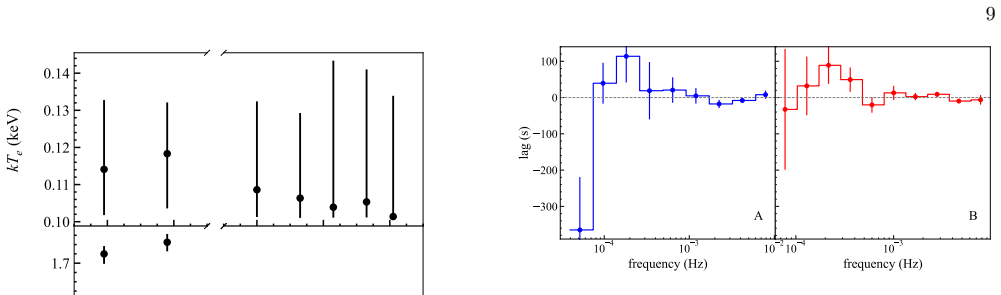
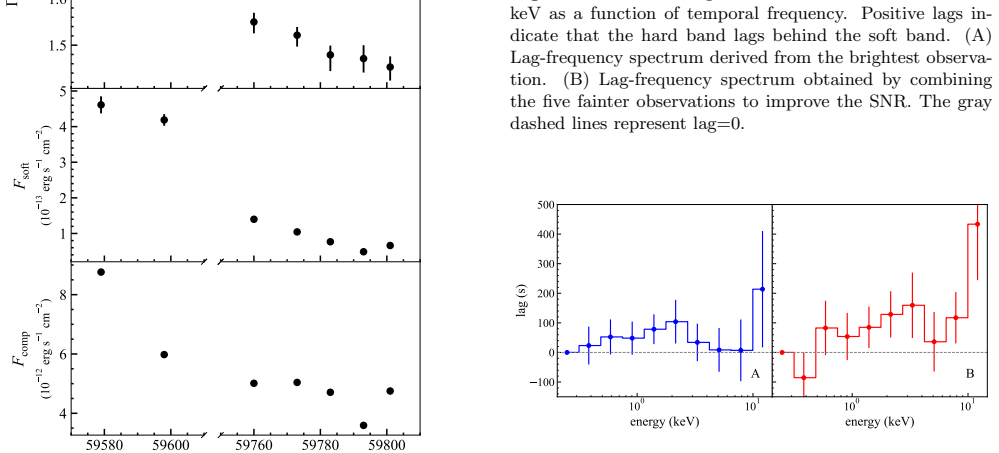
Constant break frequency and hard lag at 10 to the minus 4 Hz during the luminosity drop mean the disk-corona geometry stays fixed, allowing radiation-pressure instability to set the light-curve shape.
What would settle it
A clear change in break frequency or hard lag during the luminosity decline, or amplitudes that fail to damp in step with a shrinking unstable zone, would contradict the instability interpretation.
Figures
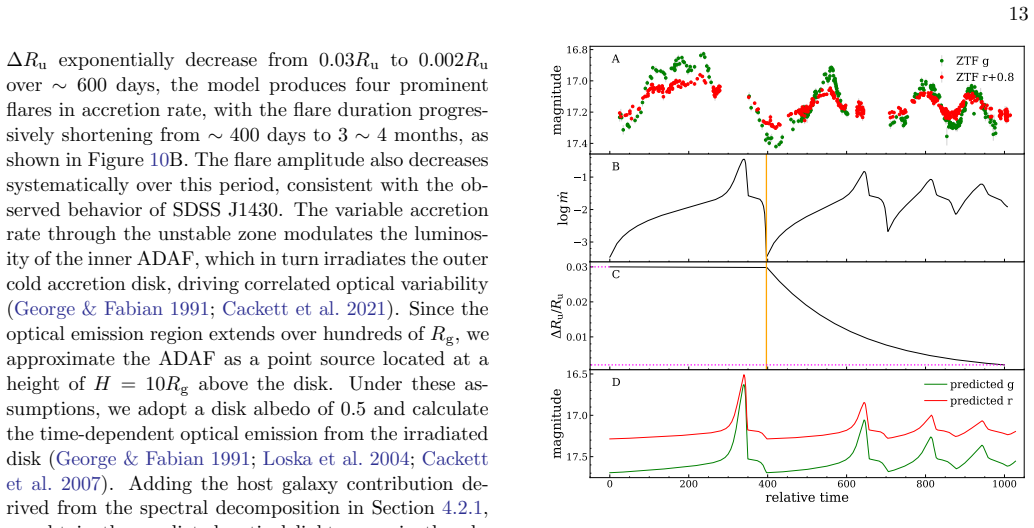
read the original abstract
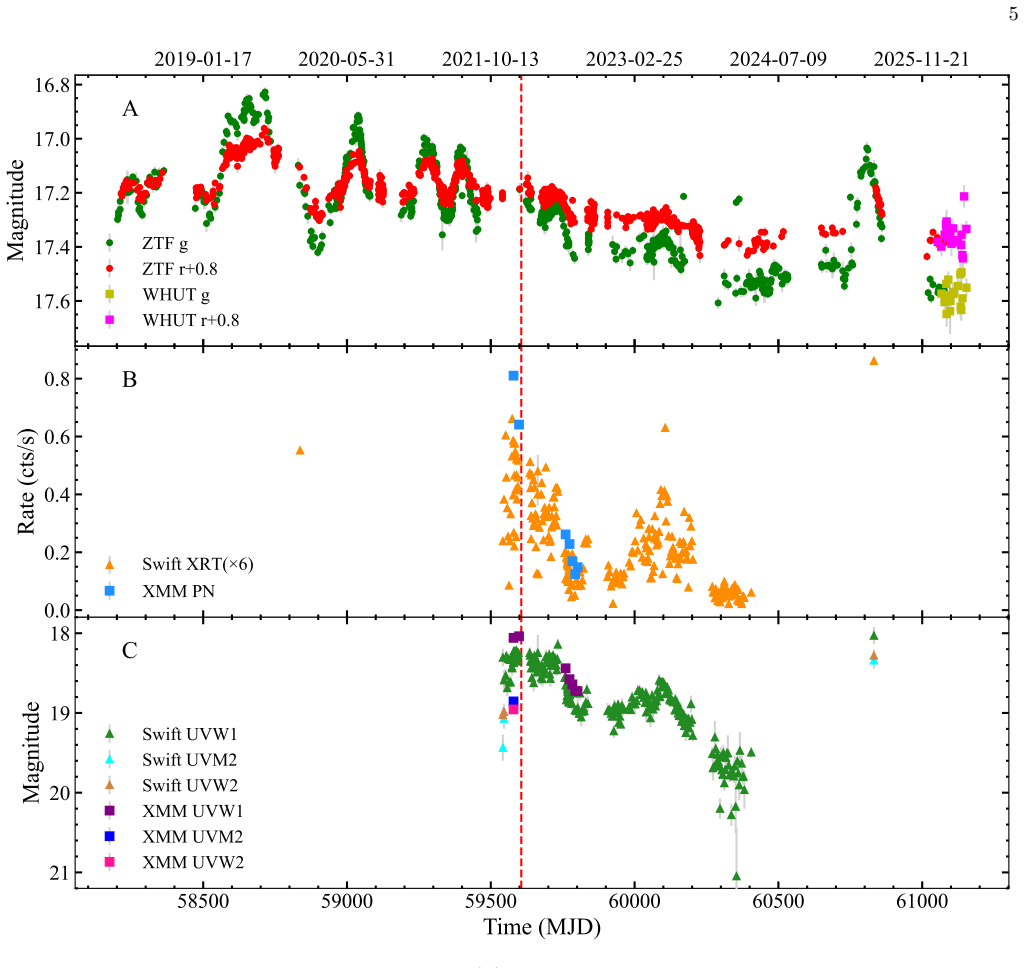
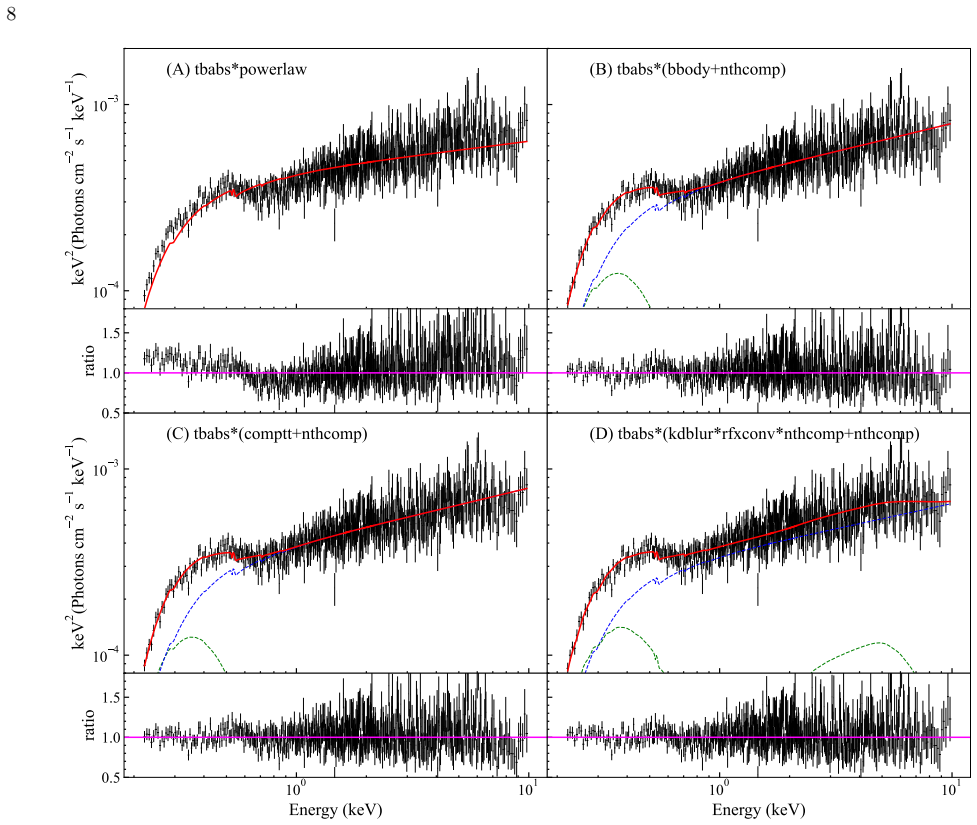
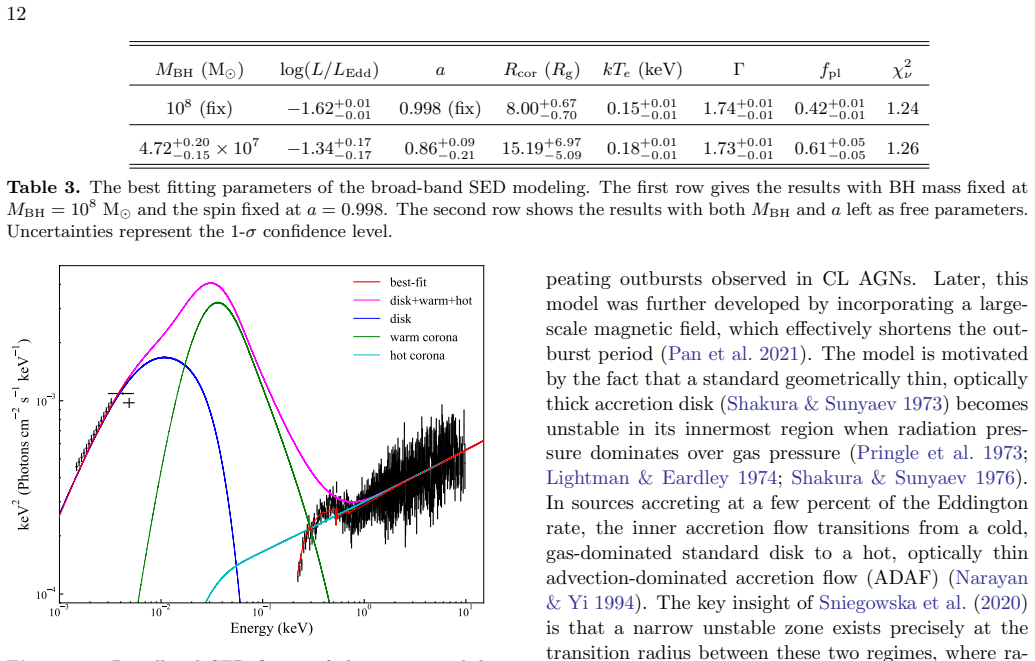
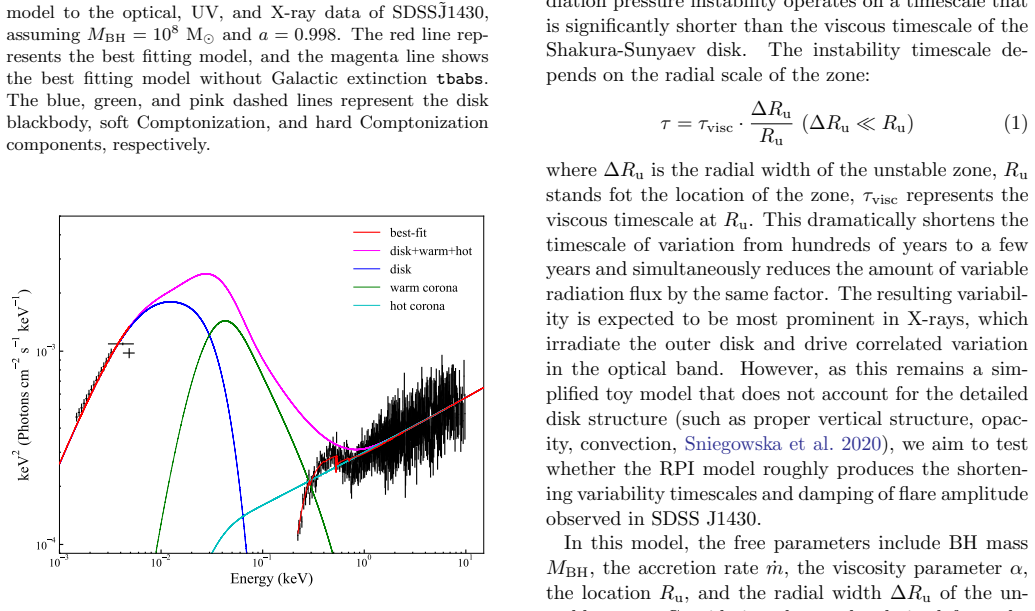
We present a multi-wavelength study of the changing-look AGN SDSS J1430+2303. The optical flux increased by an order of magnitude over four years, driving a spectral transition from Seyfert 1.9 to 1.2. During the brightened high state, optical, UV, and X-ray light curves exhibited rapid decaying periods with progressively decreasing amplitudes. X-ray spectral analysis reveals a remarkably weak soft excess which declines more steeply than the hard X-rays as the total luminosity decreases. X-ray timing analysis shows a constant break frequency and a hard lag at $\sim 10^{-4}$ Hz during the luminosity decline, indicating a stable disk-corona geometry. Further broad-band spectral energy distribution fitting constrains the black hole mass to the range $M_{\rm BH}=4.7-19.5\times10^7\rm M_\odot$, corresponding to an Eddington ratio to $L/L_{\rm Edd}\sim0.024 - 0.046$, and favors a high spin ($a\gtrsim 0.86$). Consequently, we propose that the observed multi-wavelength decaying periods and damping amplitudes are associated with a shrinking unstable zone, driven by radiation pressure instabilities within the accretion disk.
Editorial analysis
A structured set of objections, weighed in public.
Referee Report
Summary. The manuscript presents multi-wavelength observations of the changing-look AGN SDSS J1430+2303, documenting an order-of-magnitude rise in optical flux over four years that drives a spectral transition from Seyfert 1.9 to 1.2. In the high state, optical/UV/X-ray light curves exhibit decaying periods with progressively smaller amplitudes. X-ray spectra show a weak soft excess that declines more steeply than the hard X-rays; timing analysis finds constant break frequency and hard lag at ~10^{-4} Hz, taken to indicate stable disk-corona geometry. Broadband SED fitting yields M_BH = 4.7–19.5 × 10^7 M_⊙, L/L_Edd ≈ 0.024–0.046, and a ≳ 0.86. The authors propose that the observed decaying periods and damping amplitudes arise from a shrinking unstable zone driven by radiation-pressure instabilities in the accretion disk.
Significance. If the quantitative link between the timing data and the shrinking-zone model can be established, the result would supply rare observational evidence for radiation-pressure instability operating at low Eddington ratio and would offer a concrete mechanism for the turn-on phase of changing-look AGN. The multi-wavelength light-curve coverage and the reported constancy of the X-ray timing properties are clear strengths of the dataset.
major comments (2)
- [Abstract (final paragraph) and timing analysis section] Abstract (final paragraph) and timing analysis section: The central claim requires that radiation-pressure instability produces a shrinking unstable zone whose multi-wavelength signatures match the decaying periods and damping amplitudes. This interpretation is tied to the X-ray timing result of constant break frequency and hard lag at ~10^{-4} Hz, which is used to infer stable disk-corona geometry. However, a shrinking unstable zone (altering the radial extent or thermal structure of the radiation-pressure-dominated region) would be expected to modify the characteristic timescales or propagation delays that set the break frequency and lag, unless the unstable zone is entirely decoupled from the X-ray emitting corona in a manner that is not demonstrated.
- [Abstract (SED fitting paragraph)] Abstract (SED fitting paragraph): The derived Eddington ratio range L/L_Edd ∼ 0.024–0.046 is low. Radiation-pressure instability is expected to operate only where radiation pressure dominates, which at these accretion rates occupies a narrow radial range; the manuscript does not show how an unstable zone of sufficient size and radial extent can exist and produce the observed multi-wavelength decaying periods while leaving the X-ray timing signal unchanged.
minor comments (1)
- [Abstract] The abstract states that SED fitting 'favors a high spin (a ≳ 0.86)' but does not list the model components, priors, or goodness-of-fit metrics used to obtain the mass, Eddington ratio, and spin constraints.
Simulated Author's Rebuttal
We thank the referee for the constructive and detailed comments, which help clarify the interpretation of our results. We address each major comment below.
read point-by-point responses
-
Referee: [Abstract (final paragraph) and timing analysis section] Abstract (final paragraph) and timing analysis section: The central claim requires that radiation-pressure instability produces a shrinking unstable zone whose multi-wavelength signatures match the decaying periods and damping amplitudes. This interpretation is tied to the X-ray timing result of constant break frequency and hard lag at ~10^{-4} Hz, which is used to infer stable disk-corona geometry. However, a shrinking unstable zone (altering the radial extent or thermal structure of the radiation-pressure-dominated region) would be expected to modify the characteristic timescales or propagation delays that set the break frequency and lag, unless the unstable zone is entirely decoupled from the X-ray emitting corona in a manner that is not demonstrated.
Authors: We agree that the link between the shrinking unstable zone and the unchanged X-ray timing properties requires clearer justification. Our interpretation rests on the observational result that the break frequency and hard lag remain constant at ~10^{-4} Hz while optical/UV amplitudes damp, which we take as indicating that the corona's characteristic scales are unaffected. We posit that the instability primarily influences larger radii contributing to the optical/UV, leaving the inner corona stable. We will revise the timing analysis and discussion sections to explicitly address the radial separation and the assumption of decoupling. revision: yes
-
Referee: [Abstract (SED fitting paragraph)] Abstract (SED fitting paragraph): The derived Eddington ratio range L/L_Edd ∼ 0.024–0.046 is low. Radiation-pressure instability is expected to operate only where radiation pressure dominates, which at these accretion rates occupies a narrow radial range; the manuscript does not show how an unstable zone of sufficient size and radial extent can exist and produce the observed multi-wavelength decaying periods while leaving the X-ray timing signal unchanged.
Authors: The SED-derived Eddington ratios of 0.024–0.046 are indeed low, and we recognize that the radiation-pressure-dominated region is expected to be radially limited at these rates. The manuscript does not provide a quantitative model of the unstable zone's extent or a calculation demonstrating how a narrow zone produces the observed damping while preserving X-ray timing. We will add a paragraph in the discussion explicitly noting this limitation and outlining why the multi-wavelength signatures can still be consistent with a compact unstable region that does not alter the inner corona. revision: partial
Circularity Check
No circularity: interpretive proposal from independent timing and SED data
full rationale
The paper reports X-ray timing (constant break frequency and hard lag) and SED fitting (BH mass, Eddington ratio, spin) as direct observational constraints. These are used to motivate an interpretive proposal linking decaying periods to a shrinking radiation-pressure unstable zone. No equations, fitted parameters, or self-citations are shown that make the proposal equivalent to its inputs by construction. The timing result is presented as evidence for stable geometry, and the instability link is a hypothesis, not a derived prediction that reduces to the fit. This is a standard non-circular interpretive step.
Axiom & Free-Parameter Ledger
free parameters (2)
- Black hole mass =
4.7-19.5 x 10^7 M_sun
- Eddington ratio =
0.024-0.046
axioms (1)
- domain assumption Radiation pressure instability can develop in accretion disks at low-to-moderate Eddington ratios and produce a shrinking unstable zone.
Reference graph
Works this paper leans on
-
[1]
2020, ApJL, 890, L29, doi: 10.3847/2041-8213/ab7306
Ai, Y., Dou, L., Yang, C., et al. 2020, ApJL, 890, L29, doi: 10.3847/2041-8213/ab7306
-
[2]
2022, A&A, 663, A139, doi: 10.1051/0004-6361/202243821 Ar´ evalo, P., & Uttley, P
An, T., Zhang, Y., Wang, A., et al. 2022, A&A, 663, A139, doi: 10.1051/0004-6361/202243821 Ar´ evalo, P., & Uttley, P. 2006, MNRAS, 367, 801, doi: 10.1111/j.1365-2966.2006.09989.x
-
[3]
Bellm, E. C., Kulkarni, S. R., Graham, M. J., et al. 2019, PASP, 131, 018002, doi: 10.1088/1538-3873/aaecbe
-
[4]
2009, A&A, 495, 421, doi: 10.1051/0004-6361:200810620
Bianchi, S., Guainazzi, M., Matt, G., Fonseca Bonilla, N., & Ponti, G. 2009, A&A, 495, 421, doi: 10.1051/0004-6361:200810620
-
[5]
2016, A&A, 588, A70, doi: 10.1051/0004-6361/201526982
Boissay, R., Ricci, C., & Paltani, S. 2016, A&A, 588, A70, doi: 10.1051/0004-6361/201526982
-
[6]
2022, astropy/photutils: 1.6.0, 1.6.0, Zenodo, doi: 10.5281/zenodo.7419741
Bradley, L., Sip˝ ocz, B., Robitaille, T., et al. 2022, astropy/photutils: 1.6.0, 1.6.0, Zenodo, doi: 10.5281/zenodo.7419741
-
[7]
A., Landsman , W., Holland , S
Breeveld, A. A., Landsman, W., Holland, S. T., et al. 2011, in American Institute of Physics Conference Series, Vol. 1358, Gamma Ray Bursts 2010, ed. J. E. McEnery, J. L. Racusin, & N. Gehrels (AIP), 373–376, doi: 10.1063/1.3621807
-
[8]
doi:10.1016/j.isci.2021.102557 , eprint =
Cackett, E. M., Bentz, M. C., & Kara, E. 2021, iScience, 24, 102557, doi: 10.1016/j.isci.2021.102557
-
[9]
Cackett, E. M., Horne, K., & Winkler, H. 2007, MNRAS, 380, 669, doi: 10.1111/j.1365-2966.2007.12098.x
-
[10]
2023, MNRAS, 526, 3273, doi: 10.1093/mnras/stad2597
Cappellari, M. 2023, MNRAS, 526, 3273, doi: 10.1093/mnras/stad2597
-
[11]
C., & et al
Chambers, K. C., & et al. 2017, VizieR Online Data Catalog: The Pan-STARRS release 1 (PS1) Survey - DR1 (Chambers+, 2016), VizieR On-line Data Catalog: II/349. Originally published in: 2016arXiv161205560C; 2016arXiv161205240M; 2016arXiv161205245W; 2016arXiv161205244M; 2016arXiv161205242M; 2016arXiv161205243F
2017
-
[12]
Chambers, K. C., Magnier, E. A., Metcalfe, N., et al. 2016, arXiv e-prints, arXiv:1612.05560, doi: 10.48550/arXiv.1612.05560
work page internal anchor Pith review Pith/arXiv arXiv doi:10.48550/arxiv.1612.05560 2016
-
[13]
Crummy, J., Fabian, A. C., Gallo, L., & Ross, R. R. 2006, MNRAS, 365, 1067, doi: 10.1111/j.1365-2966.2005.09844.x
-
[14]
2011, A&A, 525, L8, doi: 10.1051/0004-6361/201016025
Czerny, B., & Hryniewicz, K. 2011, A&A, 525, L8, doi: 10.1051/0004-6361/201016025
-
[15]
The DESI Experiment Part I: Science,Targeting, and Survey Design
Deng, L., Yang, F., Chen, X., et al. 2021, Nature, 596, 353, doi: 10.1038/s41586-021-03711-z DESI Collaboration, Aghamousa, A., Aguilar, J., et al. 2016, arXiv e-prints, arXiv:1611.00036, doi: 10.48550/arXiv.1611.00036 DESI Collaboration, Abareshi, B., Aguilar, J., et al. 2022, AJ, 164, 207, doi: 10.3847/1538-3881/ac882b DESI Collaboration, Adame, A. G., ...
work page internal anchor Pith review Pith/arXiv arXiv doi:10.1038/s41586-021-03711-z 2021
-
[16]
Done, C., Davis, S. W., Jin, C., Blaes, O., & Ward, M. 2012, MNRAS, 420, 1848, doi: 10.1111/j.1365-2966.2011.19779.x
-
[17]
2023, MNRAS, 518, 4172, doi: 10.1093/mnras/stac3344
Dotti, M., Bonetti, M., Rigamonti, F., et al. 2023, MNRAS, 518, 4172, doi: 10.1093/mnras/stac3344
-
[18]
2022, A&A, 665, L3, doi: 10.1051/0004-6361/202244450
Dou, L., Jiang, N., Wang, T., et al. 2022, A&A, 665, L3, doi: 10.1051/0004-6361/202244450
-
[19]
2020, A&A, 636, A73, doi: 10.1051/0004-6361/201936817
Duras, F., Bongiorno, A., Ricci, F., et al. 2020, A&A, 636, A73, doi: 10.1051/0004-6361/201936817
-
[20]
Fabian, A. C., Zoghbi, A., Ross, R. R., et al. 2009, Nature, 459, 540, doi: 10.1038/nature08007
-
[21]
Flewelling, H. A., Magnier, E. A., Chambers, K. C., et al. 2020, ApJS, 251, 7, doi: 10.3847/1538-4365/abb82d
-
[22]
2004, ApJ, 611, 1005, doi: 10.1086/422091
Gehrels, N., Chincarini, G., Giommi, P., et al. 2004, ApJ, 611, 1005, doi: 10.1086/422091
-
[23]
C., Arzoumanian, Z., Adkins, P
Gendreau, K. C., Arzoumanian, Z., Adkins, P. W., et al. 2016, in Society of Photo-Optical Instrumentation Engineers (SPIE) Conference Series, Vol. 9905, Space Telescopes and Instrumentation 2016: Ultraviolet to Gamma Ray, ed. J.-W. A. den Herder, T. Takahashi, & M. Bautz, 99051H, doi: 10.1117/12.2231304
-
[24]
George, I. M., & Fabian, A. C. 1991, MNRAS, 249, 352, doi: 10.1093/mnras/249.2.352
-
[25]
2022, ApJ, 937, 31, doi: 10.3847/1538-4357/ac887e Gierli´ nski, M., & Done, C
Ghosh, R., Laha, S., Deshmukh, K., et al. 2022, ApJ, 937, 31, doi: 10.3847/1538-4357/ac887e Gierli´ nski, M., & Done, C. 2004, MNRAS, 349, L7, doi: 10.1111/j.1365-2966.2004.07687.x
-
[26]
Greene, J. E., & Ho, L. C. 2005, ApJ, 630, 122, doi: 10.1086/431897
work page internal anchor Pith review doi:10.1086/431897 2005
-
[27]
2018, PyQSOFit: Python code to fit the spectrum of quasars, Astrophysics Source Code Library, record ascl:1809.008
Guo, H., Shen, Y., & Wang, S. 2018, PyQSOFit: Python code to fit the spectrum of quasars, Astrophysics Source Code Library, record ascl:1809.008. http://ascl.net/1809.008
2018
-
[28]
Guo, W.-J., Zou, H., Greenwell, C. L., et al. 2025, ApJS, 278, 28, doi: 10.3847/1538-4365/adc124
-
[29]
2021, MNRAS, 508, 144, doi: 10.1093/mnras/stab2550
Guolo, M., Ruschel-Dutra, D., Grupe, D., et al. 2021, MNRAS, 508, 144, doi: 10.1093/mnras/stab2550
-
[30]
Guy, J., Bailey, S., Kremin, A., et al. 2023, AJ, 165, 144, doi: 10.3847/1538-3881/acb212
-
[31]
Dynamic disk-corona coupling during the state transition of Swift J1727.8-1613
He, H., Long, Y., You, B., et al. 2025, arXiv e-prints, arXiv:2508.01384, doi: 10.48550/arXiv.2508.01384 HI4PI Collaboration, Ben Bekhti, N., Fl¨ oer, L., et al. 2016, A&A, 594, A116, doi: 10.1051/0004-6361/201629178
work page internal anchor Pith review Pith/arXiv arXiv doi:10.48550/arxiv.2508.01384 2025
-
[32]
2024, PASJ, 76, 103, doi: 10.1093/pasj/psad083
Hoshi, A., Yamada, T., & Ohta, K. 2024, PASJ, 76, 103, doi: 10.1093/pasj/psad083
-
[33]
Huppenkothen, D., Bachetti, M., Stevens, A. L., et al. 2019, ApJ, 881, 39, doi: 10.3847/1538-4357/ab258d
-
[34]
Husemann, B., Urrutia, T., Tremblay, G. R., et al. 2016, A&A, 593, L9, doi: 10.1051/0004-6361/201629245
-
[35]
2026, A&A, 707, A213, doi: 10.1051/0004-6361/202556654
Jana, A., Ricci, C., Tortosa, A., et al. 2026, A&A, 707, A213, doi: 10.1051/0004-6361/202556654
-
[36]
2001, A&A, 365, L1, doi: 10.1051/0004-6361:20000036
Jansen, F., Lumb, D., Altieri, B., et al. 2001, A&A, 365, L1, doi: 10.1051/0004-6361:20000036
-
[37]
2022, arXiv e-prints, arXiv:2201.11633, doi: 10.48550/arXiv.2201.11633
Jiang, N., Yang, H., Wang, T., et al. 2022, arXiv e-prints, arXiv:2201.11633, doi: 10.48550/arXiv.2201.11633
-
[38]
Jin, C., Ward, M., Done, C., & Gelbord, J. 2012, MNRAS, 420, 1825, doi: 10.1111/j.1365-2966.2011.19805.x
-
[39]
Jin, X., Ruan, J. J., Haggard, D., et al. 2021, ApJ, 912, 20, doi: 10.3847/1538-4357/abeb17
-
[40]
Kara, E., Miller, J. M., Reynolds, C., & Dai, L. 2016, Nature, 535, 388, doi: 10.1038/nature18007
-
[41]
Kolehmainen, M., Done, C., & D´ ıaz Trigo, M. 2011, MNRAS, 416, 311, doi: 10.1111/j.1365-2966.2011.19040.x
-
[42]
2026, Advances in Space Research, 77, 4041, doi: 10.1016/j.asr.2025.04.058
Komossa, S., Grupe, D., Marziani, P., et al. 2026, Advances in Space Research, 77, 4041, doi: 10.1016/j.asr.2025.04.058
-
[43]
Kotov, O., Churazov, E., & Gilfanov, M. 2001, MNRAS, 327, 799, doi: 10.1046/j.1365-8711.2001.04769.x
-
[44]
LaMassa, S. M., Cales, S., Moran, E. C., et al. 2015, ApJ, 800, 144, doi: 10.1088/0004-637X/800/2/144
- [45]
-
[46]
Lightman, A. P., & Eardley, D. M. 1974, ApJL, 187, L1, doi: 10.1086/181377
-
[47]
Loska, Z., Czerny, B., & Szczerba, R. 2004, MNRAS, 355, 1080, doi: 10.1111/j.1365-2966.2004.08387.x
-
[48]
2021, MNRAS, 506, 4188, doi: 10.1093/mnras/stab1581
Lyu, B., Yan, Z., Yu, W., & Wu, Q. 2021, MNRAS, 506, 4188, doi: 10.1093/mnras/stab1581
-
[49]
MacLeod, C. L., Ross, N. P., Lawrence, A., et al. 2016, MNRAS, 457, 389, doi: 10.1093/mnras/stv2997
-
[50]
Magdziarz, P., Blaes, O. M., Zdziarski, A. A., Johnson, W. N., & Smith, D. A. 1998, MNRAS, 301, 179, doi: 10.1046/j.1365-8711.1998.02015.x
-
[51]
2023, A&A, 673, A126, doi: 10.1051/0004-6361/202346115
Marin, F., Hutsem´ ekers, D., Liodakis, I., et al. 2023, A&A, 673, A126, doi: 10.1051/0004-6361/202346115
-
[52]
Masci, F. J., Laher, R. R., Rusholme, B., et al. 2019, PASP, 131, 018003, doi: 10.1088/1538-3873/aae8ac
work page internal anchor Pith review doi:10.1088/1538-3873/aae8ac 2019
-
[53]
Masterson, M., Kara, E., Pasham, D. R., et al. 2023, ApJL, 945, L34, doi: 10.3847/2041-8213/acbea9
-
[54]
, archivePrefix = "arXiv", eprint =
Miller, L., Turner, T. J., & Reeves, J. N. 2008, A&A, 483, 437, doi: 10.1051/0004-6361:200809590
-
[55]
Napier, P. J., Bagri, D. S., Clark, B. G., et al. 1994, IEEE Proceedings, 82, 658, doi: 10.1109/5.284733
-
[56]
Narayan, R., & Yi, I. 1994, ApJL, 428, L13, doi: 10.1086/187381
-
[57]
2000, ApJL, 530, L65, doi: 10.1086/312491
Nicastro, F. 2000, ApJL, 530, L65, doi: 10.1086/312491
-
[58]
2018, MNRAS, 480, 3898, doi: 10.1093/mnras/sty2032
Noda, H., & Done, C. 2018, MNRAS, 480, 3898, doi: 10.1093/mnras/sty2032
-
[59]
Oh, K., Yi, S. K., Schawinski, K., et al. 2015, ApJS, 219, 1, doi: 10.1088/0067-0049/219/1/1 16
-
[60]
2021, ApJ, 910, 97, doi: 10.3847/1538-4357/abe766
Pan, X., Li, S.-L., & Cao, X. 2021, ApJ, 910, 97, doi: 10.3847/1538-4357/abe766
-
[61]
2013, A&A, 549, A73, doi: 10.1051/0004-6361/201219956
Petrucci, P.-O., Paltani, S., Malzac, J., et al. 2013, A&A, 549, A73, doi: 10.1051/0004-6361/201219956
-
[62]
E., Rees, M
Pringle, J. E., Rees, M. J., & Pacholczyk, A. G. 1973, A&A, 29, 179
1973
-
[63]
2024, ApJ, 974, 153, doi: 10.3847/1538-4357/ad6e76
Ren, W., Guo, H., Shen, Y., et al. 2024, ApJ, 974, 153, doi: 10.3847/1538-4357/ad6e76
-
[64]
2023, Nature Astronomy, 7, 1282, doi: 10.1038/s41550-023-02108-4
Ricci, C., & Trakhtenbrot, B. 2023, Nature Astronomy, 7, 1282, doi: 10.1038/s41550-023-02108-4
-
[65]
Roming, P. W. A., Kennedy, T. E., Mason, K. O., et al. 2005, SSRv, 120, 95, doi: 10.1007/s11214-005-5095-4
work page internal anchor Pith review doi:10.1007/s11214-005-5095-4 2005
-
[66]
Ross, R. R., & Fabian, A. C. 2005, MNRAS, 358, 211, doi: 10.1111/j.1365-2966.2005.08797.x R´ o˙ za´ nska, A., Malzac, J., Belmont, R., Czerny, B., &
-
[67]
2015, A&A, 580, A77, doi: 10.1051/0004-6361/201526288
Petrucci, P.-O. 2015, A&A, 580, A77, doi: 10.1051/0004-6361/201526288
-
[68]
Schlegel, D. J., Finkbeiner, D. P., & Davis, M. 1998, ApJ, 500, 525, doi: 10.1086/305772
work page internal anchor Pith review doi:10.1086/305772 1998
-
[69]
Shakura, N. I., & Sunyaev, R. A. 1973, A&A, 24, 337 —. 1976, MNRAS, 175, 613, doi: 10.1093/mnras/175.3.613
-
[70]
Shen, Y., Hall, P. B., Horne, K., et al. 2019, ApJS, 241, 34, doi: 10.3847/1538-4365/ab074f
-
[71]
2020, A&A, 641, A167, doi: 10.1051/0004-6361/202038575
Sniegowska, M., Czerny, B., Bon, E., & Bon, N. 2020, A&A, 641, A167, doi: 10.1051/0004-6361/202038575
-
[72]
From truck to optical fibre: the coming-of-age of eVLBI
Szomoru, A., Biggs, A., Garrett, M., et al. 2004, in European VLBI Network on New Developments in VLBI Science and Technology, ed. R. Bachiller, F. Colomer, J.-F. Desmurs, & P. de Vicente, 257–260, doi: 10.48550/arXiv.astro-ph/0412686
work page internal anchor Pith review Pith/arXiv arXiv doi:10.48550/arxiv.astro-ph/0412686 2004
-
[73]
Turner, T. J., & Miller, L. 2009, A&A Rv, 17, 47, doi: 10.1007/s00159-009-0017-1
-
[74]
Turner, T. J., Miller, L., Reeves, J. N., & Kraemer, S. B. 2007, A&A, 475, 121, doi: 10.1051/0004-6361:20077947
-
[75]
Wilkins, D. R. 2014, A&A Rv, 22, 72, doi: 10.1007/s00159-014-0072-0
-
[76]
2025, in American Astronomical Society Meeting Abstracts, Vol
Valencic, L., Tanner, R., & Weaver, K. 2025, in American Astronomical Society Meeting Abstracts, Vol. 245, American Astronomical Society Meeting Abstracts #245, 471.07
2025
-
[77]
Vasudevan, R. V., Mushotzky, R. F., Reynolds, C. S., et al. 2014, ApJ, 785, 30, doi: 10.1088/0004-637X/785/1/30
-
[78]
Wang, J., Jin, S., Xu, D. W., et al. 2026, ApJ, 1002, 85, doi: 10.3847/1538-4357/ae592c
-
[79]
2024, ApJ, 961, 172, doi: 10.3847/1538-4357/ad147d
Ward, C., Gezari, S., Nugent, P., et al. 2024, ApJ, 961, 172, doi: 10.3847/1538-4357/ad147d
-
[80]
On the Absorption of X-rays in the Interstellar Medium
Wilms, J., Allen, A., & McCray, R. 2000, ApJ, 542, 914, doi: 10.1086/317016
work page internal anchor Pith review doi:10.1086/317016 2000
discussion (0)
Sign in with ORCID, Apple, or X to comment. Anyone can read and Pith papers without signing in.