REVIEW 2 major objections 2 minor 94 references
MAC uses multi-view adaptive counterattacks to strengthen CLIP against adversarial attacks at test time without tuning.
Reviewed by Pith at T0; open to challenge. T0 means a machine referee read the full paper against a public rubric. the ladder, T0–T4 →
T0 review · grok-4.3
2026-06-27 22:26 UTC pith:TPUI5UKT
load-bearing objection MAC adds multi-view views plus soft per-view weighting to TTC, but the abstract gives no details on how corruption is estimated or whether the gains hold under strong attacks. the 2 major comments →
When CLIP Sees More, It Fights Back Harder: Multi-View Guided Adaptive Counterattacks for Test-Time Adversarial Robustness
The pith
A machine-rendered reading of the paper's core claim, the machinery that carries it, and where it could break.
Core claim
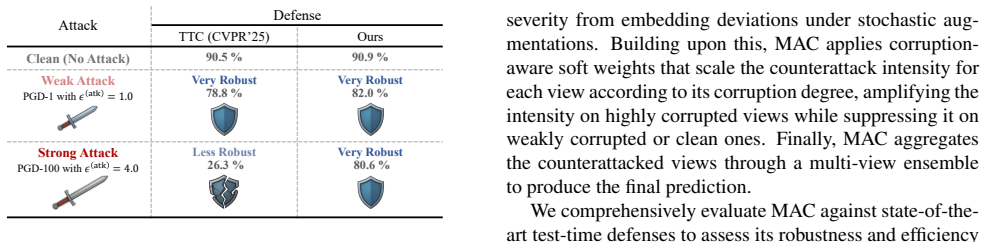
MAC constructs augmented views of an input image to obtain diverse embeddings, performs counterattacks to refine corrupted embeddings of views, adaptively scales the counterattack intensity for each view based on its estimated corruption degree using corruption-aware soft weighting, and aggregates the adaptively counterattacked views to yield a robust final prediction.
What carries the argument
Multi-view guided Adaptive Counterattack (MAC) with corruption-aware soft weighting on augmented views
Load-bearing premise
Constructing augmented views and estimating per-view corruption degree allows reliable adaptive scaling of counterattack intensity that outperforms hard-gating under strong attacks.
What would settle it
Experiments on standard benchmarks that show MAC failing to improve robust accuracy over TTC when facing strong adversarial attacks would falsify the central claim.
If this is right
- MAC substantially improves robustness compared to prior TTC methods under strong attacks across 20 datasets.
- It preserves high inference speed and memory efficiency with its tuning-free design.
- The approach handles diverse attack scenarios effectively.
- Adaptive soft weighting enables better handling of varying corruption severity than hard-gating.
Where Pith is reading between the lines
- MAC could be applied to other vision-language models that share CLIP's zero-shot setup and robustness limitations.
- The multi-view adaptive strategy might combine with other test-time adaptation methods for compounded gains in deployed systems.
- Real-world applications using CLIP for classification could gain reliability in adversarial environments without requiring model changes.
Editorial analysis
A structured set of objections, weighed in public.
Referee Report
Summary. The paper proposes Multi-view guided Adaptive Counterattack (MAC) to improve CLIP's test-time adversarial robustness. Building on Test-time Counterattack (TTC), MAC constructs augmented views of an input, performs counterattacks on the views' embeddings, estimates each view's corruption degree to apply soft-weighted adaptive scaling of counterattack intensity (instead of TTC's noise-driven hard-gating), and aggregates the refined views for the final prediction. The method is presented as tuning-free and efficient; experiments on 20 datasets under diverse attacks are claimed to show substantial robustness gains while preserving inference speed and memory use.
Significance. If the per-view corruption estimation and soft weighting prove reliable and outperform hard-gating under strong attacks without new failure modes, the work would offer a practical, training-free advance for zero-shot VLM robustness. The open-sourced code at the cited GitHub link is a clear strength supporting reproducibility.
major comments (2)
- [Method (likely §3)] The central claim that multi-view construction plus corruption-aware soft weighting yields better robustness than TTC's hard-gating rests on the reliability of the per-view corruption-degree estimator. The manuscript must specify the exact inputs, formula, and any safeguards against estimation error (e.g., attack sensitivity of the estimator itself) in the method section; without this, it is impossible to verify that the adaptive mechanism does not collapse under the strong attacks highlighted in the abstract.
- [Experiments section] Table or figure reporting quantitative results (e.g., accuracy under PGD or AutoAttack of varying strength): the abstract asserts "substantial improvements" across 20 datasets, but load-bearing evidence requires explicit numbers, attack norms, dataset splits, and direct comparisons to TTC and other baselines to substantiate the claim that adaptive scaling is the decisive factor.
minor comments (2)
- Clarify notation for the soft-weighting function and aggregation step; ensure all symbols are defined before first use.
- The efficiency claims (speed and memory) should be supported by explicit timing/memory measurements on the same hardware used for baselines.
Simulated Author's Rebuttal
We thank the referee for the constructive feedback. We address the two major comments point-by-point below. Both concerns can be resolved by expanding the method description and strengthening the experimental presentation in a revised manuscript.
read point-by-point responses
-
Referee: [Method (likely §3)] The central claim that multi-view construction plus corruption-aware soft weighting yields better robustness than TTC's hard-gating rests on the reliability of the per-view corruption-degree estimator. The manuscript must specify the exact inputs, formula, and any safeguards against estimation error (e.g., attack sensitivity of the estimator itself) in the method section; without this, it is impossible to verify that the adaptive mechanism does not collapse under the strong attacks highlighted in the abstract.
Authors: We agree that the per-view corruption-degree estimator requires a more explicit specification to support verification of the adaptive mechanism. The current manuscript describes the estimator at a high level in Section 3 but does not provide the precise inputs, mathematical formula, or explicit safeguards. We will revise the method section to include these details (exact inputs consisting of view embeddings and text embeddings, the formula, and any bounding or averaging steps used as safeguards) together with a short discussion of estimator behavior under strong attacks. This revision will directly address the concern. revision: yes
-
Referee: [Experiments section] Table or figure reporting quantitative results (e.g., accuracy under PGD or AutoAttack of varying strength): the abstract asserts "substantial improvements" across 20 datasets, but load-bearing evidence requires explicit numbers, attack norms, dataset splits, and direct comparisons to TTC and other baselines to substantiate the claim that adaptive scaling is the decisive factor.
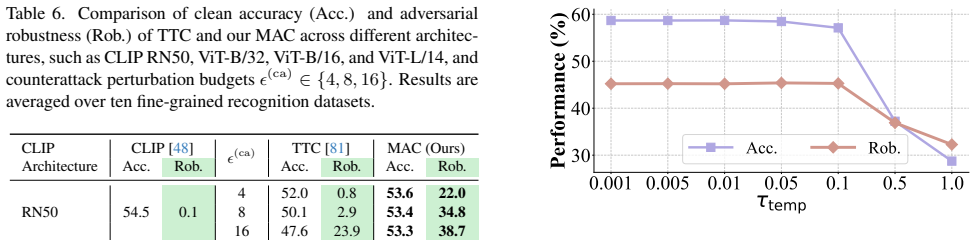
Authors: The manuscript already contains tables in Section 4 that report accuracy numbers under PGD and AutoAttack (with specified norms and standard dataset splits) together with direct comparisons to TTC and other baselines across the 20 datasets. To make the contribution of the soft-weighting component more transparent and to strengthen the evidence that adaptive scaling is decisive, we will add a dedicated ablation table or figure in the revision that isolates the effect of corruption-aware soft weighting versus hard-gating, including the corresponding numerical results. revision: yes
Circularity Check
No significant circularity; method builds on external TTC with independent components
full rationale
The paper describes MAC as an extension of cited TTC work using multi-view augmentation, per-view corruption estimation, and soft weighting, presented as distinct algorithmic steps without any equations, fitted parameters, or self-citations that reduce the central claim to its inputs by construction. The abstract and description supply no self-definitional loops, renamed predictions, or load-bearing self-citations; the derivation remains self-contained against external benchmarks.
Axiom & Free-Parameter Ledger
read the original abstract
Vision-language models such as CLIP have achieved remarkable zero-shot recognition capabilities, yet their robustness against adversarial perturbations remains limited. Test-time counterattack (TTC) was recently proposed to improve CLIP's robustness by perturbing an input image to steer it away from a corrupted state during inference. However, TTC remains fragile under strong attacks because its counterattack relies on a directly corrupted original view and employs a noise-driven hard-gating scheme that cannot adapt to varying corruption severity. To address these limitations, we introduce Multi-view guided Adaptive Counterattack (MAC), which performs counterattacks for multi-view with corruption-aware soft weighting. Specifically, MAC first constructs augmented views of an input image to obtain diverse embeddings. It then performs counterattacks to refine corrupted embeddings of views. Next, MAC adaptively scales the counterattack intensity for each view based on its estimated corruption degree. Finally, the adaptively counterattacked views are aggregated to yield a robust final prediction. Extensive experiments across 20 datasets and diverse attack scenarios demonstrate that MAC substantially improves robustness while preserving high inference speed and memory efficiency with its tuning-free design. Our code is available at https://github.com/sunoh-kim/MAC.
Figures




Reference graph
Works this paper leans on
-
[1]
Combating adver- saries with anti-adversaries
Motasem Alfarra, Juan C P ´erez, Ali Thabet, Adel Bibi, Philip HS Torr, and Bernard Ghanem. Combating adver- saries with anti-adversaries. InAAAI, 2022. 3
2022
-
[2]
Square attack: a query-efficient black-box adversarial attack via random search
Maksym Andriushchenko, Francesco Croce, Nicolas Flam- marion, and Matthias Hein. Square attack: a query-efficient black-box adversarial attack via random search. InECCV,
-
[3]
Obfus- cated gradients give a false sense of security: Circumventing defenses to adversarial examples
Anish Athalye, Nicholas Carlini, and David Wagner. Obfus- cated gradients give a false sense of security: Circumventing defenses to adversarial examples. InICML, 2018. 7, 2
2018
-
[4]
Synthesizing robust adversarial examples
Anish Athalye, Logan Engstrom, Andrew Ilyas, and Kevin Kwok. Synthesizing robust adversarial examples. InICML,
-
[5]
Recent advances in adversarial training for adversarial ro- bustness
Tao Bai, Jinqi Luo, Jun Zhao, Bihan Wen, and Qian Wang. Recent advances in adversarial training for adversarial ro- bustness. InIJCAI, 2021. 2
2021
-
[6]
Estimating or Propagating Gradients Through Stochastic Neurons for Conditional Computation
Yoshua Bengio, Nicholas L ´eonard, and Aaron Courville. Estimating or propagating gradients through stochastic neurons for conditional computation.arXiv preprint arXiv:1308.3432, 2013. 7, 2
work page internal anchor Pith review Pith/arXiv arXiv 2013
-
[7]
Food-101–mining discriminative components with random forests
Lukas Bossard, Matthieu Guillaumin, and Luc Van Gool. Food-101–mining discriminative components with random forests. InECCV, 2014. 5, 1
2014
-
[8]
Towards evaluating the robustness of neural networks
Nicholas Carlini and David Wagner. Towards evaluating the robustness of neural networks. In2017 ieee symposium on security and privacy (sp), 2017. 2, 7
2017
-
[9]
Multi-cache enhanced prototype learning for test- time generalization of vision-language models
Xinyu Chen, Haotian Zhai, Can Zhang, Xiupeng Shi, and Ruirui Li. Multi-cache enhanced prototype learning for test- time generalization of vision-language models. InICCV,
-
[10]
Describing textures in the wild
Mircea Cimpoi, Subhransu Maji, Iasonas Kokkinos, Sammy Mohamed, and Andrea Vedaldi. Describing textures in the wild. InCVPR, 2014. 5, 1
2014
-
[11]
An analysis of single-layer networks in unsupervised feature learning
Adam Coates, Andrew Ng, and Honglak Lee. An analysis of single-layer networks in unsupervised feature learning. In AISTATS, 2011. 5, 1
2011
-
[12]
Certified adversarial robustness via randomized smoothing
Jeremy Cohen, Elan Rosenfeld, and Zico Kolter. Certified adversarial robustness via randomized smoothing. InICML,
-
[13]
Reliable evalua- tion of adversarial robustness with an ensemble of diverse parameter-free attacks
Francesco Croce and Matthias Hein. Reliable evalua- tion of adversarial robustness with an ensemble of diverse parameter-free attacks. InICML, 2020. 2, 7
2020
-
[14]
Imagenet: A large-scale hierarchical image database
Jia Deng, Wei Dong, Richard Socher, Li-Jia Li, Kai Li, and Li Fei-Fei. Imagenet: A large-scale hierarchical image database. InCVPR, 2009. 5, 1 6
2009
-
[15]
Learning gener- ative visual models from few training examples: An incre- mental bayesian approach tested on 101 object categories
Li Fei-Fei, Rob Fergus, and Pietro Perona. Learning gener- ative visual models from few training examples: An incre- mental bayesian approach tested on 101 object categories. In CVPR workshop, 2004. 5, 1
2004
-
[16]
Explaining and harnessing adversarial examples
Ian J Goodfellow, Jonathon Shlens, and Christian Szegedy. Explaining and harnessing adversarial examples. InICLR,
-
[17]
Caltech- 256 object category dataset
Gregory Griffin, Alex Holub, Pietro Perona, et al. Caltech- 256 object category dataset. Technical report, Technical Report 7694, California Institute of Technology Pasadena,
-
[18]
Patrick Helber, Benjamin Bischke, Andreas Dengel, and Damian Borth. Eurosat: A novel dataset and deep learning benchmark for land use and land cover classification.IEEE Journal of Selected Topics in Applied Earth Observations and Remote Sensing, 2019. 5, 1
2019
-
[19]
Augmix: A simple data processing method to improve robustness and uncertainty
Dan Hendrycks, Norman Mu, Ekin D Cubuk, Barret Zoph, Justin Gilmer, and Balaji Lakshminarayanan. Augmix: A simple data processing method to improve robustness and uncertainty. InICLR, 2020. 6, 1
2020
-
[20]
The many faces of robust- ness: A critical analysis of out-of-distribution generalization
Dan Hendrycks, Steven Basart, Norman Mu, Saurav Kada- vath, Frank Wang, Evan Dorundo, Rahul Desai, Tyler Zhu, Samyak Parajuli, Mike Guo, et al. The many faces of robust- ness: A critical analysis of out-of-distribution generalization. InICCV, 2021. 5, 1
2021
-
[21]
Natural adversarial examples
Dan Hendrycks, Kevin Zhao, Steven Basart, Jacob Stein- hardt, and Dawn Song. Natural adversarial examples. In CVPR, 2021. 5, 1
2021
-
[22]
Cosmic: Clique- oriented semantic multi-space integration for robust clip test- time adaptation
Fanding Huang, Jingyan Jiang, Qinting Jiang, Hebei Li, Faisal Nadeem Khan, and Zhi Wang. Cosmic: Clique- oriented semantic multi-space integration for robust clip test- time adaptation. InCVPR, 2025. 3
2025
-
[23]
Black-box adversarial attacks with limited queries and information
Andrew Ilyas, Logan Engstrom, Anish Athalye, and Jessy Lin. Black-box adversarial attacks with limited queries and information. InICML, 2018. 2
2018
-
[24]
Test-time prompt tuning for zero-shot depth comple- tion
Chanhwi Jeong, Inhwan Bae, Jin-Hwi Park, and Hae-Gon Jeon. Test-time prompt tuning for zero-shot depth comple- tion. InICCV, 2025. 3
2025
-
[25]
Scaling up visual and vision-language representation learning with noisy text supervision
Chao Jia, Yinfei Yang, Ye Xia, Yi-Ting Chen, Zarana Parekh, Hieu Pham, Quoc Le, Yun-Hsuan Sung, Zhen Li, and Tom Duerig. Scaling up visual and vision-language representation learning with noisy text supervision. InICML, 2021. 1
2021
-
[26]
Efficient test-time adaptation of vision-language models
Adilbek Karmanov, Dayan Guan, Shijian Lu, Abdulmotaleb El Saddik, and Eric Xing. Efficient test-time adaptation of vision-language models. InCVPR, 2024. 3
2024
-
[27]
Swag-net: Semantic word-aware graph network for temporal video grounding
Sunoh Kim, Taegil Ha, Kimin Yun, and Jin Young Choi. Swag-net: Semantic word-aware graph network for temporal video grounding. InACM CIKM, 2022. 2
2022
-
[28]
Gaussian mixture proposals with pull- push learning scheme to capture diverse events for weakly supervised temporal video grounding
Sunoh Kim, Jungchan Cho, Joonsang Yu, YoungJoon Yoo, and Jin Young Choi. Gaussian mixture proposals with pull- push learning scheme to capture diverse events for weakly supervised temporal video grounding. InAAAI, 2024. 1
2024
-
[29]
Learnable negative proposals using dual-signed cross- entropy loss for weakly supervised video moment localiza- tion
Sunoh Kim, Daeho Um, HyunJun Choi, and Jin Young Choi. Learnable negative proposals using dual-signed cross- entropy loss for weakly supervised video moment localiza- tion. InMM, 2024. 2
2024
-
[30]
Finding opti- mal video moment without training: Gaussian boundary op- timization for weakly supervised video grounding.IEEE Transactions on Multimedia, 2026
Sunoh Kim, Kimin Yun, and Daeho Um. Finding opti- mal video moment without training: Gaussian boundary op- timization for weakly supervised video grounding.IEEE Transactions on Multimedia, 2026. 2
2026
-
[31]
3d object representations for fine-grained categorization
Jonathan Krause, Michael Stark, Jia Deng, and Li Fei-Fei. 3d object representations for fine-grained categorization. In ICCV workshops, 2013. 5, 1
2013
-
[32]
Learning multiple layers of features from tiny images
Alex Krizhevsky, Geoffrey Hinton, et al. Learning multiple layers of features from tiny images. 2009. 5, 1
2009
-
[33]
Ad- versarial examples in the physical world
Alexey Kurakin, Ian J Goodfellow, and Samy Bengio. Ad- versarial examples in the physical world. InArtificial intel- ligence safety and security. Chapman and Hall/CRC, 2018. 2
2018
-
[34]
One prompt word is enough to boost adversarial robustness for pre-trained vision-language models
Lin Li, Haoyan Guan, Jianing Qiu, and Michael Spratling. One prompt word is enough to boost adversarial robustness for pre-trained vision-language models. InCVPR, 2024. 1, 3
2024
-
[35]
Language-driven anchors for zero-shot ad- versarial robustness
Xiao Li, Wei Zhang, Yining Liu, Zhanhao Hu, Bo Zhang, and Xiaolin Hu. Language-driven anchors for zero-shot ad- versarial robustness. InCVPR, 2024. 1
2024
-
[36]
Visual instruction tuning
Haotian Liu, Chunyuan Li, Qingyang Wu, and Yong Jae Lee. Visual instruction tuning. InNeurIPS, 2023. 1
2023
-
[37]
Visualiz- ing data using t-sne.Journal of machine learning research,
Laurens van der Maaten and Geoffrey Hinton. Visualiz- ing data using t-sne.Journal of machine learning research,
-
[38]
Towards deep learning models resistant to adversarial attacks
Aleksander Madry, Aleksandar Makelov, Ludwig Schmidt, Dimitris Tsipras, and Adrian Vladu. Towards deep learning models resistant to adversarial attacks. InICLR, 2018. 2, 3, 4, 6
2018
-
[39]
Fine-Grained Visual Classification of Aircraft
Subhransu Maji, Esa Rahtu, Juho Kannala, Matthew Blaschko, and Andrea Vedaldi. Fine-grained visual classi- fication of aircraft.arXiv preprint arXiv:1306.5151, 2013. 5, 1
work page internal anchor Pith review Pith/arXiv arXiv 2013
-
[40]
Understanding zero-shot adversarial robust- ness for large-scale models
Chengzhi Mao, Scott Geng, Junfeng Yang, Xin Wang, and Carl V ondrick. Understanding zero-shot adversarial robust- ness for large-scale models. InICLR, 2023. 1, 3
2023
-
[41]
Deepfool: a simple and accurate method to fool deep neural networks
Seyed-Mohsen Moosavi-Dezfooli, Alhussein Fawzi, and Pascal Frossard. Deepfool: a simple and accurate method to fool deep neural networks. InCVPR, 2016. 2
2016
-
[42]
Universal adversarial perturba- tions
Seyed-Mohsen Moosavi-Dezfooli, Alhussein Fawzi, Omar Fawzi, and Pascal Frossard. Universal adversarial perturba- tions. InCVPR, 2017. 2
2017
-
[43]
Diffusion models for ad- versarial purification
Weili Nie, Brandon Guo, Yujia Huang, Chaowei Xiao, Arash Vahdat, and Anima Anandkumar. Diffusion models for ad- versarial purification. InICML, 2022. 2
2022
-
[44]
Automated flower classification over a large number of classes
Maria-Elena Nilsback and Andrew Zisserman. Automated flower classification over a large number of classes. InIn- dian conference on computer vision, graphics & image pro- cessing, 2008. 5, 1
2008
-
[45]
The limitations of deep learning in adversarial settings
Nicolas Papernot, Patrick McDaniel, Somesh Jha, Matt Fredrikson, Z Berkay Celik, and Ananthram Swami. The limitations of deep learning in adversarial settings. In2016 IEEE European symposium on security and privacy (Eu- roS&P), 2016. 2
2016
-
[46]
Cats and dogs
Omkar M Parkhi, Andrea Vedaldi, Andrew Zisserman, and CV Jawahar. Cats and dogs. InCVPR, 2012. 5, 1 7
2012
-
[47]
Enhancing adversarial robustness via test-time transforma- tion ensembling
Juan C P ´erez, Motasem Alfarra, Guillaume Jeanneret, Laura Rueda, Ali Thabet, Bernard Ghanem, and Pablo Arbel ´aez. Enhancing adversarial robustness via test-time transforma- tion ensembling. InICCV, 2021. 3
2021
-
[48]
Learn- ing transferable visual models from natural language super- vision
Alec Radford, Jong Wook Kim, Chris Hallacy, Aditya Ramesh, Gabriel Goh, Sandhini Agarwal, Girish Sastry, Amanda Askell, Pamela Mishkin, Jack Clark, et al. Learn- ing transferable visual models from natural language super- vision. InICML, 2021. 1, 3, 5, 6, 7, 4
2021
-
[49]
Zero-shot text-to-image generation
Aditya Ramesh, Mikhail Pavlov, Gabriel Goh, Scott Gray, Chelsea V oss, Alec Radford, Mark Chen, and Ilya Sutskever. Zero-shot text-to-image generation. InICML, 2021. 1
2021
-
[50]
Do imagenet classifiers generalize to im- agenet? InICML, 2019
Benjamin Recht, Rebecca Roelofs, Ludwig Schmidt, and Vaishaal Shankar. Do imagenet classifiers generalize to im- agenet? InICML, 2019. 5, 1
2019
-
[51]
Overfitting in ad- versarially robust deep learning
Leslie Rice, Eric Wong, and Zico Kolter. Overfitting in ad- versarially robust deep learning. InICML, 2020. 2
2020
-
[52]
Photorealistic text-to-image diffusion models with deep language understanding
Chitwan Saharia, William Chan, Saurabh Saxena, Lala Li, Jay Whang, Emily L Denton, Kamyar Ghasemipour, Raphael Gontijo Lopes, Burcu Karagol Ayan, Tim Salimans, et al. Photorealistic text-to-image diffusion models with deep language understanding. InNeurIPS, 2022. 1
2022
-
[53]
Provably robust deep learning via adversarially trained smoothed clas- sifiers
Hadi Salman, Jerry Li, Ilya Razenshteyn, Pengchuan Zhang, Huan Zhang, Sebastien Bubeck, and Greg Yang. Provably robust deep learning via adversarially trained smoothed clas- sifiers. InNeurIPS, 2019. 2
2019
-
[54]
Denoised smoothing: A provable defense for pretrained classifiers
Hadi Salman, Mingjie Sun, Greg Yang, Ashish Kapoor, and J Zico Kolter. Denoised smoothing: A provable defense for pretrained classifiers. InNeurIPS, 2020
2020
-
[55]
Defense-gan: Protecting classifiers against adversarial at- tacks using generative models
Pouya Samangouei, Maya Kabkab, and Rama Chellappa. Defense-gan: Protecting classifiers against adversarial at- tacks using generative models. InICLR, 2018. 2
2018
-
[56]
Robust clip: Unsupervised ad- versarial fine-tuning of vision embeddings for robust large vision-language models
Christian Schlarmann, Naman Deep Singh, Francesco Croce, and Matthias Hein. Robust clip: Unsupervised ad- versarial fine-tuning of vision embeddings for robust large vision-language models. InICML, 2024. 1, 3
2024
-
[57]
Improving robustness against common corruptions by covariate shift adaptation
Steffen Schneider, Evgenia Rusak, Luisa Eck, Oliver Bring- mann, Wieland Brendel, and Matthias Bethge. Improving robustness against common corruptions by covariate shift adaptation. InNeurIPS, 2020. 2
2020
-
[58]
Adversarial training for free! InNeurIPS, 2019
Ali Shafahi, Mahyar Najibi, Mohammad Amin Ghiasi, Zheng Xu, John Dickerson, Christoph Studer, Larry S Davis, Gavin Taylor, and Tom Goldstein. Adversarial training for free! InNeurIPS, 2019. 2
2019
-
[59]
O-tpt: Orthogonality constraints for calibrating test-time prompt tuning in vision-language models
Ashshak Sharifdeen, Muhammad Akhtar Munir, Sanoojan Baliah, Salman Khan, and Muhammad Haris Khan. O-tpt: Orthogonality constraints for calibrating test-time prompt tuning in vision-language models. InCVPR, 2025. 3
2025
-
[60]
Jail- break in pieces: Compositional adversarial attacks on multi- modal language models
Erfan Shayegani, Yue Dong, and Nael Abu-Ghazaleh. Jail- break in pieces: Compositional adversarial attacks on multi- modal language models. InICLR, 2023. 3
2023
-
[61]
R-tpt: Improving adversarial robustness of vision-language models through test-time prompt tuning
Lijun Sheng, Jian Liang, Zilei Wang, and Ran He. R-tpt: Improving adversarial robustness of vision-language models through test-time prompt tuning. InCVPR, 2025. 2, 3, 5, 6, 7
2025
-
[62]
Test- time prompt tuning for zero-shot generalization in vision- language models
Manli Shu, Weili Nie, De-An Huang, Zhiding Yu, Tom Goldstein, Anima Anandkumar, and Chaowei Xiao. Test- time prompt tuning for zero-shot generalization in vision- language models. InNeurIPS, 2022. 2, 3
2022
-
[63]
Clip models are few-shot learners: Empirical studies on vqa and visual entailment
Haoyu Song, Li Dong, Wei-Nan Zhang, Ting Liu, and Furu Wei. Clip models are few-shot learners: Empirical studies on vqa and visual entailment. InACL, 2022. 1, 2
2022
-
[64]
A dataset of 101 human action classes from videos in the wild.Center for Research in Computer Vision, 2012
Khurram Soomro, Amir Roshan Zamir, and Mubarak Shah. A dataset of 101 human action classes from videos in the wild.Center for Research in Computer Vision, 2012. 5, 1
2012
-
[65]
One pixel attack for fooling deep neural networks.IEEE Transactions on Evolutionary Computation, 2019
Jiawei Su, Danilo Vasconcellos Vargas, and Kouichi Sakurai. One pixel attack for fooling deep neural networks.IEEE Transactions on Evolutionary Computation, 2019. 2
2019
-
[66]
Test-time training with self- supervision for generalization under distribution shifts
Yu Sun, Xiaolong Wang, Zhuang Liu, John Miller, Alexei Efros, and Moritz Hardt. Test-time training with self- supervision for generalization under distribution shifts. In ICML, 2020. 3
2020
-
[67]
In- triguing properties of neural networks
Christian Szegedy, Wojciech Zaremba, Ilya Sutskever, Joan Bruna, Dumitru Erhan, Ian Goodfellow, and Rob Fergus. In- triguing properties of neural networks. InICLR, 2014. 2, 3
2014
-
[68]
Tesla: Test-time self-learning with au- tomatic adversarial augmentation
Devavrat Tomar, Guillaume Vray, Behzad Bozorgtabar, and Jean-Philippe Thiran. Tesla: Test-time self-learning with au- tomatic adversarial augmentation. InCVPR, 2023. 3
2023
-
[69]
On the zero-shot adversarial robustness of vision-language models: A truly zero-shot and training-free approach
Baoshun Tong, Hanjiang Lai, Yan Pan, and Jian Yin. On the zero-shot adversarial robustness of vision-language models: A truly zero-shot and training-free approach. InCVPR, 2025. 3
2025
-
[70]
Tent: Fully test-time adaptation by entropy minimization
Dequan Wang, Evan Shelhamer, Shaoteng Liu, Bruno Ol- shausen, and Trevor Darrell. Tent: Fully test-time adaptation by entropy minimization. InICLR, 2021. 3
2021
-
[71]
Learning robust global representations by penalizing local predictive power
Haohan Wang, Songwei Ge, Zachary Lipton, and Eric P Xing. Learning robust global representations by penalizing local predictive power. InNeurIPS, 2019. 5, 1
2019
-
[72]
Con- tinual test-time domain adaptation
Qin Wang, Olga Fink, Luc Van Gool, and Dengxin Dai. Con- tinual test-time domain adaptation. InCVPR, 2022. 3
2022
-
[73]
Pre- trained model guided fine-tuning for zero-shot adversarial robustness
Sibo Wang, Jie Zhang, Zheng Yuan, and Shiguang Shan. Pre- trained model guided fine-tuning for zero-shot adversarial robustness. InCVPR, 2024. 1, 3
2024
-
[74]
Tapt: Test-time adversarial prompt tuning for robust inference in vision-language models
Xin Wang, Kai Chen, Jiaming Zhang, Jingjing Chen, and Xingjun Ma. Tapt: Test-time adversarial prompt tuning for robust inference in vision-language models. InCVPR, 2025. 2, 3, 6, 7, 1
2025
-
[75]
Fast is better than free: Revisiting adversarial training
Eric Wong, Leslie Rice, and J Zico Kolter. Fast is better than free: Revisiting adversarial training. InICLR, 2020. 2
2020
-
[76]
arXiv preprint arXiv:2106.04938 , year=
Boxi Wu, Heng Pan, Li Shen, Jindong Gu, Shuai Zhao, Zhifeng Li, Deng Cai, Xiaofei He, and Wei Liu. At- tacking adversarial attacks as a defense.arXiv preprint arXiv:2106.04938, 2021. 2, 3
-
[77]
Adversarial weight perturbation helps robust generalization
Dongxian Wu, Shu-Tao Xia, and Yisen Wang. Adversarial weight perturbation helps robust generalization. InNeurIPS,
-
[78]
Sun database: Large-scale scene recognition from abbey to zoo
Jianxiong Xiao, James Hays, Krista A Ehinger, Aude Oliva, and Antonio Torralba. Sun database: Large-scale scene recognition from abbey to zoo. InIEEE computer soci- ety conference on computer vision and pattern recognition, pages 3485–3492. IEEE, 2010. 5, 1
2010
-
[79]
Improving transferabil- 8 ity of adversarial examples with input diversity
Cihang Xie, Zhishuai Zhang, Yuyin Zhou, Song Bai, Jianyu Wang, Zhou Ren, and Alan L Yuille. Improving transferabil- 8 ity of adversarial examples with input diversity. InCVPR,
-
[80]
Chain of attack: On the robustness of vision-language models against transfer-based adversarial attacks
Peng Xie, Yequan Bie, Jianda Mao, Yangqiu Song, Yang Wang, Hao Chen, and Kani Chen. Chain of attack: On the robustness of vision-language models against transfer-based adversarial attacks. InCVPR, 2025. 2
2025
discussion (0)
Sign in with ORCID, Apple, or X to comment. Anyone can read and Pith papers without signing in.