Collisional excitation of H₂CO by He: Experimental validation of state-of-the-art scattering calculations
Pith reviewed 2026-06-27 21:05 UTC · model grok-4.3
The pith
Experiments confirm state-of-the-art H2CO-He scattering calculations within 95% confidence intervals.
A machine-rendered reading of the paper's core claim, the machinery that carries it, and where it could break.
Core claim
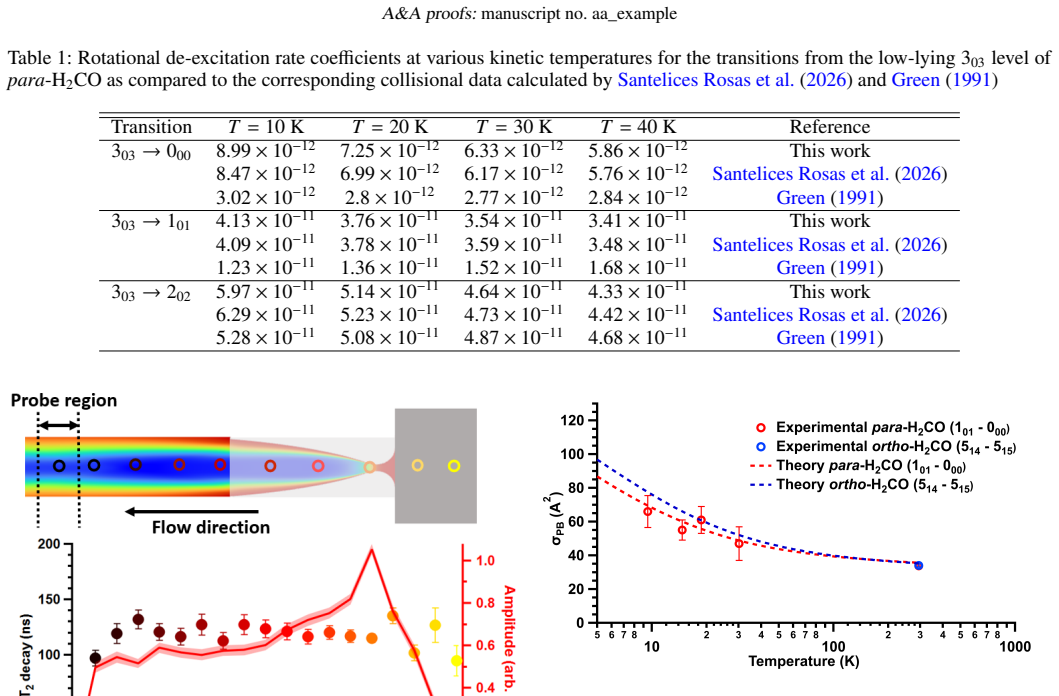
The paper establishes that excellent agreement is obtained between the measured and calculated pressure-broadening cross-sections for the H2CO-He system, with the theoretical values falling within the experimental 95% confidence intervals, thereby validating the high accuracy of the state-of-the-art scattering calculations.
What carries the argument
A new potential energy surface for the H2CO-He system implemented in close-coupling scattering calculations to derive collisional rate coefficients and pressure-broadening cross-sections.
Load-bearing premise
The chirped-pulse in uniform supersonic flow method with in-situ photolysis produces H2CO under conditions that allow direct extraction of pressure-broadening cross-sections without significant systematic bias from flow non-uniformity or precursor chemistry.
What would settle it
An experimental measurement of a pressure-broadening cross-section at a given low temperature that lies outside the 95% confidence interval of the corresponding calculated value.
Figures
read the original abstract
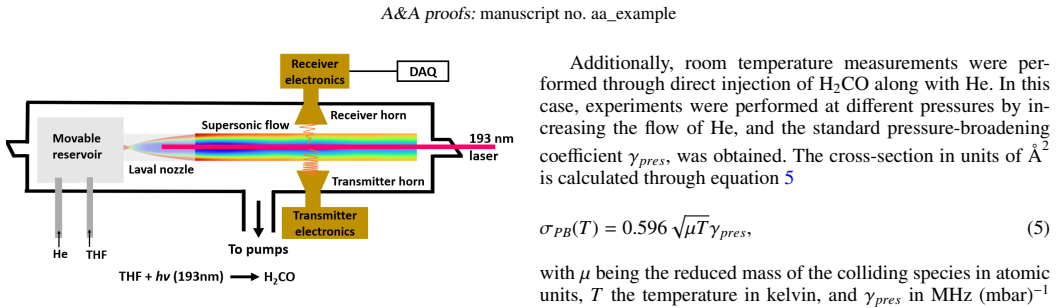
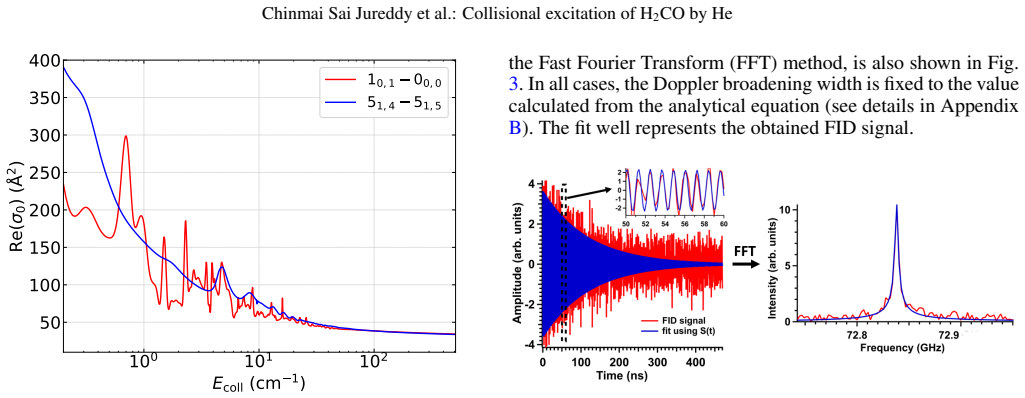
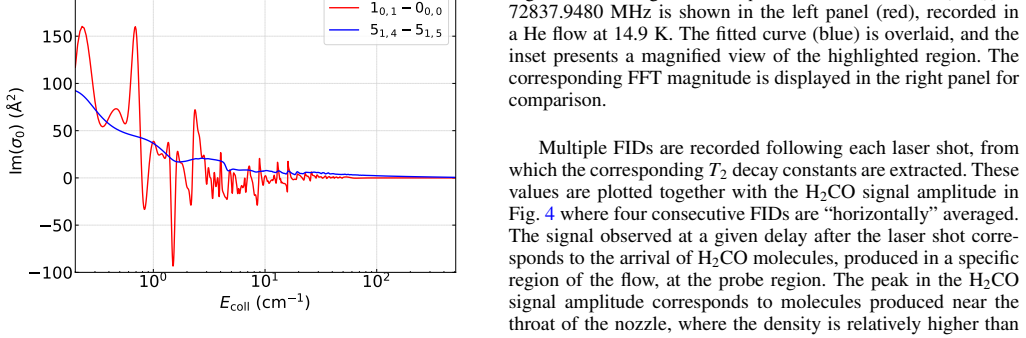
Context. Non-local thermodynamic equilibrium conditions in the interstellar medium require collisional rate coefficients to model astronomical observations; these are usually determined from theoretical scattering calculations. Aims. The aim of this study is to measure experimentally low-temperature pressure-broadening cross-sections for the H2CO-He system in order to validate the theoretical methodology involved in determining new collisional rate coefficients. Methods. The experiments employed the chirped-pulse in uniform supersonic flow method, and H2CO is generated in situ by 193 nm excimer laser photolysis of tetrahydrofuran in cold He flows. State-of-the-art calculations are performed by computing a new potential energy surface for the H2CO-He system which is subsequently implemented in scattering calculations using the close-coupling method to derive collisional rate coefficients and pressure-broadening cross-sections. Results. Excellent agreement between theory and experiment is obtained, with the calculated values falling within the 95% confidence intervals of the experimental measurements. Such agreement validates the high accuracy of the theoretical data. Conclusions. Helium constitutes about 20% relative to H2 in the interstellar medium. The inclusion of collisional rate coefficients for H2CO with He in radiative transfer modelling leads to variations in the excitation temperature of frequently detected rotational lines of up to 12% in warm regions such as protostars.
Editorial analysis
A structured set of objections, weighed in public.
Referee Report
Summary. The paper reports low-temperature experimental measurements of pressure-broadening cross-sections for the H2CO-He system obtained via the chirped-pulse in uniform supersonic flow technique with in-situ 193 nm photolysis of tetrahydrofuran. These measurements are compared to independent state-of-the-art close-coupling scattering calculations performed on a newly computed ab initio potential energy surface; the theoretical cross-sections are found to lie inside the 95% experimental confidence intervals. The agreement is presented as validation of the theoretical methodology for generating collisional rate coefficients used in non-LTE modeling of the interstellar medium, where inclusion of He rates can alter excitation temperatures by up to 12%.
Significance. If the experimental isolation of the H2CO-He interaction is robust, the direct comparison supplies a valuable benchmark for theoretical collisional data on a molecule frequently observed in star-forming regions. The work addresses a practical need in astrochemistry by confirming that He (∼20% relative to H2) must be treated separately in radiative-transfer calculations.
major comments (1)
- [Abstract] Abstract (and Methods description): the central validation claim rests on the measured pressure-broadening cross-sections being free of systematic bias from flow non-uniformity, temperature gradients, or photolysis byproducts. No quantitative tests (precursor-concentration dependence, flow-uniformity maps, or comparison with an alternative H2CO source) are reported that would bound these effects below the stated 95% CI uncertainty; without such tests the observed agreement cannot be taken as unambiguous confirmation of the scattering calculations.
Simulated Author's Rebuttal
We thank the referee for the careful review and for identifying the need to more explicitly bound possible systematic effects. We respond to the single major comment below.
read point-by-point responses
-
Referee: [Abstract] Abstract (and Methods description): the central validation claim rests on the measured pressure-broadening cross-sections being free of systematic bias from flow non-uniformity, temperature gradients, or photolysis byproducts. No quantitative tests (precursor-concentration dependence, flow-uniformity maps, or comparison with an alternative H2CO source) are reported that would bound these effects below the stated 95% CI uncertainty; without such tests the observed agreement cannot be taken as unambiguous confirmation of the scattering calculations.
Authors: We agree that the manuscript would be strengthened by more explicit discussion of possible systematic biases. The reported 95% confidence intervals already incorporate the observed run-to-run scatter under the range of flow conditions employed. In the revised manuscript we will add a short subsection to the Methods section that (i) summarizes diagnostic checks on flow uniformity performed with the same apparatus in prior work on related systems and (ii) presents a brief analysis of precursor-concentration dependence extracted from the existing H2CO-He dataset. A direct comparison with an alternative H2CO source is not feasible within the current experimental configuration, but the multi-transition agreement with independent close-coupling calculations provides supporting evidence that large unrecognized systematics are unlikely. We therefore revise the abstract and Methods description to reflect these additions while retaining the original validation claim. revision: partial
Circularity Check
No significant circularity; experiment and new-PES theory are independent
full rationale
The paper computes a new H2CO-He PES, performs close-coupling scattering to obtain pressure-broadening cross-sections, and compares them to an independent experimental measurement obtained via chirped-pulse uniform supersonic flow with 193 nm photolysis of tetrahydrofuran. Neither the experimental extraction nor the theoretical values are defined in terms of the other; the reported agreement is a validation test, not a reduction by construction. No self-citation load-bearing steps, fitted-input predictions, or ansatz smuggling appear in the derivation chain. The central claim therefore remains self-contained against external benchmarks.
Axiom & Free-Parameter Ledger
axioms (1)
- domain assumption The close-coupling method on the computed PES yields pressure-broadening cross-sections that can be directly compared to the measured values.
Reference graph
Works this paper leans on
-
[1]
FAUST. X. Formaldehyde in the protobinary system [BHB2007] 11: Small-scale deuteration. , keywords =. doi:10.1051/0004-6361/202346428 , archivePrefix =. 2309.00501 , primaryClass =
-
[2]
Hunting pre-stellar cores with APEX IRAS16293E (Oph464). , keywords =. doi:10.1051/0004-6361/202452625 , archivePrefix =. 2412.13760 , primaryClass =
-
[3]
The H2CO abundance in the inner warm regions of low mass protostellar envelopes
The H _ 2 CO abundance in the inner warm regions of low mass protostellar envelopes. , keywords =. doi:10.1051/0004-6361:20034157 , archivePrefix =. astro-ph/0310536 , primaryClass =
work page internal anchor Pith review Pith/arXiv arXiv doi:10.1051/0004-6361:20034157
-
[4]
Astronomy & Astrophysics , volume=
A computer program for fast non-LTE analysis of interstellar line spectra-With diagnostic plots to interpret observed line intensity ratios , author=. Astronomy & Astrophysics , volume=. 2007 , publisher=
2007
-
[5]
Collisional excitation of. Nature Chemistry , author =. 2022 , pages =. doi:10.1038/s41557-022-00936-x , language =
-
[6]
Physical Review Letters , author =
Microwave. Physical Review Letters , author =. 1969 , pages =. doi:10.1103/PhysRevLett.22.679 , language =
-
[7]
The Astrophysical Journal , author =
Formaldehyde. The Astrophysical Journal , author =. 1969 , pages =. doi:10.1086/180368 , language =
-
[8]
I-Absorption studies, dark clouds, and the cosmic background radiation , author=
Interstellar H2CO. I-Absorption studies, dark clouds, and the cosmic background radiation , author=. Astrophysical Journal, vol. 196, Mar. 1, 1975, pt. 1, p. 433-456. , volume=
1975
-
[9]
Astrophysical Journal, vol
A pumping mechanism for anomalous microwave absorption in formaldehyde in interstellar space , author=. Astrophysical Journal, vol. 157, p. L103 , volume=
-
[10]
Astrophysical Journal, vol
Cooling of the 6-centimeter and 2-centimeter doublets of interstellar H2CO by collision-an accurate quantum-mechanical calculation , author=. Astrophysical Journal, vol. 200, Sept. 15, 1975, pt. 2, p. L175-L177. , volume=
1975
-
[11]
Astronomy & Astrophysics , volume=
Rotational excitation of formaldehyde by hydrogen molecules: ortho-H2CO at low temperature , author=. Astronomy & Astrophysics , volume=. 2009 , publisher=
2009
-
[12]
Astronomy & Astrophysics , author =
Constraining the ortho-to-para ratio of. Astronomy & Astrophysics , author =. 2009 , pages =. doi:10.1051/0004-6361/200912770 , number =
-
[13]
Molecular. Chemical Reviews , author =. 2013 , pages =. doi:10.1021/cr400145a , language =
-
[14]
Astrophysical Journal Supplement Series, vol
Collisional excitation of interstellar formaldehyde , author=. Astrophysical Journal Supplement Series, vol. 37, July 1978, p. 321-341. Navy-supported research; , volume=
1978
-
[15]
Astrophysical Journal Supplement Series (ISSN 0067-0049), vol
Collisional excitation of formaldehyde in'hot'interstellar molecular regions , author=. Astrophysical Journal Supplement Series (ISSN 0067-0049), vol. 76, July 1991, p. 979-983. , volume=
1991
-
[16]
The Journal of Chemical Physics , author =
Coupled-channel study of rotational excitation of a rigid asymmetric top by atom impact: (. The Journal of Chemical Physics , author =. 1976 , pages =. doi:10.1063/1.433375 , language =
-
[17]
Astronomy & Astrophysics , volume=
H2CO and CS in diffuse clouds: Excitation and abundance , author=. Astronomy & Astrophysics , volume=. 2024 , publisher=
2024
-
[18]
The Journal of Chemical Physics , volume=
Effect of electron correlation on the H2CO-He interaction potential , author=. The Journal of Chemical Physics , volume=. 1975 , publisher=
1975
-
[19]
Chemical physics letters , volume=
A new potential energy surface for He--H2CO , author=. Chemical physics letters , volume=. 2003 , publisher=
2003
-
[20]
Physical Review A , author =. 2010 , pages =. doi:10.1103/PhysRevA.82.040702 , language =
-
[21]
, author=
Collision Broadening of Microwave Spectral Lines of Monomeric Formaldehyde and Formic Acid. , author=. Ph. D. Thesis , year=
-
[22]
Journal of Physics B: Atomic and Molecular Physics , volume=
Microwave pressure broadening studies of some molecules , author=. Journal of Physics B: Atomic and Molecular Physics , volume=
-
[23]
Journal of Molecular Spectroscopy , volume=
Experimental microwave collision diameters in the rotational spectrum of H2CO , author=. Journal of Molecular Spectroscopy , volume=. 1973 , publisher=
1973
-
[24]
Journal of Molecular Spectroscopy , volume=
Pressure broadening and shift in the millimeter-wave spectrum of formaldehyde , author=. Journal of Molecular Spectroscopy , volume=. 1975 , publisher=
1975
-
[25]
Journal of Physics B: Atomic and Molecular Physics , volume=
Foreign-gas linewidth-broadening measurements in formaldehyde , author=. Journal of Physics B: Atomic and Molecular Physics , volume=
-
[26]
Zeitschrift f
Investigation of Ti-relaxation with a Microwave Pulse Spectrometer Rotational Lines of Formaldehyde and Sulfurdioxide , author=. Zeitschrift f. 1979 , publisher=
1979
-
[27]
The Astrophysical Journal , volume=
Helium and hydrogen induced rotational relaxation of H2CO observed at temperatures of the interstellar medium , author=. The Astrophysical Journal , volume=
-
[28]
The Journal of Chemical Physics , author =
A chirped-pulse. The Journal of Chemical Physics , author =. 2014 , pages =. doi:10.1063/1.4897979 , language =
-
[29]
The Journal of Chemical Physics , author =
A chirped-pulse. The Journal of Chemical Physics , author =. 2014 , pages =. doi:10.1063/1.4903253 , language =
-
[30]
The Journal of Chemical Physics , author =
A novel. The Journal of Chemical Physics , author =. 2020 , pages =. doi:10.1063/5.0017978 , language =
-
[31]
The Journal of Chemical Physics , author =
Product-specific reaction kinetics in continuous uniform supersonic flows probed by chirped-pulse microwave spectroscopy , volume =. The Journal of Chemical Physics , author =. 2024 , pages =. doi:10.1063/5.0203428 , language =
-
[32]
Journal of Quantitative Spectroscopy and Radiative Transfer , author =
Design and performance of an. Journal of Quantitative Spectroscopy and Radiative Transfer , author =. 2020 , pages =. doi:10.1016/j.jqsrt.2020.107001 , language =
-
[33]
Zeitschrift f
Determination of spectral parameters in microwave Fouriertransform spectroscopy by analysis of time-domain signals , author=. Zeitschrift f. 1988 , publisher=
1988
-
[34]
The Journal of Physical Chemistry Letters , author =
Time-. The Journal of Physical Chemistry Letters , author =. 2017 , pages =. doi:10.1021/acs.jpclett.7b02864 , language =
-
[35]
Rowe, Bertrand R and Canosa, André and Heard, Dwayne E , month = jun, year =. Uniform
-
[36]
and Le Picard, S
Fournier, M. and Le Picard, S. D. and Sims, I. R. , editor =. Theoretical and. 2017 , doi =
2017
-
[37]
Angewandte Chemie International Edition , author =
Uniform. Angewandte Chemie International Edition , author =. 2017 , pages =. doi:10.1002/anie.201611240 , language =
-
[38]
Astronomy & Astrophysics , author =
Isotopic effects in rotational de-excitation of. Astronomy & Astrophysics , author =. doi:10.1051/0004-6361/202659186 , language =
-
[39]
The Journal of Chemical Physics , author=
A simple and efficient CCSD(T)-F12 approximation , volume=. The Journal of Chemical Physics , author=. 2007 , month=dec, pages=. doi:10.1063/1.2817618 , number=
-
[40]
and Knowles, P
Werner, H.-J. and Knowles, P. J. and Knizia, G. and Manby, F. R. and Sch. MOLPRO, version 2015.1, a package of ab initio programs , year =
2015
-
[41]
and Knizia, Gerald and Manby, Frederick R
Werner, Hans-Joachim and Knowles, Peter J. and Knizia, Gerald and Manby, Frederick R. and Sch. Wiley Interdisciplinary Reviews: Computational Molecular Science , month =. doi:10.1002/wcms.82 , issn =
-
[42]
Boys, S. F. and Bernardi, F. , doi =. Molecular Physics , number =
-
[43]
The Journal of Physical Chemistry A , author=
Rotational Excitation Cross Sections for Chloronium Based on a New 5D Interaction Potential with Molecular Hydrogen , volume=. The Journal of Physical Chemistry A , author=. 2025 , pages=. doi:10.1021/acs.jpca.4c07467 , number=
-
[44]
Computer Physics Communications , author=
MOLSCAT: a program for non-reactive quantum scattering calculations on atomic and molecular collisions , volume=. Computer Physics Communications , author=. 2019 , month=aug, pages=. doi:10.1016/j.cpc.2019.02.014 , note=
-
[45]
Arthurs, A. M. and Dalgarno, Alexander and Bates, David Robert , title =. Proceedings of the Royal Society of London. Series A. Mathematical and Physical Sciences , volume =. 1960 , doi =
1960
-
[46]
Monthly Notices of the Royal Astronomical Society , author=
Rotational quenching of H2CO by molecular hydrogen: cross-sections, rates and pressure broadening , volume=. Monthly Notices of the Royal Astronomical Society , author=. 2013 , pages=. doi:10.1093/mnras/stt616 , number=
-
[47]
Journal of Molecular Spectroscopy , author=
The Ground State Rotational Spectrum of Formaldehyde , volume=. Journal of Molecular Spectroscopy , author=. 1996 , pages=. doi:10.1006/jmsp.1996.0128 , number=
-
[48]
Tonolo, Francesca and Jóźwiak, Hubert J. and Bizzocchi, Luca and Melosso, Mattia and Wcisło, Piotr and Lique, François and Puzzarini, Cristina , year=. Experimental and theoretical investigation on N2 pressure-induced coefficients of the lowest rotational transitions of HCN , volume=. doi:10.1016/j.jqsrt.2025.109521 , journal=
-
[49]
Astronomy & Astrophysics , author =
Formaldehyde as a densitometer and thermometer in. Astronomy & Astrophysics , author =. 2026 , pages =. doi:10.1051/0004-6361/202558050 , urldate =
-
[50]
Monthly Notices of the Royal Astronomical Society , author =
Formaldehyde observations of the. Monthly Notices of the Royal Astronomical Society , author =. 2024 , pages =. doi:10.1093/mnras/stad3959 , language =
-
[51]
Formaldehyde as a tracer of extragalactic molecular gas. I. Para-H2CO emission from M82 , author=. The Astrophysical Journal , volume=
-
[52]
Rowe, B. R. and Dupeyrat, G. and Marquette, J. B. and Gaucherel, P. , year = 1984, month = may, journal =. Study of the Reactions. doi:10.1063/1.446513 , urldate =
-
[53]
Sims, I. R. and Queffelec, J.-L. and Defrance, A. and. Ultralow Temperature Kinetics of Neutral--Neutral Reactions. The Journal of Chemical Physics , volume =. doi:10.1063/1.467227 , urldate =
-
[54]
Cooke, Ilsa R. and Sims, Ian R. , year = 2022, month = jun, pages =. Collisional. Uniform. doi:10.1142/9781800610996_0007 , urldate =
-
[55]
Cooke, Ilsa R. and Sims, Ian R. , year = 2019, month = jul, journal =. Experimental. doi:10.1021/acsearthspacechem.9b00064 , urldate =
-
[56]
N.,& Stewart, J
Cox, A. N.,& Stewart, J. N. 1969,
1969
-
[57]
Tscharnuter W. M. 1987,
1987
-
[58]
1992, in ASP Conf
Terlevich, R. 1992, in ASP Conf. Ser. 31,
1992
-
[59]
F., Tytler, D
Zheng, W., Davidsen, A. F., Tytler, D. & Kriss, G. A
discussion (0)
Sign in with ORCID, Apple, or X to comment. Anyone can read and Pith papers without signing in.