REVIEW 3 major objections 2 minor 30 references
mmPISA-bench: Do LLMs Reason Equally Well Across 43 Languages?
T0 review · 3 major / 2 minor · reviewed 2026-06-27 · grok-4.3
Pith's one-line read Modern LLMs reason effectively across all 43 evaluated languages on a compact PISA-derived benchmark and match human test-taker accuracy with some variations.
desk verdict A small new multilingual benchmark from PISA items, but the claims about cross-lingual reasoning rest on untested assumptions and very limited data. read the letter →
The pith
A machine-rendered reading of the paper's core claim, the machinery that carries it, and where it could break.
The reading
What carries the argument
mmPISA-bench, the set of 25 multiple-choice reasoning questions drawn from PISA and supplied in 43 languages with both human and machine translations.
What would settle it
A finding that accuracy on the 25 questions falls substantially below human levels in most languages or that the questions require language-specific cultural knowledge would falsify the central claim.
Extended reading notes
Core claim
The paper establishes that modern LLMs can reason effectively across all evaluated languages, achieve accuracy comparable to human test-takers, with some performance variations across covered languages. Machine-translated questions do not degrade accuracy relative to official human translations, suggesting high-quality machine translation is often adequate for large-scale multilingual reasoning evaluations.
Load-bearing premise
The 25 selected PISA questions test general reasoning ability rather than language-specific knowledge, memorization, or test familiarity, and translations preserve these reasoning requirements.
Editorial extensions
If this is right
- LLMs can handle reasoning tasks in many languages at levels comparable to humans without major accuracy loss.
- High-quality machine translation suffices for building large multilingual reasoning benchmarks when official translations are unavailable.
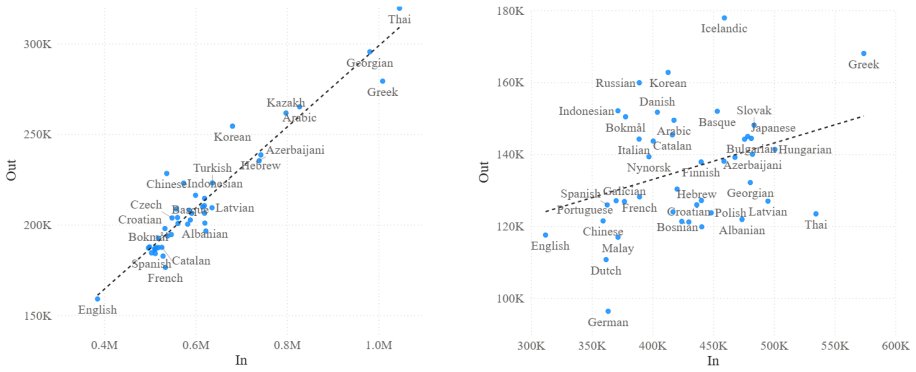
- Inference cost and accuracy vary together by language, with some languages proving both more expensive and less accurate.
- The benchmark provides a compact way to compare cross-lingual reasoning without relying on language-specific knowledge.
Reading between the lines
- Global deployment of LLMs for reasoning tasks becomes more feasible if the pattern holds beyond the 43 languages tested.
- Developers may need to optimize token usage separately for lower-performing languages to control costs.
- Extending the same question set to additional languages or question formats could test whether the observed consistency generalizes.
- The finding that machine translations work well reduces reliance on scarce human translation resources for future benchmarks.
Signed reviews
Editorial analysis
A structured set of objections, weighed in public.
Referee Report
Summary. The paper introduces mmPISA-bench, consisting of 25 multiple-choice PISA questions provided in official human translations to 43 languages plus machine-translated versions (2,150 items total). It evaluates two proprietary LLMs on accuracy across languages, reasoning effort, and translation type, claiming that modern LLMs reason effectively across all languages at levels comparable to human test-takers, that machine translation does not degrade accuracy relative to human translations, and that token usage (hence cost) varies with accuracy across languages.
Significance. If the central empirical claims hold after addressing benchmark validity, the work supplies a compact, publicly derivable multilingual reasoning test set that could serve as a practical alternative to larger existing benchmarks. The observation that high-quality MT preserves performance would support broader use of synthetic data for multilingual evaluation. The cost-accuracy trade-off analysis adds a practical dimension for deployment considerations.
major comments (3)
- [Abstract and §3] Abstract and §3 (Benchmark Construction): The headline claim that LLMs 'reason effectively across all evaluated languages' and achieve human-comparable accuracy rests on the assumption that the 25 selected PISA items measure transferable reasoning rather than training-data familiarity or language-specific phrasing. No decontamination check against the public OECD item pool is reported, nor are paraphrased controls or item-level error analysis provided; with only 25 questions this directly undermines the inference that accuracy reflects preserved reasoning steps under both human and machine translation.
- [§4 and Results] §4 (Experimental Setup) and Results: The abstract asserts accuracy 'comparable to human test-takers' and no degradation under machine translation, yet supplies neither exact per-language accuracies, statistical significance tests, confidence intervals, nor prompting templates and decoding parameters. These omissions make it impossible to verify the quantitative support for the cross-lingual and translation-type claims.
- [§5] §5 (Analysis): The finding that machine-translated questions preserve accuracy is load-bearing for the recommendation that synthetic data can substitute for official translations. Without details on the MT system, translation-quality metrics, or controls that isolate reasoning from surface-form overlap, the result cannot be generalized beyond the specific 25 items.
minor comments (2)
- [Abstract] The abstract refers to 'two mainstream proprietary LLMs' without naming the models or release versions; this information should appear in §4 for reproducibility.
- [§5] Token-usage and cost figures are mentioned but lack per-language tables or statistical comparison; adding these would strengthen the final analysis paragraph.
Simulated Author's Rebuttal
We thank the referee for the constructive and detailed feedback. We agree that additional details on benchmark construction, experimental setup, and analysis are needed to strengthen the claims. We will revise the manuscript to incorporate the suggested improvements and address each point below.
read point-by-point responses
-
Referee: [Abstract and §3] Abstract and §3 (Benchmark Construction): The headline claim that LLMs 'reason effectively across all evaluated languages' and achieve human-comparable accuracy rests on the assumption that the 25 selected PISA items measure transferable reasoning rather than training-data familiarity or language-specific phrasing. No decontamination check against the public OECD item pool is reported, nor are paraphrased controls or item-level error analysis provided; with only 25 questions this directly undermines the inference that accuracy reflects preserved reasoning steps under both human and machine translation.
Authors: We acknowledge the need to demonstrate that the items primarily test reasoning. We will add a decontamination check in the revised §3 by systematically comparing the 25 selected items against the publicly released OECD PISA item pool and reporting any overlaps found. We will also include an item-level accuracy breakdown across languages to show consistency of performance rather than item-specific effects. While generating paraphrased variants is not feasible within the constraints of using official translations, the observed stability across 43 languages and between human/MT versions provides supporting evidence against language-specific phrasing. These additions will be made to support the claims despite the compact item set. revision: yes
-
Referee: [§4 and Results] §4 (Experimental Setup) and Results: The abstract asserts accuracy 'comparable to human test-takers' and no degradation under machine translation, yet supplies neither exact per-language accuracies, statistical significance tests, confidence intervals, nor prompting templates and decoding parameters. These omissions make it impossible to verify the quantitative support for the cross-lingual and translation-type claims.
Authors: We agree that full quantitative details are required for verification. The revised manuscript will include tables reporting exact per-language accuracies, 95% confidence intervals, and results of statistical significance tests (e.g., paired tests comparing human vs. machine translation accuracies). We will also document the complete prompting templates used and all decoding parameters (temperature, top-p, max new tokens, etc.). These elements will be added to §4 and the results section. revision: yes
-
Referee: [§5] §5 (Analysis): The finding that machine-translated questions preserve accuracy is load-bearing for the recommendation that synthetic data can substitute for official translations. Without details on the MT system, translation-quality metrics, or controls that isolate reasoning from surface-form overlap, the result cannot be generalized beyond the specific 25 items.
Authors: We will expand §5 to specify the exact machine translation system and version used, report translation quality metrics (e.g., BLEU or COMET scores against human references), and add an analysis of surface-form overlap by quantifying lexical differences and examining accuracy on subsets with high vs. low overlap. This will better contextualize the generalization to synthetic data while remaining grounded in the 25-item set. revision: yes
Circularity Check
No circularity: purely empirical benchmark measurement
full rationale
The paper introduces mmPISA-bench as a fixed set of 25 PISA items in 43 languages and reports direct accuracy measurements on two LLMs. No equations, derivations, parameter fitting, predictions, or self-citation chains appear in the abstract or described structure. All claims reduce to observed performance on the provided data points rather than any self-referential construction.
Assumptions & free parameters
assumptions (1)
- domain assumption The 25 PISA questions require reasoning in order to be answered correctly.
Cite this review
Pith. "Pith review of mmPISA-bench: Do LLMs Reason Equally Well Across 43 Languages?." pith.science (2026). https://pith.science/paper/P7ARDJCX
@misc{pith2026260607069,
  author       = {Pith},
  title        = {Pith review of: mmPISA-bench: Do LLMs Reason Equally Well Across 43 Languages?},
  year         = {2026},
  howpublished = {\url{https://pith.science/paper/P7ARDJCX}},
  note         = {Machine review of arXiv:2606.07069}
}
read the original abstract
We introduce mmPISA-bench, a compact high-quality multilingual reasoning benchmark derived from the OECD Programme for International Student Assessment (PISA). The benchmark consists of 25 multiple-choice questions that require reasoning in order to be answered correctly. Each question is provided in official human translations to 43 languages and complemented with machine-translated counterparts (i.e., 2,150 data points in total). We evaluate two mainstream proprietary LLMs across languages, reasoning effort levels, and translation types in terms of their ability to answer the questions correctly. Our results show that modern LLMs can reason effectively across all evaluated languages, achieve accuracy comparable to human test-takers, with some performance variations across covered languages. We further find that machine-translated questions do not degrade accuracy relative to official human translations which suggests that high-quality machine translation (synthetic data) might often be adequate for large-scale multilingual reasoning evaluations where official translations are not available. Finally, we analyze token usage and related inference cost and find that LLMs usage in some languages is simultaneously more expensive and less accurate.
Figures


Reference graph
Works this paper leans on
-
[1]
2025 , url =
Zhao, Weixiang and Guo, Jiahe and Deng, Yang and Wu, Tongtong and Zhang, Wenxuan and Hu, Yulin and Sui, Xingyu and Zhao, Yanyan and Che, Wanxiang and Qin, Bing and Chua, Tat-Seng and Liu, Ting , booktitle =. 2025 , url =
2025
-
[2]
Proceedings of the 63rd Annual Meeting of the Association for Computational Linguistics (Volume 1: Long Papers) , year =
G. Proceedings of the 63rd Annual Meeting of the Association for Computational Linguistics (Volume 1: Long Papers) , year =
-
[3]
Leviathan, Yaniv and Kalman, Matan and Matias, Yossi , journal =. 2025 , url =. doi:10.48550/arXiv.2512.14982 , month =
-
[4]
2025 , url =
Ghosh, Akash and Datta, Debayan and Saha, Sriparna and Agarwal, Chirag , booktitle =. 2025 , url =
2025
-
[5]
Proceedings of the 2023 Conference on Empirical Methods in Natural Language Processing (EMNLP) , year =
Kargaran, Amir Hossein and Imani, Ayyoob and Yvon, Fran. Proceedings of the 2023 Conference on Empirical Methods in Natural Language Processing (EMNLP) , year =
2023
-
[6]
2024 , url =
Huang, Zixian and Zhu, Wenhao and Cheng, Gong and Li, Lei and Yuan, Fei , booktitle =. 2024 , url =
2024
-
[7]
Findings of the Association for Computational Linguistics: EMNLP 2025 , year =
Qi, Jirui and Chen, Shan and Xiong, Zidi and Fern. Findings of the Association for Computational Linguistics: EMNLP 2025 , year =
2025
-
[8]
2025 , url =
Pomerenke, David and Nothnagel, Jonas and Ostermann, Simon , journal =. 2025 , url =
2025
Show all 30 references
-
[9]
Nature , volume =
Costa-juss. Nature , volume =. 2024 , url =
2024
-
[10]
, journal =
Qin, Libo and Chen, Qiguang and Zhou, Yuhang and Chen, Zhi and Li, Yinghui and Liao, Lizi and Li, Min and Che, Wanxiang and Yu, Philip S. , journal =. 2025 , publisher =
2025
-
[11]
and Schmidt, Fabian David and Nakatumba-Nabende, Joyce and Adelani, David Ifeoluwa , booktitle =
Beyene, Luel Hagos and Verma, Vivek and Ma, Min and Alabi, Jesujoba O. and Schmidt, Fabian David and Nakatumba-Nabende, Joyce and Adelani, David Ifeoluwa , booktitle =. 2025 , url =
2025
-
[12]
2022 , organization=
Conneau, Alexis and Ma, Min and Khanuja, Simran and Zhang, Yu and Axelrod, Vera and Dalmia, Siddharth and Riesa, Jason and Rivera, Clara and Bapna, Ankur , booktitle=. 2022 , organization=
2022
-
[13]
2025 , url =
Wu, Minghao and Wang, Weixuan and Liu, Sinuo and Yin, Huifeng and Wang, Xintong and Zhao, Yu and Lyu, Chenyang and Wang, Longyue and Luo, Weihua and Zhang, Kaifu , journal =. 2025 , url =
2025
-
[14]
2023 , url =
Shi, Freda and Suzgun, Mirac and Freitag, Markus and Wang, Xuezhi and Srivats, Suraj and Vosoughi, Soroush and Chung, Hyung Won and Tay, Yi and Ruder, Sebastian and Zhou, Denny and Das, Dipanjan and Wei, Jason , booktitle =. 2023 , url =
2023
-
[15]
2024 , address =
Bandarkar, Lucas and Liang, Davis and Muller, Benjamin and Artetxe, Mikel and Shukla, Satya Narayan and Husa, Donald and Goyal, Naman and Krishnan, Abhinandan and Zettlemoyer, Luke and Khabsa, Madian , booktitle =. 2024 , address =
2024
-
[16]
Proceedings of the 2025 Conference on Empirical Methods in Natural Language Processing: System Demonstrations , year =
Luo, Hengyu and Li, Zihao and Attieh, Joseph and Devkota, Sawal and de Gibert, Ona and Huang, Xu and Ji, Shaoxiong and Lin, Peiqin and Mantina, Bhavani Sai Praneeth Varma and Sreenidhi, Ananda and V. Proceedings of the 2025 Conference on Empirical Methods in Natural Language P...
2025
-
[17]
2024 , url =
Asai, Akari and Kudugunta, Sneha and Yu, Xinyan Velocity and Blevins, Terra and Gonen, Hila and Reid, Machel and Tsvetkov, Yulia and Ruder, Sebastian and Hajishirzi, Hannaneh , booktitle =. 2024 , url =
2024
-
[18]
2025 , url =
Xuan, Weihao and Yang, Rui and Qi, Heli and Zeng, Qingcheng and Xiao, Yunze and Feng, Aosong and Liu, Dairui and Xing, Yun and Wang, Junjue and Gao, Fan and Lu, Jinghui and Jiang, Yuang and Li, Huitao and Li, Xin and Yu, Kunyu and Dong, Ruihai and Gu, Shangding and Li, Yuekang...
2025
-
[19]
2023 , url =
Zhang, Wenxuan and Aljunied, Sharifah Mahani and Gao, Chang and Chia, Yew Ken and Bing, Lidong , booktitle =. 2023 , url =
2023
-
[20]
Proceedings of the 63rd Annual Meeting of the Association for Computational Linguistics (Volume 1: Long Papers) , month =
Singh, Shivalika and Romanou, Angelika and Fourrier, Cl. Proceedings of the 63rd Annual Meeting of the Association for Computational Linguistics (Volume 1: Long Papers) , month =. 2025 , address =
2025
-
[21]
2025 , url =
Haller, Patrick and Barth, Fabio and Golde, Jonas and Rehm, Georg and Akbik, Alan , journal =. 2025 , url =
2025
-
[22]
2023 , address =
Takami, Kyosuke , booktitle =. 2023 , address =
2023
-
[23]
Technology, Knowledge and Learning , year =
Ba. Technology, Knowledge and Learning , year =. doi:10.1007/s10758-025-09883-1 , url =
-
[24]
Petrov, Aleksandr and La Malfa, Emanuele and Torr, Philip H. S. and Bibi, Adel , booktitle =. 2023 , url =
2023
-
[25]
and Smith, Noah A
Ahia, Orevaoghene and Kumar, Sachin and Gonen, Hila and Kasai, Jungo and Mortensen, David R. and Smith, Noah A. and Tsvetkov, Yulia , booktitle =. 2023 , address =. doi:10.18653/v1/2023.emnlp-main.614 , pages =
2023 doi
- [26]
- [27]
- [28]
- [29]
-
[30]
2026 , howpublished =
2026
Reviewed June 27, 2026 · model on record in the stance chip above.
Discussion (0). Continue with ORCID to comment.