MetaConfigurator: AI-Assisted RDF Authoring from JSON Data
Pith reviewed 2026-06-27 21:24 UTC · model grok-4.3
The pith
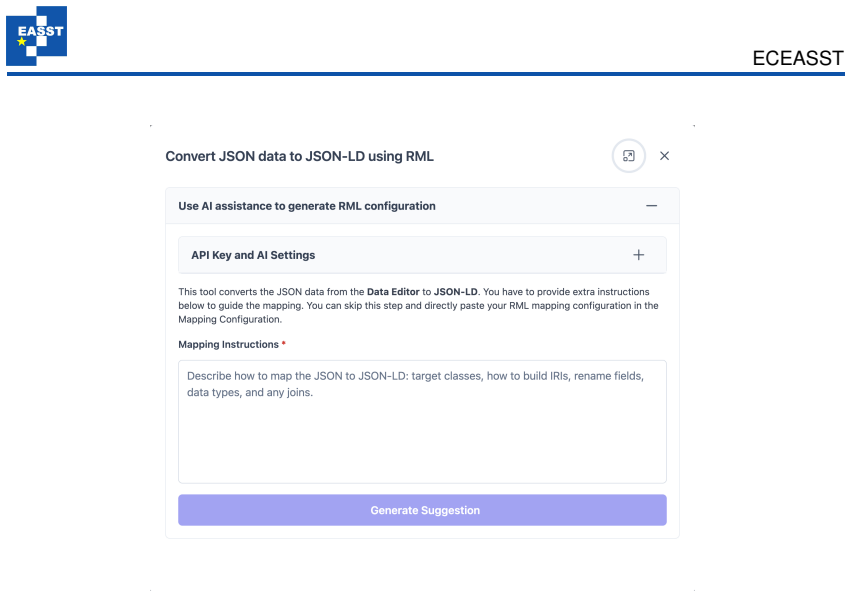
MetaConfigurator adds an RDF authoring view that converts JSON data to ontology-linked triples using AI-assisted RML mappings inside one web interface.
A machine-rendered reading of the paper's core claim, the machinery that carries it, and where it could break.
Core claim
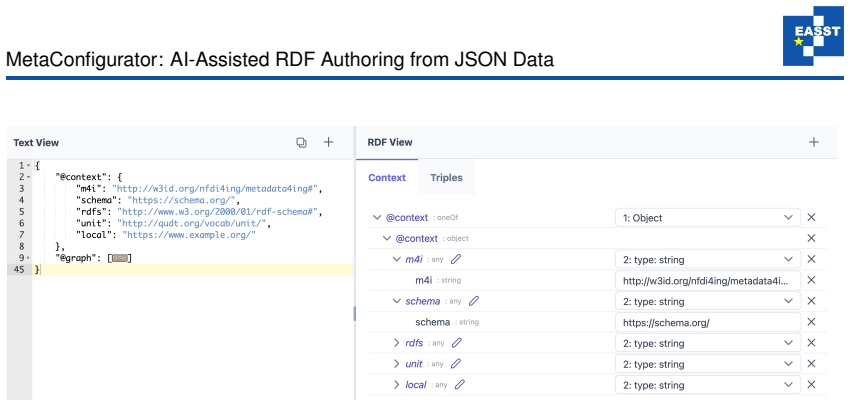
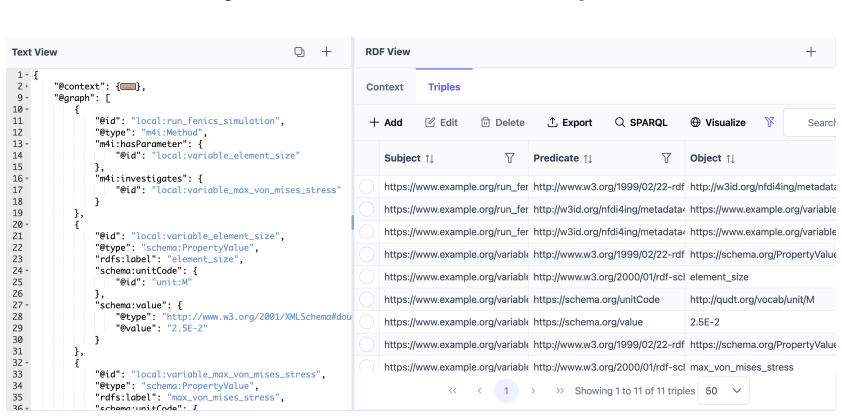
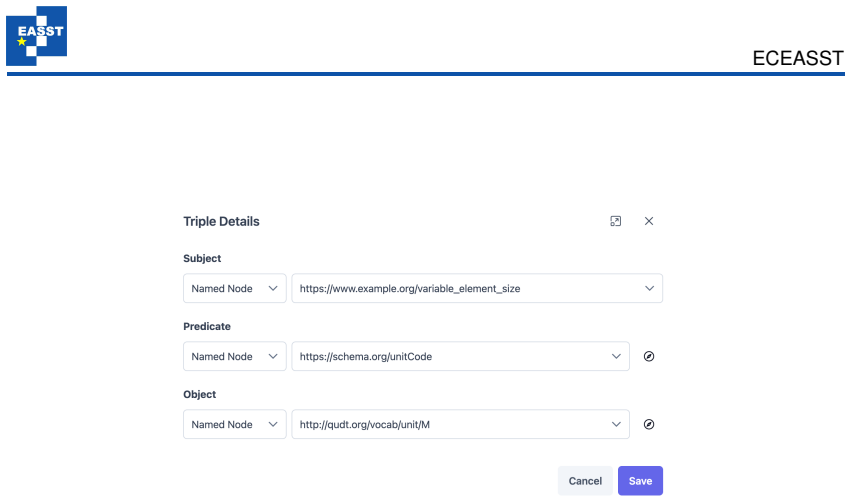
The RDF Authoring View extends MetaConfigurator with AI-assisted RML mappings from JSON/YAML/CSV, ontology-aware IRI auto-completion, bidirectional synchronization between JSON-LD text and RDF tables, AI-assisted SPARQL generation, and interactive knowledge-graph visualization, demonstrated by converting MOF protocol data to ontology-based JSON-LD, refining triples, and querying relationships.
What carries the argument
The RDF Authoring View, which integrates AI-assisted RML mappings with bidirectional JSON-LD/RDF synchronization and SPARQL support inside the existing editor.
If this is right
- Protocol data from experiments can be converted directly to ontology terms while preserving quantities and steps.
- Users can refine triples in a table view and immediately see effects in the JSON-LD and graph views.
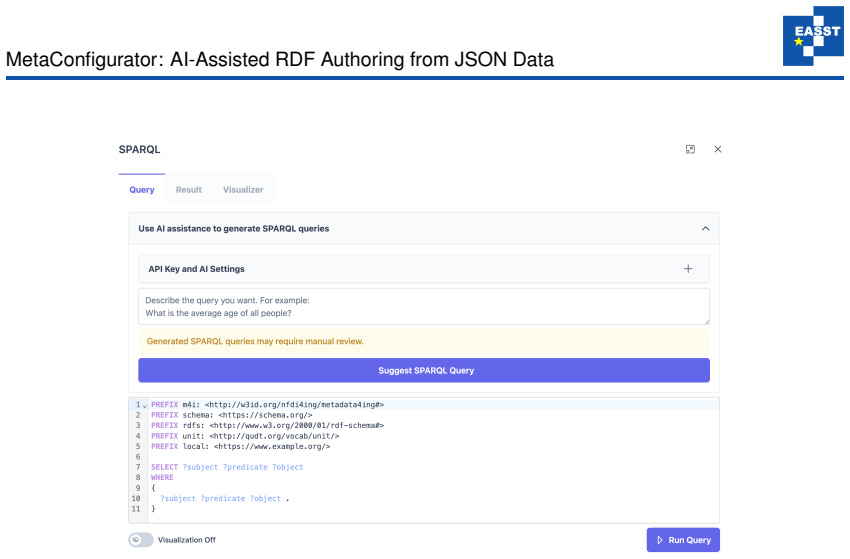
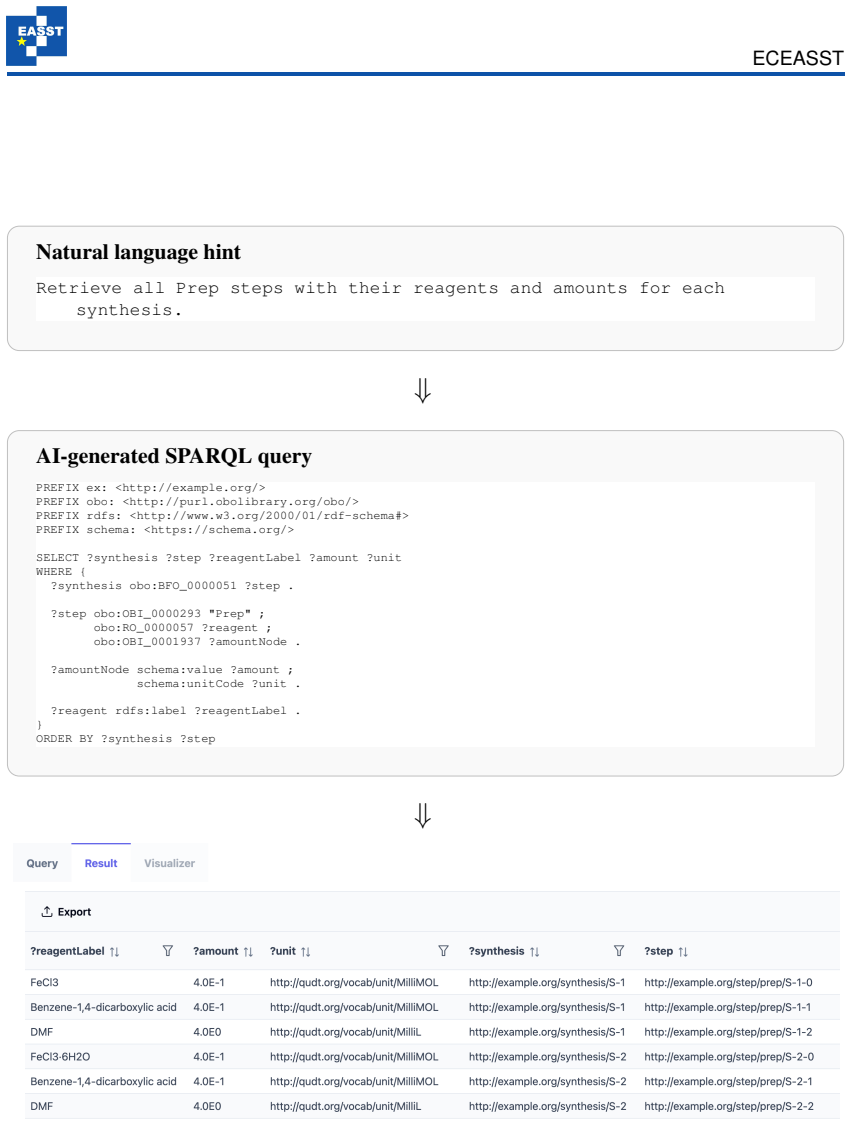
- Natural-language hints can generate SPARQL queries that retrieve relationships between experimental inputs and outcomes.
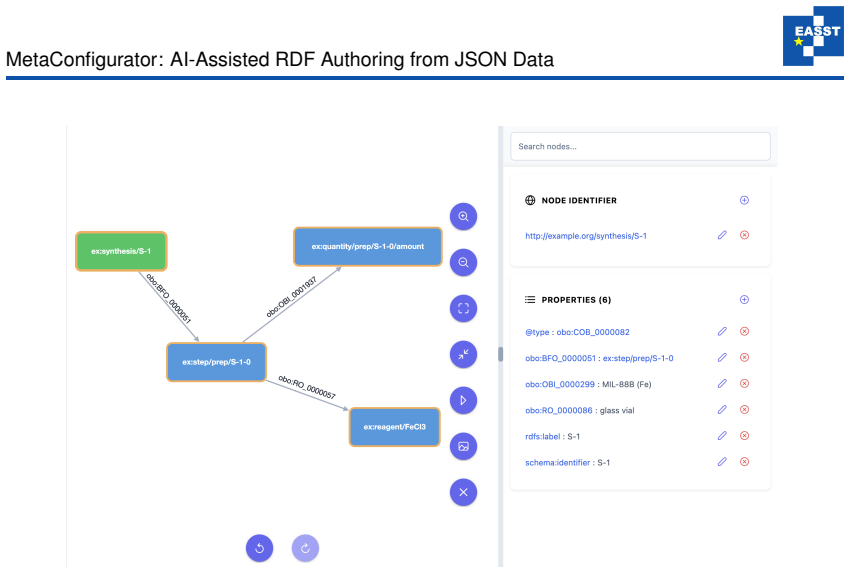
- The resulting knowledge graph can be explored interactively and exported in standard RDF serializations.
- The same interface supports structural validation from JSON Schema alongside semantic enrichment.
Where Pith is reading between the lines
- The same pattern could apply to other JSON-heavy scientific domains such as materials or biology if suitable ontologies exist.
- Bidirectional sync might reduce errors when domain experts who do not write RDF directly edit data.
- Lowering the barrier could increase the volume of laboratory data published as Linked Data.
- Integration with existing JSON editors may encourage gradual adoption rather than requiring a full switch to RDF tools.
Load-bearing premise
That AI-generated RML mappings plus auto-completion will produce accurate, context-preserving RDF from arbitrary JSON without needing separate validation steps.
What would settle it
Compare the automatically generated triples and query results for the MOF dataset against a manually authored ground-truth RDF version and measure mismatch rates in triples or query answers.
Figures

read the original abstract
Scientific workflows increasingly generate structured JSON data that is easy to exchange but difficult to interpret consistently across systems due to lacking semantic interoperability. While JSON Schema ensures structural validation, it provides no native support for Linked Data semantics. This paper presents an RDF Authoring View extending the open-source JSON Schema editor MetaConfigurator, enabling researchers to transform existing JSON, YAML, or CSV data into RDF using AI-assisted RML mappings, refine triples, execute SPARQL queries, visualize knowledge graphs, and export RDF serializations within a single integrated web interface. This workflow is supported by ontology-aware IRI auto-completion, bidirectional synchronization between JSON-LD text views and RDF triple tables, and AI-assisted SPARQL query generation from natural language hints. We demonstrate the workflow using laboratory data from metal-organic framework (MOF) synthesis experiments. Protocol data describing reagents, procedure steps, and quantities is converted from JSON to ontology-based JSON-LD via RML mappings. We then refine the semantic representation, query relationships between experimental conditions and outcomes, and explore the resulting knowledge graph interactively. This integrated environment bridges conventional structured data management with Semantic Web technologies while preserving experimental context and lowering technical barriers through AI assistance.
Editorial analysis
A structured set of objections, weighed in public.
Referee Report
Summary. The paper presents an extension to the open-source MetaConfigurator JSON Schema editor called the RDF Authoring View. This integrated web interface supports converting JSON/YAML/CSV data to RDF via AI-assisted RML mappings, refining triples, executing SPARQL queries (with AI assistance), visualizing knowledge graphs, and exporting RDF serializations. Key supporting features include ontology-aware IRI auto-completion and bidirectional synchronization between JSON-LD and RDF triple views. The workflow is illustrated qualitatively through a demonstration converting laboratory protocol data from MOF synthesis experiments into ontology-based JSON-LD.
Significance. If the described features function reliably, the tool could meaningfully lower barriers for domain scientists to incorporate Linked Data semantics into existing JSON-based workflows, improving interoperability without requiring deep Semantic Web expertise. The integration of AI assistance for mappings and queries is a practical contribution in the cs.SE/tool-building space, though its impact depends on validation that is not yet present.
major comments (1)
- [MOF demonstration] MOF demonstration (abstract and associated section): The paper claims the AI-assisted RML mappings and related features enable reliable, context-preserving conversion of arbitrary structured data into accurate RDF. However, the demonstration consists solely of a qualitative walkthrough with no ground-truth comparison, precision/recall metrics, error analysis, or ablation of the AI component. This absence directly weakens the central claim of effective workflow support and interoperability.
minor comments (1)
- [Abstract] The abstract and introduction could more explicitly distinguish between the novel RDF Authoring View contributions and the pre-existing MetaConfigurator features to clarify the scope of the new work.
Simulated Author's Rebuttal
We thank the referee for the constructive feedback on the tool's potential impact. We address the single major comment below regarding the nature and evaluation of the MOF demonstration.
read point-by-point responses
-
Referee: [MOF demonstration] MOF demonstration (abstract and associated section): The paper claims the AI-assisted RML mappings and related features enable reliable, context-preserving conversion of arbitrary structured data into accurate RDF. However, the demonstration consists solely of a qualitative walkthrough with no ground-truth comparison, precision/recall metrics, error analysis, or ablation of the AI component. This absence directly weakens the central claim of effective workflow support and interoperability.
Authors: We respectfully disagree with the characterization of the paper's claims. The manuscript presents an integrated authoring environment in which AI assists with initial RML mapping generation and SPARQL query formulation, but explicitly includes user-driven refinement of triples, ontology-aware IRI completion, and bidirectional JSON-LD/RDF synchronization. The MOF section is framed as a qualitative demonstration of this workflow on real laboratory protocol data, not as an empirical evaluation of automated conversion accuracy. Tool papers in cs.SE commonly use illustrative walkthroughs to show end-to-end usability rather than quantitative benchmarks of underlying AI components. We will add explicit wording in the abstract and demonstration section clarifying that the example is illustrative, that final semantic accuracy remains under user control, and that the contribution lies in lowering barriers via integration rather than in claiming reliable fully-automatic RDF production. revision: partial
Circularity Check
No circularity: tool-description paper with no derivations or equations
full rationale
The paper is a straightforward description of an open-source web tool (MetaConfigurator RDF Authoring View) that integrates JSON Schema editing with RML mappings, SPARQL, and visualization. It contains no equations, no fitted parameters, no predictions, and no derivation chain. All content is either feature enumeration or a qualitative MOF walkthrough; nothing reduces to its own inputs by construction. Self-citations, if present, are not load-bearing for any claimed result. This is the normal non-finding for a software-engineering demonstration paper.
Axiom & Free-Parameter Ledger
Reference graph
Works this paper leans on
-
[1]
doi:10.1087/20150211 [BCG20] K. A. Briney, H. Coates, A. Goben. Foundational Practices of Research Data Man- agement.Research Ideas and Outcomes,
-
[2]
doi:10.3897/rio.6.e56508 [BHL01] T. Berners-Lee, J. Hendler, O. Lassila. The Semantic Web.Scientific American 284(5):28–37,
-
[3]
doi:10.1016/j.future.2017.01.012 [CBI] S. CBIR. Protégé. https://protege.stanford.edu [CG] S.-G. CG. SPARQL-Generate. https://github.com/SPARQL-Generate 4 https://github.com/MetaConfigurator/meta-configurator 5 https://github.com/MetaConfigurator/meta-configurator/tree/develop/documentation_user/examples/rdf 13 / 16 MetaConfigurator: AI-Assisted RDF Autho...
-
[4]
doi:10.1002/adma.202521420 https://advanced.onlinelibrary.wiley.com/doi/10.1002/adma.202521420 [CWB25] S. Canossa, S. Wuttke, L. J. Barbour. The Chemistry of Space: From Crystallo- graphic Abstraction to Framework Design.Angewandte Chemie International Edi- tion64(52):e23850,
-
[5]
doi:10.1002/anie.202523850 https://onlinelibrary.wiley.com/doi/10.1002/anie.202523850 [CWL14] R. Cyganiak, D. Wood, M. Lanthaler. RDF 1.1 Concepts and Abstract Syntax
-
[6]
doi:10.1093/bioinformatics/btv557 https://js.cytoscape.org/ [HBC+21] A. Hogan, E. Blomqvist, M. Cochez, C. d’Amato, G. de Melo, C. Gutierrez, S. Kir- rane, J. E. Labra Gayo, R. Navigli, S. Neumaier, A.-C. N. Ngomo, A. Polleres, S. M. Rashid, A. Rula, L. Schmelzeisen, J. Sequeda, S. Staab, A. Zimmermann. Knowledge Graphs.ACM Computing Surveys54(4):1–37,
-
[7]
Knowledgegraphs.ACM Computing Surveys, 54(4):1–37, 2021
doi:10.1145/3447772 [HGN+14] M. Horridge, R. S. Gonçalves, C. Nyulas, T. Tudorache, M. A. Musen. WebPro- tégé: A Collaborative Web-Based Platform for Editing Biomedical Ontologies. Bioinformatics,
-
[8]
doi:10.1609/aimag.v36i1.2568 14 / 16 ECEASST [KJP+20] N. Kochev, N. Jeliazkova, V . Paskaleva, G. Tancheva, L. Iliev, P. Ritchie, V . Jeli- azkov. Your Spreadsheets Can Be FAIR: A Tool and FAIRification Workflow for the eNanoMapper Database.Nanomaterials10,
-
[9]
doi:10.3390/nano10101908 [Kou19] V . Koutkias. From data silos to standardized, linked, and FAIR data for pharma- covigilance: current advances and challenges with observational healthcare data. Drug safety42(5):583–586,
-
[10]
doi:10.1007/s40264-018-00793-z [MMM+04] F. Manola, E. Miller, B. McBride et al. RDF primer.W3C recommendation10(1- 107):6,
-
[11]
doi:10.1007/s13222-024-00472-7 [NEB+26] F. Neubauer, K. Endo, F. Bender, E. Ciftci, N. Hansen, S. Krause, B. Uekermann, J. Pleiss. Data Management and Analysis of Metal–Organic Framework Synthesis Using Data Models.Journal of Chemical Information and Modeling,
-
[12]
doi:10.1021/acs.jcim.6c00542 [NPU25] F. Neubauer, J. Pleiss, B. Uekermann. Data Model Creation with MetaConfigura- tor. InDatenbanksysteme für Business, Technologie und Web (BTW 2025). Lecture Notes in Informatics (LNI), Proceedings P-361. Gesellschaft für Informatik, Bonn,
-
[13]
doi:10.18420/BTW2025-60 https://dl.gi.de/handle/20.500.12116/45927 [NUP25] F. Neubauer, B. Uekermann, J. Pleiss. AI-assisted JSON Schema Creation and Mapping. In28th ACM/IEEE Int. Conf. Model Driven Eng. Languages and Sys- tems Companion (MODELS-C). Pp. 79–83
-
[14]
doi:10.1109/MODELS-C68889.2025.00019 [Pat19] J. Patel. Bridging data silos using big data integration.International Journal of Database Management Systems11(3):01–06,
-
[15]
doi:10.5121/ijdms.2019.11301 [Pro] O. Project. OpenRefine. https://openrefine.org/ [RDF] RDFLib Project. RDFLib: A Python library for working with RDF. https://rdflib.dev/ [Red] Redland RDF Project. Redland RDF Libraries. http://librdf.org/ 15 / 16 MetaConfigurator: AI-Assisted RDF Authoring from JSON Data [SKL14] M. Sporny, G. Kellogg, M. Lanthaler. JSON...
-
[16]
Shapes Constraint Language (SHACL)
doi:10.1038/s41597-025-05126-1 [W3C17] W3C. Shapes Constraint Language (SHACL)
-
[17]
doi:10.1038/s41597-025-04451-9 [W AR+26] K. Wang, D. D. Ahn, N. Rampal, J. Thomassian, N. S. Sabeva, O. Kannan, C. Borgs, J. T. Chayes, O. M. Yaghi. Synthesis of Highly Crystalline Covalent Or- ganic Frameworks Using Large Language Models.Journal of the American Chem- ical Society148(9):10094–10104,
-
[18]
doi:10.1021/jacs.5c23233 https://pubs.acs.org/doi/abs/10.1021/jacs.5c23233 16 / 16
discussion (0)
Sign in with ORCID, Apple, or X to comment. Anyone can read and Pith papers without signing in.