Generalized analytical relations to describe global optical systems with a plenoptic camera
Pith reviewed 2026-06-27 21:05 UTC · model grok-4.3
The pith
Optical transfer matrix formalism yields analytical expressions for effective resolution, depth of field, disparity and optimum patch size in any plenoptic camera setup.
A machine-rendered reading of the paper's core claim, the machinery that carries it, and where it could break.
Core claim
The central claim is that the optical transfer matrix formalism remains applicable to global optical systems containing a plenoptic camera and supplies analytical relations that give the effective resolution, depth of field, disparity and optimum patch size for image reconstruction as explicit functions of the optical parameters of any such arrangement.
What carries the argument
The optical transfer matrix formalism applied to ray propagation through the full system including the microlens array and sensor of the plenoptic camera.
If this is right
- Effective resolution follows immediately from the matrix elements for any lens and plenoptic combination.
- Depth of field and disparity are obtained from the same matrix without separate derivations.
- Optimum patch size for reconstruction can be calculated analytically from the system parameters.
- The relations hold for non-standard geometries such as astigmatic cylindrical imaging.
- Performance predictions for new arrangements become possible by simple matrix multiplication.
Where Pith is reading between the lines
- Designers could optimize plenoptic systems by treating matrix elements as variables to maximize resolution or depth of field.
- The same matrix approach might extend to other discrete sampling cameras if the no-correction assumption continues to hold.
- Numerical checks against full wave-optics simulations in three-dimensional object scenes would reveal the practical range of the analytic formulas.
Load-bearing premise
The standard optical transfer matrix remains valid after the plenoptic camera is inserted into the train without extra correction terms for the discrete sampling or angular integration performed by the microlenses.
What would settle it
A direct comparison in a calibrated setup where the measured effective resolution or depth of field differs substantially from the value computed from the transfer matrix for the same optical parameters.
Figures

read the original abstract
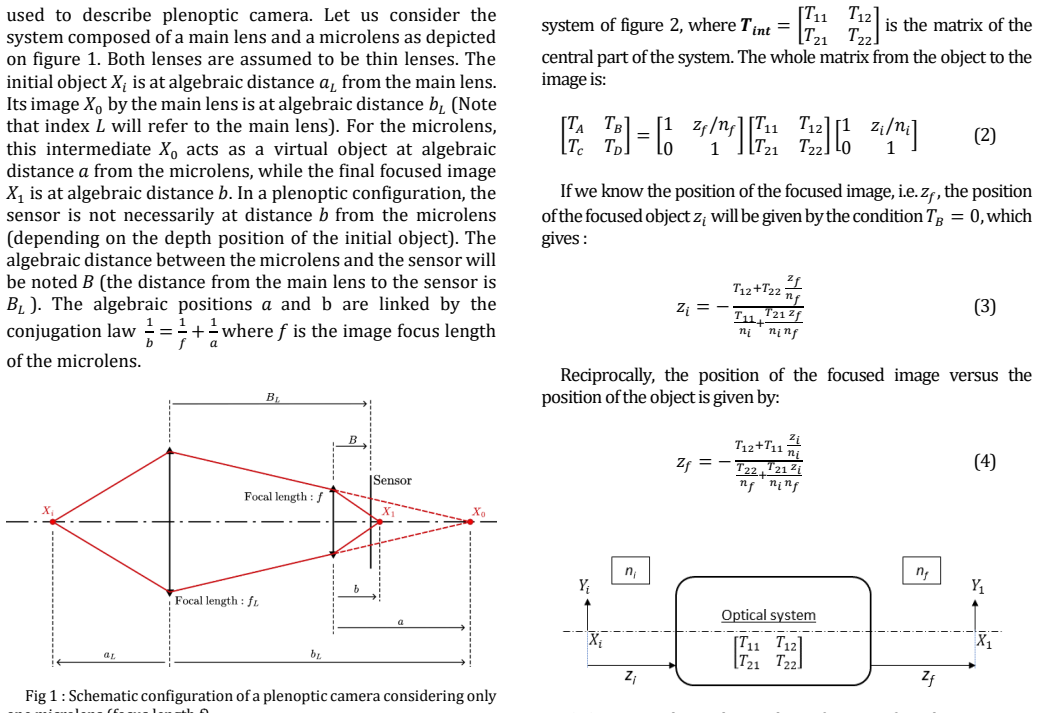
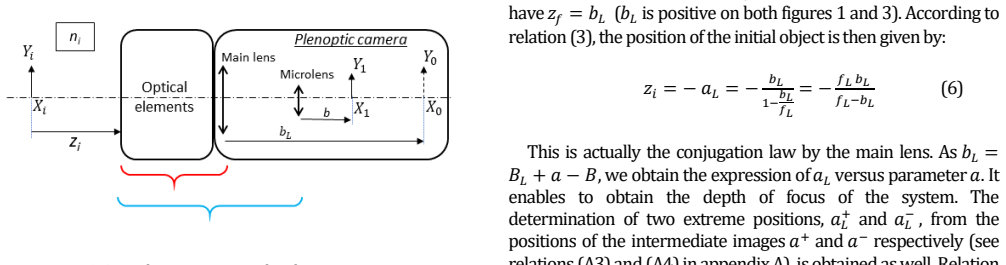
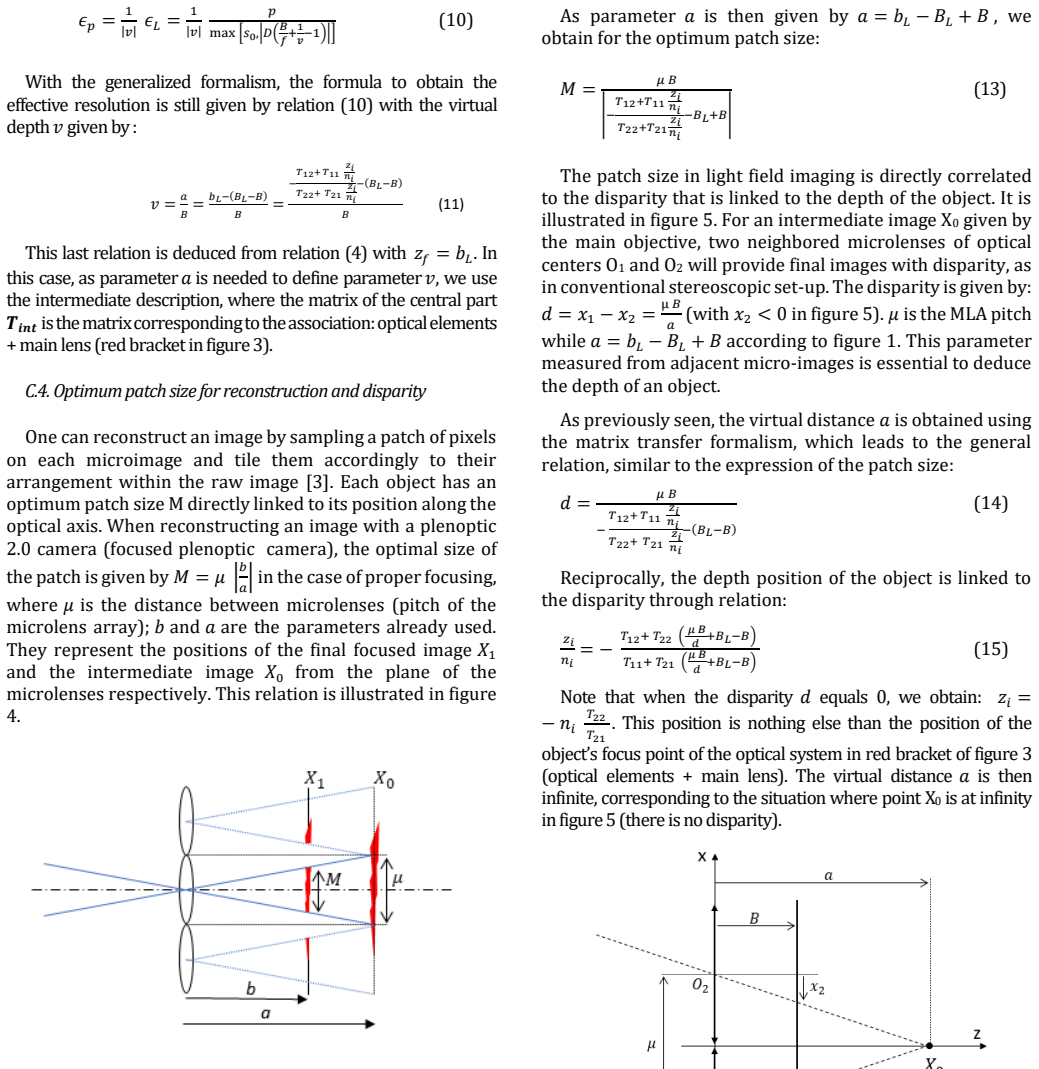
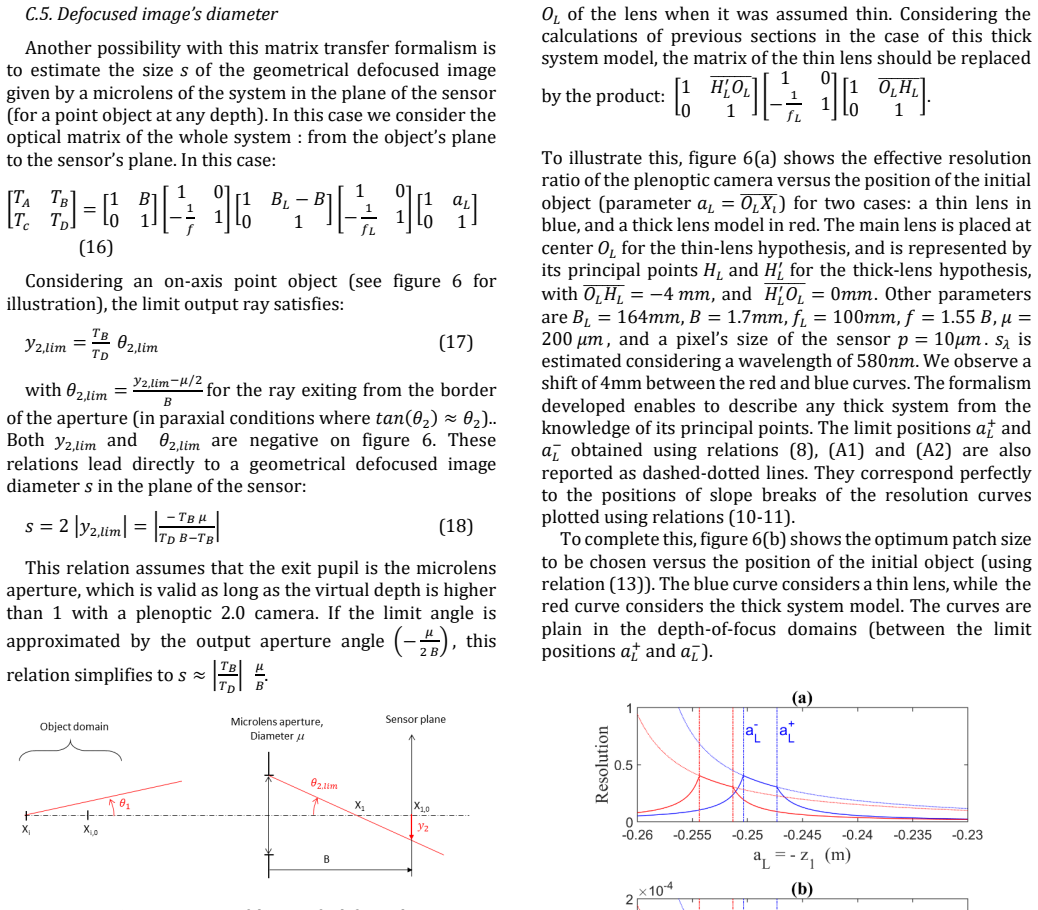
The optical transfer matrix formalism is used to describe global set-ups incorporating a plenoptic camera. Analytical relations that give the effective resolution, depth of field, disparity and optimum patch size for image reconstruction are established versus the optical parameters of any global arrangement. The potentiality of this formulation is illustrated analyzing experimental results obtained in astigmatic cylindrical imaging conditions.
Editorial analysis
A structured set of objections, weighed in public.
Referee Report
Summary. The paper applies the optical transfer matrix (ABCD) formalism to model arbitrary global optical trains that terminate with a plenoptic camera (microlens array plus sensor). It derives closed-form analytical expressions for effective resolution, depth of field, disparity, and optimum patch size for image reconstruction, expressed in terms of the system's optical parameters. The approach is illustrated by re-analyzing experimental data acquired under astigmatic cylindrical imaging conditions.
Significance. If the derivations hold and the matrix formalism applies without additional discrete-sampling corrections, the work supplies a compact analytical framework that could replace numerical ray-tracing for design and optimization of plenoptic systems embedded in complex optics. The experimental illustration on astigmatic data provides a concrete test case, though quantitative error metrics are not yet visible.
major comments (2)
- [Abstract and §2 (formalism)] The central claim that the derived relations are general for 'any global arrangement' rests on treating the microlens array as an ordinary thin-lens element whose effect is fully captured by the ABCD matrix elements. No section justifies or tests this against finite microlens pitch, discrete angular sampling, or aperture integration; if these effects modify the effective pupil or introduce aliasing, the closed-form expressions lose their claimed generality. This assumption is load-bearing for all four analytical relations.
- [§3 (analytical relations)] No derivation steps, explicit matrix definitions for the plenoptic termination, or error-propagation analysis appear in the visible text. Without these, the soundness of the expressions for resolution, DoF, disparity, and patch size cannot be verified.
minor comments (2)
- [Experimental results] The experimental section would benefit from a table comparing predicted versus measured values for at least one of the four quantities (resolution, DoF, disparity, patch size) together with uncertainty estimates.
- [§2] Notation for the plenoptic-specific matrix elements should be defined explicitly (e.g., focal length of microlenses, pitch, sensor pixel size) rather than left implicit.
Simulated Author's Rebuttal
We thank the referee for the constructive comments. We respond to each major point below, agreeing where revisions are needed to clarify assumptions and derivations.
read point-by-point responses
-
Referee: [Abstract and §2 (formalism)] The central claim that the derived relations are general for 'any global arrangement' rests on treating the microlens array as an ordinary thin-lens element whose effect is fully captured by the ABCD matrix elements. No section justifies or tests this against finite microlens pitch, discrete angular sampling, or aperture integration; if these effects modify the effective pupil or introduce aliasing, the closed-form expressions lose their claimed generality. This assumption is load-bearing for all four analytical relations.
Authors: We agree that the manuscript does not explicitly justify or test the thin-lens ABCD treatment of the microlens array against finite pitch, discrete sampling, or aperture effects. The derivations assume the paraxial geometric-optics limit in which the microlens array is represented by its standard thin-lens matrix elements. We will revise §2 to state these assumptions explicitly, note that aliasing and discrete-sampling corrections lie outside the present scope, and qualify the generality claim accordingly. This addresses the load-bearing nature of the assumption without altering the core analytical relations. revision: partial
-
Referee: [§3 (analytical relations)] No derivation steps, explicit matrix definitions for the plenoptic termination, or error-propagation analysis appear in the visible text. Without these, the soundness of the expressions for resolution, DoF, disparity, and patch size cannot be verified.
Authors: The expressions are obtained by matrix multiplication of the preceding optics with the microlens-array and sensor-plane matrices, followed by extraction of the relevant ray-transfer parameters. We acknowledge that the visible text omits the explicit plenoptic termination matrices and the intermediate algebraic steps. We will expand §3 to include these definitions, the full derivation sequence for each quantity, and a short discussion of parameter sensitivity (in place of formal error propagation, as the relations are deterministic). revision: yes
Circularity Check
No significant circularity in derivation chain
full rationale
The paper derives analytical expressions for resolution, depth of field, disparity and patch size by propagating the standard ABCD optical transfer matrix through an arbitrary global train ending in a microlens array plus sensor. No equations reduce a claimed prediction to a fitted parameter by construction, no self-definitional loops appear, and no load-bearing self-citations or imported uniqueness theorems are invoked in the abstract or described method. The central relations follow directly from matrix multiplication under the stated paraxial assumption; the derivation remains self-contained against external optical benchmarks and does not collapse to its inputs.
Axiom & Free-Parameter Ledger
axioms (1)
- standard math Optical elements can be represented by 2x2 or 4x4 transfer matrices whose product yields the overall system matrix.
Reference graph
Works this paper leans on
-
[1]
Adelson, J.Y.A
E.H. Adelson, J.Y.A. Wang, Single lens stereo with a plenoptic camera, IEEE Trans. Pattern Anal. Machine Intell. 14 (1992) 99–
1992
-
[2]
https://doi.org/10.1109/34.121783
-
[3]
R. Ng, M. Levoy, M. Brédif, G. Duval, M. Horowitz, P. Hanrahan, Light field photography with a hand-held plenoptic camera, Stanford university, 2005
2005
-
[4]
doi:10.1111/j.1467-8659.2010.01725.x Yuxuan Yao, Zixuan Zeng, Chun Gu, Xiatian Zhu, and Li Zhang
T. Georgiev, A. Lumsdaine, Reducing Plenoptic Camera Artifacts, Computer Graphics Forum 29 (2010) 1955–1968. https://doi.org/10.1111/j.1467-8659.2010.01662.x
-
[5]
I. Ihrke, J. Restrepo, L. Mignard-Debise, Principles of Light Field Imaging: Briefly revisiting 25 years of research, IEEE Signal Process. Mag. 33 (2016) 59–69. https://doi.org/10.1109/MSP.2016.2582220
-
[6]
Synaptic electronics: Materials, devices and applications,
T.W. Fahringer, K.P. Lynch, B.S. Thurow, Volumetric particle image velocimetry with a single plenoptic camera, Meas. Sci. Technol. 26 (2015) 115201. https://doi.org/10.1088/0957- 0233/26/11/115201
-
[7]
Hall, B.S
E.M. Hall, B.S. Thurow, D.R. Guildenbecher, Comparison of three-dimensional particle tracking and sizing using plenoptic imaging and digital in-line holography, Appl. Opt. 55 (2016)
2016
-
[8]
https://doi.org/10.1364/AO.55.006410
-
[9]
L. Chen, C. Xu, J. Li, B. Zhang, A 3D measurement method of bubbles based on edge gradient segmentation of light field images, Chemical Engineering Journal 452 (2023) 139590. https://doi.org/10.1016/j.cej.2022.139590
-
[10]
L. Cao, Md.M. Hossain, J. Li, C. Xu, Three-dimensional particle image velocimetry measurement through three-dimensional U- Net neural network, Physics of Fluids 36 (2024) 047136. https://doi.org/10.1063/5.0205872
-
[11]
In: Human Vision and Electronic Imaging (HVEI)
C. Perwass, L. Wietzke, Single lens 3D-camera with extended depth-of-field, in: Burlingame, California, USA, 2012: p. 829108. https://doi.org/10.1117/12.909882
-
[12]
N. Verrier, C. Remacha, M. Brunel, D. Lebrun, S. Coëtmellec, Micropipe flow visualization using digital in-line holographic microscopy, Opt. Express 18 (2010) 7807. https://doi.org/10.1364/OE.18.007807
-
[13]
L. Wang, Y. Zhao, Y. Wang, Y. Wu, G. Song, T. Liu, X. Wu, Modeling and verification of astigmatic digital off-axis holography for burning droplet measurement in a flame tube, Optics and Lasers in Engineering 159 (2022) 107219. https://doi.org/10.1016/j.optlaseng.2022.107219
-
[14]
H. Shen, S. Saengkaew, G. Gréhan, S. Coe¨tmellec, M. Brunel, Interferometric out-of-focus imaging for the 3D tracking of spherical bubbles in a cylindrical channel, Optics Communications 320 (2014) 156–161. https://doi.org/10.1016/j.optcom.2014.01.020
-
[15]
A. Rostami, S. Mohammadnejad, R. Li, S. Kheirkhah, Astigmatic interferometric particle imaging of reacting Jet A-1 sprays: Joint droplet and cluster characteristics, Proceedings of the Combustion Institute 40 (2024) 105600. https://doi.org/10.1016/j.proci.2024.105600
-
[16]
P. Schleuniger, R.-A. Herrera Leclerc, M. Brunel, M.-C. Renoult, J.-B. Blaisot, Experimental three-dimensional location and size distribution of rising bubbles in a cylindrical column through light field imaging, Physics of Fluids 36 (2024) 103352. https://doi.org/10.1063/5.0231162
discussion (0)
Sign in with ORCID, Apple, or X to comment. Anyone can read and Pith papers without signing in.