Asymmetry dynamics and nonequilibrium symmetry-breaking phase transitions
Pith reviewed 2026-06-27 20:43 UTC · model grok-4.3
The pith
Open quantum many-body systems with symmetry-breaking transitions exhibit a quantum Mpemba effect from non-monotonic asymmetry evolution.
A machine-rendered reading of the paper's core claim, the machinery that carries it, and where it could break.
Core claim
In open quantum many-body systems featuring symmetry-breaking phase transitions, the asymmetry of a subsystem evolves non-monotonically in the symmetric phase, directly producing a quantum Mpemba effect, while in the broken-symmetry phase an imbalance arises between the rates at which asymmetry can increase or decrease.
What carries the argument
The asymmetry of a subsystem, used as an analog of temperature, whose non-monotonic time evolution in the symmetric phase generates the Mpemba effect and whose change rates become imbalanced in the broken phase.
If this is right
- A quantum Mpemba effect appears in the symmetric phase as a direct result of non-monotonic asymmetry evolution.
- An imbalance exists between the system's ability to increase versus decrease its asymmetry in the broken-symmetry phase.
- Open quantum many-body systems with symmetry-breaking transitions serve as a platform for observing and controlling anomalous relaxation.
- The reported behaviors extend the quantum Mpemba effect beyond closed systems to dissipative many-body settings.
Where Pith is reading between the lines
- The non-monotonic asymmetry could be used to design protocols that accelerate or slow symmetry restoration in engineered open quantum systems.
- Similar imbalance effects might appear in other dissipative models that lack an explicit phase transition but still break symmetry.
- Numerical studies of specific lattice models with local dissipation could map the parameter regions where the Mpemba effect is strongest.
Load-bearing premise
The open quantum many-body dynamics with symmetry-breaking phase transitions permit a non-monotonic asymmetry evolution that is absent in closed-system settings.
What would settle it
A calculation or experiment on a concrete open quantum many-body model with symmetry breaking that finds strictly monotonic asymmetry decay throughout the symmetric phase would rule out the reported Mpemba effect.
Figures
read the original abstract
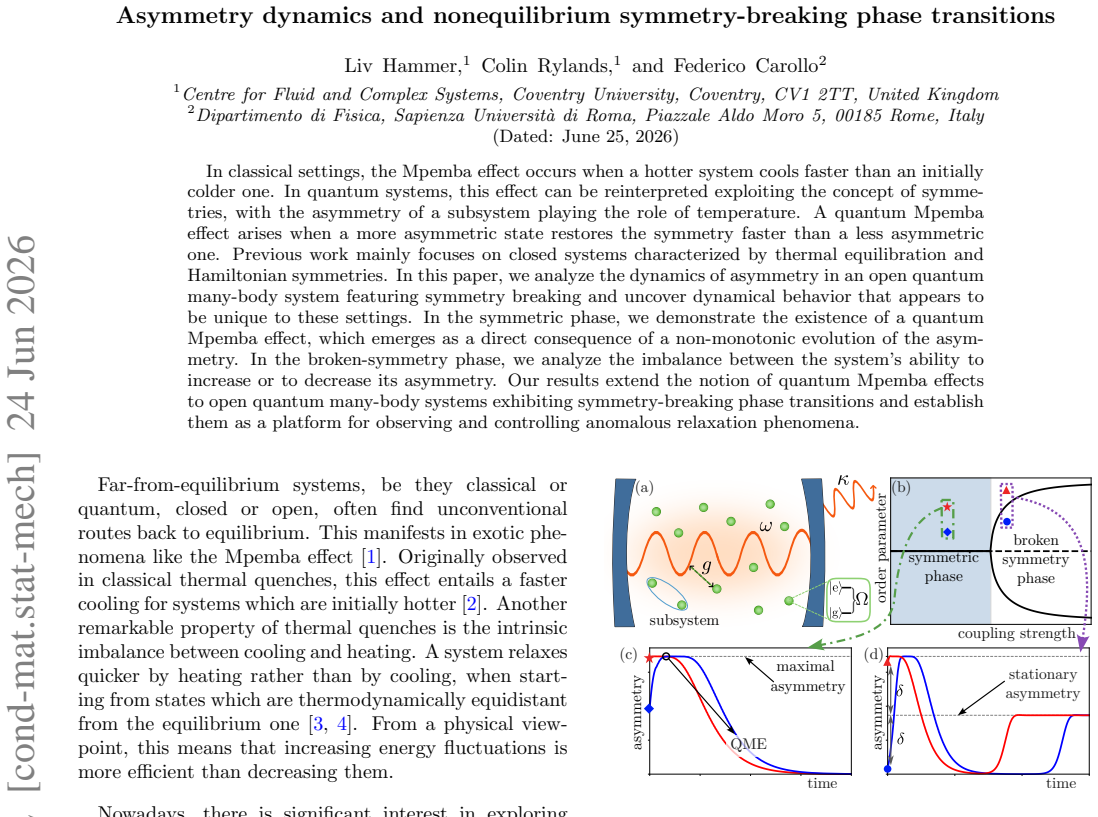
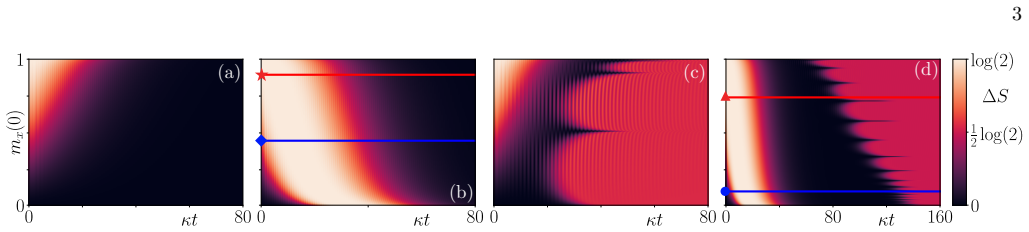
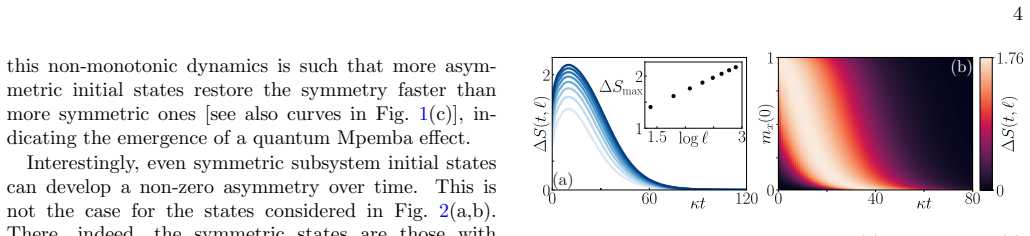
In classical settings, the Mpemba effect occurs when a hotter system cools faster than an initially colder one. In quantum systems, this effect can be reinterpreted exploiting the concept of symmetries, with the asymmetry of a subsystem playing the role of temperature. A quantum Mpemba effect arises when a more asymmetric state restores the symmetry faster than a less asymmetric one. Previous work mainly focuses on closed systems characterized by thermal equilibration and Hamiltonian symmetries. In this paper, we analyze the dynamics of asymmetry in an open quantum many-body system featuring symmetry breaking and uncover dynamical behavior that appears to be unique to these settings. In the symmetric phase, we demonstrate the existence of a quantum Mpemba effect, which emerges as a direct consequence of a non-monotonic evolution of the asymmetry. In the broken-symmetry phase, we analyze the imbalance between the system's ability to increase or to decrease its asymmetry. Our results extend the notion of quantum Mpemba effects to open quantum many-body systems exhibiting symmetry-breaking phase transitions and establish them as a platform for observing and controlling anomalous relaxation phenomena.
Editorial analysis
A structured set of objections, weighed in public.
Referee Report
Summary. The paper analyzes the dynamics of asymmetry in an open quantum many-body system with symmetry-breaking phase transitions. It reports a quantum Mpemba effect in the symmetric phase arising directly from non-monotonic asymmetry evolution, and an imbalance between the system's ability to increase versus decrease asymmetry in the broken-symmetry phase. These behaviors are presented as unique to open-system settings with symmetry breaking, extending prior closed-system studies of quantum Mpemba effects.
Significance. If the claims are supported by the (unavailable) derivations and data, the work would establish open quantum many-body systems with symmetry-breaking transitions as a platform for anomalous relaxation, including a symmetry-based Mpemba effect. The abstract positions the non-monotonic asymmetry evolution as a direct consequence of the open dynamics, which could be a substantive extension if demonstrated.
major comments (2)
- [Abstract] Abstract: the central claims (quantum Mpemba effect from non-monotonic asymmetry; asymmetry imbalance in the broken phase) are stated without any derivations, numerical protocols, error analysis, or explicit methods. This prevents assessment of whether the reported behaviors are actually supported by the math or simulations.
- [Abstract] Abstract: the assertion that the non-monotonic asymmetry evolution and resulting Mpemba effect are 'unique to these settings' (open systems with symmetry breaking) cannot be evaluated, as no comparison to closed-system cases or explicit dynamical equations are provided.
Simulated Author's Rebuttal
We thank the referee for their assessment. The abstract is a concise overview; the full manuscript contains the derivations, protocols, equations, and supporting analysis. We respond point by point to the major comments.
read point-by-point responses
-
Referee: [Abstract] Abstract: the central claims (quantum Mpemba effect from non-monotonic asymmetry; asymmetry imbalance in the broken phase) are stated without any derivations, numerical protocols, error analysis, or explicit methods. This prevents assessment of whether the reported behaviors are actually supported by the math or simulations.
Authors: Abstracts are summaries and do not contain full derivations or methods. The dynamical equations, numerical protocols, error analysis, and explicit methods supporting the quantum Mpemba effect and asymmetry imbalance are provided in Sections II and III of the manuscript, with additional details and figures in the appendices. These elements allow direct assessment of the claims. revision: no
-
Referee: [Abstract] Abstract: the assertion that the non-monotonic asymmetry evolution and resulting Mpemba effect are 'unique to these settings' (open systems with symmetry breaking) cannot be evaluated, as no comparison to closed-system cases or explicit dynamical equations are provided.
Authors: The explicit dynamical equations, including the open-system Lindblad operators that produce the non-monotonic asymmetry, appear in Section II. The uniqueness argument rests on the mechanism requiring both open dissipation and symmetry-breaking transitions, which is absent in closed Hamiltonian systems; this contrast is outlined in the introduction and conclusion with references to prior closed-system work. The abstract qualifies the claim as behavior that 'appears to be unique.' revision: no
Circularity Check
No significant circularity; derivation self-contained
full rationale
The provided abstract and reader's assessment describe emergent dynamical behaviors (non-monotonic asymmetry evolution producing a quantum Mpemba effect, and asymmetry imbalance in the broken phase) as arising from analysis of open quantum many-body dynamics with symmetry-breaking transitions. No load-bearing steps are indicated that reduce by construction to fitted parameters, self-definitions, or self-citation chains. The central claims are presented as consequences of the system's evolution rather than renamed inputs or ansatzes smuggled via prior work. With no quoted equations or sections exhibiting the enumerated circular patterns, the derivation chain is self-contained against external benchmarks.
Axiom & Free-Parameter Ledger
axioms (2)
- domain assumption Asymmetry of a subsystem can serve as the quantum analogue of temperature for defining a Mpemba effect.
- domain assumption The system is an open quantum many-body system that exhibits symmetry-breaking phase transitions.
Reference graph
Works this paper leans on
-
[1]
This quantity is non-negative, ∆S(t, ℓ)≥0, and only vanishes when the subsystem state is symmetric, i.e.,ρ A(t) = ρA(t)
or entropic order parameter [44, 45]. This quantity is non-negative, ∆S(t, ℓ)≥0, and only vanishes when the subsystem state is symmetric, i.e.,ρ A(t) = ρA(t). For the considered symmetry operatorP A, it is bounded from above by log(2) [25, 54]. Exploiting the fact that the reduced subsystem stateρ A(t) is a pure product state at all times [40, 53], we can...
-
[2]
E. B. Mpemba and D. G. Osborne, Cool?, Phys. Educ. 4, 172 (1969)
1969
-
[3]
G. Teza, J. Bechhoefer, A. Lasanta, O. Raz, and M. Vucelja, Speedups in nonequilibrium thermal relax- ation: Mpemba and related effects, Phys. Rep.1164, 1–97 (2026)
2026
-
[4]
Lapolla and A
A. Lapolla and A. Godec, Faster uphill relaxation in ther- modynamically equidistant temperature quenches, Phys. Rev. Lett.125, 110602 (2020)
2020
-
[5]
Thermal relaxation asymmetry persists under inertial effects
C. Dieball and A. Godec, Thermal relaxation asymmetry persists under inertial effects (2026), arXiv:2603.18721
work page internal anchor Pith review Pith/arXiv arXiv 2026
-
[6]
Carollo, A
F. Carollo, A. Lasanta, and I. Lesanovsky, Exponentially Accelerated Approach to Stationarity in Markovian Open Quantum Systems through the Mpemba Effect, Phys. Rev. Lett.127, 060401 (2021)
2021
-
[7]
A. K. Chatterjee, S. Takada, and H. Hayakawa, Quantum Mpemba Effect in a Quantum Dot with Reservoirs, Phys. Rev. Lett.131, 080402 (2023)
2023
-
[8]
A. K. Chatterjee, S. Takada, and H. Hayakawa, Multiple quantum Mpemba effect: Exceptional points and oscilla- tions, Phys. Rev. A110, 022213 (2024)
2024
-
[9]
Nava and R
A. Nava and R. Egger, Mpemba effects in open nonequi- librium quantum systems, Phys. Rev. Lett.133, 136302 (2024)
2024
-
[10]
F. Ares, P. Calabrese, and S. Murciano, The quantum Mpemba effects, Nat. Rev. Phys.7, 451–460 (2025)
2025
-
[11]
Liu, H.-K
S. Liu, H.-K. Zhang, S. Yin, and S.-X. Zhang, Symmetry Restoration and Quantum Mpemba Effect in Symmetric Random Circuits, Phys. Rev. Lett.133, 140405 (2024)
2024
-
[12]
Turkeshi, P
X. Turkeshi, P. Calabrese, and A. De Luca, Quantum mpemba effect in random circuits, Phys. Rev. Lett.135, 040403 (2025)
2025
-
[13]
Summer, M
A. Summer, M. Moroder, L. P. Bettmann, X. Turkeshi, I. Marvian, and J. Goold, Resource-Theoretical Unifica- tion of Mpemba Effects: Classical and Quantum, Phys. Rev. X16, 011065 (2026)
2026
-
[14]
Beato and G
N. Beato and G. Teza, Relaxation control of open quan- tum systems, Phys. Rev. Lett.136, 070401 (2026)
2026
-
[15]
Yamashika and F
S. Yamashika and F. Ares, Quantum mpemba effect in long-range spin systems, Phys. Rev. Lett.136, 090402 (2026)
2026
-
[16]
L. K. Joshi, J. Franke, A. Rath, F. Ares, S. Murciano, F. Kranzl, R. Blatt, P. Zoller, B. Vermersch, P. Cal- abrese, C. F. Roos, and M. K. Joshi, Observing the Quan- tum Mpemba Effect in Quantum Simulations, Phys. Rev. Lett.133, 010402 (2024)
2024
-
[17]
Aharony Shapira, Y
S. Aharony Shapira, Y. Shapira, J. Markov, G. Teza, N. Akerman, O. Raz, and R. Ozeri, Inverse Mpemba Ef- fect Demonstrated on a Single Trapped Ion Qubit, Phys. Rev. Lett.133, 010403 (2024)
2024
-
[18]
Zhang, G
J. Zhang, G. Xia, C.-W. Wu, T. Chen, Q. Zhang, Y. Xie, W.-B. Su, W. Wu, C.-W. Qiu, P.-X. Chen, W. Li, H. Jing, and Y.-L. Zhou, Observation of quantum strong mpemba effect, Nat. Commun.16, 301 (2025)
2025
-
[19]
Observation and Modulation of the Quantum Mpemba Effect on a Superconducting Quantum Processor
Y. Xu, C.-P. Fang, B.-J. Chen, M.-C. Wang, Z.-Y. Ge, Y.-H. Shi, Y. Liu, C.-L. Deng, K. Zhao, Z.-H. Liu, T.-M. Li, H. Li, Z. Wang, G.-H. Liang, D. Feng, X. Guo, X.-Y. Gu, Y. He, H.-T. Liu, Z.-Y. Mei, Y. Xiao, Y. Yan, Y.-H. Yu, W.-P. Yuan, J.-C. Zhang, Z.-A. Wang, G. Liu, X. Song, Y. Tian, Y.-R. Zhang, S.-X. Zhang, K. Huang, Z. Xiang, D. Zheng, K. Xu, and H...
work page internal anchor Pith review Pith/arXiv arXiv 2025
-
[20]
A. Chatterjee, S. Khan, S. Jain, and T. S. Mahesh, Direct Experimental Observation of Quantum Mpemba Effect without Bath Engineering (2025), arXiv:2509.13451
- [21]
-
[22]
Observation of quantum multi-Mpemba effect in a trapped-ion system
G. Xia, Y.-J. Zheng, J. Huang, C.-W. Wu, Y. Xie, T. Chen, W. Wu, W. Li, H. Jing, J. Zhang, Y.-L. Zhou, and P.-X. Chen, Observation of quantum multi-Mpemba effect in a trapped-ion system (2026), arXiv:2604.21320
work page internal anchor Pith review Pith/arXiv arXiv 2026
-
[23]
F. Ares, S. Murciano, and P. Calabrese, Entanglement asymmetry as a probe of symmetry breaking, Nat. Com- mun.14, 2036 (2023)
2036
-
[24]
Yamashika, F
S. Yamashika, F. Ares, and P. Calabrese, Entangle- ment asymmetry and quantum Mpemba effect in two- dimensional free-fermion systems, Phys. Rev. B110, 085126 (2024)
2024
-
[25]
Rylands, K
C. Rylands, K. Klobas, F. Ares, P. Calabrese, S. Mur- ciano, and B. Bertini, Microscopic Origin of the Quan- tum Mpemba Effect in Integrable Systems, Phys. Rev. Lett.133, 010401 (2024)
2024
-
[26]
Ferro, F
F. Ferro, F. Ares, and P. Calabrese, Non-equilibrium en- tanglement asymmetry for discrete groups: the example of the XY spin chain, J. Stat. Mech.: Theory Exp.2024 (2), 023101
2024
-
[27]
Chalas, F
K. Chalas, F. Ares, C. Rylands, and P. Calabrese, Mul- tiple crossings during dynamical symmetry restoration and implications for the quantum mpemba effect, J. Stat. Mech.: Theory Exp.2024(10), 103101
2024
-
[28]
F. Ares, C. Rylands, and P. Calabrese, A simpler probe of 6 the quantum Mpemba effect in closed systems, J. Phys. A58, 445302 (2025)
2025
-
[29]
F. Ares, S. Murciano, E. Vernier, and P. Calabrese, Lack of symmetry restoration after a quantum quench: An entanglement asymmetry study, SciPost Phys.15, 089 (2023)
2023
-
[30]
Rylands, E
C. Rylands, E. Vernier, and P. Calabrese, Dynamical symmetry restoration in the Heisenberg spin chain, J. Stat. Mech.: Theory Exp.2024(12), 123102
2024
-
[31]
Caceffo, S
F. Caceffo, S. Murciano, and V. Alba, Entangled multi- plets, asymmetry, and quantum Mpemba effect in dissi- pative systems, J. Stat. Mech.: Theory Exp.2024(6), 063103
2024
-
[32]
F. Ares, V. Vitale, and S. Murciano, Quantum Mpemba effect in free-fermionic mixed states, Phys. Rev. B111, 104312 (2025)
2025
-
[33]
Di Giulio, X
G. Di Giulio, X. Turkeshi, and S. Murciano, Measurement-Induced Symmetry Restoration and Quantum Mpemba Effect, Entropy27, 407 (2025)
2025
-
[34]
Russotto, F
A. Russotto, F. Ares, P. Calabrese, and V. Alba, Dynam- ics of entanglement fluctuations and quantum Mpemba effect in theν= 1 QSSEP model, J. Stat. Mech.2026, 033103 (2026)
2026
-
[35]
Dimer, B
F. Dimer, B. Estienne, A. S. Parkins, and H. J. Carmichael, Proposed realization of the dicke-model quantum phase transition in an optical cavity qed sys- tem, Phys. Rev. A75, 013804 (2007)
2007
-
[36]
Baumann, R
K. Baumann, R. Mottl, F. Brennecke, and T. Esslinger, Exploring symmetry breaking at the dicke quantum phase transition, Phys. Rev. Lett.107, 140402 (2011)
2011
-
[37]
Baumann, C
K. Baumann, C. Guerlin, F. Brennecke, and T. Esslinger, Dicke quantum phase transition with a superfluid gas in an optical cavity, Nature464, 1301 (2010)
2010
-
[38]
Mivehvar, F
F. Mivehvar, F. Piazza, T. Donner, and H. Ritsch, Cavity QED with quantum gases: new paradigms in many-body physics, Adv. Phys.70, 1 (2021)
2021
-
[39]
Kirton, M
P. Kirton, M. M. Roses, J. Keeling, and E. G. Dalla Torre, Introduction to the Dicke Model: From Equilibrium to Nonequilibrium, and Vice Versa, Adv. Quantum Technol.2, 1800043 (2019)
2019
-
[40]
Kirton and J
P. Kirton and J. Keeling, Suppressing and Restoring the Dicke Superradiance Transition by Dephasing and Decay, Phys. Rev. Lett.118, 123602 (2017)
2017
-
[41]
Carollo and I
F. Carollo and I. Lesanovsky, Exactness of Mean-Field Equations for Open Dicke Models with an Application to Pattern Retrieval Dynamics, Phys. Rev. Lett.126, 230601 (2021)
2021
-
[42]
Boneberg, I
M. Boneberg, I. Lesanovsky, and F. Carollo, Quantum fluctuations and correlations in open quantum Dicke models, Phys. Rev. A106, 012212 (2022)
2022
-
[43]
G. Gour, I. Marvian, and R. W. Spekkens, Measuring the quality of a quantum reference frame: The relative entropy of frameness, Phys. Rev. A80, 012307 (2009)
2009
-
[44]
Marvian and R
I. Marvian and R. W. Spekkens, Extending Noether’s theorem by quantifying the asymmetry of quantum states, Nat. Commun.5, 3821 (2014)
2014
-
[45]
Casini, M
H. Casini, M. Huerta, J. M. Mag´ an, and D. Pontello, Entanglement entropy and superselection sectors. Part I. Global symmetries, J. High Energy Phys.2020(2), 14
2020
-
[46]
Casini, M
H. Casini, M. Huerta, J. M. Mag´ an, and D. Pontello, Entropic order parameters for the phases of QFT, J. High Energy Phys.2021(4), 277
2021
-
[47]
Ritsch, P
H. Ritsch, P. Domokos, F. Brennecke, and T. Esslinger, Cold atoms in cavity-generated dynamical optical poten- tials, Rev. Mod. Phys.85, 553 (2013)
2013
-
[48]
Schlawin, D
F. Schlawin, D. M. Kennes, and M. A. Sentef, Cavity quantum materials, Appl. Phys. Rev.9, 011312 (2022)
2022
-
[49]
Buˇ ca and T
B. Buˇ ca and T. Prosen, A note on symmetry reductions of the lindblad equation: transport in constrained open spin chains, New J. Phys.14, 073007 (2012)
2012
-
[50]
V. V. Albert and L. Jiang, Symmetries and conserved quantities in lindblad master equations, Phys. Rev. A 89, 022118 (2014)
2014
-
[51]
Minganti, A
F. Minganti, A. Biella, N. Bartolo, and C. Ciuti, Spec- tral theory of liouvillians for dissipative phase transitions, Phys. Rev. A98, 042118 (2018)
2018
-
[52]
We therefore restrict to the fully symmetric sector to eliminate the reducibility associated with this strong symmetry
Note that the model also features a strong symmetry, the total angular momentum. We therefore restrict to the fully symmetric sector to eliminate the reducibility associated with this strong symmetry
-
[53]
Carollo and I
F. Carollo and I. Lesanovsky, Applicability of mean-field theory for time-dependent open quantum systems with infinite-range interactions, Phys. Rev. Lett.133, 150401 (2024)
2024
-
[54]
Mattes, I
R. Mattes, I. Lesanovsky, and F. Carollo, Long-range in- teracting systems are locally noninteracting, Phys. Rev. Lett.134, 070402 (2025)
2025
-
[55]
Capizzi and V
L. Capizzi and V. Vitale, A universal formula for the en- tanglement asymmetry of matrix product states, J. Phys. A: Math. Theor.57, 45LT01 (2024)
2024
-
[56]
See supplemental material, which contains references [56– 58], for details on: (i) Properties of REA; (ii) Derivation of expressions for the REA; (iii) Additional plots
-
[57]
M. A. Nielsen and I. L. Chuang,Quantum Computation and Quantum Information(Cambridge University Press, Cambridge, UK, 2000)
2000
-
[58]
J. C. Xavier, F. C. Alcaraz, and G. Sierra, Equipartition of the entanglement entropy, Phys. Rev. B98, 041106(R) (2018)
2018
-
[59]
Goldstein and E
M. Goldstein and E. Sela, Symmetry-resolved entan- glement in many-body systems, Phys. Rev. Lett.120, 200602 (2018)
2018
-
[60]
F. Ares, S. Murciano, P. Calabrese, and L. Piroli, Entan- glement asymmetry dynamics in random quantum cir- cuits, Phys. Rev. Res.7, 033135 (2025)
2025
-
[61]
Klobas, C
K. Klobas, C. Rylands, and B. Bertini, Translation sym- metry restoration under random unitary dynamics, Phys- ical Review B111(2025)
2025
-
[62]
Yu, Z.-X
H. Yu, Z.-X. Li, and S.-X. Zhang, Symmetry Break- ing Dynamics in Quantum Many-Body Systems, Chinese Physics Letters42, 110602 (2025)
2025
- [63]
-
[64]
Asymmetry dynamics and nonequilibrium symmetry- breaking phase transitions
L. Hammer, C. Rylands, and F. Carollo, Data supporting “Asymmetry dynamics and nonequilibrium symmetry- breaking phase transitions”, Zenodo (2026). 1 SUPPLEMENTAL MATERIAL Asymmetry dynamics and nonequilibrium symmetry-breaking phase transitions Liv Hammer1, Colin Rylands 1, Federico Carollo2 1Centre for Fluid and Complex Systems, Coventry University, Cov...
2026
discussion (0)
Sign in with ORCID, Apple, or X to comment. Anyone can read and Pith papers without signing in.