On the true low-energy excitations of the three-dimensional spin glass
Pith reviewed 2026-06-27 20:29 UTC · model grok-4.3
The pith
Monte Carlo data on three-dimensional spin glasses extrapolates to zero temperature and confirms the overlap-equivalence hypothesis while favoring replica-symmetry breaking for the fractal dimension of excitations.
A machine-rendered reading of the paper's core claim, the machinery that carries it, and where it could break.
Core claim
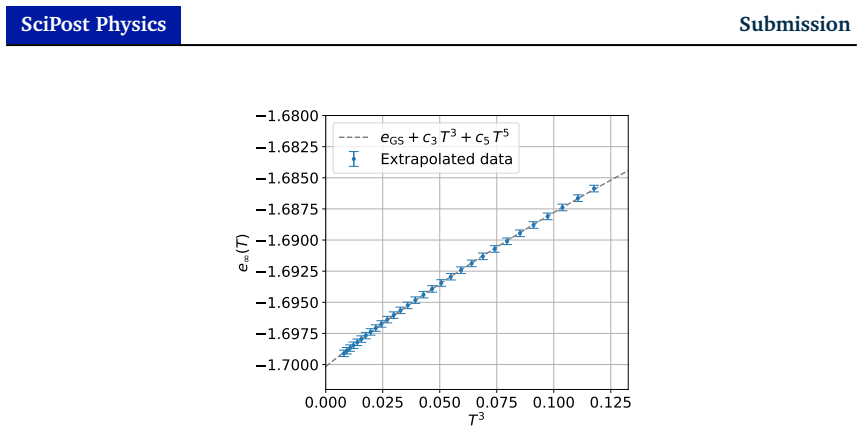
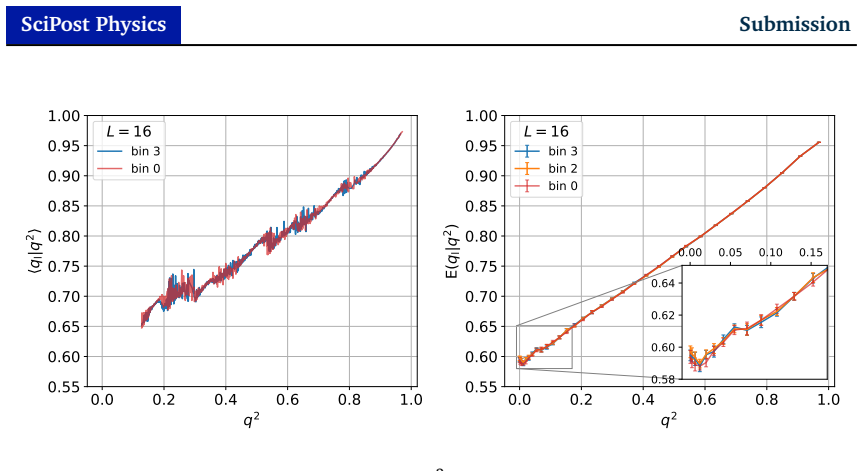
Finite-temperature Monte Carlo simulations on the three-dimensional spin glass yield smooth extrapolations to zero temperature that agree with ground-state results for energy and link overlap; the fractal dimension of the excitations is best fit by replica-symmetry breaking theory, the overlap distribution satisfies Parisi-Toulouse scaling, and the data provide a spectacular confirmation of the overlap-equivalence hypothesis.
What carries the argument
The overlap-equivalence hypothesis, which asserts that different overlap measures (spin overlap and link overlap) are equivalent for characterizing the low-energy excitations.
If this is right
- Replica-symmetry breaking supplies the correct description of low-energy excitations in the three-dimensional spin glass.
- The TNT alternative is disfavored by the measured fractal dimension.
- Different overlap definitions can be used interchangeably because of overlap equivalence.
- The Parisi-Toulouse scaling relation for the overlap distribution holds at all temperatures down to zero.
Where Pith is reading between the lines
- Finite-temperature methods may become the practical route for studying still larger systems where direct ground-state searches remain infeasible.
- The same extrapolation strategy could be tested on other disordered models where replica-symmetry breaking is conjectured.
- If overlap equivalence is general, then any convenient overlap observable can serve as a proxy in future studies of excitation structure.
Load-bearing premise
Finite-temperature Monte Carlo data can be extrapolated smoothly and without uncontrolled systematic bias to zero temperature, allowing direct comparison with ground-state results.
What would settle it
A ground-state computation on comparable or larger lattices that yields a fractal dimension of the excitations lying well outside the extrapolated confidence interval obtained from the finite-temperature data.
Figures
read the original abstract
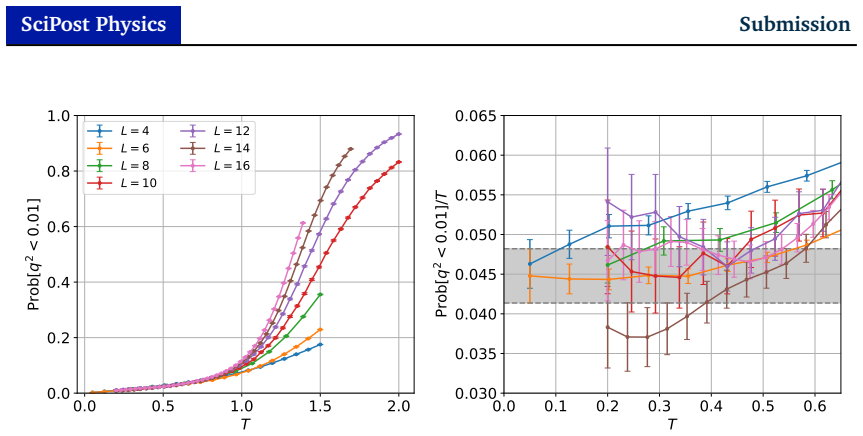
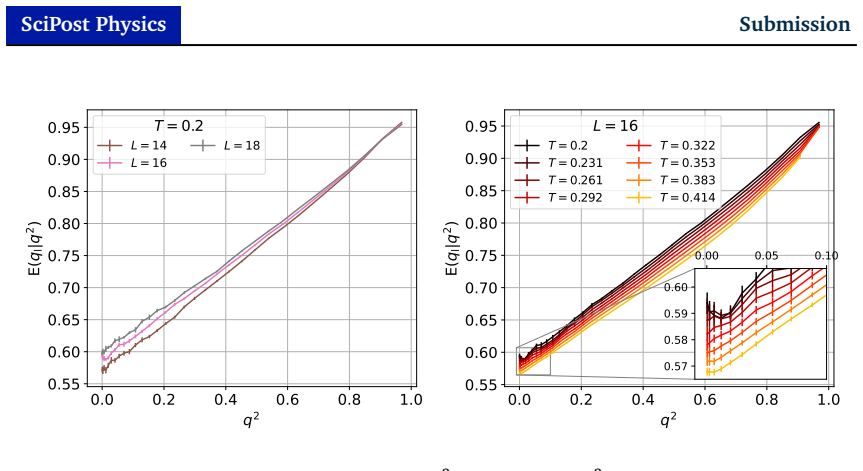
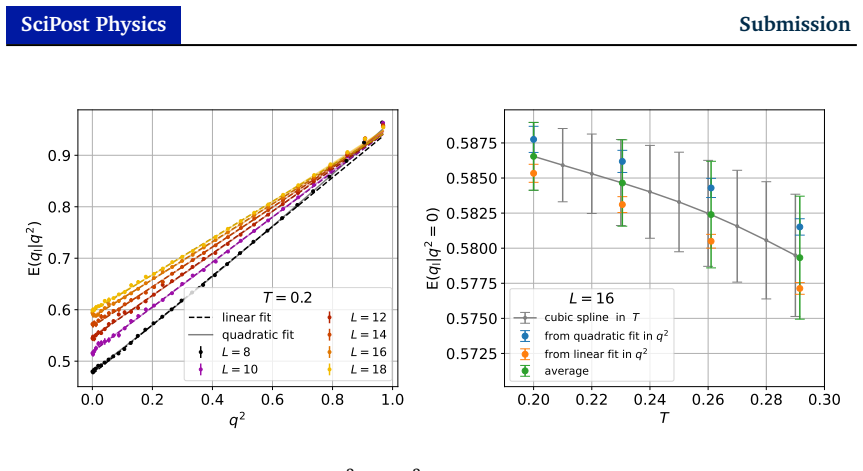
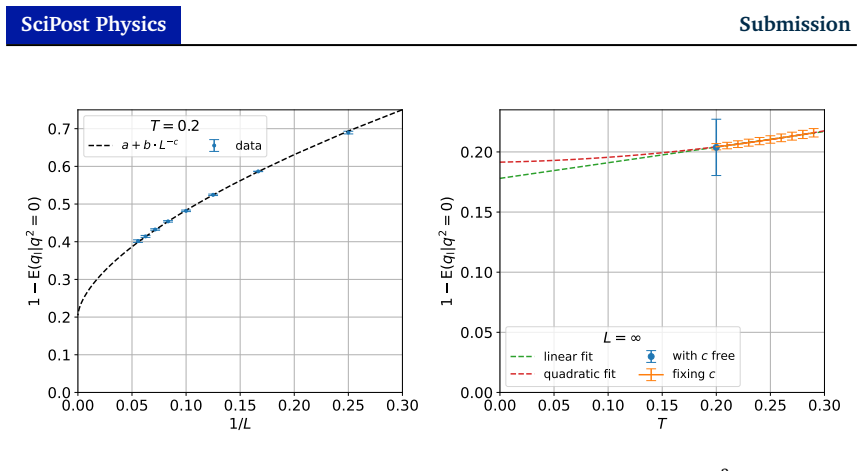
We study the low-energy excitations of the three dimensional spin glass through a large-scale Monte Carlo simulation on lattices up to $L=18$. We find smooth extrapolations down to zero temperature, which, in the case of the energy and of the link overlap, can be directly -- and favourably -- compared with previous investigations featuring ground states (i.e., at zero temperature). The best fit for the fractal dimension of the excitations is provided by Replica-Symmetry Breaking theory, but we also consider the alternative TNT description. The $P(q)$ is found to verify the Parisi-Toulouse temperature scaling. Our data provides a spectacular confirmation of the overlap-equivalence hypothesis.
Editorial analysis
A structured set of objections, weighed in public.
Referee Report
Summary. The manuscript reports large-scale Monte Carlo simulations of the three-dimensional Edwards-Anderson spin glass on lattices up to L=18. Finite-temperature data are extrapolated to T=0 for the energy, link overlap, and fractal dimension of low-energy excitations; these extrapolations are stated to be smooth and to compare favorably with prior ground-state computations. The fractal dimension is reported to be best fit by replica-symmetry-breaking (RSB) theory (with TNT also considered), the overlap distribution P(q) is found to obey Parisi-Toulouse scaling, and the results are presented as a spectacular confirmation of the overlap-equivalence hypothesis.
Significance. If the T→0 extrapolations can be shown to be free of uncontrolled systematic bias from fitting choices and sub-leading corrections, the work would supply direct numerical evidence distinguishing RSB from TNT descriptions of excitations and would strengthen the overlap-equivalence picture in three-dimensional spin glasses. The scale of the simulations (L≤18) and the explicit comparison to independent zero-temperature data are positive features that would make the result a useful benchmark if the extrapolation robustness is established.
major comments (2)
- [extrapolation procedure and fractal-dimension analysis] The central claim of a 'spectacular confirmation' of overlap equivalence and the preference for RSB over TNT rests on the T→0 extrapolations of energy, link overlap, and excitation fractal dimension. The manuscript provides no quantitative assessment of sensitivity to the choice of fitting form, possible sub-leading corrections, or consistency across independent observables (abstract and results on extrapolations).
- [fractal dimension results] The statement that RSB supplies the 'best fit' for the fractal dimension requires specification of the fitting protocol, reported χ² or equivalent goodness-of-fit metrics, and error bars on the extracted dimension so that the statistical preference over the TNT value can be evaluated (fractal-dimension results).
minor comments (2)
- The abstract would be strengthened by a brief mention of the number of disorder samples and the range of temperatures simulated.
- Notation for the link overlap and the precise definition of the excitation fractal dimension should be introduced with an equation in the methods section for clarity.
Simulated Author's Rebuttal
We thank the referee for the careful reading of our manuscript and the constructive comments. We address the major points below and will incorporate additional quantitative analyses in a revised version to strengthen the presentation of the extrapolation results.
read point-by-point responses
-
Referee: [extrapolation procedure and fractal-dimension analysis] The central claim of a 'spectacular confirmation' of overlap equivalence and the preference for RSB over TNT rests on the T→0 extrapolations of energy, link overlap, and excitation fractal dimension. The manuscript provides no quantitative assessment of sensitivity to the choice of fitting form, possible sub-leading corrections, or consistency across independent observables (abstract and results on extrapolations).
Authors: We agree that a more detailed quantitative assessment of extrapolation robustness would improve the manuscript. In the revision we will add explicit checks on the sensitivity of the T→0 limits to the choice of fitting ansatz (including forms with and without sub-leading corrections), report the variation in extrapolated values under different protocols, and demonstrate consistency of the extrapolated energy, link overlap, and fractal dimension with each other and with the independent zero-temperature data already cited. These additions will directly address concerns about uncontrolled systematic bias. revision: yes
-
Referee: [fractal dimension results] The statement that RSB supplies the 'best fit' for the fractal dimension requires specification of the fitting protocol, reported χ² or equivalent goodness-of-fit metrics, and error bars on the extracted dimension so that the statistical preference over the TNT value can be evaluated (fractal-dimension results).
Authors: We will revise the relevant section to specify the precise fitting protocol employed for the fractal dimension (including the functional form, range of system sizes, and weighting), report the χ² per degree of freedom (or equivalent metric) for both the RSB and TNT fits, and include error bars on the extracted dimension obtained from the covariance matrix of the fit. This will allow a direct statistical comparison of the two descriptions. revision: yes
Circularity Check
No significant circularity; central claims rest on direct Monte Carlo data and extrapolations
full rationale
The paper reports results from large-scale Monte Carlo simulations (L≤18) with smooth T→0 extrapolations for energy, link overlap, fractal dimension, and P(q). These are compared to prior ground-state computations and to theoretical expectations from RSB versus TNT. The 'best fit' statement is a post-hoc model comparison on simulation outputs, not a fitted parameter renamed as a prediction or a self-definitional loop. No load-bearing step reduces by construction to the paper's own inputs or to an unverified self-citation chain. The derivation chain is self-contained against external benchmarks (prior T=0 data and independent theory predictions).
Axiom & Free-Parameter Ledger
Forward citations
Cited by 1 Pith paper
-
Scalable Physics-Inspired Transformers for Spin Glasses
A physics-inspired transformer with sparse attention and FlashAttention enables up to 100x faster sampling of large spin-glass systems, providing distributions, free energies, and overlaps for SK and EA models where p...
Reference graph
Works this paper leans on
-
[1]
J. A. Mydosh, Spin Glasses: an Experimental Introduction, Taylor and Francis, London (1993)
1993
-
[2]
A. P. Young, Spin Glasses and Random Fields, World Scientific, Singapore, doi:10.1142/3517 (1998)
-
[3]
M. M \'e zard, G. Parisi and M. Virasoro, Spin-Glass Theory and Beyond, World Scientific, Singapore, doi:10.1142/0271 (1987)
-
[4]
P. Charbonneau, E. Marinari, M. M\'ezard, G. Parisi, F. Ricci-Tersenghi, G. Sicuro and F. Zamponi, eds., Spin Glass Theory and Far Beyond, World Sientific, doi:10.1142/13341 (2023)
-
[5]
E. Dahlberg, I. González-Adalid Pemartín, E. Marinari, V. Martin-Mayor, J. Moreno-Gordo, R. Orbach, I. Paga, G. Parisi, F. Ricci-Tersenghi, J. Ruiz-Lorenzo and D. Yllanes, Spin-glass dynamics: experiment, theory and simulation, Rev. Mod. Phys. 97, 045005 (2025), doi:10.1103/ctp2-zwyr
-
[6]
Parisi, Infinite number of order parameters for spin-glasses, Phys
G. Parisi, Infinite number of order parameters for spin-glasses, Phys. Rev. Lett. 43, 1754 (1979), doi:10.1103/PhysRevLett.43.1754
-
[7]
Parisi, The order parameter for spin glasses: a function on the interval 0-1, J
G. Parisi, The order parameter for spin glasses: a function on the interval 0-1, J. Phys. A: Math. Gen. 13, 1101 (1980), doi:10.1088/0305-4470/13/3/042
-
[8]
Parisi, Order parameter for spin glasses, Phys
G. Parisi, Order parameter for spin glasses, Phys. Rev. Lett. 50, 1946 (1983), doi:10.1103/PhysRevLett.50.1946
-
[9]
M. M \'e zard, G. Parisi, N. Sourlas, G. Toulouse and M. Virasoro, Nature of the spin-glass phase, Phys. Rev. Lett. 52, 1156 (1984), doi:10.1103/PhysRevLett.52.1156
-
[10]
Parisi, Nobel lecture: Multiple equilibria, Rev
G. Parisi, Nobel lecture: Multiple equilibria, Rev. Mod. Phys. 95, 030501 (2023), doi:10.1103/RevModPhys.95.030501
-
[11]
F. Guerra and F. L. Toninelli, The thermodynamic limit in mean field spin glass models, Communications in Mathematical Physics 230(1), 71 (2002), doi:10.1007/s00220-002-0699-y
-
[12]
Guerra, Broken replica symmetry bounds in the mean field spin glass model, Comm
F. Guerra, Broken replica symmetry bounds in the mean field spin glass model, Comm. Math. Phys. 233, 1 (2003), doi:10.1007/s00220-002-0773-5
-
[13]
Talagrand, The P arisi formula , Ann
M. Talagrand, The P arisi formula , Ann. of Math. 163, 221 (2006), doi:10.4007/annals.2006.163.221
-
[14]
Panchenko, The P arisi ultrametricity conjecture , Ann
D. Panchenko, The P arisi ultrametricity conjecture , Ann. of Math. 177, 383 (2013), doi:10.4007/annals.2013.177.1.8
-
[15]
D. S. Fisher and D. A. Huse, Equilibrium behavior of the spin-glass ordered phase, Phys. Rev. B 38, 386 (1988), doi:10.1103/PhysRevB.38.386
-
[16]
C. M. Newman and D. L. Stein, G round S tate E xcitations and E nergy F luctuations in S hort- R ange S pin G lasses , Unpublished (2025), arXiv:2510.27507 https://arxiv.org/abs/2510.27507
Pith/arXiv arXiv 2025
-
[17]
W. L. McMillan, S caling theory of I sing spin glasses , J. Phys. C: Solid State Phys. 17, 3179 (1984), doi:10.1088/0022-3719/17/18/010
-
[18]
A. J. Bray and M. A. Moore, Scaling theory of the ordered phase of spin glasses, In J. L. van Hemmen and I. Morgenstern, eds., Heidelberg Colloquium on Glassy Dynamics, no. 275 in Lecture Notes in Physics. Springer, Berlin (1987)
1987
-
[19]
C. M. Newman and D. L. Stein, Multiple states and thermodynamic limits in short-ranged ising spin-glass models, Phys. Rev. B 46, 973 (1992), doi:10.1103/PhysRevB.46.973
-
[20]
C. M. Newman and D. L. Stein, Spatial inhomogeneity and thermodynamic chaos, Phys. Rev. Lett. 76, 4821 (1996), doi:10.1103/PhysRevLett.76.4821
-
[21]
C. M. Newman and D. L. Stein, Metastate approach to thermodynamic chaos, Phys. Rev. E 55, 5194 (1997), doi:10.1103/PhysRevE.55.5194
-
[22]
C. M. Newman and D. L. Stein, Simplicity of state and overlap structure in finite-volume realistic spin glasses, Phys. Rev. E 57, 1356 (1998), doi:10.1103/PhysRevE.57.1356
-
[23]
M. Aizenman and J. Wehr, Rounding effects of quenched randomness on first-order phase transitions, Communications in Mathematical Physics 130(3), 489 (1990), doi:10.1007/BF02096933
-
[24]
F. Krzakala and O. C. Martin, Spin and link overlaps in three-dimensional spin glasses, Phys. Rev. Lett. 85, 3013 (2000), doi:10.1103/PhysRevLett.85.3013
-
[25]
M. Palassini and A. P. Young, Nature of the spin glass state, Phys. Rev. Lett. 85, 3017 (2000), doi:10.1103/PhysRevLett.85.3017
-
[26]
C. M. Newman and D. L. Stein, Ground-state stability and the nature of the spin glass phase, Phys. Rev. E 105, 044132 (2022), doi:10.1103/PhysRevE.105.044132
-
[27]
N. Read, Short-range ising spin glasses: The metastate interpretation of replica symmetry breaking, Phys. Rev. E 90, 032142 (2014), doi:10.1103/PhysRevE.90.032142
-
[28]
L.-P. Arguin, C. M. Newman and D. L. Stein, Thermodynamic identities and symmetry breaking in short-range spin glasses, Phys. Rev. Lett. 115, 187202 (2015), doi:10.1103/PhysRevLett.115.187202
-
[29]
C. M. Newman and D. L. Stein, Critical droplets and replica symmetry breaking, Front. Phys. 12, 1473378 (2024), doi:10.3389/fphy.2024.1473378
-
[30]
A. Billoire, L. A. Fernandez, A. Maiorano, E. Marinari, V. Martin-Mayor, J. Moreno-Gordo, G. Parisi, F. Ricci-Tersenghi and J. J. Ruiz-Lorenzo, Numerical construction of the A izenman- W ehr metastate , Phys. Rev. Lett. 119, 037203 (2017), doi:10.1103/PhysRevLett.119.037203
-
[31]
Q. Zhai, V. Martin-Mayor, D. L. Schlagel, G. G. Kenning and R. L. Orbach, Slowing down of spin glass correlation length growth: Simulations meet experiments, Phys. Rev. B 100, 094202 (2019), doi:10.1103/PhysRevB.100.094202
-
[32]
I. Paga, J. He, M. Baity-Jesi, E. Calore, A. Cruz, L. A. Fernandez, J. M. Gil-Narvion, I. Gonzalez-Adalid Pemartin, A. Gordillo-Guerrero, D. I\ niguez, A. Maiorano, E. Marinari et al., Quantifying memory in spin glasses, Phys. Rev. Lett. 133, 256704 (2024), doi:10.1103/PhysRevLett.133.256704
-
[33]
M. Shen, G. Ortiz, Y.-Y. Liu, M. Weigel and Z. Nussinov, Universal fragility of spin glass ground states under single bond changes, Phys. Rev. Lett. 132, 247101 (2024), doi:10.1103/PhysRevLett.132.247101
-
[34]
E. Marinari and G. Parisi, Effects of a bulk perturbation on the ground state of 3d ising spin glasses, Phys. Rev. Lett. 86, 3887 (2001), doi:10.1103/PhysRevLett.86.3887
-
[35]
E. Marinari and G. Parisi, Effects of changing the boundary conditions on the ground state of ising spin glasses, Phys. Rev. B 62, 11677 (2000), doi:10.1103/PhysRevB.62.11677
-
[36]
P. Contucci, C. Giardin\`a, C. Giberti and C. Vernia, Overlap equivalence in the edwards-anderson model, Phys. Rev. Lett. 96, 217204 (2006), doi:10.1103/PhysRevLett.96.217204
-
[37]
R. Alvarez Ba \ n os, A. Cruz, L. A. Fernandez, J. M. Gil-Narvion, A. Gordillo-Guerrero, M. Guidetti, A. Maiorano, F. Mantovani, E. Marinari, V. Mart\' i n-Mayor, J. Monforte-Garcia, A. Mu \ n oz Sudupe et al., Nature of the spin-glass phase at experimental length scales, J. Stat. Mech. 2010, P06026 (2010), doi:10.1088/1742-5468/2010/06/P06026
-
[38]
M. Palassini, F. Liers, M. Juenger and A. P. Young, Low-energy excitations in spin glasses from exact ground states, Phys. Rev. B 68, 064413 (2003), doi:10.1103/PhysRevB.68.064413
-
[39]
H. G. Katzgraber, M. Palassini and A. P. Young, Monte carlo simulations of spin glasses at low temperatures, Phys. Rev. B 63, 184422 (2001), doi:10.1103/PhysRevB.63.184422
-
[40]
G. Parisi and G. Toulouse, A simple hypothesis for the spin glass phase of the infinite-ranged SK model , Journal de Physique Lettres 41(15), L361 (1980), doi:10.1051/jphyslet:019800041015036100
-
[41]
E. Marinari, G. Parisi and J. J. Ruiz-Lorenzo, Low T dynamical properties of spin glasses smoothly extrapolate to T = 0 , Journal of Physics A: Mathematical and General 35(32), 6805 (2002), doi:10.1088/0305-4470/35/32/303
-
[42]
M. Baity-Jesi, R. A. Ba\ n os, A. Cruz, L. A. Fernandez, J. M. Gil-Narvion, A. Gordillo-Guerrero, D. Iniguez, A. Maiorano, F. Mantovani, E. Marinari, V. Mart\' i n-Mayor, J. Monforte-Garcia et al., Janus II : a new generation application-driven computer for spin-system simulations , Comp. Phys. Comm 185, 550 (2014), doi:10.1016/j.cpc.2013.10.019
-
[43]
J. Houdayer, A cluster monte carlo algorithm for 2-dimensional spin glasses, The European Physical Journal B - Condensed Matter and Complex Systems 22(4), 479 (2001), doi:10.1007/PL00011151
-
[44]
Z. Zhu, A. J. Ochoa and H. G. Katzgraber, Efficient cluster algorithm for spin glasses in any space dimension, Phys. Rev. Lett. 115, 077201 (2015), doi:10.1103/PhysRevLett.115.077201
-
[45]
C. Chilin, E. Marinari, V. Martín-Mayor, G. Parisi, J. J. Ruiz-Lorenzo and D. Yllanes, Cluster moves with an entropic reservoir accelerate low-temperature simulations of three-dimensional spin glasses (2026), arXiv:2605.25872 https://arxiv.org/abs/2605.25872
Pith/arXiv arXiv 2026
-
[46]
S. F. Edwards and P. W. Anderson, Theory of spin glasses, Journal of Physics F: Metal Physics 5, 965 (1975), doi:10.1088/0305-4608/5/5/017
-
[47]
S. F. Edwards and P. W. Anderson, Theory of spin glasses. II , J. Phys. F 6(10), 1927 (1976), doi:10.1088/0305-4608/6/10/022
-
[48]
E. Marinari, G. Parisi and J. J. Ruiz-Lorenzo, Phase structure of the three-dimensional E dwards- A nderson spin glass , Phys. Rev. B 58, 14852 (1998), doi:10.1103/PhysRevB.58.14852
-
[49]
M. Baity-Jesi, R. A. Ba\ n os, A. Cruz, L. A. Fernandez, J. M. Gil-Narvion, A. Gordillo-Guerrero, D. Iniguez, A. Maiorano, F. Mantovani, E. Marinari, V. Mart\' i n-Mayor, J. Monforte-Garcia et al., Critical parameters of the three-dimensional I sing spin glass , Phys. Rev. B 88, 224416 ( 2013 ), doi:10.1103/PhysRevB.88.224416
-
[50]
L. A. Fern\'andez, V. Martin-Mayor, G. Parisi and B. Seoane, Spin glasses on the hypercube, Phys. Rev. B 81, 134403 (2010), doi:10.1103/PhysRevB.81.134403
-
[51]
A. Bray and M. Moore, Metastable states in spin glasses, Journal of Physics C: Solid State Physics 13(19), L469 (1980), doi:10.1088/0022-3719/13/19/002
-
[52]
K. Hukushima and K. Nemoto, E xchange M onte C arlo method and application to spin glass simulations , J. Phys. Soc. Japan 65, 1604 (1996), doi:10.1143/JPSJ.65.1604
-
[53]
Marinari, O ptimized M onte C arlo methods , In J
E. Marinari, O ptimized M onte C arlo methods , In J. Kerst\'esz and I. Kondor, eds., Advances in Computer Simulation. Springer-Verlag, doi:10.1007/BFb0105459 (1998)
-
[54]
E. Marinari, G. Parisi, F. Ricci-Tersenghi, J. J. Ruiz-Lorenzo and F. Zuliani, Replica symmetry breaking in short-range spin glasses: Theoretical foundations and numerical evidences, J. Stat. Phys. 98, 973 (2000), doi:10.1023/A:1018607809852
-
[55]
Yllanes, Rugged Free-Energy Landscapes in Disordered Spin Systems, Ph.D
D. Yllanes, Rugged Free-Energy Landscapes in Disordered Spin Systems, Ph.D. thesis, Universidad Complutense de Madrid (2011), arXiv:1111.0266 https://arxiv.org/abs/1111.0266
Pith/arXiv arXiv 2011
-
[56]
W. H. Press, S. A. Teukolsky, W. T. Vetterling and B. P. Flannery, Numerical Recipes in C, Cambridge University Press, Cambridge, second edn. (1992)
1992
-
[57]
K. F. Pál, The ground state of the cubic spin glass with short-range interactions of gaussian distribution, Physica A: Statistical Mechanics and its Applications 233(1), 60 (1996), doi:10.1016/S0378-4371(96)00241-5
-
[58]
F. Romá, S. Risau-Gusman, A. Ramirez-Pastor, F. Nieto and E. Vogel, The ground state energy of the edwards–anderson spin glass model with a parallel tempering monte carlo algorithm, Physica A: Statistical Mechanics and its Applications 388(14), 2821 (2009), doi:10.1016/j.physa.2009.03.036
-
[59]
S. Boettcher, Physics of the edwards–anderson spin glass in dimensions d = 3, … ,8 from heuristic ground state optimization, Frontiers in Physics Volume 12 - 2024 (2024), doi:10.3389/fphy.2024.1466987
-
[60]
D. J. Thouless, P. W. Anderson and R. G. Palmer, Solution of 'solvable model of a spin glass', Phil. Mag. 35(3), 593 (1977), doi:10.1080/14786437708235992
-
[61]
Parisi, Toward a mean field theory for spin glasses, Phys
G. Parisi, Toward a mean field theory for spin glasses, Phys. Lett. 73A, 203 (1979), doi:10.1016/0375-9601(79)90708-4
-
[62]
H. G. Katzgraber and F. Krzakala, Temperature and disorder chaos in three-dimensional ising spin glasses, Phys. Rev. Lett. 98, 017201 (2007), doi:10.1103/PhysRevLett.98.017201
-
[63]
M. Bernaschi, C. Chilin, L. A. Fernandez, I. González-Adalid Pemartín, E. Marinari, V. Martin-Mayor, G. Parisi, F. Ricci-Tersenghi, J. J. Ruiz-Lorenzo and D. Yllanes, Microcanonical simulated annealing: Massively parallel monte carlo simulations with sporadic random-number generation, Comp. Phys. Comm. 325, 110182 (2026), doi:10.1016/j.cpc.2026.110182
discussion (0)
Sign in with ORCID, Apple, or X to comment. Anyone can read and Pith papers without signing in.