Elucidating the Control of Circular Dichroism in Ion Yield via Chirped Pulses with Purposeful Models
Pith reviewed 2026-06-27 20:14 UTC · model grok-4.3
The pith
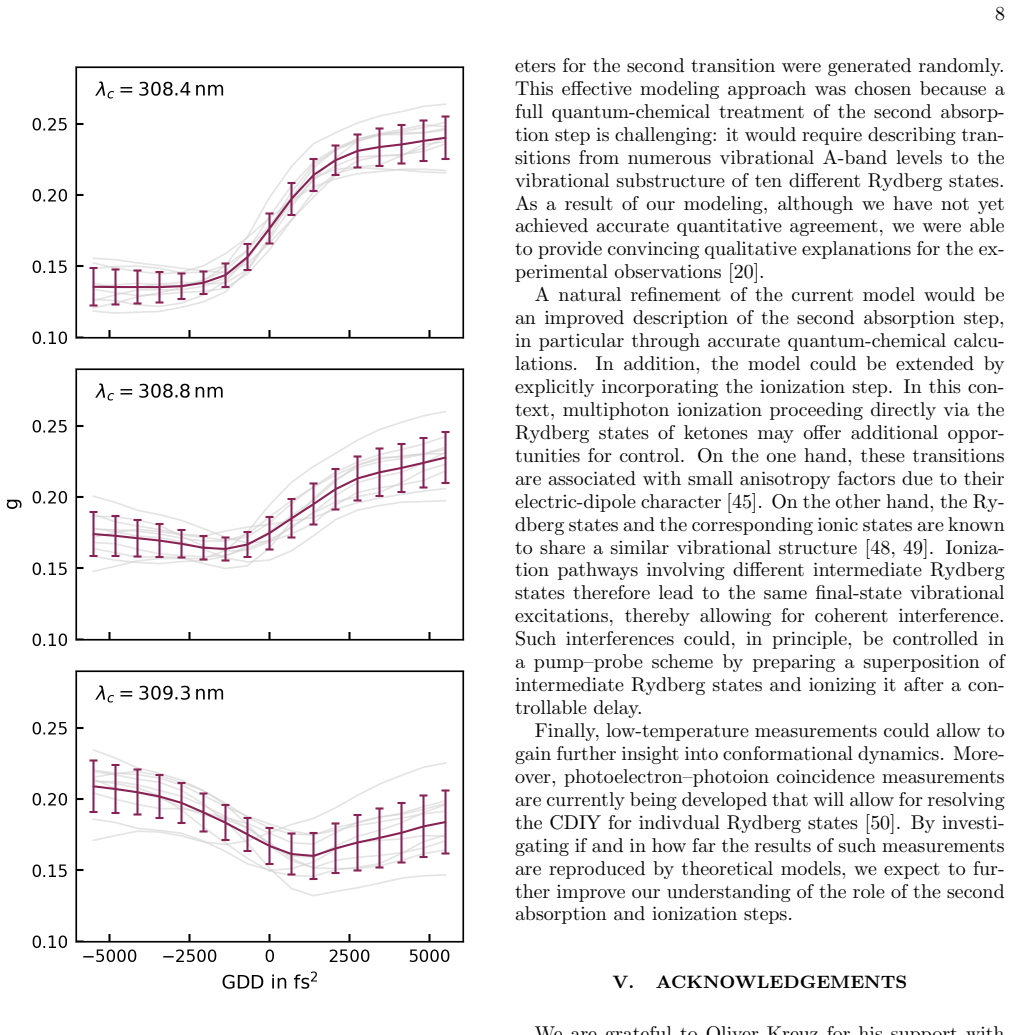
The interplay between the first and second absorption steps accounts for the chirp dependence of anisotropy in the ion yield of 3-methylcyclopentanone.
A machine-rendered reading of the paper's core claim, the machinery that carries it, and where it could break.
Core claim
Within the framework that treats the A-band transition via state-of-the-art quantum-chemical calculations and the second absorption step via an effective model, the interplay between the first and second absorption steps is identified as the key explanation for the experimentally observed chirp dependence of the anisotropy in the ion yield.
What carries the argument
Numerical solution of the time-dependent Schrödinger equation that couples a quantum-chemical description of the first absorption step to an effective model of the second absorption step into Rydberg states.
If this is right
- The observed anisotropy variation with chirp arises directly from the combined action of the two absorption steps rather than from either step alone.
- Pulse chirp can be used to modulate the circular dichroism signal in the final ion yield through this interplay.
- Control schemes for chiral molecules can be refined by targeting the relative timing and spectral content of the first and second photon absorption events.
- The effective-model approach allows systematic exploration of chirp effects without requiring a complete ab initio treatment of every intermediate state.
Where Pith is reading between the lines
- Similar chirp-dependent control may appear in other chiral molecules that undergo stepwise ionization through Rydberg manifolds.
- Extending the effective model to include additional Rydberg channels could test whether the identified interplay remains dominant at higher pulse intensities.
- Time-resolved detection of intermediate-state populations would provide a direct experimental test of the proposed mechanism.
- The same modeling strategy could be applied to molecules where the second step involves different electronic symmetries to check generality of the chirp effect.
Load-bearing premise
The effective model for the second absorption step captures the relevant Rydberg-state dynamics and transition strengths.
What would settle it
A calculation or measurement that tracks population in specific Rydberg states after the second absorption step and finds a chirp dependence that differs from the model's prediction would falsify the claimed mechanism.
Figures
read the original abstract
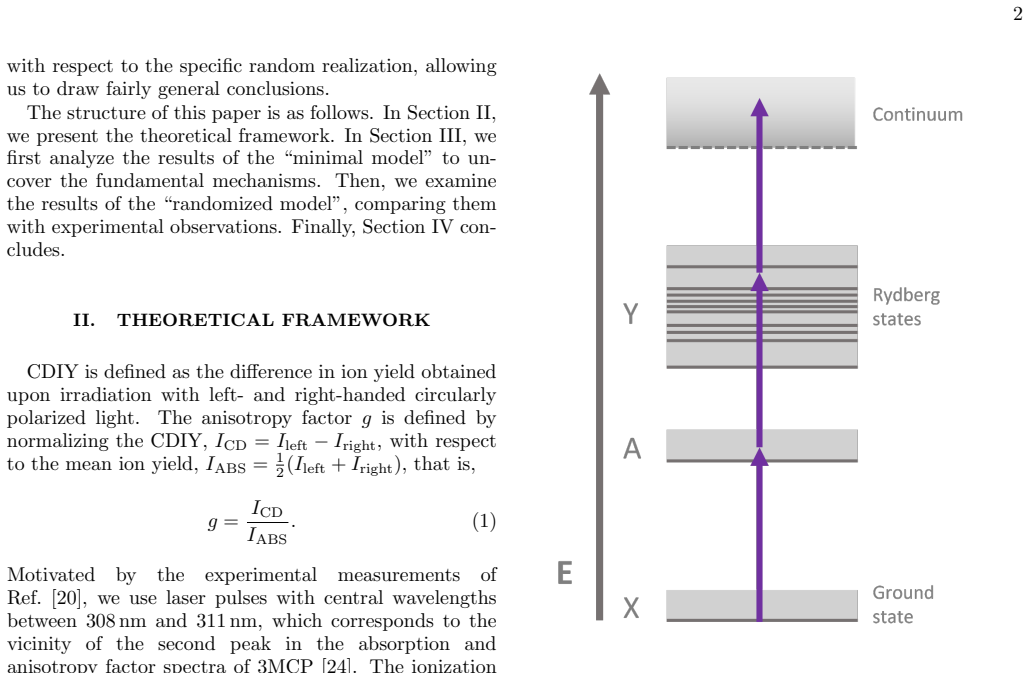
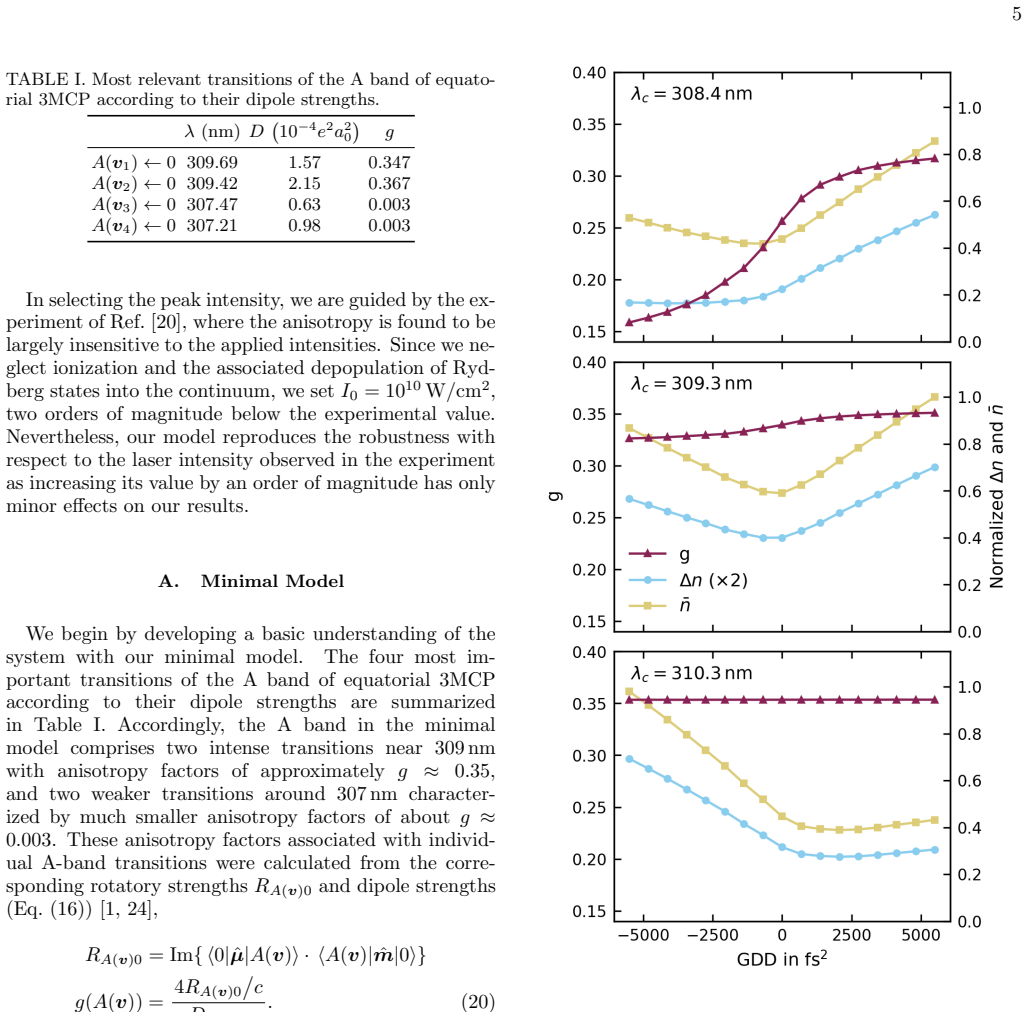
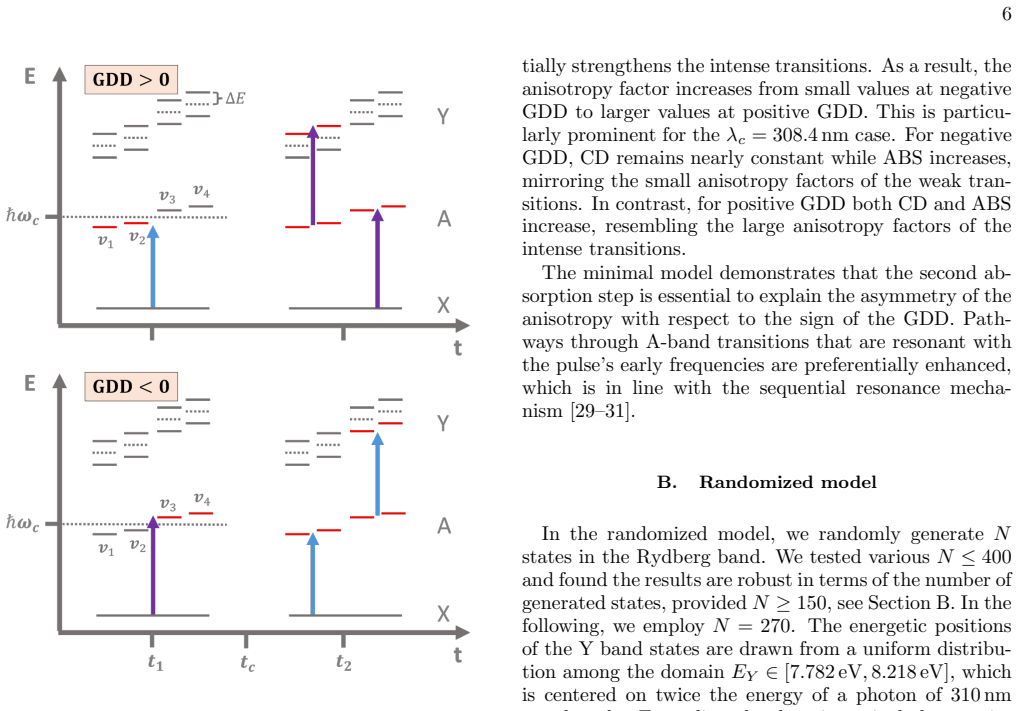
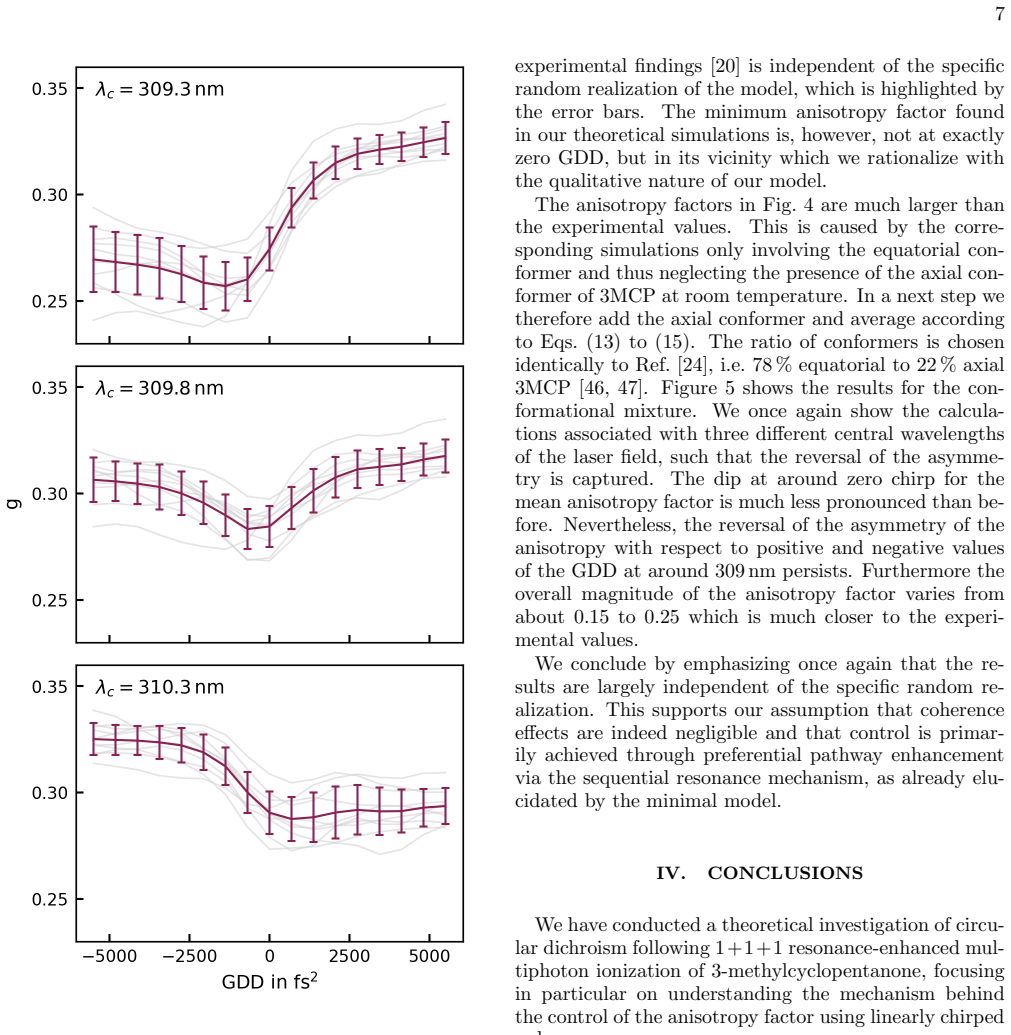
We theoretically investigate circular dichroism in the ion yield following $1+1+1$ ionization of 3-methylcyclopentanone using femtosecond linearly chirped laser pulses, inspired by recent experiments by Das et al. [Phys. Chem. Chem. Phys. 27, 8043 (2025)]. To this end, we numerically solve the time-dependent Schr\"odinger equation and evaluate the total population in the Rydberg states at the end of the second absorption step. The A-band transition in the first absorption step is treated using state-of-the-art quantum-chemical calculations, whereas the second absorption step is described via an effective model. Within our framework, we identify the interplay between the first and second absorption step as the key explanation for the experimentally observed chirp dependence of the anisotropy. By elucidating this mechanism for the chirp-enhanced signal, our findings contribute towards the development of improved control schemes for chiral molecules.
Editorial analysis
A structured set of objections, weighed in public.
Referee Report
Summary. The manuscript theoretically investigates circular dichroism in the ion yield following 1+1+1 ionization of 3-methylcyclopentanone with linearly chirped femtosecond pulses. It solves the TDSE, using state-of-the-art quantum-chemical calculations for the A-band first absorption step and an effective model for the second absorption step to Rydberg states. The central claim is that the interplay between the first and second steps explains the experimentally observed chirp dependence of the anisotropy.
Significance. If the effective model is shown to be faithful, the work would provide a mechanistic account of chirp-enhanced chiral selectivity, supporting the development of improved control schemes. The quantum-chemical treatment of the first step is a positive feature.
major comments (2)
- [Methods (effective model for second absorption step)] The effective model for the second absorption step lacks any quantitative validation of transition strengths, detunings, or Rydberg dynamics against ab initio matrix elements or known experimental lifetimes. This unquantified uncertainty directly affects the load-bearing claim that the interplay between steps is the origin of the chirp dependence.
- [Results and discussion] No quantitative results, error bars, or direct comparison to the Das et al. experiment are presented to support the extracted mechanism; the abstract and framework description provide only a qualitative attribution.
minor comments (1)
- The abstract would be strengthened by inclusion of at least one key numerical result or uncertainty estimate.
Simulated Author's Rebuttal
We thank the referee for their careful reading of the manuscript and for highlighting these important points regarding the effective model and the presentation of results. We address each major comment below.
read point-by-point responses
-
Referee: [Methods (effective model for second absorption step)] The effective model for the second absorption step lacks any quantitative validation of transition strengths, detunings, or Rydberg dynamics against ab initio matrix elements or known experimental lifetimes. This unquantified uncertainty directly affects the load-bearing claim that the interplay between steps is the origin of the chirp dependence.
Authors: We agree that additional justification of the effective model is warranted. The parameters are chosen to reproduce known experimental Rydberg energies, quantum defects, and approximate lifetimes from the literature on cyclopentanone and related ketones; however, the current manuscript does not explicitly tabulate these choices or test robustness. In the revised version we will add a dedicated methods subsection that lists the adopted transition moments, detunings, and decay rates with their literature sources, together with a brief sensitivity study showing that the sign and chirp dependence of the anisotropy remain stable under reasonable (±30 %) variations of the key parameters. revision: yes
-
Referee: [Results and discussion] No quantitative results, error bars, or direct comparison to the Das et al. experiment are presented to support the extracted mechanism; the abstract and framework description provide only a qualitative attribution.
Authors: The manuscript’s central result is the identification of the two-step interplay as the origin of the observed chirp dependence; this is demonstrated by the TDSE population dynamics rather than by a numerical fit to experiment. We nevertheless accept that a more quantitative presentation would be helpful. The revised manuscript will include (i) plots of the computed anisotropy parameter versus chirp rate with shaded bands reflecting the parameter uncertainty established in the new sensitivity analysis, and (ii) a direct overlay of the simulated and experimental anisotropy trends (with appropriate scaling) to make the level of agreement explicit. revision: yes
Circularity Check
No significant circularity; derivation is self-contained
full rationale
The paper numerically solves the TDSE for 1+1+1 ionization, treating the A-band first step with external quantum-chemical calculations and the second step with an effective model, then attributes the chirp dependence of anisotropy to their interplay. No equations, fitted parameters, or predictions are shown to reduce by construction to the inputs (e.g., no self-definitional ratios or fitted quantities renamed as predictions). The cited experiment (Das et al.) is external, and no self-citation chains or uniqueness theorems from the authors are invoked to justify the central claim. The framework therefore rests on independent numerical propagation and external data rather than tautological reduction.
Axiom & Free-Parameter Ledger
Reference graph
Works this paper leans on
-
[1]
Minimal model In the minimal model, we restrict ourselves to the four most intense A band vibronic transitions of equatorial 3MCP. The intensity of the transitions is quantified by their dipole strength, DA(v)0 =| ⟨A(v)| ˆµ|0⟩|2 + 1 c2 | ⟨A(v)| ˆm|0⟩|2.(16) The Y band is represented by twice as many states as the A band and each A band state is independen...
-
[2]
minimal model
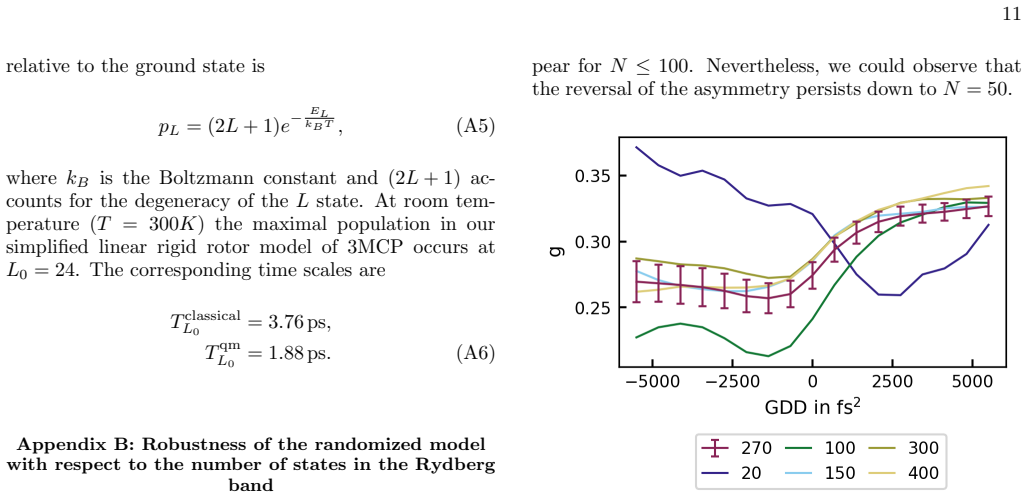
Randomized model In the randomized model, we include all A-band transi- tions, whose intensity according to their dipole strength, see Eq. (16), is at least 0.1 % compared to the strongest transition. The Y band is represented byNstates, for which we randomly generate the energetic positions as well as the electric transition matrix elements from a uni- f...
-
[3]
Nakanishi, N
K. Nakanishi, N. Berova, and R. W. Woody,Circular dichroism : principles and applications(VCH, New York, NY u.a, 1994)
1994
-
[4]
Kuhn, The physical significance of optical rotatory power, Trans
W. Kuhn, The physical significance of optical rotatory power, Trans. Faraday Soc.26, 293 (1930). 9
1930
-
[5]
Berova, L
N. Berova, L. Di Bari, and G. Pescitelli, Application of electronic circular dichroism in configurational and con- formational analysis of organic compounds, Chem. Soc. Rev.36, 914 (2007)
2007
-
[6]
Franck and E
J. Franck and E. G. Dymond, Elementary processes of photochemical reactions, Trans. Faraday Soc.21, 536 (1926)
1926
-
[7]
Condon, A theory of intensity distribution in band systems, Phys
E. Condon, A theory of intensity distribution in band systems, Phys. Rev.28, 1182 (1926)
1926
-
[8]
E. U. Condon, Nuclear motions associated with electron transitions in diatomic molecules, Phys. Rev.32, 858 (1928)
1928
-
[9]
Herzberg and E
G. Herzberg and E. Teller, Schwingungsstruktur der elek- tronen¨ uberg¨ ange bei mehratomigen molek¨ ulen, Z. Phys. Chem.21B, 410 (1933)
1933
-
[10]
Moffitt and A
W. Moffitt and A. Moscowitz, Optical activity in absorb- ing media, J. Chem. Phys.30, 648 (1959)
1959
-
[11]
O. E. Weigang, Jr., Vibrational Structuring in Circular Dichroism, J. Chem. Phys.42, 2244 (1965)
1965
-
[12]
P. W. Atkins and R. S. Friedman,Molecular Quantum Mechanics, 3rd ed. (Oxford University Press, Oxford, 1997)
1997
-
[13]
Boesl von Grafenstein and A
U. Boesl von Grafenstein and A. Bornschlegl, Circular dichroism laser mass spectrometry: Differentiation of 3- methylcyclopentanone enantiomers, ChemPhysChem7, 2085 (2006)
2085
-
[14]
R. Li, R. Sullivan, W. Al-Basheer, R. M. Pagni, and R. N. Compton, Linear and nonlinear circular dichroism of R-(+)-3-methylcyclopentanone, J. Chem. Phys.125, 144304 (2006)
2006
-
[15]
Bornschlegl, C
A. Bornschlegl, C. Log´ e, and U. Boesl, Investigation of CD effects in the multi photon ionisation of R-(+)- 3-methylcyclopentanone, Chem. Phys. Lett.447, 187 (2007)
2007
-
[16]
Log´ e, A
C. Log´ e, A. Bornschlegl, and U. Boesl, Progress in cir- cular dichroism laser mass spectrometry, Anal. Bioanal. Chem.395, 1631 (2009)
2009
-
[17]
H. G. Breunig, G. Urbasch, P. Horsch, J. Cordes, U. Ko- ert, and K.-M. Weitzel, Circular dichroism in ion yields of femtosecond-laser mass spectrometry, ChemPhysChem 10, 1199 (2009)
2009
-
[18]
Boesl, A
U. Boesl, A. Bornschlegl, C. Log´ e, and K. Titze, Resonance-enhanced multiphoton ionization with circu- larly polarized light: chiral carbonyls, Anal. Bioanal. Chem.405, 6913 (2013)
2013
-
[19]
Titze, T
K. Titze, T. Zollitsch, U. Heiz, and U. Boesl, Laser mass spectrometry with circularly polarized light: Circular dichroism of cold molecules in a supersonic gas beam, ChemPhysChem15, 2762 (2014)
2014
-
[20]
T. Ring, C. Witte, S. Vasudevan, S. Das, S. T. Ra- necky, H. Lee, N. Ladda, A. Senftleben, H. Braun, and T. Baumert, Self-referencing circular dichroism ion yield measurements for improved statistics using femtosecond laser pulses, Rev. Sci. Instrum.92, 033001 (2021)
2021
-
[21]
Horsch, G
P. Horsch, G. Urbasch, K.-M. Weitzel, and D. Kr¨ oner, Circular dichroism in ion yields employing femtosecond laser ionization—the role of laser pulse duration, Phys. Chem. Chem. Phys.13, 2378 (2011)
2011
-
[22]
S. Das, J. Ghosh, S. Vasudevan, S. T. Ranecky, T. Rosen, N. Ladda, H.-g. Lee, T.-J. Stehling, F. Westmeier, J. Mikosch, A. Senftleben, T. Baumert, and H. Braun, Control of circular dichroism in ion yield of 3-methyl cy- clopentanone with femtosecond laser pulses, Phys. Chem. Chem. Phys.27, 8043 (2025)
2025
-
[23]
N. Lin, F. Santoro, X. Zhao, A. Rizzo, and V. Barone, Vi- bronically resolved electronic circular dichroism spectra of R-(+)-3-methylcyclopentanone: A theoretical study, J. Phys. Chem. A112, 12401 (2008)
2008
-
[24]
Feinleib and F
S. Feinleib and F. A. Bovey, Vapour-phase vacuum- ultraviolet circular-dichroism spectrum of (+)-3- methylcyclopentanone, Chem. Commun., 978 (1968)
1968
-
[25]
H. P. J. M. Dekkers and L. E. Closs, The optical activity of low-symmetry ketones in absorption and emission, J. Am. Chem. Soc.98, 2210 (1976)
1976
-
[26]
L. A. Kerber, O. Kreuz, T. Ring, H. Braun, R. Berger, and D. M. Reich, Anisotropy Factor Spectra for Weakly Allowed Electronic Transitions in Chiral Ke- tones, ChemPhysChem26, e202400898 (2025)
2025
-
[27]
D. W. Urry, Optical rotation, Annu. Rev Phys. Chem. 19, 477 (1968)
1968
-
[28]
Kr¨ oner, Chiral distinction by ultrashort laser pulses: Electron wavepacket dynamics incorporating magnetic interactions, J
D. Kr¨ oner, Chiral distinction by ultrashort laser pulses: Electron wavepacket dynamics incorporating magnetic interactions, J. Phys. Chem. A115, 14510 (2011)
2011
-
[29]
Mondelo-Martell, D
M. Mondelo-Martell, D. Basilewitsch, H. Braun, C. P. Koch, and D. M. Reich, Increasing ion yield circular dichroism in femtosecond photoionisation using opti- mal control theory, Phys. Chem. Chem. Phys.24, 9286 (2022)
2022
-
[30]
Mondelo-Martell, L
M. Mondelo-Martell, L. A. Kerber, D. Basilewitsch, H. Braun, C. P. Koch, and D. M. Reich, Correction: In- creasing ion yield circular dichroism in femtosecond pho- toionisation using optimal control theory, Phys. Chem. Chem. Phys.25, 24163 (2023)
2023
-
[31]
J. Cao, J. Che, and K. R. Wilson, Intrapulse Dynamical Effects in Multiphoton Processes: Theoretical Analysis, J. Phys. Chem. A102, 4284 (1998)
1998
-
[32]
V. V. Yakovlev, C. J. Bardeen, J. Che, J. Cao, and K. R. Wilson, Chirped pulse enhancement of multiphoton ab- sorption in molecular iodine, J. Chem. Phys.108, 2309 (1998)
1998
-
[33]
Balling, D
P. Balling, D. J. Maas, and L. D. Noordam, Interference in climbing a quantum ladder system with frequency- chirped laser pulses, Phys. Rev. A50, 4276 (1994)
1994
-
[34]
M. Krug, T. Bayer, M. Wollenhaupt, C. Sarpe-Tudoran, T. Baumert, S. S. Ivanov, and N. V. Vitanov, Coherent strong-field control of multiple states by a single chirped femtosecond laser pulse, New J. Phys.11, 105051 (2009)
2009
-
[35]
Plenge, A
J. Plenge, A. Wirsing, C. Raschpichler, M. Meyer, and E. R¨ uhl, Chirped pulse multiphoton ionization of ni- trogen: Control of selective rotational excitation in N+ 2 (B2Σ+ u ), J. Chem. Phys.130, 244313 (2009)
2009
-
[36]
M. E. Casida, C. Jamorski, K. C. Casida, and D. R. Salahub, Molecular excitation energies to high-lying bound states from time-dependent density-functional re- sponse theory: Characterization and correction of the time-dependent local density approximation ionization threshold, J. Chem. Phys.108, 4439 (1998)
1998
-
[37]
R. E. Goetz, T. A. Isaev, B. Nikoobakht, R. Berger, and C. P. Koch, Theoretical description of circular dichro- ism in photoelectron angular distributions of randomly oriented chiral molecules after multi-photon photoioniza- tion, J. Chem. Phys.146, 024306 (2017)
2017
-
[38]
J. ˇSmydke, Using Koopmans’ theorem for constructing basis sets: approaching high Rydberg excited states of lithium with a compact Gaussian basis, Physical Chem- istry Chemical Physics25, 20250 (2023)
2023
-
[39]
Creutzberg, W
J. Creutzberg, W. Skomorowski, and T.-C. Jagau, Com- puting Decay Widths of Autoionizing Rydberg States 10 with Complex-Variable Coupled-Cluster Theory, The Journal of Physical Chemistry Letters14, 10943 (2023)
2023
-
[40]
O’Toole, P
L. O’Toole, P. Brint, C. Kosmidis, G. Boulakis, and A. Bolovinos, Vacuum ultraviolet absorption spectra of methyl-substituted cyclopentanones and cyclohexanones, J. Chem. Soc., Faraday Trans.88, 1237 (1992)
1992
-
[41]
Wollenhaupt, A
M. Wollenhaupt, A. Assion, and T. Baumert,Springer Handbook of Lasers and Optics, edited by F. Tr¨ ager, Springer Handbooks (Springer Berlin Heidelberg, 2012) pp. 1047–1094
2012
-
[42]
Li, Microwave spectrum, dipole moment, and con- formation of 3-methylcyclopentanone, J
Y.-S. Li, Microwave spectrum, dipole moment, and con- formation of 3-methylcyclopentanone, J. Mol. Spectrosc. 104, 302 (1984)
1984
-
[43]
B. W. Shore,Manipulating quantum structures using laser pulses(Cambridge University Press, Cambridge, 2011)
2011
-
[44]
QDYN Library,https://www.qdyn-library.net/
-
[45]
V. I. Lebedev and D. N. Laikov, A quadrature formula for the sphere of the 131st algebraic order of accuracy, Dokl. Math.59, 477 (1999)
1999
-
[46]
Blech, R
A. Blech, R. M. M. Ebeling, M. Heger, C. P. Koch, and D. M. Reich, Numerical evaluation of orientation aver- ages and its application to molecular physics, J. Chem. Phys.161, 131501 (2024)
2024
-
[47]
F. Pulm, J. Schramm, J. Hormes, S. Grimme, and S. D. Peyerimhoff, Theoretical and experimental investigations of the electronic circular dichroism and absorption spec- tra of bicyclic ketones, Chem. Phys.224, 143 (1997)
1997
-
[48]
J. He, A. G. Petrovic, and P. L. Polavarapu, De- termining the conformer populations of (R)-(+)-3- methylcyclopentanone using vibrational absorption, vi- brational circular dichroism, and specific rotation, J. Phys. Chem. B108, 20451 (2004)
2004
-
[49]
Al-Basheer, R
W. Al-Basheer, R. M. Pagni, and R. N. Compton, Spectroscopic and theoretical investigation of (R)-3- methylcyclopentanone. The effect of solvent and temper- ature on the distribution of conformers, J. Phys. Chem. A111, 2293 (2007)
2007
-
[50]
Kastner, G
A. Kastner, G. Koumarianou, P. Glodic, P. C. Samartzis, N. Ladda, S. T. Ranecky, T. Ring, S. Vasudevan, C. Witte, H. Braun, H.-G. Lee, A. Senftleben, R. Berger, G. B. Park, T. Sch¨ afer, and T. Baumert, High-resolution resonance-enhanced multiphoton photoelectron circular dichroism, Phys. Chem. Chem. Phys.22, 7404 (2020)
2020
-
[51]
D. P. Singh, N. De Oliveira, G. A. Garcia, A. Vredenborg, and I. Powis, Experimental and Theoretical Investiga- tion of the 3sp(d) Rydberg States of Fenchone by Polar- ized Laser Resonance-Enhanced-Multiphoton-Ionization and Fourier Transform VUV Absorption Spectroscopy, ChemPhysChem21, 2468 (2020)
2020
-
[52]
Braun, J
H. Braun, J. Mikosch, and S. Das, Personal communica- tion. Appendix A: Time scale of the rotational degree of freedom The characteristic time scale for 3MCP can be es- timated using both classical and quantum mechanical methods. While the classical method provides a clear il- lustration, the quantum approach is more rigorous. Still, both methods yield co...
discussion (0)
Sign in with ORCID, Apple, or X to comment. Anyone can read and Pith papers without signing in.