REVIEW 1 major objections 2 cited by
Infrared shielding suppresses quasiparticle poisoning in superconducting qubits to a density of 1.88×10^{-11} per Cooper pair.
Reviewed by Pith at T0; open to challenge. T0 means a machine referee read the full paper against a public rubric. the ladder, T0–T4 →
T0 review · grok-4.3
2026-06-27 21:46 UTC pith:YGRBXUGG
load-bearing objection The paper reaches a claimed record-low quasiparticle density of 1.88×10^{-11} via better IR shielding, but that number hinges on an unexamined conversion from parity rate. the 1 major comments →
Suppression of Quasiparticle Poisoning to 10⁻¹¹ Levels in Superconducting Qubits via Infrared Shielding
The pith
A machine-rendered reading of the paper's core claim, the machinery that carries it, and where it could break.
Core claim
By comparing three infrared shielding configurations, the work shows that improved shielding suppresses the quasiparticle-induced parity switching rate by over four orders of magnitude. In the best case the rate decreases after cooldown and reaches 0.069 Hz on day 34, corresponding to an anticipated quasiparticle density per Cooper pair of 1.88×10^{-11}. The effective qubit temperature follows the phonon bath to 17 mK, enabling initialization errors of approximately 0.01 percent for 3 GHz qubits. The remaining quasiparticles are attributed to sporadic phonon bursts from mechanical stress release in the films and the surrounding environment.
What carries the argument
Multi-layer infrared shielding that blocks stray radiation and improves thermalization, with the parity switching rate serving as the direct observable of quasiparticle density.
Load-bearing premise
The measured parity switching rate is assumed to map directly to quasiparticle density via an established conversion formula whose accuracy and applicability to this device geometry are taken as given.
What would settle it
A direct, independent measurement of quasiparticle density that differs by more than an order of magnitude from the value inferred from the observed 0.069 Hz parity switching rate on day 34 would falsify the 10^{-11} claim.
If this is right
- Proper infrared shielding and thermalization are required to reach the reported suppression levels.
- The residual quasiparticle population after shielding is dominated by sporadic phonon bursts from mechanical stress release and the environment.
- Qubit initialization errors of ~0.01 percent become feasible for 3 GHz qubits when the effective temperature reaches 17 mK.
- High-coherence scalable superconducting qubit systems require both infrared shielding and control of phonon bursts.
Where Pith is reading between the lines
- Further reduction below 10^{-11} would require targeted mitigation of mechanical stress in on-chip films or the package.
- The observed slow decrease in rate over weeks after cooldown suggests that device aging or relaxation protocols could be optimized to reach the minimum faster.
- The same shielding strategy might be applied to other quasiparticle-sensitive superconducting devices such as resonators or detectors to test generality.
- Package-level integration of multi-layer shielding could become a standard requirement for large-scale quantum processors.
Editorial analysis
A structured set of objections, weighed in public.
Referee Report
Summary. The manuscript reports experimental results from three infrared shielding configurations for superconducting qubits. Parity switching rates are measured to quantify quasiparticle poisoning, showing a reduction by over four orders of magnitude with improved shielding. In the best configuration the rate falls over time after cooldown, reaching 0.069 Hz on day 34 and corresponding to a quasiparticle density of 1.88×10^{-11} per Cooper pair (claimed lowest in the literature). Residual quasiparticles are attributed to phonon bursts; the effective qubit temperature tracks the phonon bath to 17 mK, enabling ~0.01% initialization error for 3 GHz qubits.
Significance. If the reported density holds, the work demonstrates a practical route to quasiparticle densities low enough to support high-coherence scalable processors and provides benchmark data on shielding efficacy and time-dependent relaxation. The multi-configuration comparison and identification of phonon bursts as the limiting mechanism supply actionable guidance. The systematic experimental approach strengthens the evidence that infrared shielding and thermalization are essential controls.
major comments (1)
- [Abstract] Abstract: the headline density 1.88×10^{-11} is obtained by converting the observed 0.069 Hz parity rate via an established formula, yet the manuscript provides neither the explicit formula nor the device-specific parameters (qubit volume, gap, tunneling matrix element, geometry factor) that enter it, nor validation that assumptions (uniform distribution, negligible multi-quasiparticle events) remain valid at these densities. This mapping is load-bearing for the central 10^{-11} claim.
Simulated Author's Rebuttal
We thank the referee for their thorough review and valuable comments on our manuscript. We address the major comment point by point below.
read point-by-point responses
-
Referee: [Abstract] Abstract: the headline density 1.88×10^{-11} is obtained by converting the observed 0.069 Hz parity rate via an established formula, yet the manuscript provides neither the explicit formula nor the device-specific parameters (qubit volume, gap, tunneling matrix element, geometry factor) that enter it, nor validation that assumptions (uniform distribution, negligible multi-quasiparticle events) remain valid at these densities. This mapping is load-bearing for the central 10^{-11} claim.
Authors: We agree that the conversion formula and supporting parameters are central to the claim and should be explicitly detailed. In the revised manuscript, we will include the explicit formula used to convert the parity switching rate to quasiparticle density, along with the device-specific parameters such as qubit volume, superconducting gap, tunneling matrix element, and geometry factor. We will also add a discussion validating the assumptions of uniform quasiparticle distribution and negligible multi-quasiparticle events at these low densities. This information will be added to the main text (likely in the Methods or Results section) and referenced from the abstract to ensure the mapping is transparent. revision: yes
Circularity Check
No significant circularity; purely experimental result with external conversion formula
full rationale
The reported quasiparticle density is obtained by applying a literature conversion formula to a directly measured parity switching rate (0.069 Hz). No equations in the provided text define the density in terms of itself, fit a parameter to the target data and rename it a prediction, or rely on a self-citation chain for the central claim. The mapping is presented as an established external relation rather than derived within the paper, so the result remains independent of its own inputs.
Axiom & Free-Parameter Ledger
axioms (1)
- domain assumption Parity switching rate maps to quasiparticle density via a standard conversion formula
Cite this review
Pith. "Pith review of Suppression of Quasiparticle Poisoning to $10^{-11}$ Levels in Superconducting Qubits via Infrared Shielding." pith.science (2026). https://pith.science/paper/YGRBXUGG
@misc{pith2026260607339,
  author       = {Pith},
  title        = {Pith review of: Suppression of Quasiparticle Poisoning to $10^-11$ Levels in Superconducting Qubits via Infrared Shielding},
  year         = {2026},
  howpublished = {\url{https://pith.science/paper/YGRBXUGG}},
  note         = {Machine review of arXiv:2606.07339}
}
read the original abstract
Quasiparticle poisoning bottlenecks superconducting qubits, limiting coherence and the scalability of quantum processors. In this work, we systematically investigate quasiparticle poisoning in superconducting qubits under three infrared (IR) shielding configurations, ranging from a dedicated multi-layer design to a simplified implementation. By measuring quasiparticle-induced parity switching, we demonstrate a suppression of the switching rate by over four orders of magnitude via the implementation of improved shielding. In the best configuration, the rate decreases over time following cooldown and reaches 0.069$\,$Hz on day 34, corresponding to an anticipated quasiparticle density per Cooper pair of $1.88\times10^{-11}$. To our knowledge, this represents the lowest quasiparticle density reported in the literature to date. The remaining quasiparticle population is likely dominated by sporadic phonon bursts stemming from mechanical stress release in the on-chip films, as well as from the surrounding environment. The effective qubit temperature follows the phonon bath down to 17$\,$mK, enabling initialization errors of $\sim 0.01\%$ for 3$\,$GHz qubits. These results demonstrate that proper IR shielding and thermalization are essential for suppressing quasiparticle poisoning and enabling high-coherence, scalable superconducting qubit systems.
Figures

Forward citations
Cited by 2 Pith papers
-
Quasiparticle-induced transitions in a fluxonium qubit
Fluxonium decoherence under quasiparticle injection is accurately described only when the asymmetric superconducting gaps across the junctions are included, reconciling previously contradictory quasiparticle-density bounds.
-
Mitigation of Measurement-Induced State Transitions via a Fast-Load and Fast-Clear Readout
State-independent fast-load/fast-clear three-step pulses suppress ng-dependent measurement-induced state transitions in transmons and minimize ng-averaged readout and post-readout errors.
Reference graph
Works this paper leans on
-
[1]
The corresponding extrapolated values of Γ 1 p ver- susn g are shown in Fig. 2(d). The extracted minimal Γ1 p is 1.37 Hz. Using Eq. (1) with ∆ = 170µeV and ω01/2π≈2.946 GHz, we estimate a quasiparticle den- sity ofx qp ≈4.1×10 −11. Furthermore, as shown in Fig. 2(b), the measured parity-switching rate Γ p gradu- ally decreases over time. Assuming Γ 1 p ∝Γ...
-
[2]
The measured 6 0.1 0.2 0.3 0.4 0.5 0.6 T1 (ms) 0 50 100 150 200Counts 0 1 2 tf (ms) 0 1P1 T1 = 0.60 ms FIG
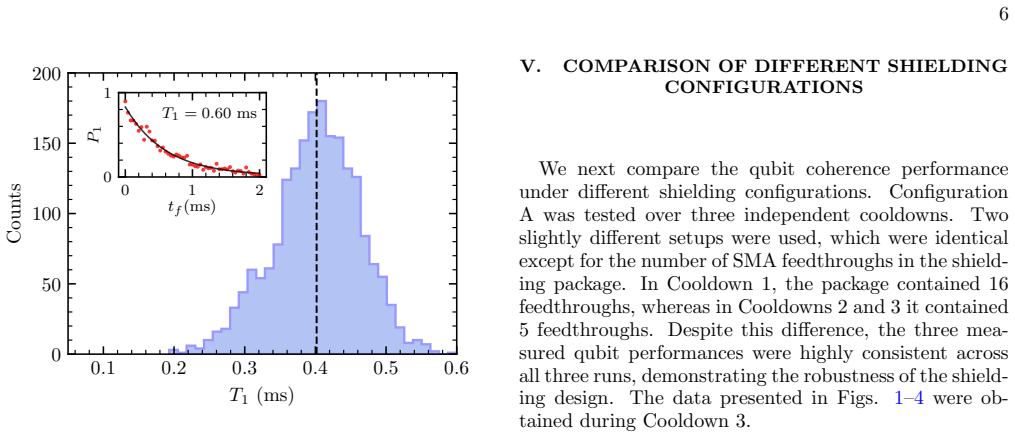
The dashed line indicatesT q =T MX. The measured 6 0.1 0.2 0.3 0.4 0.5 0.6 T1 (ms) 0 50 100 150 200Counts 0 1 2 tf (ms) 0 1P1 T1 = 0.60 ms FIG. 4. Histogram ofT 1 for Q2 on Day 24. The distribution has a mean of 402µs and a standard deviation of 60.7µs. The inset shows the longest measuredT 1, reaching 600µs. data follow this line closely down toT MX ≈16....
2000
-
[3]
Tinkham,Introduction to Superconductivity, 2nd ed
M. Tinkham,Introduction to Superconductivity, 2nd ed. (Courier Corporation, 2004)
2004
-
[4]
A. L. Pankratov, A. V. Gordeeva, A. V. Chiginev, L. S. Revin, A. V. Blagodatkin, N. Crescini, and L. S. Kuzmin, Detection of single-mode thermal microwave photons us- ing an underdamped josephson junction, Nature Com- munications16, 3457 (2025)
2025
-
[5]
E. D. Walsh, W. Jung, G.-H. Lee, D. K. Efetov, B.-I. Wu, K.-F. Huang, T. A. Ohki, T. Taniguchi, K. Watanabe, P. Kim, D. Englund, and K. C. Fong, Josephson junction infrared single-photon detector, Science372, 409 (2021)
2021
-
[6]
Oelsner, C
G. Oelsner, C. K. Andersen, M. Reh´ ak, M. Schmelz, S. Anders, M. Grajcar, U. H¨ ubner, K. Mølmer, and E. Il’ichev, Detection of weak microwave fields with an underdamped josephson junction, Physical Review Ap- plied7, 014012 (2017)
2017
-
[7]
Alesini, D
D. Alesini, D. Babusci, C. Barone, B. Buonomo, M. M. Beretta, L. Bianchini, G. Castellano, F. Chiarello, D. Di Gioacchino, P. Falferi,et al., Development of a josephson junction based single photon microwave detec- tor for axion detection experiments, Journal of Physics: Conference Series1559, 012020 (2020)
2020
-
[8]
P. K. Day, N. F. Cothard, C. Albert, L. Foote, E. Kane, B. H. Eom, R. Basu Thakur, R. M. J. Janssen, A. Beyer, P. M. Echternach, S. van Berkel, S. Hailey-Dunsheath, T. R. Stevenson, S. Dabironezare, J. J. A. Basel- mans, J. Glenn, C. M. Bradford, and H. G. Leduc, A 25-micrometer single-photon-sensitive kinetic inductance detector, Physical Review X14, 041...
2024
-
[9]
M. D. Shaw, R. M. Lutchyn, P. Delsing, and P. M. Echternach, Kinetics of nonequilibrium quasiparticle tun- neling in superconducting charge qubits, Physical Review B78, 024503 (2008)
2008
-
[10]
J. M. Martinis, M. Ansmann, and J. Aumentado, En- ergy decay in superconducting Josephson-junction qubits from nonequilibrium quasiparticle excitations, Physical Review Letters103, 097002 (2009)
2009
-
[11]
Catelani, J
G. Catelani, J. Koch, L. Frunzio, R. J. Schoelkopf, M. H. Devoret, and L. I. Glazman, Quasiparticle relaxation of superconducting qubits in the presence of flux, Physical Review Letters106, 077002 (2011)
2011
-
[12]
Catelani, R
G. Catelani, R. J. Schoelkopf, M. H. Devoret, and L. I. Glazman, Relaxation and frequency shifts induced by quasiparticles in superconducting qubits, Physical Re- view B84, 064517 (2011)
2011
-
[13]
F. Yan, S. Gustavsson, A. Kamal, J. Birenbaum, A. P. Sears, D. Hover, T. J. Gudmundsen, D. Rosenberg, G. Samach, S. Weber,et al., The flux qubit revisited to enhance coherence and reproducibility, Nature Com- munications7, 12964 (2016)
2016
-
[14]
C. D. Wilen, S. Abdullah, N. A. Kurinsky, C. Stanford, L. Cardani, G. d’Imperio, C. Tomei, L. Faoro, L. B. Ioffe, C. H. Liu,et al., Correlated charge noise and relax- ation errors in superconducting qubits, Nature594, 369 (2021)
2021
-
[15]
P. J. de Visser, J. J. A. Baselmans, P. Diener, S. J. C. Yates, A. Endo, and T. M. Klapwijk, Number fluctua- tions of sparse quasiparticles in a superconductor, Phys- ical Review Letters106, 167004 (2011)
2011
-
[16]
C. Wang, Y. Y. Gao, I. M. Pop, U. Vool, C. Axline, T. Brecht, R. W. Heeres, L. Frunzio, M. H. Devoret, G. Catelani,et al., Measurement and control of quasipar- ticle dynamics in a superconducting qubit, Nature Com- munications5, 5836 (2014)
2014
-
[18]
C.-H. Liu, D. C. Harrison, S. Patel, C. D. Wilen, O. Raf- ferty, A. Shearrow, A. Ballard, V. Iaia, J. Ku, B. L. T. Plourde,et al., Quasiparticle poisoning of superconduct- ing qubits from resonant absorption of pair-breaking pho- tons, Physical Review Letters132, 017001 (2024)
2024
-
[19]
Connolly, P
T. Connolly, P. D. Kurilovich, S. Diamond, H. Nho, C. G. L. Bøttcher, L. I. Glazman, V. Fatemi, and M. H. Devoret, Coexistence of nonequilibrium density and equi- librium energy distribution of quasiparticles in a super- conducting qubit, Physical Review Letters132, 217001 (2024)
2024
-
[20]
McEwen, L
M. McEwen, L. Faoro, K. Arya, A. Dunsworth, T. Huang, S. Kim, B. Burkett, A. Fowler, F. Arute, J. C. Bardin,et al., Resolving catastrophic error bursts from cosmic rays in large arrays of superconducting qubits, Nature Physics18, 107 (2022)
2022
-
[21]
J. M. Martinis, Saving superconducting quantum pro- cessors from decay and correlated errors generated by gamma and cosmic rays, npj Quantum Information7, 90 (2021)
2021
-
[22]
A. P. Veps¨ al¨ ainen, A. H. Karamlou, J. L. Orrell, A. S. Do- gra, B. Loer, F. Vasconcelos, D. K. Kim, A. J. Melville, B. M. Niedzielski, J. L. Yoder, S. Gustavsson, J. A. For- maggio, B. A. VanDevender, and W. D. Oliver, Impact of ionizing radiation on superconducting qubit coherence, Nature584, 551 (2020)
2020
-
[23]
P. M. Harrington, M. Li, M. Hays, W. Van De Pontseele, D. Mayer, H. D. Pinckney, F. Contipelli, M. Gingras, B. M. Niedzielski, H. Stickler,et al., Synchronous de- tection of cosmic rays and correlated errors in supercon- ducting qubit arrays, Nature Communications16, 6428 (2025)
2025
-
[24]
X. Li, J. Wang, Y.-Y. Jiang, G.-M. Xue, X. Cai, J. Zhou, M. Gong, Z.-F. Liu, S.-Y. Zheng, D.-K. Ma,et al., Cosmic-ray-induced correlated errors in superconducting qubit array, Nature Communications16, 4677 (2025)
2025
-
[25]
Cardani, F
L. Cardani, F. Valenti, N. Casali, G. Catelani, T. Char- pentier, M. Clemenza, I. Colantoni, A. Cruciani, G. D’Imperio, L. Gironi,et al., Reducing the impact of radioactivity on quantum circuits in a deep-underground facility, Nature Communications12, 2733 (2021)
2021
-
[26]
Bratrudet al., Measurement of correlated charge noise in superconducting qubits at an underground facility, Na- ture Communications16, 9906 (2025)
G. Bratrudet al., Measurement of correlated charge noise in superconducting qubits at an underground facility, Na- ture Communications16, 9906 (2025)
2025
-
[27]
Henriques, F
F. Henriques, F. Valenti, T. Charpentier, M. Lagoin, C. Gouriou, M. Mart´ ınez, L. Cardani, M. Vignati, L. Gr¨ unhaupt, D. Gusenkova,et al., Phonon traps reduce the quasiparticle density in superconducting circuits, Ap- plied Physics Letters115, 212601 (2019)
2019
-
[28]
V. Iaia, J. Ku, A. Ballard, C. P. Larson, E. Yelton, C. H. Liu, S. Patel, R. McDermott, and B. L. T. Plourde, Phonon downconversion to suppress correlated errors in superconducting qubits, Nature Communications13, 6425 (2022)
2022
-
[29]
Anthony-Petersen, A
R. Anthony-Petersen, A. Biekert, R. Bunker, C. L. Chang, Y.-Y. Chang, L. Chaplinsky, E. Fascione, C. W. Fink, M. Garcia-Sciveres, R. Germond,et al., A stress- induced source of phonon bursts and quasiparticle poi- soning, Nature Communications15, 6444 (2024)
2024
-
[30]
Yelton, C
E. Yelton, C. P. Larson, K. Dodge, K. Okubo, and B. L. T. Plourde, Correlated quasiparticle poisoning from phonon-only events in superconducting qubits, Physical Review Letters135, 123601 (2025)
2025
-
[31]
L. Sun, L. DiCarlo, M. D. Reed, G. Catelani, L. S. Bishop, D. I. Schuster, B. R. Johnson, G. A. Yang, L. Frunzio, L. Glazman,et al., Measurements of quasi- particle tunneling dynamics in a band-gap-engineered transmon qubit, Physical Review Letters108, 230509 (2012)
2012
-
[33]
X. Pan, Y. Zhou, H. Yuan, L. Nie, W. Wei, L. Zhang, J. Li, S. Liu, Z. H. Jiang, G. Catelani,et al., Engineer- ing superconducting qubits to reduce quasiparticles and charge noise, Nature Communications13, 7196 (2022)
2022
-
[34]
Barends, J
R. Barends, J. Wenner, M. Lenander, Y. Chen, R. C. Bialczak, J. Kelly, E. Lucero, P. O’Malley, M. Mariantoni, D. Sank,et al., Minimizing quasiparti- cle generation from stray infrared light in superconduct- ing quantum circuits, Applied Physics Letters99, 113507 (2011)
2011
-
[35]
J. M. Kreikebaum, A. Dove, W. Livingston, E. Kim, and I. Siddiqi, Optimization of infrared and magnetic shield- ing of superconducting TiN and Al coplanar microwave resonators, Superconductor Science and Technology29, 9 104002 (2016)
2016
-
[36]
Danilin, J
S. Danilin, J. Barbosa, M. Farage, Z. Zhao, X. Shang, J. Burnett, N. Ridler, C. Li, and M. Weides, Engineering the microwave to infrared noise photon flux for supercon- ducting quantum systems, EPJ Quantum Technology9, 1 (2022)
2022
-
[37]
O. Rafferty, S. Patel, C. H. Liu, S. Abdullah, C. D. Wilen, D. C. Harrison, and R. McDermott, Spurious antenna modes of the transmon qubit (2021), arXiv:2103.06803 [quant-ph]
-
[38]
E. I. Malevannaya, V. I. Polozov, A. I. Ivanov, A. R. Matanin, N. S. Smirnov, V. V. Echeistov, D. O. Moskalev, D. A. Mikhalin, D. E. Shirokov, Y. V. Pan- filov, I. A. Ryzhikov, A. V. Andriyash, and I. A. Rodi- onov, An engineering guide to superconducting quantum circuit shielding, Applied Physics Reviews12, 031334 (2025)
2025
-
[39]
Rist` e, C
D. Rist` e, C. C. Bultink, M. J. Tiggelman, R. N. Schouten, K. W. Lehnert, and L. DiCarlo, Millisecond charge-parity fluctuations and induced decoherence in a superconduct- ing transmon qubit, Nature Communications4, 1913 (2013)
1913
-
[40]
J. Koch, T. M. Yu, J. Gambetta, A. A. Houck, D. I. Schuster, J. Majer, A. Blais, M. H. Devoret, S. M. Girvin, and R. J. Schoelkopf, Charge-insensitive qubit design de- rived from the Cooper pair box, Physical Review A76, 042319 (2007)
2007
-
[41]
McDermott, private communication (2022)
R. McDermott, private communication (2022)
2022
-
[42]
L. R. Rabiner, A tutorial on hidden markov models and selected applications in speech recognition, Proceedings of the IEEE77, 257 (1989)
1989
-
[43]
L. I. Glazman and G. Catelani, Bogoliubov quasiparticles in superconducting qubits, SciPost Phys. Lect. Notes , 31 (2021)
2021
-
[44]
Diamond, V
S. Diamond, V. Fatemi, M. Hays, H. Nho, P. D. Kurilovich, T. Connolly, V. R. Joshi, K. Serniak, L. Frun- zio, L. I. Glazman,et al., Distinguishing parity-switching mechanisms in a superconducting qubit, PRX Quantum 3, 040304 (2022)
2022
-
[45]
X. Y. Jin, A. Kamal, A. P. Sears, T. Gudmundsen, D. Hover, J. Miloshi, R. Slattery, F. Yan, J. Yoder, T. P. Orlando,et al., Thermal and residual excited-state pop- ulation in a 3D transmon qubit, Physical Review Letters 114, 240501 (2015)
2015
-
[46]
P. V. Klimov, J. Kelly, Z. Chen, M. Neeley, A. Megrant, B. Burkett, R. Barends, K. Arya, B. Chiaro, Y. Chen, et al., Fluctuations of energy-relaxation times in super- conducting qubits, Physical Review Letters121, 090502 (2018)
2018
-
[47]
Schl¨ or, J
S. Schl¨ or, J. Lisenfeld, C. M¨ uller, A. Bilmes, A. Schnei- der, D. P. Pappas, A. V. Ustinov, and M. Weides, Cor- relating decoherence in transmon qubits: Low frequency noise by single fluctuators, Physical Review Letters123, 190502 (2019). Supplementary Material for ”Suppression of Quasiparticle Poisoning to10 −11 Levels in Superconducting Qubits via I...
2019
-
[48]
Liebig, openems - open electromagnetic field solver
T. Liebig, openems - open electromagnetic field solver
-
[49]
L. R. Rabiner, A tutorial on hidden markov models and selected applications in speech recognition, Proceedings of the IEEE 77, 257 (1989)
1989
-
[50]
hmmlearn developers, hmmlearn: Hidden Markov Models in Python,https://github.com/hmmlearn/hmmlearn(2026), python package, accessed 2026-05-07
2026
-
[51]
Serniak, M
K. Serniak, M. Hays, G. De Lange, S. Diamond, S. Shankar, L. D. Burkhart, L. Frunzio, M. Houzet, and M. H. Devoret, Hot nonequilibrium quasiparticles in transmon qubits, Physical Review Letters121, 157701 (2018)
2018
-
[52]
Rist` e, C
D. Rist` e, C. C. Bultink, M. J. Tiggelman, R. N. Schouten, K. W. Lehnert, and L. DiCarlo, Millisecond charge-parity fluctuations and induced decoherence in a superconducting transmon qubit, Nature Communications4, 1913 (2013)
1913
-
[53]
Connolly, P
T. Connolly, P. D. Kurilovich, S. Diamond, H. Nho, C. G. L. Bøttcher, L. I. Glazman, V. Fatemi, and M. H. Devoret, Coexistence of nonequilibrium density and equilibrium energy distribution of quasiparticles in a superconducting qubit, Physical Review Letters132, 217001 (2024)
2024
-
[54]
Diamond, V
S. Diamond, V. Fatemi, M. Hays, H. Nho, P. D. Kurilovich, T. Connolly, V. R. Joshi, K. Serniak, L. Frunzio, L. I. Glazman, et al., Distinguishing parity-switching mechanisms in a superconducting qubit, PRX Quantum3, 040304 (2022)
2022
-
[55]
H. Nho, T. Connolly, P. D. Kurilovich, S. Diamond, C. G. L. Bøttcher, L. I. Glazman, and M. H. Devoret, Recovery dynamics of a gap-engineered transmon after a quasiparticle burst, Physical Review Letters136, 050601 (2026)
2026
-
[56]
C.-H. Liu, D. C. Harrison, S. Patel, C. D. Wilen, O. Rafferty, A. Shearrow, A. Ballard, V. Iaia, J. Ku, B. L. T. Plourde, et al., Quasiparticle poisoning of superconducting qubits from resonant absorption of pair-breaking photons, Physical Review Letters132, 017001 (2024)
2024
discussion (0)
Sign in with ORCID, Apple, or X to comment. Anyone can read and Pith papers without signing in.