ALMAGAL IX. The chemical complexity of AG318.9477-00.1960: A line-identification template for ALMAGAL
Pith reviewed 2026-06-27 21:18 UTC · model grok-4.3
The pith
AG318-c9 provides a chemically rich line-identification template for ALMAGAL through detection of dozens of species including complex organics.
A machine-rendered reading of the paper's core claim, the machinery that carries it, and where it could break.
Core claim
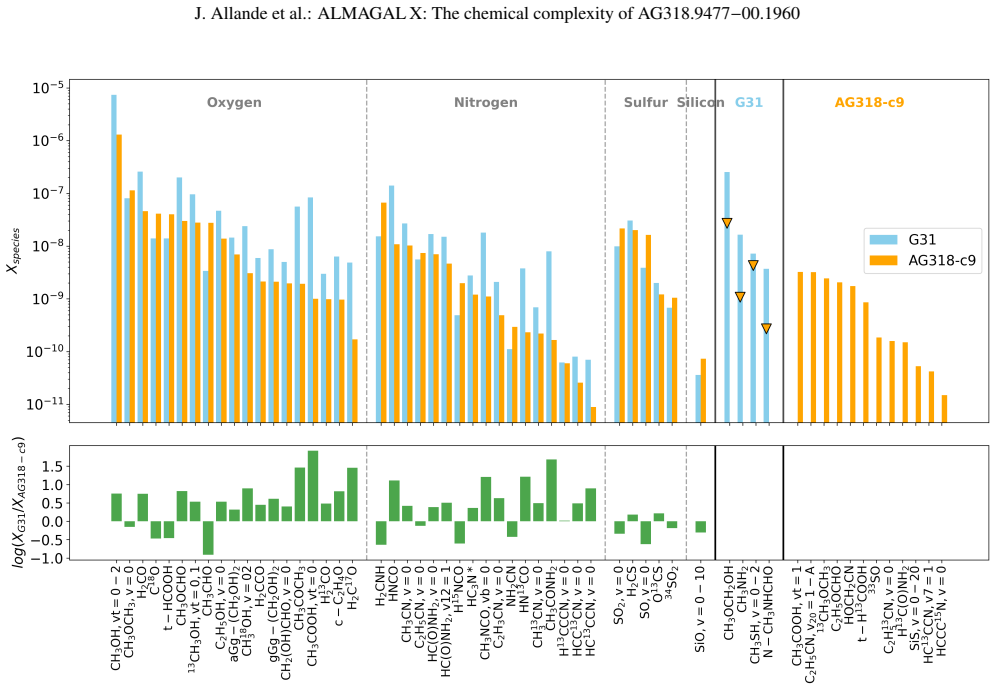
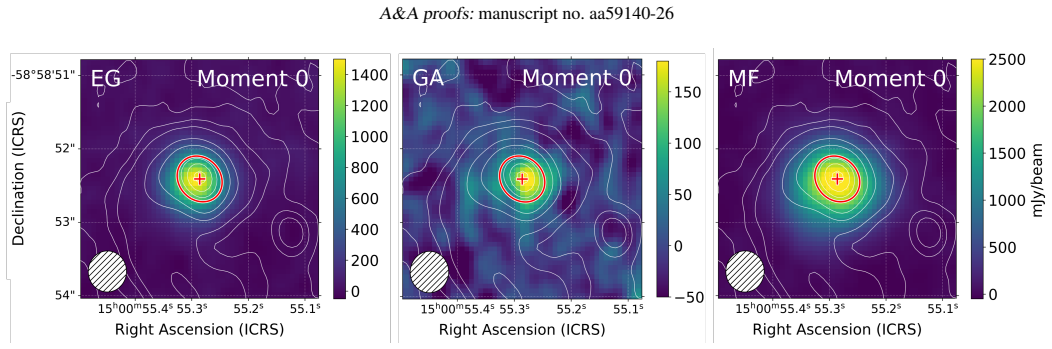
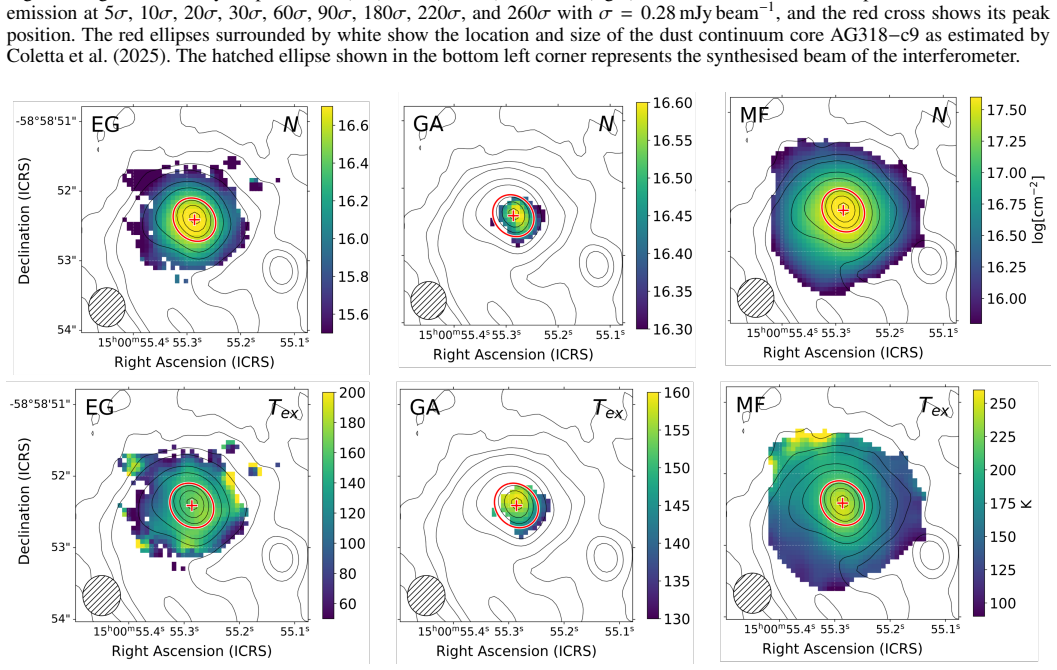
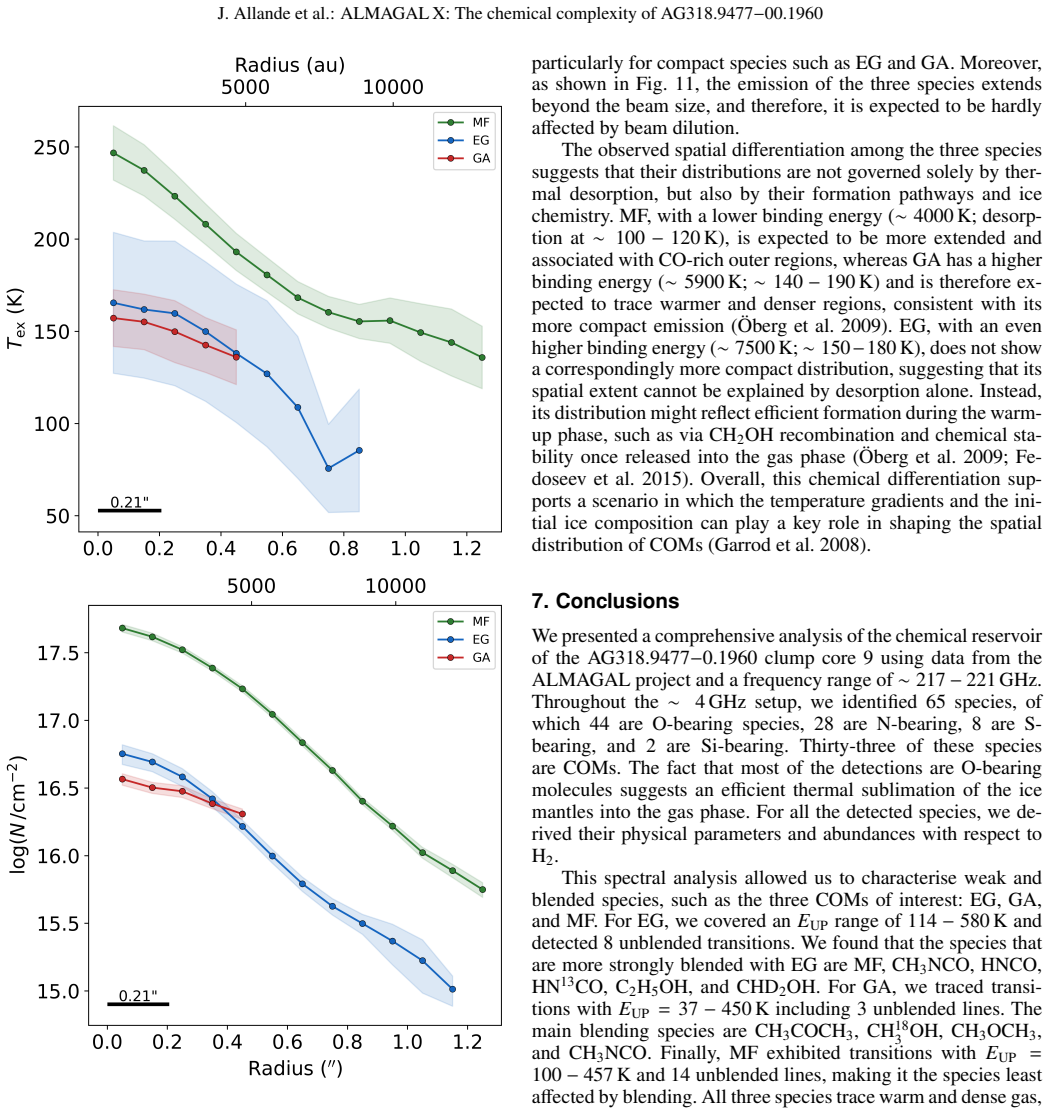
AG318-c9 at ~10.4 kpc distance is one of the most chemically rich cores in the ALMAGAL sample, with a molecular inventory that includes many complex organic molecules and closely matches that of G31.41+0.31. LTE modeling yields physical parameters for all detected lines, while the spatial analysis of EG, GA, and MF shows compact emission whose radial profiles support their role in tracing the innermost regions of hot molecular cores.
What carries the argument
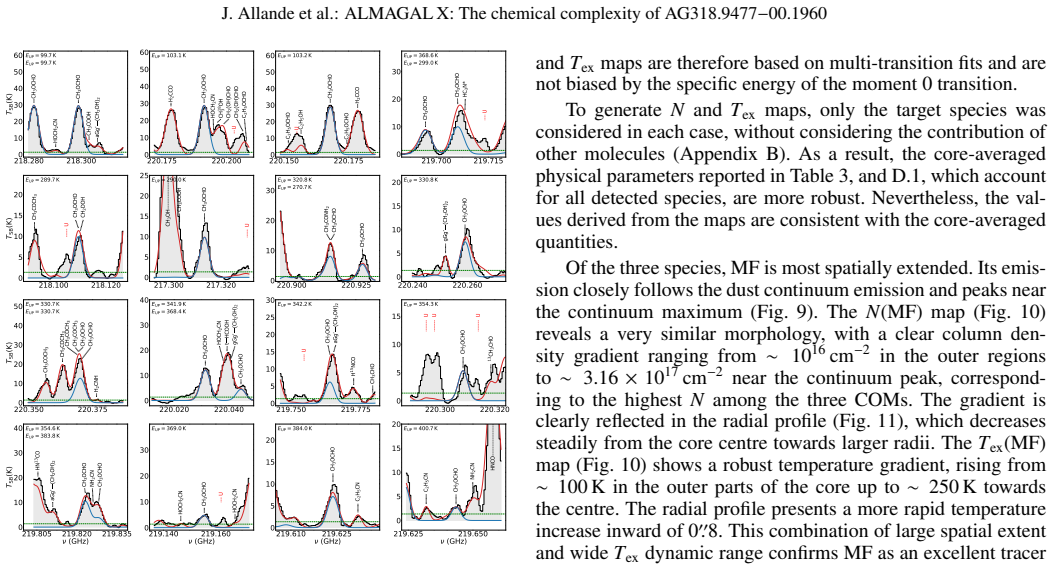
MADCUBA LTE spectral modeling for line identification, parameter derivation (column density, Tex, abundance), and pixel-by-pixel mapping of EG, GA, and MF to produce resolved N and Tex maps with radial profiles.
If this is right
- The chemical inventory of AG318-c9 supplies a reference set of identified lines and parameters for identifying species in other ALMAGAL high-mass cores.
- The compact spatial distributions and radial profiles of EG, GA, and MF indicate these molecules originate from the innermost HMC regions and can serve as tracers there.
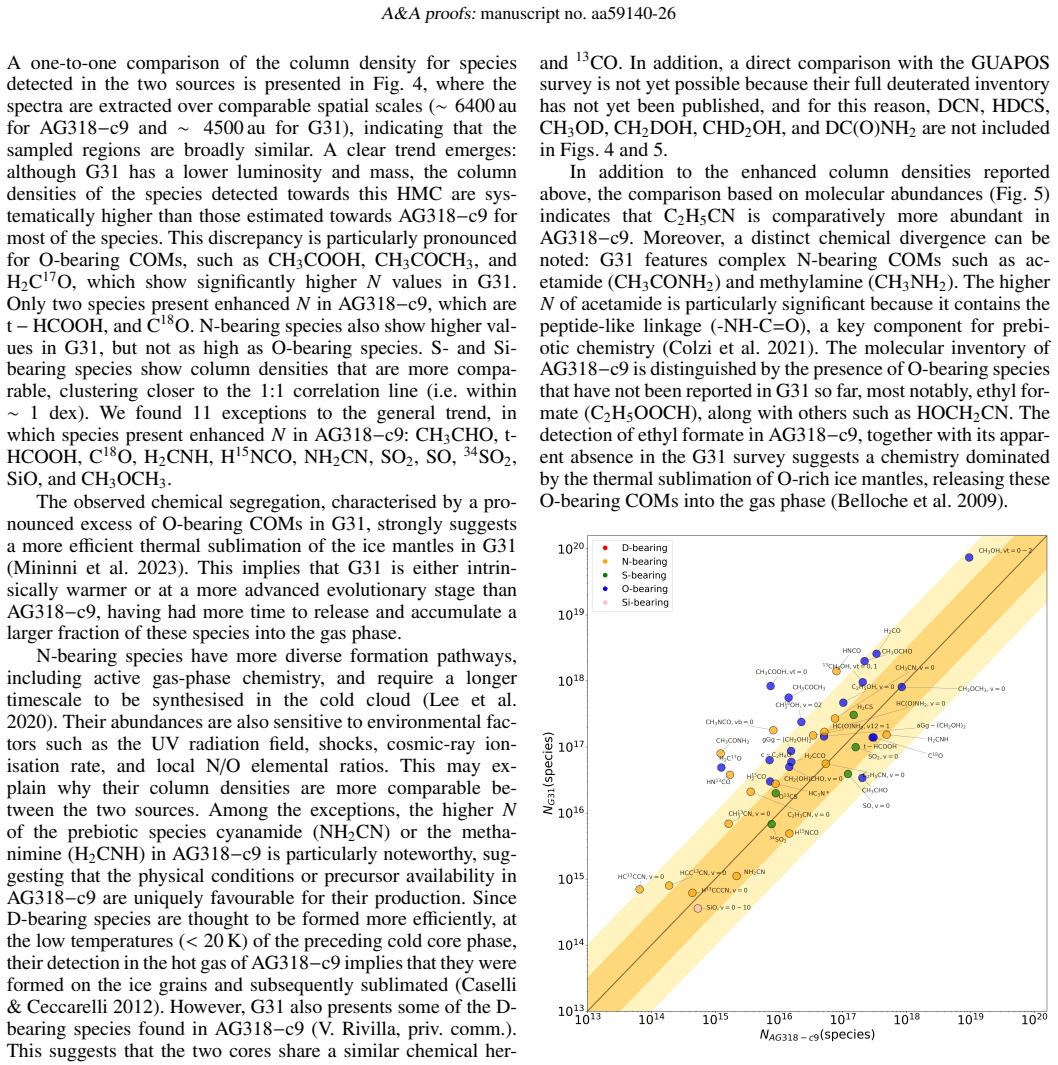
- Direct comparison shows the chemical complexity of AG318-c9 is similar to G31, implying shared formation pathways in high-mass star-forming regions.
- Abundances relative to H2 are established for every detected species, providing quantitative benchmarks for chemical models of hot cores.
Where Pith is reading between the lines
- If EG, GA, and MF reliably mark the innermost zones, targeted follow-up observations of these three molecules alone could locate embedded hot cores in large surveys without requiring full spectral scans.
- The template spectra and parameters from AG318-c9 could reduce line misidentification rates when applied to other distant clumps observed at comparable resolution and frequency.
- Repeating the pixel-by-pixel radial profile analysis on additional ALMAGAL cores would test whether the tracer utility of these COMs holds across different evolutionary stages or distances.
Load-bearing premise
The analysis assumes local thermodynamic equilibrium holds for the detected lines so that MADCUBA LTE modeling can reliably convert observed intensities into column densities, excitation temperatures, and abundances.
What would settle it
Detection of multiple transitions of the same species yielding inconsistent excitation temperatures or line intensity ratios that deviate from LTE predictions would invalidate the derived column densities and abundances.
Figures
read the original abstract
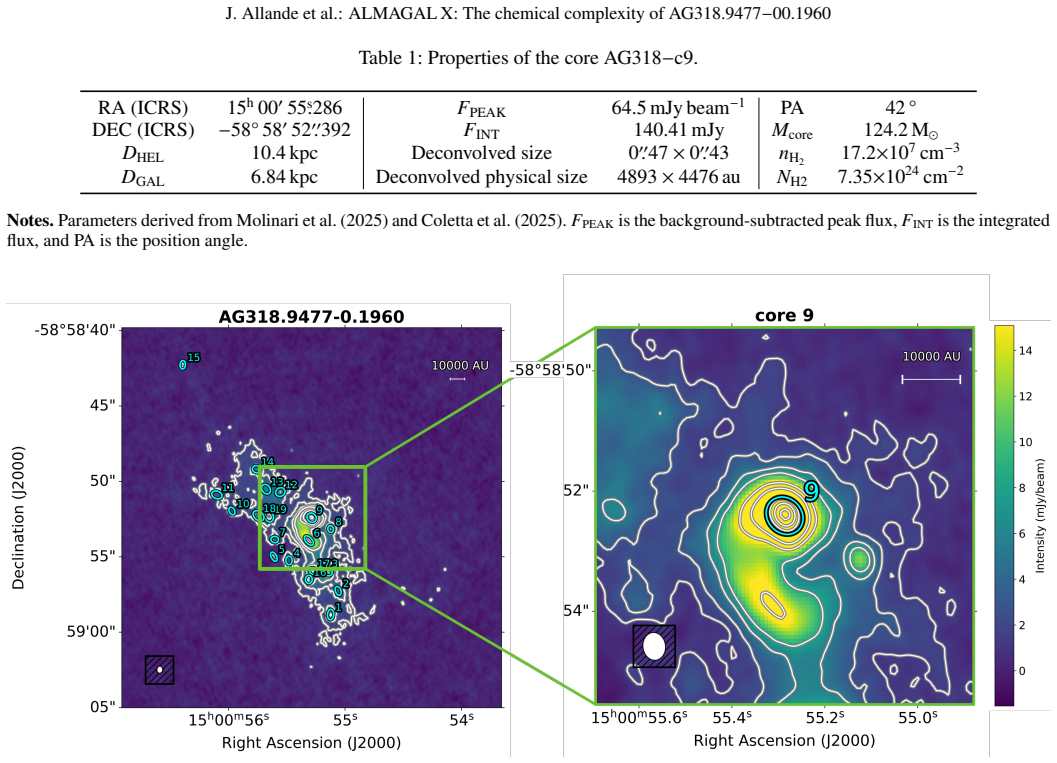
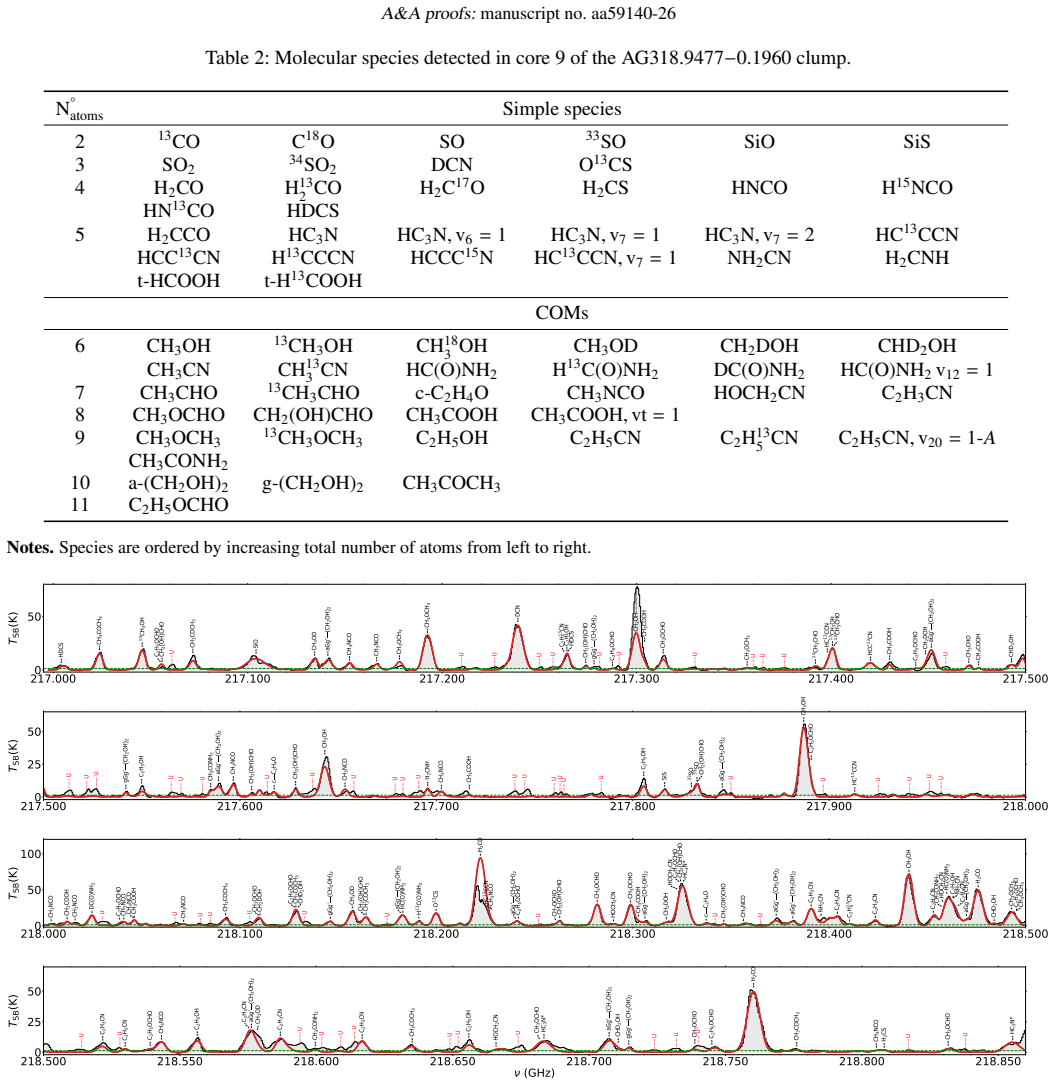
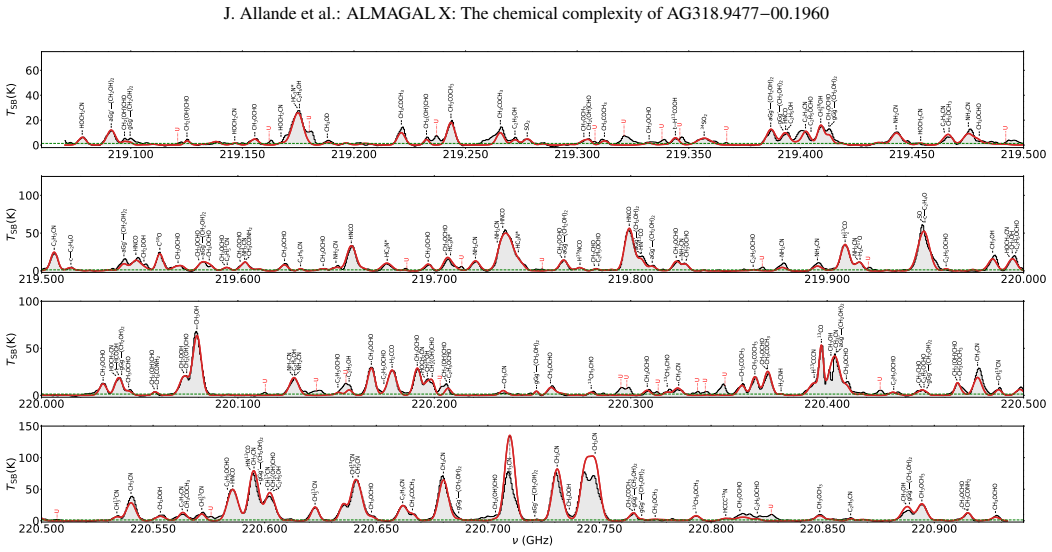
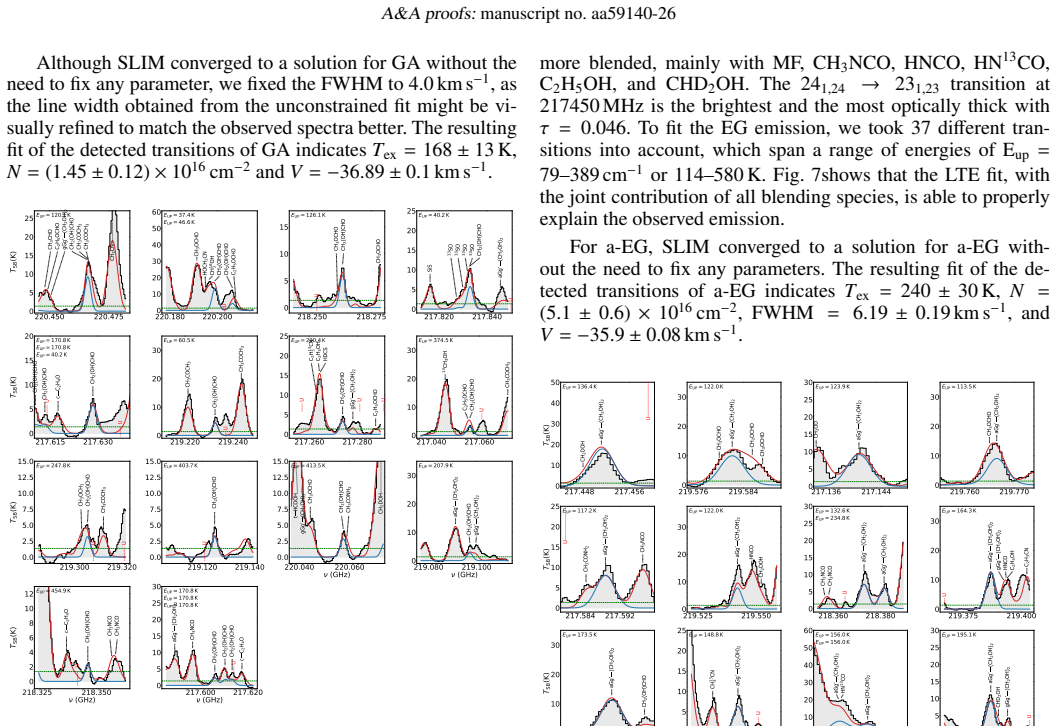
We present a detailed molecular line analysis of one of the most chemically rich cores in the ALMAGAL sample, the high-mass core~9 in the AG318.9477-00.1960 clump (AG318-c9), located at a heliocentric distance of \sim 10.4\,\rm kpc. We further assessed whether the emission of selected COMs, that is, ethylene glycol ((CH_2OH)_2; EG), glycolaldehyde (CH_2(OH)CHO; GA), and methyl formate (CH_3OCHO; MF), can be used to trace the innermost regions of hot molecular cores (HMCs). We analysed ALMA Band~6 observations (\sim 217-221GHz). Spectral line identification and local thermodynamic equilibrium modelling were performed using the software MADCUBA. We derived the physical parameters, including the column density (N), excitation temperature (Tex), velocity, line width, and molecular abundances relative to H_2, for all detected species. The chemical inventory of AG318-c9 was compared with that of the HMC G31.41+0.31 (G31). In addition, we performed a pixel-by-pixel analysis of EG, GA, and MF to generate spatially resolved N and Tex maps and corresponding radial profiles.
Editorial analysis
A structured set of objections, weighed in public.
Referee Report
Summary. The paper presents a detailed molecular line analysis of the high-mass core AG318-c9 in the ALMAGAL sample using ALMA Band 6 data (~217-221 GHz). It employs MADCUBA for spectral line identification and LTE modeling to derive column densities (N), excitation temperatures (Tex), velocities, line widths, and abundances relative to H2 for all detected species. The chemical inventory is compared to that of G31.41+0.31, and a pixel-by-pixel LTE analysis is performed on ethylene glycol (EG), glycolaldehyde (GA), and methyl formate (MF) to produce spatially resolved N and Tex maps and radial profiles, with the goal of assessing whether these COMs can trace the innermost regions of hot molecular cores.
Significance. If the results hold, the work supplies a practical line-identification template for the broader ALMAGAL survey and supplies spatially resolved evidence that selected COMs may serve as tracers of HMC centers. The pixel-by-pixel mapping approach, when combined with the extensive species inventory, adds concrete observational constraints on chemical complexity in high-mass star-forming regions.
major comments (1)
- [Pixel-by-pixel analysis and radial profiles] The central claim that EG, GA, and MF trace the innermost HMC regions rests on the pixel-by-pixel MADCUBA LTE fits and the resulting radial profiles of N and Tex. The manuscript does not report checks for optical-depth effects, line-blending handling, or the applicability of the LTE assumption at larger radii where gas densities may fall below the critical densities of the observed transitions. Without such validation, systematic biases in the derived column-density and temperature profiles cannot be excluded, weakening the tracer assessment.
minor comments (1)
- [Abstract] The abstract states that physical parameters were derived for all detected species but provides no quantitative summary of the number of lines or species modeled, nor any mention of data-exclusion criteria; adding these details would improve clarity.
Simulated Author's Rebuttal
We thank the referee for their constructive and detailed review of our manuscript. We address the single major comment below and indicate the planned revisions.
read point-by-point responses
-
Referee: [Pixel-by-pixel analysis and radial profiles] The central claim that EG, GA, and MF trace the innermost HMC regions rests on the pixel-by-pixel MADCUBA LTE fits and the resulting radial profiles of N and Tex. The manuscript does not report checks for optical-depth effects, line-blending handling, or the applicability of the LTE assumption at larger radii where gas densities may fall below the critical densities of the observed transitions. Without such validation, systematic biases in the derived column-density and temperature profiles cannot be excluded, weakening the tracer assessment.
Authors: We agree that the manuscript would benefit from explicit reporting of these validation steps. MADCUBA's LTE implementation solves the radiative transfer equation including optical depth for each transition, and our line identification procedure (detailed in Section 3) required multiple unblended transitions per species. The pixel-by-pixel fits were performed only on pixels where lines exceeded a 5-sigma threshold, which implicitly limits the analysis to sufficiently dense gas. Nevertheless, we did not include dedicated checks or caveats for optical depth, residual blending, or the breakdown of LTE at larger radii. In the revised manuscript we will add a dedicated paragraph (or short subsection) that (i) reports optical-depth values for the strongest lines of EG, GA, and MF at the map center and at selected outer radii, (ii) describes the line-selection criteria used to minimize blending, and (iii) provides a brief justification for the LTE assumption based on the continuum-derived H2 densities together with a caveat for the outermost radial bins. These additions constitute a partial revision: the underlying data products and main conclusions remain unchanged, but the presentation of the tracer assessment will be strengthened. revision: partial
Circularity Check
No circularity: direct observational fitting and mapping
full rationale
The paper conducts spectral line identification and LTE modeling with MADCUBA on ALMA Band 6 data to extract N, Tex, and abundances for detected species including EG, GA, and MF. Pixel-by-pixel fits produce N and Tex maps whose radial profiles are then inspected for central concentration. These steps are standard data reduction with no equations that equate fitted outputs back to inputs by construction, no self-citation chains invoked as uniqueness theorems, and no ansatzes or renamings presented as derivations. The comparison to G31 is external. The analysis remains self-contained against the observed spectra and maps.
Axiom & Free-Parameter Ledger
free parameters (3)
- Column density N
- Excitation temperature Tex
- Line width and velocity
axioms (1)
- domain assumption Local thermodynamic equilibrium (LTE) is a valid approximation for the molecular emission in AG318-c9
Reference graph
Works this paper leans on
-
[1]
Constant ratios pointing to formation in similar pre-stellar conditions across a large mass range
N-bearing complex organics toward high-mass protostars. Constant ratios pointing to formation in similar pre-stellar conditions across a large mass range. , keywords =. doi:10.1051/0004-6361/202243788 , archivePrefix =. 2208.11128 , primaryClass =
-
[2]
Bridging the gap between physics and chemistry in early stages of star formation
-
[3]
Molecular inheritance from cloud to disk: a story of complex organics and accretion shocks
-
[4]
Selected oxygen-bearing species
CoCCoA: Complex Chemistry in hot Cores with ALMA. Selected oxygen-bearing species. , keywords =. doi:10.1051/0004-6361/202346491 , archivePrefix =. 2308.02688 , primaryClass =
-
[5]
Astrochemistry During the Formation of Stars. , keywords =. doi:10.1146/annurev-astro-032620-021927 , archivePrefix =. 2006.07071 , primaryClass =
-
[6]
ALMAGAL: I. The ALMA evolutionary study of high-mass protocluster formation in the Galaxy: Presentation of the survey and early results. , keywords =. doi:10.1051/0004-6361/202452702 , archivePrefix =. 2503.05555 , primaryClass =
-
[7]
ALMAGAL: II. The ALMA evolutionary study of high-mass protocluster formation in the Galaxy: ALMA data processing and pipeline. , keywords =. doi:10.1051/0004-6361/202452703 , archivePrefix =. 2503.05559 , primaryClass =
-
[8]
Compact source catalog: Fragmentation statistics and physical evolution of the core population
ALMAGAL: III. Compact source catalog: Fragmentation statistics and physical evolution of the core population. , keywords =. doi:10.1051/0004-6361/202452706 , archivePrefix =. 2503.05663 , primaryClass =
-
[9]
ALMAGAL: IV. Morphological comparison of molecular and thermal dust emission using the histogram of oriented gradients method. , keywords =. doi:10.1051/0004-6361/202452700 , archivePrefix =. 2504.12963 , primaryClass =
-
[10]
Hi-GAL, the Herschel infrared Galactic Plane Survey: photometric maps and compact source catalogues. First data release for the inner Milky Way: +68 l -70. , keywords =. doi:10.1051/0004-6361/201526380 , archivePrefix =. 1604.05911 , primaryClass =
work page internal anchor Pith review Pith/arXiv arXiv doi:10.1051/0004-6361/201526380
-
[11]
Interactive software for data cube analysis
Spectral Line Identification and Modelling (SLIM) in the MAdrid Data CUBe Analysis (MADCUBA) package. Interactive software for data cube analysis. , keywords =. doi:10.1051/0004-6361/201936144 , archivePrefix =. 1909.02147 , primaryClass =
-
[12]
The Cologne Database for Molecular Spectroscopy, CDMS. , keywords =. doi:10.1051/0004-6361:20010367 , adsurl =
-
[13]
Journal of Molecular Structure , year = 2005, month = may, volume =
The Cologne Database for Molecular Spectroscopy, CDMS: a useful tool for astronomers and spectroscopists. Journal of Molecular Structure , year = 2005, month = may, volume =. doi:10.1016/j.molstruc.2005.01.027 , adsurl =
-
[14]
Journal of Molecular Spectroscopy , keywords =
The Cologne Database for Molecular Spectroscopy, CDMS, in the Virtual Atomic and Molecular Data Centre, VAMDC. Journal of Molecular Spectroscopy , keywords =. doi:10.1016/j.jms.2016.03.005 , adsurl =
-
[15]
Submillimeter, millimeter and microwave spectral line catalog. , keywords =. doi:10.1016/S0022-4073(98)00091-0 , adsurl =
-
[16]
2022, PASP, 134, 114501, doi: 10.1088/1538-3873/ac9642
CASA, the Common Astronomy Software Applications for Radio Astronomy. , keywords =. doi:10.1088/1538-3873/ac9642 , archivePrefix =. 2210.02276 , primaryClass =
work page internal anchor Pith review Pith/arXiv arXiv doi:10.1088/1538-3873/ac9642
-
[17]
Source extraction and photometry for the far-infrared and sub-millimeter continuum in the presence of complex backgrounds. , keywords =. doi:10.1051/0004-6361/201014752 , archivePrefix =. 1011.3946 , primaryClass =
work page internal anchor Pith review Pith/arXiv arXiv doi:10.1051/0004-6361/201014752
-
[18]
The Atacama Large Millimeter/Submillimeter Array. IEEE Proceedings , keywords =. doi:10.1109/JPROC.2009.2020572 , archivePrefix =. 0904.3739 , primaryClass =
-
[19]
The ALMA correlator. , keywords =. doi:10.1051/0004-6361:20054519 , adsurl =
-
[20]
Fifteenth International Symposium on Space Terahertz Technology , year = 2004, editor =
The ALMA Band 6 (211-275 GHz) Sideband-Separating SIS Mixer-Preamp. Fifteenth International Symposium on Space Terahertz Technology , year = 2004, editor =
2004
-
[21]
, year = 2009, month = feb, volume =
The Atacama Compact Array (ACA). , year = 2009, month = feb, volume =. doi:10.1093/pasj/61.1.1 , adsurl =
-
[22]
A METHOD FOR THE SOLUTION OF CERTAIN NON-LINEAR PROBLEMS IN LEAST SQUARES , urldate =
Kenneth Levenberg , journal =. A METHOD FOR THE SOLUTION OF CERTAIN NON-LINEAR PROBLEMS IN LEAST SQUARES , urldate =
-
[23]
, title =
Marquardt, Donald W. , title =. jstor , volume =. 1963 , doi =
1963
-
[24]
, year = 2009, month = sep, volume =
Complex Organic Interstellar Molecules. , year = 2009, month = sep, volume =. doi:10.1146/annurev-astro-082708-101654 , adsurl =
-
[25]
Our astrochemical heritage. , keywords =. doi:10.1007/s00159-012-0056-x , archivePrefix =. 1210.6368 , primaryClass =
work page internal anchor Pith review Pith/arXiv arXiv doi:10.1007/s00159-012-0056-x
-
[26]
Organic chemistry in the first phases of Solar-type protostars. arXiv e-prints , keywords =. doi:10.48550/arXiv.2206.13270 , archivePrefix =. 2206.13270 , primaryClass =
-
[27]
Observations of the Icy Universe
Observations of the icy universe. , keywords =. doi:10.1146/annurev-astro-082214-122348 , archivePrefix =. 1501.05317 , primaryClass =
work page internal anchor Pith review Pith/arXiv arXiv doi:10.1146/annurev-astro-082214-122348
-
[28]
Atom addition reactions in interstellar ice analogues
Atom addition reactions in interstellar ice analogues. arXiv e-prints , keywords =. doi:10.48550/arXiv.1507.02729 , archivePrefix =. 1507.02729 , primaryClass =
work page internal anchor Pith review Pith/arXiv arXiv doi:10.48550/arxiv.1507.02729
-
[29]
The molecular universe. RMP , keywords =. doi:10.1103/RevModPhys.85.1021 , adsurl =
-
[30]
Grain Surface Models and Data for Astrochemistry. , keywords =. doi:10.1007/s11214-016-0319-3 , adsurl =
-
[31]
Efficient Formation of Formaldehyde and Methanol by the Addition of Hydrogen Atoms to CO in H _ 2 O-CO Ice at 10 K. , keywords =. doi:10.1086/341412 , adsurl =
-
[32]
A combined experimental/theoretical approach
Hydrogenation reactions in interstellar CO ice analogues. A combined experimental/theoretical approach. , keywords =. doi:10.1051/0004-6361/200810784 , adsurl =
-
[33]
First Experimental Confirmation of the CH _ 3 O + H _ 2 CO CH _ 3 OH + HCO Reaction: Expanding the CH _ 3 OH Formation Mechanism in Interstellar Ices. , keywords =. doi:10.3847/2041-8213/ac7158 , archivePrefix =. 2205.12284 , primaryClass =
-
[34]
Experimental evidence for glycolaldehyde and ethylene glycol formation by surface hydrogenation of CO molecules under dense molecular cloud conditions. , keywords =. doi:10.1093/mnras/stu2603 , archivePrefix =. 1705.09235 , primaryClass =
work page internal anchor Pith review Pith/arXiv arXiv doi:10.1093/mnras/stu2603
-
[35]
Formation of Glycerol through Hydrogenation of CO ice under Prestellar Core Conditions
Formation of Glycerol through Hydrogenation of CO Ice under Prestellar Core Conditions. , keywords =. doi:10.3847/1538-4357/aa74dc , archivePrefix =. 1705.09625 , primaryClass =
work page internal anchor Pith review Pith/arXiv arXiv doi:10.3847/1538-4357/aa74dc
-
[36]
Testing grain-surface chemistry in massive hot-core regions
Testing grain-surface chemistry in massive hot-core regions. , keywords =. doi:10.1051/0004-6361:20065963 , archivePrefix =. astro-ph/0702066 , primaryClass =
work page internal anchor Pith review Pith/arXiv arXiv doi:10.1051/0004-6361:20065963
-
[37]
Complex organic molecules in the interstellar medium: IRAM 30 m line survey of Sagittarius B2(N) and (M). , keywords =. doi:10.1051/0004-6361/201321096 , archivePrefix =. 1308.5062 , primaryClass =
work page internal anchor Pith review Pith/arXiv arXiv doi:10.1051/0004-6361/201321096
-
[38]
The formation of ethylene glycol and other complex organic molecules in star-forming regions
Formation of ethylene glycol and other complex organic molecules in star-forming regions. , keywords =. doi:10.1051/0004-6361/201628373 , archivePrefix =. 1608.07491 , primaryClass =
work page internal anchor Pith review Pith/arXiv arXiv doi:10.1051/0004-6361/201628373
-
[39]
The Luminosity Functions and Timescales of MYSOs and Compact HII regions
The RMS Survey: The Luminosity Functions and Timescales of Massive Young Stellar Objects and Compact H II Regions. , keywords =. doi:10.1088/2041-8205/730/2/L33 , archivePrefix =. 1102.4702 , primaryClass =
work page internal anchor Pith review Pith/arXiv arXiv doi:10.1088/2041-8205/730/2/l33 2041
-
[40]
The Red MSX Source Survey: the Massive Young Stellar Population of our Galaxy
The Red MSX Source Survey: The Massive Young Stellar Population of Our Galaxy. , keywords =. doi:10.1088/0067-0049/208/1/11 , archivePrefix =. 1308.0134 , primaryClass =
work page internal anchor Pith review Pith/arXiv arXiv doi:10.1088/0067-0049/208/1/11
-
[41]
On the totally positive grassmannian
Toward Understanding Massive Star Formation. , keywords =. doi:10.1146/annurev.astro.44.051905.092549 , archivePrefix =. 0707.1279 , primaryClass =
work page internal anchor Pith review Pith/arXiv arXiv doi:10.1146/annurev.astro.44.051905.092549
-
[42]
Massive Star Formation. Protostars and Planets VI , year = 2014, editor =. doi:10.2458/azu_uapress_9780816531240-ch007 , archivePrefix =. 1402.0919 , primaryClass =
work page internal anchor Pith review Pith/arXiv arXiv doi:10.2458/azu_uapress_9780816531240-ch007 2014
-
[43]
High-Mass Star and Massive Cluster Formation in the Milky Way
High-Mass Star and Massive Cluster Formation in the Milky Way. , keywords =. doi:10.1146/annurev-astro-091916-055235 , archivePrefix =. 1706.00118 , primaryClass =
work page internal anchor Pith review Pith/arXiv arXiv doi:10.1146/annurev-astro-091916-055235
-
[44]
The Formation of Massive Stars
The Formation of Massive Stars. Protostars and Planets V , year = 2007, editor =. doi:10.48550/arXiv.astro-ph/0602012 , archivePrefix =. astro-ph/0602012 , primaryClass =
work page internal anchor Pith review Pith/arXiv arXiv doi:10.48550/arxiv.astro-ph/0602012 2007
-
[45]
Chemical modelling of glycolaldehyde and ethylene glycol in star-forming regions
Chemical modelling of glycolaldehyde and ethylene glycol in star-forming regions. , keywords =. doi:10.1093/mnras/stx3335 , archivePrefix =. 1712.08778 , primaryClass =
work page internal anchor Pith review Pith/arXiv arXiv doi:10.1093/mnras/stx3335
-
[46]
Formation of Complex Organic Molecules in Hot Molecular Cores through Nondiffusive Grain-surface and Ice-mantle Chemistry. , keywords =. doi:10.3847/1538-4365/ac3131 , archivePrefix =. 2110.09743 , primaryClass =
-
[47]
Multifractal Analysis of the Interstellar Medium. First application to Hi-GAL Observations
Multifractal analysis of the interstellar medium: first application to Hi-GAL observations. , keywords =. doi:10.1093/mnras/sty2170 , archivePrefix =. 1808.02851 , primaryClass =
work page internal anchor Pith review Pith/arXiv arXiv doi:10.1093/mnras/sty2170
-
[48]
The 360 catalogue of clump physical properties
The Hi-GAL compact source catalogue - II. The 360 catalogue of clump physical properties. , keywords =. doi:10.1093/mnras/stab1038 , archivePrefix =. 2104.04807 , primaryClass =
-
[49]
Massive Star Birth: A Crossroads of Astrophysics , year = 2005, editor =
The RMS survey: Massive young stars throughout the galaxy. Massive Star Birth: A Crossroads of Astrophysics , year = 2005, editor =. doi:10.1017/S174392130500476X , adsurl =
-
[50]
The RMS Survey: Radio observations of candidate massive YSOs in the southern hemisphere
The RMS survey. Radio observations of candidate massive YSOs in the southern hemisphere. , keywords =. doi:10.1051/0004-6361:20065837 , archivePrefix =. astro-ph/0605738 , primaryClass =
work page internal anchor Pith review Pith/arXiv arXiv doi:10.1051/0004-6361:20065837
-
[51]
Molecules in Space , year =
-
[52]
The evolution of the spectral energy distribution in massive young stellar objects. , keywords =. doi:10.1051/0004-6361:20078661 , adsurl =
-
[53]
The SQUALO project (Star formation in QUiescent And Luminous Objects) I: clump-fed accretion mechanism in high-mass star-forming objects. , keywords =. doi:10.1093/mnras/stad272 , archivePrefix =. 2301.09917 , primaryClass =
-
[54]
The Hi-GAL compact source catalogue - I. The physical properties of the clumps in the inner Galaxy (-71.0 < < 67.0 ). , keywords =. doi:10.1093/mnras/stx1357 , archivePrefix =. 1706.01046 , primaryClass =
work page internal anchor Pith review Pith/arXiv arXiv doi:10.1093/mnras/stx1357
-
[55]
Evolution of young protoclusters embedded in dense massive clumps. A new grid of population synthesis SED models and a new set of L/M evolutionary tracks. , keywords =. doi:10.1093/mnras/stz900 , archivePrefix =. 1904.08140 , primaryClass =
work page internal anchor Pith review Pith/arXiv arXiv doi:10.1093/mnras/stz900 1904
-
[56]
ATLASGAL-selected massive clumps in the inner Galaxy. III. Dust continuum characterization of an evolutionary sample. , keywords =. doi:10.1051/0004-6361/201526841 , archivePrefix =. 1610.09055 , primaryClass =
work page internal anchor Pith review Pith/arXiv arXiv doi:10.1051/0004-6361/201526841
-
[57]
, keywords =
An evolutionary diagram for young stellar objects. , keywords =
-
[58]
A search for ionized jets towards massive young stellar objects
A search for ionized jets towards massive young stellar objects. , keywords =. doi:10.1093/mnras/stw1027 , archivePrefix =. 1605.01200 , primaryClass =
work page internal anchor Pith review Pith/arXiv arXiv doi:10.1093/mnras/stw1027
-
[59]
Southern class I methanol masers at 36 and 44 GHz
Southern class I methanol masers at 36 and 44 GHz. , keywords =. doi:10.1093/mnras/stu116 , archivePrefix =. 1401.5179 , primaryClass =
work page internal anchor Pith review Pith/arXiv arXiv doi:10.1093/mnras/stu116
-
[60]
Monthly Notices of the Royal Astronomical Society , author =
Lee, J.-K. and Walsh, A.J. and Burton, M.G. and Ashley, M.C.B. , title =. , volume =. 2001 , month =. doi:10.1046/j.1365-8711.2001.04396.x , url =
-
[61]
De Buizer, J. M. , title =. , volume =. 2003 , month =. doi:10.1046/j.1365-8711.2003.06419.x , url =
-
[62]
SiO outflow signatures toward massive young stellar objects with linearly distributed methanol masers. , keywords =. doi:10.1051/0004-6361:200810907 , archivePrefix =. 0810.4951 , primaryClass =
work page internal anchor Pith review Pith/arXiv arXiv doi:10.1051/0004-6361:200810907
-
[63]
The GUAPOS project - V: The chemical ingredients of a massive stellar protocluster in the making. , keywords =. doi:10.1093/mnras/stae676 , archivePrefix =. 2403.02191 , primaryClass =
-
[64]
The GUAPOS project. III. Characterization of the O- and N-bearing complex organic molecules content and search for chemical differentiation. , keywords =. doi:10.1051/0004-6361/202245277 , archivePrefix =. 2306.13563 , primaryClass =
-
[65]
The GUAPOS project: G31.41+0.31 Unbiased ALMA sPectral Observational Survey. IV. Phosphorus-bearing molecules and their relation to shock tracers. , keywords =. doi:10.1051/0004-6361/202348219 , archivePrefix =. 2311.13367 , primaryClass =
-
[66]
The GUAPOS project. II. A comprehensive study of peptide-like bond molecules. , keywords =. doi:10.1051/0004-6361/202141573 , archivePrefix =. 2107.11258 , primaryClass =
-
[67]
The GUAPOS project: G31.41+0.31 Unbiased ALMA sPectral Observational Survey. I. Isomers of C _ 2 H _ 4 O _ 2. , keywords =. doi:10.1051/0004-6361/202038966 , archivePrefix =. 2009.13297 , primaryClass =
-
[68]
Anomalous peculiar motions of high-mass young stars in the Scutum spiral arm. , keywords =. doi:10.1051/0004-6361/201834208 , archivePrefix =. 1911.06806 , primaryClass =
-
[69]
Collapsing Hot Molecular Cores: A Model for the Dust Spectrum and Ammonia Line Emission of the G31.41+0.31 Hot Core. , keywords =. doi:10.1088/0004-637X/694/1/29 , archivePrefix =. 0811.4096 , primaryClass =
work page internal anchor Pith review Pith/arXiv arXiv doi:10.1088/0004-637x/694/1/29
-
[70]
Mass of dusty clumps with temperature and density structure. , keywords =. doi:10.1051/0004-6361/201936334 , archivePrefix =. 1909.07259 , primaryClass =
-
[71]
, year = 1955, month = jan, volume =
The Luminosity Function and Stellar Evolution. , year = 1955, month = jan, volume =. doi:10.1086/145971 , adsurl =
-
[72]
Massive Star Birth: A Crossroads of Astrophysics , year = 2005, editor =
Hot molecular cores. Massive Star Birth: A Crossroads of Astrophysics , year = 2005, editor =. doi:10.1017/S1743921305004369 , adsurl =
-
[73]
The ALMA Protostellar Interferometric Line Survey (PILS). First results from an unbiased submillimeter wavelength line survey of the Class 0 protostellar binary IRAS 16293-2422 with ALMA. , keywords =. doi:10.1051/0004-6361/201628648 , archivePrefix =. 1607.08733 , primaryClass =
work page internal anchor Pith review Pith/arXiv arXiv doi:10.1051/0004-6361/201628648
-
[74]
Exploring molecular complexity in the Galactic Center with ALMA , volume=. Proc. IAU , author=. 2017 , pages=. doi:10.1017/S1743921317007815 , number=
-
[75]
Dissecting a hot molecular core: The case of G31.41+0.31
Dissecting a hot molecular core: the case of G31.41+0.31. , keywords =. doi:10.1051/0004-6361/201117206 , archivePrefix =. 1107.2849 , primaryClass =
work page internal anchor Pith review Pith/arXiv arXiv doi:10.1051/0004-6361/201117206
-
[76]
Baek, Giseon and Lee, Jeong-Eun and Hirota, Tomoya and Kim, Kee-Tae and Kyoung Kim, Mi , title =. , abstract =. 2022 , month =. doi:10.3847/1538-4357/ac81d3 , url =
-
[77]
Evolutionary study of complex organic molecules in high-mass star-forming regions , author=. , year=
-
[78]
Formation of COMs through CO hydrogenation on interstellar grains. , keywords =. doi:10.1051/0004-6361/201936522 , archivePrefix =. 2001.04895 , primaryClass =
-
[79]
Formation of complex organic molecules in cold objects: the role of gas phase reactions
Formation of complex organic molecules in cold objects: the role of gas-phase reactions. , keywords =. doi:10.1093/mnrasl/slv009 , archivePrefix =. 1501.03668 , primaryClass =
work page internal anchor Pith review Pith/arXiv arXiv doi:10.1093/mnrasl/slv009
-
[80]
The genealogical tree of ethanol: gas-phase formation of glycolaldehyde, acetic acid and formic acid
The Genealogical Tree of Ethanol: Gas-phase Formation of Glycolaldehyde, Acetic Acid, and Formic Acid. , keywords =. doi:10.3847/1538-4357/aaa41e , archivePrefix =. 1712.08938 , primaryClass =
work page internal anchor Pith review Pith/arXiv arXiv doi:10.3847/1538-4357/aaa41e
discussion (0)
Sign in with ORCID, Apple, or X to comment. Anyone can read and Pith papers without signing in.