Polar and quadratic magneto-optical Kerr effects in nonmagnetic/ferromagnet bilayers for spin-orbit torque measurements
Pith reviewed 2026-06-27 21:05 UTC · model grok-4.3
The pith
MOKE signals allow reliable spin-torque efficiency extraction in NM/FM bilayers by avoiding SMR contributions that plague Hall measurements.
A machine-rendered reading of the paper's core claim, the machinery that carries it, and where it could break.
Core claim
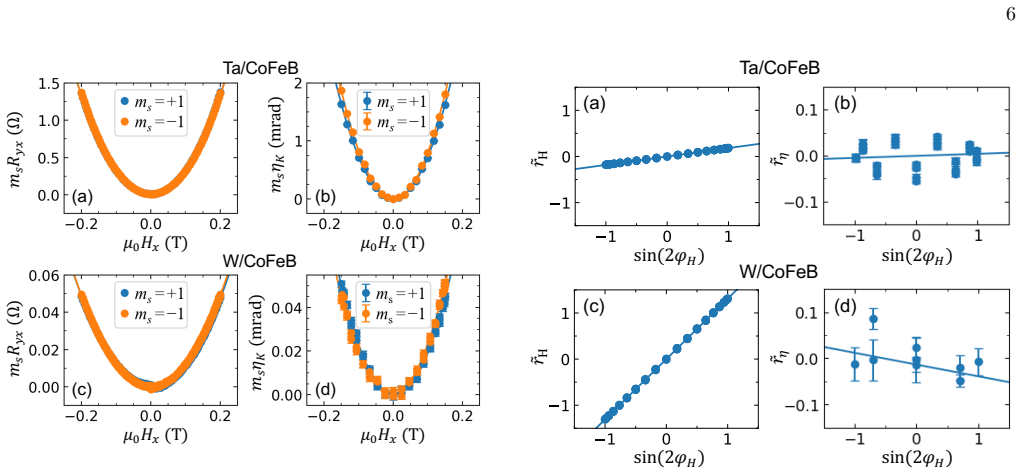
In NM/FM bilayers, SMR causes the planar Hall resistance to become comparable to the anomalous Hall resistance when the NM has a large spin Hall angle, complicating spin-torque efficiency extraction from harmonic Hall voltages. The polar MOKE corresponds to the anomalous Hall resistance and the quadratic MOKE to the planar Hall resistance in the low-frequency limit. Measurements show the quadratic-to-polar MOKE ratio remains significantly smaller, demonstrating that SMR does not affect MOKE in the visible range, allowing the extracted spin-torque efficiency to match expectations from the NM spin Hall angle.
What carries the argument
Polar and quadratic magneto-optical Kerr effect components, which map to anomalous and planar Hall resistances but without significant SMR contribution at optical frequencies.
If this is right
- Spin-torque efficiency can be accurately measured using MOKE in bilayers with large SMR effects.
- MOKE serves as a robust alternative to harmonic Hall voltage measurements for SOT characterization.
- The negligible SMR in MOKE allows direct correlation to the spin Hall angle of the NM layer.
- Optical measurements at visible wavelengths isolate FM magnetization dynamics from NM contributions.
Where Pith is reading between the lines
- This implies that the frequency dependence of SMR effects might allow optical methods to probe pure magnetization responses.
- MOKE could be applied to other systems where transport is affected by interface or NM effects.
- Testing MOKE at different wavelengths might reveal the onset of SMR contributions.
Load-bearing premise
Polar and quadratic MOKE components at optical frequencies correspond directly to anomalous and planar Hall resistances without additional contributions from the NM layer or interface at those frequencies.
What would settle it
A direct comparison of the quadratic-to-polar MOKE ratio versus the planar-to-anomalous Hall ratio in a W/CoFeB bilayer, or checking if MOKE-derived spin-torque efficiency matches independent measurements like spin pumping.
Figures
read the original abstract
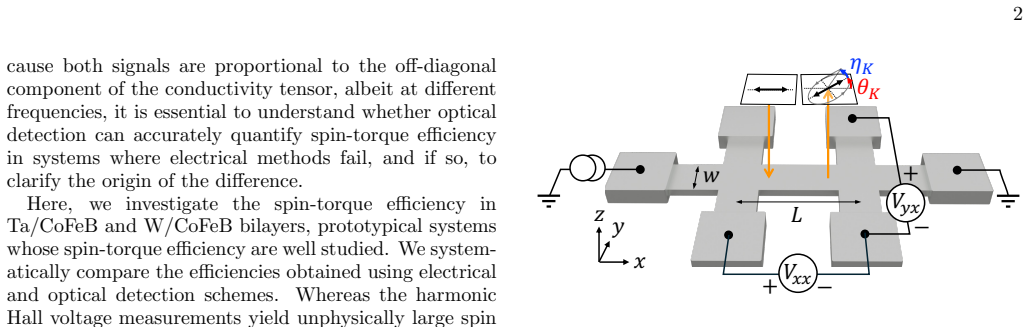
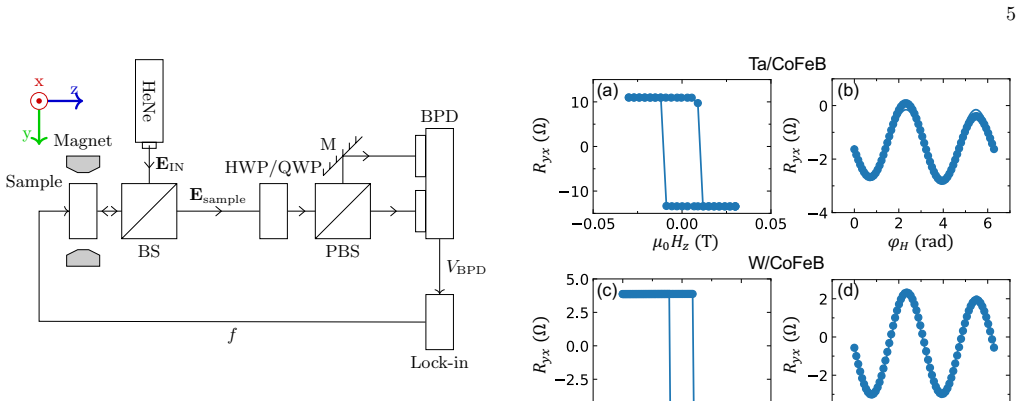
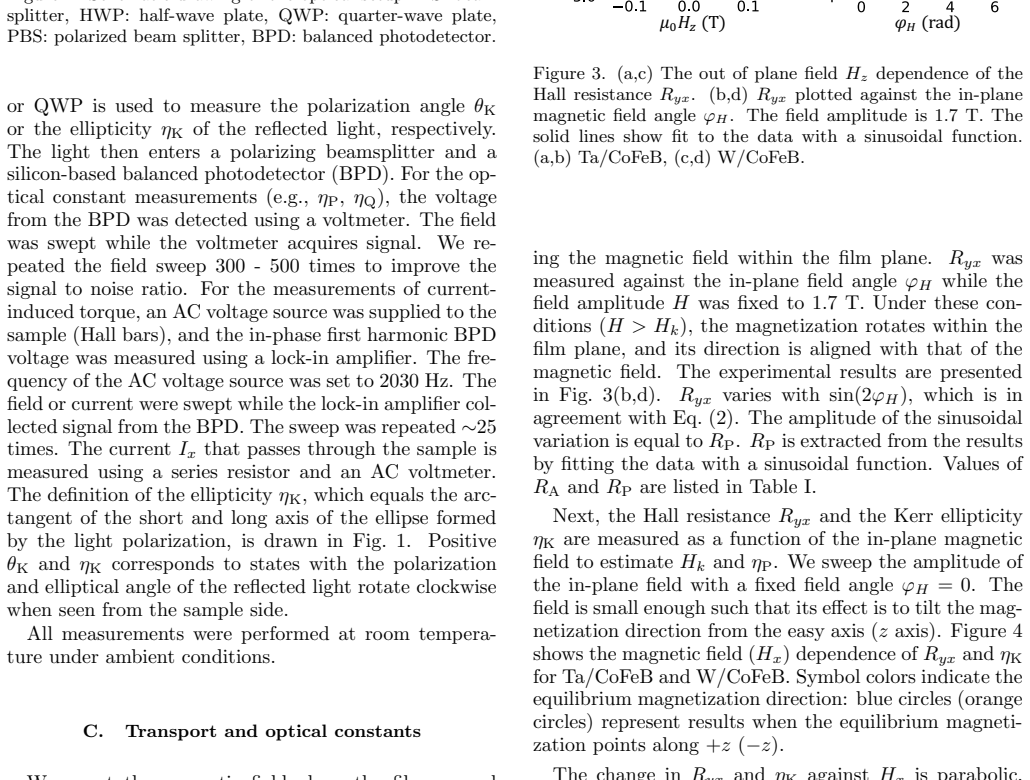
Recent studies have revealed that spin Hall magnetoresistance (SMR) contributes to both the anomalous and planar Hall resistances in nonmagnetic metal (NM)/ferromagnetic metal (FM) bilayers. This effect becomes pronounced when the NM layer exhibits a large spin Hall angle, as in W/CoFeB bilayers. In such systems, the ratio of planar to anomalous Hall resistances, normally small in single CoFeB layers, can approach unity. This unusually large ratio complicates the determination of spin-torque efficiency using harmonic Hall voltage measurements. To overcome this limitation, magneto-optical Kerr effect (MOKE) measurements have been proposed as an alternative approach. Here, we investigate the polar and quadratic MOKE components, which correspond to, respectively, the anomalous and planar Hall resistances in the low-frequency limit to clarify whether the MOKE measurements are suitable for characterizing the spin-torque efficiency. We find that the ratio of quadratic to polar MOKE signals in NM/FM bilayers is significantly smaller than the corresponding Hall resistance ratio, indicating that SMR contributes negligibly to the MOKE response in the visible range. Consequently, the spin-torque efficiency extracted from MOKE measurements agree well with those expected from the spin Hall angle of the NM layer. These results clarify the reason why MOKE measurements provide reliable determination of the spin-torque efficiency.
Editorial analysis
A structured set of objections, weighed in public.
Referee Report
Summary. The paper experimentally compares polar and quadratic magneto-optical Kerr effect (MOKE) signals with anomalous and planar Hall resistances in NM/FM bilayers (e.g., W/CoFeB). It reports that the quadratic-to-polar MOKE ratio is substantially smaller than the corresponding planar-to-anomalous Hall ratio, indicating negligible spin Hall magnetoresistance (SMR) contribution to MOKE at visible wavelengths. Consequently, spin-torque efficiencies extracted from MOKE agree with values expected from the NM layer's spin Hall angle, validating MOKE as a reliable alternative when Hall measurements are complicated by SMR.
Significance. If the result holds, the work provides a practical optical method for spin-orbit torque characterization in bilayers with large spin Hall angles, where electrical methods suffer from SMR contamination. The direct side-by-side comparison on identical samples and consistency with independently known spin Hall angles are strengths. This strengthens the case for MOKE-based measurements in the field.
minor comments (3)
- The abstract states the central finding without numerical values, error bars, or sample details; the main text should ensure all key ratios and efficiencies are reported with uncertainties in the results section for reproducibility.
- Figure captions and legends should explicitly state the optical wavelength used for MOKE and confirm that single-FM-layer controls are shown alongside bilayer data to support the negligible-SMR conclusion.
- Notation for the quadratic MOKE component should be defined once in the methods or early results section to avoid ambiguity when comparing to the planar Hall resistance.
Simulated Author's Rebuttal
We thank the referee for the positive assessment of our manuscript and the recommendation for minor revision. The referee's summary accurately reflects our key finding that the quadratic-to-polar MOKE ratio is substantially smaller than the planar-to-anomalous Hall ratio in NM/FM bilayers, confirming negligible SMR contribution to visible-range MOKE and validating MOKE-based spin-torque efficiency measurements.
Circularity Check
No significant circularity detected
full rationale
The manuscript is an experimental study that measures polar/quadratic MOKE ratios versus planar/anomalous Hall ratios on the same NM/FM bilayers and compares the extracted spin-torque efficiencies to the independently known spin Hall angle of the NM layer. No derivation chain, equation, or parameter is shown to reduce to a self-defined input or to a self-citation whose validity depends on the present work. The stated correspondence between MOKE components and Hall resistances is presented as an empirical mapping to be tested, not as an identity imposed by construction. The central claim therefore rests on external benchmarks and direct observation rather than internal re-labeling of fitted quantities.
Axiom & Free-Parameter Ledger
axioms (1)
- domain assumption Polar and quadratic MOKE signals correspond to anomalous and planar Hall resistances in the low-frequency limit
Reference graph
Works this paper leans on
-
[1]
(13) is introduced due to the conversion of sin 2(ωt) to cos(2ωt)
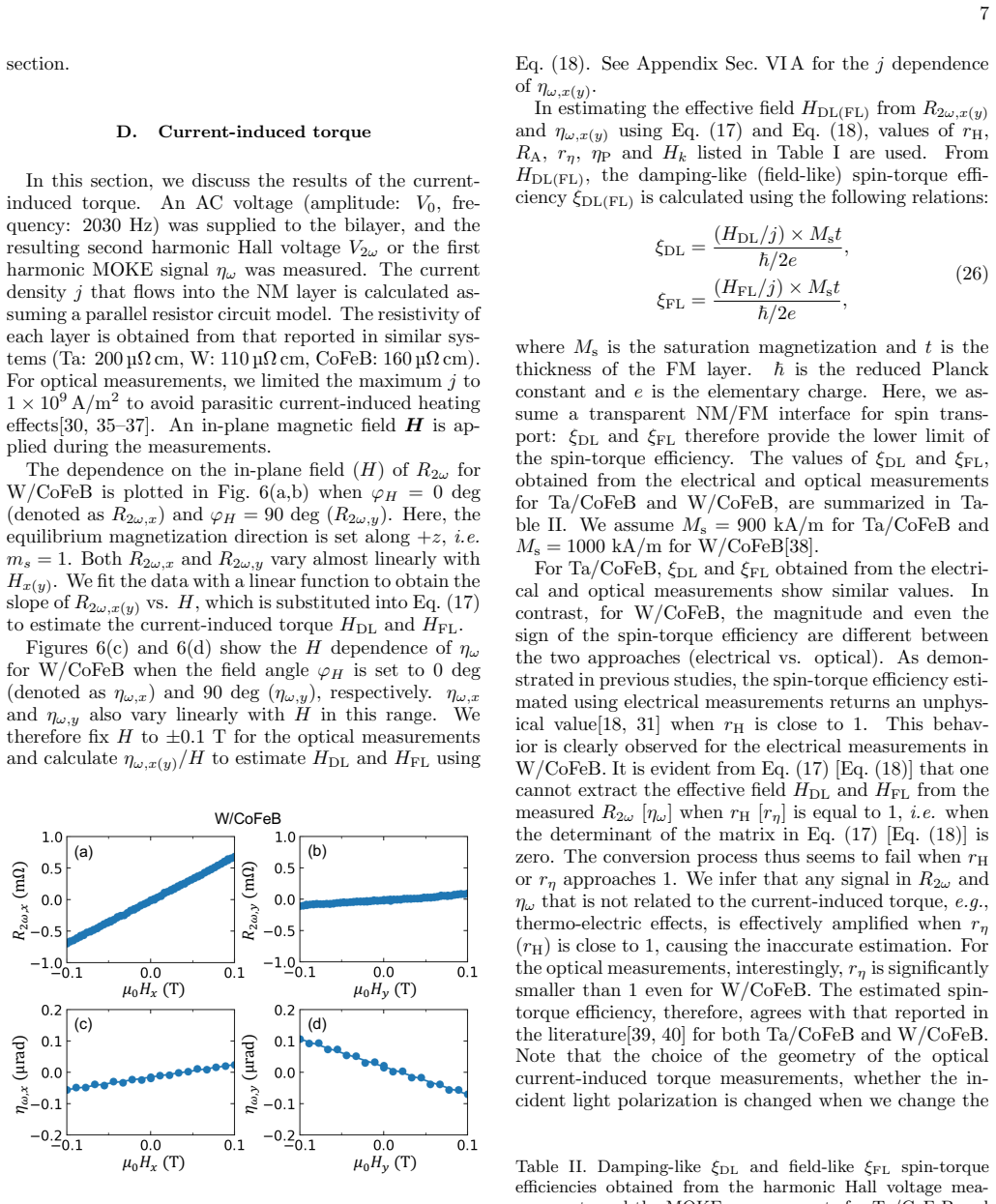
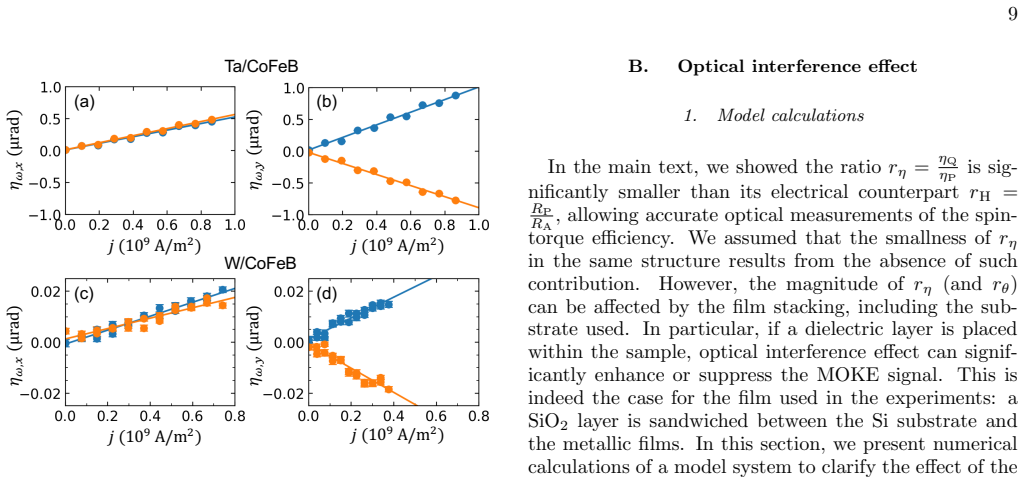
The factor of− 1 2 in Eq. (13) is introduced due to the conversion of sin 2(ωt) to cos(2ωt). Equations (13) and (15) show that one can extract in- formation on the current-induced torque from the second harmonic Hall voltage and the first harmonic MOKE sig- nal. The current-induced torque is decomposed into the damping-like (H DL) and field-like (H FL) co...
-
[2]
(T) 𝜇!𝐻
Note that the measurement scheme, whether one fixes the polarization direction or changes it with the magnetic field, does not influence the results ifr η ≪1. III. EXPERIMENTAL RESULTS A. Samples NM/FM bilayers were prepared using radio frequency magnetron sputtering. Thin films were deposited on oxi- dized silicon substrates at room temperature. The thic...
2030
-
[3]
We assumed that the smallness ofr η in the same structure results from the absence of such contribution
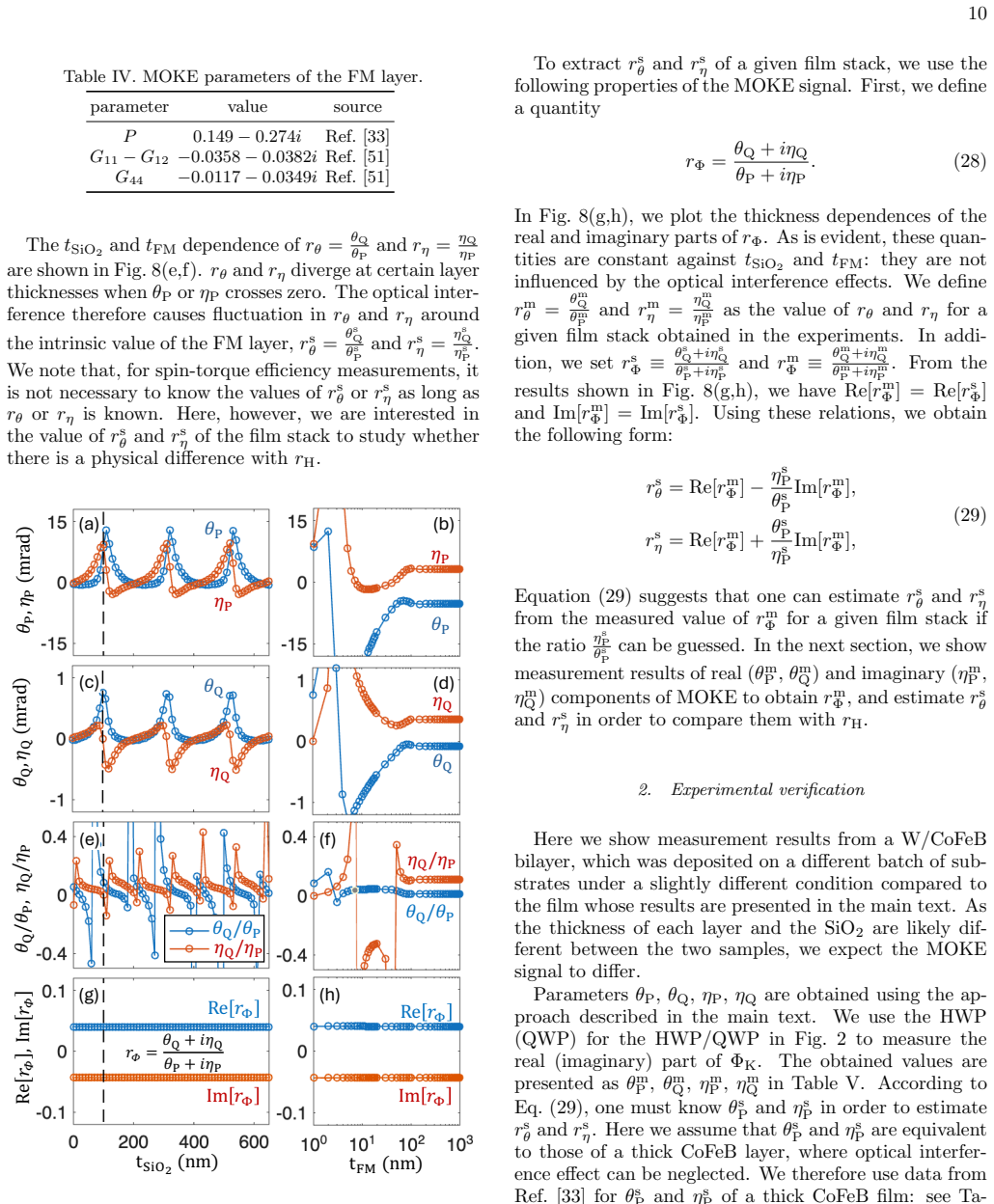
Model calculations In the main text, we showed the ratior η = ηQ ηP is sig- nificantly smaller than its electrical counterpartr H = RP RA , allowing accurate optical measurements of the spin- torque efficiency. We assumed that the smallness ofr η in the same structure results from the absence of such contribution. However, the magnitude ofr η (andr θ) can...
-
[4]
As the thickness of each layer and the SiO 2 are likely dif- ferent between the two samples, we expect the MOKE signal to differ
Experimental verification Here we show measurement results from a W/CoFeB bilayer, which was deposited on a different batch of sub- strates under a slightly different condition compared to the film whose results are presented in the main text. As the thickness of each layer and the SiO 2 are likely dif- ferent between the two samples, we expect the MOKE s...
-
[5]
M. I. Dyakonov and V. I. Perel, Possibility of orienting electron spins with current, JETP Letters13, 467 (1971)
1971
-
[6]
Y. K. Kato, R. C. Myers, A. C. Gossard, and D. D. Awschalom, Observation of the spin hall effect in semi- conductors, Science306, 1910 (2004)
1910
-
[7]
Liu, C.-F
L. Liu, C.-F. Pai, Y. Li, H. W. Tseng, D. C. Ralph, and R. A. Buhrman, Spin-torque switching with the giant spin hall effect of tantalum, Science336, 555 (2012)
2012
-
[8]
Y. K. Kato, R. C. Myers, A. C. Gossard, and D. D. Awschalom, Current-induced spin polarization in strained semiconductors, Phys. Rev. Lett.93, 176601 (2004)
2004
-
[9]
I. M. Miron, K. Garello, G. Gaudin, P. J. Zermatten, M. V. Costache, S. Auffret, S. Bandiera, B. Rodmacq, A. Schuhl, and P. Gambardella, Perpendicular switching of a single ferromagnetic layer induced by in-plane cur- rent injection, Nature476, 189 (2011)
2011
-
[10]
U. H. Pi, K. W. Kim, J. Y. Bae, S. C. Lee, Y. J. Cho, K. S. Kim, and S. Seo, Tilting of the spin orientation induced by rashba effect in ferromagnetic metal layer, Appl. Phys. Lett.97, 162507 (2010)
2010
-
[11]
J. Kim, J. Sinha, M. Hayashi, M. Yamanouchi, S. Fukami, T. Suzuki, S. Mitani, and H. Ohno, Layer thickness dependence of the current induced effective field vector in ta—cofeb—mgo, Nat. Mater.12, 240 (2013)
2013
-
[12]
Garello, I
K. Garello, I. M. Miron, C. O. Avci, F. Freimuth, Y. Mokrousov, S. Blugel, S. Auffret, O. Boulle, G. Gaudin, and P. Gambardella, Symmetry and magni- tude of spin-orbit torques in ferromagnetic heterostruc- tures, Nat. Nanotechnol.8, 587 (2013)
2013
-
[13]
Hayashi, J
M. Hayashi, J. Kim, M. Yamanouchi, and H. Ohno, Quantitative characterization of the spin-orbit torque us- ing harmonic hall voltage measurements, Phys. Rev. B 89, 144425 (2014)
2014
-
[14]
C. O. Avci, K. Garello, M. Gabureac, A. Ghosh, A. Fuhrer, S. F. Alvarado, and P. Gambardella, Inter- play of spin-orbit torque and thermoelectric effects in ferromagnet/normal-metal bilayers, Phys. Rev. B90, 224427 (2014)
2014
-
[15]
Roschewsky, E
N. Roschewsky, E. S. Walker, P. Gowtham, S. Muschinske, F. Hellman, S. R. Bank, and S. Salahud- din, Spin-orbit torque and nernst effect in bi-sb/co heterostructures, Phys. Rev. B99, 195103 (2019)
2019
-
[16]
L. Q. Liu, T. Moriyama, D. C. Ralph, and R. A. Buhrman, Spin-torque ferromagnetic resonance induced by the spin hall effect, Phys. Rev. Lett.106, 036601 (2011)
2011
-
[17]
Nakayama, M
H. Nakayama, M. Althammer, Y. T. Chen, K. Uchida, Y. Kajiwara, D. Kikuchi, T. Ohtani, S. Geprags, M. Opel, S. Takahashi, R. Gross, G. E. W. Bauer, S. T. B. Goennenwein, and E. Saitoh, Spin hall magnetoresistance induced by a nonequilibrium proximity effect, Phys. Rev. Lett.110, 206601 (2013)
2013
-
[18]
J. Kim, P. Sheng, S. Takahashi, S. Mitani, and M. Hayashi, Spin hall magnetoresistance in metallic bi- layers, Phys. Rev. Lett.116, 097201 (2016)
2016
-
[19]
C. O. Avci, K. Garello, A. Ghosh, M. Gabureac, S. F. Alvarado, and P. Gambardella, Unidirectional spin hall magnetoresistance in ferromagnet/normal metal bilayers, Nat. Phys.11, 570 (2015)
2015
-
[20]
Yamanouchi, L
M. Yamanouchi, L. Chen, J. Kim, M. Hayashi, H. Sato, S. Fukami, S. Ikeda, F. Matsukura, and H. Ohno, Three terminal magnetic tunnel junction utilizing the spin hall effect of iridium-doped copper, Appl. Phys. Lett.102, 212408 (2013)
2013
-
[21]
C.-F. Pai, M. Mann, A. J. Tan, and G. S. D. Beach, Determination of spin torque efficiencies in heterostruc- tures with perpendicular magnetic anisotropy, Phys. Rev. B93, 144409 (2016)
2016
-
[22]
Torrejon, J
J. Torrejon, J. Kim, J. Sinha, S. Mitani, M. Hayashi, M. Yamanouchi, and H. Ohno, Interface control of the magnetic chirality in cofeb/mgo heterostructures with heavy-metal underlayers, Nat. Commun.5, 4655 (2014)
2014
-
[23]
S. J. Yun, E. S. Park, K. J. Lee, and S. H. Lim, Accurate analysis of harmonic hall voltage measurement for spin- orbit torques, Npg Asia Materials9, e449 (2017)
2017
-
[24]
Karimeddiny, J
S. Karimeddiny, J. A. Mittelstaedt, R. A. Buhrman, and D. C. Ralph, Transverse and longitudinal spin-torque fer- romagnetic resonance for improved measurement of spin- orbit torque, Physical Review Applied14, 024024 (2020)
2020
-
[25]
Karimeddiny and D
S. Karimeddiny and D. C. Ralph, Resolving discrep- ancies in spin-torque ferromagnetic resonance measure- ments: Lineshape versus linewidth analyses, Physical Re- view Applied15, 064017 (2021)
2021
-
[26]
Kawaguchi, D
M. Kawaguchi, D. Towa, Y. C. Lau, S. Takahashi, and M. Hayashi, Anomalous spin hall magnetoresistance in pt/co bilayers, Appl. Phys. Lett.112, 202405 (2018)
2018
-
[27]
L. K. Zou, Y. Zhang, L. Gu, J. W. Cai, and L. Sun, Tun- able angular-dependent magnetoresistance correlations in magnetic films and their implications for spin hall mag- netoresistance analysis, Phys. Rev. B93, 075309 (2016). 12
2016
-
[28]
J. Zak, E. R. Moog, C. Liu, and S. D. Bader, Universal approach to magneto-optics, J. Magn. Magn. Mater.89, 107 (1990)
1990
-
[29]
Z. Q. Qiu and S. D. Bader, Surface magneto-optic kerr effect, Rev. Sci. Instrum.71, 1243 (2000)
2000
-
[30]
Kimel, A
A. Kimel, A. Zvezdin, S. Sharma, S. Shallcross, N. de Sousa, A. Garcia-Martin, G. Salvan, J. Ham- rle, O. Stejskal, J. McCord, S. Tacchi, G. Carlotti, P. Gambardella, G. Salis, M. Munzenberg, M. Schultze, V. Temnov, I. Bychkov, L. N. Kotov, N. Maccaferri, D. Ignatyeva, V. Belotelov, C. Donnelly, A. H. Ro- driguez, I. Matsuda, T. Ruchon, M. Fanciulli, M. S...
2022
-
[31]
X. Fan, H. Celik, J. Wu, C. Ni, K.-J. Lee, V. O. Lorenz, and J. Q. Xiao, Quantifying interface and bulk contri- butions to spin-orbit torque in magnetic bilayers, Nat. Commun.5, 3042 (2014)
2014
-
[32]
X. Fan, A. R. Mellnik, W. Wang, N. Reynolds, T. Wang, H. Celik, V. O. Lorenz, D. C. Ralph, and J. Q. Xiao, All- optical vector measurement of spin-orbit-induced torques using both polar and quadratic magneto-optic kerr ef- fects, Appl. Phys. Lett.109, 122406 (2016)
2016
-
[33]
Y. P. Chen, H. Celik, T. Wang, H. Kannan, I. N. Kriv- orotov, and J. Q. Xiao, Quantifying angular dependence of spin-orbit torques in ta/cofeb/mgo trilayers with per- pendicular magnetic anisotropy, Phys. Rev. B95, 144405 (2017)
2017
-
[34]
Marui, M
Y. Marui, M. Kawaguchi, and M. Hayashi, Optical de- tection of spin-orbit torque and current-induced heating, Appl. Phys. Express11, 5 (2018)
2018
-
[35]
Karimeddiny, T
S. Karimeddiny, T. M. J. Cham, O. Smedley, D. C. Ralph, and Y. K. Luo, Sagnac interferometry for high- sensitivity optical measurements of spin-orbit torque, Sci- ence Advances9, eadi9039 (2023)
2023
-
[36]
Y.-C. Lau, Y. Marui, Z. Chi, M. Kawaguchi, and M. Hayashi, Comments on the formula to extract current- induced torques from the harmonic hall voltage measure- ments, arXiv:2601.03583 (2026)
arXiv 2026
-
[37]
S. Sumi, H. Awano, and M. Hayashi, Interference induced enhancement of magneto-optical kerr effect in ultrathin magnetic films, Scientific Reports8, 776 (2018)
2018
-
[38]
Ikeda, K
S. Ikeda, K. Miura, H. Yamamoto, K. Mizunuma, H. D. Gan, M. Endo, S. Kanai, J. Hayakawa, F. Matsukura, and H. Ohno, A perpendicular-anisotropy cofeb-mgo magnetic tunnel junction, Nat. Mater.9, 721 (2010)
2010
-
[39]
Riego, S
P. Riego, S. Velez, J. M. Gomez-Perez, J. A. Arregi, L. E. Hueso, F. Casanova, and A. Berger, Absence of detectable current-induced magneto-optical kerr effects in pt, ta, and w, Appl. Phys. Lett.109, 172402 (2016)
2016
-
[40]
Y. D. Su, H. Wang, J. Li, C. S. Tian, R. Q. Wu, X. F. Jin, and Y. R. Shen, Absence of detectable moke signals from spin hall effect in metals, Appl. Phys. Lett.110, 042401 (2017)
2017
-
[41]
Stamm, C
C. Stamm, C. Murer, M. Berritta, J. Feng, M. Gabureac, P. M. Oppeneer, and P. Gambardella, Magneto-optical detection of the spin hall effect in pt and w thin films, Phys. Rev. Lett.119, 087203 (2017)
2017
-
[42]
Lau and M
Y.-C. Lau and M. Hayashi, Spin torque efficiency of ta, w, and pt in metallic bilayers evaluated by harmonic hall and spin hall magnetoresistance measurements, Japanese Journal of Applied Physics56, 0802b5 (2017)
2017
-
[43]
Sinova, S
J. Sinova, S. O. Valenzuela, J. Wunderlich, C. H. Back, and T. Jungwirth, Spin hall effects, Rev. Mod. Phys.87, 1213 (2015)
2015
-
[44]
Hoffmann, Spin hall effects in metals, IEEE Trans
A. Hoffmann, Spin hall effects in metals, IEEE Trans. Magn.49, 5172 (2013)
2013
-
[45]
Y. T. Chen, S. Takahashi, H. Nakayama, M. Althammer, S. T. B. Goennenwein, E. Saitoh, and G. E. W. Bauer, Theory of spin hall magnetoresistance, Phys. Rev. B87, 144411 (2013)
2013
-
[46]
M. D. Stiles and A. Zangwill, Anatomy of spin-transfer torque, Phys. Rev. B66, 014407 (2002)
2002
-
[47]
Weiler, M
M. Weiler, M. Althammer, M. Schreier, J. Lotze, M. Pernpeintner, S. Meyer, H. Huebl, R. Gross, A. Kamra, J. Xiao, Y.-T. Chen, H. Jiao, G. E. W. Bauer, and S. T. B. Goennenwein, Experimental test of the spin mixing interface conductivity concept, Phys. Rev. Lett. 111, 176601 (2013)
2013
-
[48]
J. Kim, J. Sinha, S. Mitani, M. Hayashi, S. Takahashi, S. Maekawa, M. Yamanouchi, and H. Ohno, Anomalous temperature dependence of current-induced torques in cofeb/mgo heterostructures with ta-based underlayers, Phys. Rev. B89, 174424 (2014)
2014
-
[49]
Sheng, Y
P. Sheng, Y. Sakuraba, Y.-C. Lau, S. Takahashi, S. Mi- tani, and M. Hayashi, The spin nernst effect in tungsten, Science Advances3, e1701503 (2017)
2017
-
[50]
L. J. Zhu, D. C. Ralph, and R. A. Buhrman, Effective spin-mixing conductance of heavy-metal-ferromagnet in- terfaces, Phys. Rev. Lett.123, 057203 (2019)
2019
-
[51]
Marui, M
Y. Marui, M. Kawaguchi, S. Sumi, H. Awano, K. Naka- mura, and M. Hayashi, Spin and orbital hall currents detected via current-induced magneto-optical kerr effect in v and pt, Phys. Rev. B108, 144436 (2023)
2023
-
[52]
Yeh, Optics of anisotropic layered media: A new 4× 4 matrix algebra, Surface Science96, 41 (1980)
P. Yeh, Optics of anisotropic layered media: A new 4× 4 matrix algebra, Surface Science96, 41 (1980)
1980
-
[53]
Visnovsky, Magneto-optical ellipsometry, Czechoslo- vak Journal of Physics B36, 625 (1986)
S. Visnovsky, Magneto-optical ellipsometry, Czechoslo- vak Journal of Physics B36, 625 (1986)
1986
-
[54]
Visnovsky, Magneto-optical permittivity tensor in crystals, Czechoslovak Journal of Physics B36, 1424 (1986)
S. Visnovsky, Magneto-optical permittivity tensor in crystals, Czechoslovak Journal of Physics B36, 1424 (1986)
1986
-
[55]
Buchmeier, R
M. Buchmeier, R. Schreiber, D. E. Burgler, and C. M. Schneider, Thickness dependence of linear and quadratic magneto-optical kerr effects in ultrathin fe(001) films, Phys. Rev. B79, 064402 (2009)
2009
discussion (0)
Sign in with ORCID, Apple, or X to comment. Anyone can read and Pith papers without signing in.