Revisiting Time Evolution and Spatial Distribution of a Resonance
Pith reviewed 2026-06-27 21:43 UTC · model grok-4.3
The pith
A resonance represented in real momentum space via Gamow continuation satisfies the Hamiltonian with virtual states and its time evolution describes both decay and scattering production.
A machine-rendered reading of the paper's core claim, the machinery that carries it, and where it could break.
Core claim
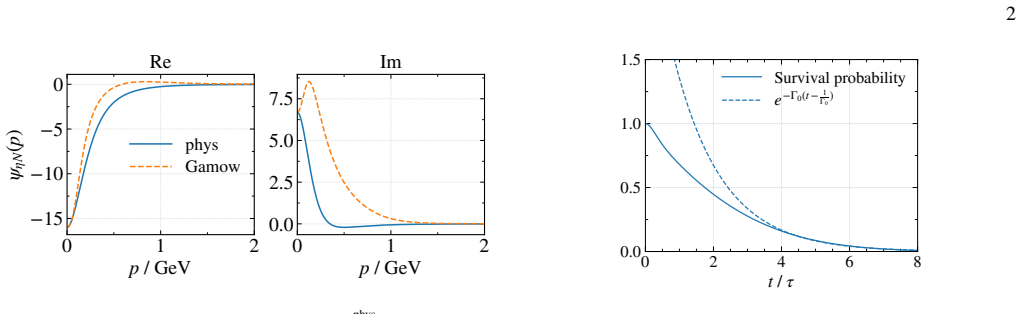
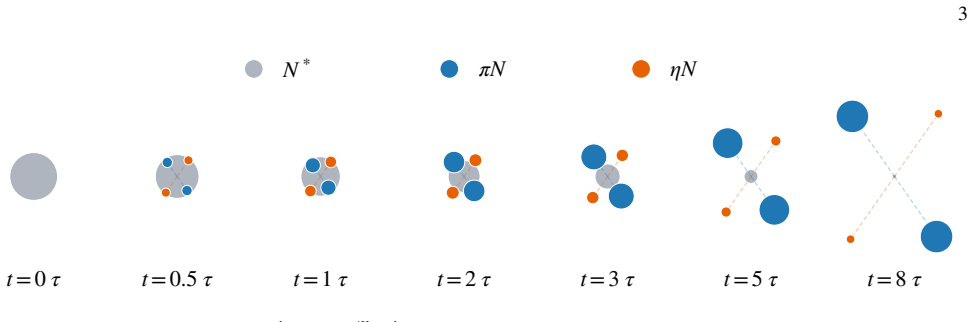
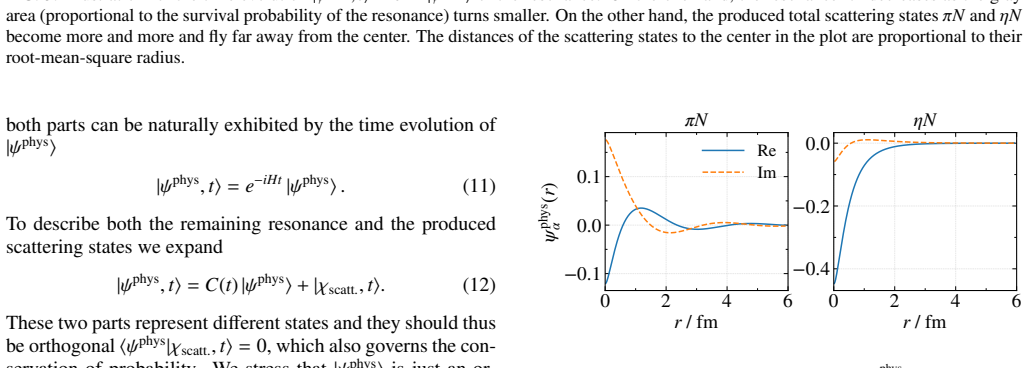
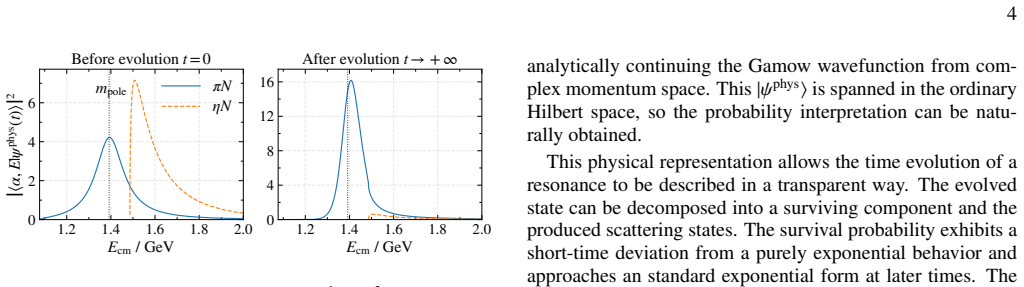
The resonance is represented by the Gamow vector in complex momentum space. Its representation in real momentum space is obtained through analytical continuation of the Gamow wavefunction, which satisfies the Hamiltonian eigenequation with the assistance of discrete virtual state vectors having kinetic energies equal to the complex eigenmass. The time evolution of this physical state describes both the decreasing behavior of the resonance and the production of decayed scattering states. At initial time, it gives finite-range confinement, while at large times it provides a Breit-Wigner-like distribution of final scattering states with appearance probability nonzero as r approaches infinity.
What carries the argument
The analytically continued Gamow wavefunction in real momentum space, assisted by discrete virtual state vectors.
If this is right
- The initial state at t=0 is confined to a finite range.
- The asymptotic state at large t follows a Breit-Wigner distribution for scattering states with nonzero probability as r to infinity.
- The time evolution operator applied to the physical state captures both resonance decay and scattering state production simultaneously.
- Numerical results from the hadron physics toy model confirm the described picture.
Where Pith is reading between the lines
- This representation might enable direct computation of resonance properties in real space without complex contours.
- It could be applied to study how resonances manifest in scattering experiments at large distances.
- The role of virtual states suggests examining their contribution in other decay processes.
Load-bearing premise
The analytical continuation of the Gamow wavefunction to real momentum space satisfies the Hamiltonian eigenequation only with the assistance of a few discrete virtual state vectors whose kinetic energies equal the complex eigenmass.
What would settle it
Numerical simulation in the toy model checking whether the time-evolved state at large t has a spatial distribution matching Breit-Wigner form with nonzero probability at infinity, or whether the eigenequation fails without the virtual states.
Figures
read the original abstract
A resonance can be represented by the Gamow vector $|\psi^{\rm Gamow}\rangle$ in the complex momentum space $|\vec p e^{-i\theta}\rangle$. In this work we revisit its representation $|\psi^{\rm phys}\rangle$ in the real momentum space $|\vec p \rangle$ through the analytical continuation of Gamow wavefunction, which also satisfies with the Hamilton eigenequation with the assistance of a few discrete virtual state vectors whose kinetic energies are the complex eigenmass. Both the decreasing behavior of the resonance and the production of the decayed scattering states can be both simultaneously described by the time evolution $|\psi^{\rm phys},t\rangle=\exp(-iH t) \, |\psi^{\rm phys}\rangle$. The $|\psi^{\rm phys},t=0\rangle$ gives the finite-range confinement of the resonance while the $|\psi^{\rm phys},t\to +\infty\rangle$ provides a Breit-Wigner-like distribution of the final scattering states whose appearance probability is nonzero as $r\to \infty$. A toy model in hadron physics is used and numerically shows the above picture.
Editorial analysis
A structured set of objections, weighed in public.
Referee Report
Summary. The manuscript claims that analytically continuing the Gamow wavefunction from complex to real momentum space, supplemented by a few discrete virtual state vectors whose kinetic energies equal the complex resonance mass, yields a state |ψ^phys⟩ that satisfies the Hamiltonian eigenequation H|ψ^phys⟩ = E_complex |ψ^phys⟩. Unitary time evolution |ψ^phys,t⟩ = exp(−iHt) |ψ^phys⟩ then simultaneously describes the finite-range spatial confinement of the resonance at t=0 and the emergence of a Breit-Wigner-like distribution of scattering states with nonzero probability at r→∞ as t→+∞. The construction is illustrated numerically with a toy model in hadron physics.
Significance. If rigorously justified within standard quantum mechanics, the approach would provide a concrete bridge between Gamow vectors and physical Hilbert-space states, allowing simultaneous treatment of resonance decay and asymptotic scattering distributions without explicit complex scaling. This could be useful for modeling resonances in hadron physics where both spatial and temporal aspects matter. The toy-model numerics offer a concrete check, but the absence of error analysis or comparison to known limits (e.g., narrow-width approximation) limits immediate impact.
major comments (2)
- [abstract and section on analytical continuation] The central claim that the analytically continued Gamow wavefunction plus discrete virtual states satisfies H|ψ^phys⟩ = E_complex |ψ^phys⟩ with Im(E) ≠ 0 (abstract and the section on construction of |ψ^phys⟩) is load-bearing for the subsequent time-evolution argument, yet appears to conflict with the spectral theorem for self-adjoint Hamiltonians on L²(ℝ³), which admits only real eigenvalues. The manuscript must clarify whether |ψ^phys⟩ lies in the physical Hilbert space, whether the equation holds only in a distributional or rigged-Hilbert-space sense, or whether the virtual states render the construction approximate; without this, the asserted exact properties at t=0 and t→+∞ cannot be guaranteed.
- [numerical results section] The toy-model numerics (section on numerical results) are presented as confirmation, but no quantitative comparison is given to the expected exponential decay law or to the exact Breit-Wigner lineshape in the t→∞ limit; the reported distributions could be consistent with many alternative constructions. A direct check against the known analytic continuation properties of the S-matrix pole would strengthen the claim.
minor comments (3)
- [notation and definitions] Notation for the continued wavefunction and the virtual-state vectors should be introduced with explicit definitions (e.g., how the kinetic energies are assigned) to avoid ambiguity when the same symbol is used for both complex and real momenta.
- [abstract] The abstract states that both decreasing behavior and production of scattering states are 'simultaneously described'; a short paragraph contrasting this with the standard exponential decay plus asymptotic free evolution would help readers situate the result.
- [figures] Figure captions in the toy-model section should include the specific parameter values (mass, width, cutoff) used for each panel so that the plots can be reproduced from the text alone.
Simulated Author's Rebuttal
We thank the referee for the thorough review and constructive feedback on our manuscript. The comments highlight important points regarding the mathematical foundations and numerical validation, which we address below. We will incorporate clarifications and additional analyses in a revised version.
read point-by-point responses
-
Referee: [abstract and section on analytical continuation] The central claim that the analytically continued Gamow wavefunction plus discrete virtual states satisfies H|ψ^phys⟩ = E_complex |ψ^phys⟩ with Im(E) ≠ 0 (abstract and the section on construction of |ψ^phys⟩) is load-bearing for the subsequent time-evolution argument, yet appears to conflict with the spectral theorem for self-adjoint Hamiltonians on L²(ℝ³), which admits only real eigenvalues. The manuscript must clarify whether |ψ^phys⟩ lies in the physical Hilbert space, whether the equation holds only in a distributional or rigged-Hilbert-space sense, or whether the virtual states render the construction approximate; without this, the asserted exact properties at t=0 and t→+∞ cannot be guaranteed.
Authors: The construction is formulated within the rigged Hilbert space (RHS) framework, which is the standard setting for Gamow vectors and allows eigenvectors with complex eigenvalues outside the physical L² Hilbert space. The analytical continuation of the Gamow wavefunction to real momentum, combined with the discrete virtual states (whose inclusion compensates for the continuation to satisfy the eigenequation), is understood in the distributional sense of the RHS. This does not violate the spectral theorem, which applies strictly to the self-adjoint operator on L²; |ψ^phys⟩ is not claimed to be a normalizable element of L². We will revise the abstract and the relevant section to explicitly reference the RHS and distributional interpretation, making clear that the complex eigenvalue holds in this extended sense rather than as an approximate construction. revision: yes
-
Referee: [numerical results section] The toy-model numerics (section on numerical results) are presented as confirmation, but no quantitative comparison is given to the expected exponential decay law or to the exact Breit-Wigner lineshape in the t→∞ limit; the reported distributions could be consistent with many alternative constructions. A direct check against the known analytic continuation properties of the S-matrix pole would strengthen the claim.
Authors: We agree that quantitative benchmarks are needed to strengthen the numerical evidence. In the revision, we will add direct comparisons: (i) the survival probability |⟨ψ^phys|ψ^phys(t)⟩| versus the expected exponential decay exp(−Γt) from the resonance width, (ii) the asymptotic momentum distribution at large t against the Breit-Wigner lineshape, and (iii) consistency checks with the S-matrix pole position obtained from the toy-model potential. Error estimates arising from the finite discretization and momentum cutoff will also be included. These additions will help rule out consistency with unrelated constructions. revision: yes
Circularity Check
Complex eigenequation satisfied only by construction via added virtual states; time-evolution properties follow tautologically
specific steps
-
self definitional
[Abstract]
"which also satisfies with the Hamilton eigenequation with the assistance of a few discrete virtual state vectors whose kinetic energies are the complex eigenmass. Both the decreasing behavior of the resonance and the production of the decayed scattering states can be both simultaneously described by the time evolution |ψ^phys,t⟩=exp(−iHt) |ψ^phys⟩."
The state |ψ^phys⟩ is defined via continuation plus the added virtual vectors precisely so that H|ψ^phys⟩ = E_complex |ψ^phys⟩ holds; the time-evolution properties (exponential decrease from Im(E) and asymptotic Breit-Wigner distribution) are then immediate algebraic consequences of that eigenvalue equation rather than an independent result.
full rationale
The paper's central derivation asserts that the analytically continued Gamow wavefunction in real momentum space satisfies the complex-eigenvalue equation only after supplementing it with discrete virtual states whose energies match the complex eigenmass. The claimed simultaneous description of resonance decay and asymptotic scattering states via unitary time evolution then follows directly from this constructed eigenequation (exponential factor from complex E). This matches the self-definitional pattern: the load-bearing property is inserted by definition rather than derived independently. The toy-model numerics illustrate the picture but do not remove the definitional step. No other circularity patterns (self-citation chains, fitted predictions, or ansatz smuggling) are exhibited in the provided text.
Axiom & Free-Parameter Ledger
Reference graph
Works this paper leans on
-
[1]
Breit and E
G. Breit and E. Wigner, Capture of Slow Neutrons, Phys. Rev. 49, 519 (1936)
1936
-
[2]
J. R. Taylor, Scattering Theory: The Quantum Theory of Non- relativistic Collisions (1972)
1972
-
[3]
Moiseyev, Quantum theory of resonances: calculating ener- gies, widths and cross-sections by complex scaling, Phys
N. Moiseyev, Quantum theory of resonances: calculating ener- gies, widths and cross-sections by complex scaling, Phys. Rept. 302, 212 (1998)
1998
-
[4]
Willenbrock, Mass and width of an unstable particle, Eur
S. Willenbrock, Mass and width of an unstable particle, Eur. Phys. J. Plus139, 523 (2024)
2024
-
[5]
Matsuyama, T
A. Matsuyama, T. Sato, and T. S. H. Lee, Dynamical coupled- channel model of meson production reactions in the nucleon resonance region, Phys. Rept.439, 193 (2007)
2007
-
[6]
Drechsel, S
D. Drechsel, S. S. Kamalov, and L. Tiator, Unitary Isobar Model - MAID2007, Eur. Phys. J. A34, 69 (2007)
2007
-
[7]
R ¨onchen, M
D. R ¨onchen, M. D ¨oring, F. Huang, H. Haberzettl, J. Haiden- bauer, C. Hanhart, S. Krewald, U. G. Meißner, and K. Nakayama, Photocouplings at the Pole from Pion Photopro- duction, Eur. Phys. J. A50, 101 (2014), [Erratum: Eur.Phys.J.A 51, 63 (2015)]
2014
-
[8]
W. J. Briscoe, A. Schmidt, I. Strakovsky, R. L. Workman, and A. Svarc (SAID Group), Extended SAID partial-wave analysis of pion photoproduction, Phys. Rev. C108, 065205 (2023)
2023
-
[9]
D ¨oring, J
M. D ¨oring, J. Haidenbauer, M. Mai, and T. Sato, Dynamical coupled-channel models for hadron dynamics, Prog. Part. Nucl. Phys.146, 104213 (2026)
2026
-
[10]
V . Baru, J. Haidenbauer, C. Hanhart, Y . Kalashnikova, and A. E. Kudryavtsev, Evidence that the a(0)(980) and f(0)(980) are not elementary particles, Phys. Lett. B586, 53 (2004)
2004
-
[11]
Wang, X.-W
Z.-Q. Wang, X.-W. Kang, J. A. Oller, and L. Zhang, Analysis on the composite nature of the light scalar mesons f0(980) and a0(980), Phys. Rev. D105, 074016 (2022)
2022
-
[12]
Wang, U.-G
Y .-F. Wang, U.-G. Meißner, D. R¨onchen, and C.-W. Shen, Ex- amination of the nature of the N* and∆resonances via coupled- channels dynamics, Phys. Rev. C109, 015202 (2024)
2024
-
[13]
L. A. Heuser, G. Chanturia, F. K. Guo, C. Hanhart, M. Hoferichter, and B. Kubis, From pole parameters to line 5 shapes and branching ratios, Eur. Phys. J. C84, 599 (2024)
2024
-
[14]
P. D. Mannheim, Critique of Breit-Wigner resonance scattering (2026), arXiv:2605.28756 [hep-ph]
work page internal anchor Pith review Pith/arXiv arXiv 2026
-
[15]
Weinberg, Evidence That the Deuteron Is Not an Elementary Particle, Phys
S. Weinberg, Evidence That the Deuteron Is Not an Elementary Particle, Phys. Rev.137, B672 (1965)
1965
-
[16]
Y . S. Kalashnikova and A. V . Nefediev, Nature of X(3872) from data, Phys. Rev. D80, 074004 (2009)
2009
-
[17]
Gamermann, J
D. Gamermann, J. Nieves, E. Oset, and E. Ruiz Arriola, Cou- plings in coupled channels versus wave functions: application to the X(3872) resonance, Phys. Rev. D81, 014029 (2010)
2010
-
[18]
V . Baru, C. Hanhart, Y . S. Kalashnikova, A. E. Kudryavtsev, and A. V . Nefediev, Interplay of quark and meson degrees of freedom in a near-threshold resonance, Eur. Phys. J. A44, 93 (2010)
2010
-
[19]
Hanhart, Y
C. Hanhart, Y . S. Kalashnikova, and A. V . Nefediev, Interplay of quark and meson degrees of freedom in a near-threshold res- onance: multi-channel case, Eur. Phys. J. A47, 101 (2011)
2011
-
[20]
Hyodo, D
T. Hyodo, D. Jido, and A. Hosaka, Compositeness of dynami- cally generated states in a chiral unitary approach, Phys. Rev. C 85, 015201 (2012)
2012
-
[21]
Aceti and E
F. Aceti and E. Oset, Wave functions of composite hadron states and relationship to couplings of scattering amplitudes for gen- eral partial waves, Phys. Rev. D86, 014012 (2012)
2012
-
[22]
Sekihara, T
T. Sekihara, T. Arai, J. Yamagata-Sekihara, and S. Yasui, Compositeness of baryonic resonances: Application to the ∆(1232),N(1535), andN(1650) resonances, Phys. Rev. C93, 035204 (2016)
2016
-
[23]
Kamiya and T
Y . Kamiya and T. Hyodo, Structure of near-threshold quasi- bound states, Phys. Rev. C93, 035203 (2016)
2016
-
[24]
Guo and J
Z.-H. Guo and J. A. Oller, Probabilistic interpretation of com- positeness relation for resonances, Phys. Rev. D93, 096001 (2016)
2016
-
[25]
Sekihara, Two-body wave functions and compositeness from scattering amplitudes
T. Sekihara, Two-body wave functions and compositeness from scattering amplitudes. I. General properties with schematic models, Phys. Rev. C95, 025206 (2017)
2017
-
[26]
Kang, Z.-H
X.-W. Kang, Z.-H. Guo, and J. A. Oller, General considerations on the nature ofZ b(10610) andZ b(10650) from their pole posi- tions, Phys. Rev. D94, 014012 (2016)
2016
-
[27]
J. A. Oller, New results from a number operator interpreta- tion of the compositeness of bound and resonant states, Annals Phys.396, 429 (2018)
2018
-
[28]
Li, F.-K
Y . Li, F.-K. Guo, J.-Y . Pang, and J.-J. Wu, Generalization of Weinberg’s compositeness relations, Phys. Rev. D105, L071502 (2022)
2022
-
[29]
Kinugawa and T
T. Kinugawa and T. Hyodo, Compositeness of hadrons, nuclei, and atomic systems, Eur. Phys. J. A61, 154 (2025)
2025
-
[30]
Fonda, G
L. Fonda, G. C. Ghirardi, and A. Rimini, Decay Theory of Un- stable Quantum Systems, Rept. Prog. Phys.41, 587 (1978)
1978
-
[31]
C. B. Chiu, E. C. G. Sudarshan, and B. Misra, Time Evolution of Unstable Quantum States and a Resolution of Zeno’s Para- dox, Phys. Rev. D16, 520 (1977)
1977
-
[32]
L. A. Khalfin, The Proton Nonstability and the Nonexponen- tiality of the Decay Law, Phys. Lett. B112, 223 (1982)
1982
-
[33]
E. B. Norman, S. B. Gazes, S. G. Crane, and D. A. Bennett, Tests of the Exponential Decay Law at Short and Long Times, Phys. Rev. Lett.60, 2246 (1988)
1988
-
[34]
Nakazato, M
H. Nakazato, M. Namiki, and S. Pascazio, Temporal behavior of quantum mechanical systems, Int. J. Mod. Phys. B10, 247 (1996)
1996
-
[35]
Rothe, S
C. Rothe, S. I. Hintschich, and A. P. Monkman, Violation of the Exponential-Decay Law at Long Times, Phys. Rev. Lett.96, 163601 (2006)
2006
-
[36]
D. F. Ram ´ırez Jim´enez and N. G. Kelkar, Quantum decay law: Critical times and the Equivalence of approaches, J. Phys. A52, 055201 (2019)
2019
-
[37]
S. M. Wang, W. Nazarewicz, A. V olya, and Y . G. Ma, Prob- ing the nonexponential decay regime in open quantum systems, Phys. Rev. Res.5, 023183 (2023)
2023
-
[38]
W. A. Yamada, O. Morimatsu, T. Sato, and K. Yazaki, Survival probability of unstable states in coupled-channels: Nonexpo- nential decay of threshold cusp, Phys. Rev. D108, L071502 (2023)
2023
-
[39]
Aguilar and J
J. Aguilar and J. M. Combes, A class of analytic perturbations for one-body schroedinger hamiltonians, Commun. Math. Phys. 22, 269 (1971)
1971
-
[40]
Balslev and J
E. Balslev and J. M. Combes, Spectral properties of many- body schroedinger operators with dilatation-analytic interac- tions, Commun. Math. Phys.22, 280 (1971)
1971
-
[41]
C. D. Abell, D. B. Leinweber, Z.-W. Liu, A. W. Thomas, and J.-J. Wu, Low-lying odd-parity nucleon resonances as quark- model-like states, Phys. Rev. D108, 094519 (2023)
2023
-
[42]
E. P. Wigner, Lower Limit for the Energy Derivative of the Scat- tering Phase Shift, Phys. Rev.98, 145 (1955)
1955
discussion (0)
Sign in with ORCID, Apple, or X to comment. Anyone can read and Pith papers without signing in.