Critique of Breit-Wigner resonance scattering
Pith reviewed 2026-06-29 11:19 UTC · model grok-4.3
The pith
The Breit-Wigner complex pole is not an energy eigenvalue and produces exponentially growing wave functions, while PT symmetry yields conjugate energy pairs with one observable resonance.
A machine-rendered reading of the paper's core claim, the machinery that carries it, and where it could break.
Core claim
Because of its antilinear PT symmetry, solutions to the square well Schrödinger equation appear in complex conjugate energy pairs E∓ = E2 ∓ i Γ2 with E− ≠ E_BW, giving a time-independent probability amplitude that neither grows nor decays in time or space and leading to just one now observable physical resonance.
What carries the argument
Antilinear PT symmetry of the square well potential, which forces scattering solutions to appear in conjugate energy pairs rather than isolated complex poles.
If this is right
- The standard identification of the Breit-Wigner pole E_BW with an unstable physical particle is invalid.
- Energy-decaying states must be rejected if their spatial wave functions grow exponentially.
- Scattering data yield only one observable resonance rather than two from conjugate pairs.
- The phase-shift parameter Gamma1 can take negative values without violating unitarity.
Where Pith is reading between the lines
- Resonance analyses in other short-range potentials may need to replace isolated complex poles with PT-symmetric conjugate pairs.
- Time-independent probability amplitudes allow resonances to be treated as stationary states for probability calculations.
- Reinterpretation of existing particle data could reduce the number of reported resonances by half in some channels.
Load-bearing premise
The square well potential and its PT symmetry properties represent the essential physics in realistic resonance scattering problems where the Breit-Wigner approach is applied.
What would settle it
Measurement of an exponentially growing spatial wave function for a resonance state, or detection of two distinct observable resonances corresponding to a conjugate energy pair, would test the claims.
Figures

read the original abstract
In the standard Breit-Wigner approach to scattering the phase shift is to have a form $\tan\delta_{\rm BW} =\Gamma_1/(E_1-E)$ at a real energy resonance. This leads to complex energy poles in the scattering amplitude at $E_{\rm BW}=E_1-i\Gamma_1$, poles that are identified with unstable physical particles. By solving the square well scattering problem we identify some challenges to this approach. We find that setting $\tan\delta_{\rm BW} =\Gamma_1/(E_1-E)$ is not always a good description of the real energy scattering amplitude, that $\Gamma_1$ can be negative, that $E_{\rm BW}$ is not in fact an energy eigenvalue (and thus not a physical particle), and that states that decay in energy possess spatial wave functions that unacceptably grow exponentially. All of this is resolved by noting that because of its antilinear $PT$ symmetry solutions to the square well Schr\"odinger equation appear in complex conjugate energy pairs $E_{\mp}=E_2\mp i \Gamma_2$ with $E_- \neq E_{\rm BW}$, doing so in a way that gives a time independent probability amplitude that neither grows nor decays in time or space, and leads to just one now observable physical resonance not two.
Editorial analysis
A structured set of objections, weighed in public.
Referee Report
Summary. The paper critiques the Breit-Wigner parametrization of resonance scattering by exactly solving the square-well Schrödinger equation. It reports that the form tan δ_BW = Γ1/(E1 - E) does not always match the real-energy scattering amplitude, that Γ1 can be negative, that the complex pole E_BW is not an energy eigenvalue, and that energy-decaying states produce spatially exponentially growing wave functions. These issues are claimed to be resolved by PT symmetry, which produces complex-conjugate eigenvalue pairs E∓ = E2 ∓ i Γ2 (with E- ≠ E_BW) whose associated probability density is time-independent and yields only a single observable physical resonance.
Significance. If the central claims were shown to hold beyond the square-well model, the work would challenge the standard identification of Breit-Wigner poles with physical resonances in particle phenomenology. The explicit square-well solutions constitute a reproducible calculation, but the manuscript does not demonstrate that the PT-symmetric construction reproduces the finite-lifetime exponential decay required of resonances.
major comments (2)
- [Abstract] Abstract (final paragraph): the assertion that PT-symmetric solutions produce 'a time independent probability amplitude that neither grows nor decays in time or space' is incompatible with the defining property of a resonance, namely |ψ(t)|² ∼ e^{-Γ t} with Γ > 0. This internal mismatch means the proposed alternative does not describe the decaying states that Breit-Wigner is intended to model.
- [Abstract] Abstract (paragraph on square-well solution): the leap from the square-well results to the general claim that 'E_BW is not in fact an energy eigenvalue (and thus not a physical particle)' and that Breit-Wigner is therefore invalidated rests on a single exactly solvable model without demonstrated robustness under changes to the potential or comparison to standard resonance calculations in the literature.
minor comments (1)
- [Abstract] Notation: the subscripts on E∓, E2, Γ2 are introduced without an explicit definition of the indexing convention used for the PT pair.
Simulated Author's Rebuttal
We thank the referee for their detailed review. We respond to each major comment below and note revisions where appropriate.
read point-by-point responses
-
Referee: [Abstract] Abstract (final paragraph): the assertion that PT-symmetric solutions produce 'a time independent probability amplitude that neither grows nor decays in time or space' is incompatible with the defining property of a resonance, namely |ψ(t)|² ∼ e^{-Γ t} with Γ > 0. This internal mismatch means the proposed alternative does not describe the decaying states that Breit-Wigner is intended to model.
Authors: The referee correctly notes that our PT-symmetric construction yields time-independent probability densities, which does not reproduce the exponential decay |ψ(t)|² ∼ e^{-Γ t}. The manuscript's focus is on resolving inconsistencies in the Breit-Wigner approach, such as possible negative widths, non-eigenvalue poles, and spatially growing wave functions for decaying states. The PT pairing provides conjugate eigenvalues with conserved probability, avoiding those problems. We agree this creates a distinction from standard resonance modeling and will revise the abstract to clarify that the approach prioritizes eigenvalue structure and probability conservation over temporal decay. revision: yes
-
Referee: [Abstract] Abstract (paragraph on square-well solution): the leap from the square-well results to the general claim that 'E_BW is not in fact an energy eigenvalue (and thus not a physical particle)' and that Breit-Wigner is therefore invalidated rests on a single exactly solvable model without demonstrated robustness under changes to the potential or comparison to standard resonance calculations in the literature.
Authors: The square-well potential is selected specifically because it allows exact analytic solutions, making it possible to compute the phase shift explicitly and demonstrate mismatches with the Breit-Wigner form as well as the non-eigenvalue character of E_BW. The underlying issues arise from the analytic continuation of the scattering amplitude and the antilinear PT symmetry of the real-potential Schrödinger equation, features that are not unique to this model. We will add discussion of the generality of these PT-symmetric conjugate pairs and include comparisons to known resonance results in the literature for other potentials. revision: partial
- The PT-symmetric construction does not reproduce the finite-lifetime exponential decay |ψ(t)|² ∼ e^{-Γ t} required of resonances, as the probability amplitude is time-independent by construction.
Circularity Check
No significant circularity; derivation from direct SE solution
full rationale
The paper derives its claims by explicitly solving the square-well Schrödinger equation, extracting the scattering phase shift and energy eigenvalues, and invoking the antilinear PT symmetry of the Hamiltonian to obtain conjugate energy pairs. No step reduces a claimed prediction to a fitted parameter by construction, renames a known result, or relies on a load-bearing self-citation whose content is itself unverified. The central assertions follow from the differential-equation solution and the symmetry property without self-referential definitions or statistical forcing.
Axiom & Free-Parameter Ledger
axioms (1)
- domain assumption The square well potential possesses antilinear PT symmetry leading to complex conjugate energy pairs.
Forward citations
Cited by 1 Pith paper
-
Revisiting Time Evolution and Spatial Distribution of a Resonance
Analytical continuation of Gamow wavefunctions to real momentum space, with discrete virtual states, yields time evolution from finite-range confined resonance to Breit-Wigner distributed scattering states at large distances.
Reference graph
Works this paper leans on
-
[1]
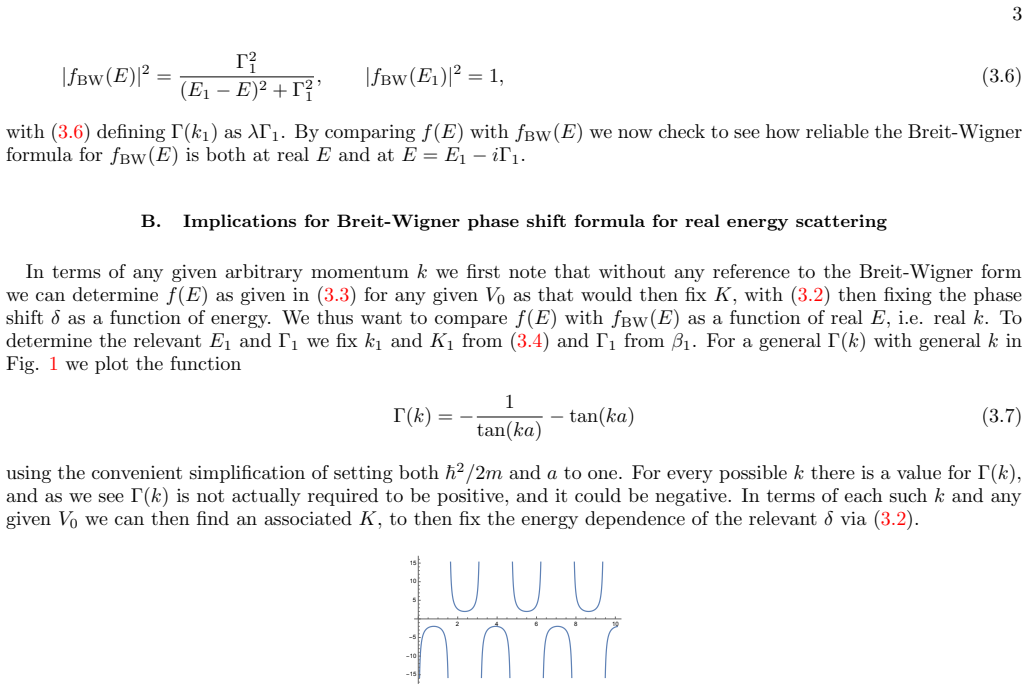
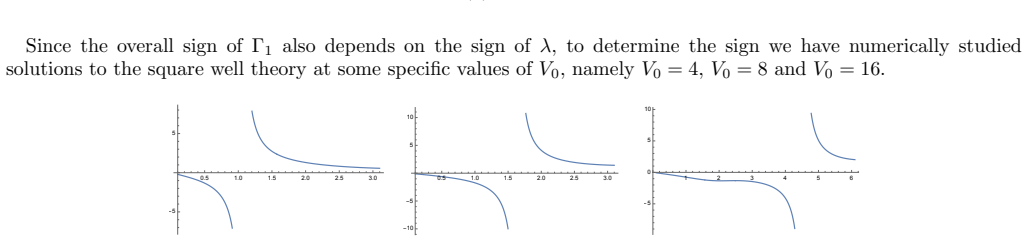
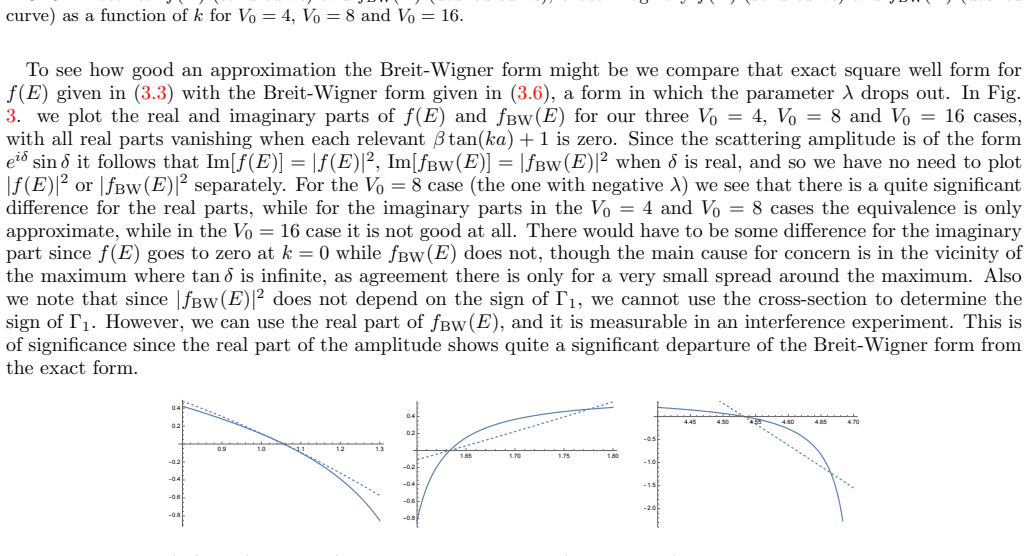
we plot the real and imaginary parts off(E) andf BW(E) for our threeV 0 = 4,V 0 = 8 andV 0 = 16 cases, with all real parts vanishing when each relevantβtan(ka) + 1 is zero. Since the scattering amplitude is of the form eiδ sinδit follows that Im[f(E)] =|f(E)| 2, Im[fBW(E)] =|f BW(E)|2 whenδis real, and so we have no need to plot |f(E)| 2 or|f BW(E)|2 sepa...
-
[2]
E. P. Wigner, Phys. Rev. D98, 145 (1955)
1955
-
[3]
P. D. Mannheim,PT symmetry and the square well potential: Antilinear symmetry rather than Hermiticity in scattering processes, arXiv:2505:07798 [quant-ph]
-
[4]
C. M. Bender and S. Boettcher, Phys. Rev. Lett.80, 5243 (1998)
1998
-
[5]
C. M. Bender, S. Boettcher and P. N. Meisinger, J. Math. Phys.40, 2201 (1999)
1999
-
[6]
Mostafazadeh, J
A. Mostafazadeh, J. Math. Phys.43, 205 (2002); J. Math. Phys.43, 2814 (2002); J. Math. Phys.43, 3944 (2202)
2002
-
[7]
C. M. Bender, D. C. Brody and H. F. Jones, Phys. Rev. Lett.89, 270401 (2002)
2002
-
[8]
C. M. Bender, Rep. Prog. Phys.70, 947 (2007)
2007
-
[9]
K. G. Makris, R. El-Ganainy, D. N. Christodoulides and Z. H. Musslimani, Phys. Rev. Lett.100, 103904 (2008)
2008
-
[10]
C. M. Bender and P. D. Mannheim, Phys. Rev. Lett.100, 110402 (2008)
2008
-
[11]
C. M. Bender and P. D. Mannheim, Phys. Rev. D78, 025022 (2008)
2008
-
[12]
A. Guo, G. J. Salamo, D. Duchesne, R. Morandotti, M. Volatier-Ravat, V. Aimez, G. A. Siviloglou and D. N. Christodoulides, Phys. Rev. Lett.103, 093902 (2009)
2009
-
[13]
C. M. Bender and P. D. Mannheim, Phys. Lett. A374, 2616 (2010). [13]Special issue on quantum physics with non-Hermitian operators, C. Bender, A. Fring, U. G¨ unther, and H. Jones (Guest Editors) J. Phys. A: Math. Theor.45, 444001 - 444036 (2012). [14]Theme issue on PT quantum mechanics, C. M. Bender, M. DeKieviet, and S. P. Klevansky (Guest Editors) Phil....
2010
-
[14]
El-Ganainy, K
R. El-Ganainy, K. G. Makris, M. Khajavikhan, Z. H. Musslimasni, S. Rotter and D. M. Christodoulides, Nature Phys.14, 1119 (2018)
2018
-
[15]
P. D. Mannheim, J. Phys. A: Math. Theor.3, 315302 (2018)
2018
-
[16]
C. M. Bender,PT Symmetry in Quantum And Classical Physics, World Scientific Press, Singapore (2018)
2018
-
[17]
Fring, F
A. Fring, F. Correa and C. M. Bender, Proceedings of Virtual seminar series on Pseudo-Hermitian Hamiltonians in Quantum Physics, Journal of Physics Conference Series, Vol.2038(2021)
2038
-
[18]
P. D. Mannheim, Phys. Rev. D112, L031903 (2025)
2025
-
[19]
E. P. Wigner, J. Math. Phys.1, 409 (1960)
1960
-
[20]
P. A. M. Dirac, Proc. Roy. Soc. A180, 1 (1942)
1942
-
[21]
Pauli, Rev
W. Pauli, Rev. Mod. Phys.15, 175 (1943)
1943
-
[22]
P. D. Mannheim, Int. J. Mod. Phys. D33, 2441016 (2024)
2024
-
[23]
P. D. Mannheim, Phil. Trans. R. Soc. A371, 20120060 (2013)
2013
-
[24]
T. D. Lee and G. C. Wick, Nucl. Phys. B9, 209 (1969); Nucl. Phys. B10, 1 (1969); Phys. Rev. D2, 1033 (1970)
1969
-
[25]
In their original approach Dirac and Pauli introduced a unitarity-violating negative Hilbert space metric and a propagator of the form 1/(k 2 −M 2 1 )−1/(k 2 −M 2 2 ) with a relative minus sign, as it would be more convergent at largek 2 than the standard single pole 1/(k 2 −M 2 1 ). To avoid the indefinite metric Lee and Wick introduced the complex conju...
-
[26]
Sinclair, D
J. Sinclair, D. Angulo, K. Thompson, K. Bonsma-Fisher, A. Brodutch and A. M. Steinberg, PRX Quantum3, 010314 (2022)
2022
- [27]
discussion (0)
Sign in with ORCID, Apple, or X to comment. Anyone can read and Pith papers without signing in.