Reshaping Undergraduate Computer Science Education in the Generative AI Era
Pith reviewed 2026-07-01 00:52 UTC · model grok-4.3
The pith
CS curricula should shift from teaching implementation skills to understanding and verifying AI-generated artifacts.
A machine-rendered reading of the paper's core claim, the machinery that carries it, and where it could break.
Core claim
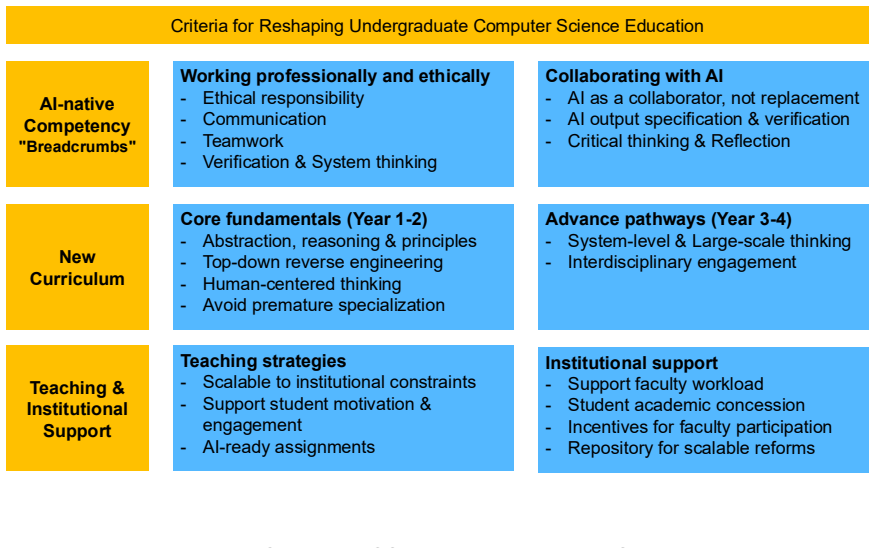
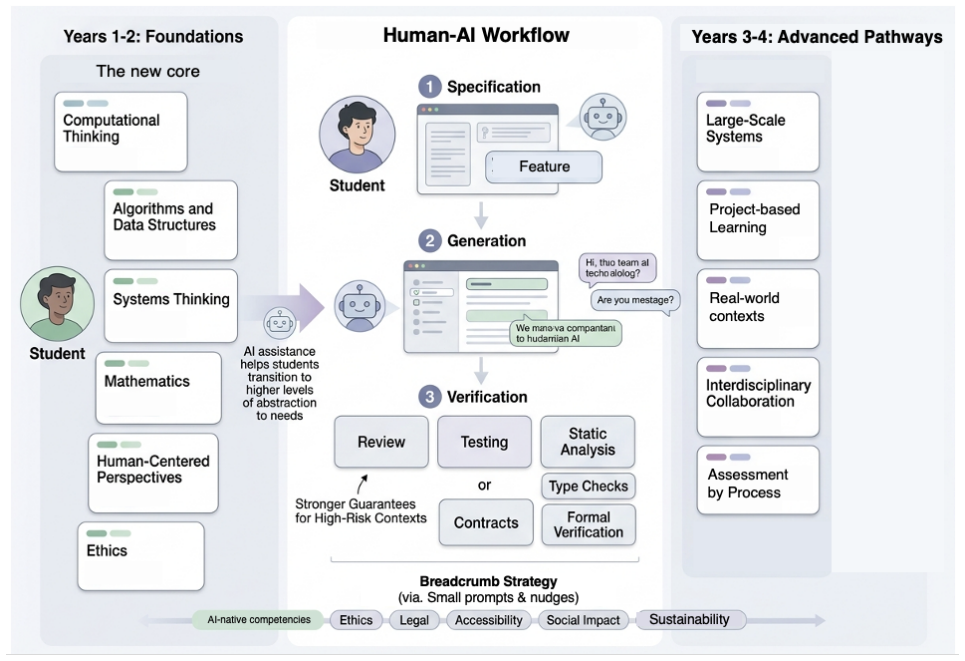
The central claim is that to prepare future computer science graduates for creating, solving problems, and co-creating with AI, curricula must foster AI-native competencies, re-center fundamental education on abstraction and design, enhance advanced pathways, embrace new pedagogies, and shift institutional support, all derived from workshop identification of preserved versus less important skills.
What carries the argument
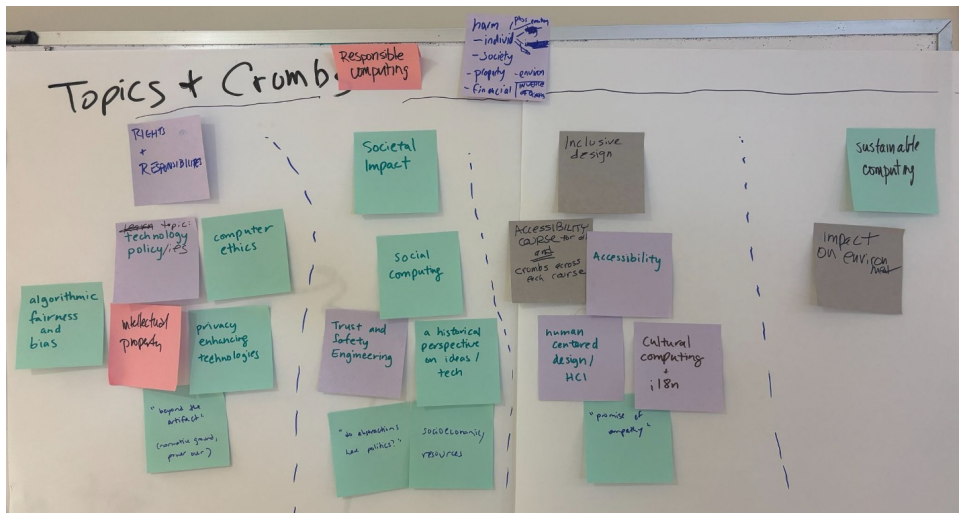
The breadcrumbs approach of embedding helpful nudges and engaging exercises for new competencies directly into the current curriculum structure.
If this is right
- Students will practice verifying and refining AI outputs as a core activity rather than writing code from scratch.
- System design and abstraction will receive more instructional time across multiple courses.
- Incremental updates can occur inside existing course sequences without waiting for full program redesign.
- Institutional policies will need to support new forms of assessment and faculty preparation for AI-integrated teaching.
Where Pith is reading between the lines
- Assessment methods may need to evolve to test students' ability to critique and improve AI artifacts rather than produce original code.
- Parallel adjustments could appear in adjacent fields such as information systems or software engineering programs.
- Early experiments could test whether short modules on AI output evaluation improve student outcomes in existing programming courses.
Load-bearing premise
The workshops produced representative and actionable insights about which skills will remain important for future graduates.
What would settle it
A controlled comparison of job performance or problem-solving outcomes between cohorts trained under the proposed verification-focused curriculum versus traditional implementation-focused training would show no advantage or a reversal of the predicted benefit.
Figures

read the original abstract
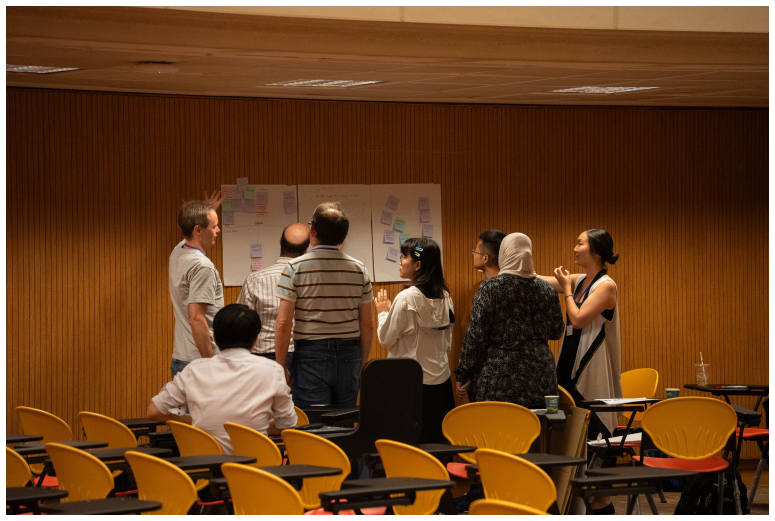
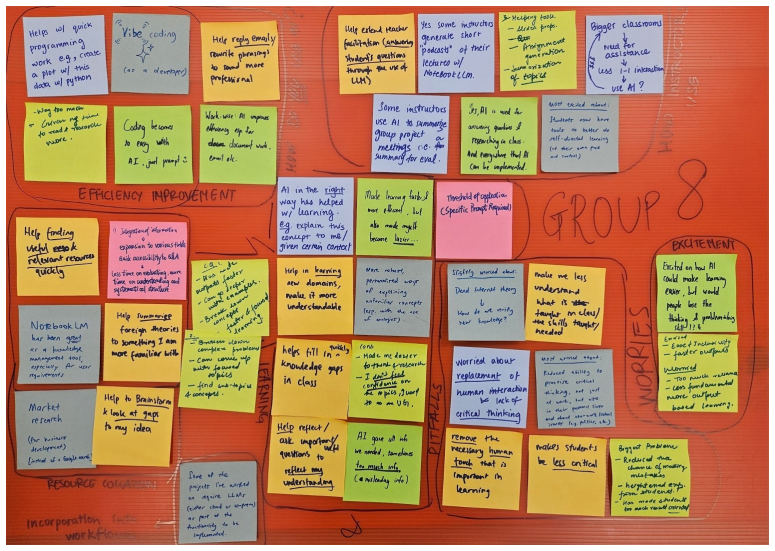
Generative AI represents a turning point for Computer Science (CS) education. In recent decades, post-secondary CS education has largely focused on what has been seen as practical software engineering skills: implementation-level programming, debugging, testing, and software design, analysis, and documentation. However, this framing is becoming less tenable as generative AI automates many of these tasks, challenging their centrality in CS education. To keep pace with advances in AI technology, CS curricula should consider a shift toward understanding and verifying AI-generated artifacts. This white paper outlines the findings of two international NUS-Google Workshops in Singapore, where we convened faculty members, industry practitioners, and students, and proposes a strategic response to reshape how CS should be taught at the undergraduate level. Based on the findings, we identify critical skills that must be preserved and those that are becoming less important. By incorporating these skills as "breadcrumbs," we can provide helpful nudges and engaging exercises within the current curriculum, enhancing learning experiences for everyone. We believe that to effectively prepare future computer science graduates, capable of creating, solving problems, and managing, as well as co-creating, artifacts with AI. It is important to consider a shift in curricula. Emphasizing system design, abstraction, and critical evaluation could greatly enhance their education and readiness for the challenges ahead. We propose prerequisites for solutions to reform CS education by fostering AI-native competencies, re-centering fundamental education, enhancing advanced pathways, embracing new pedagogies, and shifting institutional support.
Editorial analysis
A structured set of objections, weighed in public.
Referee Report
Summary. The paper claims that generative AI is automating core implementation, debugging, and design tasks traditionally central to undergraduate CS education, rendering that focus less tenable. Drawing on findings from two NUS-Google workshops in Singapore that convened faculty, industry practitioners, and students, it argues for a curriculum shift toward understanding, verifying, and co-creating with AI-generated artifacts. It identifies skills to preserve (system design, abstraction, critical evaluation) versus de-emphasize, introduces “breadcrumbs” as incremental exercises, and lists five prerequisites for reform: fostering AI-native competencies, re-centering fundamentals, enhancing advanced pathways, embracing new pedagogies, and shifting institutional support.
Significance. If the workshop-derived recommendations prove representative, the paper offers a timely, stakeholder-informed framework for adapting CS curricula to AI capabilities. The incremental “breadcrumbs” approach and explicit listing of institutional prerequisites provide concrete starting points that could influence departmental discussions and policy. The work’s strength lies in convening diverse voices (faculty, practitioners, students) rather than deriving claims from first principles or new empirical data.
major comments (2)
- [Abstract] Abstract (workshop description paragraph): The central recommendations for preserving system design, abstraction, and critical evaluation rest on the claim that the two workshops identified these as critical skills. However, the manuscript supplies no details on participant selection criteria, total numbers, session structure, recording methods, synthesis process, or handling of disagreement. This absence makes the specific skill list untraceable to verifiable evidence and leaves the curriculum-shift claim without a documented basis.
- [Findings and recommendations] Findings and recommendations section: The assertion that implementation-level programming is becoming less central is presented as following directly from AI automation, yet the text offers no counterexamples, capability benchmarks, or discussion of tasks that remain outside current generative-AI reach. Without such grounding, the premise that the traditional framing is “less tenable” cannot be evaluated against the workshops’ outputs.
minor comments (2)
- [Abstract] The term “breadcrumbs” is introduced in the abstract as “helpful nudges and engaging exercises” but receives no operational definition or examples in the provided text, reducing clarity for readers attempting to implement the proposal.
- [Proposed prerequisites] The five prerequisites for reform are enumerated without cross-references to specific workshop findings that support each item, making it difficult to assess how directly they derive from the convened discussions.
Simulated Author's Rebuttal
We thank the referee for the constructive comments, which identify opportunities to strengthen the evidential basis and transparency of the workshop-derived recommendations. We respond to each major comment below and indicate planned revisions.
read point-by-point responses
-
Referee: [Abstract] Abstract (workshop description paragraph): The central recommendations for preserving system design, abstraction, and critical evaluation rest on the claim that the two workshops identified these as critical skills. However, the manuscript supplies no details on participant selection criteria, total numbers, session structure, recording methods, synthesis process, or handling of disagreement. This absence makes the specific skill list untraceable to verifiable evidence and leaves the curriculum-shift claim without a documented basis.
Authors: We agree that the absence of methodological details limits traceability. The manuscript is a white paper summarizing consensus outcomes rather than a formal empirical study of the workshops. Participant selection was by invitation to NUS faculty, Google practitioners, and students; sessions used facilitated discussion rounds with iterative synthesis of themes. We will revise the abstract and add a short methods paragraph describing composition, structure, and consensus process to the extent records allow. revision: yes
-
Referee: [Findings and recommendations] Findings and recommendations section: The assertion that implementation-level programming is becoming less central is presented as following directly from AI automation, yet the text offers no counterexamples, capability benchmarks, or discussion of tasks that remain outside current generative-AI reach. Without such grounding, the premise that the traditional framing is “less tenable” cannot be evaluated against the workshops’ outputs.
Authors: The premise reflects workshop consensus on AI automating routine implementation. We acknowledge the lack of explicit counterexamples or limitation discussion. We will revise the findings section to include examples of tasks remaining outside current AI reach (e.g., novel architectural decisions under uncertainty, ethical oversight of AI outputs) and note current capability boundaries, providing better grounding against the workshop outputs. revision: yes
Circularity Check
No circularity; workshop synthesis is self-contained opinion reporting
full rationale
The paper reports outcomes from two NUS-Google workshops as the basis for curriculum recommendations, with no equations, fitted parameters, predictions, or derivations present. The central claims rest on participant convening and identified skills rather than any self-referential reduction, self-citation chain, or ansatz imported from prior author work. No load-bearing step reduces by construction to the paper's own inputs; the text functions as opinion synthesis without the enumerated circular patterns.
Axiom & Free-Parameter Ledger
axioms (1)
- domain assumption Generative AI automates many implementation-level programming, debugging, and documentation tasks
Reference graph
Works this paper leans on
-
[1]
P . AI. Introducing perplexity computer. URL https://www.perplexity.ai/hub/blog/ introducing-perplexity-computer
-
[2]
G. Amasanti and J. Jahic. The impact of ai-generated solutions on software architecture and productivity: Results from a survey study, 2025. URLhttps://arxiv.org/abs/2506.17833
-
[3]
Bastani, O
H. Bastani, O. Bastani, A. Sungu, H. Ge, Ö. Kabakcı, and R. Mariman. Generative ai without guardrails can harm learning: Evidence from high school mathematics.Proceedings of the National Academy of Sciences, 122(26):e2422633122, 2025
2025
-
[4]
Openai claims gpt-5 model boosts chatgpt to ’phd level’
BBC. Openai claims gpt-5 model boosts chatgpt to ’phd level’. URL https://www.bbc.com/ news/articles/cy5prvgw0r1o
-
[5]
Measuring the impact of early-2025 AI on experienced open-source developer productivity,
J. Becker, N. Rush, E. Barnes, and D. Rein. Measuring the impact of early-2025 ai on experi- enced open-source developer productivity.arXiv preprint arXiv:2507.09089, 2025
-
[6]
Brynjolfsson, B
E. Brynjolfsson, B. Chandar, and R. Chen. Canaries in the coal mine?: Six facts about the recent employment effects of artificial intelligence. 2025
2025
-
[7]
V. Charisi. Artificial intelligence in classrooms: Pedagogical dimensions. Briefing PE 784.574, European Parliament, Policy Department for Citizens, Equality and Culture, March
-
[8]
URL https://www.europarl.europa.eu/RegData/etudes/BRIE/2026/784574/IUST_ BRI(2026)784574_EN.pdf
2026
-
[9]
Choudhuri, A
R. Choudhuri, A. Ramakrishnan, A. Chatterjee, B. Trinkenreich, I. Steinmacher, M. Gerosa, and A. Sarma. Insights from the Frontline: GenAI Utilization Among Software Engineering Students. In2025 IEEE/ACM 37th International Conference on Software Engineering Education and Training (CSEE&T), pages 1–12. IEEE, 2025
2025
-
[10]
Thinking Less, Trusting More: GenAI's Impacts on Students' Cognitive Habits
R. Choudhuri, C. Sanchez, M. Burnett, and A. Sarma. Why johnny can’t think: Genai’s impacts on cognitive engagement.arXiv preprint arXiv:2601.22430, 2026
work page internal anchor Pith review Pith/arXiv arXiv 2026
-
[11]
T. Clear, A. Cajander, A. Clear, R. McDermott, M. Daniels, M. Divitini, M. Forshaw, N. Humble, M. Kasinidou, S. Kleanthous, C. Kultur, G. Parvini, M. Polash, and T. Zhu. Ai integration in the it professional workplace: A scoping review and interview study with implications for education and professional competencies. In2024 Working Group Reports on Innova...
-
[12]
Becker, James Finnie-Ansley, Arto Hellas, Juho Leinonen, Andrew Luxton-Reilly, Brent N
P . Denny, J. Prather, B. A. Becker, J. Finnie-Ansley, A. Hellas, J. Leinonen, A. Luxton-Reilly, B. N. Reeves, E. A. Santos, and S. Sarsa. Computing education in the era of generative ai.Commun. ACM, 67(2):56–67, Jan. 2024. ISSN 0001-0782. doi:10.1145/3624720. URL https://doi.org/10.1145/3624720. 35
-
[13]
P . Denny, V. Kumar, S. MacNeil, J. Prather, and J. Leinonen. Probing the unknown: Ex- ploring student interactions with probeable problems at scale in introductory programming. InProceedings of the 30th ACM Conference on Innovation and Technology in Computer Science Education V. 1, ITiCSE 2025, page 618–624, New Y ork, NY , USA, 2025. Associa- tion for C...
-
[14]
natural language programming
E. W. Dijkstra. On the foolishness of "natural language programming". InProgram Construction, International Summer Schoo, page 51–53, Berlin, Heidelberg, 1978. Springer-Verlag. ISBN 354009251X
1978
-
[15]
Dongol, C
B. Dongol, C. Dubois, S. Hallerstede, E. Hehner, C. Morgan, P . Müller, L. Ribeiro, A. Silva, G. Smith, and E. de Vink. On formal methods thinking in computer science education.Formal Aspects of Computing, 37(1):1–23, 2024
2024
-
[16]
Eaton and S
E. Eaton and S. L. Epstein. Artificial intelligence in the cs2023 undergraduate computer science curriculum: Rationale and challenges. InProceedings of the AAAI Conference on Artificial Intelligence, volume 38, pages 23078–23083, 2024
2024
-
[17]
Y . Fan, L. Tang, H. Le, K. Shen, S. Tan, Y . Zhao, Y . Shen, X. Li, and D. Gaševi´c. Beware of metacognitive laziness: Effects of generative artificial intelligence on learning motivation, processes, and performance.British Journal of Educational Technology, 56(2):489–530, 2025
2025
-
[18]
D. Gries. What should we teach in an introductory programming course? InProceedings of the Fourth SIGCSE Technical Symposium on Computer Science Education, SIGCSE ’74, page 81–89, New Y ork, NY , USA, 1974. Association for Computing Machinery. ISBN 9781450374835. doi:10.1145/800183.810447. URLhttps://doi.org/10.1145/800183.810447
-
[19]
H. He, C. Miller, S. Agarwal, C. Kästner, and B. Vasilescu. Speed at the cost of quality: How Cursor AI increases short-term velocity and long-term complexity in open-source projects. In Proceedings of the 23rd International Conference on Mining Software Repositories, MSR ’26, New Y ork, NY , USA, 2026. ACM. doi:10.1145/3793302.3793349. arXiv:2511.04427
-
[20]
Scalable and Personalized Oral Assessments Using Voice AI
P . Ipeirotis and K. Rizakos. Scalable and personalized oral assessments using voice ai, 2026. URLhttps://arxiv.org/abs/2603.18221
work page internal anchor Pith review Pith/arXiv arXiv 2026
-
[21]
Kleppmann
M. Kleppmann. Prediction: Ai will make formal verification go mainstream, 2025. URL https: //martin.kleppmann.com/2025/12/08/ai-formal-verification.html
2025
-
[22]
A. N. Kumar, R. K. Raj, S. G. Aly, M. D. Anderson, B. A. Becker, R. L. Blumenthal, E. Eaton, S. L. Epstein, M. Goldweber, P . Jalote, et al. Computer science curricula 2023, 2024
2023
-
[23]
H.-P . Lee, A. Sarkar, L. Tankelevitch, I. Drosos, S. Rintel, R. Banks, and N. Wilson. The impact of generative ai on critical thinking: Self-reported reductions in cognitive effort and confidence effects from a survey of knowledge workers. InProceedings of the 2025 CHI Conference on Human Factors in Computing Systems, pages 1–22, 2025. 36
2025
-
[24]
Mohammadkarimi
E. Mohammadkarimi. Teachers’ reflections on academic dishonesty in efl students’ writings in the era of artificial intelligence.Journal of Applied Learning & Teaching, 6(2):105–113, 2023
2023
-
[25]
E. Moores, G. K. Birdi, and H. E. Higson. Determinants of university students’ attendance. Educational Research, 61(4):371–387, 2019. doi:10.1080/00131881.2019.1660587. URL https: //doi.org/10.1080/00131881.2019.1660587
-
[26]
S. Peng, E. Kalliamvakou, P . Cihon, and M. Demirer. The impact of ai on developer productivity: Evidence from github copilot, 2023. URLhttps://arxiv.org/abs/2302.06590
work page internal anchor Pith review Pith/arXiv arXiv 2023
-
[27]
Petrich, K
M. Petrich, K. Wilkinson, and B. Bevan. It looks like fun, but are they learning? 2013. URL https://api.semanticscholar.org/CorpusID:111722217
2013
-
[28]
J. Prather, P . Denny, J. Leinonen, B. A. Becker, I. Albluwi, M. Craig, H. Keuning, N. Kiesler, T. Kohn, A. Luxton-Reilly, S. MacNeil, A. Petersen, R. Pettit, B. N. Reeves, and J. Savelka. The robots are here: Navigating the generative ai revolution in computing education. InPro- ceedings of the 2023 Working Group Reports on Innovation and Technology in C...
-
[29]
J. Prather, J. Leinonen, N. Kiesler, J. Gorson Benario, S. Lau, S. MacNeil, N. Norouzi, S. Opel, V. Pettit, L. Porter, B. N. Reeves, J. Savelka, I. Smith, David H., S. Strickroth, and D. Zingaro. Beyond the hype: A comprehensive review of current trends in generative ai research, teaching practices, and tools. In2024 Working Group Reports on Innovation an...
-
[30]
V.-A. P˘adurean, P . Denny, A. Gotovos, and A. Singla. Prompt programming: A platform for dialogue-based computational problem solving with generative ai models. InProceedings of the 30th ACM Conference on Innovation and Technology in Computer Science Education V. 1, ITiCSE 2025, page 458–464, New Y ork, NY , USA, 2025. Association for Computing Machinery...
-
[31]
V. J. Reddi.Introduction to Machine Learning Systems. MIT Press, 2026. Available online at https://mlsysbook.ai/book/
2026
-
[32]
M. I. H. Shihab, C. Hundhausen, A. Tariq, S. Haque, Y . Qiao, and B. W. Mulanda. The effects of github copilot on computing students’ programming effectiveness, efficiency, and processes in brownfield coding tasks. InProceedings of the 2025 ACM Conference on International Computing Education Research V.1, ICER ’25, page 407–420, New Y ork, NY , USA, 2025....
-
[33]
Somanath, R
S. Somanath, R. Wakkary, O. Ettehadi, H. W. J. Lin, A. Behzad, J. Eshpeter, and D. Oogjes. Exploring the composite intentionality of 3d printers and makers in digital fabrication. 2023. URL https://api.semanticscholar.org/CorpusID:261364233
2023
-
[34]
Tankelevitch, V
L. Tankelevitch, V. Kewenig, A. Simkute, A. E. Scott, A. Sarkar, A. Sellen, and S. Rintel. The metacognitive demands and opportunities of generative AI. InCHI Conference on Human Factors in Computing Systems, pages 1–24, 2024
2024
-
[35]
A. S. Theobold. Oral exams: A more meaningful assessment of students’ understanding.Journal of Statistics and Data Science Education, 29(2):156–159, 2021. doi:10.1080/26939169.2021. 1914527. URLhttps://doi.org/10.1080/26939169.2021.1914527
-
[36]
Washizaki, editor.Guide to the Software Engineering Body of Knowledge (SWEBOK Guide)
H. Washizaki, editor.Guide to the Software Engineering Body of Knowledge (SWEBOK Guide). IEEE Computer Society, 4.0 edition, 2024. URLhttps://www.swebok.org
2024
-
[37]
L. Yu. Paradigm shift on coding productivity using genai. InProceedings of the 29th International Conference on Evaluation and Assessment in Software Engineering, EASE ’25, page 708–713, New Y ork, NY , USA, 2025. Association for Computing Machinery. ISBN 9798400713859. doi: 10.1145/3756681.3757081. URLhttps://doi.org/10.1145/3756681.3757081. 38
discussion (0)
Sign in with ORCID, Apple, or X to comment. Anyone can read and Pith papers without signing in.