Exact Boundary Enforcement Along Implicit Geometries for Physics-Informed, Deep Learning Problems in Continuum Mechanics
Pith reviewed 2026-06-29 14:09 UTC · model grok-4.3
The pith
PINNs achieve higher accuracy on first-order plane strain elastodynamics, but accuracy and training time trade off with the mix of hard versus soft boundary enforcement.
A machine-rendered reading of the paper's core claim, the machinery that carries it, and where it could break.
Core claim
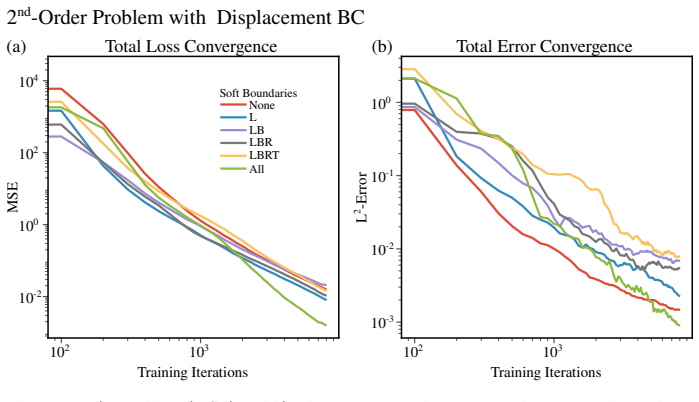
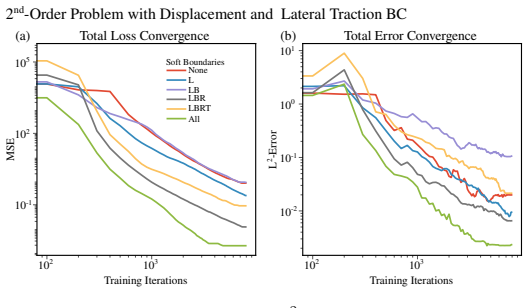
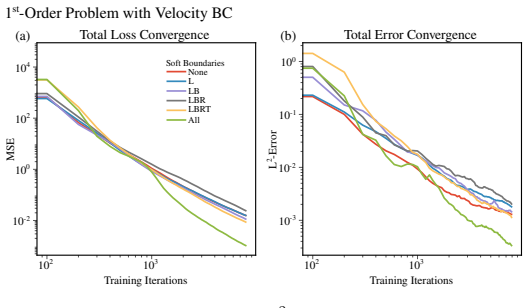
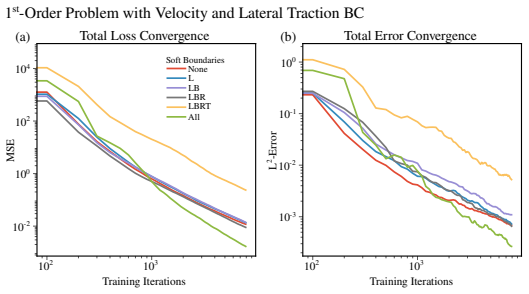
PINNs achieve a higher relative accuracy when solving the first-order plane strain problem and a tradeoff exists between final relative error and total training runtime, characterized by the number of hard and soft boundaries, where all-soft enforcement yields greater accuracy with longer runtime and all-hard enforcement yields lesser accuracy with shorter runtime.
What carries the argument
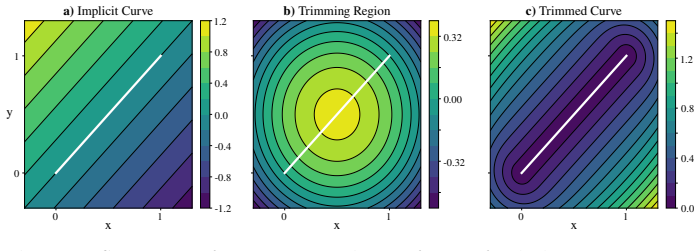
Interpolation of boundary data over implicit boundary representations for hard-enforcement of traction conditions on arbitrary domains.
If this is right
- First-order formulations of the governing equations produce higher relative accuracy than second-order formulations.
- Raising the fraction of soft boundary enforcement improves final accuracy.
- Raising the fraction of hard boundary enforcement reduces total training runtime.
- The observed accuracy-runtime tradeoff is governed by the specific count of hard versus soft boundaries.
Where Pith is reading between the lines
- The tradeoff may guide selection of enforcement strategy when PINNs are embedded in larger optimization loops with limited compute.
- The same hard/soft counting approach could be tested on time-dependent three-dimensional problems to see whether the pattern generalizes.
- Pairing the method with adaptive collocation-point sampling might shift the observed accuracy-runtime curve.
Load-bearing premise
Interpolating boundary data over implicit boundary representations accurately captures the geometry and traction conditions for arbitrary domains without significant discretization or approximation error.
What would settle it
Solve the same plane-strain problem on a rectangular domain with a known analytical solution using varying ratios of hard and soft boundaries and check whether relative error indeed decreases and runtime increases as the fraction of soft boundaries rises.
Figures
read the original abstract
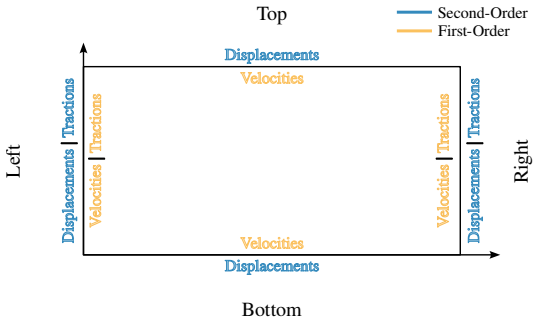
Solutions to well-posed problems in continuum mechanics are continuously dependent upon prescribed boundary conditions. Because of this, variations in the enforcement of boundary data can impact the reliability of inversion techniques that rely on efficient and accurate forward models. To this end, it is necessary to understand how specific boundary implementation techniques can affect the performance of a given forward model. Our work focuses on the impact that key modeling decisions have on physics-informed neural network (PINN) solutions for initial boundary value problems in continuum mechanics. By interpolating boundary data over implicit boundary representations, we measure the performance of a physics-informed neural network across different configurations of soft and hard boundary enforcement. We target the problem of elastodynamic plane-strain and present a method of hard-enforcement of traction conditions over arbitrary, implicitly-defined, domain boundaries considering both first and second order formulations of the governing equations. We show that PINNs achieve a higher relative accuracy when solving the first-order plane strain problem and we observe a tradeoff between the final relative error and the total run time to complete training. This tradeoff is characterized by the number of hard and soft boundaries where, in the extremes, all soft-enforcement results in greater accuracy with a longer run time, while all hard-enforcement leads to lesser accuracy and a shorter run time.
Editorial analysis
A structured set of objections, weighed in public.
Referee Report
Summary. The manuscript investigates the impact of soft versus hard boundary enforcement on PINN solutions to elastodynamic plane-strain problems. Using interpolation of boundary data over implicit representations, it compares first- and second-order formulations across mixed hard/soft configurations and reports that the first-order formulation yields higher relative accuracy while the number of hard versus soft boundaries produces an accuracy-runtime tradeoff (all-soft yields highest accuracy but longest training; all-hard yields lowest accuracy but shortest training).
Significance. If the interpolation-based hard enforcement can be shown to introduce negligible geometry/traction error relative to the reported residuals, the empirical comparison would usefully inform boundary-enforcement choices for PINN forward models in continuum mechanics. The work supplies a concrete method for hard-enforcing traction conditions on arbitrary implicit domains and documents a practical accuracy-runtime tradeoff, both of which could guide practitioners even if the quantitative bounds require strengthening.
major comments (1)
- [Abstract] Abstract, paragraph on method for hard-enforcement of traction conditions: the central accuracy-runtime tradeoff claim assumes the interpolation procedure enforces boundaries exactly. No a-priori error bound on the interpolation nor a quantitative check (e.g., boundary residual evaluated on a manufactured geometry) is supplied to demonstrate that the interpolation error remains orders of magnitude below the reported relative errors. Without this verification the 'hard' cases are not demonstrably stricter than the soft cases, undermining the tradeoff interpretation.
minor comments (2)
- [Abstract] The abstract asserts performance differences and a tradeoff but supplies no error bars, dataset sizes, convergence plots, or explicit description of how relative accuracy was computed.
- Consider adding a table or figure that reports the exact number of hard/soft boundaries, final relative errors, and wall-clock times for each configuration so the tradeoff can be inspected quantitatively.
Simulated Author's Rebuttal
We thank the referee for their careful reading and constructive feedback. We address the single major comment below.
read point-by-point responses
-
Referee: [Abstract] Abstract, paragraph on method for hard-enforcement of traction conditions: the central accuracy-runtime tradeoff claim assumes the interpolation procedure enforces boundaries exactly. No a-priori error bound on the interpolation nor a quantitative check (e.g., boundary residual evaluated on a manufactured geometry) is supplied to demonstrate that the interpolation error remains orders of magnitude below the reported relative errors. Without this verification the 'hard' cases are not demonstrably stricter than the soft cases, undermining the tradeoff interpretation.
Authors: We agree that the current manuscript lacks an explicit verification that the interpolation error is negligible relative to the reported residuals. In the revision we will add a quantitative check (boundary residual evaluated on a manufactured geometry) demonstrating that the interpolation error lies orders of magnitude below the relative errors shown in the results. This addition will confirm that the hard-enforcement cases are indeed stricter and will support the accuracy-runtime tradeoff interpretation. revision: yes
Circularity Check
No circularity; empirical measurement study with independent experimental results.
full rationale
The paper reports direct measurements of PINN training accuracy and runtime across hard/soft boundary configurations for elastodynamic plane-strain problems. No equations, derivations, or 'predictions' are presented that reduce reported quantities to fitted parameters by construction, nor does any load-bearing claim rest on self-citation chains. The central tradeoff observation follows from the experimental design itself and is not forced by redefinition or imported uniqueness results. The work is self-contained against external benchmarks as an empirical study.
Axiom & Free-Parameter Ledger
Reference graph
Works this paper leans on
-
[1]
Bachmayr, M., Dahmen, W., Oster, M., 2025. Variationally correct neural residual regression for parametric pdes: On the viability of controlled ac- curacy. IMA Journal of Numerical Analysis , draf073doi:10.1093/imanum/ draf073
-
[2]
Machine learning for data-driven discovery in solid earth geoscience
Bergen, K.J., Johnson, P.A., de Hoop, M.V., Beroza, G.C., 2019. Machine learning for data-driven discovery in solid earth geoscience. Science 363, eaau0323. doi:10.1126/science.aau0323
-
[4]
Model reduction and neural networks for parametric pdes
Bhattacharya, K., Hosseini, B., Kovachki, N.B., Stuart, A.M., 2021. Model reduction and neural networks for parametric pdes. The SMAI journal of computational mathematics 7, 121–157. doi:10.5802/smai-jcm.74
-
[5]
Approximate distance fields with non- vanishing gradients
Biswas, A., Shapiro, V., 2004. Approximate distance fields with non- vanishing gradients. Graphical Models 66, 133–159. doi:10.1016/j.gmod. 2004.01.003
-
[6]
The mathematical theory of finite element methods
Brenner, S.C., Scott, L.R., Scott, L.R., 2008. The mathematical theory of finite element methods. volume 3. Springer
2008
-
[7]
Physics-informed neural networks for heat transfer problems
Cai, S., Wang, Z., Wang, S., Perdikaris, P., Karniadakis, G.E., 2021. Physics-informed neural networks for heat transfer problems. Journal of Heat Transfer 143. doi:10.1115/1.4050542
-
[8]
Dpg loss functions for learning parameter-to-solution maps by neural networks
Castillo, P.C., Dahmen, W., Gopalakrishnan, J., 2025. Dpg loss functions for learning parameter-to-solution maps by neural networks. arXiv preprint arXiv:2506.18773 doi:10.48550/arXiv.2506.18773
-
[9]
Heterogeneous high frequency seismic radi- ation from complex ruptures
Cebry, S., McLaskey, G., 2024. Heterogeneous high frequency seismic radi- ation from complex ruptures. Seismica 3. doi:10.26443/seismica.v3i2. 1351
-
[10]
Creep fronts and complexity in laboratory earth- quake sequences illuminate delayed earthquake triggering
Cebry, S.B.L., Ke, C.Y., Shreedharan, S., Marone, C., Kammer, D.S., McLaskey, G.C., 2022. Creep fronts and complexity in laboratory earth- quake sequences illuminate delayed earthquake triggering. Nature Commu- nications 13, 6839
2022
-
[11]
Fast computation of the bezout and dixon resultant matrices
Chionh, E.W., Zhang, M., Goldman, R.N., 2002. Fast computation of the bezout and dixon resultant matrices. Journal of Symbolic Computation 33, 13–29. doi:10.1006/jsco.2001.0462
-
[12]
The finite element method for elliptic problems
Ciarlet, P.G., 2002. The finite element method for elliptic problems. vol- ume 40. Siam. 30
2002
-
[13]
Scientific machine learning through physics–informed neural net- works: Where we are and what’s next
Cuomo, S., Di Cola, V.S., Giampaolo, F., Rozza, G., Raissi, M., Piccialli, F., 2022. Scientific machine learning through physics–informed neural net- works: Where we are and what’s next. Journal of Scientific Computing 92,
2022
-
[14]
doi:10.1007/s10915-022-01939-z
-
[15]
Data driven approximation of parametrized pdes by reduced basis and neural networks
Dal Santo, N., Deparis, S., Pegolotti, L., 2020. Data driven approximation of parametrized pdes by reduced basis and neural networks. Journal of Computational Physics 416, 109550. doi:10.1016/j.jcp.2020.109550
-
[16]
Error estimates for physics informed neural networks approximating the navier-stokes equations
De Ryck, T., Jagtap, A.D., Mishra, S., 2022. Error estimates for physics informed neural networks approximating the navier-stokes equations. arXiv preprint arXiv:2203.09346 doi:10.48550/arXiv.2203.09346
-
[17]
On the approximation of functions by tanh neural networks
De Ryck, T., Lanthaler, S., Mishra, S., 2021. On the approximation of functions by tanh neural networks. Neural Networks 143, 732–750. doi:10. 1016/j.neunet.2021.08.015
2021
-
[18]
Erickson, B.A., Jiang, J., Barall, M., Lapusta, N., Dunham, E.M., Harris, R., Abrahams, L.S., Allison, K.L., Ampuero, J.P., Barbot, S., Cattania, C., Elbanna, A., Fialko, Y., Idini, B., Kozdon, J.E., Lambert, V., Liu, Y., Luo, Y., Ma, X., Mckay, M.B., Segall, P., Shi, P., van den Ende, M., Wei, M.,
-
[19]
The community code verification exercise for simulating sequences of earthquakes and aseismic slip (SEAS). Seismol. Res. Lett. 91, 874–890. doi:10.1785/0220190248
-
[20]
Theory and practice of finite elements
Ern, A., Guermond, J.L., 2004. Theory and practice of finite elements. volume 159. Springer. doi:10.1007/978-1-4757-4355-5
-
[21]
2018updatetotheUS Geological Survey national volcanic threat assessment
Ewert, J.W., Diefenbach, A.K., Ramsey, D.W., 2018. 2018updatetotheUS Geological Survey national volcanic threat assessment. U.S. Geological Sur- vey Scientific Investigations Report 2018-5140. doi:10.3133/sir20185140
-
[22]
A tutorial on the adjoint method for inverse problems
Givoli, D., 2021. A tutorial on the adjoint method for inverse problems. Computer Methods in Applied Mechanics and Engineering 380, 113810. doi:10.1016/j.cma.2021.113810
-
[23]
Transfer learning enhanced physics informed neural network for phase-field model- ing of fracture
Goswami, S., Anitescu, C., Chakraborty, S., Rabczuk, T., 2020. Transfer learning enhanced physics informed neural network for phase-field model- ing of fracture. Theoretical and Applied Fracture Mechanics 106, 102447. doi:10.1016/j.tafmec.2019.102447
-
[24]
A physics-informed deep learning framework for inversion and surrogate mod- eling in solid mechanics
Haghighat, E., Raissi, M., Moure, A., Gomez, H., Juanes, R., 2021. A physics-informed deep learning framework for inversion and surrogate mod- eling in solid mechanics. Computer Methods in Applied Mechanics and Engineering 379, 113741. doi:10.1016/j.cma.2021.113741
-
[25]
The SCEC/USGS dynamic earthquake rupture code verification exercise
Harris, R.A., Barall, M., Archuleta, R., Dunham, E.M., Aagaard, B., Am- puero, J.P., Bhat, H., Cruz-Atienza, V., Dalguer, L., Dawson, P., Day, S., Duan, B., Ely, G., Kaneko, Y., Kase, Y., Lapusta, N., Liu, Y., Ma, S., 31 Oglesby, D., Olsen, K., Pitarka, A., Song, S., Templeton, E., 2009. The SCEC/USGS dynamic earthquake rupture code verification exercise....
-
[26]
US geological survey earthquake hazards program decadal science strategy, 2024–33
Hayes, G.P., Barnhart, W.D., Blanpied, M.L., Davis, L.A., Earle, P.S., Field, N., Franks, J.M., Given, D.D., Gold, R.D., Goulet, C.A., et al., 2024. US geological survey earthquake hazards program decadal science strategy, 2024–33. US Geological Survey Circular 1544. doi:10.3133/cir1544
-
[27]
Fundamentals of computer aided geometric design
Hoschek, J., Lasser, D., 1993. Fundamentals of computer aided geometric design. AK Peters, Ltd
1993
-
[28]
Jagtap, A.D., Kharazmi, E., Karniadakis, G.E., 2020. Conservative physics-informed neural networks on discrete domains for conservation laws: Applications to forward and inverse problems. Computer Methods in Applied Mechanics and Engineering 365, 113028. doi:10.1016/j.cma. 2020.113028
-
[29]
Jin, X., Cai, S., Li, H., Karniadakis, G.E., 2021. Nsfnets (navier- stokes flow nets): Physics-informed neural networks for the incompressible navier-stokes equations. Journal of Computational Physics 426, 109951. doi:https://doi.org/10.1016/j.jcp.2020.109951
-
[30]
Physics-informed machine learning
Karniadakis, G.E., Kevrekidis, I.G., Lu, L., Perdikaris, P., Wang, S., Yang, L., 2021. Physics-informed machine learning. Nature Reviews Physics 3, 422–440. doi:10.1038/s42254-021-00314-5
-
[31]
Numerical methods for inverse problems
Kern, M., 2016. Numerical methods for inverse problems. John Wiley & Sons
2016
-
[32]
Variational physics- informed neural networks for solving partial differential equations
Kharazmi, E., Zhang, Z., Karniadakis, G.E., 2019. Variational physics- informed neural networks for solving partial differential equations. arXiv preprint arXiv:1912.00873 doi:10.48550/arXiv.1912.00873
-
[33]
hp-vpinns: Variational physics-informed neural networks with domain decomposition
Kharazmi, E., Zhang, Z., Karniadakis, G.E., 2021. hp-vpinns: Variational physics-informed neural networks with domain decomposition. Computer Methods in Applied Mechanics and Engineering 374, 113547. doi:10.1016/ j.cma.2020.113547
-
[34]
Deep Learning in Computational Mechanics
Kollmannsberger, S., D’Angella, D., Jokeit, M., Herrmann, L., et al., 2021. Deep Learning in Computational Mechanics. Springer
2021
-
[35]
The mathematics of artificial intelligence
Kutyniok, G., 2022. The mathematics of artificial intelligence. arXiv preprint arXiv:2203.08890 doi:10.48550/arXiv.2203.08890
-
[36]
Artificial neural networks for solving ordinary and partial differential equations
Lagaris, I.E., Likas, A., Fotiadis, D.I., 1998. Artificial neural networks for solving ordinary and partial differential equations. IEEE transactions on neural networks 9, 987–1000. doi:10.1109/72.712178. 32
-
[37]
Neural-network meth- ods for boundary value problems with irregular boundaries
Lagaris, I.E., Likas, A.C., Papageorgiou, D.G., 2000. Neural-network meth- ods for boundary value problems with irregular boundaries. IEEE Trans- actions on Neural Networks 11, 1041–1049. doi:10.1109/72.870037
-
[38]
Finite difference methods for ordinary and partial differential equations: steady-state and time-dependent problems
LeVeque, R.J., 2007. Finite difference methods for ordinary and partial differential equations: steady-state and time-dependent problems. SIAM
2007
-
[39]
Heliyon9(4), 14534 (2023) https://doi.org/10.1016/j
Lundquist, T., Nordström, J., 2014. The sbp-sat technique for initial value problems. Journal of Computational Physics 270, 86–104. doi:10.1016/j. jcp.2014.03.048
work page doi:10.1016/j 2014
-
[40]
Physics-informed neural networks for high-speed flows
Mao, Z., Jagtap, A.D., Karniadakis, G.E., 2020. Physics-informed neural networks for high-speed flows. Computer Methods in Applied Mechanics and Engineering 360, 112789. doi:10.1016/j.cma.2019.112789
-
[41]
Near-optimal sketchy naturalgradientsforphysics-informedneuralnetworks, in: Forty-secondIn- ternational Conference on Machine Learning
Mckay, M.B., Kaur, A., Greif, C., Wetton, B., 2025. Near-optimal sketchy naturalgradientsforphysics-informedneuralnetworks, in: Forty-secondIn- ternational Conference on Machine Learning. URL:https://openreview. net/forum?id=bKsZomnmqn
2025
-
[42]
Earthquake initiation from laboratory observations and implications for foreshocks
McLaskey, G.C., 2019. Earthquake initiation from laboratory observations and implications for foreshocks. Journal of Geophysical Research: Solid Earth 124, 12882–12904
2019
-
[43]
Slow and fast ruptures on a labo- ratory fault controlled by loading characteristics
Mclaskey, G.C., Yamashita, F., 2017. Slow and fast ruptures on a labo- ratory fault controlled by loading characteristics. Journal of Geophysical Research: Solid Earth 122, 3719–3738
2017
-
[44]
Mishra, S., Molinaro, R., 2022a. Estimates on the generalization error of physics-informed neural networks for approximating a class of inverse problems for pdes. IMA Journal of Numerical Analysis 42, 981–1022. doi:10.1093/imanum/drab032
-
[45]
Estimates on the generalization error of physics-informed neural networks for approximating pdes
Mishra, S., Molinaro, R., 2022b. Estimates on the generalization error of physics-informed neural networks for approximating pdes. IMA Journal of Numerical Analysis doi:10.1093/imanum/drab093
-
[46]
Achieving high accuracy with pinns via energy natural gradients
Müller, J., Zeinhofer, M., 2023. Achieving high accuracy with pinns via energy natural gradients. arXiv preprint arXiv:2302.13163 doi:10.48550/ arXiv.2302.13163
-
[47]
Nordström, J., Lundquist, T., 2013. Summation-by-parts in time. Journal of Computational Physics 251, 487–499. doi:10.1016/j.jcp.2013.05.042
-
[48]
Raissi, M., Perdikaris, P., Karniadakis, G.E., 2019. Physics-informed neu- ral networks: A deep learning framework for solving forward and inverse problems involving nonlinear partial differential equations. Journal of Com- putational physics 378, 686–707. doi:10.1016/j.jcp.2018.10.045. 33
-
[49]
Hidden fluid mechanics: Learning velocity and pressure fields from flow visualizations
Raissi, M., Yazdani, A., Karniadakis, G.E., 2020. Hidden fluid mechanics: Learning velocity and pressure fields from flow visualizations. Science 367, 1026–1030
2020
-
[50]
Verification and Validation in Computational Science and Engineering
Roache, P., 1998. Verification and Validation in Computational Science and Engineering. 1 ed., Hermosa Publishers, Albuquerque, NM
1998
-
[51]
Physics-informed deep learning of rate- and-state fault friction
Rucker, C., Erickson, B.A., 2024. Physics-informed deep learning of rate- and-state fault friction. Computer Methods in Applied Mechanics and Engineering 430, 117211. doi:10.1016/j.cma.2024.117211
-
[52]
R-functions in boundary value problems in mechanics
Rvachev, V.L., Sheiko, T.I., 1995. R-functions in boundary value problems in mechanics. Applied Mechanics Reviews 48, 151–188. URL:https://doi.org/10.1115/1.3005099, doi:10.1115/1.3005099, arXiv:https://asmedigitalcollection.asme.org/appliedmechanicsreviews/article-pdf/48/4/151/5437257/151_- 1.pdf
-
[53]
On complete- ness of rfm solution structures
Rvachev, V.L., Sheiko, T.I., Shapiro, V., Tsukanov, I., 2000. On complete- ness of rfm solution structures. Computational Mechanics 25, 305–317. doi:10.1007/s004660050479
-
[54]
Transfinite interpolation over implicitly defined sets
Rvachev, V.L., Sheiko, T.I., Shapiro, V., Tsukanov, I., 2001. Transfinite interpolation over implicitly defined sets. Computer aided geometric design 18, 195–220. doi:10.1016/S0167-8396(01)00015-2
-
[55]
Physics-Informed Neural Net- works for Solving Contact Problems in Three Dimensions
Sahin, T., Wolff, D., Popp, A., 2025. Physics-Informed Neural Net- works for Solving Contact Problems in Three Dimensions. Springer Na- ture Switzerland, Cham. pp. 419–431. URL:https://doi.org/10.1007/ 978-3-031-93213-7_33, doi:10.1007/978-3-031-93213-7_33
-
[56]
Implicit repre- sentation of parametric curves and surfaces
Sederberg, T.W., Anderson, D.C., Goldman, R.N., 1984. Implicit repre- sentation of parametric curves and surfaces. Computer Vision, Graphics, and Image Processing 28, 72–84. doi:10.1016/0734-189X(84)90140-3
-
[57]
Theory of R-functions and applications: A primer
Shapiro, V., 1991. Theory of R-functions and applications: A primer. Technical Report. Cornell University. doi:10.1201/9781315154411
-
[58]
Semi-analytic geometry with r-functions
Shapiro, V., 2007. Semi-analytic geometry with r-functions. ACTA numer- ica 16, 239–303
2007
-
[59]
Implicit functions with guaranteed dif- ferential properties, in: Proceedings of the fifth ACM symposium on Solid modeling and applications, pp
Shapiro, V., Tsukanov, I., 1999. Implicit functions with guaranteed dif- ferential properties, in: Proceedings of the fifth ACM symposium on Solid modeling and applications, pp. 258–269
1999
-
[60]
Sheikholeslami, M., Salehi, S., Mao, W., Eslamdoost, A., Nilsson, H., 2025. Physics-informed neural networks with hard and soft boundary conditions for linear free surface waves. Physics of fluids 37. doi:10.1063/5.0277421
-
[61]
Shepard, D., 1968. Atwo-dimensionalinterpolationfunctionforirregularly- spaced data, in: Proceedings of the 1968 23rd ACM national conference, pp. 517–524. doi:10.1145/800186.810616. 34
-
[62]
On the convergence of physics informed neural networks for linear second-order elliptic and parabolic type pdes
Shin, YeonjongDarbon, J., Em Karniadakis, G., 2020. On the convergence of physics informed neural networks for linear second-order elliptic and parabolic type pdes. Communications in Computational Physics 28, 2042–
2020
-
[63]
doi:10.4208/cicp.OA-2020-0193
-
[64]
Error estimates of resid- ual minimization using neural networks for linear pdes
Shin, Y., Zhang, Z., Karniadakis, G.E., 2023. Error estimates of resid- ual minimization using neural networks for linear pdes. Journal of Ma- chine Learning for Modeling and Computing 4, 73–101. doi:10.1615/ JMachLearnModelComput.2023050411
2023
-
[65]
Sobh, N., Gladstone, R.J., Meidani, H., 2025. Pinn-fem: A hybrid approach for enforcing dirichlet boundary conditions in physics-informed neural net- works. arXiv preprint arXiv:2501.07765 doi:10.48550/arXiv.2501.07765
-
[66]
Straub, C., Brendel, P., Medvedev, V., Rosskopf, A., 2025. Hard- constraining neumann boundary conditions in physics-informed neural net- works via fourier feature embeddings. arXiv preprint arXiv:2504.01093 doi:10.48550/arXiv.2504.01093
-
[67]
Sukumar, N., Srivastava, A., 2022. Exact imposition of boundary con- ditions with distance functions in physics-informed deep neural networks. Computer Methods in Applied Mechanics and Engineering 389, 114333. doi:10.1016/j.cma.2021.114333
-
[68]
Sun, L., Gao, H., Pan, S., Wang, J.X., 2020. Surrogate modeling for fluid flows based on physics-constrained deep learning without simulation data. Computer Methods in Applied Mechanics and Engineering 361, 112732. doi:10.1016/j.cma.2019.112732
-
[69]
Algebraic dis- tance estimations for enriched isogeometric analysis
Upreti, K., Song, T., Tambat, A., Subbarayan, G., 2014. Algebraic dis- tance estimations for enriched isogeometric analysis. Computer methods in applied mechanics and engineering 280, 28–56. doi:10.1016/j.cma.2014. 07.012
-
[70]
US Geological Survey, 2017. Advanced National Seismic System—Current status, development opportunities, and priorities for 2017–2027. U.S. Geo- logical Survey Circular 1429. doi:10.3133/cir1429
-
[71]
Multi-scale deep neural network (mscalednn) methods for oscillatory stokes flows in complex domains
Wang, BoZhang, W., Cai, W., 2020. Multi-scale deep neural network (mscalednn) methods for oscillatory stokes flows in complex domains. Com- munications in Computational Physics 28, 2139–2157. doi:10.4208/cicp. OA-2020-0192
-
[72]
The deep ritz method: a deep learning-based numerical algorithm for solving variational problems
Yu, B., et al., 2018. The deep ritz method: a deep learning-based numerical algorithm for solving variational problems. Communications in Mathemat- ics and Statistics 6, 1–12. doi:10.1007/s40304-018-0127-z
-
[73]
Machine learning for predicting battery capacity for electric vehicles
Zhao, J., Ling, H., Liu, J., Wang, J., Burke, A.F., Lian, Y., 2023. Machine learning for predicting battery capacity for electric vehicles. eTransporta- tion 15, 100214. doi:10.1016/j.etran.2022.100214. 35
discussion (0)
Sign in with ORCID, Apple, or X to comment. Anyone can read and Pith papers without signing in.