LFNO: Bridging Laplace and Fourier via Transient-Steady Decomposition
Pith reviewed 2026-06-28 23:22 UTC · model grok-4.3
The pith
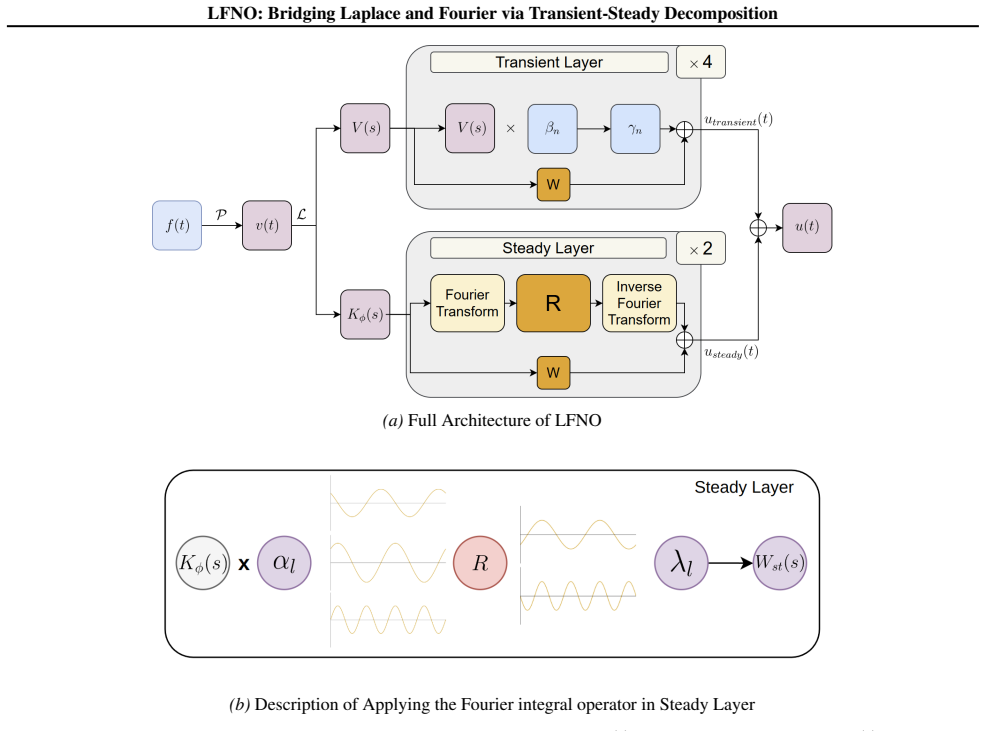
LFNO decomposes dynamical responses into transient and steady-state parts using separate Laplace and Fourier branches.
A machine-rendered reading of the paper's core claim, the machinery that carries it, and where it could break.
Core claim
LFNO employs a dual-branch architecture that explicitly decomposes system dynamics into transient and steady-state components, integrating the spectral advantages of Laplace and Fourier Neural Operators to provide a unified framework for learning complex dynamical systems across multiple temporal scales, with demonstrated gains on ODE benchmarks and competitive PDE results plus improved stability and interpretability.
What carries the argument
Dual-branch architecture that decomposes responses into transient (Laplace) and steady-state (Fourier) components.
If this is right
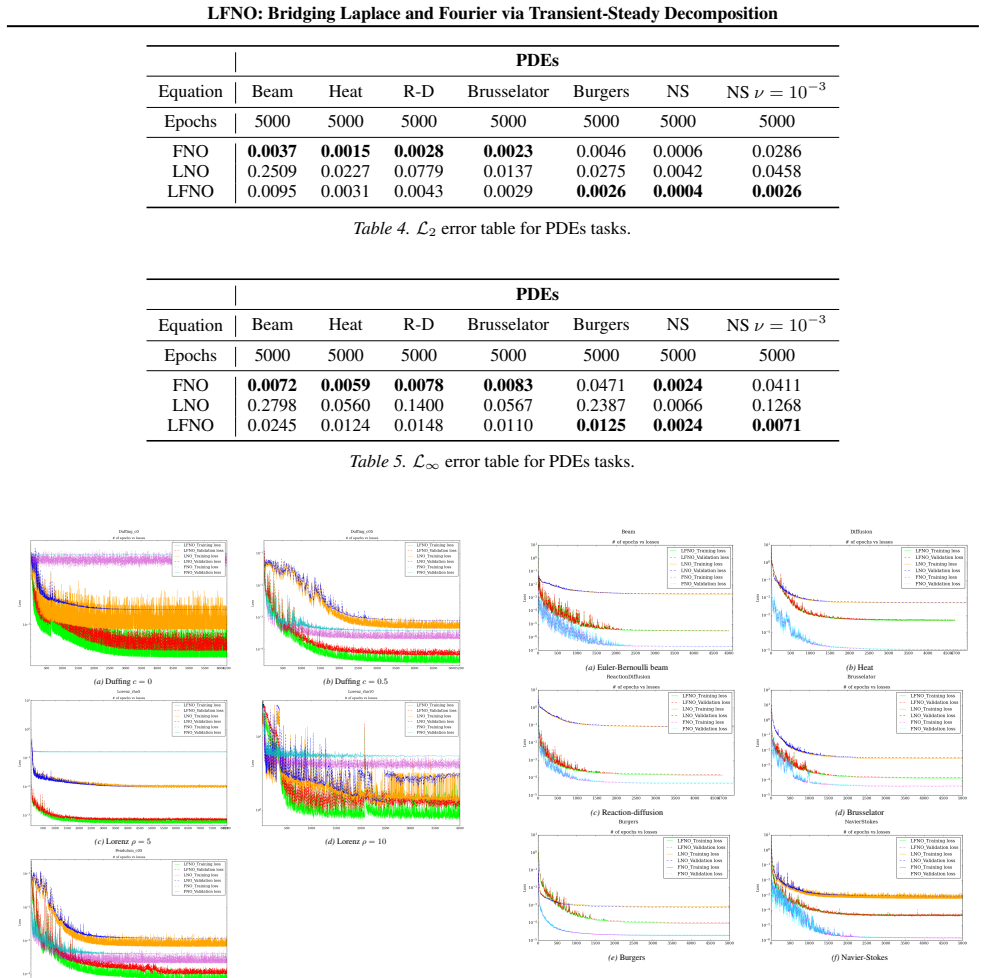
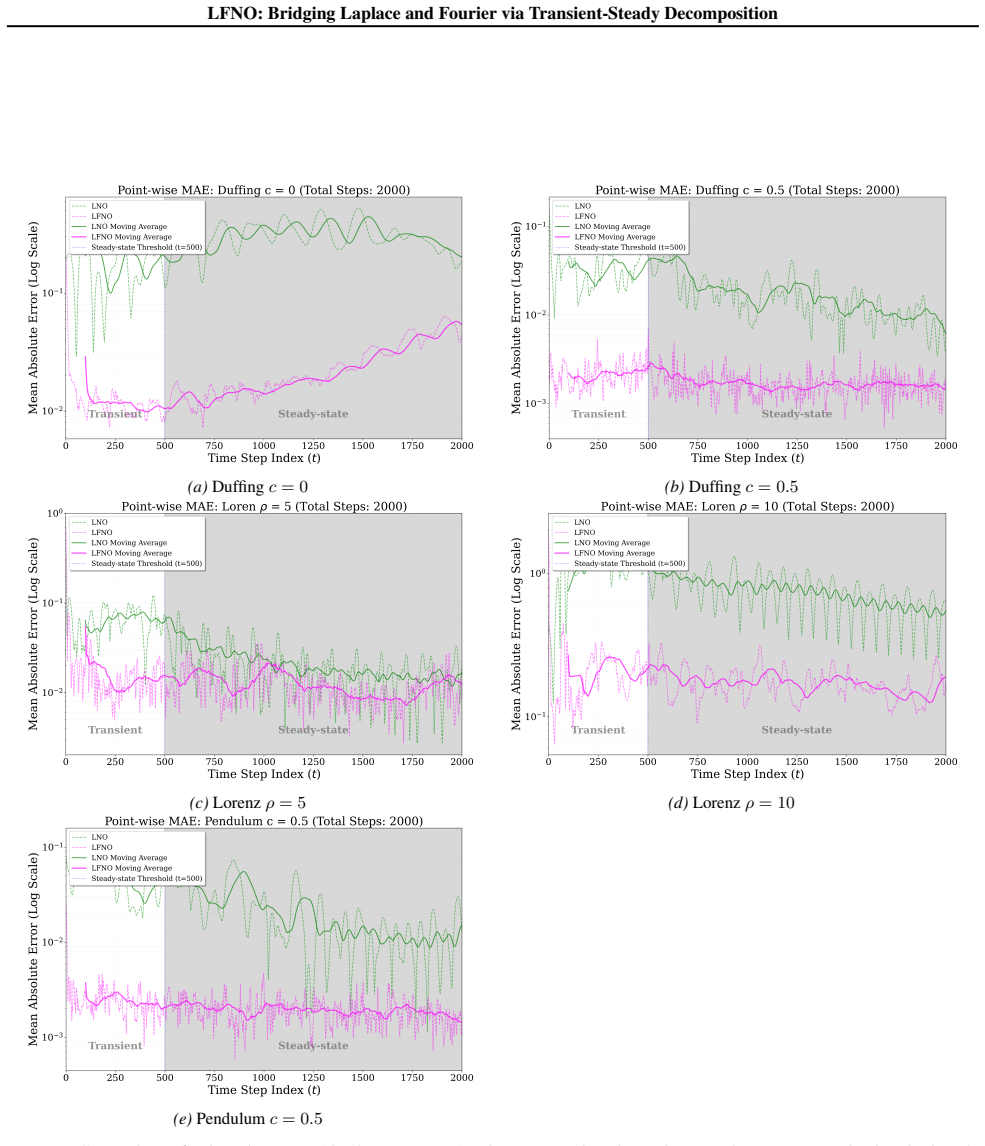
- LFNO outperforms prior operators on ODE systems where transient dynamics dominate.
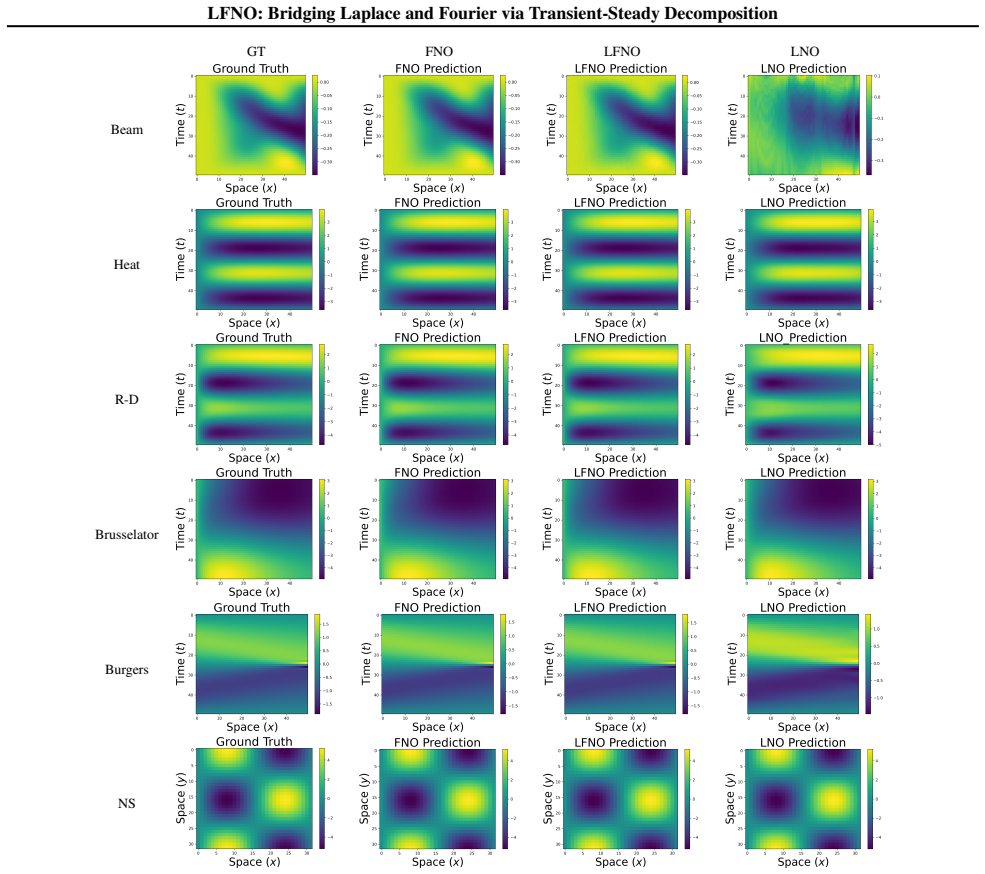
- It surpasses LNO and matches FNO on PDE benchmarks.
- Component-wise decomposition yields improved stability and physical interpretability.
Where Pith is reading between the lines
- The separation could let practitioners update only the transient branch when initial conditions change while keeping the steady branch fixed.
- Similar dual-branch ideas might apply to other paired transforms for systems with multiple distinct scales.
Load-bearing premise
Dynamical system responses can be cleanly decomposed into independent transient and steady-state components best captured by separate Laplace and Fourier branches without significant interaction or information loss.
What would settle it
Performance drop or training instability on a coupled transient-steady system when the model is forced to use the two-branch split versus a single unified branch.
Figures
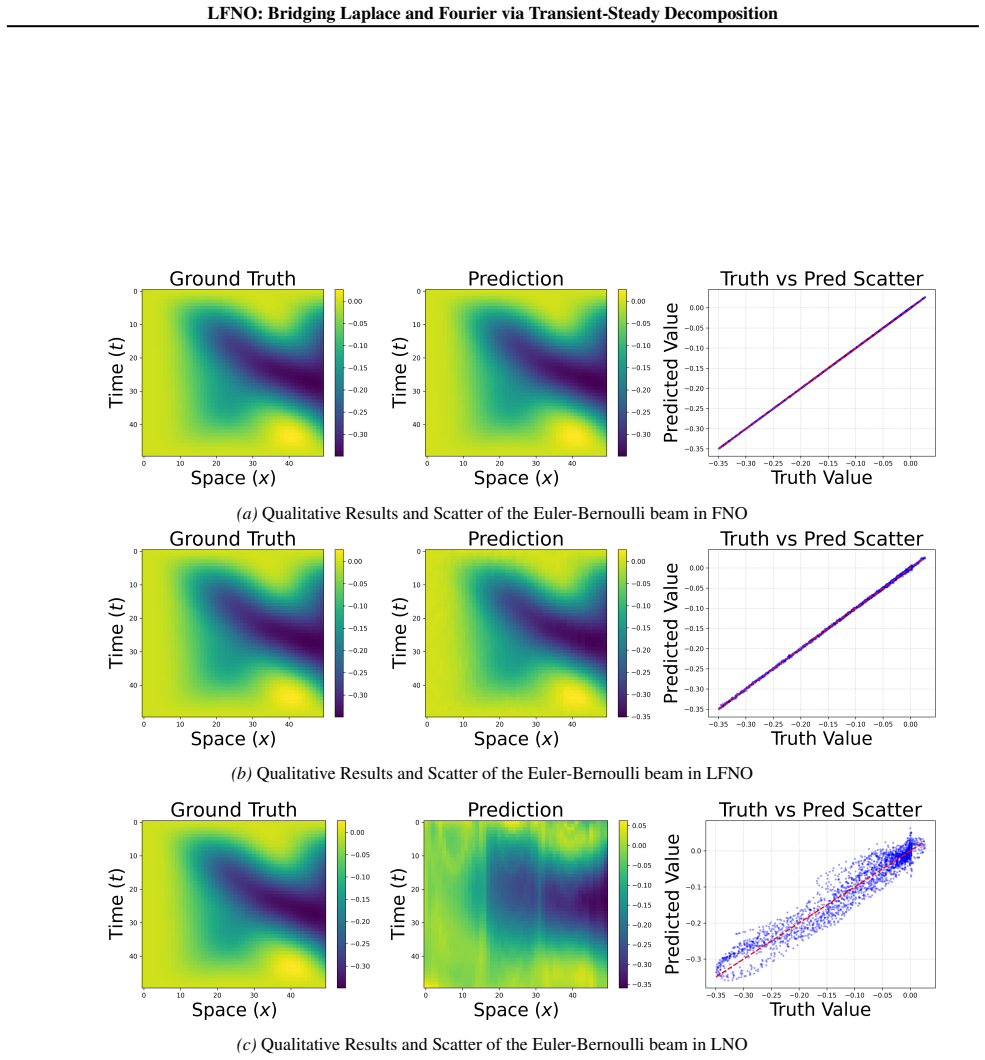
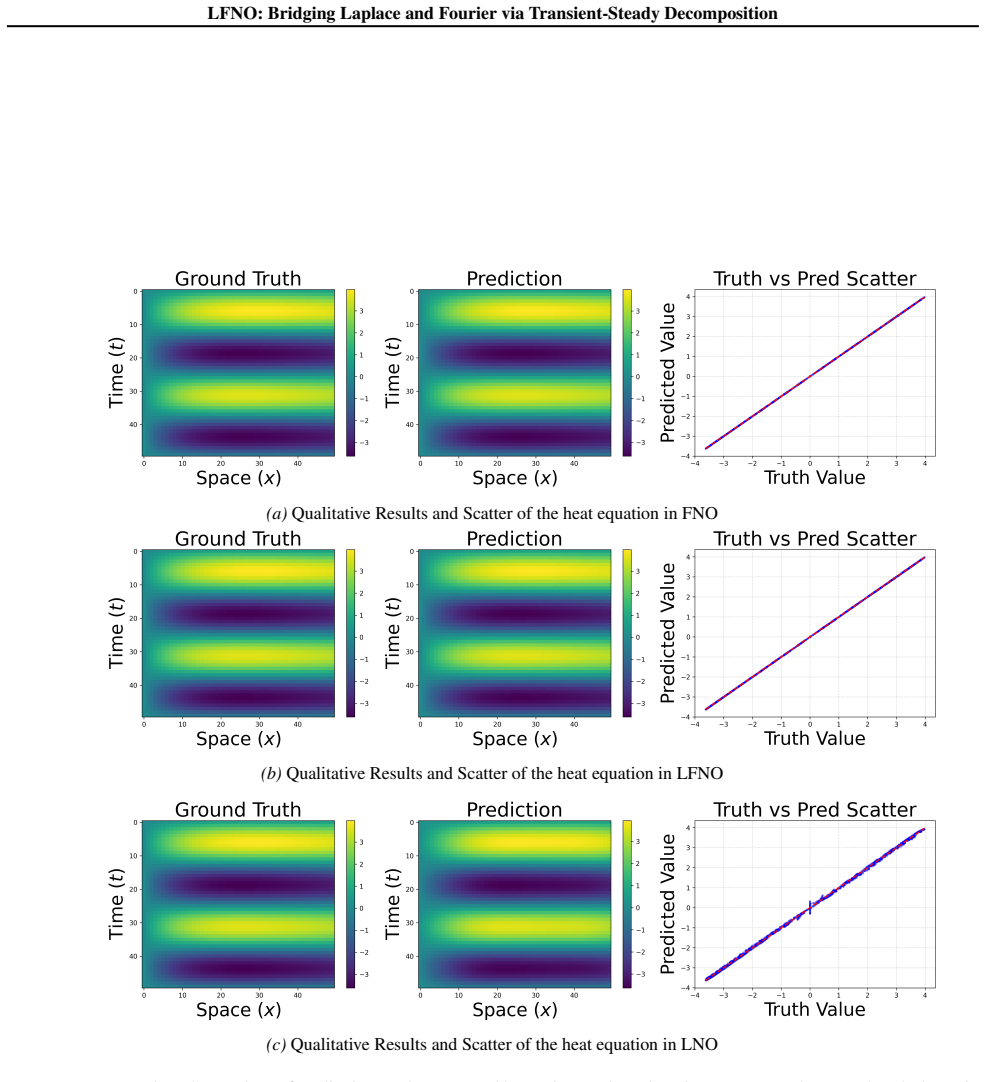
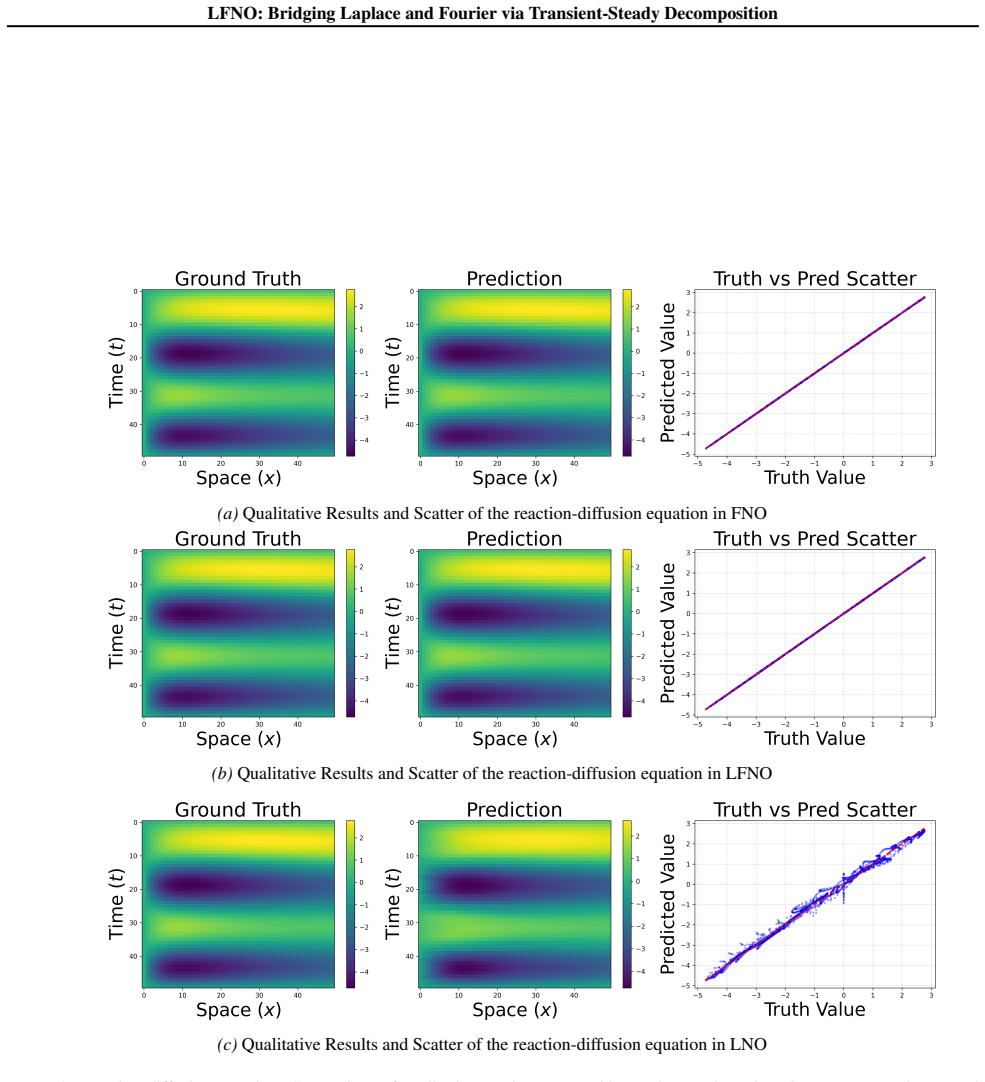
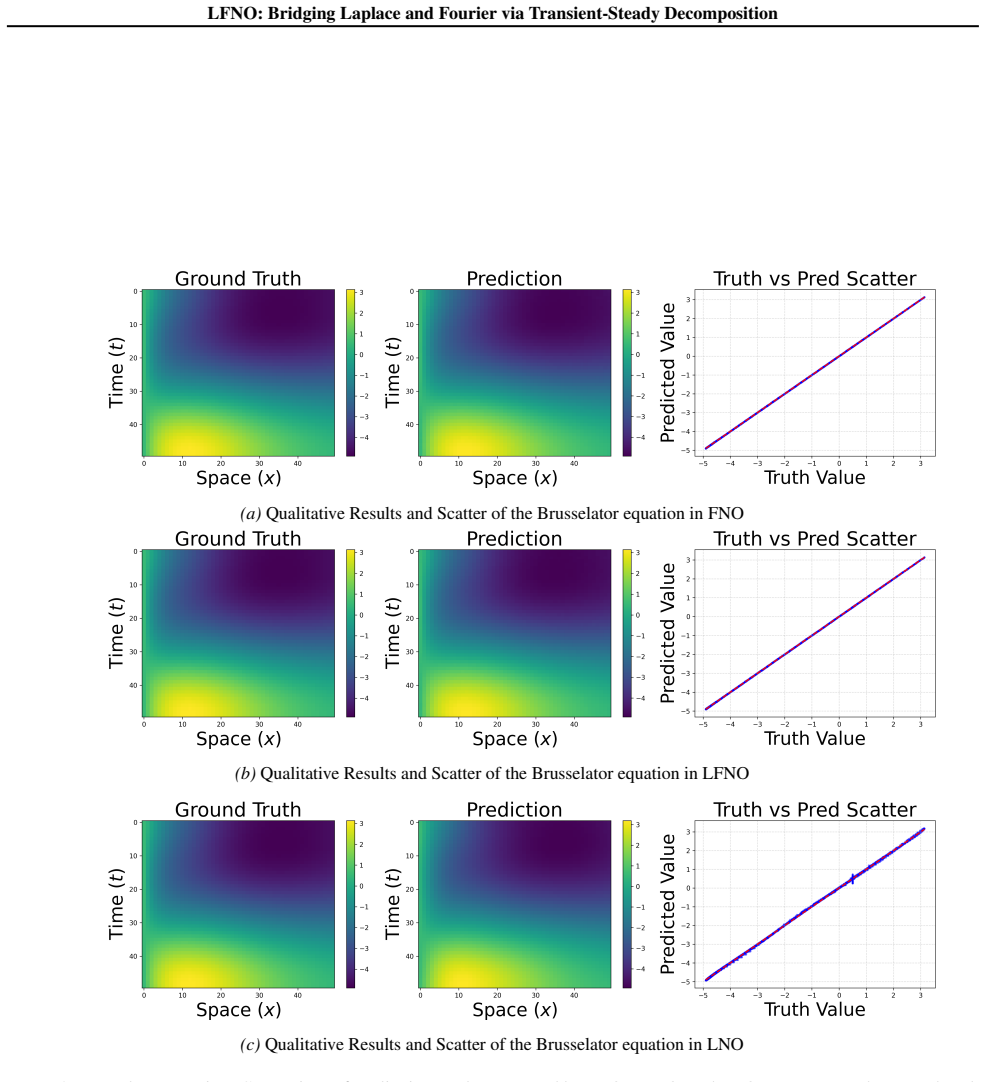
read the original abstract
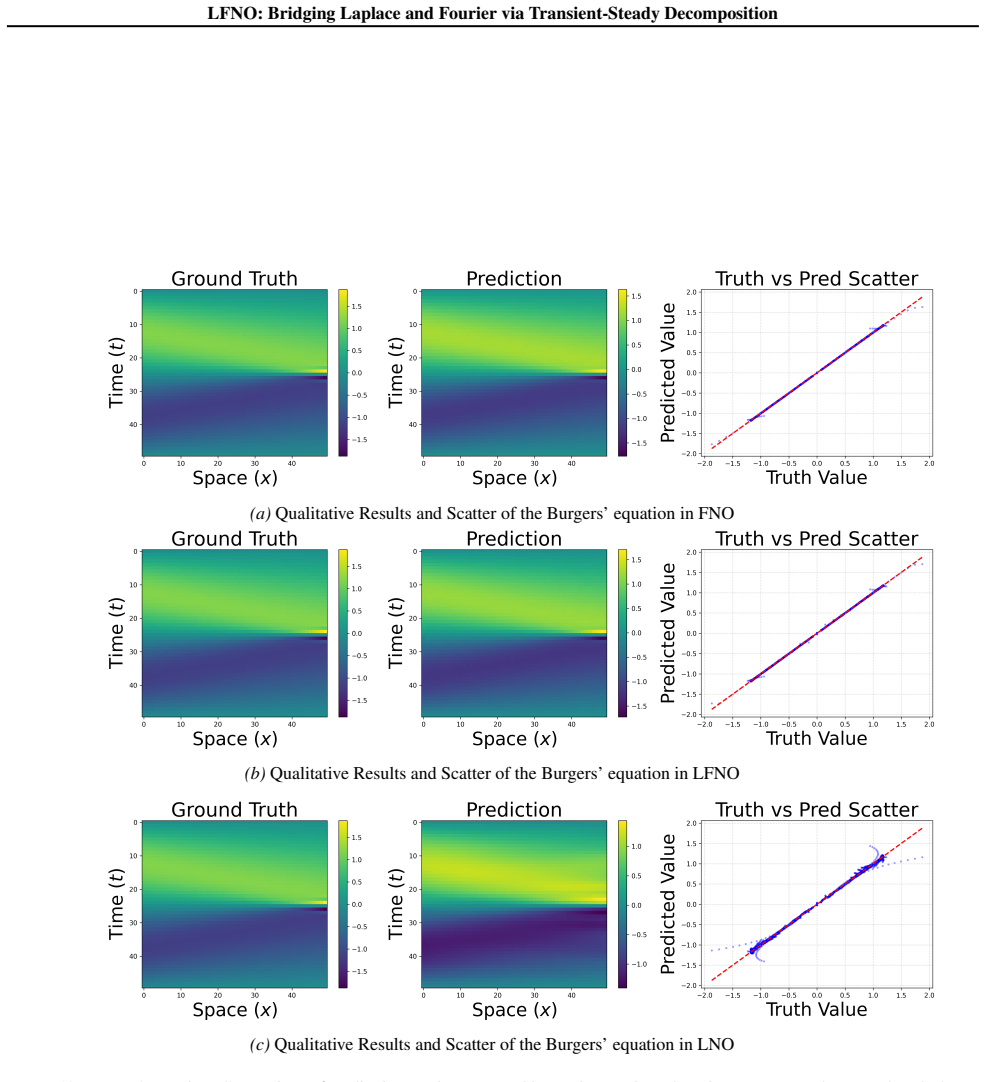
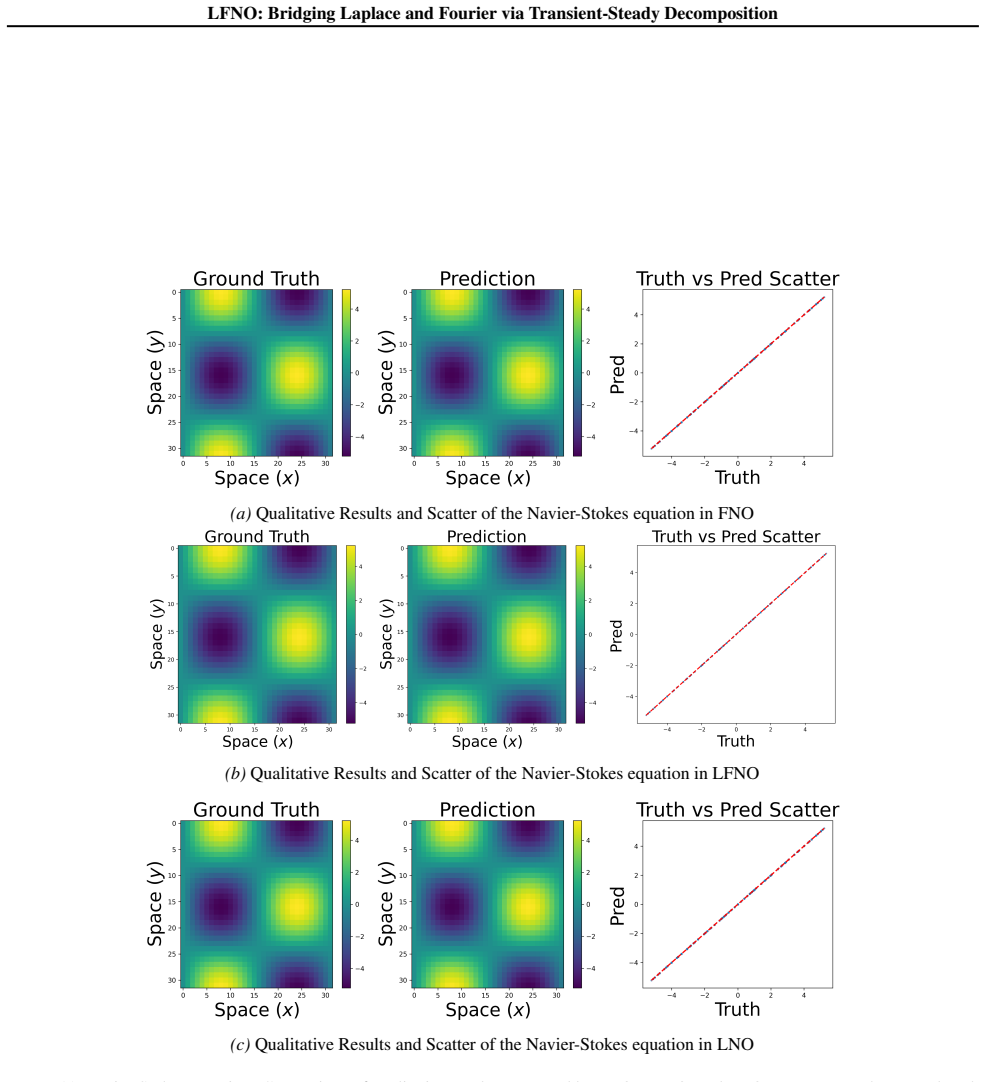
We introduce the Laplace-Fourier Neural Operator (LFNO), a unified framework for modeling dynamical systems across transient and steady-state regimes by integrating the spectral advantages of Laplace and Fourier Neural Operators. LFNO employs a dual-branch architecture that explicitly decomposes system dynamics into transient and steady-state components. We evaluate LFNO on nine benchmarks, including three ODE systems (Duffing, Lorenz, and Pendulum) and six PDE systems (Euler-Bernoulli beam, Heat, Reaction-diffusion, Brusselator, Burgers, and Navier-Stokes). LFNO significantly outperforms existing operators on ODE systems, where transient dynamics dominate, and consistently surpasses LNO while achieving performance competitive with FNO on PDE benchmarks. Furthermore, LFNO offers improved stability and physical interpretability through its component-wise decomposition. These results demonstrate that LFNO provides a robust and unified approach for learning complex dynamical systems across multiple temporal scales.
Editorial analysis
A structured set of objections, weighed in public.
Referee Report
Summary. The paper introduces LFNO, a dual-branch neural operator that decomposes dynamical system responses into transient components (modeled via a Laplace branch) and steady-state components (modeled via a Fourier branch). It evaluates the method on three ODE benchmarks (Duffing, Lorenz, Pendulum) and six PDE benchmarks (Euler-Bernoulli beam, Heat, Reaction-diffusion, Brusselator, Burgers, Navier-Stokes), claiming significant outperformance over existing operators on ODEs, consistent improvement over LNO, and competitive results with FNO on PDEs, along with gains in stability and physical interpretability from the explicit decomposition.
Significance. If the decomposition mechanism is shown to be responsible for the gains rather than capacity alone, LFNO would provide a principled way to combine the complementary strengths of Laplace and Fourier transforms for multi-regime dynamics, extending neural operators to systems with dominant transients while retaining PDE performance. The explicit component-wise structure could also support interpretability in learned operators.
major comments (2)
- [Experiments] Experiments (likely §4 or §5): The reported outperformance on the three ODE systems is presented as evidence for the benefit of assigning Laplace to transients and Fourier to steady-state, but no ablation is described that compares LFNO against a same-capacity dual-branch baseline in which both branches use the same transform (e.g., two Fourier branches or two Laplace branches). Without this control, it is impossible to determine whether the gains arise from the specific transient-steady assignment or simply from the added parallel capacity.
- [§3] §3 (Architecture): The claim that the dual-branch design enforces a clean separation without significant cross-regime interaction or information loss is central to the interpretability and stability arguments, yet the manuscript provides no quantitative verification (e.g., cross-branch leakage metrics, reconstruction error when one branch is ablated, or visualization of learned component isolation) on the ODE test cases where the separation is asserted to be most beneficial.
minor comments (2)
- [§3] Notation for the transient and steady-state projections (likely Eq. (3)–(5)) could be clarified to make explicit whether the decomposition is learned jointly or imposed via separate loss terms.
- [Figures] Figure captions for the benchmark results should include error bars or standard deviations across random seeds to allow assessment of statistical significance of the reported improvements.
Simulated Author's Rebuttal
We thank the referee for the detailed and constructive feedback. The two major comments highlight important gaps in experimental validation that we will address through targeted additions in the revised manuscript.
read point-by-point responses
-
Referee: [Experiments] Experiments (likely §4 or §5): The reported outperformance on the three ODE systems is presented as evidence for the benefit of assigning Laplace to transients and Fourier to steady-state, but no ablation is described that compares LFNO against a same-capacity dual-branch baseline in which both branches use the same transform (e.g., two Fourier branches or two Laplace branches). Without this control, it is impossible to determine whether the gains arise from the specific transient-steady assignment or simply from the added parallel capacity.
Authors: We agree that the current experiments do not include a same-capacity dual-branch control with identical transforms in both branches, which would more directly isolate the contribution of the transient-steady assignment. In the revised version we will add these ablations on the three ODE benchmarks (Duffing, Lorenz, Pendulum), reporting results for (i) two Fourier branches and (ii) two Laplace branches, each with parameter counts matched to LFNO. This will allow readers to distinguish architecture capacity from the specific Laplace-Fourier decomposition. revision: yes
-
Referee: [§3] §3 (Architecture): The claim that the dual-branch design enforces a clean separation without significant cross-regime interaction or information loss is central to the interpretability and stability arguments, yet the manuscript provides no quantitative verification (e.g., cross-branch leakage metrics, reconstruction error when one branch is ablated, or visualization of learned component isolation) on the ODE test cases where the separation is asserted to be most beneficial.
Authors: We acknowledge that the manuscript currently lacks quantitative verification of branch separation on the ODE cases. In the revision we will add (i) visualizations of the transient and steady-state components learned on the ODE test trajectories, (ii) reconstruction error when each branch is ablated individually, and (iii) a simple cross-branch leakage metric (e.g., L2 norm of the component that should be zero under ideal separation). These additions will be placed in §3 and §4 to support the interpretability claims. revision: yes
Circularity Check
No circularity: LFNO is an explicit dual-branch architectural proposal with external benchmark evaluation.
full rationale
The paper introduces LFNO as a new operator architecture that decomposes dynamics into transient (Laplace) and steady-state (Fourier) branches. No derivation step reduces a claimed prediction or uniqueness result to a fitted parameter or self-citation by construction. The central claims rest on empirical performance across nine standard benchmarks rather than any algebraic identity or imported theorem that collapses to the input data. Self-citations, if present, are not load-bearing for the decomposition mechanism itself. This is the normal case of an architectural contribution whose validity is tested externally.
Axiom & Free-Parameter Ledger
axioms (1)
- domain assumption Dynamical systems can be explicitly decomposed into transient and steady-state components that are independently and optimally modeled by Laplace and Fourier branches.
invented entities (1)
-
LFNO dual-branch architecture
no independent evidence
Reference graph
Works this paper leans on
-
[1]
Journal of Computational physics , volume=
Physics-informed neural networks: A deep learning framework for solving forward and inverse problems involving nonlinear partial differential equations , author=. Journal of Computational physics , volume=. 2019 , publisher=
2019
-
[2]
Physics of Fluids , volume=
Physics-informed neural networks for solving Reynolds-averaged Navier--Stokes equations , author=. Physics of Fluids , volume=. 2022 , publisher=
2022
-
[3]
Neural Operator: Graph Kernel Network for Partial Differential Equations
Neural operator: Graph kernel network for partial differential equations , author=. arXiv preprint arXiv:2003.03485 , year=
work page internal anchor Pith review Pith/arXiv arXiv 2003
-
[4]
Advances in Neural Information Processing Systems , volume=
Multipole graph neural operator for parametric partial differential equations , author=. Advances in Neural Information Processing Systems , volume=
-
[5]
International Conference on Learning Representations , year=
Fourier Neural Operator for Parametric Partial Differential Equations , author=. International Conference on Learning Representations , year=
-
[6]
Nature machine intelligence , volume=
Learning nonlinear operators via DeepONet based on the universal approximation theorem of operators , author=. Nature machine intelligence , volume=. 2021 , publisher=
2021
-
[7]
Science advances , volume=
Learning the solution operator of parametric partial differential equations with physics-informed DeepONets , author=. Science advances , volume=. 2021 , publisher=
2021
-
[8]
arXiv preprint arXiv:2201.11967 , year=
Pseudo-differential neural operator: Generalized fourier neural operator for learning solution operators of partial differential equations , author=. arXiv preprint arXiv:2201.11967 , year=
-
[9]
Journal of Machine Learning Research , volume=
Fourier neural operator with learned deformations for pdes on general geometries , author=. Journal of Machine Learning Research , volume=
-
[10]
The Eleventh International Conference on Learning Representations , year=
Factorized Fourier Neural Operators , author=. The Eleventh International Conference on Learning Representations , year=
-
[11]
Doklady Mathematics , volume=
Spectral neural operators , author=. Doklady Mathematics , volume=. 2023 , organization=
2023
-
[12]
International conference on machine learning , pages=
Spherical fourier neural operators: Learning stable dynamics on the sphere , author=. International conference on machine learning , pages=. 2023 , organization=
2023
-
[13]
Journal of Machine Learning Research , volume=
Neural operator: Learning maps between function spaces with applications to pdes , author=. Journal of Machine Learning Research , volume=
-
[14]
International Conference on Machine Learning , pages=
Gnot: A general neural operator transformer for operator learning , author=. International Conference on Machine Learning , pages=. 2023 , organization=
2023
-
[15]
ACM/IMS Journal of Data Science , volume=
Physics-informed neural operator for learning partial differential equations , author=. ACM/IMS Journal of Data Science , volume=. 2024 , publisher=
2024
-
[16]
Journal of Engineering Mechanics , volume=
Laplace- and Frequency-Domain Methods on Computing Transient Responses of Oscillators with Hysteretic Dampings to Deterministic Loading , author=. Journal of Engineering Mechanics , volume=. 2023 , publisher=
2023
-
[17]
Nature Machine Intelligence , volume=
Laplace neural operator for solving differential equations , author=. Nature Machine Intelligence , volume=. 2024 , publisher=
2024
-
[18]
IEEE Transactions on Antennas and Propagation , year=
Spatial-Temporal Electromagnetic Field Simulation Based on Fourier Neural Operator , author=. IEEE Transactions on Antennas and Propagation , year=
-
[19]
Computer Methods in Applied Mechanics and Engineering , volume=
Variational physics-informed neural operator (VINO) for solving partial differential equations , author=. Computer Methods in Applied Mechanics and Engineering , volume=. 2025 , publisher=
2025
-
[20]
arXiv preprint arXiv:2504.20249 , year=
Temporal Neural Operator for Modeling Time-Dependent Physical Phenomena , author=. arXiv preprint arXiv:2504.20249 , year=
-
[21]
and Zingg, David W
Lomax, Harvard and Pulliam, Thomas H. and Zingg, David W. , year =. Fundamentals of
-
[22]
Proceedings of the national academy of sciences , volume=
Discovering governing equations from data by sparse identification of nonlinear dynamical systems , author=. Proceedings of the national academy of sciences , volume=. 2016 , publisher=
2016
-
[23]
Journal of Fluid Mechanics , volume=
Reynolds averaged turbulence modelling using deep neural networks with embedded invariance , author=. Journal of Fluid Mechanics , volume=. 2016 , publisher=
2016
-
[24]
Water Resources Research , volume=
Physics-informed deep neural networks for learning parameters and constitutive relationships in subsurface flow problems , author=. Water Resources Research , volume=. 2020 , publisher=
2020
-
[25]
Computer Methods in Applied Mechanics and Engineering , volume=
DiscretizationNet: A machine-learning based solver for Navier--Stokes equations using finite volume discretization , author=. Computer Methods in Applied Mechanics and Engineering , volume=. 2021 , publisher=
2021
-
[26]
arXiv preprint arXiv:1910.13531 , year=
Data-driven discovery of partial differential equations for multiple-physics electromagnetic problem , author=. arXiv preprint arXiv:1910.13531 , year=
-
[27]
IET Science, Measurement & Technology , volume=
Solving 1D non-linear magneto quasi-static Maxwell's equations using neural networks , author=. IET Science, Measurement & Technology , volume=. 2021 , publisher=
2021
-
[28]
IEEE Journal on Multiscale and Multiphysics Computational Techniques , volume=
A Maxwell's equations based deep learning method for time domain electromagnetic simulations , author=. IEEE Journal on Multiscale and Multiphysics Computational Techniques , volume=. 2021 , publisher=
2021
-
[29]
Nature communications , volume=
Bypassing the Kohn-Sham equations with machine learning , author=. Nature communications , volume=. 2017 , publisher=
2017
-
[30]
Communications in Mathematics and Statistics , volume=
The Deep Ritz Method: A Deep Learning-Based Numerical Algorithm for Solving Variational Problems , author=. Communications in Mathematics and Statistics , volume=. 2018 , publisher=
2018
-
[31]
Deep-neural-network solution of the electronic Schr
Hermann, Jan and Sch. Deep-neural-network solution of the electronic Schr. Nature Chemistry , volume=. 2020 , publisher=
2020
discussion (0)
Sign in with ORCID, Apple, or X to comment. Anyone can read and Pith papers without signing in.