EvoCSFL: Surrogate-Assisted Evolutionary Client Selection for Efficient and Robust Federated Learning
Pith reviewed 2026-06-27 22:55 UTC · model grok-4.3
The pith
A surrogate model guides evolutionary search to select better client subsets in federated learning.
A machine-rendered reading of the paper's core claim, the machinery that carries it, and where it could break.
Core claim
The paper establishes that client selection in federated learning can be cast as a combinatorial optimization task whose objective combines model performance, latency, and energy; a surrogate trained on a modest set of candidate subsets allows an evolutionary algorithm to locate near-optimal subsets efficiently, and the subsets found this way outperform random and heuristic baselines in convergence speed, energy use, and robustness.
What carries the argument
The surrogate model fitted to candidate client selections and the composite metric, which stands in for the expensive true evaluation and thereby lets the evolutionary search explore the full combinatorial space of client subsets.
If this is right
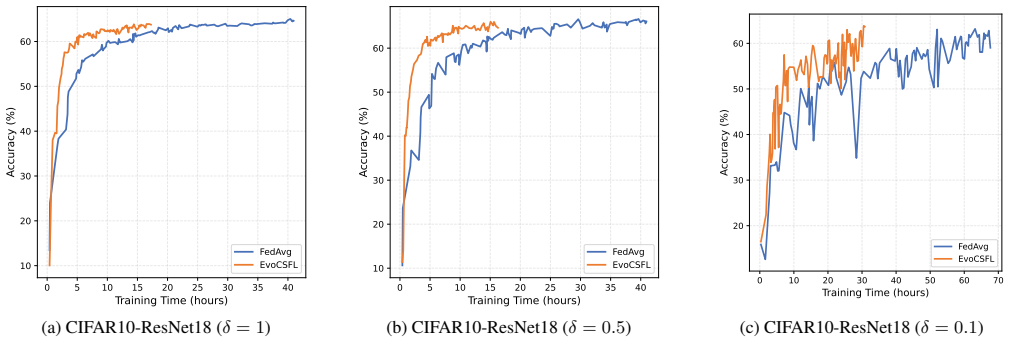
- The selected client subsets converge faster than random or heuristic selections on MNIST, CIFAR10, CINIC10, and TinyImageNet.
- Total energy consumed during training drops because high-latency or high-cost clients are avoided.
- Training remains stable even when client data distributions and system capabilities differ widely.
- The method outperforms existing client-selection baselines under the same heterogeneity conditions.
Where Pith is reading between the lines
- If the surrogate remains accurate for client pools much larger than those tested, the framework could be applied to cross-device settings with thousands of participants without exhaustive evaluation.
- The same surrogate-plus-evolution pattern could be reused for other selection tasks inside distributed training, such as choosing which model updates to aggregate.
- Replacing or augmenting the current metric with additional terms such as differential-privacy noise level would let practitioners trade off privacy cost against speed without redesigning the search.
Load-bearing premise
The surrogate model trained on a limited collection of candidate client selections can reliably predict the true metric value for any other subset the evolutionary search might examine.
What would settle it
A direct test would be to run the evolutionary search, deploy the resulting client subsets in actual federated training, and check whether the observed convergence speed, energy consumption, and robustness match the surrogate predictions and exceed the baselines on the same datasets.
Figures
read the original abstract
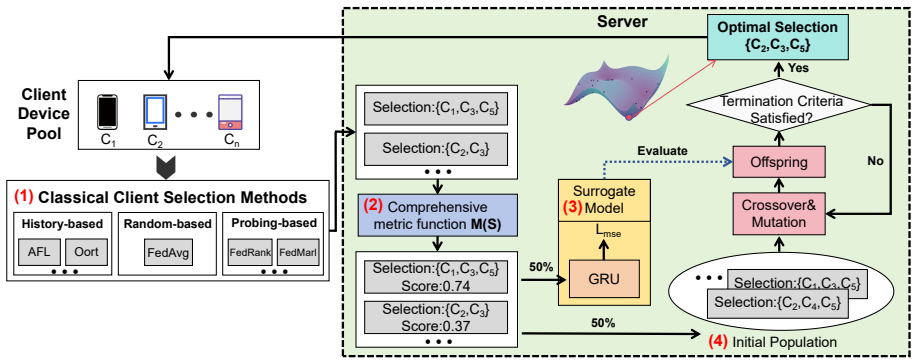
The heterogeneity of client data and systems makes it difficult to achieve satisfactory convergence speed and robustness in federated learning with random client selection. To address this issue, this paper proposes a surrogate-assisted client evolutionary selection framework for federated learning. In this framework, some typical client selection strategies are first used to generate candidate sets, and a metric function that integrates model performance, communication latency, and energy consumption is developed to formulate the client selection problem as a combinatorial optimization one. Subsequently, a surrogate model is constructed using the candidate selections and metric to efficiently approximate the performance of selected client subsets. An evolutionary algorithm is employed to search the combinatorial space of client selections, guided by the surrogate model to accelerate convergence. Experiments on MNIST, CIFAR10, CINIC10, and TinyImageNet demonstrate that the proposed algorithm achieves faster convergence, lower energy consumption, and improved robustness compared to existing methods.
Editorial analysis
A structured set of objections, weighed in public.
Referee Report
Summary. The paper proposes EvoCSFL, a surrogate-assisted evolutionary framework for client selection in federated learning. Typical selection strategies generate candidate client subsets; a composite metric integrates model performance, communication latency, and energy consumption to cast selection as combinatorial optimization. A surrogate model is built on these candidates to approximate subset performance, and an evolutionary algorithm searches the space guided by the surrogate. Experiments on MNIST, CIFAR10, CINIC10, and TinyImageNet report faster convergence, lower energy use, and better robustness versus existing methods.
Significance. If the surrogate generalizes reliably to subsets returned by the evolutionary search, the framework offers a practical route to optimized client selection that improves convergence speed and resource efficiency in heterogeneous federated learning. The multi-dataset experimental evaluation is a positive feature that supports assessment of practical impact. The surrogate-assisted design directly tackles the intractability of exhaustive search over client combinations.
major comments (1)
- [Abstract / framework description] Abstract (framework description): the surrogate is trained exclusively on candidate subsets produced by standard heuristics plus the composite metric. No mechanism is described that ensures these candidates cover regions of the combinatorial space that the evolutionary algorithm will explore; if extrapolation error is high on EA-proposed subsets, the reported gains in convergence, energy, and robustness become artifacts of surrogate inaccuracy rather than genuine optimization. Explicit validation (e.g., hold-out accuracy or ranking correlation on EA-generated subsets) is required to support the central claim.
minor comments (1)
- [Abstract] The abstract does not specify the surrogate model family (e.g., GP, NN) or the evolutionary algorithm variant and operators; adding these details would improve reproducibility.
Simulated Author's Rebuttal
We thank the referee for the constructive feedback on our manuscript. The major comment raises an important point about surrogate generalization, which we address below. We are happy to revise the paper to strengthen this aspect of the work.
read point-by-point responses
-
Referee: [Abstract / framework description] Abstract (framework description): the surrogate is trained exclusively on candidate subsets produced by standard heuristics plus the composite metric. No mechanism is described that ensures these candidates cover regions of the combinatorial space that the evolutionary algorithm will explore; if extrapolation error is high on EA-proposed subsets, the reported gains in convergence, energy, and robustness become artifacts of surrogate inaccuracy rather than genuine optimization. Explicit validation (e.g., hold-out accuracy or ranking correlation on EA-generated subsets) is required to support the central claim.
Authors: We acknowledge that the surrogate is trained on candidate subsets generated by standard heuristics and that the manuscript does not explicitly describe mechanisms guaranteeing coverage of regions explored by the evolutionary algorithm, nor does it report hold-out validation metrics on EA-proposed subsets. While the diversity of the heuristic-generated candidates is intended to provide broad initial coverage, we agree that this does not fully address potential extrapolation concerns. To support the central claim, we will add explicit validation experiments in the revised manuscript, including surrogate prediction accuracy and ranking correlation evaluated on hold-out subsets generated by the evolutionary search. revision: yes
Circularity Check
No circularity: framework and claims are empirically grounded
full rationale
The derivation proceeds by (1) running standard client-selection heuristics to produce candidate subsets, (2) defining an explicit composite metric, (3) training a surrogate on the resulting (subset, metric) pairs, and (4) letting an EA optimize under the surrogate. Reported gains in convergence, energy, and robustness are obtained by executing the full pipeline on MNIST/CIFAR-10/etc. and comparing against baselines; none of these quantities is defined in terms of the surrogate output or the initial candidates. No self-citation chain, fitted-parameter-as-prediction, or ansatz-smuggling is present in the given text. The method is therefore self-contained against external benchmarks.
Axiom & Free-Parameter Ledger
Reference graph
Works this paper leans on
-
[1]
Fedmccs: Multicriteria client selection model for optimal iot feder- ated learning.IEEE Internet of Things Journal, 8(6):4723– 4735,
[AbdulRahmanet al., 2020 ] Sawsan AbdulRahman, Hanine Tout, Azzam Mourad, and Chamseddine Talhi. Fedmccs: Multicriteria client selection model for optimal iot feder- ated learning.IEEE Internet of Things Journal, 8(6):4723– 4735,
2020
-
[2]
Tifl: A tier- based federated learning system
[Chaiet al., 2020 ] Zheng Chai, Ahsan Ali, Syed Zawad, Stacey Truex, Ali Anwar, Nathalie Baracaldo, Yi Zhou, Heiko Ludwig, Feng Yan, and Yue Cheng. Tifl: A tier- based federated learning system. InProceedings of the 29th International Symposium on High-Performance Par- allel and Distributed Computing, pages 125–136,
2020
-
[3]
Optimal device selection for federated learning over mobile edge networks
[Chinget al., 2020 ] Cheng-Wei Ching, Yu-Chun Liu, Chung-Kai Yang, Jian-Jhih Kuo, and Feng-Ting Su. Optimal device selection for federated learning over mobile edge networks. In2020 IEEE 40th International Conference on Distributed Computing Systems (ICDCS), pages 1298–1303. IEEE,
2020
-
[4]
Empirical Evaluation of Gated Recurrent Neural Networks on Sequence Modeling
[Chunget al., 2014 ] Junyoung Chung, Caglar Gulcehre, KyungHyun Cho, and Yoshua Bengio. Empirical Evalu- ation of Gated Recurrent Neural Networks on Sequence Modeling.arXiv e-prints, page arXiv:1412.3555, Decem- ber
work page internal anchor Pith review Pith/arXiv arXiv 2014
-
[5]
CINIC-10 is not ImageNet or CIFAR-10
[Darlowet al., 2018 ] Luke N Darlow, Elliot J Crowley, Antreas Antoniou, and Amos J Storkey. Cinic-10 is not imagenet or cifar-10.arXiv preprint arXiv:1810.03505,
work page internal anchor Pith review Pith/arXiv arXiv 2018
-
[6]
Imagenet: A large-scale hierarchical image database
[Denget al., 2009 ] Jia Deng, Wei Dong, Richard Socher, Li- Jia Li, Kai Li, and Li Fei-Fei. Imagenet: A large-scale hierarchical image database. In2009 IEEE Conference on Computer Vision and Pattern Recognition, pages 248–255,
2009
-
[7]
A mul- tiobjective optimization based framework to balance the global exploration and local exploitation in expensive opti- mization.Journal of Global Optimization, 61(4):677–694,
[Fenget al., 2015 ] Zhiwei Feng, Qingbin Zhang, Qingfu Zhang, Qiangang Tang, Tao Yang, and Yang Ma. A mul- tiobjective optimization based framework to balance the global exploration and local exploitation in expensive opti- mization.Journal of Global Optimization, 61(4):677–694,
2015
-
[8]
Ac- tive federated learning.arXiv preprint arXiv:1909.12641,
[Goetzet al., 2019 ] Jack Goetz, Kshitiz Malik, Duc Bui, Se- ungwhan Moon, Honglei Liu, and Anuj Kumar. Ac- tive federated learning.arXiv preprint arXiv:1909.12641,
-
[9]
Long short-term memory.Su- pervised Sequence Labelling with Recurrent Neural Net- works, pages 37–45,
[Graves, 2012] Alex Graves. Long short-term memory.Su- pervised Sequence Labelling with Recurrent Neural Net- works, pages 37–45,
2012
-
[10]
Deep residual learning for image recogni- tion
[Heet al., ] Kaiming He, Xiangyu Zhang, Shaoqing Ren, and Jian Sun. Deep residual learning for image recogni- tion. InProceedings of the IEEE Conference on Computer Vision and Pattern Recognition, pages 770–778. [Imteajet al., 2022 ] Ahmed Imteaj, Khandaker Ma- mun Ahmed, Urmish Thakker, Shiqiang Wang, Jian Li, and M Hadi Amini. Federated learning for res...
2022
-
[11]
An evolutionary algorithm with spatially dis- tributed surrogates for multiobjective optimization
[Isaacset al., 2007 ] Amitay Isaacs, Tapabrata Ray, and War- ren Smith. An evolutionary algorithm with spatially dis- tributed surrogates for multiobjective optimization. In Australian Conference on Artificial Life, pages 257–268. Springer,
2007
-
[12]
Scaffold: Stochastic controlled averaging for federated learning
[Karimireddyet al., 2020 ] Sai Praneeth Karimireddy, Satyen Kale, Mehryar Mohri, Sashank Reddi, Sebas- tian Stich, and Ananda Theertha Suresh. Scaffold: Stochastic controlled averaging for federated learning. In International Conference on Machine Learning, pages 5132–5143. PMLR,
2020
-
[13]
A review on genetic al- gorithm: past, present, and future.Multimedia Tools and Applications, 80(5):8091–8126,
[Katochet al., 2021 ] Sourabh Katoch, Sumit Singh Chauhan, and Vijay Kumar. A review on genetic al- gorithm: past, present, and future.Multimedia Tools and Applications, 80(5):8091–8126,
2021
-
[14]
A hybrid evolutionary multi- objective optimization strategy for the dynamic power sup- ply problem in magnesia grain manufacturing.Applied Soft Computing, 13(5):2960–2969,
[Konget al., 2013 ] Weijian Kong, Tianyou Chai, Shengxi- ang Yang, and Jinliang Ding. A hybrid evolutionary multi- objective optimization strategy for the dynamic power sup- ply problem in magnesia grain manufacturing.Applied Soft Computing, 13(5):2960–2969,
2013
-
[15]
Crossover operators in genetic algorithms: A review.International Journal of Computer Applications, 162(10),
[Kora and Yadlapalli, 2017] Padmavathi Kora and Priyanka Yadlapalli. Crossover operators in genetic algorithms: A review.International Journal of Computer Applications, 162(10),
2017
-
[16]
Learning multiple layers of features from tiny images
[Krizhevsky and Hinton, 2009] Alex Krizhevsky and Geof- frey Hinton. Learning multiple layers of features from tiny images
2009
-
[17]
Oort: Efficient fed- erated learning via guided participant selection
[Laiet al., 2021 ] Fan Lai, Xiangfeng Zhu, Harsha V Mad- hyastha, and Mosharaf Chowdhury. Oort: Efficient fed- erated learning via guided participant selection. In15th USENIX Symposium on Operating Systems Design and Implementation, OSDI 2021, pages 19–35. USENIX As- sociation,
2021
-
[18]
Gradient-based learning ap- plied to document recognition.Proceedings of the IEEE, 86(11):2278–2324,
[LeCunet al., 2002 ] Yann LeCun, L ´eon Bottou, Yoshua Bengio, and Patrick Haffner. Gradient-based learning ap- plied to document recognition.Proceedings of the IEEE, 86(11):2278–2324,
2002
-
[19]
The mnist database of hand- written digits.http://yann
[LeCun, 1998] Yann LeCun. The mnist database of hand- written digits.http://yann. lecun. com/exdb/mnist/,
1998
-
[20]
Fedsae: A novel self-adaptive federated learn- ing framework in heterogeneous systems
[Liet al., 2021 ] Li Li, Moming Duan, Duo Liu, Yu Zhang, Ao Ren, Xianzhang Chen, Yujuan Tan, and Chengliang Wang. Fedsae: A novel self-adaptive federated learn- ing framework in heterogeneous systems. In2021 Inter- national Joint Conference on Neural Networks (IJCNN), pages 1–10. IEEE,
2021
-
[21]
Plato: An open-source research framework for production federated learning
[Liet al., 2023 ] Baochun Li, Ningxin Su, Chen Ying, and Fei Wang. Plato: An open-source research framework for production federated learning. InProceedings of the ACM Turing Award Celebration Conference-China 2023, pages 1–2,
2023
-
[22]
Accelerating surro- gate assisted evolutionary algorithms for expensive multi- objective optimization via explainable machine learning
[Liet al., 2024 ] Bingdong Li, Yanting Yang, Dacheng Liu, Yan Zhang, Aimin Zhou, and Xin Yao. Accelerating surro- gate assisted evolutionary algorithms for expensive multi- objective optimization via explainable machine learning. Swarm and Evolutionary Computation, 88:101610,
2024
-
[23]
Feder- ated learning in mobile edge networks: A comprehen- sive survey.IEEE Communications Surveys & Tutorials, 22(3):2031–2063,
[Limet al., 2020 ] Wei Yang Bryan Lim, Nguyen Cong Lu- ong, Dinh Thai Hoang, Yutao Jiao, Ying-Chang Liang, Qiang Yang, Dusit Niyato, and Chunyan Miao. Feder- ated learning in mobile edge networks: A comprehen- sive survey.IEEE Communications Surveys & Tutorials, 22(3):2031–2063,
2020
-
[24]
[Lvet al., 2019 ] Zhiming Lv, Linqing Wang, Zhongyang Han, Jun Zhao, and Wei Wang. Surrogate-assisted parti- cle swarm optimization algorithm with pareto active learn- ing for expensive multi-objective optimization.IEEE/CAA Journal of Automatica Sinica, 6(3):838–849,
2019
-
[25]
Communication-efficient learning of deep networks from decentralized data
[McMahanet al., 2017 ] Brendan McMahan, Eider Moore, Daniel Ramage, Seth Hampson, and Blaise Aguera y Ar- cas. Communication-efficient learning of deep networks from decentralized data. InArtificial Intelligence and Statistics, pages 1273–1282. PMLR,
2017
-
[26]
Fedgcs: a generative framework for ef- ficient client selection in federated learning via gradient- based optimization
[Ninget al., 2024 ] Zhiyuan Ning, Chunlin Tian, Meng Xiao, Wei Fan, Pengyang Wang, Li Li, Pengfei Wang, and Yuanchun Zhou. Fedgcs: a generative framework for ef- ficient client selection in federated learning via gradient- based optimization. pages 4760–4768,
2024
-
[27]
Client selection for federated learning with het- erogeneous resources in mobile edge
[Nishio and Yonetani, 2019] Takayuki Nishio and Ryo Yo- netani. Client selection for federated learning with het- erogeneous resources in mobile edge. InICC 2019- 2019 IEEE International Conference on Communications (ICC), pages 1–7. IEEE,
2019
-
[28]
Combinatorial optimization approach to client scheduling for federated learning.IEEE Control Systems Letters, 7:2203–2208,
[Omori and Kashima, 2023] Tomohito Omori and Kenji Kashima. Combinatorial optimization approach to client scheduling for federated learning.IEEE Control Systems Letters, 7:2203–2208,
2023
-
[29]
Surrogate-assisted evolutionary algorithm with decomposition-based local learning for high-dimensional multi-objective optimiza- tion.Expert Systems with Applications, 240:122575,
[Shenet al., 2024 ] Jiangtao Shen, Peng Wang, Huachao Dong, Wenxin Wang, and Jinglu Li. Surrogate-assisted evolutionary algorithm with decomposition-based local learning for high-dimensional multi-objective optimiza- tion.Expert Systems with Applications, 240:122575,
2024
-
[30]
A survey on federated learning: evo- lution, applications and challenges.Applied and Compu- tational Engineering, 22:106–111, 10
[Shi, 2023] Lingyu Shi. A survey on federated learning: evo- lution, applications and challenges.Applied and Compu- tational Engineering, 22:106–111, 10
2023
-
[31]
Very deep convolutional networks for large-scale image recognition
[Simonyan and Zisserman, 2015] K Simonyan and A Zisser- man. Very deep convolutional networks for large-scale image recognition. In3rd International Conference on Learning Representations (ICLR 2015). Computational and Biological Learning Society,
2015
-
[32]
A pairwise com- parison based surrogate-assisted evolutionary algorithm for expensive multi-objective optimization.Swarm and Evolutionary Computation, 80:101323,
[Tianet al., 2023 ] Ye Tian, Jiaxing Hu, Cheng He, Haiping Ma, Limiao Zhang, and Xingyi Zhang. A pairwise com- parison based surrogate-assisted evolutionary algorithm for expensive multi-objective optimization.Swarm and Evolutionary Computation, 80:101323,
2023
-
[33]
Ranking-based client imitation selection for efficient federated learning
[Tianet al., 2024 ] Chunlin Tian, Zhan Shi, Xinpeng Qin, Li Li, and Chengzhong Xu. Ranking-based client imitation selection for efficient federated learning. InProceedings of the 41st International Conference on Machine Learn- ing, ICML’24. JMLR.org,
2024
-
[34]
Optimizing federated learning on non- iid data with reinforcement learning
[Wanget al., 2020 ] Hao Wang, Zakhary Kaplan, Di Niu, and Baochun Li. Optimizing federated learning on non- iid data with reinforcement learning. InIEEE INFO- COM 2020-IEEE conference on computer communica- tions, pages 1698–1707. IEEE,
2020
-
[35]
Optimizing client selection in federated learning base on genetic algorithm.Cluster Computing, 28(6):400,
[Wuet al., 2025 ] Jiagao Wu, Hongyan Ji, Jing Yi, and Lin- feng Liu. Optimizing client selection in federated learning base on genetic algorithm.Cluster Computing, 28(6):400,
2025
-
[36]
Client selection and bandwidth allocation in wireless federated learning networks: A long-term perspective.IEEE Trans- actions on Wireless Communications, 20(2):1188–1200,
[Xu and Wang, 2020] Jie Xu and Heqiang Wang. Client selection and bandwidth allocation in wireless federated learning networks: A long-term perspective.IEEE Trans- actions on Wireless Communications, 20(2):1188–1200,
2020
-
[37]
Surrogate-assisted classification-collaboration differential evolution for ex- pensive constrained optimization problems.Information Sciences, 508:50–63,
[Yanget al., 2020 ] Zan Yang, Haobo Qiu, Liang Gao, Xiwen Cai, Chen Jiang, and Liming Chen. Surrogate-assisted classification-collaboration differential evolution for ex- pensive constrained optimization problems.Information Sciences, 508:50–63,
2020
-
[38]
Shufflenet: An extremely efficient convolu- tional neural network for mobile devices
[Zhanget al., ] Xiangyu Zhang, Xinyu Zhou, Mengxiao Lin, and Jian Sun. Shufflenet: An extremely efficient convolu- tional neural network for mobile devices. InProceedings of the IEEE Conference on Computer Vision and Pattern Recognition, pages 6848–6856. [Zhanget al., 2022 ] Sai Qian Zhang, Jieyu Lin, and Qi Zhang. A multi-agent reinforcement learning app...
2022
-
[39]
Federated Learning with Non-IID Data
[Zhaoet al., 2018 ] Yue Zhao, Meng Li, Liangzhen Lai, Naveen Suda, Damon Civin, and Vikas Chandra. Fed- erated learning with non-iid data.arXiv preprint arXiv:1806.00582,
work page internal anchor Pith review Pith/arXiv arXiv 2018
-
[40]
[Zhouet al., 2006 ] Zongzhao Zhou, Yew Soon Ong, Pras- anth B Nair, Andy J Keane, and Kai Yew Lum. Combin- ing global and local surrogate models to accelerate evo- lutionary optimization.IEEE Transactions on Systems, Man, and Cybernetics, Part C (Applications and Reviews), 37(1):66–76, 2006
2006
discussion (0)
Sign in with ORCID, Apple, or X to comment. Anyone can read and Pith papers without signing in.