Moduli spaces of type II twists
Pith reviewed 2026-06-27 20:59 UTC · model grok-4.3
The pith
Type IIA twisting supercharges are classified by the orbits of square-zero elements in the ten-dimensional (1,1) super Poincaré algebra under the Spin group.
A machine-rendered reading of the paper's core claim, the machinery that carries it, and where it could break.
Core claim
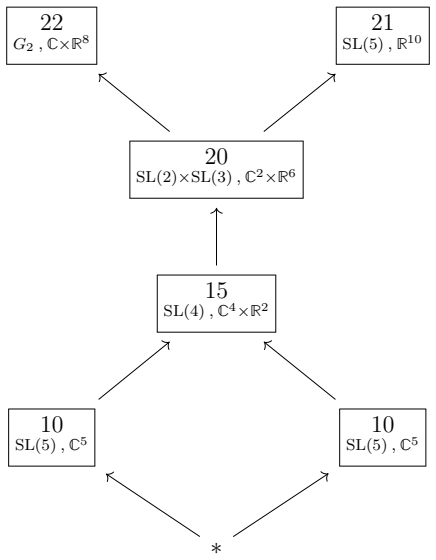
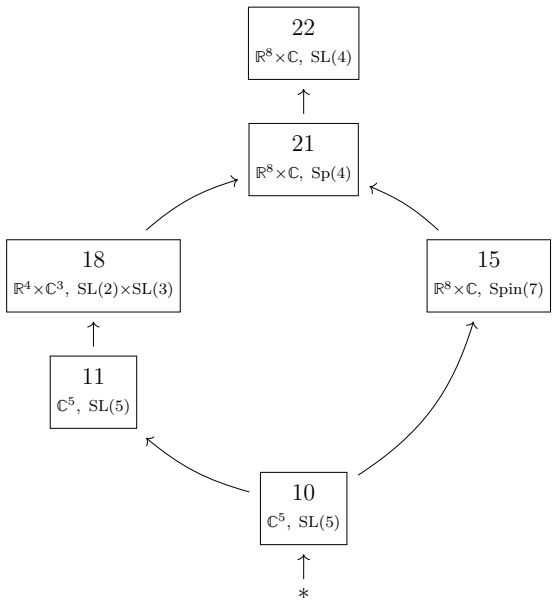
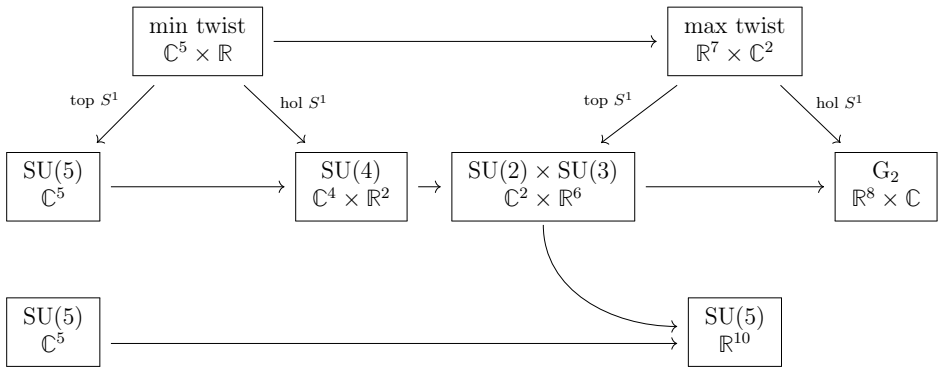
The twisting supercharges for type IIA supergravity in a flat background stand in bijection with the orbits of square-zero elements of the (1,1) super Poincaré algebra in ten dimensions under the Spin group. Together with the type IIB classification this gives the complete moduli space of twists for type II supergravities. The twists are realized as dimensional reductions from eleven dimensions; the pure spinor formulation of the superstring maps them to worldsheet twists, producing supergravity versions of mixed A/B models; and T-duality acts by relating the IIA and IIB twists to each other.
What carries the argument
Orbits of square-zero elements in the (1,1) super Poincaré algebra under the Spin group action, which label the distinct twisting supercharges.
If this is right
- The full set of flat-space twists for both type IIA and type IIB supergravities is now known.
- Every twist descends from a corresponding twist in eleven-dimensional supergravity via dimensional reduction.
- Target-space twists correspond one-to-one with worldsheet twists in the pure spinor formulation, including mixed A/B models.
- T-duality supplies an explicit map that sends each IIA twist to a unique IIB twist and vice versa.
Where Pith is reading between the lines
- The same orbit method could be applied to other supergravity theories whose superalgebras admit a comparable square-zero analysis.
- If the flat-space classification survives deformation to curved backgrounds, the resulting twisted theories would give new examples of consistent string backgrounds.
- The mixed A/B models identified here may furnish concrete realizations of duality-symmetric formulations of supergravity.
- Extending the classification beyond flat space would require checking whether additional constraints from the supergravity equations alter the orbit structure.
Load-bearing premise
The orbits of square-zero elements in the flat-space (1,1) super Poincaré algebra under the Spin group already capture every twisting supercharge without further restrictions from the full supergravity dynamics or from curved backgrounds.
What would settle it
An explicit twisting supercharge for type IIA supergravity whose corresponding supercharge does not lie in any of the enumerated orbits, or an orbit that yields no valid twist, would falsify the classification.
Figures
read the original abstract
We provide a complete classification of twisting supercharges for type IIA supergravity in a flat background by determining the orbits of square-zero elements in the (1,1) super Poincar\'e algebra in ten dimensions under the action of the Spin group. Together with recent results for type IIB, this completes the description of the moduli space of twists for type II supergravities. Further, we discuss the origins of these twists as dimensional reductions from eleven dimensions. Using the pure spinor formulation of the superstring, we relate the target space classification to worldsheet twists and identify supergravity counterparts of mixed A/B models. Finally, we work out the action of T-duality that relates twists of type IIA with those of type IIB.
Editorial analysis
A structured set of objections, weighed in public.
Referee Report
Summary. The paper provides a complete classification of twisting supercharges for type IIA supergravity in a flat background by determining the orbits of square-zero elements in the (1,1) super Poincaré algebra in ten dimensions under the action of the Spin group. Together with prior IIB results, this completes the moduli space of twists for type II supergravities. It further traces the twists to dimensional reductions from eleven dimensions, relates the target-space classification to worldsheet twists via the pure spinor formulation (identifying supergravity counterparts of mixed A/B models), and derives the action of T-duality relating IIA and IIB twists.
Significance. If the orbit classification is exhaustive, the work supplies a parameter-free algebraic foundation for the moduli space of type II twists, completing the type II picture and enabling systematic study of twisted compactifications. The explicit links to 11D reductions, pure-spinor worldsheet twists, mixed models, and T-duality are concrete strengths that increase the result's utility across target-space and worldsheet formulations.
minor comments (2)
- [Abstract / Introduction] The abstract states that the classification is 'complete' but does not indicate whether an explicit enumeration or generating-function argument is supplied to confirm that all orbits have been found; a short paragraph in the introduction summarizing the enumeration strategy would improve clarity.
- [Section on worldsheet twists] When discussing the relation to mixed A/B models, the manuscript should explicitly note which worldsheet twists correspond to which target-space orbits (e.g., by referencing the orbit representatives listed in the classification tables).
Simulated Author's Rebuttal
We thank the referee for their positive assessment of the manuscript and for recommending acceptance. The report accurately captures the main results on the classification of type IIA twists, their relation to 11D reductions, pure spinor worldsheet twists, and T-duality.
Circularity Check
No significant circularity; algebraic classification on external algebra
full rationale
The central derivation is an orbit classification of square-zero elements in the standard (1,1) super Poincaré algebra under the Spin(1,9) action. This is a direct group-theoretic computation on an externally defined Lie superalgebra with no reduction to fitted parameters, self-definitions, or load-bearing self-citations. The mention of prior IIB results is supplementary and does not underpin the IIA classification. No equations or steps in the provided abstract or claim reduce the output to the inputs by construction.
Axiom & Free-Parameter Ledger
Reference graph
Works this paper leans on
-
[1]
Topological M-theory as Unification of Form Theories of Gravity
arXiv:hep-th/0411073. [EH23] R. Eager and F. Hahner. “Maximally Twisted Eleven-Dimensional Supergravity.” Commun. Math. Phys.398.1 (2023), pp. 59–88. arXiv:2106.15640 [hep-th]. [ESW21] R.Eager,I.Saberi,andJ.Walcher.“Nilpotencevarieties.”Annales Henri Poincaré 22.4 (2021), pp. 1319–1376. arXiv:1807.03766 [hep-th]. [ES19] C. Elliott and P. Safronov. “Topolo...
work page internal anchor Pith review Pith/arXiv arXiv 2023
-
[2]
arXiv:2106.15639 [math-ph]. [STV89] D. P. Sorokin, V. I. Tkach, and D. V. Volkov. “Superparticles, Twistors and Siegel Symmetry.”Mod. Phys. Lett. A4 (1989), pp. 901–908. [Wit98] E. Witten. “Mirror manifolds and topological field theory.”AMS/IP Stud. Adv. Math.9 (1998). Ed. by S.-T. Yau, pp. 121–160. arXiv:hep-th/9112056. [Yoo25] P. Yoo. “Twists of Supersy...
discussion (0)
Sign in with ORCID, Apple, or X to comment. Anyone can read and Pith papers without signing in.