Quantum-Enhanced Similarity Measures for Polarimetric Materials Classification
Pith reviewed 2026-06-27 22:02 UTC · model grok-4.3
The pith
A quantum SWAP-test on 32-dimensional embeddings computes material similarity scores that match classical classification accuracy on polarimetric data.
A machine-rendered reading of the paper's core claim, the machinery that carries it, and where it could break.
Core claim
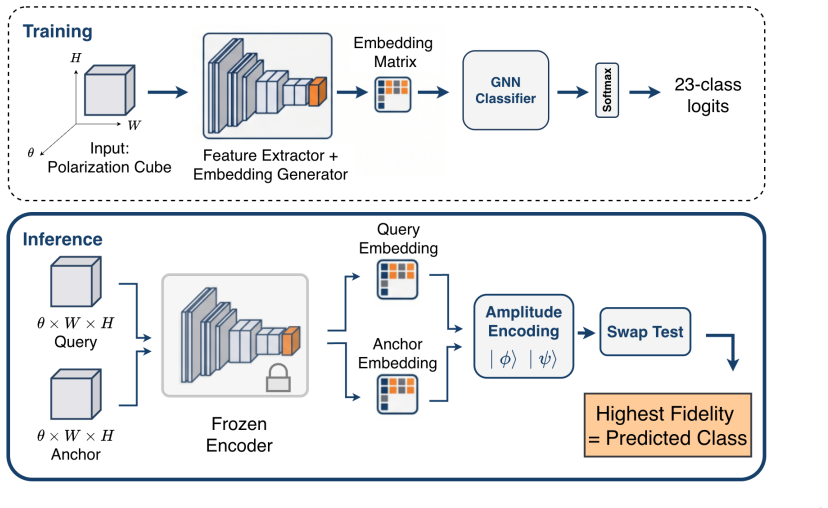
Encoding the 32-dimensional embeddings as quantum state amplitudes and estimating their pairwise fidelity with a SWAP-test circuit produces aggregated similarity scores that correctly assign a queried material cube to the class of the anchor cube with the highest score; on a dataset of 23 materials this quantum point-matching procedure reaches accuracy levels competitive with a classical optimal transport baseline and additionally supports open-set discrimination.
What carries the argument
The SWAP-test circuit that estimates fidelity between two quantum states prepared from the 32-dimensional embeddings.
If this is right
- The quantum pipeline achieves classification accuracy competitive with a classical optimal transport point-matching method.
- Aggregated fidelity scores support discrimination between materials inside and outside the training set.
- The overall procedure constitutes a viable implementation path for material recognition on noisy intermediate-scale quantum hardware.
Where Pith is reading between the lines
- The same fidelity-based matching could be tested on voxel data from other optical modalities to check whether the quantum step generalizes beyond polarimetry.
- Replacing the SWAP-test with other quantum distance estimators might reduce circuit depth while preserving the reported accuracy.
- If embedding dimension is varied, one could measure how fidelity estimation quality changes with the number of qubits required.
Load-bearing premise
Fidelity values produced by the SWAP-test circuit on the 32-dimensional embeddings serve as reliable material similarity scores capable of driving accurate classification and open-set detection.
What would settle it
Applying the full pipeline to the 23-material dataset and obtaining classification accuracy substantially below the optimal transport baseline, or failing to separate open-set samples using the aggregated fidelity scores.
Figures

read the original abstract
We present a quantum--classical hybrid pipeline for polarimetric material classification that casts this as a point-matching problem. Voxel cubes, containing polarized light reflections, are used to train an encoder to produce 32-dimensional embeddings for the voxels of the cubes. At inference, the encoder head is discarded and the embeddings are encoded as probability amplitudes of quantum states. Next, a SWAP-test circuit estimates the fidelity between each of the 32D embeddings from the query cube and a dataset of anchor cubes. The aggregated fidelity serves as materials similarity scores, and the class of the anchor with highest aggregated fidelity is deemed as the class of the queried material. We evaluate our approach on a dataset of 23 materials ($\approx$800 samples each) derived from their Mueller matrices. The point-matching approaches from the proposed quantum SWAP-test and a classical classifier using Optimal Transport are compared. Our results demonstrate the competitive classification accuracy alongside open-set discrimination potential, establishing it as a viable path toward NISQ-based material recognition.
Editorial analysis
A structured set of objections, weighed in public.
Referee Report
Summary. The manuscript presents a quantum-classical hybrid pipeline for polarimetric material classification. Voxel cubes from polarized light reflections train an encoder to produce 32-dimensional embeddings. At inference the embeddings are encoded as quantum states and a SWAP-test circuit estimates fidelities that serve as aggregated similarity scores; the anchor class with highest score is assigned to the query. The method is evaluated on a 23-material dataset and compared against Optimal Transport, with claims of competitive accuracy and open-set discrimination potential for NISQ-based recognition.
Significance. If quantitative results were supplied and a genuine advantage over classical inner-product baselines were demonstrated, the hybrid encoding approach on a real polarimetric dataset could contribute to explorations of NISQ primitives in computer-vision tasks. The point-matching formulation and use of Mueller-matrix-derived data are constructive elements. However, the mathematical equivalence of the SWAP-test output to classical squared cosine similarity limits the potential impact unless additional benefits (e.g., for open-set detection) are shown.
major comments (3)
- [Abstract and Methods (pipeline)] Abstract and pipeline description: the SWAP-test fidelity on normalized 32D embeddings computes |⟨ψ|φ⟩|^2 = (u · v)^2 exactly, which is the squared cosine similarity and is classically computable in linear time with no superposition or entanglement advantage. The manuscript compares only to Optimal Transport and supplies no direct classical inner-product baseline, which is load-bearing for the title claim of 'quantum-enhanced' similarity measures.
- [Results/Evaluation] Evaluation section: the abstract asserts 'competitive classification accuracy' and 'open-set discrimination potential' yet reports no accuracy values, error bars, training details, baseline implementations, or statistical tests. This prevents verification that the data support the central claim.
- [Discussion/Conclusion] Discussion or Conclusion: no description of actual NISQ hardware execution or circuit simulation details is provided, which is required to substantiate the claim of a 'viable path toward NISQ-based material recognition'.
minor comments (1)
- [Abstract/Dataset] Dataset description: the approximate figure of ≈800 samples per material is given without precise counts, train/test splits, or class-balance statistics, which would improve reproducibility.
Simulated Author's Rebuttal
We thank the referee for the constructive and detailed comments. We address each major point below and indicate planned revisions.
read point-by-point responses
-
Referee: [Abstract and Methods (pipeline)] Abstract and pipeline description: the SWAP-test fidelity on normalized 32D embeddings computes |⟨ψ|φ⟩|^2 = (u · v)^2 exactly, which is the squared cosine similarity and is classically computable in linear time with no superposition or entanglement advantage. The manuscript compares only to Optimal Transport and supplies no direct classical inner-product baseline, which is load-bearing for the title claim of 'quantum-enhanced' similarity measures.
Authors: We agree that the SWAP-test fidelity for normalized pure states is mathematically identical to squared cosine similarity and can be computed classically in linear time. This equivalence is a standard property of the SWAP test. Our contribution centers on casting polarimetric material classification as a point-matching task using Mueller-matrix data and exploring a hybrid pipeline. To address the concern directly, we will add an explicit classical inner-product (cosine similarity) baseline alongside the Optimal Transport comparison, revise the title and abstract to reflect the hybrid implementation without claiming a computational advantage at 32 dimensions, and retain the comparison to Optimal Transport as it represents a distinct classical method for the same task. revision: yes
-
Referee: [Results/Evaluation] Evaluation section: the abstract asserts 'competitive classification accuracy' and 'open-set discrimination potential' yet reports no accuracy values, error bars, training details, baseline implementations, or statistical tests. This prevents verification that the data support the central claim.
Authors: The full evaluation contains the requested quantitative results, but they were not reported with sufficient detail or highlighted in the abstract. In the revision we will explicitly state the classification accuracies for the SWAP-test pipeline versus Optimal Transport, include error bars from repeated trials, provide encoder training hyperparameters, describe baseline implementations, and report any statistical tests. This will allow direct verification of the competitive performance and open-set claims. revision: yes
-
Referee: [Discussion/Conclusion] Discussion or Conclusion: no description of actual NISQ hardware execution or circuit simulation details is provided, which is required to substantiate the claim of a 'viable path toward NISQ-based material recognition'.
Authors: We will expand the discussion section to include circuit simulation details: the 33-qubit SWAP-test circuit (32 data qubits plus ancilla), gate decomposition, shot count for fidelity estimation, and classical post-processing of the aggregated scores. No physical NISQ hardware execution was performed; the results are from classical simulation of the quantum circuit. We will clarify this distinction and outline the resource requirements and noise considerations for future hardware deployment to substantiate the viability claim. revision: partial
Circularity Check
No circularity; pipeline applies independent SWAP-test to trained embeddings
full rationale
The paper trains a classical encoder on voxel data to produce 32D embeddings, then encodes those embeddings as quantum states and applies the standard SWAP-test circuit to estimate fidelities. This quantum primitive is applied after training and is mathematically independent of the encoder weights; the claimed classification and open-set results follow from comparing the resulting scores to Optimal Transport baselines. No step reduces a prediction to a fitted parameter by construction, no self-citation is load-bearing for the central claim, and no ansatz or uniqueness theorem is smuggled in. The derivation chain is self-contained.
Axiom & Free-Parameter Ledger
free parameters (1)
- embedding dimension =
32
axioms (1)
- domain assumption The SWAP-test circuit provides a faithful estimate of state fidelity that translates into useful material similarity
Reference graph
Works this paper leans on
-
[1]
Constraining object features using a polarization reflectance model,
L. B. Wolff and T. E. Boult, “Constraining object features using a polarization reflectance model,”IEEE Transactions on Pattern Analysis and Machine Intelligence, vol. 13, no. 7, pp. 635–657, 1991
1991
-
[2]
Image-based acquisition and modeling of polarimetric reflectance,
S.-H. Baek, T. Zeltner, H. Ku, I. Hwang, X. Tong, W. Jakob, and M. H. Kim, “Image-based acquisition and modeling of polarimetric reflectance,”ACM Transactions on Graphics, vol. 39, no. 4, p. 139, 2020
2020
-
[3]
Quantum finger- printing,
H. Buhrman, R. Cleve, J. Watrous, and R. de Wolf, “Quantum finger- printing,”Physical Review Letters, vol. 87, no. 16, p. 167902, 2001
2001
-
[4]
Learning the quantum algorithm for state overlap,
L. Cincio, Y . Subası, A. T. Sornborger, and P. J. Coles, “Learning the quantum algorithm for state overlap,”New Journal of Physics, vol. 20, no. 11, p. 113022, 2018
2018
-
[5]
Octgpt: Octree-based multiscale autoregressive models for 3D shape generation,
S.-T. Wei, R.-H. Wang, C.-Z. Zhou, B. Chen, and P.-S. Wang, “Octgpt: Octree-based multiscale autoregressive models for 3D shape generation,” inACM SIGGRAPH 2025 Conference Papers, 2025, pp. 32:1–32:11
2025
-
[6]
Computational optimal transport,
G. Peyr ´e and M. Cuturi, “Computational optimal transport,”Foundations and Trends in Machine Learning, vol. 11, no. 5–6, pp. 355–607, 2019
2019
-
[7]
Polarization-based material classification from specular reflection,
L. B. Wolff, “Polarization-based material classification from specular reflection,”IEEE Transactions on Pattern Analysis and Machine Intel- ligence, vol. 12, no. 11, pp. 1059–1071, 1990
1990
-
[8]
Polarization phase-based method for material classification in computer vision,
H. Chen and L. B. Wolff, “Polarization phase-based method for material classification in computer vision,”International Journal of Computer Vision, vol. 28, no. 1, pp. 73–83, 1998
1998
-
[9]
Interpretation of Mueller matrices based on polar decomposition,
S.-Y . Lu and R. A. Chipman, “Interpretation of Mueller matrices based on polar decomposition,”Journal of the Optical Society of America A, vol. 13, no. 5, pp. 1106–1113, 1996
1996
-
[10]
Polarization imaging for material clas- sification,
S. Tominaga and A. Kimachi, “Polarization imaging for material clas- sification,”Optical Engineering, vol. 47, no. 12, p. 123201, 2008
2008
-
[11]
Accurate polarimetric BRDF for real polarization scene rendering,
Y . Kondo, T. Ono, L. Sun, Y . Hirasawa, and J. Murayama, “Accurate polarimetric BRDF for real polarization scene rendering,” inComputer Vision – ECCV 2020, 2020, pp. 220–236
2020
-
[12]
Image-based acquisition and modeling of polarimetric reflectance,
S.-H. Baek, T. Zeltner, H. J. Ku, I. Hwang, X. Tong, W. Jakob, and M. H. Kim, “Image-based acquisition and modeling of polarimetric reflectance,”ACM Transactions on Graphics, vol. 39, no. 4, 2020
2020
-
[13]
Deep polarization imaging for 3D shape and SVBRDF acquisition,
V . Deschaintre, Y . Lin, and A. Ghosh, “Deep polarization imaging for 3D shape and SVBRDF acquisition,” inProceedings of the IEEE/CVF Conference on Computer Vision and Pattern Recognition, 2021, pp. 15 567–15 576
2021
-
[14]
Multimodal material segmentation,
Y . Liang, R. Wakaki, S. Nobuhara, and K. Nishino, “Multimodal material segmentation,” inProceedings of the IEEE/CVF Conference on Computer Vision and Pattern Recognition, 2022, pp. 19 800–19 808
2022
-
[15]
PointNet++: Deep hierarchical feature learning on point sets in a metric space,
C. R. Qi, L. Yi, H. Su, and L. J. Guibas, “PointNet++: Deep hierarchical feature learning on point sets in a metric space,” inAdvances in Neural Information Processing Systems, 2017, pp. 5099–5108
2017
-
[16]
O-CNN: Octree-based convolutional neural networks for 3D shape analysis,
P.-S. Wang, Y . Liu, Y .-X. Guo, C.-Y . Sun, and X. Tong, “O-CNN: Octree-based convolutional neural networks for 3D shape analysis,” ACM Transactions on Graphics, vol. 36, no. 4, pp. 72:1–72:11, 2017
2017
-
[17]
Dynamic graph CNN for learning on point clouds,
Y . Wang, Y . Sun, Z. Liu, S. E. Sarma, M. M. Bronstein, and J. M. Solomon, “Dynamic graph CNN for learning on point clouds,”ACM Transactions on Graphics, vol. 38, no. 5, pp. 146:1–146:12, 2019
2019
-
[18]
Dual octree graph networks for learning adaptive volumetric shape representations,
P.-S. Wang, Y . Liu, and X. Tong, “Dual octree graph networks for learning adaptive volumetric shape representations,”ACM Transactions on Graphics, vol. 41, no. 4, pp. 103:1–103:15, 2022
2022
-
[19]
Point transformer,
H. Zhao, L. Jiang, J. Jia, P. H. S. Torr, and V . Koltun, “Point transformer,” inProceedings of the IEEE/CVF International Conference on Computer Vision, 2021, pp. 16 259–16 268
2021
-
[20]
Point-BERT: Pre-training 3D point cloud transformers with masked point modeling,
X. Yu, L. Tang, Y . Rao, T. Huang, J. Zhou, and J. Lu, “Point-BERT: Pre-training 3D point cloud transformers with masked point modeling,” inProceedings of the IEEE/CVF Conference on Computer Vision and Pattern Recognition, 2022, pp. 19 313–19 322
2022
-
[21]
Octformer: Octree-based transformers for 3D point clouds,
P.-S. Wang, “Octformer: Octree-based transformers for 3D point clouds,” ACM Transactions on Graphics, vol. 42, no. 4, pp. 155:1–155:11, 2023
2023
-
[22]
Quantum Algorithms for Nearest-Neighbor Methods for Supervised and Unsupervised Learning
N. Wiebe, A. Kapoor, and K. Svore, “Quantum algorithms for nearest- neighbor methods for supervised and unsupervised learning,”arXiv preprint arXiv:1401.2142, 2014
work page internal anchor Pith review Pith/arXiv arXiv 2014
-
[23]
Implementing a distance-based classifier with a quantum interference circuit,
M. Schuld, M. Fingerhuth, and F. Petruccione, “Implementing a distance-based classifier with a quantum interference circuit,”Euro- physics Letters, vol. 119, no. 6, p. 60002, 2017
2017
-
[24]
Quantumk-nearest neighbors algorithm,
A. Basheer, A. Afham, and S. K. Goyal, “Quantumk-nearest neighbors algorithm,”arXiv preprint arXiv:2003.09187, 2020
-
[25]
A quantum k-nearest neigh- bors algorithm based on the euclidean distance estimation,
E. Zardini, E. Blanzieri, and D. Pastorello, “A quantum k-nearest neigh- bors algorithm based on the euclidean distance estimation,”Quantum Machine Intelligence, vol. 6, no. 1, p. 23, 2024
2024
-
[26]
Ancilla-free continuous-variable swap test,
T. J. V olkoff and Y . Subas ¸ı, “Ancilla-free continuous-variable swap test,” Quantum, vol. 6, p. 800, 2022
2022
-
[27]
A quantum computational approach to correspondence problems on point sets,
V . Golyanik and C. Theobalt, “A quantum computational approach to correspondence problems on point sets,” inProceedings of the IEEE/CVF Conference on Computer Vision and Pattern Recognition, 2020, pp. 9182–9191
2020
-
[28]
Q-match: Iterative shape matching via quantum annealing,
M. S. Benkner, Z. L ¨ahner, V . Golyanik, C. Wunderlich, C. Theobalt, and M. Moeller, “Q-match: Iterative shape matching via quantum annealing,” inProceedings of the IEEE/CVF International Conference on Computer Vision, 2021, pp. 7586–7596
2021
-
[29]
Ccuantumm: Cycle-consistent quantum- hybrid matching of multiple shapes,
H. Bhatia, E. Tretschk, Z. L ¨ahner, M. S. Benkner, M. Moeller, C. Theobalt, and V . Golyanik, “Ccuantumm: Cycle-consistent quantum- hybrid matching of multiple shapes,” inProceedings of the IEEE/CVF Conference on Computer Vision and Pattern Recognition, 2023, pp. 1296–1305
2023
-
[30]
A baseline for detecting misclassified and out-of-distribution examples in neural networks,
D. Hendrycks and K. Gimpel, “A baseline for detecting misclassified and out-of-distribution examples in neural networks,” inInternational Conference on Learning Representations (ICLR), 2017
2017
-
[31]
Deep neural networks are easily fooled: High confidence predictions for unrecognizable images,
A. Nguyen, J. Yosinski, and J. Clune, “Deep neural networks are easily fooled: High confidence predictions for unrecognizable images,”IEEE Conference on Computer Vision and Pattern Recognition (CVPR), 2015
2015
-
[32]
Do deep generative models know what they don’t know?
E. Nalisnick, A. Matsukawa, Y . W. Teh, D. Gorur, and B. Lakshmi- narayanan, “Do deep generative models know what they don’t know?” inInternational Conference on Learning Representations (ICLR), 2019
2019
-
[33]
Can you trust your model’s uncertainty? evaluating predictive uncertainty under dataset shift,
Y . Ovadiaet al., “Can you trust your model’s uncertainty? evaluating predictive uncertainty under dataset shift,” inAdvances in Neural Infor- mation Processing Systems (NeurIPS), 2019
2019
discussion (0)
Sign in with ORCID, Apple, or X to comment. Anyone can read and Pith papers without signing in.