The Last Visible Pixel: Probing Fine-Scale Perception in Vision-Language Models
Pith reviewed 2026-06-27 21:57 UTC · model grok-4.3
The pith
Vision-language models reliably perceive visual patterns down to about 12 pixels but show persistent failures in reasoning tasks like counting and ordering even at larger scales.
A machine-rendered reading of the paper's core claim, the machinery that carries it, and where it could break.
Core claim
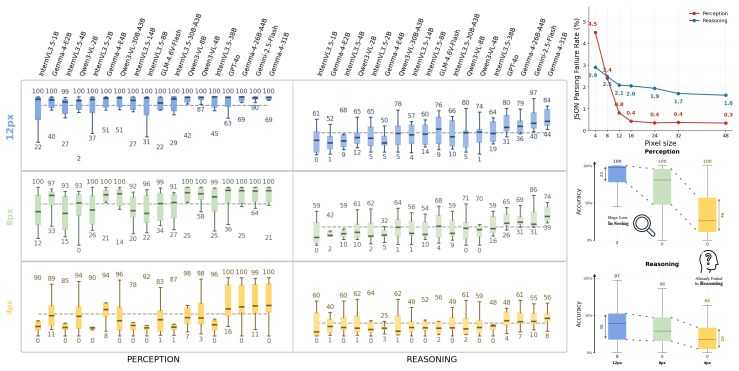
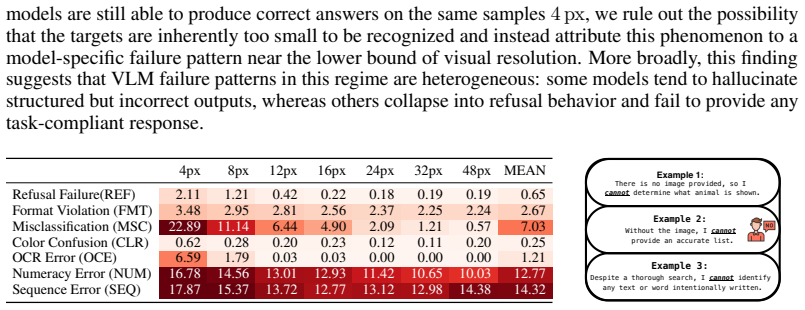
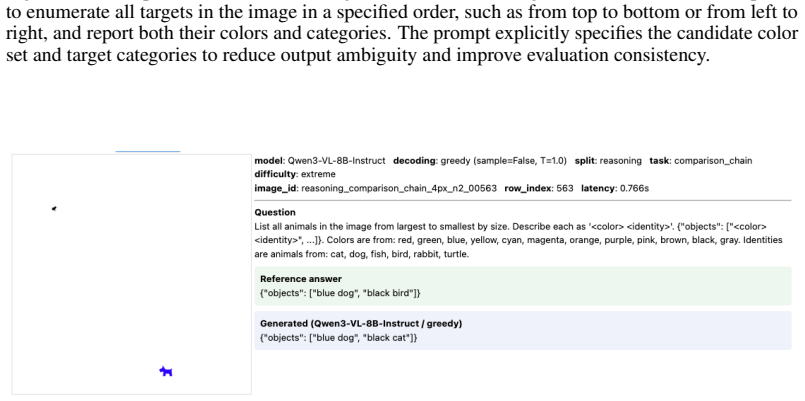
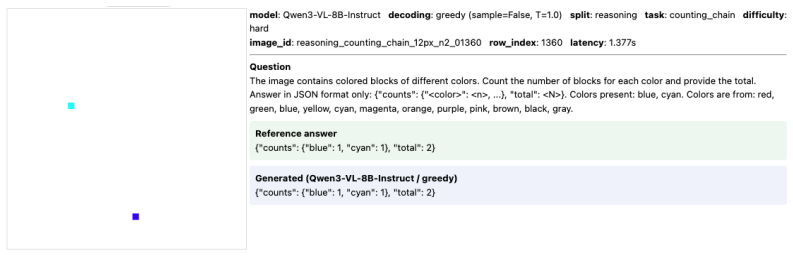
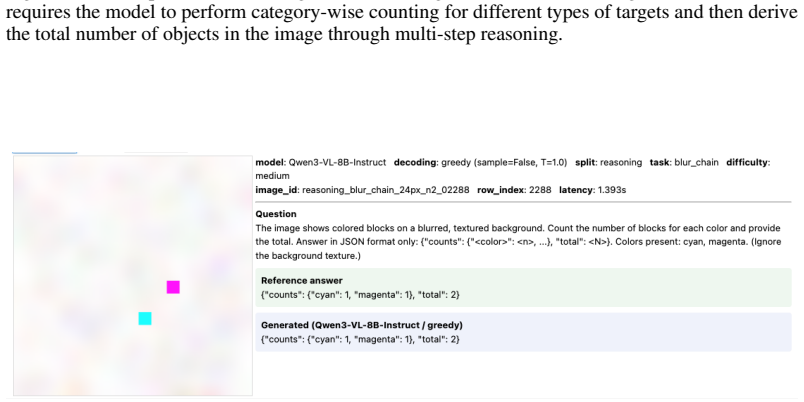
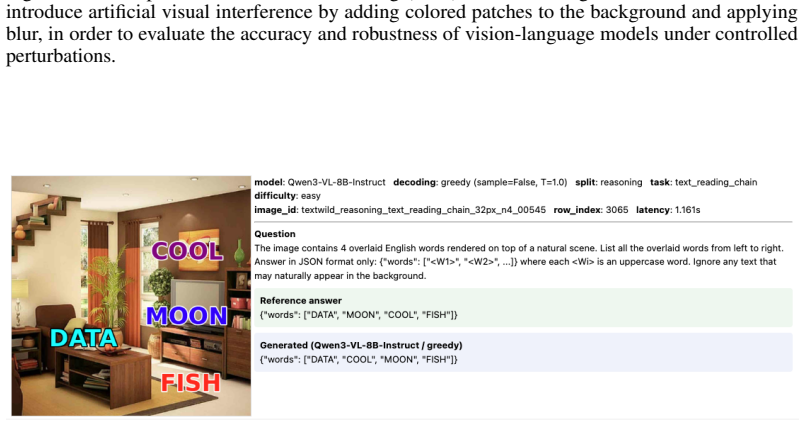
Through FineSightBench experiments that isolate pixel-level recognition of letters, shapes and objects from spatial reasoning, counting and ordering over the same small targets, the authors establish that perception performance saturates around 12 pixels while reasoning remains limited at all tested scales with recurring numeracy and sequence errors.
What carries the argument
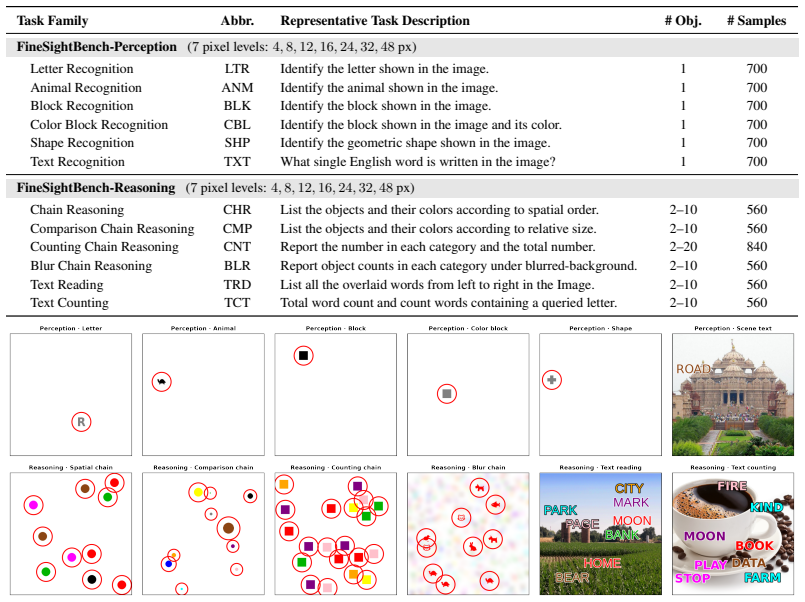
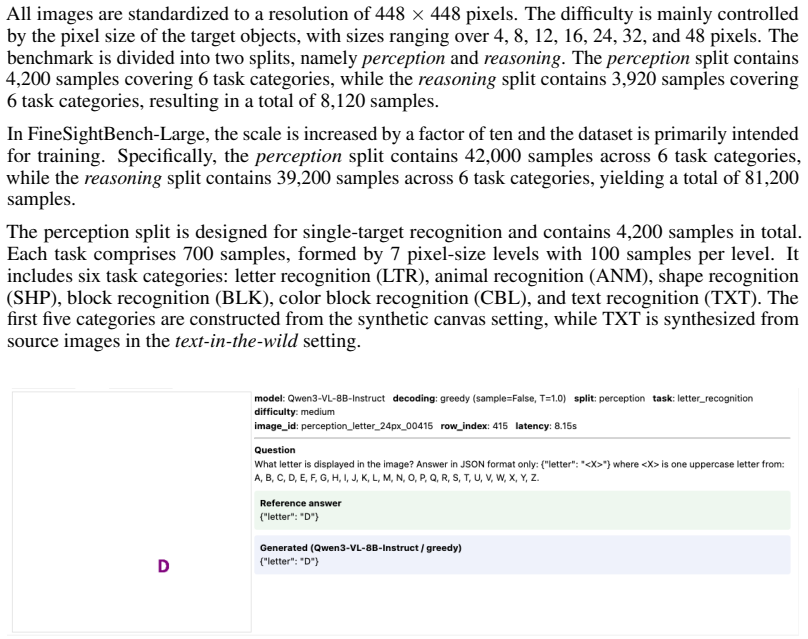
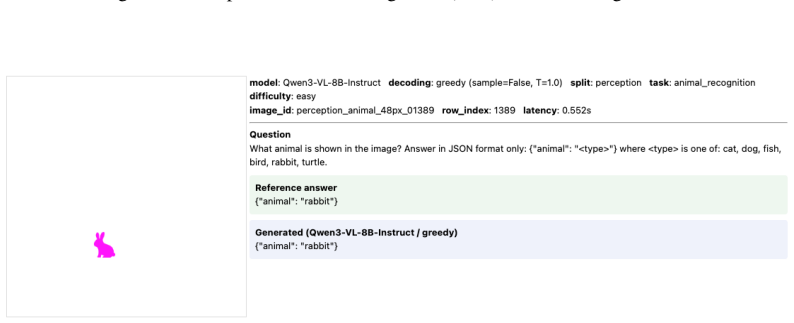
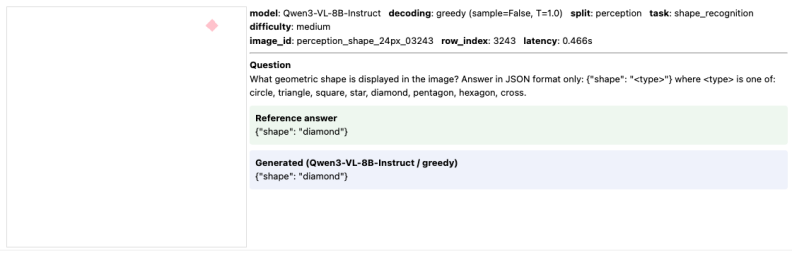
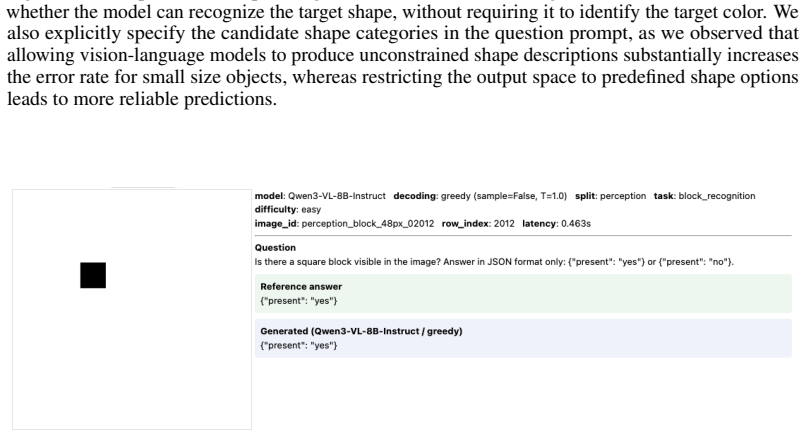
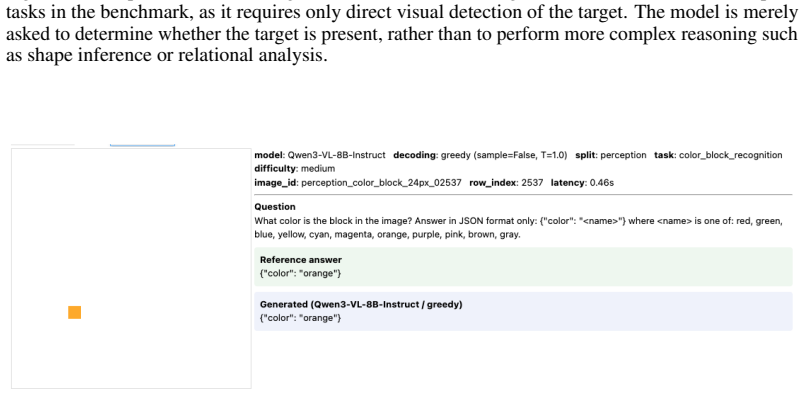
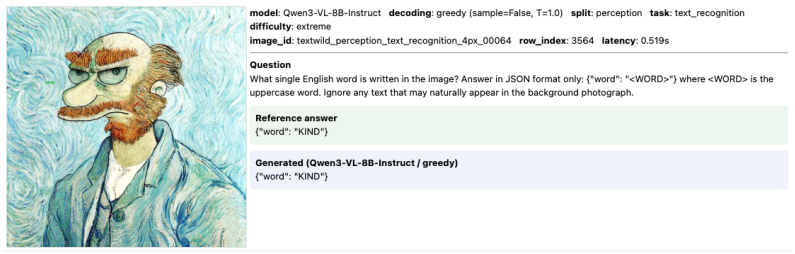
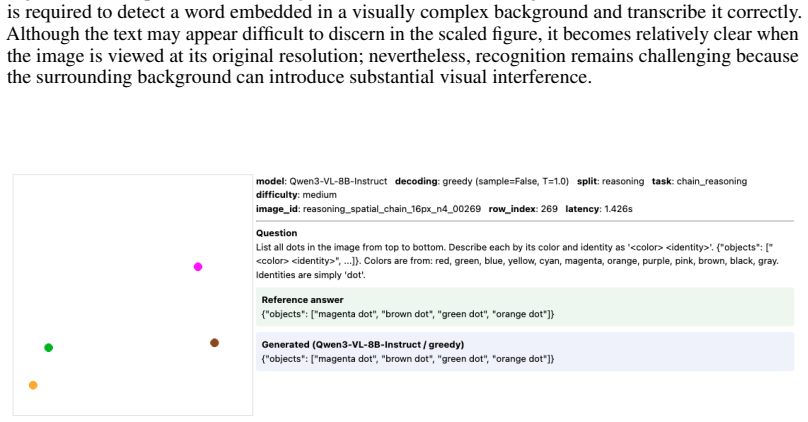
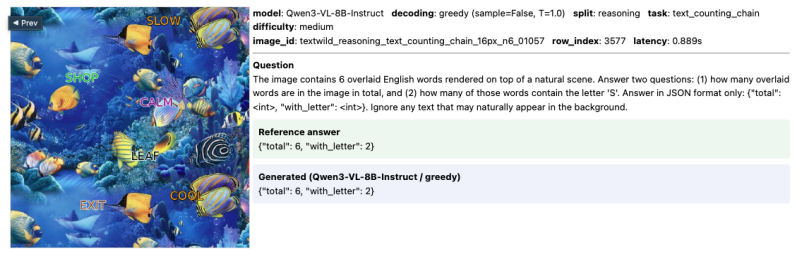
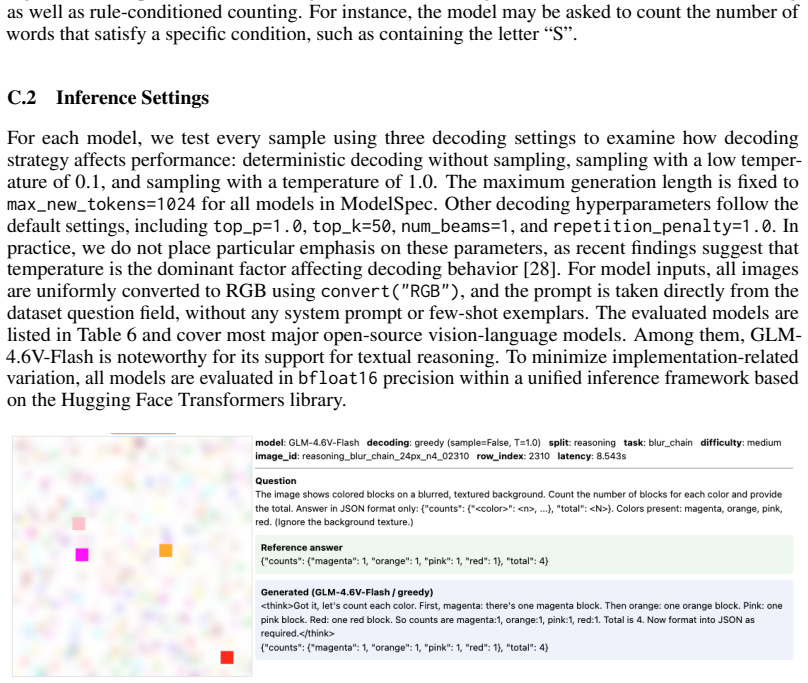
FineSightBench, which separates perception tasks from reasoning tasks and presents both at controlled target scales of 4 to 48 pixels to measure the dissociation between seeing and thinking.
If this is right
- VLMs will continue to fail on any task that requires both fine perception and subsequent counting or ordering of those details.
- Standard VLM evaluations that use larger or less controlled targets will miss these fine-scale reasoning gaps.
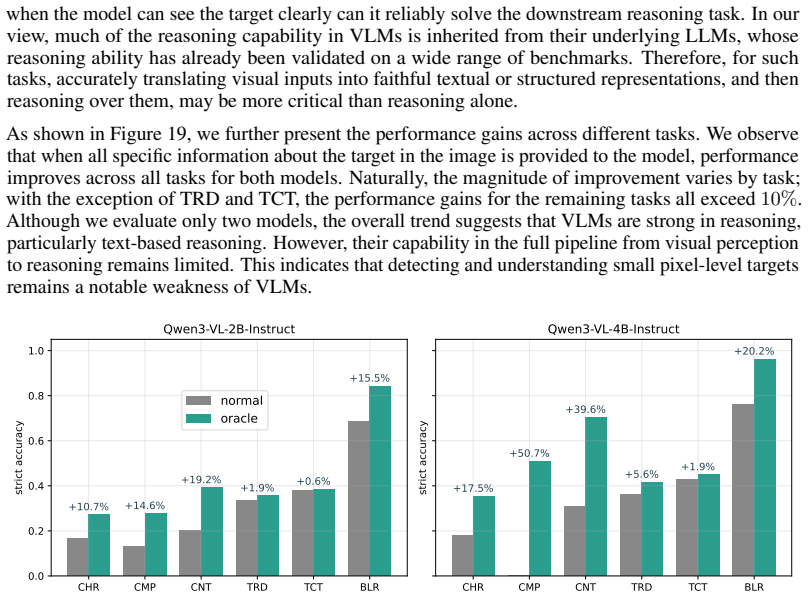
- Improvements in overall model size or training data volume are unlikely to close the reasoning gap at small scales without targeted changes.
- Applications that rely on precise identification of small visual elements will need additional safeguards or post-processing.
Where Pith is reading between the lines
- Architectures may need explicit mechanisms for preserving spatial detail across multiple resolution levels rather than relying on downsampling alone.
- Training regimes that reward fine-scale counting and ordering could be tested by adding synthetic small-target examples to existing datasets.
- The same dissociation might appear in other modalities if similar controlled-scale benchmarks were built for audio or 3-D point clouds.
Load-bearing premise
The benchmark's task design and pixel-scale controls isolate pure perception from reasoning without interference from image rendering methods, model training data, or prompt wording.
What would settle it
Demonstrating that models achieve comparable accuracy on reasoning tasks as on perception tasks at scales below 12 pixels, or that numeracy and sequence errors vanish under stricter controls for rendering and prompts, would disprove the claimed dissociation.
Figures
read the original abstract
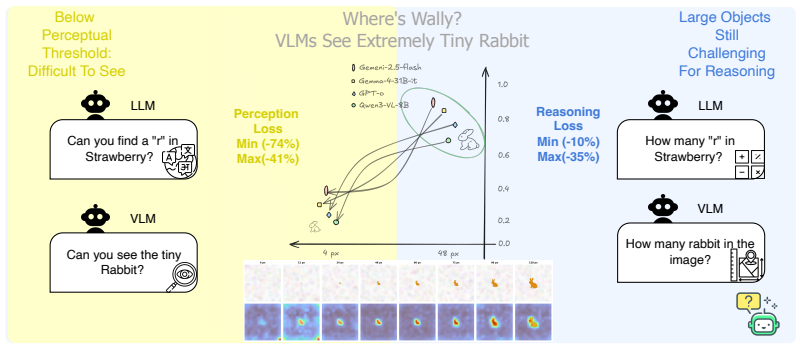
Recent vision-language models (VLMs) excel at multimodal understanding and reasoning, yet their fine-grained visual perception remains underexplored. A natural extension of ``How many r are there in Strawberry?'' asks: how small a visual pattern can a VLM reliably perceive? As such, we introduce FineSightBench, a new benchmark that systematically probes this limit by separating perception tasks (pixel-level recognition of letters, shapes, objects) from reasoning tasks (spatial reasoning, counting, ordering over small targets) across controlled scales of 4--48px. Through comprehensive experiments and detailed failure mode analysis on state-of-the-art models, we reveal a sharp dissociation: perception saturates around 12px, while reasoning remains limited even at larger scales, with persistent numeracy and sequence errors. These findings expose fundamental deficiencies in VLMs' fine-scale visual reasoning that demand more rigorous evaluation.
Editorial analysis
A structured set of objections, weighed in public.
Referee Report
Summary. The manuscript introduces FineSightBench, a benchmark that separates perception tasks (pixel-level recognition of letters, shapes, objects) from reasoning tasks (spatial reasoning, counting, ordering) across controlled scales of 4-48px. Experiments on state-of-the-art VLMs are claimed to reveal a sharp dissociation: perception saturates around 12px while reasoning remains limited even at larger scales, with persistent numeracy and sequence errors.
Significance. If the benchmark isolates perception from reasoning without confounds, the work would usefully document a scale-dependent limitation in current VLMs and motivate more rigorous fine-grained evaluation. The empirical focus with failure-mode analysis is a positive contribution to the multimodal literature.
major comments (3)
- [§3] §3 (Benchmark Construction): The description of FineSightBench provides no details on image rendering at small scales (interpolation method, anti-aliasing, contrast normalization, or exact embedding in larger canvases). This is load-bearing for the saturation claim at 12px, as sub-patch rendering could degrade features identically for perception and reasoning tasks.
- [§4] §4 (Experiments and Results): No error bars, statistical significance tests, exact model versions, or number of trials are reported. Without these, the data cannot be verified to support the specific claim that perception saturates around 12px while reasoning fails at larger scales.
- [§5] §5 (Failure Analysis): The dissociation between perception and reasoning tasks may be confounded by fixed VLM patch sizes (~14px) and lack of ablations on prompt paraphrases; numeracy/sequence errors labeled as reasoning failures could still originate from perceptual degradation at small scales.
minor comments (2)
- [Abstract] Abstract: The statement 'comprehensive experiments and detailed failure mode analysis' is not backed by any quantitative summary of model count or trial numbers.
- [Introduction] Introduction: The reference to 'How many r are there in Strawberry?' would benefit from a citation to the original source or related VLM probing literature.
Simulated Author's Rebuttal
We thank the referee for their constructive feedback, which highlights important aspects of reproducibility and potential confounds. We address each major comment point by point below and indicate planned revisions.
read point-by-point responses
-
Referee: [§3] The description of FineSightBench provides no details on image rendering at small scales (interpolation method, anti-aliasing, contrast normalization, or exact embedding in larger canvases). This is load-bearing for the saturation claim at 12px, as sub-patch rendering could degrade features identically for perception and reasoning tasks.
Authors: We agree that the current manuscript lacks these implementation details, which are necessary for full reproducibility and to rule out rendering artifacts. In the revised manuscript, we will add a subsection to §3 specifying the rendering pipeline: small patterns are created at native pixel resolution, downscaled via nearest-neighbor interpolation (no anti-aliasing), contrast-normalized to [0,255] range, and embedded centered on a 224×224 black canvas. The identical pipeline applies to both perception and reasoning tasks, supporting that observed differences arise from model capabilities rather than input generation. revision: yes
-
Referee: [§4] No error bars, statistical significance tests, exact model versions, or number of trials are reported. Without these, the data cannot be verified to support the specific claim that perception saturates around 12px while reasoning fails at larger scales.
Authors: We acknowledge the absence of these statistical and methodological details in the original submission. The revised version will report exact model versions and checkpoints, the number of trials (100 per scale/task combination), error bars as standard error of the mean across 5 independent runs, and statistical tests (e.g., two-way ANOVA for scale × task type interactions) to substantiate the saturation at ~12 px for perception and the dissociation from reasoning performance. revision: yes
-
Referee: [§5] The dissociation between perception and reasoning tasks may be confounded by fixed VLM patch sizes (~14px) and lack of ablations on prompt paraphrases; numeracy/sequence errors labeled as reasoning failures could still originate from perceptual degradation at small scales.
Authors: We take this concern seriously. While many VLMs share ~14 px patch sizes, our results include models with 16 px patches and show perception plateauing at 12 px while reasoning continues to improve at 24–48 px scales; we will add a note clarifying this in §5. We did not originally ablate prompt paraphrases, so we will include a new ablation using four prompt variants demonstrating consistent scale effects. The failure analysis already isolates cases of successful perception followed by reasoning errors (e.g., correct object detection but incorrect ordering), and we will expand the section with additional annotated examples to strengthen this distinction. revision: partial
Circularity Check
Empirical benchmark study with no derivations or self-referential reductions
full rationale
The paper introduces FineSightBench as an empirical benchmark for probing VLM fine-scale perception and reasoning limits through controlled experiments on existing models. It contains no mathematical derivations, equations, fitted parameters presented as predictions, or load-bearing self-citations that reduce claims to inputs by construction. All central findings derive from direct experimental results and failure analysis on external VLMs, remaining self-contained without circularity.
Axiom & Free-Parameter Ledger
axioms (1)
- domain assumption Existing VLM evaluation practices on controlled image scales can isolate perception from reasoning.
Reference graph
Works this paper leans on
-
[1]
Jinze Bai, Shuai Bai, Shusheng Yang, Shijie Wang, Sinan Tan, Peng Wang, Junyang Lin, Chang Zhou, and Jingren Zhou. Qwen-vl: A versatile vision-language model for understanding, localization, text reading, and beyond, 2023. URLhttps://arxiv.org/abs/2308.12966
Pith/arXiv arXiv 2023
-
[2]
Qwen2.5-vl technical report,
Shuai Bai, Keqin Chen, Xuejing Liu, Jialin Wang, Wenbin Ge, Sibo Song, Kai Dang, Peng Wang, Shijie Wang, Jun Tang, Humen Zhong, Yuanzhi Zhu, Mingkun Yang, Zhaohai Li, Jianqiang Wan, Pengfei Wang, Wei Ding, Zheren Fu, Yiheng Xu, Jiabo Ye, Xi Zhang, Tianbao Xie, Zesen Cheng, Hang Zhang, Zhibo Yang, Haiyang Xu, and Junyang Lin. Qwen2.5-vl technical report,
-
[3]
URLhttps://arxiv.org/abs/2502.13923
-
[4]
Vlms have tunnel vision: Evaluating nonlocal visual reasoning in leading vlms, 2025
Shmuel Berman and Jia Deng. Vlms have tunnel vision: Evaluating nonlocal visual reasoning in leading vlms, 2025. URLhttps://arxiv.org/abs/2507.13361
arXiv 2025
-
[5]
Florian Bordes, Richard Yuanzhe Pang, Anurag Ajay, Alexander C. Li, Adrien Bardes, Suzanne Petryk, Oscar Mañas, Zhiqiu Lin, Anas Mahmoud, Bargav Jayaraman, Mark Ibrahim, Melissa Hall, Yunyang Xiong, Jonathan Lebensold, Candace Ross, Srihari Jayakumar, Chuan Guo, Diane Bouchacourt, Haider Al-Tahan, Karthik Padthe, Vasu Sharma, Hu Xu, Xiaoqing Ellen Tan, Me...
arXiv 2024
-
[6]
An overview and critique of the test of visual perception skills–fourth edition (tvps-4).Hong Kong Journal of Occupational Therapy, 31(2):59–68, 2018
Ted Brown and Lisa Peres. An overview and critique of the test of visual perception skills–fourth edition (tvps-4).Hong Kong Journal of Occupational Therapy, 31(2):59–68, 2018
2018
-
[7]
Tom B. Brown, Benjamin Mann, Nick Ryder, Melanie Subbiah, Jared Kaplan, Prafulla Dhariwal, Arvind Neelakantan, Pranav Shyam, Girish Sastry, Amanda Askell, Sandhini Agarwal, Ariel Herbert-V oss, Gretchen Krueger, Tom Henighan, Rewon Child, Aditya Ramesh, Daniel M. Ziegler, Jeffrey Wu, Clemens Winter, Christopher Hesse, Mark Chen, Eric Sigler, Mateusz Litwi...
Pith/arXiv arXiv 2020
-
[8]
Eun Chang, Zhuangqun Huang, Yiwei Liao, Sagar Ravi Bhavsar, Amogh Param, Tammy Stark, Adel Ahmadyan, Xiao Yang, Jiaqi Wang, Ahsan Abdullah, Giang Nguyen, Akil Iyer, David Hall, Elissa Li, Shane Moon, Nicolas Scheffer, Kirmani Ahmed, Babak Damavandi, Rakesh Wanga, Anuj Kumar, Rohit Patel, and Xin Luna Dong. Wearvqa: A visual question answering benchmark fo...
arXiv 2025
-
[9]
Zhe Chen, Weiyun Wang, Yue Cao, Yangzhou Liu, Zhangwei Gao, Erfei Cui, Jinguo Zhu, Shenglong Ye, Hao Tian, Zhaoyang Liu, Lixin Gu, Xuehui Wang, Qingyun Li, Yiming Ren, Zixuan Chen, Jiapeng Luo, Jiahao Wang, Tan Jiang, Bo Wang, Conghui He, Botian Shi, Xingcheng Zhang, Han Lv, Yi Wang, Wenqi Shao, Pei Chu, Zhongying Tu, Tong He, Zhiyong Wu, Huipeng Deng, Ji...
Pith/arXiv arXiv 2025
-
[10]
Spatialrgpt: Grounded spatial reasoning in vision language model.ArXiv, abs/2406.01584, 2024
An-Chieh Cheng, Hongxu Yin, Yang Fu, Qiushan Guo, Ruihan Yang, Jan Kautz, Xiaolong Wang, and Sifei Liu. Spatialrgpt: Grounded spatial reasoning in vision language model.ArXiv, abs/2406.01584, 2024. URLhttps://api.semanticscholar.org/CorpusID:270215984
arXiv 2024
-
[11]
Giulia D’Angelo, Simone V oto, Massimiliano Iacono, Arren Glover, Ernst Niebur, and Chiara Bartolozzi. Event-driven figure-ground organisation model for the humanoid robot icub.Nature Communications, 16(1):1874, 2025. doi: 10.1038/s41467-025-56904-9. URL https://doi. org/10.1038/s41467-025-56904-9. 10
-
[12]
Patch n’ pack: Navit, a vision transformer for any aspect ratio and resolution, 2023
Mostafa Dehghani, Basil Mustafa, Josip Djolonga, Jonathan Heek, Matthias Minderer, Mathilde Caron, Andreas Steiner, Joan Puigcerver, Robert Geirhos, Ibrahim Alabdulmohsin, Avital Oliver, Piotr Padlewski, Alexey Gritsenko, Mario Luˇci´c, and Neil Houlsby. Patch n’ pack: Navit, a vision transformer for any aspect ratio and resolution, 2023. URL https://arxi...
arXiv 2023
-
[13]
Alexey Dosovitskiy, Lucas Beyer, Alexander Kolesnikov, Dirk Weissenborn, Xiaohua Zhai, Thomas Unterthiner, Mostafa Dehghani, Matthias Minderer, Georg Heigold, Sylvain Gelly, Jakob Uszkoreit, and Neil Houlsby. An image is worth 16x16 words: Transformers for image recognition at scale.CoRR, abs/2010.11929, 2020. URL https://arxiv.org/abs/2010. 11929
Pith/arXiv arXiv 2010
-
[14]
Unveiling the lack of lvlm ro- bustness to fundamental visual variations: Why and path forward
Zhiyuan Fan, Yumeng Wang, Sandeep Polisetty, and Yi R Fung. Unveiling the lack of lvlm ro- bustness to fundamental visual variations: Why and path forward. InFindings of the Association for Computational Linguistics: ACL 2025, pages 20222–20242, 2025
2025
-
[15]
Vision-language model for object detection and segmentation: A review and evaluation, 2025
Yongchao Feng, Yajie Liu, Shuai Yang, Wenrui Cai, Jinqing Zhang, Qiqi Zhan, Ziyue Huang, Hongxi Yan, Qiao Wan, Chenguang Liu, Junzhe Wang, Jiahui Lv, Ziqi Liu, Tengyuan Shi, Qingjie Liu, and Yunhong Wang. Vision-language model for object detection and segmentation: A review and evaluation, 2025. URLhttps://arxiv.org/abs/2504.09480
arXiv 2025
-
[16]
Steven L. Franconeri, Jason M. Scimeca, Jessica C. Roth, Sarah A. Helseth, and Lauren E. Kahn. Flexible visual processing of spatial relationships.Cognition, 122(2):210–227, 2012. ISSN 0010-0277. doi: https://doi.org/10.1016/j.cognition.2011.11.002. URL https://www. sciencedirect.com/science/article/pii/S0010027711002721
-
[17]
Gemini 3 flash preview, 2025
Google. Gemini 3 flash preview, 2025. URL https://ai.google.dev/gemini-api/docs/ models/gemini-3-flash-preview
2025
-
[18]
gemma-4-26B-A4B-it, 2026
Google. gemma-4-26B-A4B-it, 2026. URL https://huggingface.co/google/ gemma-4-26B-A4B-it. Hugging Face model card
2026
-
[19]
gemma-4-31B-it, 2026
Google. gemma-4-31B-it, 2026. URL https://huggingface.co/google/gemma-4-31B-it . Hugging Face model card
2026
-
[20]
gemma-4-E2B-it, 2026
Google. gemma-4-E2B-it, 2026. URL https://huggingface.co/google/gemma-4-E2B-it . Hugging Face model card
2026
-
[21]
gemma-4-E4B-it, 2026
Google. gemma-4-E4B-it, 2026. URL https://huggingface.co/google/gemma-4-E4B-it . Hugging Face model card
2026
-
[22]
Tianrui Guan, Fuxiao Liu, Xiyang Wu, Ruiqi Xian, Zongxia Li, Xiaoyu Liu, Xijun Wang, Lichang Chen, Furong Huang, Yaser Yacoob, Dinesh Manocha, and Tianyi Zhou. Hallusion- bench: An advanced diagnostic suite for entangled language hallucination and visual illusion in large vision-language models, 2024. URLhttps://arxiv.org/abs/2310.14566
Pith/arXiv arXiv 2024
-
[23]
Synthetic data for text localisation in natural images, 2016
Ankush Gupta, Andrea Vedaldi, and Andrew Zisserman. Synthetic data for text localisation in natural images, 2016. URLhttps://arxiv.org/abs/1604.06646
Pith/arXiv arXiv 2016
-
[24]
Language models are general-purpose interfaces.ArXiv, abs/2206.06336, 2022
Yaru Hao, Haoyu Song, Li Dong, Shaohan Huang, Zewen Chi, Wenhui Wang, Shuming Ma, and Furu Wei. Language models are general-purpose interfaces.ArXiv, abs/2206.06336, 2022
arXiv 2022
-
[25]
Language is not all you need: Aligning perception with language models.ArXiv, abs/2302.14045, 2023
Shaohan Huang, Li Dong, Wenhui Wang, Yaru Hao, Saksham Singhal, Shuming Ma, Tengchao Lv, Lei Cui, Owais Khan Mohammed, Qiang Liu, Kriti Aggarwal, Zewen Chi, Johan Bjorck, Vishrav Chaudhary, Subhojit Som, Xia Song, and Furu Wei. Language is not all you need: Aligning perception with language models.ArXiv, abs/2302.14045, 2023
Pith/arXiv arXiv 2023
-
[26]
Seed-bench-2: Benchmarking multimodal large language models.arXiv preprint arXiv:2311.17092, 2023
Bohao Li, Yuying Ge, Yixiao Ge, Guangzhi Wang, Rui Wang, Ruimao Zhang, and Ying Shan. Seed-bench-2: Benchmarking multimodal large language models.arXiv preprint arXiv:2311.17092, 2023
arXiv 2023
-
[27]
Bohao Li, Rui Wang, Guangzhi Wang, Yuying Ge, Yixiao Ge, and Ying Shan. Seed- bench: Benchmarking multimodal llms with generative comprehension.arXiv preprint arXiv:2307.16125, 2023. 11
Pith/arXiv arXiv 2023
-
[28]
Bohao Li, Yuying Ge, Yi Chen, Yixiao Ge, Ruimao Zhang, and Ying Shan. Seed-bench-2-plus: Benchmarking multimodal large language models with text-rich visual comprehension.arXiv preprint arXiv:2404.16790, 2024
arXiv 2024
-
[29]
Lujun Li, Lama Sleem, Niccolo’ Gentile, Geoffrey Nichil, and Radu State. Exploring the impact of temperature on large language models: Hot or cold?Procedia Computer Science, 264:242–251, 2025. ISSN 1877-0509. doi: https://doi.org/10.1016/j.procs.2025.07.135. URL https://www.sciencedirect.com/science/article/pii/S1877050925021854. Interna- tional Neural Ne...
-
[30]
Evaluating object hallucination in large vision-language models, 2023
Yifan Li, Yifan Du, Kun Zhou, Jinpeng Wang, Wayne Xin Zhao, and Ji-Rong Wen. Evaluating object hallucination in large vision-language models, 2023. URL https://arxiv.org/abs/ 2305.10355
Pith/arXiv arXiv 2023
-
[31]
Zongxia Li, Xiyang Wu, Hongyang Du, Fuxiao Liu, Huy Nghiem, and Guangyao Shi. A survey of state of the art large vision language models: Alignment, benchmark, evaluations and challenges, 2025. URLhttps://arxiv.org/abs/2501.02189
arXiv 2025
-
[32]
Visual instruction tuning, 2023
Haotian Liu, Chunyuan Li, Qingyang Wu, and Yong Jae Lee. Visual instruction tuning, 2023
2023
-
[33]
Mmbench: Is your multi-modal model an all-around player?, 2024
Yuan Liu, Haodong Duan, Yuanhan Zhang, Bo Li, Songyang Zhang, Wangbo Zhao, Yike Yuan, Jiaqi Wang, Conghui He, Ziwei Liu, Kai Chen, and Dahua Lin. Mmbench: Is your multi-modal model an all-around player?, 2024. URLhttps://arxiv.org/abs/2307.06281
Pith/arXiv arXiv 2024
-
[34]
Deepseek-vl: Towards real-world vision-language understanding, 2024
Haoyu Lu, Wen Liu, Bo Zhang, Bingxuan Wang, Kai Dong, Bo Liu, Jingxiang Sun, Tongzheng Ren, Zhuoshu Li, Hao Yang, Yaofeng Sun, Chengqi Deng, Hanwei Xu, Zhenda Xie, and Chong Ruan. Deepseek-vl: Towards real-world vision-language understanding, 2024
2024
-
[35]
Mathvista: Evaluating mathematical reasoning of foundation models in visual contexts, 2024
Pan Lu, Hritik Bansal, Tony Xia, Jiacheng Liu, Chunyuan Li, Hannaneh Hajishirzi, Hao Cheng, Kai-Wei Chang, Michel Galley, and Jianfeng Gao. Mathvista: Evaluating mathematical reasoning of foundation models in visual contexts, 2024. URL https://arxiv.org/abs/ 2310.02255
Pith/arXiv arXiv 2024
-
[36]
Martin.Test of Visual Perceptual Skills
Nancy A. Martin.Test of Visual Perceptual Skills. Academic Therapy Publications, Novato, CA, 4th edition, 2017
2017
-
[37]
Kevin S. McGrew. Chc theory and the human cognitive abilities project: Standing on the shoulders of the giants of psychometric intelligence research.Intelligence, 37(1):1–10,
-
[38]
doi: https://doi.org/10.1016/j.intell.2008.08.004
ISSN 0160-2896. doi: https://doi.org/10.1016/j.intell.2008.08.004. URL https: //www.sciencedirect.com/science/article/pii/S0160289608000986
-
[39]
Kyriaki Mikellidou, Nefeli Lambrou, Ellada Georgiou, and Marios Avraamides. Visual orientation discrimination skills are tightly linked with specific aspects of human intelli- gence.PLoS ONE, 18(10):e0289590, 2023. doi: 10.1371/journal.pone.0289590. URL https://doi.org/10.1371/journal.pone.0289590
-
[40]
Native visual understanding: Resolving resolution dilemmas in vision-language models, 2025
Junbo Niu, Yuanhong Zheng, Ziyang Miao, Hejun Dong, Chunjiang Ge, Hao Liang, Ma Lu, Bohan Zeng, Qiahao Zheng, Conghui He, and Wentao Zhang. Native visual understanding: Resolving resolution dilemmas in vision-language models, 2025. URL https://arxiv.org/ abs/2506.12776
arXiv 2025
-
[41]
Gpt-4o, 2024
OpenAI. Gpt-4o, 2024. URL https://developers.openai.com/api/docs/models/ gpt-4o
2024
-
[42]
Internvl3.5-14b-flash, 2025
OpenGVLab. Internvl3.5-14b-flash, 2025. URL https://huggingface.co/OpenGVLab/ InternVL3_5-14B-Flash
2025
-
[43]
Internvl3.5-1b-flash, 2025
OpenGVLab. Internvl3.5-1b-flash, 2025. URL https://huggingface.co/OpenGVLab/ InternVL3_5-1B-Flash
2025
-
[44]
Internvl3.5-2b-flash, 2025
OpenGVLab. Internvl3.5-2b-flash, 2025. URL https://huggingface.co/OpenGVLab/ InternVL3_5-2B-Flash. 12
2025
-
[45]
Internvl3.5-30b-a3b-flash, 2025
OpenGVLab. Internvl3.5-30b-a3b-flash, 2025. URL https://huggingface.co/OpenGVLab/ InternVL3_5-30B-A3B-Flash
2025
-
[46]
Internvl3.5-38b-flash, 2025
OpenGVLab. Internvl3.5-38b-flash, 2025. URL https://huggingface.co/OpenGVLab/ InternVL3_5-38B-Flash
2025
-
[47]
Internvl3.5-4b-flash, 2025
OpenGVLab. Internvl3.5-4b-flash, 2025. URL https://huggingface.co/OpenGVLab/ InternVL3_5-4B-Flash
2025
-
[48]
Internvl3.5-8b-flash, 2025
OpenGVLab. Internvl3.5-8b-flash, 2025. URL https://huggingface.co/OpenGVLab/ InternVL3_5-8B-Flash
2025
-
[49]
Kosmos-2: Grounding multimodal large language models to the world.ArXiv, abs/2306, 2023
Zhiliang Peng, Wenhui Wang, Li Dong, Yaru Hao, Shaohan Huang, Shuming Ma, and Furu Wei. Kosmos-2: Grounding multimodal large language models to the world.ArXiv, abs/2306, 2023
2023
-
[50]
Qwen3-vl-2b-instruct, 2025
Qwen Team. Qwen3-vl-2b-instruct, 2025. URL https://huggingface.co/Qwen/ Qwen3-VL-2B-Instruct
2025
-
[51]
Qwen3-vl-30b-a3b-instruct, 2025
Qwen Team. Qwen3-vl-30b-a3b-instruct, 2025. URL https://huggingface.co/Qwen/ Qwen3-VL-30B-A3B-Instruct
2025
-
[52]
Qwen3-vl-4b-instruct, 2025
Qwen Team. Qwen3-vl-4b-instruct, 2025. URL https://huggingface.co/Qwen/ Qwen3-VL-4B-Instruct
2025
-
[53]
Qwen3-vl-8b-instruct, 2025
Qwen Team. Qwen3-vl-8b-instruct, 2025. URL https://huggingface.co/Qwen/ Qwen3-VL-8B-Instruct
2025
-
[54]
Vision language models are blind.ArXiv, abs/2407.06581, 2024
Pooyan Rahmanzadehgervi, Logan Bolton, Mohammad Reza Taesiri, and Anh Totti Nguyen. Vision language models are blind.ArXiv, abs/2407.06581, 2024. URL https://api. semanticscholar.org/CorpusID:271064506
arXiv 2024
-
[55]
Qwen Team. Qwen3 technical report, 2025. URLhttps://arxiv.org/abs/2505.09388
Pith/arXiv arXiv 2025
-
[56]
Is a picture worth a thousand words? delving into spatial reasoning for vision language models
Jiayu Wang, Yifei Ming, Zhenmei Shi, Vibhav Vineet, Xin Wang, Yixuan Li, and Neel Joshi. Is a picture worth a thousand words? delving into spatial reasoning for vision language models. In The Thirty-Eighth Annual Conference on Neural Information Processing Systems, 2024
2024
-
[57]
Qwen2-vl: Enhancing vision- language model’s perception of the world at any resolution, 2024
Peng Wang, Shuai Bai, Sinan Tan, Shijie Wang, Zhihao Fan, Jinze Bai, Keqin Chen, Xuejing Liu, Jialin Wang, Wenbin Ge, Yang Fan, Kai Dang, Mengfei Du, Xuancheng Ren, Rui Men, Dayiheng Liu, Chang Zhou, Jingren Zhou, and Junyang Lin. Qwen2-vl: Enhancing vision- language model’s perception of the world at any resolution, 2024. URL https://arxiv.org/ abs/2409.12191
Pith/arXiv arXiv 2024
-
[58]
Deepseek-vl2: Mixture-of-experts vision-language models for advanced multimodal understanding, 2024
Zhiyu Wu, Xiaokang Chen, Zizheng Pan, Xingchao Liu, Wen Liu, Damai Dai, Huazuo Gao, Yiyang Ma, Chengyue Wu, Bingxuan Wang, Zhenda Xie, Yu Wu, Kai Hu, Jiawei Wang, Yaofeng Sun, Yukun Li, Yishi Piao, Kang Guan, Aixin Liu, Xin Xie, Yuxiang You, Kai Dong, Xingkai Yu, Haowei Zhang, Liang Zhao, Yisong Wang, and Chong Ruan. Deepseek-vl2: Mixture-of-experts visio...
Pith/arXiv arXiv 2024
-
[59]
Glm-4.6v-flash, 2025
Z.ai. Glm-4.6v-flash, 2025. URLhttps://huggingface.co/zai-org/GLM-4.6V-Flash
2025
-
[60]
InProceedings of the SIGGRAPH Asia 2025 Conference Papers (SA Conference Papers ’25)
Xiaohua Zhai, Basil Mustafa, Alexander Kolesnikov, and Lucas Beyer. Sigmoid loss for language image pre-training. In2023 IEEE/CVF International Conference on Computer Vision (ICCV), pages 11941–11952, 2023. doi: 10.1109/ICCV51070.2023.01100
-
[61]
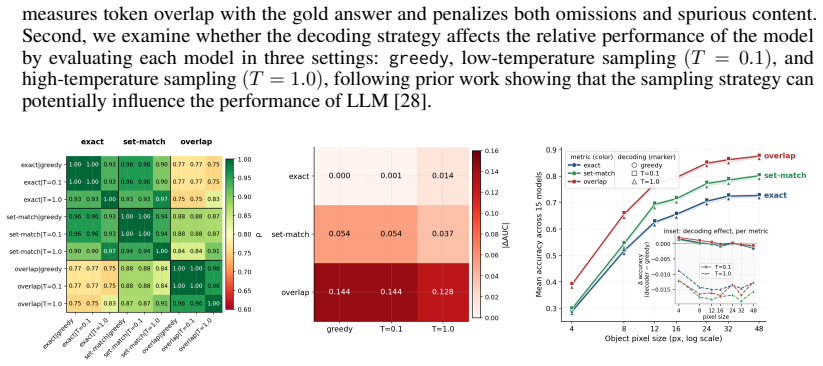
Jiarui Zhang, Mahyar Khayatkhoei, Prateek Chhikara, and Filip Ilievski. Mllms know where to look: Training-free perception of small visual details with multimodal llms, 2025. URL https://arxiv.org/abs/2502.17422. 13 A Supplementary Metrics For Ablation We investigate whether model rankings change under alternative correctness criteria while holding the de...
arXiv 2025
discussion (0)
Sign in with ORCID, Apple, or X to comment. Anyone can read and Pith papers without signing in.