Crystallizing Substrates Drag Supported Nanoparticles
Pith reviewed 2026-06-27 21:13 UTC · model grok-4.3
The pith
Crystallization fronts in amorphous alumina films drag supported platinum nanoparticles long distances by asymmetric interfacial energies.
A machine-rendered reading of the paper's core claim, the machinery that carries it, and where it could break.
Core claim
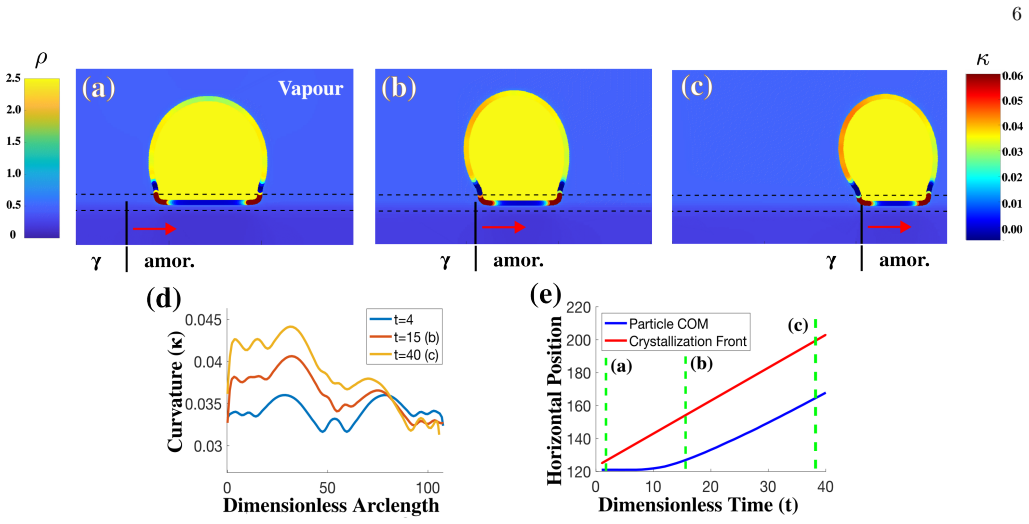
Propagating crystallization fronts in amorphous AlOx thin films actively drag supported Pt nanoparticles over long distances. The front separates regions of distinct surface energy and thereby imposes an asymmetric particle-substrate interfacial energy environment that supplies a lateral thermodynamic driving force. Temporal correlation between crystallization onset and particle migration, together with virtual crystallinity maps from 4D-STEM, establishes the front as the causal agent. Phase-field simulations confirm that particle-substrate interfacial energy contrast alone sustains the drag and identify curvature gradients along the particle surface as the mechanism that redistributes mass
What carries the argument
The propagating amorphous-to-crystalline transformation front, which functions as a moving interfacial energy boundary that generates a lateral thermodynamic force on any straddling nanoparticle.
If this is right
- Any propagating surface-energy boundary on a substrate can act as a deterministic driver of supported nanoparticle transport.
- Particle motion is sustained by particle-substrate interfacial energy contrast alone.
- Curvature gradients along the particle surface redistribute mass and thereby displace the particle.
- The mechanism applies to any supported nanoparticle system whose substrate undergoes a surface-energy-changing transformation.
Where Pith is reading between the lines
- The same energy-boundary mechanism could operate during other substrate phase changes such as melting or solid-state polymorphic transitions.
- Engineered crystallization fronts might be used to assemble or reposition nanoparticles on a surface without external manipulation.
- Unexpected long-range nanoparticle mobility observed in annealed thin-film devices may arise from unnoticed crystallization fronts.
Load-bearing premise
That the observed timing correlation and 4D-STEM crystallinity maps prove the crystallization front itself, rather than simultaneous heating or stress, is the direct cause of particle motion.
What would settle it
Controlled experiments in which particles remain stationary despite a clear, propagating crystallization front, or in which particles migrate without any detectable front.
Figures
read the original abstract
When a solid support undergoes crystallization, the advancing amorphous-to-crystalline transformation front separates regions of distinct surface energy, creating a moving interfacial energy boundary. A supported nanoparticle straddling such a boundary experiences an asymmetric particle-substrate interfacial energy environment that constitutes a lateral thermodynamic driving force for migration. Here, using in situ transmission electron microscopy to track Pt nanoparticle motion statistically, paired with time-resolved diffraction and 4D-STEM analysis to characterize support crystallization, we demonstrate that propagating crystallization fronts in amorphous AlO$_x$ thin films actively drag supported Pt nanoparticles over long distances. Temporal correlation between the onsets of support crystallization and rapid particle migration, together with 4D-STEM virtual crystallinity maps, establishes that the front drives particle motion. Phase-field simulations confirm that particle-substrate interfacial energy contrast alone sustains particle drag, and identify curvature gradients along the particle surface as the mechanism by which the advancing front redistributes mass and displaces the particle. These results establish a general mechanism by which any propagating surface-energy boundary on a substrate can act as a deterministic driver of supported nanoparticle transport.
Editorial analysis
A structured set of objections, weighed in public.
Referee Report
Summary. The manuscript claims that propagating crystallization fronts in amorphous AlOx thin films actively drag supported Pt nanoparticles over long distances via interfacial-energy contrast at the amorphous-crystalline boundary. This is supported by in-situ TEM statistical tracking of Pt motion, time-resolved diffraction showing crystallization onset, 4D-STEM virtual crystallinity maps aligning the front with particle displacement, and phase-field simulations demonstrating that energy contrast alone can drive the observed drag through curvature-gradient-induced mass redistribution.
Significance. If the central claim is substantiated, the work identifies a general, deterministic mechanism by which any propagating surface-energy boundary can transport supported nanoparticles, with implications for thin-film processing, catalysis, and self-assembly. The combination of statistical experimental observations with phase-field modeling that isolates curvature gradients as the operative mechanism constitutes a clear strength; the simulations are noted as reproducing the experimental front geometry and mobility.
major comments (2)
- [Results describing temporal correlation and 4D-STEM analysis] The central claim that the crystallization front supplies the dominant lateral force (abstract; results on temporal correlation and 4D-STEM maps) rests on correlation between crystallization onset and particle migration. This does not isolate interfacial-energy contrast from concurrent in-situ TEM effects such as local beam heating or stress relief; the phase-field simulations assume the observed front geometry without a control case in which energy contrast is removed while heating/stress profiles are retained.
- [Phase-field simulation section] The assertion that 'particle-substrate interfacial energy contrast alone sustains particle drag' (abstract and simulation section) requires explicit demonstration that alternative mechanisms are insufficient; the current simulations test only the energy-contrast scenario and do not quantify the relative magnitude of thermal or mechanical contributions that are necessarily present during in-situ crystallization.
minor comments (2)
- [Particle tracking results] Clarify the precise definition of 'long distances' in the particle-tracking statistics and provide the distribution of migration distances relative to front velocity.
- [4D-STEM methods] The 4D-STEM virtual crystallinity maps would benefit from an explicit statement of the spatial resolution and any binning applied when overlaying with particle trajectories.
Simulated Author's Rebuttal
We thank the referee for their thoughtful review and constructive feedback on our manuscript. We address each major comment below, providing clarifications on the evidence from our experiments and simulations while noting where additional discussion will be incorporated.
read point-by-point responses
-
Referee: [Results describing temporal correlation and 4D-STEM analysis] The central claim that the crystallization front supplies the dominant lateral force (abstract; results on temporal correlation and 4D-STEM maps) rests on correlation between crystallization onset and particle migration. This does not isolate interfacial-energy contrast from concurrent in-situ TEM effects such as local beam heating or stress relief; the phase-field simulations assume the observed front geometry without a control case in which energy contrast is removed while heating/stress profiles are retained.
Authors: The 4D-STEM virtual crystallinity maps establish spatial as well as temporal correlation: particle displacements align precisely with the position and curvature of the advancing front rather than occurring uniformly across the field of view. This spatial specificity is difficult to reconcile with delocalized beam heating or global stress relief, which would not produce motion localized to the front. The phase-field simulations take the experimentally measured front geometry as input but isolate the interfacial energy contrast as the sole driver, reproducing both the observed particle velocities and the curvature-gradient mass redistribution without additional terms. While an explicit control simulation with energy contrast removed is not included, the model demonstrates sufficiency of the proposed mechanism. We will add a paragraph in the revised manuscript discussing why beam-induced effects are unlikely to dominate based on the observed front-particle alignment. revision: partial
-
Referee: [Phase-field simulation section] The assertion that 'particle-substrate interfacial energy contrast alone sustains particle drag' (abstract and simulation section) requires explicit demonstration that alternative mechanisms are insufficient; the current simulations test only the energy-contrast scenario and do not quantify the relative magnitude of thermal or mechanical contributions that are necessarily present during in-situ crystallization.
Authors: The phase-field framework is constructed to test whether interfacial energy contrast at the amorphous-crystalline boundary, acting through curvature gradients, is sufficient to produce the measured drag distances and front geometries. It achieves quantitative agreement with experiment on these metrics. Quantifying the relative strength of concurrent thermal or mechanical contributions would require a coupled multi-physics model that incorporates beam heating and residual stress evolution, which lies beyond the scope of the present study. The close match obtained with the energy-contrast mechanism alone indicates it is the primary driver. We will revise the simulation section to include order-of-magnitude estimates of beam heating and stress effects drawn from the literature on similar AlOx systems, showing they are secondary to the directional force from the energy boundary. revision: partial
Circularity Check
No circularity: experimental correlations and phase-field confirmation are independent of inputs
full rationale
The paper's central claim rests on direct in-situ TEM particle tracking, time-resolved diffraction, 4D-STEM crystallinity maps showing spatial-temporal alignment, and phase-field simulations that model interfacial energy contrast as a driver. These elements do not reduce by construction to fitted parameters, self-definitions, or self-citation chains; the simulations test a proposed mechanism rather than reproducing observations tautologically. No load-bearing steps match the enumerated circularity patterns.
Axiom & Free-Parameter Ledger
axioms (1)
- domain assumption Interfacial energy differences between particle-substrate contacts create a lateral thermodynamic driving force
Reference graph
Works this paper leans on
-
[1]
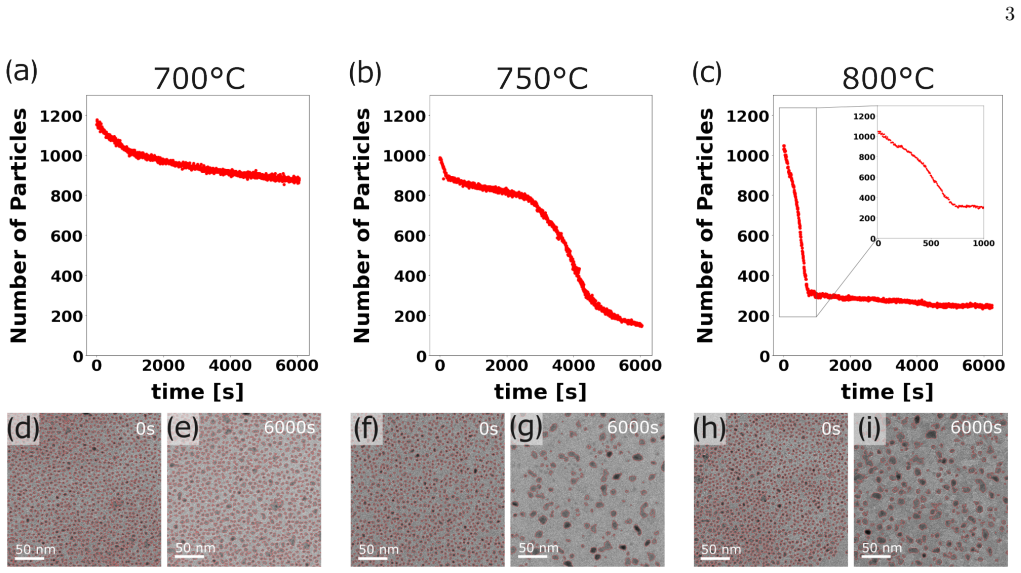
Initial coalescence among closely spaced particles, present at all temperatures
-
[2]
Limited migration on the amorphous support, which dominates at 700 ◦C and precedes the onset of crystallization at higher temperatures
-
[3]
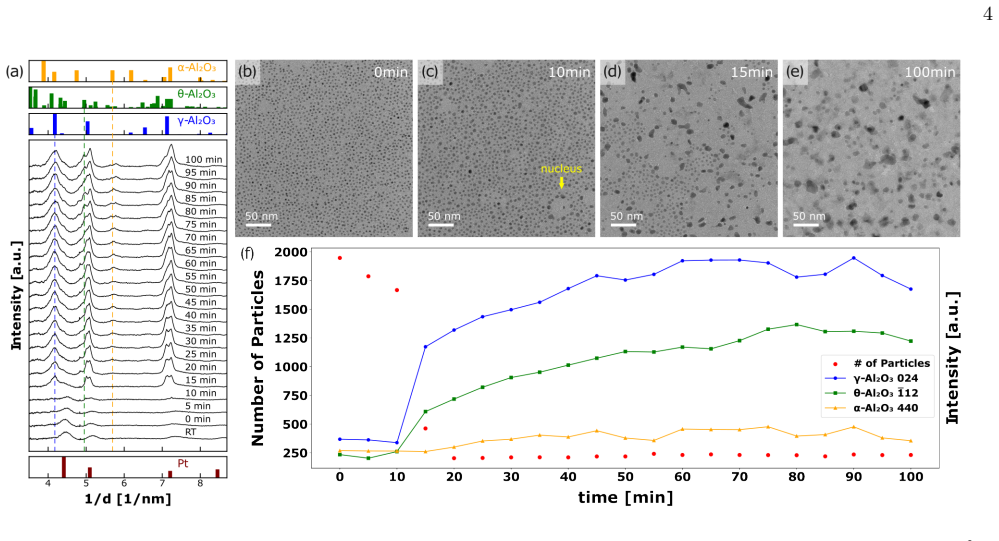
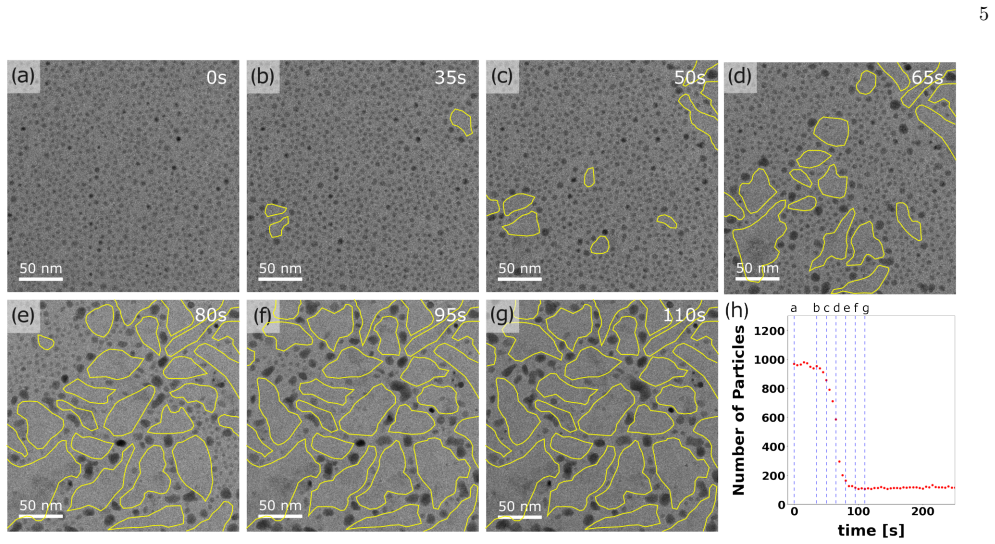
Rapid migration driven by the nucleation and growth of crystalline Al 2O3, observed only at 750 and 800◦C
-
[4]
Particle locking as growing crystallites impinge and cover most of the support surface Of the four regimes identified above, the third provides the clearest opportunity to test our mechanistic hypoth- esis, because it captures the interval during which rapid particle migration occurs while the support is actively crystallizing. We therefore focus on this ...
-
[5]
andγ AlOx >0.97J/m 2 [12]). However, owing to the favorable platinum-oxygen bonding [23], we suspect the platinum-crystalline interface has a higher interfacial energy compared to the platinum-AlO x interface (thus lower adhesion energy). Macroscopic adhesion energy measurements of blistering of Pt thin films on ALD de- posited amorphous alumina corrobora...
-
[6]
Brochard, Motions of droplets on solid surfaces in- duced by chemical or thermal gradients, langmuir5, 432 (1989)
F. Brochard, Motions of droplets on solid surfaces in- duced by chemical or thermal gradients, langmuir5, 432 (1989)
1989
-
[7]
M. K. Chaudhury and G. M. Whitesides, How to make water run uphill, Science256, 1539 (1992)
1992
-
[8]
W. W. Mullins, Theory of thermal grooving, Journal of Applied Physics28, 333 (1957)
1957
-
[9]
T. W. Hansen, A. T. DeLaRiva, S. R. Challa, and A. K. Datye, Sintering of catalytic nanoparticles: particle mi- gration or ostwald ripening?, Accounts of chemical re- search46, 1720 (2013)
2013
-
[10]
Rapha¨ el, Capillary rise of a wetting fluid in a semi- circular groove, Journal de Physique50, 485 (1989)
E. Rapha¨ el, Capillary rise of a wetting fluid in a semi- circular groove, Journal de Physique50, 485 (1989)
1989
-
[11]
C.-Y. Chen, D. Burns, P. W. Voorhees, and E. A. Stach, Interfacial energy gradients drive coalescence of sup- ported nanoparticles, ACS nano19, 41623 (2025)
2025
-
[12]
Blakely and H
J. Blakely and H. Mykura, Surface self diffusion and sur- face energy measurements on platinum by the multiple scratch method, Acta Metallurgica10, 565 (1962)
1962
-
[13]
J.-Y. Lee, M. Punkkinen, S. Sch¨ onecker, Z. Nabi, K. K´ adas, V. Z´ olyomi, Y. Koo, Q.-M. Hu, R. Ahuja, B. Johansson, J. Koll´ ar, L. Vitos, and S. Kwon, The sur- face energy and stress of metals, Surface Science674, 51 (2018). 8
2018
-
[14]
Nayar, A
P. Nayar, A. Khanna, D. Kabiraj, S. Abhilash, B. D. Beake, Y. Losset, and B. Chen, Structural, optical and mechanical properties of amorphous and crystalline alu- mina thin films, Thin Solid Films568, 19 (2014)
2014
-
[15]
Dragoo and J
A. Dragoo and J. Diamond, Transitions in vapor- deposited alumina from 300°to 1200°c, Journal of the American Ceramic Society50, 568 (1967)
1967
-
[16]
Mavriˇ c, M
A. Mavriˇ c, M. Valant, C. Cui, and Z. M. Wang, Advanced applications of amorphous alumina: From nano to bulk, Journal of Non-Crystalline Solids521, 119493 (2019)
2019
-
[17]
A. H. Tavakoli, P. S. Maram, S. J. Widgeon, J. Rufner, K. Van Benthem, S. Ushakov, S. Sen, and A. Navrotsky, Amorphous alumina nanoparticles: structure, surface en- ergy, and thermodynamic phase stability, The Journal of Physical Chemistry C117, 17123 (2013)
2013
-
[18]
Edlmayr, M
V. Edlmayr, M. Moser, C. Walter, and C. Mitterer, Ther- mal stability of sputtered al2o3 coatings, Surface and Coatings Technology204, 1576 (2010)
2010
-
[19]
Jeyaraj, S
M. Jeyaraj, S. Gurunathan, M. Qasim, M.-H. Kang, and J.-H. Kim, A comprehensive review on the synthesis, characterization, and biomedical application of platinum nanoparticles, Nanomaterials9, 1719 (2019)
2019
-
[20]
Mems heating and biasing; hummingbird scien- tific,https://hummingbirdscientific.com/products/ heating-biasing/, accessed: 2026-03-25
2026
-
[21]
Murray, K
J. Murray, K. Song, W. Huebner, and M. O’Keefe, Elec- tron beam induced crystallization of sputter deposited amorphous alumina thin films, Materials Letters74, 12 (2012)
2012
-
[22]
J. P. Horwath, D. N. Zakharov, R. M´ egret, and E. A. Stach, Understanding important features of deep learning models for segmentation of high-resolution transmission electron microscopy images, npj Computational Materi- als6, 108 (2020)
2020
-
[23]
L. Vyas, J. P. Horwath, and E. A. Stach, Tutorial on un- supervised image segmentation for electron microscopy, https://mlforem.github.io, accessed: 2026-03-25
2026
-
[24]
Panjan, A
P. Panjan, A. Drnovˇ sek, P. Gselman, M. ˇCekada, and M. Panjan, Review of growth defects in thin films pre- pared by pvd techniques, Coatings10, 447 (2020)
2020
-
[25]
McHale, A
J. McHale, A. Auroux, A. Perrotta, and A. Navrotsky, Surface energies and thermodynamic phase stability in nanocrystalline aluminas, Science277, 788 (1997)
1997
-
[26]
Drazin, D
J. Drazin, D. Kazerooni, E. Gorzkowski, C. Feng, S. Qadri, R. Goswami, B. Feigelson, and J. Wollmer- shauser, Reducing the size of nanocrystals below the ther- modynamic size limit, Crystal Growth & Design17, 1752 (2017)
2017
-
[27]
Guzm´ an-Castillo, X
M. Guzm´ an-Castillo, X. Bokhimi, A. Rodr´ ıguez- Hern´ andez, A. Toledo-Antonio, F. Hern´ andez-Beltr´ an, and J. Fripiat, The surface energy of quasi-amorphous γalumina calculated from the temperature of theγ→α transition, Journal of Non-Crystalline Solids329, 53 (2003)
2003
-
[28]
Oware Sarfo, A
K. Oware Sarfo, A. Clauser, M. Santala, and L. ´Arnad´ ottir, On the atomic structure of pt(111)/γ- al2o3(111) interfaces and the changes in their interfacial energy with temperature and oxygen pressure, Applied Surface Science542, 148594 (2021)
2021
-
[29]
Berdova, J
M. Berdova, J. Lyytinen, K. Grigoras, A. Baby, L. Kilpi, H. Ronkainen, S. Franssila, and J. Koskinen, Characteri- zation of thin film adhesion by mems shaft-loading blister testing, Journal of Vacuum Science & Technology A31, 031102 (2013)
2013
discussion (0)
Sign in with ORCID, Apple, or X to comment. Anyone can read and Pith papers without signing in.