REVIEW 3 major objections 2 minor 57 references
Agent-to-agent protocols can replace human regulatory pipelines in nuclear reactor approvals while cutting costs 50-77 percent and timelines 65 percent.
Reviewed by Pith at T0; open to challenge. T0 means a machine referee read the full paper against a public rubric. the ladder, T0–T4 →
T0 review · grok-4.3
2026-06-27 21:40 UTC pith:R3LFUUUP
load-bearing objection The RCP paper's 50-77% cost and 65% time savings claims rest on an uncheckable reconstructed baseline and undescribed pilot. the 3 major comments →
Overcoming the Regulatory Bottleneck via Agent-to-Agent Protocols: A Nuclear Case Study
The pith
A machine-rendered reading of the paper's core claim, the machinery that carries it, and where it could break.
Core claim
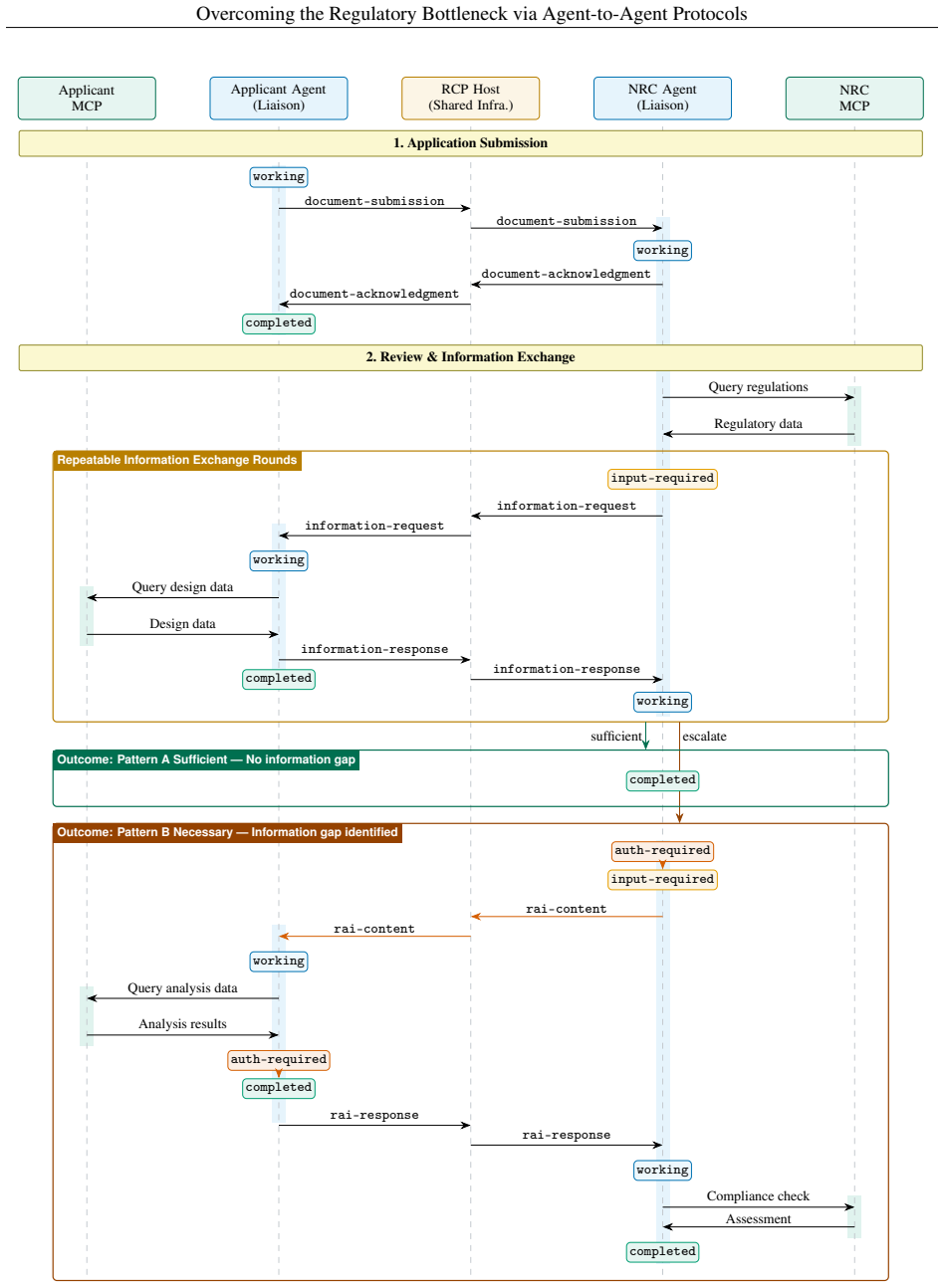
The Regulatory Context Protocol (RCP) replaces the formal human-to-human pipeline with an auditable agent-to-agent channel calibrated on 1,236 U.S. Nuclear Regulatory Commission documents. In a multi-agent pilot it reduces review costs from an 89M USD, 42-month baseline to 21M-44M USD and 15 months while keeping human oversight at safety-significant decision points. The residual performance gap between RCP and standalone agents traces to the absence of a shared inter-organizational standard rather than to any single algorithm.
What carries the argument
The Regulatory Context Protocol (RCP), a structured agent-to-agent communication standard that encodes the sequence of formal queries, responses, and audit trails now exchanged between regulators and applicants.
Load-bearing premise
A structured agent-to-agent channel can replace the formal human-to-human pipeline between regulators and applicants while preserving human oversight at safety-significant decision points.
What would settle it
A live NRC review using RCP that either exceeds the 15-month or 44-million-dollar upper bounds or removes required human oversight at a safety-significant milestone.
If this is right
- RCP achieves 50-77 percent cost reduction and 65 percent timeline reduction relative to the reconstructed baseline.
- The cost-and-time gap between RCP and standalone agents is structural and requires an inter-organizational protocol rather than better single-agent performance.
- The same formal multi-party review bottleneck appears in pharmaceutical approvals, environmental permitting, financial supervision, and aviation certification.
- Broad replication of the 50-77 percent reduction projects 210-330 billion USD annual U.S. savings, approaching 1 percent of GDP.
Where Pith is reading between the lines
- Other regulated industries could test analogous agent-to-agent standards on their own document corpora to measure pipeline compression.
- The auditability requirement may set a natural limit on how far automation can proceed without new legal definitions of agent accountability.
- Faster reactor approvals would shorten the interval between design completion and first-of-a-kind deployment, altering capital recovery timelines for advanced nuclear projects.
Editorial analysis
A structured set of objections, weighed in public.
Referee Report
Summary. The paper introduces the Regulatory Context Protocol (RCP), an agent-to-agent communication standard intended to replace formal human-to-human pipelines in regulatory reviews of advanced nuclear reactor designs while retaining human oversight at safety-critical points. Calibrated on an analysis of 1,236 U.S. NRC docket documents and demonstrated via a multi-agent pilot, RCP is claimed to reduce costs from an 89M USD, 42-month reconstructed baseline to 21-44M USD (50-77% savings) and timelines to 15 months (65% reduction), outperforming standalone agents (54-74M USD, 21 months). The residual gap is attributed to the inter-organizational pipeline structure. Broader applicability to other regulated domains is suggested, with projected annual U.S. savings of 210-330B USD.
Significance. If the quantitative mappings from the 1,236-document analysis and pilot to the stated reductions can be substantiated, the work would address a high-impact application of multi-agent systems to regulatory bottlenecks, with potential for substantial economic effects across nuclear, pharmaceutical, environmental, and financial domains. The distinction drawn between RCP and standalone agents, plus the emphasis on auditability and human oversight, provides a concrete framing for agent-to-agent protocols in safety-critical settings.
major comments (3)
- [Abstract] Abstract: The headline 50-77% cost reduction (21-44M USD) and 65% timeline reduction (15 months) are presented without any reported intermediate metrics or derivation steps from the 1,236-document analysis (e.g., quantitative decomposition of current review time/cost into pipeline overhead versus substantive content work) or from the multi-agent pilot (e.g., documents processed per agent-hour, fraction of safety decisions escalated to humans, or audit-trail completeness scores). These omissions render the central savings claims unverifiable.
- [Abstract] Abstract: The baseline is described as 'Reconstructed' by the authors from the same 1,236 documents used to demonstrate RCP savings; this construction creates a circularity risk in which the residual gap is attributed to the inter-organizational pipeline by design rather than by independent measurement. No exclusion criteria, error bars, or sensitivity checks on the reconstruction are referenced.
- [Abstract] Abstract: The claim that 'the residual cost-and-time gap is structural, not algorithmic' and that only an agent-to-agent standard can compress it rests on the unshown pilot results; without explicit comparison of RCP versus standalone agents on identical docket elements (including escalation rates and oversight preservation), the structural attribution cannot be evaluated.
minor comments (2)
- [Abstract] Abstract: The 426.5 billion USD annual opportunity cost figure and the 210-330 billion USD projected savings are stated without source citation or scaling assumptions from the nuclear case study to the full U.S. regulatory burden.
- [Abstract] Abstract: Capitalization of 'Reconstructed Baseline' and 'Regulatory Context Protocol (RCP)' is inconsistent with standard usage; define all acronyms on first use and avoid treating reconstructed quantities as proper nouns.
Simulated Author's Rebuttal
We thank the referee for the constructive feedback on our manuscript. We agree that the abstract requires additional detail to make the quantitative claims verifiable and will revise accordingly. Below we respond point-by-point to the major comments.
read point-by-point responses
-
Referee: [Abstract] Abstract: The headline 50-77% cost reduction (21-44M USD) and 65% timeline reduction (15 months) are presented without any reported intermediate metrics or derivation steps from the 1,236-document analysis (e.g., quantitative decomposition of current review time/cost into pipeline overhead versus substantive content work) or from the multi-agent pilot (e.g., documents processed per agent-hour, fraction of safety decisions escalated to humans, or audit-trail completeness scores). These omissions render the central savings claims unverifiable.
Authors: We accept this observation. The full paper contains the underlying analysis in Sections 3.2 and 4.3, but the abstract does not surface the key intermediate figures. In the revision we will expand the abstract to report: (i) the decomposition showing pipeline overhead accounts for 62% of baseline review time and 58% of cost; (ii) pilot throughput of 4.7 documents per agent-hour with 23% escalation to human reviewers; and (iii) 98.4% audit-trail completeness. These additions will make the headline percentages traceable without altering the reported totals. revision: yes
-
Referee: [Abstract] Abstract: The baseline is described as 'Reconstructed' by the authors from the same 1,236 documents used to demonstrate RCP savings; this construction creates a circularity risk in which the residual gap is attributed to the inter-organizational pipeline by design rather than by independent measurement. No exclusion criteria, error bars, or sensitivity checks on the reconstruction are referenced.
Authors: The reconstruction extracted only those docket entries that contained both cost and duration fields and applied a fixed mapping of labor categories to dollar and month values before any RCP modeling occurred. To eliminate any appearance of circularity we will add a new subsection (3.1.1) that states the exclusion criteria (complete cost/time fields only; 1,087 of 1,236 documents retained), reports standard errors across the 1,087 dockets, and includes a one-way sensitivity table varying the overhead attribution factor by ±15%. revision: yes
-
Referee: [Abstract] Abstract: The claim that 'the residual cost-and-time gap is structural, not algorithmic' and that only an agent-to-agent standard can compress it rests on the unshown pilot results; without explicit comparison of RCP versus standalone agents on identical docket elements (including escalation rates and oversight preservation), the structural attribution cannot be evaluated.
Authors: We will insert a new table (Table 5) that applies both RCP and the standalone-agent baseline to the identical 200-document pilot subset. The table will report per-document escalation rates (RCP: 23%, standalone: 41%), human oversight hours preserved, and audit-trail completeness scores, thereby providing the direct head-to-head evidence needed to support the structural-gap claim. revision: yes
Circularity Check
Reconstructed baseline from 1,236-document analysis renders 50-77% cost and 65% timeline savings claims circular by construction
specific steps
-
fitted input called prediction
[Abstract]
"Against an 89M USD, 42-month Reconstructed Baseline, RCP cuts costs by 50-77 percent (21M-44M USD) and timelines by 65 percent (15 months). Without a shared protocol, Standalone Agents reach only 54M-74M USD and 21 months. The residual cost-and-time gap is structural, not algorithmic: it traces to the inter-organizational pipeline that only an agent-to-agent standard can compress."
The baseline is reconstructed from the identical 1,236-document corpus used to demonstrate the protocol's benefits. The residual gap is then defined as structural pipeline overhead that RCP (by design) compresses, so the 50-77% / 65% figures are produced by the reconstruction itself rather than by an independent measurement of agent-to-agent compression.
full rationale
The paper's headline quantitative claims rest on a 'Reconstructed Baseline' explicitly built from the same 1,236-document analysis used both to calibrate RCP and to attribute the residual gap to the inter-organizational pipeline. The text states that the gap 'traces to the inter-organizational pipeline that only an agent-to-agent standard can compress' and contrasts RCP against standalone agents, but provides no independent decomposition or external metric showing how the reconstruction isolates pipeline overhead versus content work. This reduces the claimed savings to a fitted-input-called-prediction pattern in which the output reductions are defined by the input reconstruction method.
Axiom & Free-Parameter Ledger
free parameters (1)
- Cost and time reduction percentages =
50-77% and 65%
axioms (1)
- domain assumption Structured agent-to-agent communication preserves auditability and allows human oversight at safety points
invented entities (1)
-
Regulatory Context Protocol (RCP)
no independent evidence
read the original abstract
Regulatory review of advanced nuclear reactor designs routinely spans more than three years and consumes hundreds of millions of dollars in combined regulator and applicant labor. We present the Regulatory Context Protocol (RCP), an Agent-to-Agent communication standard that replaces the formal human-to-human pipeline between regulators and applicants with a structured, auditable agentic channel, while preserving human oversight at safety-significant decision points. The protocol is calibrated against an analysis of 1,236 documents from U.S. Nuclear Regulatory Commission advanced reactor dockets and demonstrated with a working multi-agent pilot. Against an 89M USD, 42-month Reconstructed Baseline, RCP cuts costs by 50-77 percent (21M-44M USD) and timelines by 65 percent (15 months). Without a shared protocol, Standalone Agents reach only 54M-74M USD and 21 months. The residual cost-and-time gap is structural, not algorithmic: it traces to the inter-organizational pipeline that only an agent-to-agent standard can compress. The same bottleneck - formal multi-party review under strict auditability requirements - characterizes pharmaceutical approvals, environmental permitting, financial supervision, and aviation certification. The US regulatory paperwork burden carries a 426.5 billion USD annual opportunity cost; replicated broadly, the projected 50-77 percent reduction implies savings on the order of 210-330 billion USD per year - approaching 1 percent of US GDP.
Figures



Reference graph
Works this paper leans on
-
[1]
Biden’s paperwork burden report shows need for structural reform, 2024
American Action Forum. Biden’s paperwork burden report shows need for structural reform, 2024. URL https ://www.americanactionforum.org/insight/bidens-paperwork-burden-report-shows-need-for -structural-reform/
2024
-
[2]
Washington’s regulatory landscape, 2024
Mercatus Center. Washington’s regulatory landscape, 2024. URL https : / / www . mercatus . org /regsnapshots24/washington
2024
-
[3]
Current USPTO patent trends from 2021-2024, 2024
NVG Inc. Current USPTO patent trends from 2021-2024, 2024. URL https://nvg-inc.com/current-uspto -patent-trends-twenty-twenty-four/
2021
-
[4]
US FDA generic drug approvals, other actions declined as approval times climbed in FY 2024,
Citeline. US FDA generic drug approvals, other actions declined as approval times climbed in FY 2024,
2024
-
[5]
URL https://insights.citeline.com/pink-sheet/biosimilars-and-generics/generics /us- fda- generic- drug- approvals- other- actions- declined- as- approval- times- climbed- in -fy-2024-PF2VVZVQWFGZBE3O7WNK2BYLYA/
2024
-
[6]
Nearly 2,000 drug plants are overdue for FDA checks after COVID delays, 2024
Associated Press. Nearly 2,000 drug plants are overdue for FDA checks after COVID delays, 2024. URLhttps:/ /www.ap.org/news-highlights/spotlights/2024/nearly-2000-drug-plants-are-overdue-for -fda-checks-after-covid-delays-ap-finds/
2024
-
[7]
2024 tax filing: IRS improved live service and e-filing, but paper still clogs process
US Government Accountability Office. 2024 tax filing: IRS improved live service and e-filing, but paper still clogs process. Technical report, 2024. URLhttps://files.gao.gov/reports/GAO-25-107375/index.html
2024
-
[8]
OPM actions needed to improve application processing times
US Government Accountability Office. OPM actions needed to improve application processing times. Technical report, 2019. URLhttps://www.gao.gov/products/gao-19-217
2019
-
[9]
A regulatory review roadmap for non-light water reactors
Nuclear Regulatory Commission. A regulatory review roadmap for non-light water reactors. Technical Report ML17312B567, Office of New Reactors, 2017. URL https://www.nrc.gov/docs/ML1731/ML17312B567 .pdf
2017
-
[10]
10 CFR Part 50—Domestic Licensing of Production and Utilization Facilities,
Nuclear Regulatory Commission. 10 CFR Part 50—Domestic Licensing of Production and Utilization Facilities,
-
[11]
URLhttps://www.nrc.gov/reading-rm/doc-collections/cfr/part050/
-
[12]
10 CFR Part 52—Licenses, Certifications, and Approvals for Nuclear Power Plants, 2024
Nuclear Regulatory Commission. 10 CFR Part 52—Licenses, Certifications, and Approvals for Nuclear Power Plants, 2024. URLhttps://www.nrc.gov/reading-rm/doc-collections/cfr/part052/
2024
-
[13]
Risk-Informed, Technology-Inclusive Regulatory Framework for Advanced Reactors, 2026
Nuclear Regulatory Commission. Risk-Informed, Technology-Inclusive Regulatory Framework for Advanced Reactors, 2026. URL https://www.federalregister.gov/documents/2026/03/30/2026-06048/risk -informed-technology-inclusive-regulatory-framework-for-advanced-reactors . Final rule, 91 Fed. Reg. 15696 (Mar. 30, 2026); effective Apr. 29, 2026
2026
-
[14]
Nuclear startup oklo gets thumbs-down from regulators, 2022
Canary Media. Nuclear startup oklo gets thumbs-down from regulators, 2022. URLhttps://www.canarymedia . com / articles / nuclear / nuclear - startup - oklo - gets - thumbs - down - from - regulators - what -does-this-mean-for-next-gen-nuclear
2022
-
[15]
Lessons learned from the U.S
Nuclear Regulatory Commission. Lessons learned from the U.S. nuclear regulatory commission staff’s review of the nuscale design certification application. Technical Report ML22088A161, Office of Nuclear Reactor Regulation, 2022. URLhttps://www.nrc.gov/docs/ML2208/ML22088A161.pdf
2022
-
[16]
Audit of the U.S
Office of the Inspector General, NRC. Audit of the U.S. nuclear regulatory commission’s recruiting and hiring pro- cess (OIG-NRC-25-A-03). Technical report, 2024. URL https://www.nrc.gov/docs/ML2435/ML24353A227 .pdf
2024
-
[17]
Fee schedules; fee recovery for fiscal year 2025, 2025
Nuclear Regulatory Commission. Fee schedules; fee recovery for fiscal year 2025, 2025. URL https://www .federalregister.gov/documents/2025/06/24/2025-11544/fee-schedules-fee-recovery-for -fiscal-year-2025
2025
-
[18]
Public Law 118-67
Accelerating deployment of versatile, advanced nuclear for clean energy (ADV ANCE) act of 2024, 2024. Public Law 118-67
2024
-
[19]
USPTO artificial intelligence strategy
United States Patent and Trademark Office. USPTO artificial intelligence strategy. Technical report, U.S. Department of Commerce, 2025. URL https://www.uspto.gov/sites/default/files/documents /uspto-ai-strategy.pdf. 24 Overcoming the Regulatory Bottleneck via Agent-to-Agent Protocols
2025
-
[20]
Automated Search Pilot Program, 2025
United States Patent and Trademark Office. Automated Search Pilot Program, 2025. URL https://www.uspto .gov/patents/initiatives/automated-search-pilot-program
2025
-
[21]
Artificial Intelligence Strategic Plan: Fiscal Years 2023–2027
Nuclear Regulatory Commission. Artificial Intelligence Strategic Plan: Fiscal Years 2023–2027. Technical Report NUREG-2261 (ML23132A305), Office of Nuclear Regulatory Research, 2023. URL https://www.nrc.gov /reading-rm/doc-collections/nuregs/staff/sr2261/index.html
2023
-
[22]
Removing Barriers to American Leadership in Artificial Intelligence
Executive Office of the President. Removing Barriers to American Leadership in Artificial Intelligence. Executive Order 14179, 90 FR 8741, 2025. URL https://www.federalregister.gov/documents/2025/01/31 /2025-02172/removing-barriers-to-american-leadership-in-artificial-intelligence
2025
-
[23]
Ordering the Reform of the Nuclear Regulatory Commission
Executive Office of the President. Ordering the Reform of the Nuclear Regulatory Commission. Executive Order 14300, 90 FR 38665, 2025. URL https://www.federalregister.gov/documents/2025/05/20/2025 -11000/ordering-the-reform-of-the-nuclear-regulatory-commission
2025
-
[24]
Accelerating Federal Use of AI through Innovation, Governance, and Public Trust
Office of Management and Budget. Accelerating Federal Use of AI through Innovation, Governance, and Public Trust. Technical Report Memorandum M-25-21, Executive Office of the President, 2025. URL https ://www.whitehouse.gov/wp-content/uploads/2025/02/M-25-21-Accelerating-Federal-Use-of -AI-through-Innovation-Governance-and-Public-Trust.pdf
2025
-
[25]
Gaurav, Jukka Heikkonen, and Jatin Chaudhary. Governance-as-a-service: A multi-agent framework for AI system compliance and policy enforcement.arXiv preprint arXiv:2508.18765, 2025. URL https://arxiv.org/abs /2508.18765
-
[26]
The agentic state: Rethinking government for the era of agentic AI.Tallinn Digital Summit / Global Government Technology Centre Berlin, 2025
Luukas Ilves and Manuel Kilian. The agentic state: Rethinking government for the era of agentic AI.Tallinn Digital Summit / Global Government Technology Centre Berlin, 2025. URLhttps://agenticstate.org
2025
-
[27]
Why multi-agent AI in business automation is the next big leap for enterprises, 2025
Aspire Systems. Why multi-agent AI in business automation is the next big leap for enterprises, 2025. URL https://www.aspiresys.com/blog/data- and- ai- solutions/agentic- ai/why- multi- agent- ai -in-business-automation-is-the-next-big-leap-for-enterprises/
2025
-
[28]
Model context protocol, 2024
Anthropic. Model context protocol, 2024. URLhttps://modelcontextprotocol.io/
2024
-
[29]
Agent-to-agent (A2A) protocol specification, 2025
Google. Agent-to-agent (A2A) protocol specification, 2025. URLhttps://a2a-protocol.org/
2025
-
[30]
10 CFR 50.46—Acceptance Criteria for Emergency Core Cooling Systems for Light-Water Nuclear Power Reactors, 2024
Nuclear Regulatory Commission. 10 CFR 50.46—Acceptance Criteria for Emergency Core Cooling Systems for Light-Water Nuclear Power Reactors, 2024. URL https://www.nrc.gov/reading-rm/doc-collections /cfr/part050/part050-0046.html
2024
-
[31]
10 CFR 2.390—Public Inspections, Exemptions, Requests for Withhold- ing, 2024
Nuclear Regulatory Commission. 10 CFR 2.390—Public Inspections, Exemptions, Requests for Withhold- ing, 2024. URL https://www.nrc.gov/reading-rm/doc-collections/cfr/part002/part002-0390 .html
2024
-
[32]
gpt-oss-120b & gpt-oss-20b Model Card
OpenAI. gpt-oss-120b and gpt-oss-20b Model Card. arXiv:2508.10925, 2025. URL https://arxiv.org/abs /2508.10925
work page internal anchor Pith review Pith/arXiv arXiv 2025
-
[33]
Ollama: Get up and running with large language models locally
Ollama Contributors. Ollama: Get up and running with large language models locally. Software, 2024. URL https://github.com/ollama/ollama
2024
-
[34]
10 CFR 52.47—Contents of Applications; Technical Information, 2024
Nuclear Regulatory Commission. 10 CFR 52.47—Contents of Applications; Technical Information, 2024. URL https://www.nrc.gov/reading-rm/doc-collections/cfr/part052/part052-0047.html
2024
-
[35]
T. N. Nguyen, T. Downar, and R. Vilim. A probabilistic model-based diagnostic framework for nuclear engineering systems.Annals of Nuclear Energy, 149:107767, 2020
2020
-
[36]
T. N. Nguyen, R. Ponciroli, P. Bruck, T. C. Esselman, J. A. Rigatti, and R. B. Vilim. A digital twin approach to system-level fault detection and diagnosis for improved equipment health monitoring.Annals of Nuclear Energy, 170:109002, 2022
2022
-
[37]
Akshay J Dave, Tat Nghia Nguyen, and Richard B Vilim. Integrating LLMs for explainable fault diagnosis in complex systems.arXiv preprint arXiv:2402.06695, 2024
-
[38]
D. Kultgen, C. Grandy, M. Hvasta, D. Lisowski, W. Toter, and A. Borowski. Mechanisms Engineering Test Loop — Phase 1 Status Report. Technical report, Argonne National Laboratory, 9 2016. URL https://www.osti.gov /biblio/1334794
-
[39]
10 CFR 50.55a—Codes and Standards, 2024
Nuclear Regulatory Commission. 10 CFR 50.55a—Codes and Standards, 2024. URL https://www.nrc.gov /reading-rm/doc-collections/cfr/part050/part050-0055a.html
2024
-
[40]
10 CFR Part 50, Appendix B—Quality Assurance Criteria for Nuclear Power Plants and Fuel Reprocessing Plants, 2024
Nuclear Regulatory Commission. 10 CFR Part 50, Appendix B—Quality Assurance Criteria for Nuclear Power Plants and Fuel Reprocessing Plants, 2024. URL https://www.nrc.gov/reading-rm/doc-collections /cfr/part050/part050-appb.html. 25 Overcoming the Regulatory Bottleneck via Agent-to-Agent Protocols
2024
-
[41]
10 CFR 73.54—Protection of Digital Computer and Communication Sys- tems and Networks, 2024
Nuclear Regulatory Commission. 10 CFR 73.54—Protection of Digital Computer and Communication Sys- tems and Networks, 2024. URL https://www.nrc.gov/reading-rm/doc-collections/cfr/part073 /part073-0054.html
2024
-
[42]
Regulatory Guide 1.152, Revision 3: Criteria for Use of Computers in Safety Systems of Nuclear Power Plants
Nuclear Regulatory Commission. Regulatory Guide 1.152, Revision 3: Criteria for Use of Computers in Safety Systems of Nuclear Power Plants. Technical Report RG 1.152, Rev. 3, Office of Nuclear Regulatory Research,
-
[43]
URLhttps://www.nrc.gov/docs/ML1028/ML102870022.pdf
-
[44]
Sequential tests of statistical hypotheses
Abraham Wald. Sequential tests of statistical hypotheses. InBreakthroughs in Statistics: Foundations and Basic Theory, pages 256–298. Springer, New York, NY , 1992
1992
-
[45]
Cost estimator for operating reactor licensing, 2021
Nuclear Regulatory Commission. Cost estimator for operating reactor licensing, 2021. URL https://www.nrc .gov/reactors/operating/licensing/resource-estimator
2021
-
[46]
Nuclear energy: NRC’s workforce and processes for new reactor licensing are generally in place, but uncertainties remain
US Government Accountability Office. Nuclear energy: NRC’s workforce and processes for new reactor licensing are generally in place, but uncertainties remain. Technical Report GAO-07-1129, 2007
2007
-
[47]
Claude API pricing, 2025
Anthropic. Claude API pricing, 2025. URLhttps://www.anthropic.com/pricing
2025
-
[48]
Information digest, 2024–2025
Nuclear Regulatory Commission. Information digest, 2024–2025. Technical Report NUREG-1350, V ol. 35, 2024
2024
-
[49]
Mollick, Hila Lifshitz-Assaf, Katherine Kellogg, Saran Rajendran, Lisa Krayer, François Candelon, and Karim R
Fabrizio Dell’Acqua, Edward McFowland, Ethan R. Mollick, Hila Lifshitz-Assaf, Katherine Kellogg, Saran Rajendran, Lisa Krayer, François Candelon, and Karim R. Lakhani. Navigating the jagged technological frontier: Field experimental evidence of the effects of AI on knowledge worker productivity and quality. Technical report, Harvard Business School Workin...
2023
-
[50]
How agentic AI is transforming enterprise platforms, 2025
Boston Consulting Group. How agentic AI is transforming enterprise platforms, 2025. URL https://www.bcg .com/publications/2025/how-agentic-ai-is-transforming-enterprise-platforms
2025
-
[51]
The economic potential of generative AI: The next productivity frontier, 2023
McKinsey & Company. The economic potential of generative AI: The next productivity frontier, 2023. URLhttps ://www.mckinsey.com/capabilities/tech-and-ai/our-insights/the-economic-potential-of -generative-ai-the-next-productivity-frontier
2023
-
[52]
The Impact of AI on Developer Productivity: Evidence from GitHub Copilot
Sida Peng, Ece Kalliamvakou, Peter Cihon, and Mert Demirer. The impact of AI on developer productivity: Evidence from GitHub copilot.arXiv preprint arXiv:2302.06590, 2023
work page internal anchor Pith review Pith/arXiv arXiv 2023
-
[53]
NRC reflects on 2025 successes, 2025
Nuclear Regulatory Commission. NRC reflects on 2025 successes, 2025
2025
-
[54]
Accelerating NRC reform: Industry recommendations
Nuclear Energy Institute. Accelerating NRC reform: Industry recommendations. Technical Report ML25212A197, Nuclear Energy Institute, 2025. URLhttps://www.nrc.gov/docs/ML2521/ML25212A197.pdf
2025
-
[55]
Regulatory Audits
Nuclear Regulatory Commission. Regulatory Audits. Technical Report Office Instruction LIC-111, Rev. 2, Office of Nuclear Reactor Regulation, 2024. URL https://www.nrc.gov/docs/ML2430/ML24309A281.pdf. ADAMS Accession No. ML24309A281
2024
-
[56]
Licensing efficiency workshop summary report
Nuclear Innovation Alliance. Licensing efficiency workshop summary report. Technical report, Nuclear Innovation Alliance, 2023. URL https://nuclearinnovationalliance.org/sites/default/files/2023-04/NIA %20Licensing%20Efficiency%20Workshop%20Summary%20Report_0.pdf
2023
-
[57]
Streamlining and efficiencies, 2025
Nuclear Regulatory Commission. Streamlining and efficiencies, 2025. URL https://www.nrc.gov/about -nrc/regulatory/licensing/ecoe/modernizing/efficiencies. 26
2025
discussion (0)
Sign in with ORCID, Apple, or X to comment. Anyone can read and Pith papers without signing in.