Identifiability and Estimation for Unlabeled Finite Mixtures under Marginal Independence
Reviewed by Pith T0 review T1 audit T2 compute T3 formal T4 kernel 2026-06-27 19:32 UTCgrok-4.3pith:FLZ3LF6Xrecord.jsonopen to challenge →
The pith
Marginal independence on one coordinate pair per component identifies all latent components and recovers the mixing matrix from unlabeled mixtures.
A machine-rendered reading of the paper's core claim, the machinery that carries it, and where it could break.
Core claim
When every component is independent on some coordinate pair, all components are identifiable, and the mixing matrix is recoverable under the stated completion conditions. Marginally independent affine combinations of the observable mixtures recover the corresponding latent components under full-rank and no-cancellation conditions on the mixing matrix.
What carries the argument
Marginal independence assumption on at least one coordinate pair per component, which lets marginally independent affine combinations isolate individual latent components from the mixtures.
If this is right
- All components become identifiable once each satisfies marginal independence on some coordinate pair.
- The mixing matrix is recoverable under the full-rank and no-cancellation completion conditions.
- The PM-MMD estimator achieves uniform convergence and stability when marginal independence holds approximately.
- Marginal independence supplies a candidate-level diagnostic through held-out PM-MMD, while irreducibility does not.
Where Pith is reading between the lines
- The method may apply directly to flow-cytometry data where cell-type variables exhibit pairwise independence within each type.
- The diagnostic based on held-out PM-MMD could serve as a practical check before applying the recovery procedure to new unlabeled datasets.
- The separation of testable marginal independence from harder-to-check irreducibility suggests prioritizing coordinate pairs that show low dependence in exploratory analysis.
Load-bearing premise
Each latent component must be independent on at least one observed coordinate pair, together with the mixing matrix being full rank and satisfying no-cancellation conditions.
What would settle it
In a controlled experiment with known ground-truth components where each satisfies marginal independence on a coordinate pair, the PM-MMD estimator fails to recover the correct components or mixing matrix.
Figures


read the original abstract
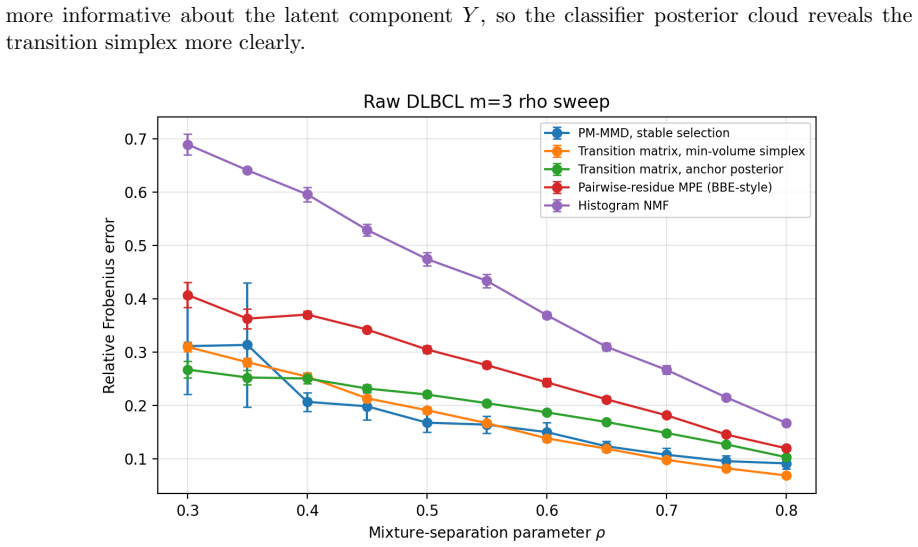
We study component recovery and mixing-matrix estimation from unlabeled finite mixtures whose observable distributions share the same latent components but have unknown mixing weights. The main identifying signal is marginal independence: each component is assumed to be independent on at least one coordinate pair, but no labels, clean component samples, or mixing weights are observed. We first prove a structural result for product components: under linear independence of the univariate marginals, any independent affine combination of the components must coincide with a single component. We then extend this principle to observable mixtures and show that, under full-rank and no-cancellation conditions, marginally independent affine combinations recover the corresponding latent components. When every component is independent on some coordinate pair, all components are identifiable, and the mixing matrix is recoverable under the stated completion conditions. Finally, we propose a Product-Marginal Maximum Mean Discrepancy (PM-MMD) estimator over affine combinations of the observable mixtures and prove uniform convergence and stability under approximate marginal independence. This framework also separates the empirical roles of the assumptions: irreducibility is, in general, not directly testable from the unlabeled mixtures alone, whereas marginal independence yields a candidate-level diagnostic through held-out PM-MMD. Controlled and flow-cytometry experiments show when marginal independence provides a useful recovery signal. In the reported multi-component comparisons, condition-aware representative selection stabilizes PM-MMD and improves recovery relative to clustering, factorization, and pairwise mixture-proportion baselines using the same unlabeled mixtures.
Editorial analysis
A structured set of objections, weighed in public.
Referee Report
Summary. The paper studies identifiability and estimation of latent components and mixing weights in unlabeled finite mixtures, where the only identifying signal is that each latent component is marginally independent on at least one (possibly component-specific) coordinate pair. It first proves a structural result that, under linear independence of univariate marginals, any independent affine combination of fully product components must equal a single component. This is extended to observable mixtures under full-rank and no-cancellation conditions on the mixing matrix, yielding identifiability of all components and recoverability of the mixing matrix. A Product-Marginal MMD (PM-MMD) estimator over affine combinations is proposed, with proofs of uniform convergence and stability under approximate marginal independence; experiments on controlled data and flow-cytometry data compare it to clustering, factorization, and baseline methods.
Significance. If the central identifiability claims hold, the work provides a new route to component recovery that does not require labels, clean samples, or known proportions and instead exploits verifiable marginal independence. Strengths include the explicit separation of the roles of irreducibility versus marginal independence (with a held-out diagnostic for the latter) and the machine-checked-style proofs of uniform convergence and stability for the PM-MMD estimator. The framework could be useful in domains such as cytometry or genomics where marginal independence on selected coordinate pairs is plausible.
major comments (2)
- [extension argument following the product-component structural result] The structural result is stated for fully product components (linear independence of univariate marginals implies any independent affine combination equals one component). The extension to observable mixtures with component-specific (possibly distinct) independence pairs invokes full-rank and no-cancellation on the mixing matrix to conclude that marginally independent affine combinations recover the latent components. It is not clear from the lifting argument whether an affine combination chosen to enforce independence on one specific pair for one component can inadvertently produce a non-product structure that violates the structural result for the remaining components; this step is load-bearing for the claim that every component is identifiable when each has its own independence pair.
- [PM-MMD estimator and convergence theorem] The PM-MMD estimator is defined over affine combinations of the observable mixtures and is shown to converge uniformly under approximate marginal independence. However, the stability claim under the case of heterogeneous independence pairs across components relies on the same lifting that is questioned above; if the extension does not fully secure the product structure for all components simultaneously, the uniform convergence guarantee for the estimator may not transfer directly to the multi-component recovery task.
minor comments (2)
- [main identifiability theorem] Notation for the coordinate pairs and the selection of which pair is used for each component should be made explicit in the statement of the main identifiability theorem.
- [discussion of assumptions] The abstract states that 'irreducibility is, in general, not directly testable from the unlabeled mixtures alone'; a brief remark on whether any diagnostic for the full-rank/no-cancellation conditions is feasible would help readers assess practical applicability.
Simulated Author's Rebuttal
We thank the referee for their thorough review and constructive comments. We address each major comment below. We agree that the lifting argument would benefit from expanded exposition for clarity, and we will revise the manuscript to make the correspondence between observable affine coefficients and effective latent weights fully explicit.
read point-by-point responses
-
Referee: [extension argument following the product-component structural result] The structural result is stated for fully product components (linear independence of univariate marginals implies any independent affine combination equals one component). The extension to observable mixtures with component-specific (possibly distinct) independence pairs invokes full-rank and no-cancellation on the mixing matrix to conclude that marginally independent affine combinations recover the latent components. It is not clear from the lifting argument whether an affine combination chosen to enforce independence on one specific pair for one component can inadvertently produce a non-product structure that violates the structural result for the remaining components; this step is load-bearing for the claim that every component is identifiable when each has its own independence pair.
Authors: The lifting argument maps an affine combination of observable mixtures to an affine combination of the latent components whose effective weights are obtained by post-multiplying the mixing matrix by the vector of affine coefficients. Full rank of the mixing matrix guarantees that, for each target component, there is a unique choice of coefficients that isolates it exactly. The no-cancellation condition then ensures that any other choice of coefficients produces a non-zero mixture on the remaining components; because the latent components are fully product and their univariate marginals are linearly independent, such a non-isolating mixture cannot be marginally independent on the designated pair. Consequently, the only affine combinations that achieve marginal independence on a given pair are the isolating ones, each of which the structural result identifies with a single product component. No inadvertent non-product structure arises for the remaining components, because each isolation is performed separately and the structural result applies directly to any distribution that attains independence. We will insert an explicit lemma stating this coefficient-to-weight correspondence and its consequences for the product property. revision: yes
-
Referee: [PM-MMD estimator and convergence theorem] The PM-MMD estimator is defined over affine combinations of the observable mixtures and is shown to converge uniformly under approximate marginal independence. However, the stability claim under the case of heterogeneous independence pairs across components relies on the same lifting that is questioned above; if the extension does not fully secure the product structure for all components simultaneously, the uniform convergence guarantee for the estimator may not transfer directly to the multi-component recovery task.
Authors: The uniform convergence theorem is proved directly on the space of affine combinations of the observable mixtures, using only the approximate marginal independence of each latent component on its own pair and standard MMD continuity arguments; it does not invoke simultaneous recovery of all components. The estimator is applied once per independence pair, and the stability result follows from the fact that each pair isolates its corresponding component under the identifiability conditions. With the expanded lifting argument supplied in the revision, the transfer from per-pair convergence to multi-component recovery is immediate. We will add a remark after the convergence theorem that explicitly decouples the uniform convergence statement from the identifiability extension. revision: yes
Circularity Check
No circularity: identifiability rests on external linear independence and full-rank assumptions
full rationale
The derivation begins with an explicit structural theorem for product components (linear independence of univariate marginals implies independent affine combinations coincide with single components) and extends it to mixtures via stated full-rank and no-cancellation conditions on the mixing matrix. These are external mathematical assumptions, not quantities fitted inside the paper or defined in terms of the target identifiability result. The PM-MMD estimator is introduced as a new construction with separate uniform convergence and stability proofs under approximate marginal independence; no step renames a fitted parameter as a prediction or reduces the central claim to a self-citation chain. The argument is therefore self-contained against the stated assumptions.
Axiom & Free-Parameter Ledger
axioms (2)
- domain assumption linear independence of the univariate marginals
- domain assumption full-rank and no-cancellation conditions on the mixing matrix
invented entities (1)
-
PM-MMD estimator
no independent evidence
Reference graph
Works this paper leans on
-
[1]
Stefan Aeberhard and M. Forina. Wine. UCI Machine Learning Repository, 1992
1992
-
[2]
Allman, Catherine Matias, and John A
Elizabeth S. Allman, Catherine Matias, and John A. Rhodes. Identifiability of parameters in latent structure models with many observed variables.Annals of Statistics, 37(6A):3099– 3132, 2009
2009
-
[3]
Optical recognition of handwritten digits
Ethem Alpaydin and Cenk Kaynak. Optical recognition of handwritten digits. UCI Machine Learning Repository, 1998
1998
-
[4]
Tensor decompositions for learning latent variable models.J
Animashree Anandkumar, Rong Ge, Daniel J Hsu, Sham M Kakade, Matus Telgarsky, et al. Tensor decompositions for learning latent variable models.J. Mach. Learn. Res., 15(1):2773–2832, 2014
2014
-
[5]
Semi-supervised novelty detection.The Journal of Machine Learning Research, 11:2973–3009, 2010
Gilles Blanchard, Gyemin Lee, and Clayton Scott. Semi-supervised novelty detection.The Journal of Machine Learning Research, 11:2973–3009, 2010. 22
2010
-
[6]
Decontamination of Mutually Contaminated Models
Gilles Blanchard and Clayton Scott. Decontamination of Mutually Contaminated Models. In Samuel Kaski and Jukka Corander, editors,Proceedings of the Seventeenth International Conference on Artificial Intelligence and Statistics, volume 33 ofProceedings of Machine Learning Research, pages 1–9, Reykjavik, Iceland, 22–25 Apr 2014. PMLR
2014
-
[7]
Oxford University Press, 2013
St´ ephane Boucheron, G´ abor Lugosi, and Pascal Massart.Concentration Inequalities: A Nonasymptotic Theory of Independence. Oxford University Press, 2013
2013
-
[8]
Nearly optimal sample complexity for learning with label proportions
Robert Istvan Busa-Fekete, Travis Dick, Claudio Gentile, Haim Kaplan, Tomer Koren, and Uri Stemmer. Nearly optimal sample complexity for learning with label proportions. In Forty-second International Conference on Machine Learning, 2025
2025
-
[9]
Class-prior estimation for learning from positive and unlabeled data
Marthinus Christoffel, Gang Niu, and Masashi Sugiyama. Class-prior estimation for learning from positive and unlabeled data. InAsian Conference on Machine Learning, pages 221–
-
[10]
Hejblum, and Rodolphe Thi´ ebaut
Daniel Commenges, Chariff Alkhassim, Raphael Gottardo, Boris P. Hejblum, and Rodolphe Thi´ ebaut. cytometree: a binary tree algorithm for automatic gating in cytometry analysis. Cytometry Part A, 93(11):1132–1140, 2018
2018
-
[11]
Archetypal analysis.Technometrics, 36(4):338–347, 1994
Adele Cutler and Leo Breiman. Archetypal analysis.Technometrics, 36(4):338–347, 1994
1994
-
[12]
Dempster, Nan M
Arthur P. Dempster, Nan M. Laird, and Donald B. Rubin. Maximum likelihood from incomplete data via the EM algorithm.Journal of the Royal Statistical Society: Series B, 39(1):1–38, 1977
1977
-
[13]
Mixture weight estimation and model prediction in multi-source multi-target domain adaptation.Advances in Neural In- formation Processing Systems, 36:4845–4898, 2023
Yuyang Deng, Ilja Kuzborskij, and Mehrdad Mahdavi. Mixture weight estimation and model prediction in multi-source multi-target domain adaptation.Advances in Neural In- formation Processing Systems, 36:4845–4898, 2023
2023
-
[14]
Learning classifiers from only positive and unlabeled data
Charles Elkan and Keith Noto. Learning classifiers from only positive and unlabeled data. InProceedings of the 14th ACM SIGKDD international conference on Knowledge discovery and data mining, pages 213–220, 2008
2008
-
[15]
Mixture proportion estimation and PU learning: A modern approach.Advances in Neural Information Processing Systems, 34:8532–8544, 2021
Saurabh Garg, Yifan Wu, Alexander J Smola, Sivaraman Balakrishnan, and Zachary Lip- ton. Mixture proportion estimation and PU learning: A modern approach.Advances in Neural Information Processing Systems, 34:8532–8544, 2021
2021
-
[16]
Large sample analysis of the median heuristic
Damien Garreau, Wittawat Jitkrittum, and Motonobu Kanagawa. Large sample analysis of the median heuristic.arXiv preprint arXiv:1707.07269, 2017
work page internal anchor Pith review Pith/arXiv arXiv 2017
-
[17]
Gonzalez
Teofilo F. Gonzalez. Clustering to minimize the maximum intercluster distance.Theoretical Computer Science, 38:293–306, 1985
1985
-
[18]
Borgwardt, Malte J
Arthur Gretton, Karsten M. Borgwardt, Malte J. Rasch, Bernhard Sch¨ olkopf, and Alexan- der Smola. A kernel two-sample test.Journal of Machine Learning Research, 13(25):723– 773, 2012
2012
-
[19]
A kernel statistical test of independence.Advances in neural information processing systems, 20, 2007
Arthur Gretton, Kenji Fukumizu, Choon Teo, Le Song, Bernhard Sch¨ olkopf, and Alex Smola. A kernel statistical test of independence.Advances in neural information processing systems, 20, 2007
2007
-
[20]
Nonparametric estimation of component distributions in a multivariate mixture.The annals of statistics, 31(1):201–224, 2003
Peter Hall and Xiao-Hua Zhou. Nonparametric estimation of component distributions in a multivariate mixture.The annals of statistics, 31(1):201–224, 2003
2003
-
[21]
Dmitry Ivanov. DEDPUL: Difference-of-estimated-densities-based positive-unlabeled learn- ing.arXiv preprint arXiv:1902.06965, 2019. 23
-
[22]
Estimating the class prior and pos- terior from noisy positives and unlabeled data.Advances in neural information processing systems, 29, 2016
Shantanu Jain, Martha White, and Predrag Radivojac. Estimating the class prior and pos- terior from noisy positives and unlabeled data.Advances in neural information processing systems, 29, 2016
2016
-
[23]
Decontamination of mutual contamination models.Journal of Machine Learning Research, 20(41):1–57, 2019
Julian Katz-Samuels, Gilles Blanchard, and Clayton Scott. Decontamination of mutual contamination models.Journal of Machine Learning Research, 20(41):1–57, 2019
2019
-
[24]
Positive- unlabeled learning with non-negative risk estimator.Advances in neural information pro- cessing systems, 30, 2017
Ryuichi Kiryo, Gang Niu, Marthinus C Du Plessis, and Masashi Sugiyama. Positive- unlabeled learning with non-negative risk estimator.Advances in neural information pro- cessing systems, 30, 2017
2017
-
[25]
Lee and H
Daniel D. Lee and H. Sebastian Seung. Learning the parts of objects by non-negative matrix factorization.Nature, 401(6755):788–791, 1999
1999
-
[26]
Provably end- to-end label-noise learning without anchor points
Xuefeng Li, Tongliang Liu, Bo Han, Gang Niu, and Masashi Sugiyama. Provably end- to-end label-noise learning without anchor points. InProceedings of the 38th International Conference on Machine Learning, volume 139 ofProceedings of Machine Learning Research, 2021
2021
-
[27]
Classification with noisy labels by importance reweighting
Tongliang Liu and Dacheng Tao. Classification with noisy labels by importance reweighting. IEEE Transactions on Pattern Analysis and Machine Intelligence, 38(3):447–461, 2016
2016
-
[28]
Some methods for classification and analysis of multivariate observations
James MacQueen. Some methods for classification and analysis of multivariate observations. InProceedings of the Fifth Berkeley Symposium on Mathematical Statistics and Probability, volume 1, pages 281–297. University of California Press, 1967
1967
-
[29]
Prior shift estimation for positive unlabeled data through the lens of kernel embedding
Jan Mielniczuk, Wojciech Rejchel, and Pawel Teisseyre. Class prior estimation for positive- unlabeled learning when label shift occurs.arXiv preprint arXiv:2502.21194, 2025
work page internal anchor Pith review Pith/arXiv arXiv 2025
-
[30]
Kernel mean embedding of distributions: A review and beyond.Foundations and Trends in Machine Learning, 10(1–2):1–141, 2017
Krikamol Muandet, Kenji Fukumizu, Bharath Sriperumbudur, and Bernhard Sch¨ olkopf. Kernel mean embedding of distributions: A review and beyond.Foundations and Trends in Machine Learning, 10(1–2):1–141, 2017
2017
-
[31]
Ng, Michael I
Andrew Y. Ng, Michael I. Jordan, and Yair Weiss. On spectral clustering: Analysis and an algorithm. InAdvances in Neural Information Processing Systems, volume 14, 2002
2002
-
[32]
Making deep neural networks robust to label noise: A loss correction approach
Giorgio Patrini, Alessandro Rozza, Aditya Krishna Menon, Richard Nock, and Lizhen Qu. Making deep neural networks robust to label noise: A loss correction approach. InProceed- ings of the IEEE Conference on Computer Vision and Pattern Recognition, pages 1944– 1952, 2017
1944
-
[33]
Optimum bounds for the distributions of martingales in banach spaces.The Annals of Probability, 22(4):1679–1706, 1994
Iosif Pinelis. Optimum bounds for the distributions of martingales in banach spaces.The Annals of Probability, 22(4):1679–1706, 1994
1994
-
[34]
Smola, Tib´ erio S
Novi Quadrianto, Alex J. Smola, Tib´ erio S. Caetano, and Quoc V. Le. Estimating labels from label proportions.Journal of Machine Learning Research, 10:2349–2374, 2009
2009
-
[35]
Mixture proportion estimation via kernel embeddings of distributions
Harish Ramaswamy, Clayton Scott, and Ambuj Tewari. Mixture proportion estimation via kernel embeddings of distributions. InInternational conference on machine learning, pages 2052–2060, 2016
2052
-
[36]
Unsupervised learning under latent label shift.Advances in Neural Information Processing Systems, 35:18763– 18778, 2022
Manley Roberts, Pranav Mani, Saurabh Garg, and Zachary Lipton. Unsupervised learning under latent label shift.Advances in Neural Information Processing Systems, 35:18763– 18778, 2022
2022
-
[37]
A rate of convergence for mixture proportion estimation, with application to learning from noisy labels
Clayton Scott. A rate of convergence for mixture proportion estimation, with application to learning from noisy labels. InArtificial Intelligence and Statistics, pages 838–846, 2015. 24
2015
-
[38]
Classification with asymmetric label noise: Consistency and maximal denoising
Clayton Scott, Gilles Blanchard, and Gregory Handy. Classification with asymmetric label noise: Consistency and maximal denoising. In Shai Shalev-Shwartz and Ingo Steinwart, editors,Proceedings of the 26th Annual Conference on Learning Theory, volume 30 ofPro- ceedings of Machine Learning Research, pages 489–511, Princeton, NJ, USA, 12–14 Jun
-
[39]
Eleni Sgouritsa, Dominik Janzing, Jonas Peters, and Bernhard Sch¨ olkopf. Identifying finite mixtures of nonparametric product distributions and causal inference of confounders.arXiv preprint arXiv:1309.6860, 2013
work page internal anchor Pith review Pith/arXiv arXiv 2013
-
[40]
Kernel distribution embeddings: Uni- versal kernels, characteristic kernels and kernel metrics on distributions.Journal of Machine Learning Research, 19(44):1–29, 2018
Carl-Johann Simon-Gabriel and Bernhard Sch¨ olkopf. Kernel distribution embeddings: Uni- versal kernels, characteristic kernels and kernel metrics on distributions.Journal of Machine Learning Research, 19(44):1–29, 2018
2018
-
[41]
Nonparametric estimation of multi-view latent variable models
Le Song, Animashree Anandkumar, Bo Dai, and Bo Xie. Nonparametric estimation of multi-view latent variable models. InInternational Conference on Machine Learning, pages 640–648. PMLR, 2014
2014
-
[42]
Sriperumbudur, Arthur Gretton, Kenji Fukumizu, Bernhard Sch¨ olkopf, and Gert R
Bharath K. Sriperumbudur, Arthur Gretton, Kenji Fukumizu, Bernhard Sch¨ olkopf, and Gert R. G. Lanckriet. Hilbert space embeddings and metrics on probability measures. Journal of Machine Learning Research, 11:1517–1561, 2010
2010
-
[43]
Invariance assumptions for class distribution estimation.arXiv preprint arXiv:2311.17225, 2023
Dirk Tasche. Invariance assumptions for class distribution estimation.arXiv preprint arXiv:2311.17225, 2023
-
[44]
Minimax estima- tion of maximum mean discrepancy with radial kernels.Advances in Neural Information Processing Systems, 29, 2016
Ilya O Tolstikhin, Bharath K Sriperumbudur, and Bernhard Sch¨ olkopf. Minimax estima- tion of maximum mean discrepancy with radial kernels.Advances in Neural Information Processing Systems, 29, 2016
2016
-
[45]
Dry Bean
UCI Machine Learning Repository. Dry Bean. UCI Machine Learning Repository, 2020
2020
-
[46]
An efficient and provable approach for mixture proportion estimation using linear independence assumption
Xiyu Yu, Tongliang Liu, Mingming Gong, Kayhan Batmanghelich, and Dacheng Tao. An efficient and provable approach for mixture proportion estimation using linear independence assumption. InProceedings of the IEEE Conference on Computer Vision and Pattern Recognition, pages 4480–4489, 2018
2018
-
[47]
Mixture proportion estimation beyond irreducibility
Yilun Zhu, Aaron Fjeldsted, Darren Holland, George Landon, Azaree Lintereur, and Clay- ton Scott. Mixture proportion estimation beyond irreducibility. InInternational Conference on Machine Learning, pages 42962–42982, 2023. 25 Appendix Contents A Notation 26 B Proof of Theorem in Section 3 27 B.1 Proof of Theorem 1 . . . . . . . . . . . . . . . . . . . . ...
2023
-
[48]
Moreover, d(ri)< c, d(r)> cforr∈∆ ¯r\ ∪i∈R(η) 12 Bi
Thereforedis strongly convex on eachB i ∩∆ ¯r. Moreover, d(ri)< c, d(r)> cforr∈∆ ¯r\ ∪i∈R(η) 12 Bi. Thus, with Ai :={r∈∆ ¯r:d(r)≤c} ∩B i, the level set{r∈∆ ¯r:d(r)≤c}is the disjoint union of the nonempty connected setsA i, and eachA i contains exactly oner i. Letr ∗ be a local minimizer ofdon this level set, and suppose r∗ ∈A i. Sincedis convex onA i,r ∗ ...
-
[49]
Hence the same argument as in part (a) gives {r∈∆ ¯r: bd(r)≤c ′}= [ i∈R(η) 12 bAi, bAi :={r∈∆ ¯r: bd(r)≤c ′} ∩B i, where the bAi are nonempty, pairwise disjoint, and connected, and each contains exactly one ri. Moreover, bdis strongly convex on eachB i ∩∆ ¯r. Thus any local minimizer br∈ bAi is the minimizer of bd, equivalently of MMD(r TbU), over bAi. Th...
discussion (0)
Sign in with ORCID, Apple, or X to comment. Anyone can read and Pith papers without signing in.