Tracking metastable phases by complex Lee-Yang zeros
Pith reviewed 2026-06-27 19:22 UTC · model grok-4.3
The pith
Metastable phases exist in the complex plane of thermal fields as regions delineated by Lee-Yang zeros.
A machine-rendered reading of the paper's core claim, the machinery that carries it, and where it could break.
Core claim
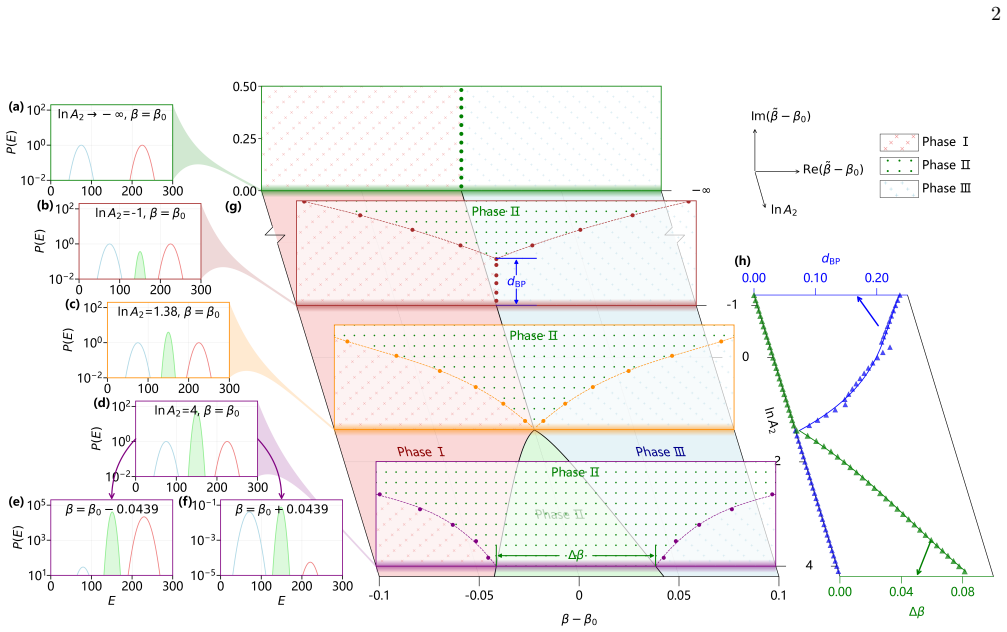
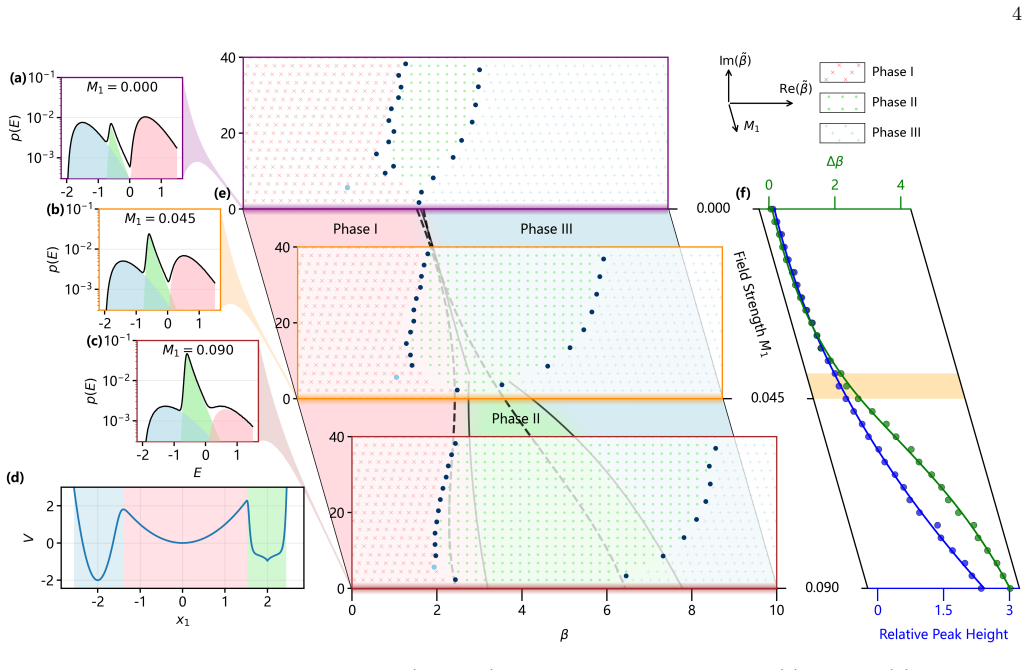
Metastable phases exist in the complex plane of thermal fields, as regions delineated by Lee-Yang zeros (LYZs). In both a toy model with a tunable density of states and a periodically driven system, increasing the artificial parameter or drive amplitude causes the LYZs that bound the metastable phase to approach the real axis and split into separated branches. This splitting signals the emergence and stabilization of the metastable phase inside the enlarged gap between two adjacent stable phases. The imaginary part of the LYZs correlates with drive strength.
What carries the argument
Lee-Yang zeros in the complex plane of thermal fields, which move and split to mark the boundaries of metastable regions.
If this is right
- As control parameters grow, Lee-Yang zeros approach the real axis and split, indicating stabilization of the metastable phase.
- The imaginary part of the zeros scales directly with drive amplitude in periodically driven systems.
- Periodic drives can be reinterpreted as complex thermal fields for phase-diagram construction.
- The same bounding mechanism supplies a practical route to mapping metastable phases that are invisible on the real axis.
Where Pith is reading between the lines
- The same zero-tracking procedure could be tested on other non-equilibrium protocols such as sudden quenches or stochastic driving.
- Experimental measurement of Lee-Yang zeros in driven systems might allow direct readout of metastable lifetimes.
- If the splitting pattern generalizes, it could guide the design of drive protocols that deliberately enlarge metastable regions.
Load-bearing premise
The numerically observed movement and splitting of Lee-Yang zeros correctly identifies the boundaries of metastable phases rather than arising as an artifact of the chosen density of states or drive protocol.
What would settle it
In the toy model, if raising the tunable parameter leaves the Lee-Yang zeros stationary or prevents them from splitting, the claim that their motion tracks metastable-phase boundaries would be falsified.
Figures
read the original abstract
Metastable phases (MPs) are energetically unfavorable states typically suppressed in equilibrium phase diagrams. Rather than remaining ''hidden'', we show that they exist in the complex plane of thermal fields, as regions delineated by Lee-Yang zeros (LYZs). We demonstrate this numerically in a toy model with a tunable density of states featuring three Gaussian peaks and in a more realistic periodically driven system. In both cases, as artificial parameters or drive amplitudes increase, the LYZs bounding the MP approach the real axis and split into separated branches, signaling the emergence and stabilization of the MP within the enlarged gap between two adjacent stable phases. In the driven system, the imaginary part of LYZs correlates with drive strength, linking Lee-Yang theory to terahertz matter manipulation. These findings provide a scheme to describe MPs in phase diagram analysis. By viewing periodic drives as complex thermal fields, it also offers a new perspective for understanding and engineering non-equilibrium collective states.
Editorial analysis
A structured set of objections, weighed in public.
Referee Report
Summary. The manuscript claims that metastable phases exist as regions in the complex plane of thermal fields, delineated by Lee-Yang zeros (LYZs). This is shown numerically in a toy model whose density of states consists of three tunable Gaussian peaks and in a periodically driven system; in both cases, increasing artificial parameters or drive amplitudes causes the LYZs that bound the metastable phase to approach the real axis and split into separated branches, signaling stabilization of the metastable phase in the gap between stable phases. In the driven case the imaginary part of the LYZs is reported to correlate with drive strength.
Significance. If the numerical correspondence between LYZ splitting and metastability generalizes beyond the specific models, the work would supply a concrete scheme for locating metastable phases within complex-field phase diagrams and would connect equilibrium Lee-Yang theory to non-equilibrium periodic driving, offering a perspective for terahertz control of collective states.
major comments (1)
- [Abstract; toy-model and driven-system numerical sections] The central claim that LYZ-bounded regions delineate metastable phases rests entirely on numerical trajectories observed in two constructions: a three-Gaussian DOS toy model and one specific periodic-drive protocol. No analytic derivation is supplied showing that LYZ splitting must occur precisely when a metastable state appears (as opposed to being an artifact of the chosen functional form of the DOS or the drive waveform). If an alternative DOS (e.g., Lorentzians of different widths) or a different drive protocol produces qualitatively different LYZ motion while preserving the underlying metastability, the proposed delineation would not be a general signature.
minor comments (1)
- [Abstract] The abstract refers to “artificial parameters or drive amplitudes” without giving their explicit functional forms or ranges, which hinders immediate reproducibility of the reported LYZ trajectories.
Simulated Author's Rebuttal
We thank the referee for the detailed reading and constructive criticism. We address the major comment below, acknowledging the numerical nature of the evidence while defending the choice of models as representative for the demonstration.
read point-by-point responses
-
Referee: [Abstract; toy-model and driven-system numerical sections] The central claim that LYZ-bounded regions delineate metastable phases rests entirely on numerical trajectories observed in two constructions: a three-Gaussian DOS toy model and one specific periodic-drive protocol. No analytic derivation is supplied showing that LYZ splitting must occur precisely when a metastable state appears (as opposed to being an artifact of the chosen functional form of the DOS or the drive waveform). If an alternative DOS (e.g., Lorentzians of different widths) or a different drive protocol produces qualitatively different LYZ motion while preserving the underlying metastability, the proposed delineation would not be a general signature.
Authors: We agree that the central claim relies on numerical observations in two specific constructions without an accompanying analytic derivation. The three-Gaussian DOS was chosen because it is a standard, analytically tractable toy model that permits independent tuning of peak positions, widths, and amplitudes to control the appearance and stabilization of a central metastable phase; the LYZ splitting is observed to occur exactly when the central peak height is increased to make that phase locally stable. The periodic-drive protocol is a concrete, experimentally relevant Floquet example. We have not examined Lorentzian DOS forms or alternative waveforms, so we cannot exclude the possibility that the LYZ motion is sensitive to these choices. In the revised manuscript we will insert explicit caveats in the abstract, the toy-model section, the driven-system section, and the conclusions stating that the reported delineation is a numerical finding within the models considered and that its status as a general signature remains to be established by future analytic work or broader numerical tests. revision: yes
- Providing an analytic derivation establishing that LYZ splitting must occur for arbitrary density-of-states forms and drive protocols whenever a metastable phase appears
Circularity Check
No circularity: numerical demonstration in specific models
full rationale
The paper's central claim is established by direct numerical simulation of LYZ trajectories in a toy model (three-Gaussian DOS) and a periodically driven system, showing LYZs approaching the real axis and splitting with increasing parameters. No equations, predictions, or uniqueness theorems are presented that reduce by construction to fitted inputs, self-citations, or ansatzes imported from prior author work. The derivation chain consists of model construction followed by observation; it does not rename known results or force outcomes via self-referential fitting. This is a standard self-contained numerical study.
Axiom & Free-Parameter Ledger
Reference graph
Works this paper leans on
-
[1]
Qi, Y.-H
T. Qi, Y.-H. Shin, K.-L. Yeh, K. A. Nelson, and A. M. Rappe, Phys. Rev. Lett.102, 247603 (2009)
2009
-
[2]
X. Li, T. Qiu, J. Zhang, E. Baldini, J. Lu, A. M. Rappe, and K. A. Nelson, Science364, 1079 (2019)
2019
-
[3]
T. F. Nova, A. S. Disa, M. Fechner, and A. Cavalleri, Science364, 1075 (2019)
2019
-
[4]
Ilyas, T
B. Ilyas, T. Luo, A. von Hoegen, E. V. Bostr¨ om, Z. Zhang, J. Park, J. Kim, J.-G. Park, K. A. Nelson, A. Rubio, and N. Gedik, Nature636, 609 (2024)
2024
-
[5]
P. G. Debenedetti,Metastable Liquids: Concepts and Principles(Princeton University Press, Princeton, NJ, 1997)
1997
-
[6]
P. G. Debenedetti and F. H. Stillinger, Nature410, 259 (2001)
2001
-
[7]
M. D. Ediger, Annu. Rev. Phys. Chem.51, 99 (2000)
2000
-
[8]
P. H. Poole, F. Sciortino, U. Essmann, and H. E. Stanley, Nature360, 324 (1992)
1992
-
[9]
Nishiyama,Martensitic transformation(Elsevier, 2012)
Z. Nishiyama,Martensitic transformation(Elsevier, 2012)
2012
-
[10]
A. B. Greninger and A. R. Troiano, JOM1, 590 (1949)
1949
-
[11]
Langer, Physica73, 61 (1974)
J. Langer, Physica73, 61 (1974)
1974
-
[12]
Non-Equilib
V.P.Skripov, J. Non-Equilib. Thermodyn.17, 193 (1992)
1992
-
[13]
Palmer, Adv
R. Palmer, Adv. Phys.31, 669 (1982)
1982
-
[14]
J. W. Cahn and J. E. Hilliard, J. Chem. Phys.28, 258 (1958)
1958
-
[15]
J. W. Cahn, Acta Metall.9, 795 (1961)
1961
-
[16]
Alert, P
R. Alert, P. Tierno, and J. Casademunt, Nat. Commun. 7, 13067 (2016)
2016
-
[17]
Sleutel, J
M. Sleutel, J. Lutsko, A. E. S. Van Driessche, M. A. Dur´ an-Olivencia, and D. Maes, Nat. Commun.5, 5598 (2014)
2014
-
[18]
J. Emo, C. Pareige, S. Saillet, C. Domain, and P. Pareige, J. Nucl. Mater.451, 361 (2014)
2014
-
[19]
P. Jund, D. Caprion, and R. Jullien, Phys. Rev. Lett. 79, 91 (1997)
1997
-
[20]
Sosso, J
G. Sosso, J. Chen, S. Cox, M. Fitzner, P. Pedevilla, A. Zen, and A. Michaelides, Chem. Rev.116, 7078 (2016)
2016
-
[21]
J.-x. Yang, H. Gould, and W. Klein, Phys. Rev. Lett. 60, 2665 (1988)
1988
-
[22]
F. P. Bundy, J. Chem. Phys.38, 631 (1963)
1963
-
[23]
K. H. Kim, K. Amann-Winkel, N. Giovambattista, A. Sp¨ ah, F. Perakis, H. Pathak, M. L. Parada, C. Yang, D. Mariedahl, T. Eklund, Thomas. J. Lane, S. You, S. Jeong, M. Weston, J. H. Lee, I. Eom, M. Kim, J. Park, S. H. Chun, P. H. Poole, and A. Nilsson, Science370, 978 (2020)
2020
-
[24]
K. Luo, B. Liu, W. Hu, X. Dong, Y. Wang, Q. Huang, Y. Gao, L. Sun, Z. Zhao, Y. Wu, Y. Zhang, M. Ma, X.-F. Zhou, J. He, D. Yu, Z. Liu, B. Xu, and Y. Tian, Nature 607, 486 (2022)
2022
-
[25]
C. N. Yang and T. D. Lee, Phys. Rev.87, 404 (1952)
1952
-
[26]
T. D. Lee and C. N. Yang, Phys. Rev.87, 410 (1952)
1952
-
[27]
Ouyang, Q.-J
X.-Y. Ouyang, Q.-J. Ye, and X.-Z. Li, Phys. Rev. E109, 024118 (2024)
2024
-
[28]
I. Bena, M. Droz, and A. Lipowski, Int. J. Mod. Phys. B19, 4269 (2005)
2005
-
[29]
Wei and R.-B
B.-B. Wei and R.-B. Liu, Phys. Rev. Lett.109, 185701 (2012)
2012
-
[30]
M. Heyl, A. Polkovnikov, and S. Kehrein, Phys. Rev. Lett.110, 135704 (2013)
2013
-
[31]
Brandner, V
K. Brandner, V. F. Maisi, J. P. Pekola, J. P. Garrahan, and C. Flindt, Phys. Rev. Lett.118, 180601 (2017)
2017
-
[32]
Ye and X.-Z
Q.-J. Ye and X.-Z. Li, Sci. China-Phys. Mech. Astron. 66, 227212 (2023)
2023
-
[33]
H. Gao, K. Wang, L. Xiao, M. Nakagawa, N. Matsumoto, D. Qu, H. Lin, M. Ueda, and P. Xue, Phys. Rev. Lett. 132, 176601 (2024)
2024
-
[34]
Gu and G
T.-Y. Gu and G. Sun, Phys. Rev. B113, 14417 (2026)
2026
-
[35]
Lee-Yang Zeros and Pseudocritical Drift in J-Q N´ eel- VBS Transitions,
C. Guo, Z. Wang, D. Wang, Z. Liu, H. Zou, and Z. Yan, “Lee-Yang Zeros and Pseudocritical Drift in J-Q N´ eel- VBS Transitions,” (2026), arXiv:2603.15116 [cond-mat]
arXiv 2026
-
[36]
Gi- ant bubbles of fisher zeros in the quantum XY chain,
S. Lv, Y. Liu, E. Zhao, H. Zou, and T. Xiang, “Gi- ant bubbles of fisher zeros in the quantum XY chain,” (2026), arXiv:2602.05899 [cond-mat]
arXiv 2026
-
[37]
Y. Liu, S. Lv, Y. Yang, and H. Zou, Chin. Phys. Lett. 40, 50502 (2023)
2023
-
[38]
Lu, S.-H
M.-C. Lu, S.-H. Shi, and G. Sun, Phys. Rev. B111, 54309 (2025)
2025
-
[39]
Y. Meng, S. Lv, Y. Liu, Z. Tan, E. Zhao, and H. Zou, Phys. Rev. Lett.135, 70402 (2025)
2025
-
[40]
X. Meng, J. Zhao, W. Zhu, and C. Wu, Phys. Lett. A 580, 131488 (2026)
2026
-
[41]
See supplemental material at http://xxx for details of the method and computational setups, as well as additional videos and discussions
-
[42]
L. Liu, Y. Dong, Q.-J. Ye, and X.-Z. Li, Phys. Rev. B 112, 104102 (2025)
2025
-
[43]
C. W. Gardiner,Handbook of Stochastic Methods: for Physics, Chemistry and the Natural Sciences, 3rd ed., Springer Series in Synergetics (Springer, 2004)
2004
-
[44]
Sekimoto, Prog
K. Sekimoto, Prog. Theor. Phys. Suppl.130, 17 (1998)
1998
discussion (0)
Sign in with ORCID, Apple, or X to comment. Anyone can read and Pith papers without signing in.