Steering Selective Formation and 2D Crystallization of [4]Radialenes on Au(111) via [1+1+1+1] Cycloaddition of Isocyanides and Enantioselective Molecular Recognition
Pith reviewed 2026-06-27 19:42 UTC · model grok-4.3
The pith
Isocyanides on Au(111) form stereospecific tetraaza[4]radialenes via [1+1+1+1] cycloaddition that then assemble into 2D homochiral crystals.
A machine-rendered reading of the paper's core claim, the machinery that carries it, and where it could break.
Core claim
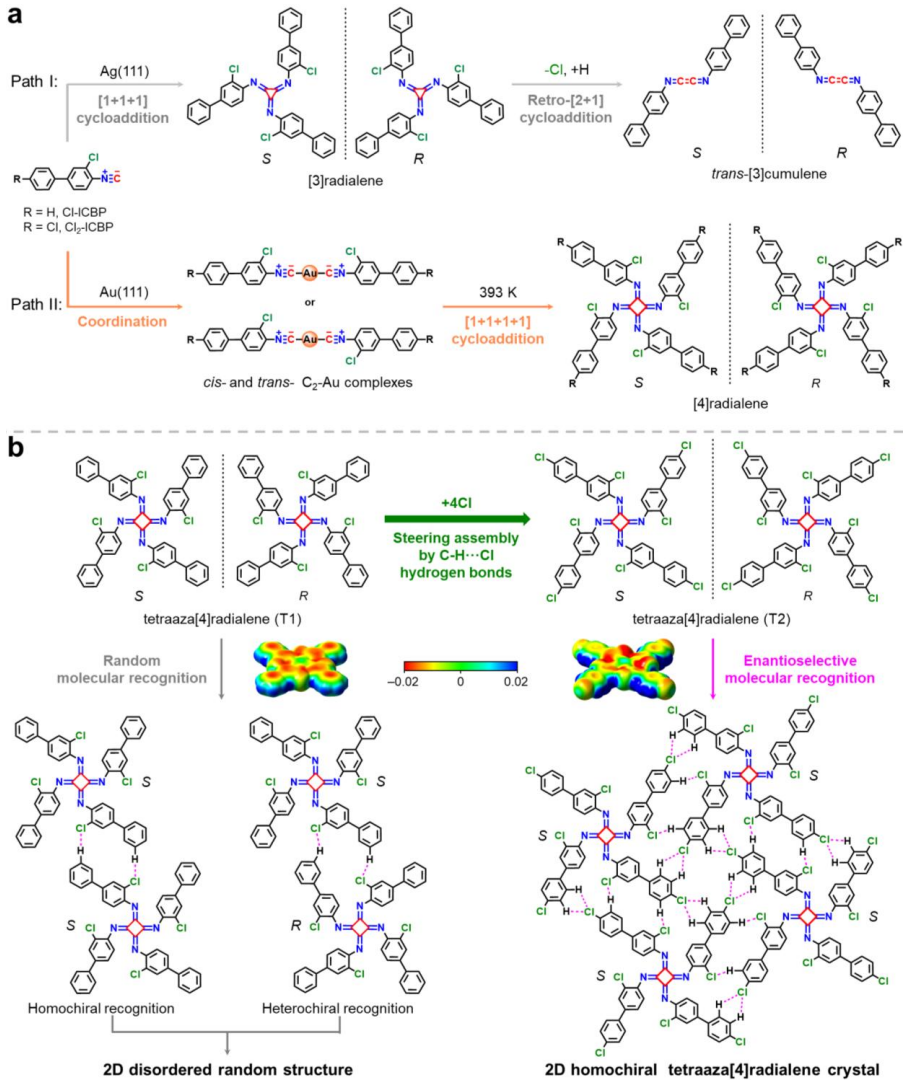
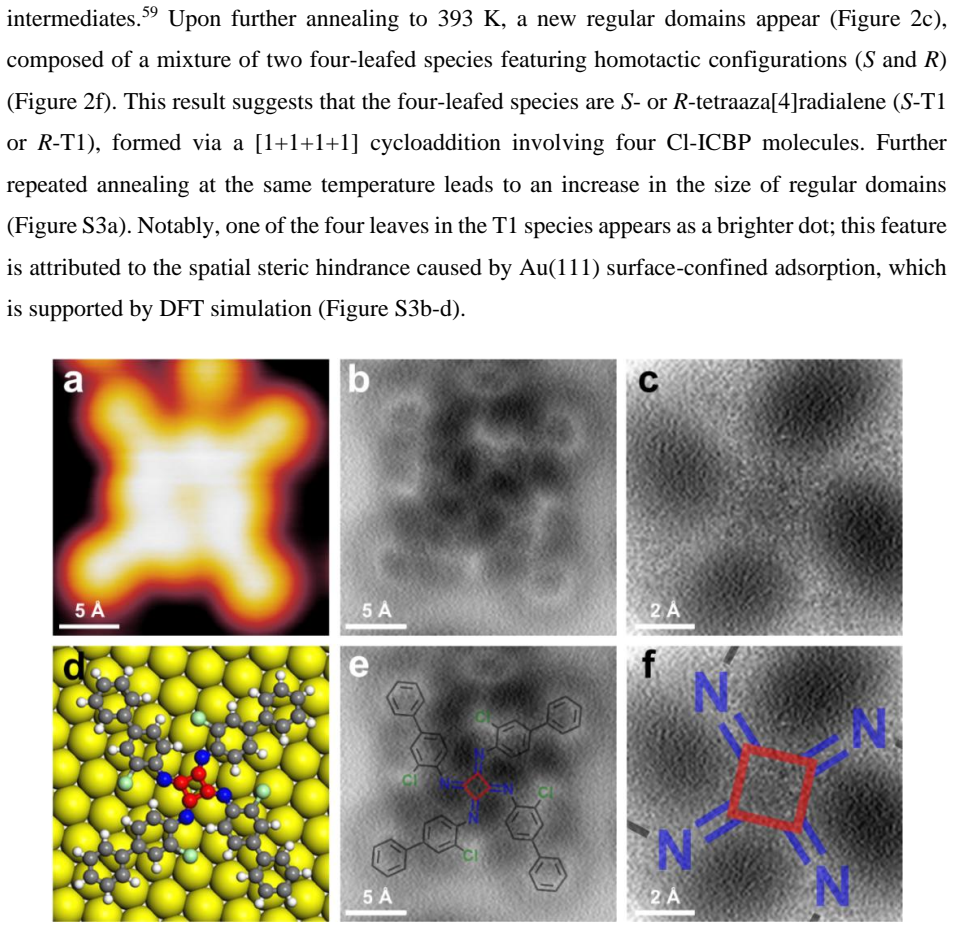
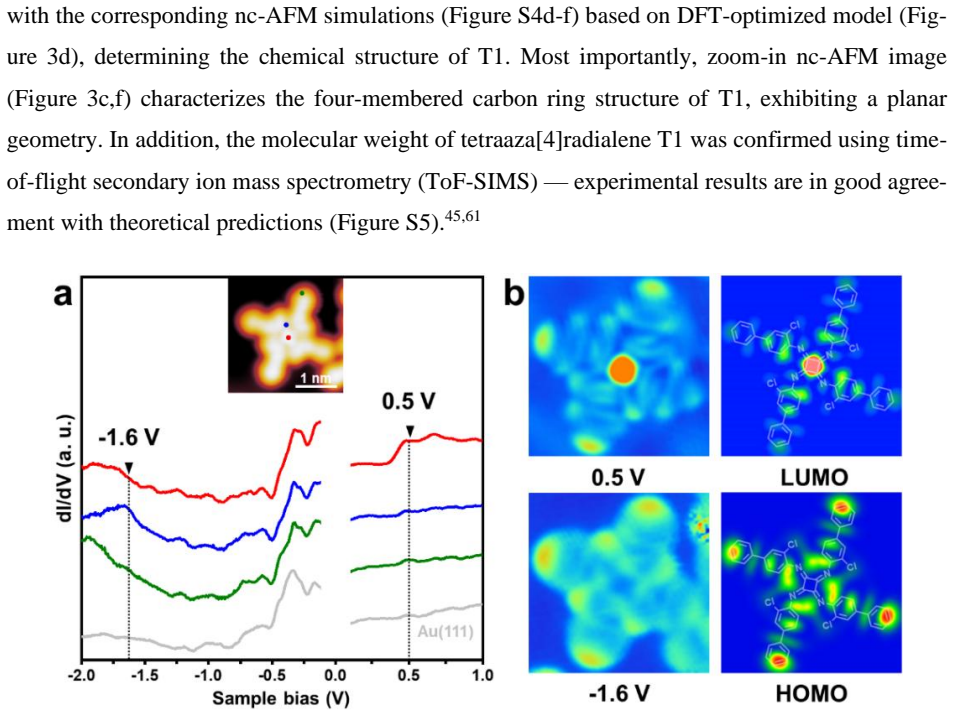
The [1+1+1+1] cycloaddition proceeds by stepwise C-C bond formation whose selectivity is enforced by spatial steric hindrance, yielding planar tetraaza[4]radialenes whose four-membered ring hosts a localized LUMO; these units then pack into homochiral 2D crystals through enantioselective C-H--Cl hydrogen bonding.
What carries the argument
The [1+1+1+1] cycloaddition of isocyanides whose selectivity arises from spatial steric hindrance, followed by enantioselective assembly via C-H--Cl hydrogen bonds.
If this is right
- The cycloaddition is highly chemoselective and produces only homotactic stereoisomers.
- The tetraaza[4]radialene adopts a planar geometry with a localized LUMO.
- The molecules form long-range ordered 2D homochiral crystals through multiple C-H--Cl interactions.
- The reaction pathway can be steered by annealing temperature from coordination complexes to covalent products.
Where Pith is reading between the lines
- The same steric-hindrance principle may extend to other isocyanide derivatives or to different metal surfaces.
- The homochiral domains could display distinct charge-transport or recognition behavior compared with racemic films.
- Changing the chlorine or hydrogen positions on the precursor could reprogram the hydrogen-bond network and therefore the crystal symmetry.
Load-bearing premise
The species imaged by STM and nc-AFM are the claimed planar tetraaza[4]radialenes with the assigned four-membered-ring connectivity rather than alternative oligomers or disordered products.
What would settle it
High-resolution nc-AFM images or STS spectra that show non-planar rings, mismatched bond lengths, or orbital densities inconsistent with the DFT-predicted localized LUMO on a four-membered ring.
Figures
read the original abstract
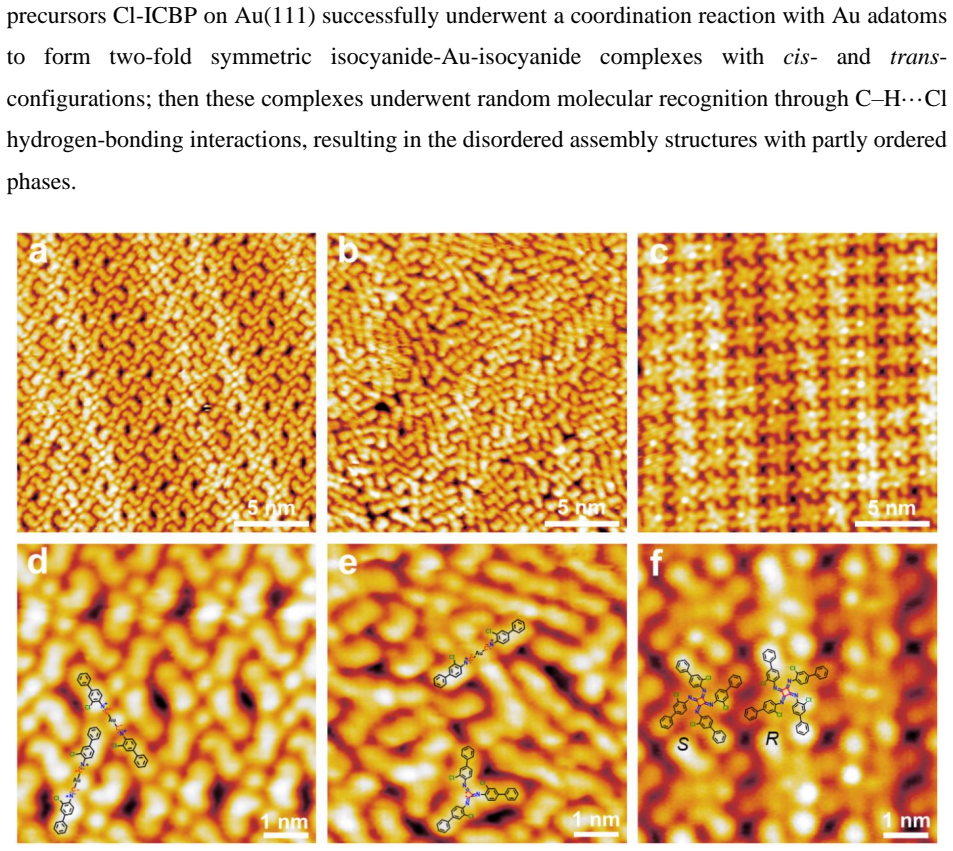
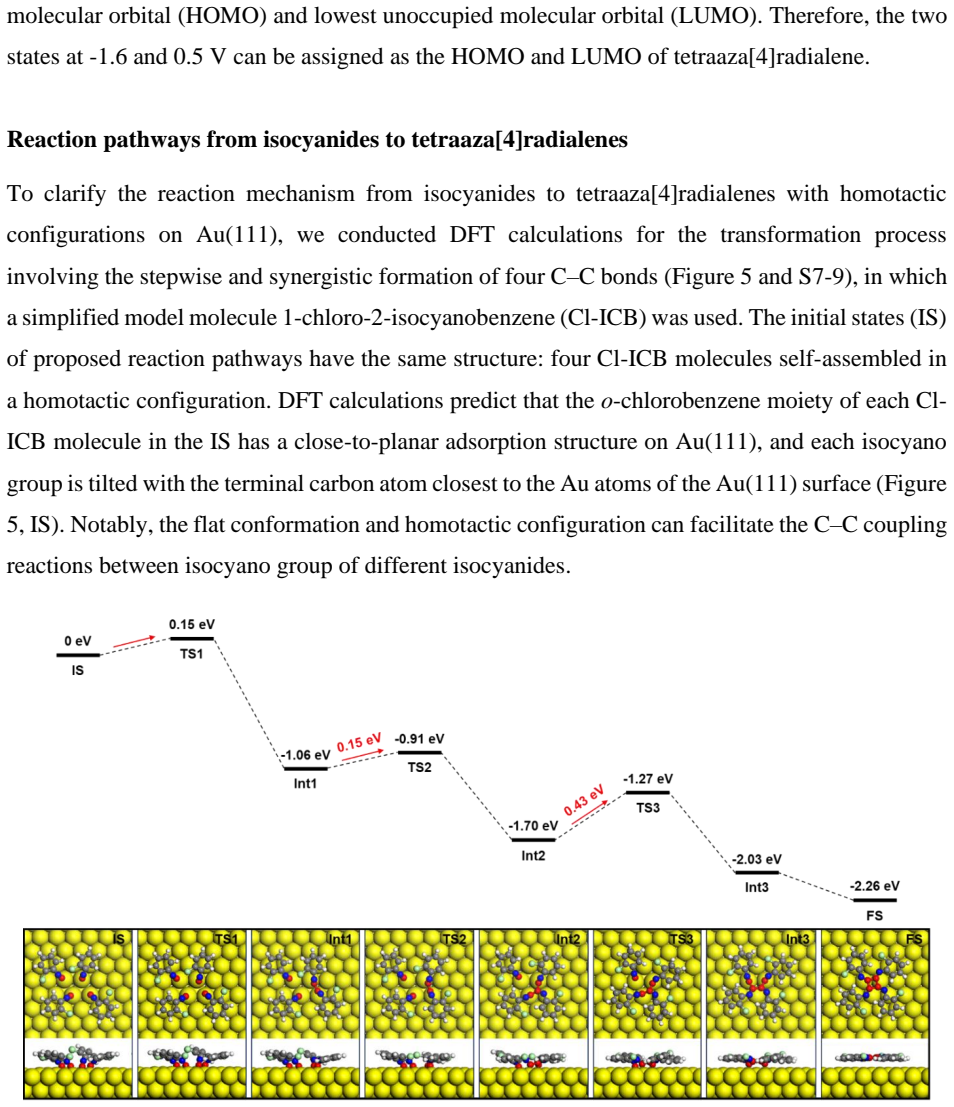
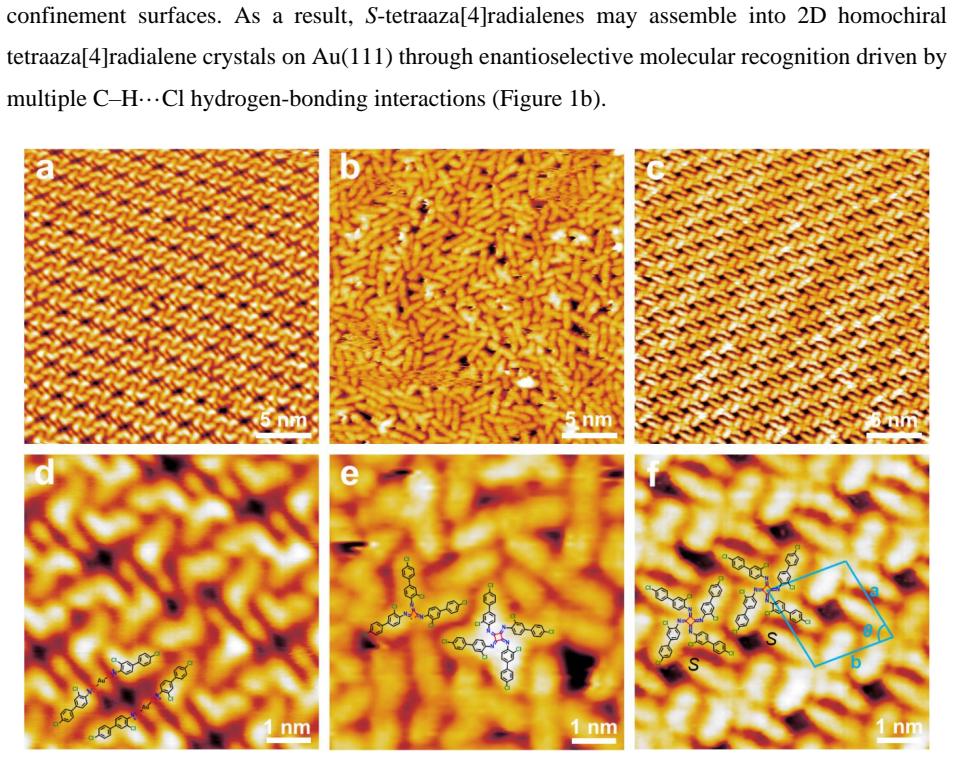
Conjugated carbon rings are fundamental skeletons of organic functional materials, and their selective formation is of paramount importance in molecular materials engineering. However, steering the formation and 2D crystallization of conjugated carbon rings on the surface with high chemo- and stereoselectivities remains a great challenge. Here, we report a highly chemoselective [1+1+1+1] cycloaddition of isocyanides on the Au(111) surface, which affords the stereospecific tetraaza[4]radialene products and further enables their long-range-ordered 2D crystallization via enantioselective molecular recognition. Using the progressive annealing method, we found that at room temperature, isocyanides undergo a coordination reaction with Au adatoms to form two-fold symmetric isocyanide-Au-isocyanide complexes. In contrast, gradually increasing the annealing temperature induces the transformation of these complexes and subsequent covalent polymerization, leading to the selective generation of tetraaza[4]radialenes with homotactic configurations. The tetraaza[4]radialenes further assemble into 2D homochiral molecular crystals through enantioselective molecular recognition driven by multiple C-H -- Cl hydrogen-bonding interactions. By combining scanning tunneling microscopy/spectroscopy and non-contact atomic force microscopy, we determined the atomic structure and molecular orbitals of tetraaza[4]radialene, confirming that its four-membered ring adopts a planar geometry with a localized lowest unoccupied molecular orbital. Density functional theory calculations suggest that the [1+1+1+1] cycloaddition process involves stepwise formation of C-C bonds and its high selectivity arises from the spatial steric hindrance. Our findings provide new insights into the selective formation of conjugated rings on surfaces and have implications for engineering 2D homochiral molecular crystallization.
Editorial analysis
A structured set of objections, weighed in public.
Referee Report
Summary. The paper claims that progressive annealing on Au(111) steers isocyanide-Au complexes into stereospecific tetraaza[4]radialenes via a chemoselective [1+1+1+1] cycloaddition; these then form 2D homochiral crystals through enantioselective C-H···Cl hydrogen bonding. Structural assignment and orbital characterization rely on STM/nc-AFM imaging matched to DFT-optimized planar geometries, with selectivity attributed to steric hindrance in the DFT section.
Significance. If the image-based assignment is correct, the work demonstrates a new on-surface route to conjugated four-membered rings with high chemo- and stereoselectivity and provides an example of surface-templated homochiral crystallization. The combination of variable-temperature annealing with high-resolution imaging is a methodological strength, but the absence of orthogonal structural data limits the result's immediate impact on the field.
major comments (2)
- [Results and Discussion (STM/nc-AFM and DFT sections)] The central claim that annealing produces covalent planar tetraaza[4]radialenes (rather than alternative oligomers or Au-coordinated species) rests exclusively on visual matching of constant-height nc-AFM images and STM orbital maps to one DFT geometry, plus a steric-hindrance argument. No XPS, vibrational spectroscopy, or other orthogonal confirmation is reported, rendering the chemoselectivity and subsequent crystallization conclusions vulnerable to misassignment.
- [Methods and Experimental Details] The manuscript provides no error analysis, statistical sampling of images, or full experimental parameters for the progressive annealing protocol and image acquisition, which are required to substantiate the transformation sequence and the claimed homotactic configuration.
minor comments (1)
- [Abstract and main text] Notation for the radialene (tetraaza[4]radialene vs. [4]radialene) should be standardized throughout the text and figures.
Simulated Author's Rebuttal
We thank the referee for the careful review and constructive feedback on our manuscript. We address each major comment below and indicate the revisions we will make.
read point-by-point responses
-
Referee: [Results and Discussion (STM/nc-AFM and DFT sections)] The central claim that annealing produces covalent planar tetraaza[4]radialenes (rather than alternative oligomers or Au-coordinated species) rests exclusively on visual matching of constant-height nc-AFM images and STM orbital maps to one DFT geometry, plus a steric-hindrance argument. No XPS, vibrational spectroscopy, or other orthogonal confirmation is reported, rendering the chemoselectivity and subsequent crystallization conclusions vulnerable to misassignment.
Authors: We acknowledge that the structural assignment is based on high-resolution STM/nc-AFM imaging combined with DFT modeling, which is a standard approach in on-surface chemistry studies. While XPS or vibrational spectroscopy could provide additional support, such techniques typically lack the molecular-scale spatial resolution needed to distinguish the tetraaza[4]radialene from closely related oligomers or Au-coordinated intermediates at the low coverages used here. The observed constant-height nc-AFM contrast and orbital maps are inconsistent with alternative structures, and the steric arguments in DFT further support selectivity. In the revised manuscript we will add explicit side-by-side comparisons of experimental images with simulated data for the most plausible alternative species to strengthen the assignment. revision: partial
-
Referee: [Methods and Experimental Details] The manuscript provides no error analysis, statistical sampling of images, or full experimental parameters for the progressive annealing protocol and image acquisition, which are required to substantiate the transformation sequence and the claimed homotactic configuration.
Authors: We agree that additional methodological details are needed. In the revised manuscript we will include full experimental parameters (temperature ramp rates, base pressures, tip conditions), error estimates on annealing temperatures, and quantitative statistical sampling (number of images, molecules counted, and observed yields) across multiple preparations to document the transformation sequence and homotactic configurations. revision: yes
Circularity Check
No circularity: experimental imaging, annealing protocol, and DFT geometry optimization are independent of the claimed outcome.
full rationale
The paper reports surface reactions observed via STM/nc-AFM under progressive annealing, with structure assignment based on direct imaging and separate DFT optimization of a candidate geometry plus steric arguments. No equations, fitted parameters, self-definitional loops, or load-bearing self-citations appear in the derivation chain; the central selectivity and crystallization claims are downstream of the experimental observations rather than presupposed by them. The image-to-structure mapping is a standard (if contestable) interpretive step, not a reduction by construction.
Axiom & Free-Parameter Ledger
Reference graph
Works this paper leans on
-
[1]
(1) Clair, S.; de Oteyza, D. G. Controlling a Chemical Coupling Reaction on a Surface: Tools and Strategies for On-Surface Synthesis. Chem. Rev. 2019, 119, 4717–4776. (2) Grill, L.; Hecht, S. Covalent On-Surface Polymerization. Nat. Chem. 2020, 12, 115–130. (3) Li, X.; Xu, Z.; Bu, D.; Cai, J.; Chen, H.; Chen, Q.; Chen, T.; Cheng, F.; Chi, L.; Dong, W.; Do...
2019
-
[2]
A.; Barison, S.; Piccinelli, S.; Baiardi, A.; Tav- ernelli, I.; Repp, J.; Albrecht, F.; Anderson, H
(18) Rončević, I.; Paschke, F.; Gao, Y .; Lieske, L.-A.; Gödde, L. A.; Barison, S.; Piccinelli, S.; Baiardi, A.; Tav- ernelli, I.; Repp, J.; Albrecht, F.; Anderson, H. L.; Gross, L. A Molecule with Half-Möbius Topology. Sci- ence 2026, 392, eaea3321. (19) Fan, Q.; Yan, L.; Tripp, M. W.; Krejčí, O.; Dimosthenous, S.; Kachel, S. R.; Chen, M.; Foster, A. S.;...
2026
-
[3]
On-surface synthesis and aromaticity of large cyclocarbons
(23) Sun, L.; Guo, Y .; Sahalianov, I.; Zhou, Z.; Zheng, W.; Xiang, W.; Guo, Y .; Feng, Y .; Valiev, R.; Kuklin, A.; Ågren, H.; Baryshnikov, G. V .; Xu, W. Tuning Aromaticity of Cyclocarbons by Heteroatom Doping: C12S and C12N. Natl. Sci. Rev. 2026, 13, nwaf472. (24) Sellies, L.; Vitek, M.; Gao, Y .; Paschke, F.; Albrecht, F.; Eckrich, J.; Dempsey, B.; Ba...
work page internal anchor Pith review Pith/arXiv arXiv doi:10.48550/arxiv.2603.02040 2026
-
[4]
P.; Wickenburg, S.; Tsai, H.-Z.; De Oteyza, D
(41) Riss, A.; Paz, A. P.; Wickenburg, S.; Tsai, H.-Z.; De Oteyza, D. G.; Bradley, A. J.; Ugeda, M. M.; Gorman, P.; Jung, H. S.; Crommie, M. F.; Rubio, A.; Fischer, F. R. Imaging Single-Molecule Reaction Intermediates Stabilized by Surface Dissipation and Entropy. Nat. Chem. 2016, 8, 678–683. (42) Shao, F.; Wang, W.; Yang, W.; Yang, Z.; Zhang, Y .; Lan, J...
2016
-
[5]
T.; Reichlmaier, S.; Hartmann, N.; Rosen, J.; Heckl, W
(43) Grossmann, L.; King, B. T.; Reichlmaier, S.; Hartmann, N.; Rosen, J.; Heckl, W. M.; Björk, J.; Lackinger, M. On-Surface Photopolymerization of Two-Dimensional Polymers Ordered on the Mesoscale. Nat. Chem. 2021, 13, 730–736. (44) Fan, Q.; Luy, J.-N.; Liebold, M.; Greulich, K.; Zugermeier, M.; Sundermeyer, J.; Tonner, R.; Gottfried, J. M. Template-Cont...
2021
-
[6]
On‐Surface Synthesis of [3]Radialenes via [1+1+1] Cycloaddition
(45) Li, D.; Wang, Y .; Hou, X.; Ren, Y .; Kang, L.; Xue, F.; Zhu, Y .; Liu, J.; Liu, M.; Shi, X.; Qiu, X.; Liu, P. On‐Surface Synthesis of [3]Radialenes via [1+1+1] Cycloaddition. Angew. Chem. Int. Ed. 2022, 61, e202117714. (46) Wang, Y .; Gong, W.-W.; Zhao, Y .; Xing, G.-Y .; Kang, L.-X.; Sha, F.; Huang, Z.-Y .; Liu, J.-W.; Han, Y .-J.; Li, P.; Li, D.-Y...
2022
-
[7]
Preparation and Properties, Reactions, and Applications of Radialenes
(58) Hopf, H.; Maas, G. Preparation and Properties, Reactions, and Applications of Radialenes. Angew. Chem. Int. Ed. Engl. 1992, 31, 931–954. (59) Liu, J.-W.; Wang, Y .; Kang, L.-X.; Zhao, Y .; Xing, G.-Y .; Huang, Z.-Y .; Zhu, Y .-C.; Li, D. -Y .; Liu, P.-N. Two-Dimensional Crystal Transition from Radialene to Cumulene on Ag(111) via Retro-[2 + 1] Cycloa...
1992
-
[8]
On-Surface Synthesis of Planar Dendrimers via Divergent Cross-Coupling Reaction
(61) Li, D.-Y .; Li, S.-W.; Xie, Y .-L.; Hua, X.; Long, Y .-T.; Wang, A.; Liu, P.-N. On-Surface Synthesis of Planar Dendrimers via Divergent Cross-Coupling Reaction. Nat. Commun. 2019, 10,
2019
-
[9]
Ab Initio Molecular Dynamics for Open-Shell Transition Metals
(62) Kresse, G.; Hafner, J. Ab Initio Molecular Dynamics for Open-Shell Transition Metals. Phys. Rev. B 1993, 48, 13115–13118. (63) Kresse, G.; Furthmüller, J. Efficient Iterative Schemes for Ab Initio Total-Energy Calculations Using a Plane-Wave Basis Set. Phys. Rev. B 1996, 54, 11169–11186. (64) Blöchl, P. E. Projector Augmented-Wave Method. Phys Rev B ...
1993
discussion (0)
Sign in with ORCID, Apple, or X to comment. Anyone can read and Pith papers without signing in.