AI-Native Closed-Loop Security for 6G-Enabled Cyber-Physical Systems: From Edge Detection to Network-Wide Mitigation
Pith reviewed 2026-06-27 19:20 UTC · model grok-4.3
The pith
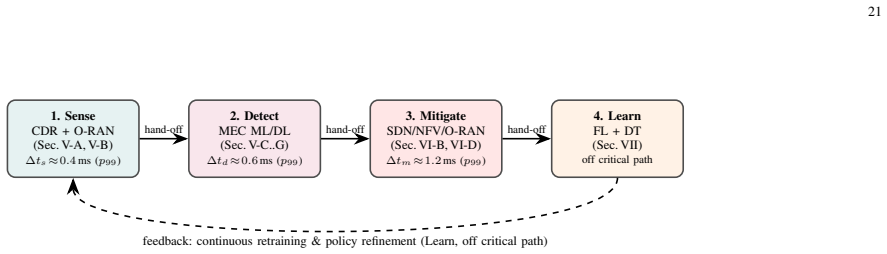
6G cyber-physical system security must operate as an AI-native closed loop that senses at the edge, decides locally, mitigates network-wide, and retrains via federated learning while meeting per-slice tail-bounded latency contracts.
A machine-rendered reading of the paper's core claim, the machinery that carries it, and where it could break.
Core claim
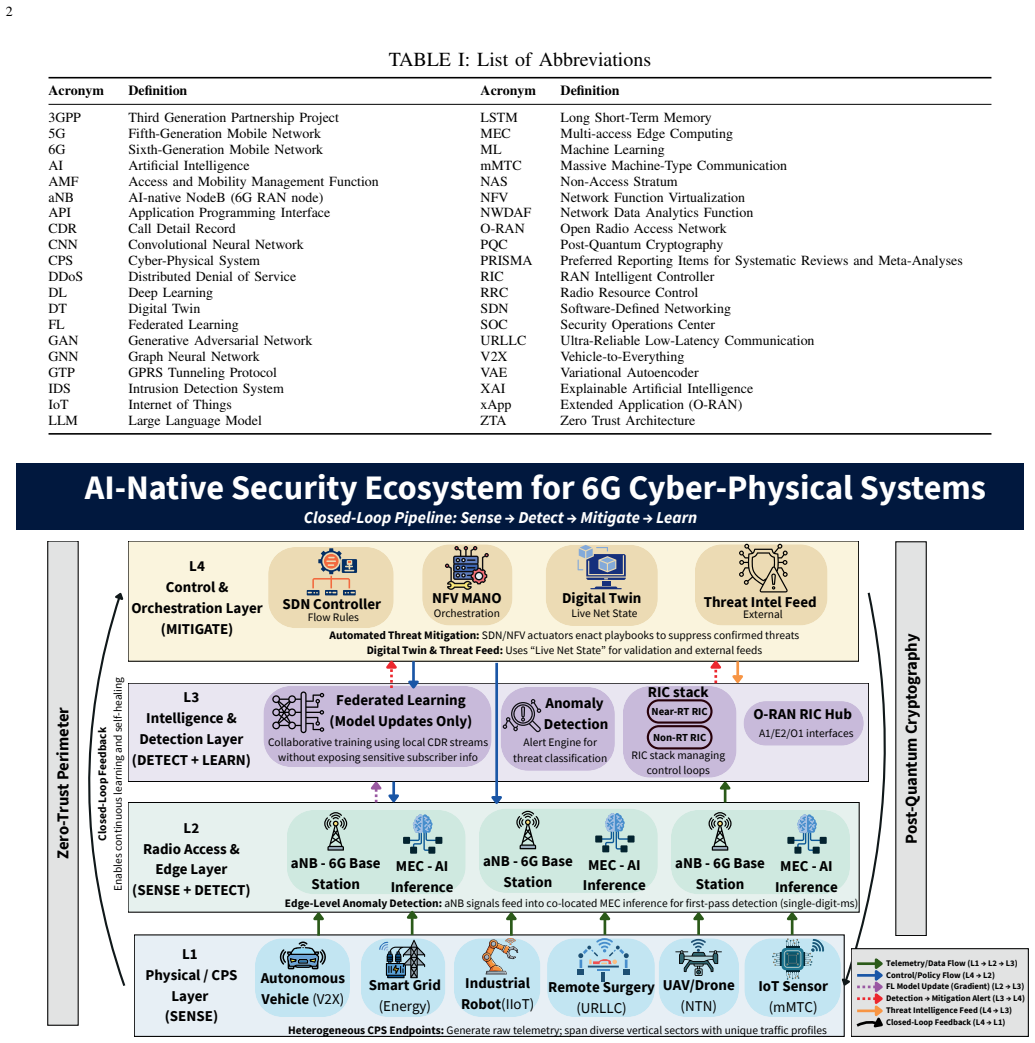
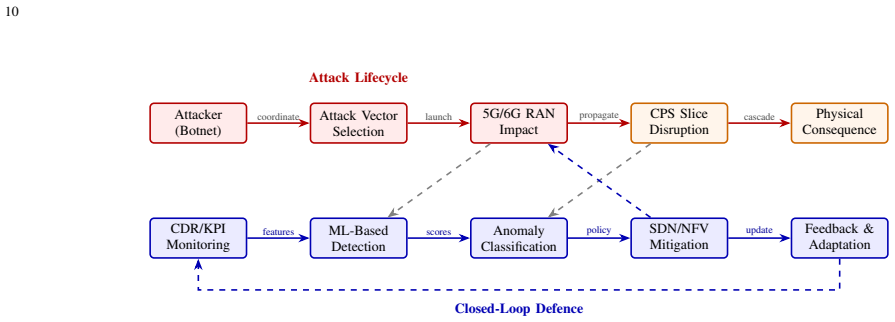
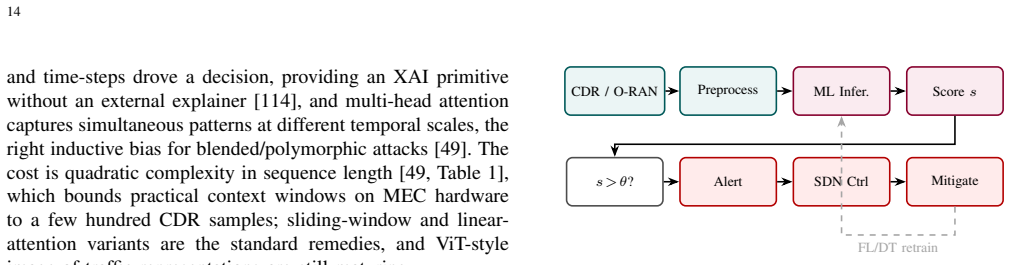
The paper claims that 6G CPS security is best understood as a single closed-loop, AI-native pipeline whose sense-detect-mitigate stages are governed by a per-slice tail-bounded latency contract, with sensing split between CDR baselines at the MEC tier and sub-millisecond O-RAN telemetry, local decisions made by compressed deep models, mitigation executed through SDN/NFV/O-RAN controllers, and continuous retraining performed by federated learning and digital-twin replay.
What carries the argument
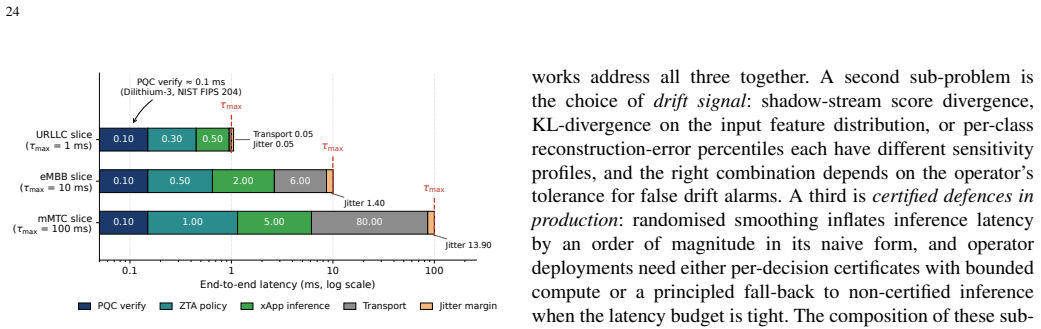
The per-slice tail-bounded latency contract on the sense-detect-mitigate stages, enforced at a slice-dependent tail percentile such as p99 for safety-critical URLLC slices.
If this is right
- Threat surfaces map to MITRE ATT&CK entries via CDR-observable feature spaces.
- Anomaly detection and DDoS classification unify across twelve datasets using statistical, graph, and transformer models.
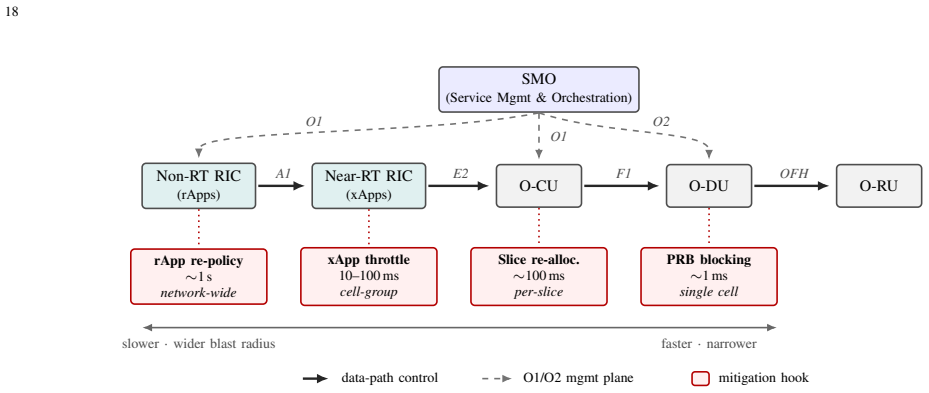
- SDN, NFV, and O-RAN primitives combine into one closed-loop reference architecture.
- FL, LLMs, DT, PQC, ZTA, and explainable AI function as cross-cutting enablers inside the same pipeline.
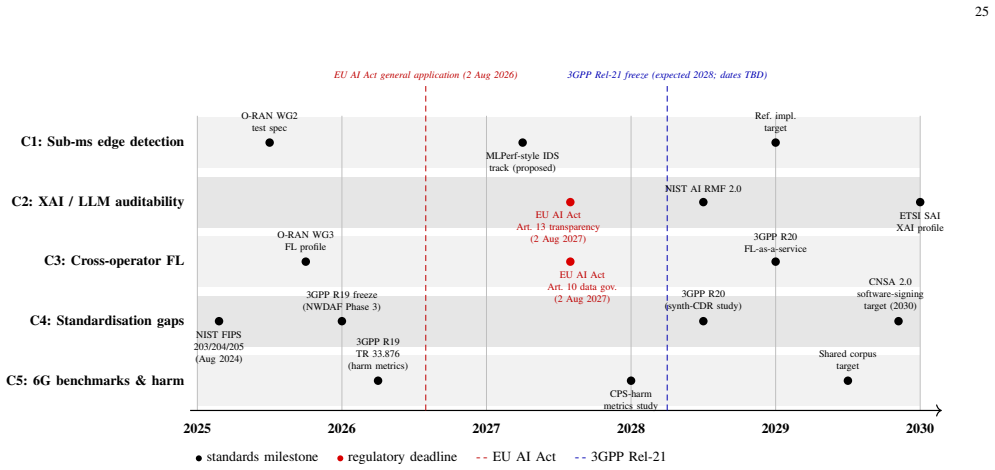
- Open problems cluster into five directions: data, latency, trust, standardization, and evaluation.
Where Pith is reading between the lines
- If the latency contract holds, security operations for physical systems must shift from centralized SOCs to edge-local decision loops.
- Real deployments would need dynamic adjustment mechanisms when slice requirements conflict.
- The approach implies that evaluation benchmarks must include tail-percentile measurements rather than average latencies.
- Integration with post-quantum cryptography would occur inside the same closed loop rather than as a separate layer.
Load-bearing premise
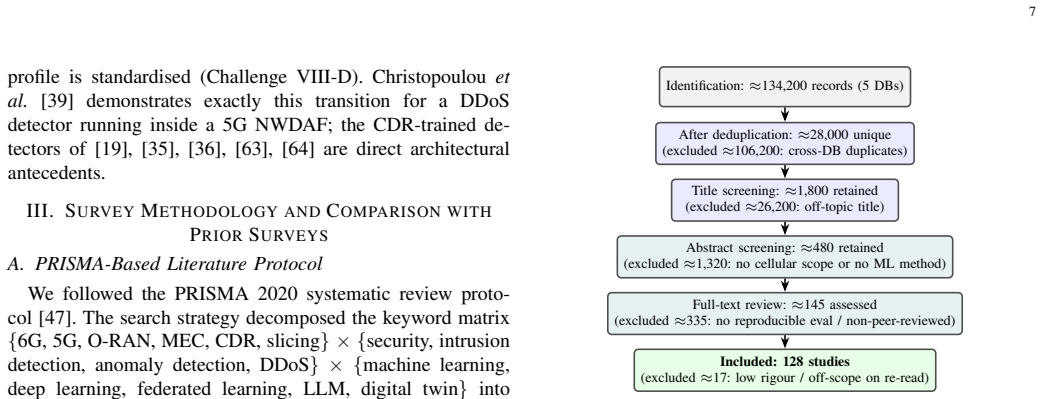
The 128 studies selected under PRISMA 2020 can be synthesized into one unified per-slice latency contract without the synthesis introducing selection bias or overlooking slice-specific requirement conflicts.
What would settle it
Empirical data from a 6G testbed showing that any safety-critical URLLC slice requires a sense-detect-mitigate tail latency incompatible with the proposed contract bounds, or a re-analysis of the 128 papers that reveals systematic conflicts between slice requirements.
Figures
read the original abstract
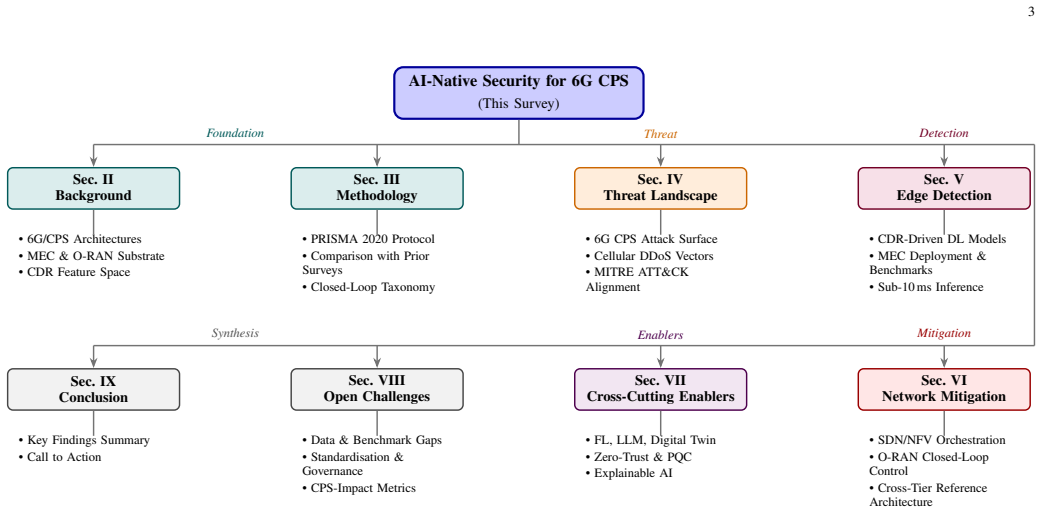
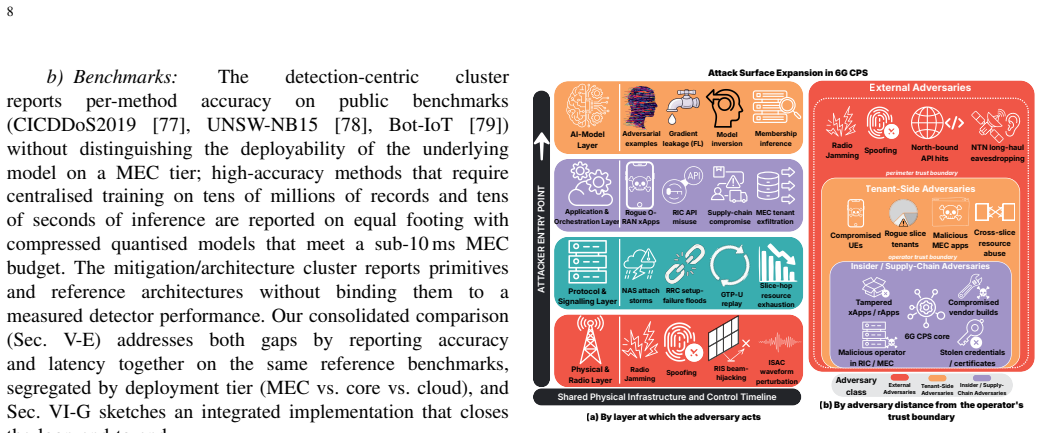
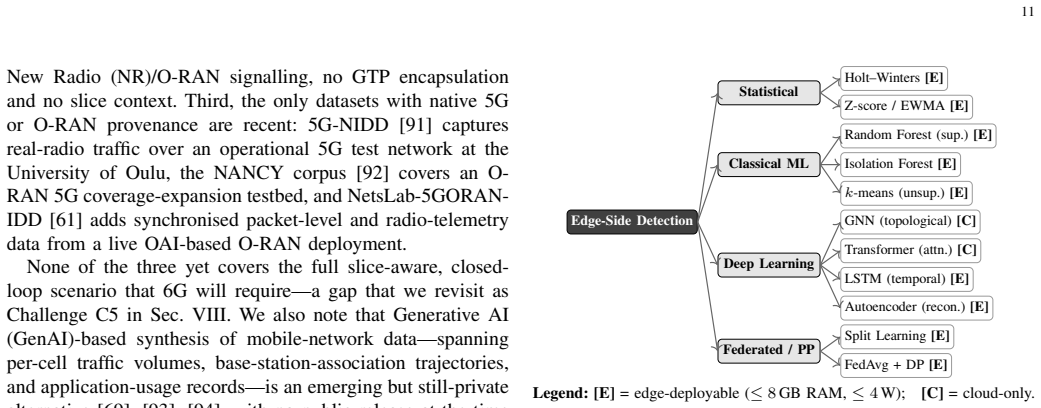
In sixth-generation (6G) networks, billions of cyber-physical systems (CPSs) - autonomous vehicles, smart grids, industrial robots, and remote-surgical equipment - will run over ultra-reliable low-latency slices, collapsing the gap between a remote breach and physical harm to milliseconds, a budget perimeter firewalls and centralised security operations centres cannot meet. This survey reframes 6G CPS security as a closed-loop, AI-native pipeline that senses at the multi-access edge computing (MEC) tier, using minute-scale call-detail records (CDRs) for baseline learning and sub-millisecond RAN/Open-RAN (O-RAN) telemetry for the latency-critical path. It decides locally with compressed deep models, mitigates network-wide via SDN, NFV, and O-RAN controllers, and retrains through federated learning (FL) and digital-twin (DT) replay. We formalise a per-slice, tail-bounded latency contract on the sense, detect, and mitigate stages, enforced at a slice-dependent tail percentile (p99 for safety-critical URLLC slices). Organising 128 peer-reviewed studies (2017-2026) under a PRISMA 2020 protocol, we (i) map the 6G/CPS threat surface to MITRE ATT&CK and a CDR-observable feature space; (ii) unify edge anomaly detection and DDoS classification across twelve datasets and statistical, graph, and transformer models; (iii) synthesise SDN/NFV/O-RAN primitives into one closed-loop reference architecture; (iv) treat FL, large language models (LLMs), DT, post-quantum cryptography (PQC), zero-trust architecture (ZTA), and explainable AI as cross-cutting enablers, not parallel pillars; and (v) consolidate open problems into five directions spanning data, latency, trust, standardisation, and evaluation.
Editorial analysis
A structured set of objections, weighed in public.
Referee Report
Summary. This survey reframes 6G CPS security as a closed-loop AI-native pipeline that senses at the MEC tier (using minute-scale CDRs for baseline and sub-millisecond RAN/O-RAN telemetry for latency-critical paths), decides locally with compressed deep models, mitigates network-wide via SDN/NFV/O-RAN controllers, and retrains via FL and DT replay. It formalizes a per-slice tail-bounded latency contract (p99 for URLLC slices) on sense-detect-mitigate stages and synthesizes 128 PRISMA 2020-selected studies (2017-2026) to (i) map threats to MITRE ATT&CK and CDR features, (ii) unify anomaly/DDoS detection across 12 datasets and model classes, (iii) synthesize a single closed-loop reference architecture, (iv) position FL/LLMs/DT/PQC/ZTA/XAI as cross-cutting enablers, and (v) consolidate open problems in five directions.
Significance. If the claimed unification holds without selection bias, the paper would provide a valuable integrative reference architecture for 6G security research, consolidating disparate threads (edge detection, O-RAN primitives, FL/DT) into a coherent per-slice latency contract that could inform standardization and future empirical work on tail-bounded security pipelines.
major comments (1)
- [Abstract] Abstract, synthesis step (iii): the central claim that 128 PRISMA-selected studies can be unified into one closed-loop reference architecture enforcing a uniform per-slice tail-bounded latency contract on sense-detect-mitigate stages is load-bearing, yet the description provides no explicit evidence that slice-specific conflicts (e.g., sub-millisecond URLLC vs. minute-scale eMBB telemetry requirements) were systematically checked or resolved; this directly matches the stress-test concern and leaves the unification vulnerable to selection bias.
Simulated Author's Rebuttal
We thank the referee for the constructive feedback and for recognizing the potential integrative value of the survey. We address the single major comment below.
read point-by-point responses
-
Referee: [Abstract] Abstract, synthesis step (iii): the central claim that 128 PRISMA-selected studies can be unified into one closed-loop reference architecture enforcing a uniform per-slice tail-bounded latency contract on sense-detect-mitigate stages is load-bearing, yet the description provides no explicit evidence that slice-specific conflicts (e.g., sub-millisecond URLLC vs. minute-scale eMBB telemetry requirements) were systematically checked or resolved; this directly matches the stress-test concern and leaves the unification vulnerable to selection bias.
Authors: The manuscript formalizes a per-slice tail-bounded latency contract that explicitly differentiates requirements (p99 for URLLC slices) and draws the reference architecture from studies spanning multiple slice types. However, we agree that the abstract and synthesis section do not provide an explicit, systematic accounting of how slice-specific conflicts were checked and resolved. To strengthen the unification claim and mitigate selection-bias concerns, we will add a dedicated subsection (in Section 4 or 5) that (i) enumerates the telemetry and mitigation conflicts across URLLC, eMBB, and mMTC slices, (ii) maps them to the 128 studies, and (iii) shows how the synthesized O-RAN/SDN/NFV primitives resolve them via slice-aware controllers. This revision will be supported by additional citations and a small table summarizing conflict-resolution mappings. revision: yes
Circularity Check
No circularity: survey synthesis rests on external PRISMA-selected studies without internal reduction
full rationale
This is a literature survey paper that organizes 128 external peer-reviewed studies under PRISMA 2020 to propose a reference architecture. No mathematical derivations, fitted parameters, or equations are present that reduce any claim to its own inputs by construction. The central unification of sense-detect-mitigate stages and per-slice latency contracts is presented as a synthesis of cited works rather than a self-definitional or self-citation load-bearing step. Self-citations, if any, are not load-bearing for the core claim. The paper is self-contained against external benchmarks and receives the default non-finding for surveys.
Axiom & Free-Parameter Ledger
axioms (1)
- domain assumption PRISMA 2020 protocol produces an unbiased and comprehensive selection of relevant studies for this topic
Reference graph
Works this paper leans on
-
[1]
On the road to 6G: Visions, requirements, key technologies, and testbeds,
C.-X. Wanget al., “On the road to 6G: Visions, requirements, key technologies, and testbeds,”IEEE Commun. Surveys Tuts., vol. 25, no. 2, pp. 905–974, 2023
2023
-
[2]
Toward 6g evolution: Three enhancements, three innovations, and three major challenges,
R. Singh, A. Kaushik, W. Shin, M. D. Renzo, V . Sciancalepore, D. Lee, H. Sasaki, A. Shojaeifard, and O. A. Dobre, “Toward 6g evolution: Three enhancements, three innovations, and three major challenges,” IEEE Netw., vol. 39, no. 6, pp. 139–147, 2025
2025
-
[3]
A vision of 6g wireless systems: Applications, trends, technologies, and open research problems,
W. Saad, M. Bennis, and M. Chen, “A vision of 6g wireless systems: Applications, trends, technologies, and open research problems,”IEEE Netw., vol. 34, no. 3, pp. 134–142, 2020
2020
-
[4]
Towards 6G wireless communication networks: Vision, enabling technologies, and new paradigm shifts,
X. Youet al., “Towards 6G wireless communication networks: Vision, enabling technologies, and new paradigm shifts,”Sci. China Inf. Sci., vol. 64, no. 1, pp. 1–74, Jan. 2021
2021
-
[5]
Cyber-physical systems security—a survey,
A. Humayed, J. Lin, F. Li, and B. Luo, “Cyber-physical systems security—a survey,”IEEE Internet Things J., vol. 4, no. 6, pp. 1802– 1831, Dec. 2017
2017
-
[6]
5G; security architecture and procedures for 5G system (3GPP TS 33.501 version 18.11.0 release 18),
ETSI, “5G; security architecture and procedures for 5G system (3GPP TS 33.501 version 18.11.0 release 18),” European Telecommunications Standards Institute (ETSI), Technical Specification ETSI TS 133 501 V18.11.0, Apr. 2026
2026
-
[7]
Security for 5g and beyond,
I. Ahmad, S. Shahabuddin, T. Kumar, J. Okwuibe, A. Gurtov, and M. Ylianttila, “Security for 5g and beyond,”IEEE Commun. Surveys Tuts., vol. 21, no. 4, pp. 3682–3722, 2019
2019
-
[8]
The roadmap to 6g security and privacy,
P. Porambage, G. G ¨ur, D. P. M. Osorio, M. Liyanage, A. Gurtov, and M. Ylianttila, “The roadmap to 6g security and privacy,”IEEE Open J. Commun. Soc., vol. 2, pp. 1094–1122, 2021. [Online]. Available: https://api.semanticscholar.org/CorpusID:235077796
2021
-
[9]
Un- derstanding O-RAN: Architecture, interfaces, algorithms, security, and research challenges,
M. Polese, L. Bonati, S. D’Oro, S. Basagni, and T. Melodia, “Un- derstanding O-RAN: Architecture, interfaces, algorithms, security, and research challenges,”IEEE Commun. Surveys Tuts., vol. 25, no. 2, pp. 1376–1411, 2023
2023
-
[10]
Intelli- gence and learning in O-RAN for data-driven NextG cellular networks,
L. Bonati, S. D’Oro, M. Polese, S. Basagni, and T. Melodia, “Intelli- gence and learning in O-RAN for data-driven NextG cellular networks,” IEEE Commun. Mag., vol. 59, no. 10, pp. 21–27, Oct. 2021
2021
-
[11]
O-RAN Architecture Description,
O-RAN ALLIANCE, “O-RAN Architecture Description,” O-RAN ALLIANCE e.V ., Alfter, Germany, Technical Specification O- RAN.WG1.TS.OAD-R005-v16.00, Feb. 2026. [Online]. Available: https://specifications.o-ran.org/download?id=1013
2026
-
[12]
Towards AI-native RAN: An operator’s perspective of 6G day 1 standardization,
N. Li, Q. Sun, L. Wang, X. Xu, J. Huang, C. Liu, J. Gao, Y . Huang, and C. I, “Towards AI-native RAN: An operator’s perspective of 6G day 1 standardization,”arXiv preprint arXiv:2507.08403, Jul. 2025, available: https://arxiv.org/abs/2507.08403
arXiv 2025
-
[13]
Cyber physical systems: Design challenges,
E. A. Lee, “Cyber physical systems: Design challenges,” inProc. 11th IEEE Int. Symp. Object/Compon./service-Oriented Real-Time Distrib. Comput. (ISORC), Orlando, FL, USA, May 2008, pp. 363–369
2008
-
[14]
Cyber-physical systems: the next computing revolution,
R. R. Rajkumar, I. Lee, L. Sha, and J. Stankovic, “Cyber-physical systems: the next computing revolution,” inProc. 47th Design Autom. Conf. (DAC), ser. DAC ’10. New York, NY , USA: Association for Computing Machinery, 2010, pp. 731–736. [Online]. Available: https://doi.org/10.1145/1837274.1837461
-
[15]
6G internet of things: A comprehensive survey,
D. C. Nguyenet al., “6G internet of things: A comprehensive survey,” IEEE Internet Things J., vol. 9, no. 1, pp. 359–383, Jan. 2022
2022
-
[16]
Edge intelligence: The confluence of edge computing and artificial intelligence,
S. Deng, H. Zhao, W. Fang, J. Yin, S. Dustdar, and A. Y . Zomaya, “Edge intelligence: The confluence of edge computing and artificial intelligence,”IEEE Internet Things J., vol. 7, no. 8, pp. 7457–7469, Aug. 2020
2020
-
[17]
Convergence of edge computing and deep learning: A comprehensive survey,
X. Wang, Y . Han, V . C. M. Leung, D. Niyato, X. Yan, and X. Chen, “Convergence of edge computing and deep learning: A comprehensive survey,”IEEE Commun. Surveys Tuts., vol. 22, no. 2, pp. 869–904, 2020
2020
-
[18]
Deep learning for cyber security intrusion detection: Approaches, datasets, and comparative study,
M. A. Ferrag, L. Maglaras, S. Moschoyiannis, and H. Janicke, “Deep learning for cyber security intrusion detection: Approaches, datasets, and comparative study,”J. Inf. Security Appl., vol. 50, no. 102419, Feb. 2020. [Online]. Available: https://www.sciencedirect.com/science/ article/pii/S2214212619305046
2020
-
[19]
Deep learning-based DDoS- attack detection for cyber–physical system over 5G network,
B. Hussain, Q. Du, B. Sun, and Z. Han, “Deep learning-based DDoS- attack detection for cyber–physical system over 5G network,”IEEE Trans. Ind. Informat., vol. 17, no. 2, pp. 860–870, Feb. 2021. 28
2021
-
[20]
A survey on distributed denial-of-service attack mitigation for 5G and beyond,
S. Hoque, A. Aydeger, E. Zeydan, and M. Liyanage, “A survey on distributed denial-of-service attack mitigation for 5G and beyond,” IEEE Open J. Commun. Soc., vol. 6, pp. 5840–5879, 2025
2025
-
[21]
Multi-access edge computing (mec); framework and reference architecture,
ETSI, “Multi-access edge computing (mec); framework and reference architecture,” European Telecommunications Standards Institute (ETSI), Tech. Rep. ETSI GS MEC 003 V4.1.1, May 2025. [Online]. Available: https://www.etsi.org/deliver/etsi gs/mec/001 099/ 003/04.01.01 60/gs mec003v040101p.pdf
2025
-
[22]
Multi-access edge computing (MEC); support for security mon- itoring and management,
ETSI, “Multi-access edge computing (MEC); support for security mon- itoring and management,” European Telecommunications Standards Institute (ETSI), ETSI Group Specification (GS) GS MEC 062 V4.1.1, Feb. 2026
2026
-
[23]
Developing software for multi-access edge comput- ing,
D. Sabellaet al., “Developing software for multi-access edge comput- ing,” European Telecommunications Standards Institute (ETSI), White Paper 20, Feb. 2019. [Online]. Available: https://www.etsi.org/images/ files/ETSIWhitePapers/etsi wp20ed2 MEC SoftwareDevelopment.pdf
2019
-
[24]
Mobile edge computing: A survey,
N. Abbas, Y . Zhang, A. Taherkordi, and T. Skeie, “Mobile edge computing: A survey,”IEEE Internet Things J., vol. 5, no. 1, pp. 450– 465, Feb. 2018
2018
-
[25]
Open, programmable, and virtualized 5G networks: State-of-the-art and the road ahead,
L. Bonati, M. Polese, S. D’Oro, S. Basagni, and T. Melodia, “Open, programmable, and virtualized 5G networks: State-of-the-art and the road ahead,”Comput. Netw., vol. 182, no. 107516, Dec. 2020
2020
-
[26]
Toward next generation open radio access networks—what O-RAN can and cannot do!
A. S. Abdalla, P. S. Upadhyaya, V . K. Shah, and V . Marojevic, “Toward next generation open radio access networks—what O-RAN can and cannot do!”IEEE Netw., vol. 36, no. 6, pp. 206–213, nov./dec. 2022
2022
-
[27]
5G- SPECTOR: An O-RAN compliant layer-3 cellular attack detection service,
H. Wen, P. Porras, V . Yegneswaran, A. Gehani, and Z. Lin, “5G- SPECTOR: An O-RAN compliant layer-3 cellular attack detection service,” inProc. Netw. Distrib. Syst. Secur. Symp. (NDSS), 2024
2024
-
[28]
Federated learning for 6G security: A survey on threats, solutions, and research directions,
C. d. Alwis, O. Aouedi, J. Xu, S. Wang, Y . Siriwardhana, T. Hewa, E. Zeydan, C. Sandeepa, and M. Liyanage, “Federated learning for 6G security: A survey on threats, solutions, and research directions,”IEEE Commun. Surveys Tuts., vol. 28, pp. 4883–4914, 2026
2026
-
[29]
IMS is not that secure on your 5G/4G phones,
J. Shiet al., “IMS is not that secure on your 5G/4G phones,” inProc. 30th Annu. Int. Conf. Mobile Computing and Networking (MobiCom), Washington, DC, USA, May 2024, pp. 513–527
2024
-
[30]
A survey on zero trust architecture: Applications and challenges of 6G networks,
N. Nahar, K. Andersson, O. Schel ´en, and S. Saguna, “A survey on zero trust architecture: Applications and challenges of 6G networks,”IEEE Access, vol. 12, pp. 93 562–93 590, 2024
2024
-
[31]
Open RAN for 6G networks: Architecture, use cases and open issues,
B. Agarwal, R. Irmer, D. Lister, and G.-M. Muntean, “Open RAN for 6G networks: Architecture, use cases and open issues,”IEEE Commun. Surveys Tuts., vol. 28, pp. 2881–2924, 2026
2026
-
[32]
XAI-guided physical adversarial machine learning attacks on automatic modulation classification,
Y . Salmi and H. Bogucka, “XAI-guided physical adversarial machine learning attacks on automatic modulation classification,”IEEE J. Sel. Areas Commun., vol. 44, pp. 4271–4286, 2026
2026
-
[33]
Mitigating signaling storms in 5G with blockchain-assisted 5GAKA,
B. Zhang, P. Zeinaty, N. Limam, and R. Boutaba, “Mitigating signaling storms in 5G with blockchain-assisted 5GAKA,” in2023 19th Inter- national Conference on Network and Service Management (CNSM), 2023, pp. 1–9
2023
-
[34]
RRC signaling storm detection in O-RAN,
D. K. Nguyen, R. E. Malki, and F. Rebecchi, “RRC signaling storm detection in O-RAN,” inProc. 2025 IEEE Symp. Comput. Commun. (ISCC), 2025
2025
-
[35]
Mobile edge computing-based data-driven deep learning framework for anomaly detection,
B. Hussain, Q. Du, S. Zhang, A. Imran, and M. A. Imran, “Mobile edge computing-based data-driven deep learning framework for anomaly detection,”IEEE Access, vol. 7, pp. 137 656–137 667, 2019
2019
-
[36]
Artificial intelligence- powered mobile edge computing-based anomaly detection in cellular networks,
B. Hussain, Q. Du, A. Imran, and M. A. Imran, “Artificial intelligence- powered mobile edge computing-based anomaly detection in cellular networks,”IEEE Trans. Ind. Informat., vol. 16, no. 8, pp. 4986–4996, Aug. 2020
2020
-
[37]
Federated learning for enhanced cyber- security and trustworthiness in 5G and 6G networks: A comprehensive survey,
A. Blika, S. Palmos, G. Doukas, V . Lamprou, S. Pelekis, M. Kontoulis, C. Ntanos, and D. Askounis, “Federated learning for enhanced cyber- security and trustworthiness in 5G and 6G networks: A comprehensive survey,”IEEE Open J. Commun. Soc., 2024
2024
-
[38]
A multi-source dataset of urban life in the city of Milan and the province of Trentino,
G. Barlacchiet al., “A multi-source dataset of urban life in the city of Milan and the province of Trentino,”Sci. Data, vol. 2, no. 150055, Oct. 2015
2015
-
[39]
User terminals as attackers: An open dataset analysis of DDoS attacks in 5G networks,
M. Christopoulouet al., “User terminals as attackers: An open dataset analysis of DDoS attacks in 5G networks,” inProc. IEEE Conf. Standards Commun. Netw. (CSCN), 2024, pp. 301–307
2024
-
[40]
LUCID: A practical, lightweight deep learn- ing solution for DDoS attack detection,
R. Doriguzzi-Corin, S. Millar, S. Scott-Hayward, J. Mart ´ınez-del Rinc´on, and D. Siracusa, “LUCID: A practical, lightweight deep learn- ing solution for DDoS attack detection,”IEEE Trans. Netw. Service Manage., vol. 17, no. 2, pp. 876–889, Jun. 2020
2020
-
[41]
An efficiency-driven anomaly detection pipeline for mobile networks,
J. M. Franco-Valiente, J. Calle-Cancho, D. Cort ´es-Polo, and J. M. Haut, “An efficiency-driven anomaly detection pipeline for mobile networks,” The Journal of Supercomputing, vol. 82, no. 5, p. 361, 2026
2026
-
[42]
Anomaly detection and mitigation in O-RAN networks using an LSTM-RNN autoencoder and secure slicing,
J. Moore, A. S. Abdalla, Z. Reshi, and V . Marojevic, “Anomaly detection and mitigation in O-RAN networks using an LSTM-RNN autoencoder and secure slicing,” in2025 IEEE Military Communica- tions Conference (MILCOM), 2025, pp. 1–6
2025
-
[43]
Cross-layer security for 5G/6G network slices: An SDN, NFV, and AI-based hybrid framework,
Z. Allaw, O. Zein, and A.-M. Ahmad, “Cross-layer security for 5G/6G network slices: An SDN, NFV, and AI-based hybrid framework,” Sensors, vol. 25, no. 11, p. 3335, 2025
2025
-
[44]
Beyond connectivity: An open architecture for AI-RAN convergence in 6G,
M. Polese, N. Mohamadi, S. D’Oro, L. Bonati, and T. Melodia, “Beyond connectivity: An open architecture for AI-RAN convergence in 6G,”IEEE Commun. Mag., pp. 1–6, 2026
2026
-
[45]
Network functions virtualisation (nfv) release 5; management and orchestration; architecture enhancement for security manage- ment specification,
ETSI, “Network functions virtualisation (nfv) release 5; management and orchestration; architecture enhancement for security manage- ment specification,” European Telecommunications Standards Institute (ETSI), Group Specification ETSI GS NFV-IFA 026 V5.4.1, Jan. 2026
2026
-
[46]
Communication-efficient learning of deep networks from decentral- ized data,
B. McMahan, E. Moore, D. Ramage, S. Hampson, and B. A. y. Arcas, “Communication-efficient learning of deep networks from decentral- ized data,” inProc. 20th Int. Conf. Artif. Intell. Statist. (AISTATS). Fort Lauderdale, FL, USA: PMLR, 2017, pp. 1273–1282
2017
-
[47]
PRISMA 2020 explanation and elaboration: Updated guidance and exemplars for reporting systematic reviews,
M. J. Page, J. E. McKenzie, P. M. Bossuytet al., “PRISMA 2020 explanation and elaboration: Updated guidance and exemplars for reporting systematic reviews,”BMJ, vol. 372, p. n160, 2021
2020
-
[48]
Deep learning,
Y . LeCun, Y . Bengio, and G. Hinton, “Deep learning,”Nature, vol. 521, pp. 436–444, May 2015
2015
-
[49]
Attention is all you need,
A. Vaswaniet al., “Attention is all you need,” inProc. 31st Conf. Neural Inf. Process. Syst. (NIPS). Long Beach, CA, USA: Curran Associates Inc., 2017, pp. 6000–6010
2017
-
[50]
A comprehensive survey on graph neural networks,
Z. Wu, S. Pan, F. Chen, G. Long, C. Zhang, and P. S. Yu, “A comprehensive survey on graph neural networks,”IEEE Trans. Neural Netw. Learn. Syst., vol. 32, no. 1, pp. 4–24, 2021
2021
-
[51]
I. H. Sarker,AI-Driven Cybersecurity and Threat Intelligence. Cham, Switzerland: Springer Nature Switzerland, 2024. [Online]. Available: https://link.springer.com/book/10.1007/978-3-031-54497-2
-
[52]
AI/ML life cycle management for interoperable AI native RAN,
C.-H. Huang, C.-K. Wen, and G. Y . Li, “AI/ML life cycle management for interoperable AI native RAN,”IEEE Commun. Standards Mag., 2025, early Access; arXiv preprint arXiv:2507.18538v2. [Online]. Available: https://arxiv.org/abs/2507.18538
arXiv 2025
-
[53]
Secure5G: A deep learning framework towards a secure network slicing in 5G and beyond,
A. Thantharate, R. Paropkari, V . Walunj, C. Beard, and P. Kankariya, “Secure5G: A deep learning framework towards a secure network slicing in 5G and beyond,” inProc. 10th Annu. Comput. Commun. Workshop Conf. (CCWC), 2020, pp. 852–857
2020
-
[54]
Intelligent reflecting surface enhanced wireless network via joint active and passive beamforming,
Q. Wu and R. Zhang, “Intelligent reflecting surface enhanced wireless network via joint active and passive beamforming,”IEEE Trans. Wireless Commun., vol. 18, no. 11, pp. 5394–5409, Nov. 2019
2019
-
[55]
RISCS: RIS-aided integrated sens- ing and communications—a cyber-physical security perspective,
S. Hassouna, M. Zubair, A. Raza, M. Ahmed, J. Kazim, M. A. Imran, and Q. H. Abbasi, “RISCS: RIS-aided integrated sens- ing and communications—a cyber-physical security perspective,” IEEE Trans. Consum. Electron., 2026, to be published, doi: 10.1109/TCE.2026.3674062
-
[56]
Integrated sensing and communications (isac); security, privacy, trustworthiness and sustainability,
ETSI, “Integrated sensing and communications (isac); security, privacy, trustworthiness and sustainability,” European Telecommunications Standards Institute (ETSI), Group Report ETSI GR ISC 004 V1.1.1, Feb. 2026. [Online]. Available: https://www.etsi.org/deliver/etsi gr/ ISC/001 099/004/01.01.01 60/gr ISC004v010101p.pdf
2026
-
[57]
A survey on network security for cyber–physical systems: From threats to resilient design,
S. Kim, K.-J. Park, and C. Lu, “A survey on network security for cyber–physical systems: From threats to resilient design,”IEEE Commun. Surv. Tutorials, vol. 24, no. 3, pp. 1534–1573, Aug. 2022
2022
-
[58]
A survey on mobile edge computing: The communication perspective,
Y . Mao, C. You, J. Zhang, K. Huang, and K. B. Letaief, “A survey on mobile edge computing: The communication perspective,”IEEE Commun. Surveys Tuts., vol. 19, no. 4, pp. 2322–2358, 2017
2017
-
[59]
Edge intelligence: Paving the last mile of artificial intelligence with edge computing,
Z. Zhou, X. Chen, E. Li, L. Zeng, K. Luo, and J. Zhang, “Edge intelligence: Paving the last mile of artificial intelligence with edge computing,”Proc. IEEE, vol. 107, no. 8, pp. 1738–1762, Aug. 2019
2019
-
[60]
Charging architecture and principles,
3GPP, “Charging architecture and principles,” 3rd Generation Partner- ship Project, Technical Specification (TS) 32.240, ver. 19.4.0, Release 19, Oct. 2025. [Online]. Available: https://www.etsi.org/deliver/etsi TS/132200 132299/132240/19.04.00 60/ts 132240v190400p.pdf
2025
-
[61]
Descriptor: 5G open radio access network multi-modal intrusion detection dataset (NetsLab-5GORAN-IDD),
F. A. Zadeh, A. Civciss, V . Ravihansa, C. Sandeepa, and M. Liyanage, “Descriptor: 5G open radio access network multi-modal intrusion detection dataset (NetsLab-5GORAN-IDD),”IEEE Data Descriptions, vol. 2, pp. 348–357, 2025
2025
-
[62]
Machine learning-driven anomaly detection for 5G O-RAN performance metrics,
B. Azkaei, K. C. Joshi, and G. Exarchakos, “Machine learning-driven anomaly detection for 5G O-RAN performance metrics,” inProc. IEEE Conf. Comput. Commun. Workshops (INFOCOM WKSHPS), May 2025, pp. 1–6
2025
-
[63]
Big data-driven anomaly detection in cellular networks,
B. Hussain, Q. Du, and P. Ren, “Big data-driven anomaly detection in cellular networks,” inProc. IEEE/CIC Int. Conf. Commun. China (ICCC), Qingdao, China, 2017, pp. 1–6. 29
2017
-
[64]
Semi-supervised learning based big data-driven anomaly detection in mobile wireless networks,
B. Hussain, Q. Du, and P. Ren, “Semi-supervised learning based big data-driven anomaly detection in mobile wireless networks,”China Communications, vol. 15, no. 4, pp. 41–57, Apr. 2018
2018
-
[65]
Deep learning-based big data- assisted anomaly detection in cellular networks,
B. Hussain, Q. Du, and P. Ren, “Deep learning-based big data- assisted anomaly detection in cellular networks,” inProc. IEEE Global Commun. Conf. (GLOBECOM), Abu Dhabi, UAE, 2018, pp. 1–6
2018
-
[66]
Call detail records driven anomaly detection and traffic prediction in mobile cellular networks,
K. Sultan, H. Ali, and Z. Zhang, “Call detail records driven anomaly detection and traffic prediction in mobile cellular networks,”IEEE Access, vol. 6, pp. 41 728–41 737, 2018
2018
-
[67]
Insight into anomaly detection and prediction and mobile network security enhancement leveraging K-means cluster- ing on call detail records,
Z. Aziz and R. Bestak, “Insight into anomaly detection and prediction and mobile network security enhancement leveraging K-means cluster- ing on call detail records,”Sensors, vol. 24, no. 6, pp. 1–18, 2024
2024
-
[68]
Modeling voice traffic patterns for anomaly detection and prediction in cellular networks based on CDR data,
Z. Aziz and R. Bestak, “Modeling voice traffic patterns for anomaly detection and prediction in cellular networks based on CDR data,”IEEE Trans. Mobile Comput., vol. 23, no. 12, pp. 13 131–13 143, Dec. 2024
2024
-
[69]
Mobile network data synthesis with generative AI: Challenges and solutions,
S. Duan, Y . Zhang, F. Lyu, C. Zhou, and X. Shen, “Mobile network data synthesis with generative AI: Challenges and solutions,”IEEE Commun. Mag., vol. 63, no. 12, pp. 172–178, 2025
2025
-
[70]
A survey on deep learning approaches for tabular data generation: Utility, alignment, fidelity, privacy, diversity, and beyond,
M. C. Stoian, E. Giunchiglia, and T. Lukasiewicz, “A survey on deep learning approaches for tabular data generation: Utility, alignment, fidelity, privacy, diversity, and beyond,”Trans. Mach. Learn. Res. (TMLR), 2026. [Online]. Available: https://openreview.net/forum?id= RoShSRQQ67
2026
-
[71]
Advancing predictive security for con- sumer applications in beyond 5G/6G networks with annotated datasets,
G. Xylouris, A. Vekraki, M. Christopoulou, M.-A. Kourtis, E. K. Markakis, and P. Trakadas, “Advancing predictive security for con- sumer applications in beyond 5G/6G networks with annotated datasets,” IEEE Transactions on Consumer Electronics, vol. 71, no. 3, pp. 1–10, May 2025
2025
-
[72]
Next-generation security in the 6G era: The role of AI in safeguarding future networks,
R. Kumar, J. Dutta, N. Vamsi, U. Sankararao Varri, and D. Puthal, “Next-generation security in the 6G era: The role of AI in safeguarding future networks,”IEEE Access, vol. 14, pp. 17 347–17 380, 2026
2026
-
[73]
Deep learning for anomaly detection: A review,
G. Pang, C. Shen, L. Cao, and A. V . D. Hengel, “Deep learning for anomaly detection: A review,”ACM Comput. Surv., vol. 54, no. 2, Mar. 2021
2021
-
[74]
A. Thakkar and R. Lohiya, “A survey on intrusion detection system: Feature selection, model, performance measures, application perspective, challenges, and future research directions,”Artif. Intell. Rev., vol. 55, no. 1, pp. 453–563, Jan. 2022. [Online]. Available: https://doi.org/10.1007/s10462-021-10037-9
-
[75]
Anomaly detection: A survey,
V . Chandola, A. Banerjee, and V . Kumar, “Anomaly detection: A survey,”ACM Comput. Surv., vol. 41, no. 3, Jul. 2009
2009
-
[76]
A survey on security and privacy of federated learning,
V . Mothukuri, R. M. Parizi, S. Pouriyeh, Y . Huang, A. Dehghantanha, and G. Srivastava, “A survey on security and privacy of federated learning,”Future Gener. Comput. Syst., vol. 115, pp. 619–640, Feb. 2021
2021
-
[77]
Devel- oping realistic distributed denial of service (DDoS) attack dataset and taxonomy,
I. Sharafaldin, A. H. Lashkari, S. Hakak, and A. A. Ghorbani, “Devel- oping realistic distributed denial of service (DDoS) attack dataset and taxonomy,” inProc. Int. Carnahan Conf. Security Technol. (ICCST), Chennai, India, 2019, pp. 1–8
2019
-
[78]
UNSW-NB15: A comprehensive data set for network intrusion detection systems (UNSW-NB15 network data set),
N. Moustafa and J. Slay, “UNSW-NB15: A comprehensive data set for network intrusion detection systems (UNSW-NB15 network data set),” inProc. Military Commun. Inf. Syst. Conf. (MilCIS), Canberra, ACT, Australia, 2015, pp. 1–6
2015
-
[79]
Towards the development of realistic botnet dataset in the Internet of Things for network forensic analytics: Bot-IoT dataset,
N. Koroniotis, N. Moustafa, E. Sitnikova, and B. Turnbull, “Towards the development of realistic botnet dataset in the Internet of Things for network forensic analytics: Bot-IoT dataset,”Future Gener. Comput. Syst., vol. 100, pp. 779–796, Nov. 2019
2019
-
[80]
Multi-layered intrusion detection and prevention in the SDN/NFV enabled cloud of 5G networks using AI-based defense mechanisms,
I. H. Abdulqadder, S. Zhou, D. Zou, I. T. Aziz, and S. M. A. Akber, “Multi-layered intrusion detection and prevention in the SDN/NFV enabled cloud of 5G networks using AI-based defense mechanisms,” Comput. Netw., vol. 179, no. 107364, Oct. 2020
2020
discussion (0)
Sign in with ORCID, Apple, or X to comment. Anyone can read and Pith papers without signing in.