Discovery of a Candidate 2 keV Cyclotron Resonance Scattering Feature in the HLX NGC 3583 X-1
Pith reviewed 2026-06-27 17:58 UTC · model grok-4.3
The pith
An absorption line at 1.97 keV in NGC 3583 X-1 is interpreted as a proton cyclotron feature from a neutron star with a magnetic field of 4 x 10^14 G.
A machine-rendered reading of the paper's core claim, the machinery that carries it, and where it could break.
Core claim
The central claim is that the combination of luminosities above 10^41 erg s^-1, a hard spectral state, and the 3.9-sigma absorption line at 1.97 keV supplies strong evidence for a highly magnetized neutron star accretor. The line width and energy yield a local field of approximately 4 x 10^14 G when interpreted as a proton CRSF; outflow or atomic-line alternatives are judged less likely. No coherent pulsations are detected, but the spectral and luminosity properties are presented as consistent with magnetized neutron-star accretion.
What carries the argument
The candidate proton cyclotron resonance scattering feature (CRSF) at 1.97 keV, whose energy directly encodes the local magnetic field strength through the proton cyclotron resonance relation.
If this is right
- The accretor is a neutron star rather than a black hole.
- The surface magnetic field reaches magnetar-range strengths.
- Hyperluminous X-ray sources can be powered by accretion onto strongly magnetized neutron stars.
- The observed spectral cutoff and variability are consistent with Comptonization in a magnetized accretion flow.
Where Pith is reading between the lines
- Similar low-energy absorption features may appear in other HLXs once observed with comparable sensitivity and broadband coverage.
- Population studies of HLXs could separate neutron-star and black-hole systems by searching for cyclotron lines below 10 keV.
- Phase-resolved or higher-resolution spectra could test whether the line energy or depth varies with pulse phase if pulsations are eventually detected.
Load-bearing premise
The 1.97 keV absorption line is a proton cyclotron resonance scattering feature produced in the neutron star's magnetic field rather than an ionized outflow or other process.
What would settle it
A higher-signal X-ray spectrum in which the line is either absent or is better fit by an absorption feature from an ionized wind with a different velocity or ionization parameter.
Figures
read the original abstract
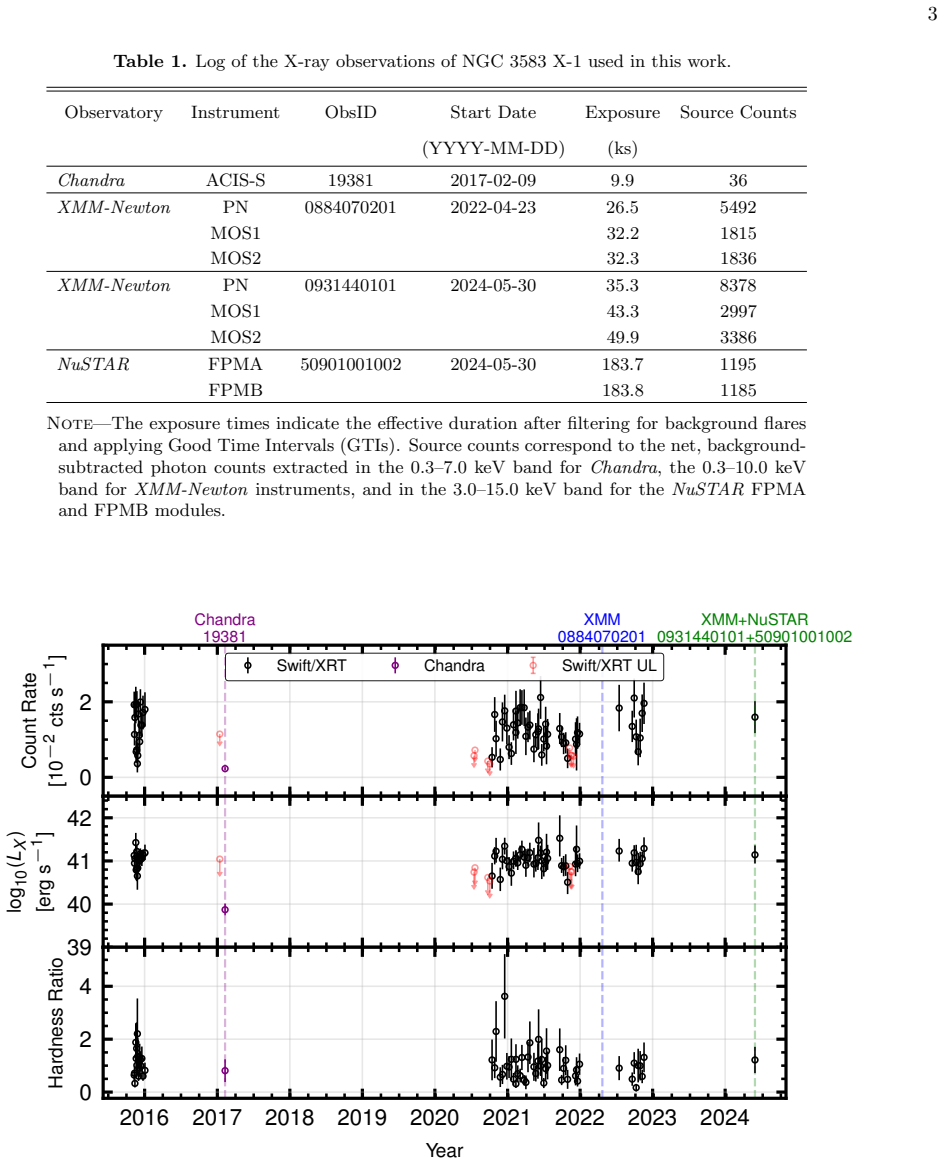
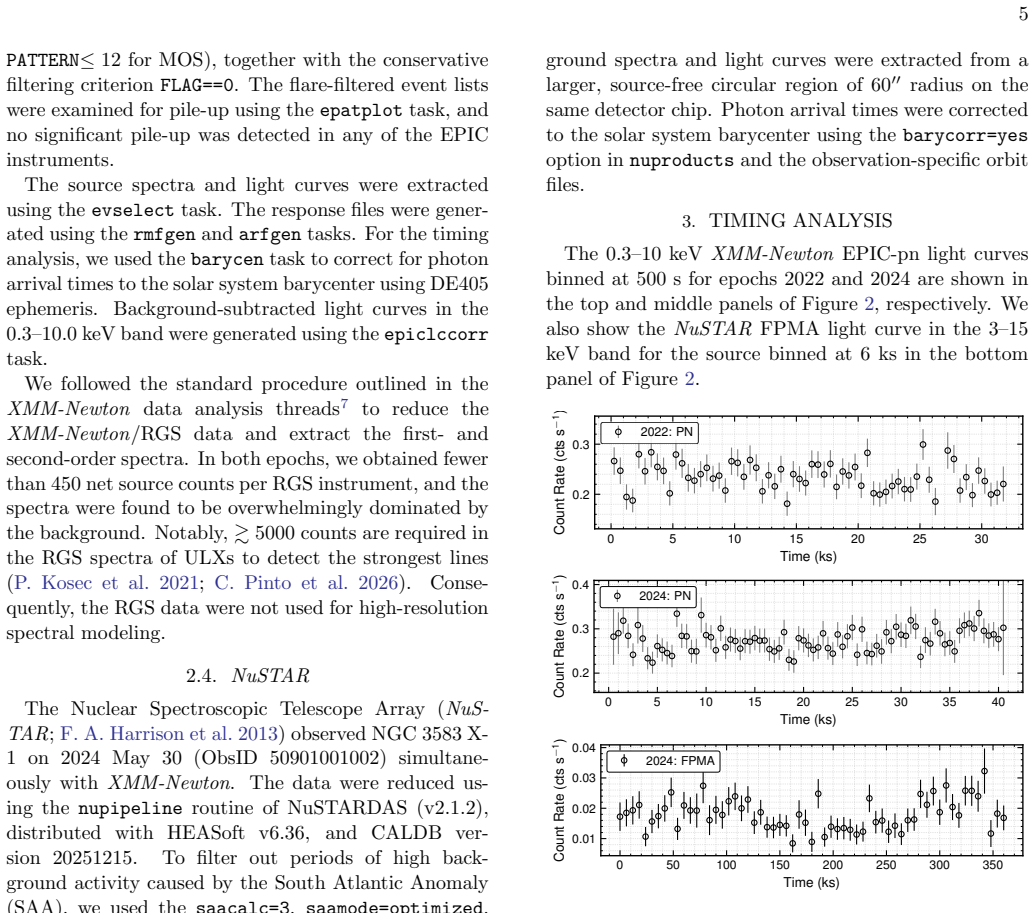
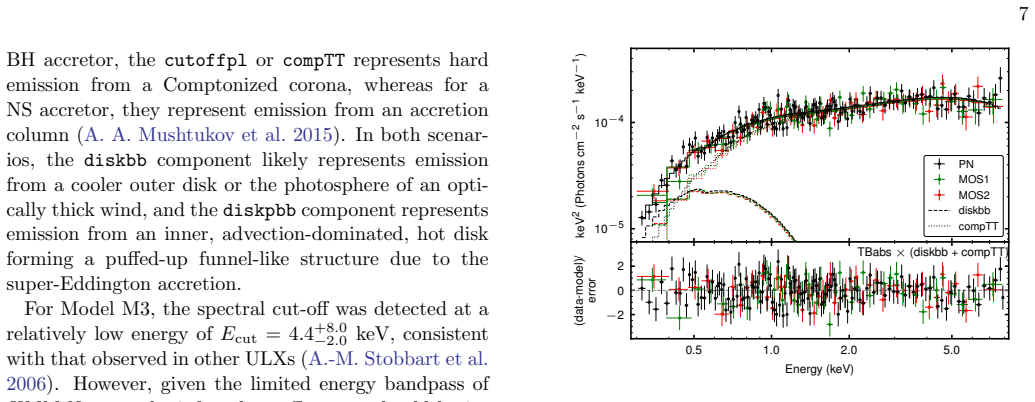
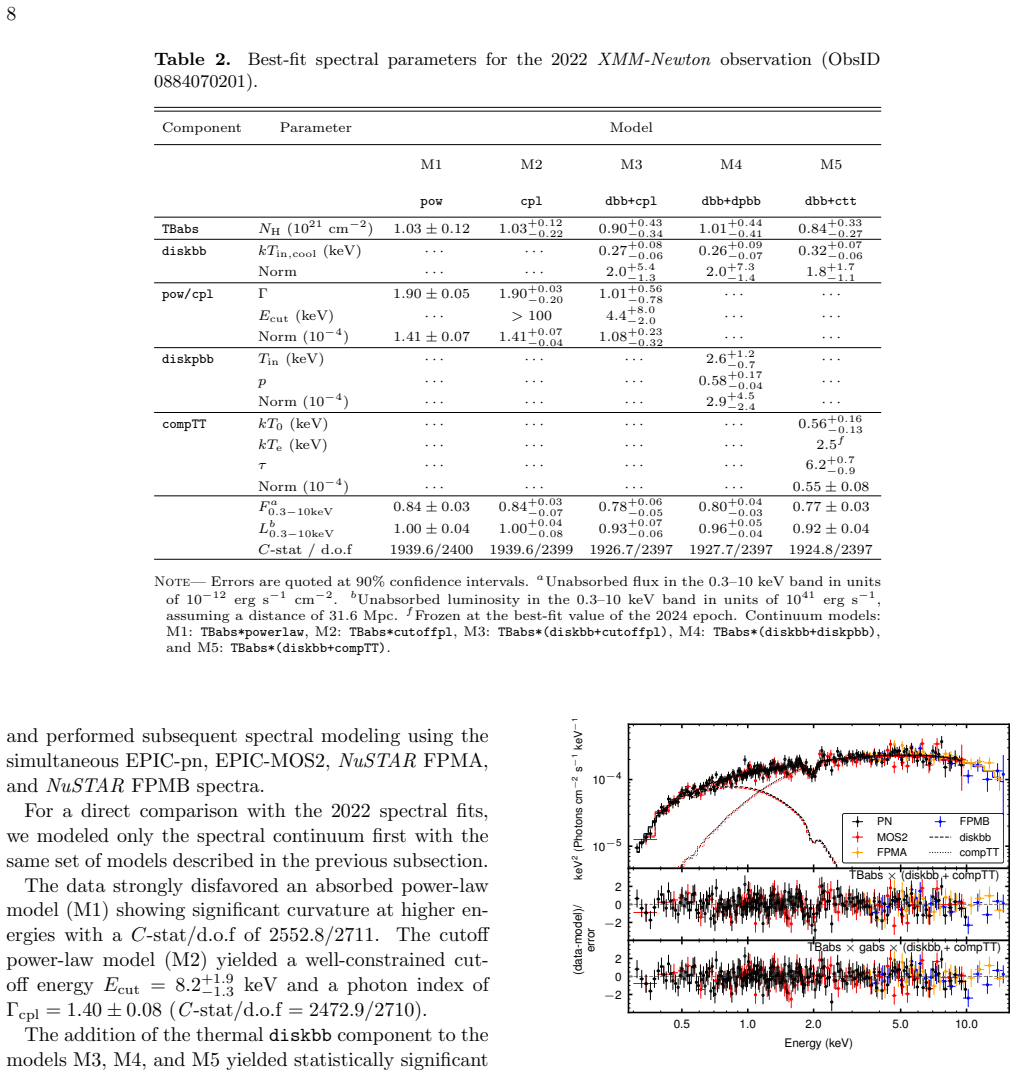
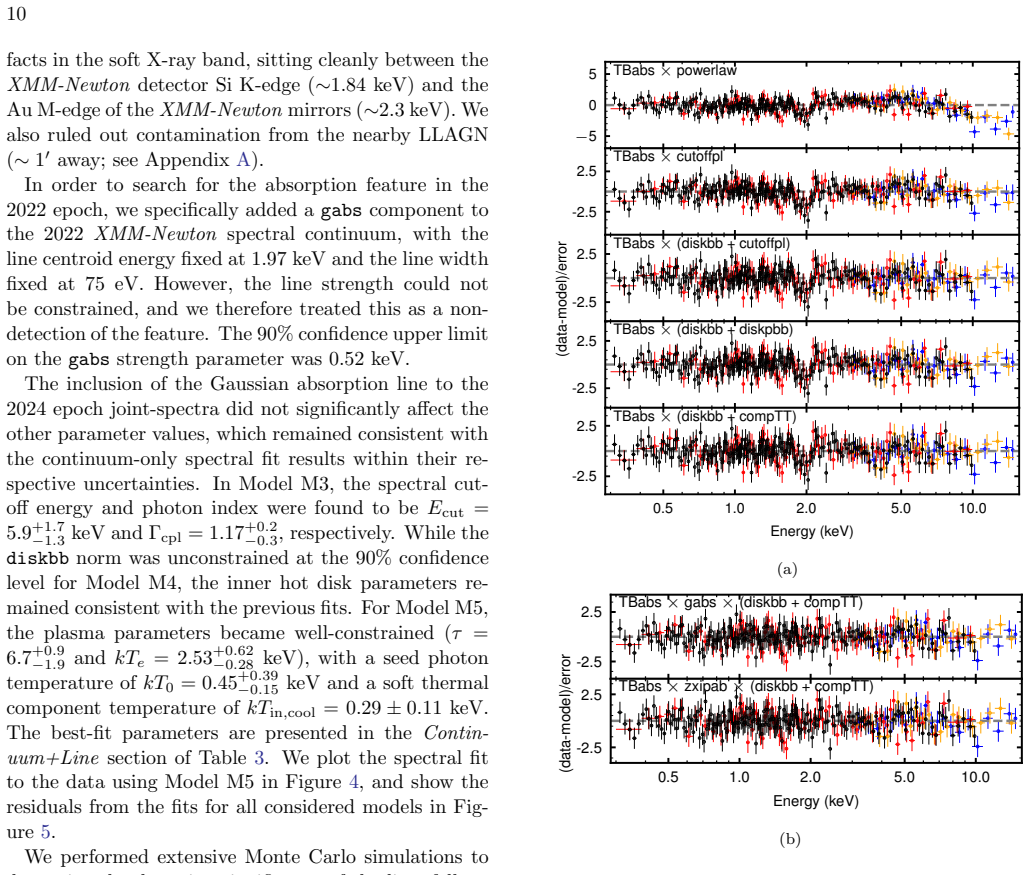
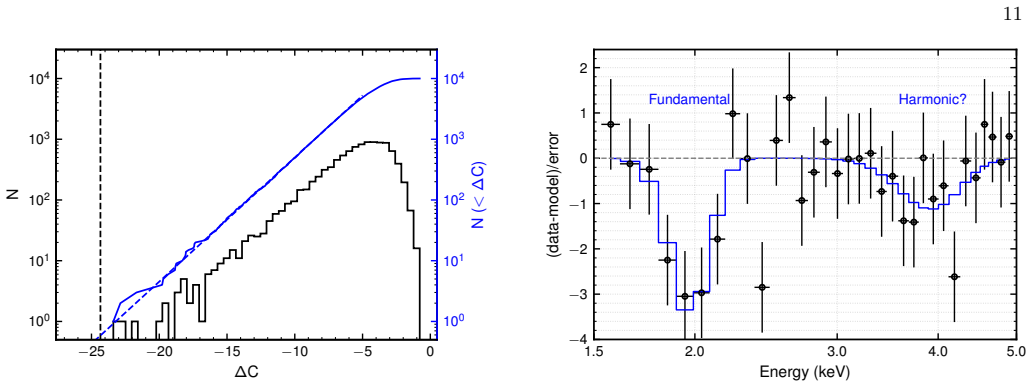
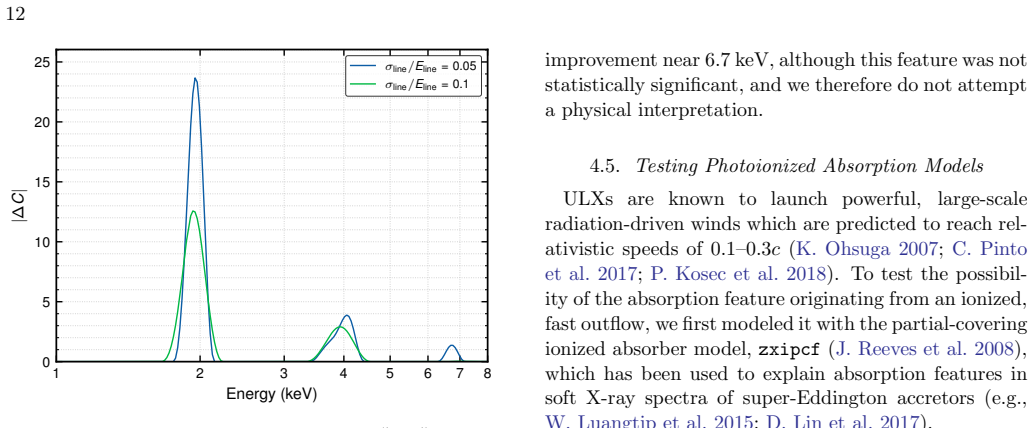
We present a broadband X-ray study of the transient hyperluminous X-ray source (HLX), 2SXPS J111416.1+481833, in the galaxy NGC 3583, using archival XMM-Newton, NuSTAR, Chandra data, and long-term Swift/XRT monitoring. The source episodically enters the hyperluminous regime with X-ray luminosities $L_X > 10^{41}$ erg s$^{-1}$ and drops by a factor of $>45$ from its peak into a deep low state. We detect a clear spectral cutoff at $\sim$5-6 keV in the broadband spectra, which are well modeled by a soft thermal component combined with optically thick thermal Comptonization or an inner advection-dominated disk. In the XMM-Newton spectra, we detect a statistically significant ($\gtrsim 3.9 \sigma$) absorption line centered at $E_{\rm line} \approx 1.97 \pm 0.04$ keV with a width of $\sigma_{\rm line} \approx 74 \pm 40$ eV. We primarily interpret the line as a candidate proton Cyclotron Resonance Scattering Feature (CRSF), implying a local magnetic field strength of $B \sim 4 \times 10^{14}$ G. Alternative interpretations, such as an origin in an ionized outflow, were explored and found to be less likely. We do not detect coherent X-ray pulsations, placing 90% confidence upper limits on the pulsed fraction of 19.3% in the 0.3-10 keV band and 36.3% in the 3-15 keV band. The combination of extreme luminosity, a hard spectral state, and the detection of a candidate cyclotron line provides strong evidence for a highly magnetized neutron star accretor.
Editorial analysis
A structured set of objections, weighed in public.
Referee Report
Summary. The manuscript reports a broadband X-ray analysis of the transient HLX 2SXPS J111416.1+481833 in NGC 3583 using archival XMM-Newton, NuSTAR, Chandra, and Swift/XRT data. The source reaches L_X > 10^41 erg s^{-1} episodically before dropping by factors >45. Spectra show a cutoff at ~5-6 keV, modeled as a soft thermal component plus optically thick Comptonization or an ADAF. An absorption line at E_line ≈ 1.97 ± 0.04 keV (width σ_line ≈ 74 ± 40 eV) is detected at ≳3.9σ in the XMM-Newton spectra and interpreted primarily as a proton CRSF implying B ~ 4×10^14 G; ionized-outflow alternatives are stated to be less likely. No coherent pulsations are detected (90% upper limits 19.3% in 0.3-10 keV and 36.3% in 3-15 keV). The combination of extreme luminosity, hard state, and candidate CRSF is presented as strong evidence for a highly magnetized neutron-star accretor.
Significance. If the line identification holds, the result would be significant for HLX/ULX studies by supplying rare direct evidence of an ultra-strong magnetic field and favoring a neutron-star accretor over a black-hole interpretation. The reported combination of hyperluminous output in a hard spectral state with a candidate proton CRSF is noteworthy and could help constrain accretion physics at extreme luminosities.
major comments (2)
- [Abstract] Abstract: the statement that 'alternative interpretations, such as an origin in an ionized outflow, were explored and found to be less likely' is load-bearing for the central NS-accretor claim yet supplies no quantitative details on (i) the exact continuum model and fit statistic improvement when the line is added, (ii) any look-elsewhere correction applied while scanning line energy, or (iii) the ionization parameter, column, or velocity values that quantitatively disfavor a wind origin. These omissions prevent independent assessment of whether the CRSF interpretation is preferred.
- [Abstract] Abstract: the reported ≳3.9σ significance of the 1.97 keV feature is presented without stating whether a trials factor for the line-energy search was included; if the search was performed over a broad energy range, the effective significance could be lower and would directly affect the weight given to the magnetar interpretation.
minor comments (2)
- [Title/Abstract] The title refers to 'NGC 3583 X-1' while the abstract uses the 2SXPS catalog name; adopt a single consistent source designation throughout.
- [Abstract] Clarify whether the quoted line width (74 ± 40 eV) is the Gaussian σ or the FWHM.
Simulated Author's Rebuttal
We thank the referee for the careful review and constructive feedback. We address each major comment below and will revise the manuscript to supply the requested quantitative details.
read point-by-point responses
-
Referee: [Abstract] Abstract: the statement that 'alternative interpretations, such as an origin in an ionized outflow, were explored and found to be less likely' is load-bearing for the central NS-accretor claim yet supplies no quantitative details on (i) the exact continuum model and fit statistic improvement when the line is added, (ii) any look-elsewhere correction applied while scanning line energy, or (iii) the ionization parameter, column, or velocity values that quantitatively disfavor a wind origin. These omissions prevent independent assessment of whether the CRSF interpretation is preferred.
Authors: We agree the abstract is concise and omits these specifics. The main text (Section 3) details the continuum models (soft thermal + Comptonization/ADAF) and reports the line detection, but we will add explicit quantitative information in the revised manuscript: fit-statistic improvements upon adding the Gaussian line, the precise energy search range and any trials correction applied, and the best-fit wind parameters (ionization, column, velocity) that were tested and disfavored relative to the CRSF model. A short reference to these results will also be incorporated into the abstract. revision: yes
-
Referee: [Abstract] Abstract: the reported ≳3.9σ significance of the 1.97 keV feature is presented without stating whether a trials factor for the line-energy search was included; if the search was performed over a broad energy range, the effective significance could be lower and would directly affect the weight given to the magnetar interpretation.
Authors: The quoted ≳3.9σ is the local significance from the spectral fit at the best-fit energy. We will revise the manuscript to state explicitly the energy range scanned for the line feature and whether a trials factor was applied. If the search was performed over a limited range around the expected CRSF energy, no correction is required; otherwise we will report the trials-corrected value or discuss its impact on the claimed significance. revision: yes
Circularity Check
No circularity: purely observational line detection and model comparison
full rationale
The paper performs archival X-ray spectral fitting on XMM-Newton, NuSTAR, Chandra, and Swift data for the HLX source. The claimed result is a statistically significant absorption feature at ~1.97 keV whose identification as a proton CRSF is presented as an interpretation after exploring (but not quantitatively detailing) outflow alternatives. No equation chain, parameter fit, or self-citation is invoked to derive the line energy, width, or magnetic-field implication from the paper's own inputs; the detection significance and model preference are reported as direct data products. The analysis is therefore self-contained against external spectral benchmarks and does not reduce any prediction to a fitted quantity by construction.
Axiom & Free-Parameter Ledger
free parameters (2)
- Line centroid energy =
1.97 keV
- Line width =
74 eV
axioms (2)
- standard math Standard proton cyclotron resonance energy-to-B conversion formula
- domain assumption The line origin is cyclotron resonance rather than outflow or other process
Reference graph
Works this paper leans on
-
[1]
2021, ApJL, 917, L31, doi: 10.3847/2041-8213/ac1859
Abarca, D., Parfrey, K., & Klu´ zniak, W. 2021, ApJL, 917, L31, doi: 10.3847/2041-8213/ac1859
-
[2]
1988, ApJ, 332, 646, doi: 10.1086/166683
Szuszkiewicz, E. 1988, ApJ, 332, 646, doi: 10.1086/166683
-
[3]
arXiv , author =:2507.14875 , journal =
Amato, R., Quintin, E., Tranin, H., et al. 2025, A&A, 701, A7, doi: 10.1051/0004-6361/202555122
-
[4]
Arnaud, K. A. 1996, in Astronomical Society of the Pacific Conference Series, Vol. 101, Astronomical Data Analysis Software and Systems V, ed. G. H. Jacoby & J. Barnes, 17
1996
-
[5]
2018, HENDRICS: High ENergy Data Reduction Interface from the Command Shell,, Astrophysics Source Code Library, record ascl:1805.019 http://ascl.net/1805.019
Bachetti, M. 2018, HENDRICS: High ENergy Data Reduction Interface from the Command Shell,, Astrophysics Source Code Library, record ascl:1805.019 http://ascl.net/1805.019
2018
-
[6]
doi:10.1038/nature13791 , eprint =
Bachetti, M., Harrison, F. A., Walton, D. J., et al. 2014, Nature, 514, 202, doi: 10.1038/nature13791
-
[7]
Baldi, R. D., Williams, D. R. A., McHardy, I. M., et al. 2018, MNRAS, 476, 3478, doi: 10.1093/mnras/sty342
-
[8]
Begelman, M. C. 2002, ApJL, 568, L97, doi: 10.1086/340457
-
[9]
arXiv , author =:2203.11955 , journal =
Brightman, M., Kosec, P., F¨ urst, F., et al. 2022, ApJ, 929, 138, doi: 10.3847/1538-4357/ac5e37
-
[10]
doi:10.1038/s41550-018-0391-6 , eprint =
Brightman, M., Harrison, F. A., F¨ urst, F., et al. 2018, Nature Astronomy, 2, 312, doi: 10.1038/s41550-018-0391-6
-
[11]
1971, PhRvD, 3, 2303, doi: 10.1103/PhysRevD.3.2303
Canuto, V., Lodenquai, J., & Ruderman, M. 1971, PhRvD, 3, 2303, doi: 10.1103/PhysRevD.3.2303
-
[12]
doi:10.1093/mnrasl/sly030 , eprint =
Carpano, S., Haberl, F., Maitra, C., & Vasilopoulos, G. 2018, MNRAS, 476, L45, doi: 10.1093/mnrasl/sly030
-
[13]
1979, ApJ, 228, 939, doi: 10.1086/156922
Cash, W. 1979, ApJ, 228, 939, doi: 10.1086/156922
-
[14]
Coburn, W., Heindl, W. A., Rothschild, R. E., et al. 2002, ApJ, 580, 394, doi: 10.1086/343033
-
[15]
Colbert, E. J. M., & Mushotzky, R. F. 1999, ApJ, 519, 89, doi: 10.1086/307356
-
[16]
Cruz-Sanchez, N., Saavedra, E. A., Fogantini, F. A., Garc´ ıa, F., & Combi, J. A. 2026a, A&A, 705, A136, doi: 10.1051/0004-6361/202556922
-
[17]
Cruz-Sanchez, N., Saavedra, E. A., Fogantini, F. A., et al. 2026b, A&A, 707, L20, doi: 10.1051/0004-6361/202658875
-
[18]
K., & Ventura, J
Daugherty, J. K., & Ventura, J. 1977, A&A, 61, 723
1977
-
[19]
2025, ApJL, 994, L38, doi: 10.3847/2041-8213/ae1c42
Ducci, L., Mereghetti, S., Pintore, F., et al. 2025, ApJL, 994, L38, doi: 10.3847/2041-8213/ae1c42
-
[20]
P., Brightman, M., Harrison, F
Earnshaw, H. P., Brightman, M., Harrison, F. A., et al. 2022, ApJ, 934, 42, doi: 10.3847/1538-4357/ac79b0
-
[21]
P., Bachetti, M., Brightman, M., et al
Earnshaw, H. P., Bachetti, M., Brightman, M., et al. 2024, ApJ, 968, 111, doi: 10.3847/1538-4357/ad43d9
-
[22]
2003, ApJ, 597, 780, doi: 10.1086/378586
Ebisawa, K., ˙Zycki, P., Kubota, A., Mizuno, T., & Watarai, K.-y. 2003, ApJ, 597, 780, doi: 10.1086/378586
-
[23]
2008, PASJ, 60, S57, doi: 10.1093/pasj/60.sp1.S57
Enoto, T., Makishima, K., Terada, Y., et al. 2008, PASJ, 60, S57, doi: 10.1093/pasj/60.sp1.S57
-
[24]
Astronomy & Astrophysics , year = 2007, volume = 469, number = 1, pages =
Evans, P. A., Beardmore, A. P., Page, K. L., et al. 2007, A&A, 469, 379, doi: 10.1051/0004-6361:20077530
-
[25]
Evans, P. A., Beardmore, A. P., Page, K. L., et al. 2009, MNRAS, 397, 1177, doi: 10.1111/j.1365-2966.2009.14913.x
-
[26]
Rodrigues, J. M. 2009, Nature, 460, 73, doi: 10.1038/nature08083
-
[27]
2011, NewAR, 55, 166, doi: 10.1016/j.newar.2011.08.002
Feng, H., & Soria, R. 2011, NewAR, 55, 166, doi: 10.1016/j.newar.2011.08.002
-
[28]
Fruscione, A., McDowell, J. C., Allen, G. E., et al. 2006, in Society of Photo-Optical Instrumentation Engineers (SPIE) Conference Series, Vol. 6270, Observatory Operations: Strategies, Processes, and Systems, ed. D. R. Silva & R. E. Doxsey, 62701V, doi: 10.1117/12.671760 F¨ urst, F., Walton, D. J., Harrison, F. A., et al. 2016, ApJL, 831, L14, doi: 10.38...
-
[29]
J., et al
Gabriel, C., Denby, M., Fyfe, D. J., et al. 2004, in Astronomical Society of the Pacific Conference Series, Vol. 314, Astronomical Data Analysis Software and Systems (ADASS) XIII, ed. F. Ochsenbein, M. G. Allen, & D. Egret, 759
2004
-
[30]
2021, MNRAS, 504, 974, doi: 10.1093/mnras/stab774
Ghosh, T., & Rana, V. 2021, MNRAS, 504, 974, doi: 10.1093/mnras/stab774
-
[31]
2023, ApJ, 949, 78, doi: 10.3847/1538-4357/acccf4
Ghosh, T., & Rana, V. 2023, ApJ, 949, 78, doi: 10.3847/1538-4357/acccf4
-
[32]
2022, ApJ, 938, 76, doi: 10.3847/1538-4357/ac8f8f
Ghosh, T., Rana, V., & Bachetti, M. 2022, ApJ, 938, 76, doi: 10.3847/1538-4357/ac8f8f
-
[33]
Ghosh, T., Sethi, S., Dewangan, G. C., et al. 2025, arXiv e-prints, arXiv:2511.10183, doi: 10.48550/arXiv.2511.10183
-
[34]
Gladstone, J. C., Roberts, T. P., & Done, C. 2009, MNRAS, 397, 1836, doi: 10.1111/j.1365-2966.2009.15123.x
-
[35]
Harding, A. K., & Daugherty, J. K. 1991, ApJ, 374, 687, doi: 10.1086/170153 19
-
[36]
Harding, A. K., & Lai, D. 2006, Reports on Progress in Physics, 69, 2631, doi: 10.1088/0034-4885/69/9/R03
-
[37]
, archivePrefix = "arXiv", eprint =
Harrison, F. A., Craig, W. W., Christensen, F. E., et al. 2013, ApJ, 770, 103, doi: 10.1088/0004-637X/770/2/103
-
[38]
Ho, W. C. G., & Lai, D. 2001, MNRAS, 327, 1081, doi: 10.1046/j.1365-8711.2001.04801.x
-
[39]
Huppenkothen, D., Bachetti, M., Stevens, A. L., et al. 2019, ApJ, 881, 39, doi: 10.3847/1538-4357/ab258d
-
[40]
Ibrahim, A. I., Safi-Harb, S., Swank, J. H., et al. 2002, ApJL, 574, L51, doi: 10.1086/342366
-
[41]
F., & Sunyaev, R
Illarionov, A. F., & Sunyaev, R. A. 1975, A&A, 39, 185
1975
-
[42]
2021, ApJ, 919, 90, doi: 10.3847/1538-4357/ac134e
Islam, N., & Mukai, K. 2021, ApJ, 919, 90, doi: 10.3847/1538-4357/ac134e
-
[43]
L., Belfiore, A., Stella, L., et al
Israel, G. L., Belfiore, A., Stella, L., et al. 2017a, Science, 355, 817, doi: 10.1126/science.aai8635
-
[44]
L., Papitto, A., Esposito, P., et al
Israel, G. L., Papitto, A., Esposito, P., et al. 2017b, MNRAS, 466, L48, doi: 10.1093/mnrasl/slw218
-
[45]
Kaaret, P., Feng, H., & Roberts, T. P. 2017, ARA&A, 55, 303, doi: 10.1146/annurev-astro-091916-055259
-
[46]
2020, MNRAS, 494, 3611, doi: 10.1093/mnras/staa930
King, A., & Lasota, J.-P. 2020, MNRAS, 494, 3611, doi: 10.1093/mnras/staa930
-
[47]
2023, NewAR, 96, 101672, doi: 10.1016/j.newar.2022.101672
King, A., Lasota, J.-P., & Middleton, M. 2023, NewAR, 96, 101672, doi: 10.1016/j.newar.2022.101672
-
[48]
King, A., & Muldrew, S. I. 2016, MNRAS, 455, 1211, doi: 10.1093/mnras/stv2347
-
[49]
2001, ApJL, 552, L109, doi: 10.1086/320343
Elvis, M. 2001, ApJL, 552, L109, doi: 10.1086/320343
-
[50]
Kobayashi, H., Ohsuga, K., Takahashi, H. R., et al. 2018, PASJ, 70, 22, doi: 10.1093/pasj/psx157 K¨ ording, E., Falcke, H., & Markoff, S. 2002, A&A, 382, L13, doi: 10.1051/0004-6361:20011776
-
[51]
Kosec, P., Pinto, C., Walton, D. J., et al. 2018, MNRAS, 479, 3978, doi: 10.1093/mnras/sty1626
-
[52]
Kosec, P., Pinto, C., Reynolds, C. S., et al. 2021, MNRAS, 508, 3569, doi: 10.1093/mnras/stab2856
-
[53]
1998, PASJ, 50, 667, doi: 10.1093/pasj/50.6.667
Kubota, A., Tanaka, Y., Makishima, K., et al. 1998, PASJ, 50, 667, doi: 10.1093/pasj/50.6.667
-
[54]
2017, Nature Astronomy, 1, 0033, doi: 10.1038/s41550-016-0033
Lin, D., Guillochon, J., Komossa, S., et al. 2017, Nature Astronomy, 1, 0033, doi: 10.1038/s41550-016-0033
-
[55]
Luangtip, W., Roberts, T. P., Mineo, S., et al. 2015, MNRAS, 446, 470, doi: 10.1093/mnras/stu2086
-
[56]
E., & Syunyaev, R
Lyubarskii, Y. E., & Syunyaev, R. A. 1988, Soviet Astronomy Letters, 14, 390
1988
-
[57]
1990, ApJL, 365, L59, doi: 10.1086/185888
Makishima, K., Mihara, T., Ishida, M., et al. 1990, ApJL, 365, L59, doi: 10.1086/185888
-
[58]
2000, ApJ, 535, 632, doi: 10.1086/308868
Makishima, K., Kubota, A., Mizuno, T., et al. 2000, ApJ, 535, 632, doi: 10.1086/308868
-
[59]
1992, High-energy radiation from magnetized neutron stars
Meszaros, P. 1992, High-energy radiation from magnetized neutron stars
1992
-
[60]
J., Brightman, M., Pintore, F., et al
Middleton, M. J., Brightman, M., Pintore, F., et al. 2019, MNRAS, 486, 2, doi: 10.1093/mnras/stz436
-
[61]
Roberts, T. P. 2015a, MNRAS, 447, 3243, doi: 10.1093/mnras/stu2644
-
[62]
Middleton, M. J., Walton, D. J., Fabian, A., et al. 2015b, MNRAS, 454, 3134, doi: 10.1093/mnras/stv2214
-
[63]
1990, Nature, 346, 250, doi: 10.1038/346250a0
Tashiro, M. 1990, Nature, 346, 250, doi: 10.1038/346250a0
-
[64]
Miller, J. M., Fabian, A. C., & Miller, M. C. 2004, ApJL, 614, L117, doi: 10.1086/425316
-
[65]
1994, ApJ, 426, 308, doi: 10.1086/174065
Fukue, J. 1994, ApJ, 426, 308, doi: 10.1086/174065
-
[66]
2019, ApJL, 883, L11, doi: 10.3847/2041-8213/ab3e4d
Molkov, S., Lutovinov, A., Tsygankov, S., Mereminskiy, I., & Mushtukov, A. 2019, ApJL, 883, L11, doi: 10.3847/2041-8213/ab3e4d
-
[67]
Nagirner, D. I., & Poutanen, J. 2021, MNRAS, 501, 2424, doi: 10.1093/mnras/staa3809
-
[68]
2017, MNRAS, 467, 1202, doi: 10.1093/mnras/stx141
Ingram, A. 2017, MNRAS, 467, 1202, doi: 10.1093/mnras/stx141
-
[69]
Poutanen, J. 2015, MNRAS, 454, 2539, doi: 10.1093/mnras/stv2087 Nasa High Energy Astrophysics Science Archive Research Center (Heasarc). 2014, HEAsoft: Unified Release of FTOOLS and XANADU,, Astrophysics Source Code Library, record ascl:1408.004 http://ascl.net/1408.004
-
[70]
2015, ApJ, 807, 164, doi: 10.1088/0004-637X/807/2/164
Nishimura, O. 2015, ApJ, 807, 164, doi: 10.1088/0004-637X/807/2/164
-
[71]
2007, ApJ, 659, 205, doi: 10.1086/512118
Ohsuga, K. 2007, ApJ, 659, 205, doi: 10.1086/512118
-
[72]
, archivePrefix = "arXiv", eprint =
Ohsuga, K., & Mineshige, S. 2011, ApJ, 736, 2, doi: 10.1088/0004-637X/736/1/2
-
[73]
2017, Astronomische Nachrichten, 338, 234, doi: 10.1002/asna.201713336
Pinto, C., Fabian, A., Middleton, M., & Walton, D. 2017, Astronomische Nachrichten, 338, 234, doi: 10.1002/asna.201713336
-
[74]
2023, Astronomische Nachrichten, 344, e20220134, doi: 10.1002/asna.20220134
Pinto, C., & Kosec, P. 2023, Astronomische Nachrichten, 344, e20220134, doi: 10.1002/asna.20220134
-
[75]
Pinto, C., Soria, R., Walton, D. J., et al. 2021, MNRAS, 505, 5058, doi: 10.1093/mnras/stab1648
-
[76]
2026, A&A, 706, A266, doi: 10.1051/0004-6361/202556631
Pinto, C., Caserta, S., Barra, F., et al. 2026, A&A, 706, A266, doi: 10.1051/0004-6361/202556631
-
[77]
2017, ApJ, 836, 113, doi: 10.3847/1538-4357/836/1/113
Pintore, F., Zampieri, L., Stella, L., et al. 2017, ApJ, 836, 113, doi: 10.3847/1538-4357/836/1/113
-
[78]
Poutanen, J., Lipunova, G., Fabrika, S., Butkevich, A. G., & Abolmasov, P. 2007, MNRAS, 377, 1187, doi: 10.1111/j.1365-2966.2007.11668.x 20
-
[79]
Ransom, S. M. 2002, in Astronomical Society of the Pacific Conference Series, Vol. 271, Neutron Stars in Supernova Remnants, ed. P. O. Slane & B. M. Gaensler, 361, doi: 10.48550/arXiv.astro-ph/0112006
work page internal anchor Pith review Pith/arXiv arXiv doi:10.48550/arxiv.astro-ph/0112006 2002
-
[80]
2008, MNRAS, 386, L82, doi: 10.1111/j.1745-3933.2008.00466.x
Reeves, J., Done, C., Pounds, K., et al. 2008, MNRAS, 385, L108, doi: 10.1111/j.1745-3933.2008.00443.x Rodr´ ıguez Castillo, G. A., Israel, G. L., Belfiore, A., et al. 2020, ApJ, 895, 60, doi: 10.3847/1538-4357/ab8a44
discussion (0)
Sign in with ORCID, Apple, or X to comment. Anyone can read and Pith papers without signing in.