Self-Gravitating Magnetic Monopoles and Dyons in String-Inspired Models: Structure and Stability
Pith reviewed 2026-06-27 18:05 UTC · model grok-4.3
The pith
Magnetic monopoles and dyons induced by global monopoles exist as stable, particle-like solutions in string-inspired gravitational models.
A machine-rendered reading of the paper's core claim, the machinery that carries it, and where it could break.
Core claim
In string-inspired models with gravity, magnetic monopoles arise from the coupling of a non-trivial massless dilaton field to the electromagnetic sector, while dyonic solutions emerge in the presence of a non-trivial Kalb-Ramond axion field and a massless dilaton coupling the KR and EM sectors. Both configurations originate from a global monopole associated with spontaneous breaking of a global O(3) symmetry. The electromagnetic sector is described by Born-Infeld electrodynamics, which ensures regularity at the core and finite self-energy. The resulting solutions are particle-like with a well-defined core and positive ADM mass, satisfy all standard energy conditions, exhibit a minimum nonzer
What carries the argument
The global monopole arising from spontaneous O(3) symmetry breaking, which induces the electromagnetic monopoles and dyons once the dilaton and Kalb-Ramond axion couplings are activated.
Load-bearing premise
The global monopole from spontaneous O(3) symmetry breaking induces the electromagnetic monopoles and dyons once the dilaton and Kalb-Ramond axion couplings are turned on.
What would settle it
A demonstration that the linear perturbation equations admit modes with imaginary frequencies in the exterior region would falsify the claimed linear stability.
Figures
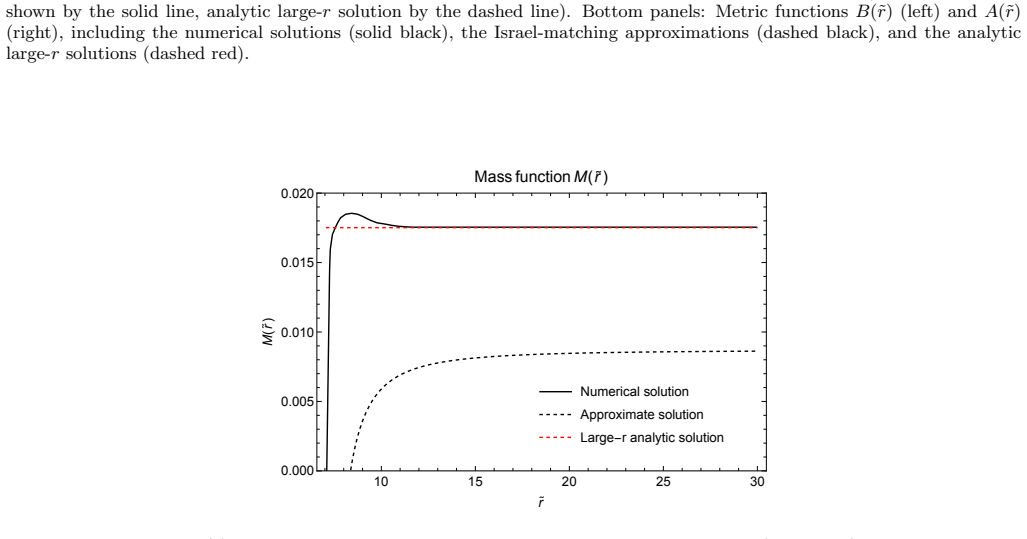
read the original abstract
We present classical solutions for magnetic monopoles and dyons induced by global monopoles for string-inspired models, in the presence of gravity. Two distinct scenarios are analyzed. In the first, magnetic monopoles arise from the coupling of a non-trivial massless dilaton field to the electromagnetic (EM) sector. In the second, dyonic solutions emerge in the presence of a non-trivial Kalb-Ramond (KR) axion field and a massless dilaton field, which couples the KR and EM sectors. In both models, the monopole and dyon configurations originate from a global monopole associated with the spontaneous breaking of a global O(3) symmetry. The EM sector is described by Born-Infeld electrodynamics, ensuring regularity of the fields at the core of the monopole and a finite self-energy. The resulting solutions represent particle-like configurations with a well-defined core and positive ADM (Arnowitt-Deser-Misner) mass, and are shown to satisfy all standard energy conditions. We also demonstrate the existence of a minimum nonzero magnetic charge in the limiting case of a magnetic monopole with vanishing mass. We also discuss stability criteria for our magnetic-monopole and dyon solutions. We first demonstrate that the mechanical-stability criteria for these solutions are satisified. These require the finiteness of the total force components and also the outward-pointing nature of the radial component, which indicates the avoidance of collapse. Next we analyse the dynamical (linear perturbative) stability of the self-gravitating Born-Infeld monopole and dyon solutions within Einstein-Born--Infeld-dilaton-axion theory in the Gervalle-Volkov framework, and demonstrate that both monopole and dyonic configurations are linearly stable against electromagnetic perturbations in the exterior region, with dyons exhibiting a birefringent helicity structure due to axion-induced mixing.
Editorial analysis
A structured set of objections, weighed in public.
Referee Report
Summary. The paper constructs classical solutions for self-gravitating magnetic monopoles (via dilaton-EM coupling) and dyons (via dilaton-KR axion-EM coupling) in Einstein-Born-Infeld theory, induced by a global O(3) monopole from spontaneous symmetry breaking. It claims these yield particle-like configurations with finite core, positive ADM mass, satisfaction of all standard energy conditions, a nonzero minimum magnetic charge in the massless limit, mechanical stability (finite outward radial force), and linear stability against EM perturbations in the exterior (with birefringent helicity for dyons due to axion mixing).
Significance. If the solutions are obtained from the fully coupled Euler-Lagrange equations of the string-inspired model (including backreaction on the global monopole sector) and the stability analysis is complete, the work would supply concrete examples of regular, stable monopoles/dyons with nonlinear electrodynamics and axion/dilaton couplings, potentially relevant for understanding non-perturbative objects in low-energy string theory.
major comments (2)
- [Abstract] Abstract and the description of the two scenarios: the statement that 'the monopole and dyon configurations originate from a global monopole associated with the spontaneous breaking of a global O(3) symmetry' and that 'the field equations are solved' leaves unclear whether the O(3) scalar triplet is treated as a fixed hedgehog background (no backreaction from dilaton, KR axion, or BI sector) or solved dynamically as part of the complete system. This distinction is load-bearing for the central claim that the configurations are self-consistent solutions of the string-inspired model with positive ADM mass and energy-condition compliance.
- [Abstract (stability discussion)] The mechanical-stability and linear-stability claims rest on the solutions satisfying the full set of field equations; if the O(3) sector is not dynamical, the force-balance and perturbation analysis cannot be taken as evidence for stability within the model under consideration.
minor comments (1)
- [Abstract] The abstract contains repetitive phrasing ('We also demonstrate... We also discuss...') that could be streamlined for clarity.
Simulated Author's Rebuttal
We thank the referee for the careful reading of our manuscript and for the constructive comments. We address the concerns regarding potential ambiguity in the treatment of the O(3) scalar triplet and the implications for stability below. We believe the solutions are obtained from the fully coupled system, but agree that the abstract requires clarification for precision.
read point-by-point responses
-
Referee: [Abstract] Abstract and the description of the two scenarios: the statement that 'the monopole and dyon configurations originate from a global monopole associated with the spontaneous breaking of a global O(3) symmetry' and that 'the field equations are solved' leaves unclear whether the O(3) scalar triplet is treated as a fixed hedgehog background (no backreaction from dilaton, KR axion, or BI sector) or solved dynamically as part of the complete system. This distinction is load-bearing for the central claim that the configurations are self-consistent solutions of the string-inspired model with positive ADM mass and energy-condition compliance.
Authors: We agree that the abstract phrasing could be interpreted ambiguously. In the manuscript, the O(3) scalar triplet is treated dynamically: the full set of Euler-Lagrange equations for the Einstein-Born-Infeld-dilaton-axion system (including the global monopole sector) are solved numerically with backreaction from the dilaton, KR axion, and BI fields included. The resulting configurations are therefore self-consistent solutions of the complete model, yielding positive ADM mass and compliance with energy conditions. We will revise the abstract to state explicitly that the O(3) sector is solved as part of the coupled system. revision: yes
-
Referee: [Abstract (stability discussion)] The mechanical-stability and linear-stability claims rest on the solutions satisfying the full set of field equations; if the O(3) sector is not dynamical, the force-balance and perturbation analysis cannot be taken as evidence for stability within the model under consideration.
Authors: Because the O(3) scalar triplet is dynamical and the solutions satisfy the complete coupled field equations (as clarified above), the mechanical stability criteria (finite total force with outward radial component) and the linear perturbative stability analysis in the Gervalle-Volkov framework are performed within the full model. The birefringent helicity for dyons arises from axion mixing in the exterior region. We will update the abstract's stability discussion to reference the dynamical treatment of all sectors. revision: yes
Circularity Check
No significant circularity; results are outputs of field-equation solutions
full rationale
The derivation proceeds by solving the coupled Einstein-Born-Infeld-dilaton-axion equations in two scenarios, with the global O(3) monopole providing the inducing background. ADM mass, energy conditions, minimum charge, and linear stability (via Gervalle-Volkov) are computed outputs, not inputs by construction. No self-definitional reduction, no fitted parameter renamed as prediction, and no load-bearing self-citation chain that collapses the central claim. The induction step is an explicit modeling choice stated in the abstract, not a hidden tautology. This is the normal non-circular case for a numerical/analytic solution paper.
Axiom & Free-Parameter Ledger
free parameters (1)
- magnetic charge parameter
axioms (2)
- domain assumption Spontaneous breaking of global O(3) symmetry produces a global monopole that sources the electromagnetic fields once dilaton and axion couplings are present.
- domain assumption Born-Infeld electrodynamics renders the core fields regular and the self-energy finite.
Reference graph
Works this paper leans on
-
[1]
III, we check whether they satisfy standard energy conditions
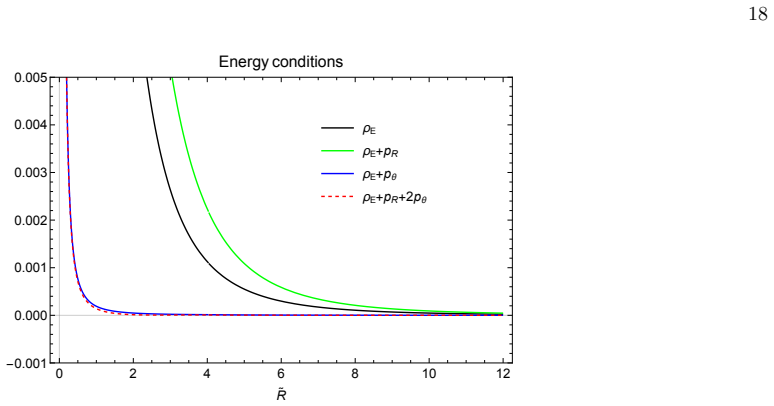
Energy conditions and mechanical stability for Magnetic Monopoles To examine the physical consistency of the magnetic monopole solutions obtained in Sec. III, we check whether they satisfy standard energy conditions. In Fig. 6, the quantitiesρ E,ρ E +p R,ρ E +p θ, andρ E +p R + 2pθ are plotted as functions of the dimensionless radius ˜R, using the numeric...
-
[2]
We give explicit expressions for the energy–momentum components, verify the standard energy conditions, and check local force balance and shell stresses
Energy conditions and mechanical stability for Dyons This subsection extends the purely magnetic analysis of Section V A to the dyonic solutions discussed in Section IV. We give explicit expressions for the energy–momentum components, verify the standard energy conditions, and check local force balance and shell stresses. For the exterior dyonic backgroun...
-
[3]
Magnetic monopole: decoupled helicities and positive potential For the purely magnetic monopole the only non-zero background field-strength component is ¯Fθφ =Q m sinθ, so the pseudoscalar invariant vanishes identically on the background: ¯Y= ¯Fµν ˜¯F µν = 0. 22 Since the off-diagonal termW(r) in (5.31) originates from theY-dependent part ofχ µν ρσ, it va...
-
[4]
23 This is the mechanism identified in the GV framework [30]: when ¯Y̸= 0, the constitutive tensor mixes the two helicity sectors
Dyon: helicity mixing and the2×2Sturm–Liouville problem For the dyonic background (4.8), both electric and magnetic fields are present and the pseudoscalar invariant ¯Y= ¯Fµν ˜¯F µν is non-vanishing: ¯Y∝ Qm Qeff e (r) R4(r) ̸= 0.(5.40) The constitutive tensorχ µν ρσ therefore acquires an off-diagonal structure in the helicity basis: the term∂2L/∂Fµν∂Fρσ e...
-
[5]
Starting from the perturbation of the vector potentialδA µ, we constructed the gauge-invariant amplitudes (Ea, B) via the standard harmonic decomposition (5.21)
-
[6]
Projecting onto a null tetrad, we identified the two helicity modesψ ± as the physically propagating degrees of freedom (5.25)–(5.26)
-
[7]
The linearised constitutive-tensor equation (5.28) reduces, after angular separation and introduction of the tortoise coordinate, to the Schr¨ odinger-like master equation (5.30) with a real symmetric potential matrix
-
[8]
Self-adjointness of the radial operator immediately implies a real spectrumω 2 ∈R
-
[9]
Addressing observational tensions in cosmology with systematics and fundamental physics (CosmoVerse)
Positivity of the effective potentialV 0(r)>0 in the exterior, together with the rigorous bound|W(r)|< V 0(r) derived from the explicit formC ℓ(r) =ℓ(ℓ+ 1)/(2R 2(r)) and the BI saturation near the core, establishesω 2 >0 and hence linear stability for both monopoles and dyons. For the magnetic monopole the analysis is particularly transparent: the two hel...
-
[10]
Linearised constitutive equation and Born–Infeld coefficients The electromagnetic equations of motion∇ µP µν = 0, withP µν :=−2∂L/∂F µν, are supplemented by the Bianchi identity∇ [µFνρ] = 0. Perturbing around the background,F µν = ¯Fµν +δF µν, the linearised relation is δP µν =χ µν ρσ δF ρσ, χ µν ρσ =−2 ∂2L ∂Fµν∂F ρσ ,(A2) and the linearised field equatio...
-
[11]
Gauge-invariant variables and helicity projection We write the metric in 2 + 2 form,ds 2 =g ab(x)dx adxb +R 2(x)γAB dθAdθB withx a = (t, r), and decompose the vector-potential perturbation in scalar and vector spherical harmonics as in equations (5.19)–(5.20) of the main text. The gauge-invariant amplitudes areE a :=u a −∂ au(e) andB:=u (o), and the mixed...
-
[12]
From weighted Sturm–Liouville to Schr¨ odinger form Before removing first-derivative terms, the projected radial equation takes the weighted Sturm–Liouville form − d dr P(r) dψ dr +Q(r)ψ=ω 2W(r)ψ,(A11) where the kinetic coefficient is determined by the transverse constitutive response,P(r)∼W(r)∼ − ¯LX(r), with geometric prefactors from the 2 + 2 decomposi...
-
[13]
Asymptotic behaviour of the effective potential The analytic exterior background is A(r) =B(r) = 1−8πGη 2 − 2GM r , R(r) = p r(r−ζ),Φ(r) =−ln 1− ζ r ,(A16) giving ¯X(r) = 2Q2 m/[r2(r−ζ) 2]. Near the inner boundaryr→ζ +, one hasR 2(r)∼ζ(r−ζ)→0 whileA(r) remains finite and positive, so the angular barrier dominates: V0(r)∼ A(ζ)ℓ(ℓ+ 1) ζ(r−ζ) ≡ c0 r−ζ , c 0 ...
-
[14]
Stress–energy tensor in Born–Infeld electrodynamics We begin by recording how the stress–energy tensor simplifies when only the magnetic field is present. With the purely radial monopole ansatzF θφ =Q m sinθandF tr = 0, the Born–Infeld constitutive factor takes the comparatively simple form ∆mag = 1 + e−2ΦQ2 m 2β2 BIR4 , and the stress tensor inherits azi...
-
[15]
One checks in turn that ρ(m) E >0, ρ (m) E +p (m) R >0, ρ (m) E +p (m) R + 2p(m) θ >0, 28 so the null, weak, and strong energy conditions are all satisfied
Energy conditions With the explicit form (B1) in hand, it is straightforward to verify that the monopole field satisfies the standard energy conditions of general relativity throughout the exterior regionR≥R core. One checks in turn that ρ(m) E >0, ρ (m) E +p (m) R >0, ρ (m) E +p (m) R + 2p(m) θ >0, 28 so the null, weak, and strong energy conditions are a...
-
[16]
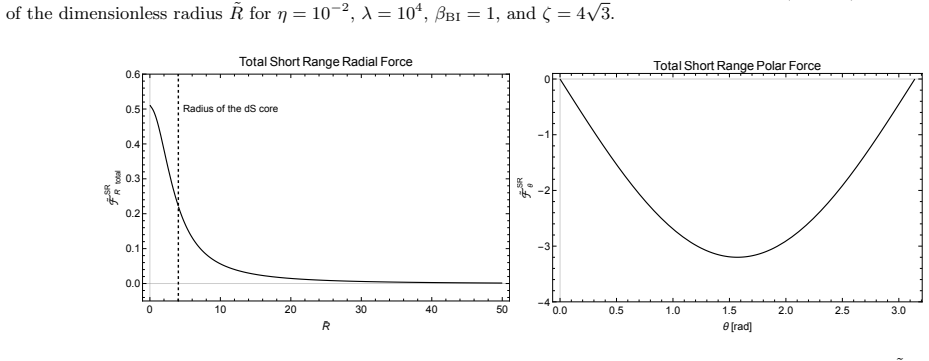
Laue force–balance condition Satisfying the energy conditions is necessary, but for the monopole to be mechanically self-consistent one must also check that the electromagnetic stress distribution admits an internal equilibrium. The appropriate criterion is the Laue condition, which demands that the integrated radial pressure exerted by each spherical she...
-
[17]
These yield the surface energy densityσ m and tangential pressure Π m, σm =− p 1−2GM/δ 2πδ + p 1−Λ coreδ2/3 2πδ ,Π m =σ m/2
Shell stresses at the core boundary The matching of the interior core geometry to the exterior monopole spacetime across the thin shell atR=δis governed by the Israel junction conditions. These yield the surface energy densityσ m and tangential pressure Π m, σm =− p 1−2GM/δ 2πδ + p 1−Λ coreδ2/3 2πδ ,Π m =σ m/2. The sign of these shell stresses is controll...
-
[18]
The energy density and pressures derived from the Born–Infeld Lagrangian satisfy the null, weak, and strong energy conditions everywhere outside the core
Summary Taken together, the three checks above paint a consistent picture of the purely magnetic Born–Infeld monopole as a mechanically stable, self-gravitating object. The energy density and pressures derived from the Born–Infeld Lagrangian satisfy the null, weak, and strong energy conditions everywhere outside the core. The Laue force-balance condition ...
-
[19]
N. E. Mavromatos and V. A. Mitsou, Magnetic monopoles revisited: Models and searches at colliders and in the Cosmos, Int. J. Mod. Phys. A35, 2030012 (2020), arXiv:2005.05100 [hep-ph]
arXiv 2020
-
[20]
’t Hooft, Magnetic Monopoles in Unified Gauge Theories, Nucl
G. ’t Hooft, Magnetic Monopoles in Unified Gauge Theories, Nucl. Phys. B79, 276 (1974)
1974
-
[21]
A. M. Polyakov, Particle Spectrum in Quantum Field Theory, JETP Lett.20, 194 (1974)
1974
-
[22]
Georgi and S
H. Georgi and S. L. Glashow, Unity of All Elementary Particle Forces, Phys. Rev. Lett.32, 438 (1974)
1974
-
[23]
A. K. Drukier and S. Nussinov, Monopole Pair Creation in Energetic Collisions: Is It Possible?, Phys. Rev. Lett.49, 102 (1982)
1982
-
[24]
Y. M. Cho and D. Maison, Monopoles in Weinberg-Salam model, Phys. Lett. B391, 360 (1997), arXiv:hep-th/9601028
Pith/arXiv arXiv 1997
-
[25]
Y. M. Cho, K. Kim, and J. H. Yoon, Finite Energy Electroweak Dyon, Eur. Phys. J. C75, 67 (2015), arXiv:1305.1699 [hep-ph]
Pith/arXiv arXiv 2015
-
[26]
J. Ellis, N. E. Mavromatos, and T. You, The Price of an Electroweak Monopole, Phys. Lett. B756, 29 (2016), arXiv:1602.01745 [hep-ph]
Pith/arXiv arXiv 2016
-
[27]
T. W. Kephart, G. K. Leontaris, and Q. Shafi, Magnetic Monopoles and Free Fractionally Charged States at Accelerators and in Cosmic Rays, JHEP10, 176, arXiv:1707.08067 [hep-ph]. 29
-
[28]
T. W. B. Kibble, Topology of cosmic domains and strings, Journal of Physics A: Mathematical and General9, 1387 (1976)
1976
-
[29]
I. K. Affleck and N. S. Manton, Monopole Pair Production in a Magnetic Field, Nucl. Phys. B194, 38 (1982)
1982
-
[30]
O. Gould and A. Rajantie, Magnetic monopole mass bounds from heavy ion collisions and neutron stars, Phys. Rev. Lett. 119, 241601 (2017), arXiv:1705.07052 [hep-ph]
Pith/arXiv arXiv 2017
- [31]
-
[32]
B. Acharyaet al.(MoEDAL), Search for magnetic monopoles produced via the Schwinger mechanism, Nature602, 63 (2022), arXiv:2106.11933 [hep-ex]
arXiv 2022
-
[33]
P. A. M. Dirac, The Theory of magnetic poles, Phys. Rev.74, 817 (1948)
1948
-
[34]
P. A. M. Dirac, Quantised singularities in the electromagnetic field,, Proc. Roy. Soc. Lond. A133, 60 (1931)
1931
-
[35]
N. E. Mavromatos and S. Sarkar, On the stability of Born-Infeld-regularised electroweak monopoles, Eur. Phys. J. Special Topics, in press (2026), arXiv:2602.01921 [hep-th]
arXiv 2026
-
[36]
Y. M. Shnir,Magnetic Monopoles, Text and Monographs in Physics (Springer, Berlin/Heidelberg, 2005)
2005
-
[37]
E. S. Fradkin and A. A. Tseytlin, Nonlinear electrodynamics from quantized strings, Phys. Lett. B163, 123 (1985)
1985
-
[38]
N. E. Mavromatos and S. Sarkar, Finite-energy dressed string-inspired Dirac-like monopoles, Universe5, 8 (2018), arXiv:1812.00495 [hep-ph]
Pith/arXiv arXiv 2018
-
[39]
P. Svrcek and E. Witten, Axions In String Theory, JHEP06, 051, arXiv:hep-th/0605206
-
[40]
N. E. Mavromatos and S. Sarkar, Magnetic monopoles from global monopoles in the presence of a Kalb-Ramond Field, Phys. Rev. D95, 104025 (2017), arXiv:1607.01315 [hep-th]
Pith/arXiv arXiv 2017
-
[41]
Barriola and A
M. Barriola and A. Vilenkin, Gravitational Field of a Global Monopole, Phys. Rev. Lett.63, 341 (1989)
1989
-
[42]
M. B. Green, J. H. Schwarz, and E. Witten,Superstring Theory Vol. 1: 25th Anniversary Edition, Cambridge Monographs on Mathematical Physics (Cambridge University Press, 2012)
2012
-
[43]
M. B. Green, J. H. Schwarz, and E. Witten,Superstring Theory Vol. 2: 25th Anniversary Edition, Cambridge Monographs on Mathematical Physics (Cambridge University Press, 2012)
2012
-
[44]
N. E. Mavromatos and S. Sarkar, Regularized Kalb-Ramond magnetic monopole with finite energy, Phys. Rev. D97, 125010 (2018), arXiv:1804.01702 [hep-th]
Pith/arXiv arXiv 2018
-
[45]
K. Farakos, G. Koutsoumbas, N. E. Mavromatos, and A. Zarafonitis, On internal mechanical properties of Electroweak Magnetic Monopoles and their effects on stability, Eur. Phys. J. ST, in press 10.1140/epjs/s11734-025-02083-z (2025), arXiv:2506.04872 [hep-th]
-
[46]
Laue, Zur Dynamik der Relativit¨ atstheorie, Annalen Phys.340, 524 (1911)
M. Laue, Zur Dynamik der Relativit¨ atstheorie, Annalen Phys.340, 524 (1911)
1911
-
[47]
N. E. Mavromatos and E. Winstanley, Aspects of hairy black holes in spontaneously broken Einstein Yang-Mills systems: Stability analysis and entropy considerations, Phys. Rev. D53, 3190 (1996), arXiv:hep-th/9510007
Pith/arXiv arXiv 1996
-
[48]
R. Gervalle and M. S. Volkov, Electroweak monopoles and their stability, Nucl. Phys. B984, 115937 (2022), arXiv:2203.16590 [hep-th]
arXiv 2022
-
[49]
S. Arunasalam and A. Kobakhidze, Electroweak monopoles and the electroweak phase transition, Eur. Phys. J. C77, 444 (2017), arXiv:1702.04068 [hep-ph]
Pith/arXiv arXiv 2017
-
[50]
J. Ellis, N. E. Mavromatos, and T. You, Light-by-Light Scattering Constraint on Born-Infeld Theory, Phys. Rev. Lett. 118, 261802 (2017), arXiv:1703.08450 [hep-ph]
Pith/arXiv arXiv 2017
- [51]
-
[52]
V. A. Mitsou and E. Musumeci, Constraining magnetic monopoles and multiply charged particles with diphoton events at the LHC, (2026), arXiv:2604.07300 [hep-ph]
Pith/arXiv arXiv 2026
-
[53]
Harari and C
D. Harari and C. Lousto, Repulsive gravitational effects of global monopoles, Phys. Rev. D42, 2626 (1990)
1990
-
[54]
Israel, Singular hypersurfaces and thin shells in general relativity, Nuovo Cim
W. Israel, Singular hypersurfaces and thin shells in general relativity, Nuovo Cim. B44S10, 1 (1966), [Erratum: Nuovo Cim.B 48, 463 (1967)]
1966
-
[55]
N. Chatzifotis, N. E. Mavromatos, and D. P. Theodosopoulos, Global monopoles in the extended Gauss-Bonnet gravity, Phys. Rev. D107, 085014 (2023), arXiv:2212.09467 [gr-qc]
arXiv 2023
-
[56]
Born, Modified field equations with a finite radius of the electron, Nature132, 282.1 (1933)
M. Born, Modified field equations with a finite radius of the electron, Nature132, 282.1 (1933)
1933
-
[57]
Born, On the quantum theory of the electromagnetic field, Proc
M. Born, On the quantum theory of the electromagnetic field, Proc. Roy. Soc. Lond. A143, 410 (1934)
1934
-
[58]
Born and L
M. Born and L. Infeld, Foundations of the new field theory, Proc. Roy. Soc. Lond. A144, 425 (1934)
1934
-
[59]
R. R. Metsaev, M. Rakhmanov, and A. A. Tseytlin, The Born-Infeld Action as the Effective Action in the Open Superstring Theory, Phys. Lett. B193, 207 (1987)
1987
-
[60]
O. D. Andreev and A. A. Tseytlin, Partition Function Representation for the Open Superstring Effective Action: Cancel- lation of Mobius Infinities and Derivative Corrections to Born-Infeld Lagrangian, Nucl. Phys. B311, 205 (1988)
1988
-
[61]
A. A. Tseytlin,Born-Infeld action, supersymmetry and string theory, edited by M. A. Shifman (1999) pp. 417–452, arXiv:hep-th/9908105
Pith/arXiv arXiv 1999
-
[62]
R. G. Leigh, Dirac-Born-Infeld Action from Dirichlet Sigma Model, Mod. Phys. Lett. A4, 2767 (1989)
1989
-
[63]
J. Dai, R. G. Leigh, and J. Polchinski, New Connections Between String Theories, Mod. Phys. Lett. A4, 2073 (1989)
2073
-
[64]
J. Polchinski, Tasi lectures on D-branes, inTheoretical Advanced Study Institute in Elementary Particle Physics (TASI 96): Fields, Strings, and Duality(1996) pp. 293–356, arXiv:hep-th/9611050
Pith/arXiv arXiv 1996
-
[65]
D. d’Enterria and G. G. da Silveira, Observing light-by-light scattering at the Large Hadron Collider, Phys. Rev. Lett. 111, 080405 (2013), [Erratum: Phys.Rev.Lett. 116, 129901 (2016)], arXiv:1305.7142 [hep-ph]
Pith/arXiv arXiv 2013
-
[66]
M. Aaboudet al.(ATLAS), Evidence for light-by-light scattering in heavy-ion collisions with the ATLAS detector at the LHC, Nature Phys.13, 852 (2017), arXiv:1702.01625 [hep-ex]. 30
Pith/arXiv arXiv 2017
-
[67]
A. M. Sirunyanet al.(CMS), Evidence for light-by-light scattering and searches for axion-like particles in ultraperipheral PbPb collisions at √sNN = 5.02 TeV, Phys. Lett. B797, 134826 (2019), arXiv:1810.04602 [hep-ex]
arXiv 2019
-
[68]
D. J. Gross and J. H. Sloan, The Quartic Effective Action for the Heterotic String, Nucl. Phys. B291, 41 (1987)
1987
-
[69]
S. S. Yazadjiev, Einstein-Born-Infeld-dilaton black holes in non-asymptotically flat spacetimes, Phys. Rev. D72, 044006 (2005), arXiv:hep-th/0504152
Pith/arXiv arXiv 2005
-
[70]
M. H. Dehghani and H. R. Rastegar Sedehi, Thermodynamics of rotating black branes in (n+1)-dimensional Einstein- Born-Infeld gravity, Phys. Rev. D74, 124018 (2006), arXiv:hep-th/0610239
Pith/arXiv arXiv 2006
-
[71]
A. Sheykhi and N. Riazi, Thermodynamics of black holes in (n+1)-dimensional Einstein-Born-Infeld dilaton gravity, Phys. Rev. D75, 024021 (2007), arXiv:hep-th/0610085
Pith/arXiv arXiv 2007
-
[72]
C. A. R. Herdeiro and E. Radu, Asymptotically flat black holes with scalar hair: a review, Int. J. Mod. Phys. D24, 1542014 (2015), arXiv:1504.08209 [gr-qc]
Pith/arXiv arXiv 2015
-
[73]
T. Karakasis, G. Koutsoumbas, A. Machattou, and E. Papantonopoulos, Magnetically charged Euler-Heisenberg black holes with scalar hair, Phys. Rev. D106, 104006 (2022), arXiv:2207.13146 [gr-qc]
arXiv 2022
-
[74]
D. P. Theodosopoulos, T. Karakasis, G. Koutsoumbas, and E. Papantonopoulos, Motion of particles around a magnetically charged Euler–Heisenberg black hole with scalar hair and the Event Horizon Telescope, Eur. Phys. J. C84, 592 (2024), arXiv:2311.02740 [gr-qc]
arXiv 2024
-
[75]
Garfinkle, G
D. Garfinkle, G. T. Horowitz, and A. Strominger, Charged black holes in string theory, Phys. Rev. D43, 3140 (1991), [Erratum: Phys.Rev.D 45, 3888 (1992)]
1991
-
[76]
S. Sur, S. Das, and S. SenGupta, Charged black holes in generalized dilaton-axion gravity, JHEP10, 064, arXiv:hep- th/0508150
discussion (0)
Sign in with ORCID, Apple, or X to comment. Anyone can read and Pith papers without signing in.