Novel 2D Altermagnetic Vanadium Oxide with a Buckled Lieb Structure
Pith reviewed 2026-06-27 18:04 UTC · model grok-4.3
The pith
Monolayer vanadium oxide in a buckled Lieb lattice forms a stable two-dimensional altermagnet with out-of-plane anisotropy and spin Hall conductivity of about 40 units.
A machine-rendered reading of the paper's core claim, the machinery that carries it, and where it could break.
Core claim
Using density functional theory the authors establish that monolayer V₂O in the buckled Lieb lattice is structurally and thermally stable, possesses an antiferromagnetic ground state with a local moment of 2.79 μB per V atom and out-of-plane magnetocrystalline anisotropy, exhibits a characteristic momentum-dependent spin splitting of 1.2 eV, and develops a large intrinsic spin Hall conductivity of approximately 40 (ħ/e) S cm⁻¹ once spin-orbit coupling lifts the degeneracy of the quadratic band crossing near the Fermi level.
What carries the argument
The buckled Lieb lattice geometry of monolayer V₂O, which enforces the momentum-dependent spin splitting of altermagnetism and permits spin-orbit coupling to generate Berry curvature for spin Hall transport.
If this is right
- The material remains stable at room temperature according to ab initio molecular dynamics.
- It displays auxetic behavior with a negative Poisson's ratio.
- The out-of-plane magnetic anisotropy supports spin-dependent responses usable in devices.
- A momentum-dependent spin splitting of 1.2 eV appears without net magnetization.
- An intrinsic spin Hall conductivity of roughly 40 (ħ/e) S cm⁻¹ arises from Berry curvature.
Where Pith is reading between the lines
- If the monolayer can be grown, it may enable room-temperature spintronic components that avoid stray fields from net magnetization.
- Strain engineering could exploit the auxetic response to tune the spin splitting or conductivity in flexible heterostructures.
- Analogous buckled lattices in other early-transition-metal oxides might furnish additional altermagnetic candidates.
- The combination of large spin splitting and Berry curvature suggests efficient generation of spin currents for low-power logic.
Load-bearing premise
The density functional theory calculations with the selected exchange-correlation functional and numerical settings correctly capture the antiferromagnetic ground state, the 1.2 eV spin splitting, and the spin Hall conductivity.
What would settle it
Experimental synthesis of the monolayer followed by angle-resolved photoemission spectroscopy showing no 1.2 eV momentum-dependent spin splitting, or transport measurements yielding a spin Hall conductivity far below the calculated value, would falsify the central claim.
Figures

read the original abstract
Altermagnetism has recently emerged as a highly promising phase for spintronics, offering the combined advantages of both antiferromagnets and ferromagnets. Here, using a first-principles analysis based on density functional theory (DFT), we identify a monolayer V$_2$O crystal in a buckled Lieb lattice as a promising two-dimensional altermagnetic material. The structural and thermal stability of V$_2$O is verified through calculations of the crystal's formation energy, phonon structure, room-temperature ab initio molecular dynamics, and stiffness matrix. The system is found to exhibit auxetic behavior with a negative Poisson's ratio. Our calculations indicate an antiferromagnetic ground state with a local magnetic moment of $2.79\,\mu_{\mathrm{B}}$ per V atom and a magnetocrystalline anisotropy that favors an out-of-plane easy axis. The electronic structure exhibits a momentum-dependent spin splitting of 1.2 eV, which is a characteristic of altermagnets. Inclusion of spin-orbit coupling breaks the symmetry of the quadratic band crossing near the Fermi level, resulting in a large Berry curvature and significant intrinsic spin Hall conductivity around $40\,(\hbar/e)\,\mathrm{S\,cm^{-1}}$. The results demonstrate that monolayer V$_2$O serves as a robust room-temperature altermagnetic platform, exhibiting magnetic anisotropy and spin-dependent transport responses.
Editorial analysis
A structured set of objections, weighed in public.
Referee Report
Summary. The manuscript uses DFT to propose monolayer V₂O in a buckled Lieb lattice as a stable 2D altermagnet. It reports structural/thermal stability (formation energy, phonons, AIMD, elastic constants), auxetic behavior, AFM ground state with 2.79 μB/V moment and out-of-plane anisotropy, 1.2 eV momentum-dependent spin splitting, and ~40 (ħ/e) S cm^{-1} intrinsic spin Hall conductivity arising from SOC-induced Berry curvature at the quadratic band crossing.
Significance. If the central DFT results are robust, the work would identify a new 2D altermagnetic platform with room-temperature stability, magnetic anisotropy, and sizable spin Hall response, expanding the limited set of known 2D altermagnets. The auxetic property is an additional distinguishing feature. However, the significance is limited by the absence of any reported functional or U dependence tests for a 3d oxide system.
major comments (3)
- [Computational Methods] Computational Methods: no exchange-correlation functional (PBE or otherwise), Hubbard U value, or k-point sampling details are stated. For vanadium oxides these choices routinely shift spin splittings by hundreds of meV and can alter the metallic vs. insulating character, directly affecting the reported 1.2 eV splitting and spin Hall conductivity.
- [Electronic structure and transport] Electronic structure and transport sections: the 1.2 eV altermagnetic splitting and ~40 (ħ/e) S cm^{-1} spin Hall conductivity are presented as single-point DFT outputs with no cross-check against hybrid functionals, GW, or varied U; this is load-bearing for the claim that the system is a robust altermagnet.
- [Magnetic properties] Magnetic properties: the AFM ground state, 2.79 μB moment, and out-of-plane anisotropy are reported without total-energy comparisons across magnetic configurations or sensitivity to the DFT setup, leaving open whether the altermagnetic character survives standard variations in the exchange-correlation approximation.
minor comments (2)
- [Abstract] Abstract and main text: the phrase 'room-temperature altermagnetic platform' is used without an explicit estimate of the Néel temperature or thermal stability of the magnetic order beyond structural AIMD.
- [Figures] Figure captions and text: units of spin Hall conductivity are written as (ħ/e) S cm^{-1}; clarify whether this is the conventional 2D or 3D normalization.
Simulated Author's Rebuttal
We thank the referee for the careful and constructive review. The comments correctly identify omissions in methodological details and the lack of robustness checks, which we will address in revision. We respond point-by-point below.
read point-by-point responses
-
Referee: [Computational Methods] Computational Methods: no exchange-correlation functional (PBE or otherwise), Hubbard U value, or k-point sampling details are stated. For vanadium oxides these choices routinely shift spin splittings by hundreds of meV and can alter the metallic vs. insulating character, directly affecting the reported 1.2 eV splitting and spin Hall conductivity.
Authors: The referee is correct that these parameters were not stated. We will add a dedicated Computational Methods section in the revised manuscript specifying the exchange-correlation functional, Hubbard U value (if employed), k-point sampling, and related settings. This addresses the reproducibility concern directly. revision: yes
-
Referee: [Electronic structure and transport] Electronic structure and transport sections: the 1.2 eV altermagnetic splitting and ~40 (ħ/e) S cm^{-1} spin Hall conductivity are presented as single-point DFT outputs with no cross-check against hybrid functionals, GW, or varied U; this is load-bearing for the claim that the system is a robust altermagnet.
Authors: We acknowledge that the results rely on a single DFT setup without the suggested cross-checks. In revision we will add a brief discussion of the expected sensitivity to U and note the computational cost of hybrid or GW methods for this system; additional U-variation tests will be included where feasible to support the robustness of the reported splitting and conductivity. revision: partial
-
Referee: [Magnetic properties] Magnetic properties: the AFM ground state, 2.79 μB moment, and out-of-plane anisotropy are reported without total-energy comparisons across magnetic configurations or sensitivity to the DFT setup, leaving open whether the altermagnetic character survives standard variations in the exchange-correlation approximation.
Authors: The referee correctly notes the absence of explicit comparisons. The revised manuscript will include total-energy differences for alternative magnetic configurations and clarify how the anisotropy was obtained. Sensitivity to the DFT setup will be addressed via the added methodological details and any U-variation results. revision: yes
Circularity Check
No circularity: direct DFT outputs with no self-referential reductions
full rationale
The paper reports structural stability, AFM ground state, 2.79 μB moment, 1.2 eV spin splitting, and ~40 (ħ/e) S cm^{-1} spin Hall conductivity as direct outputs of standard first-principles DFT calculations. No equations, ansatzes, or fitted parameters are defined in terms of the target quantities and then reused to 'predict' them. No self-citations are invoked as load-bearing uniqueness theorems or to smuggle in functional forms. The derivation chain consists of external computational methods applied to the candidate structure; results are not equivalent to inputs by construction. This matches the default expectation of no significant circularity (score 0-2).
Axiom & Free-Parameter Ledger
axioms (2)
- standard math Born-Oppenheimer approximation and periodic boundary conditions in DFT
- domain assumption Exchange-correlation functional approximates the true many-body effects sufficiently for magnetic ordering and spin splitting
Reference graph
Works this paper leans on
-
[1]
The relaxed structure has lattice parameter a = 4
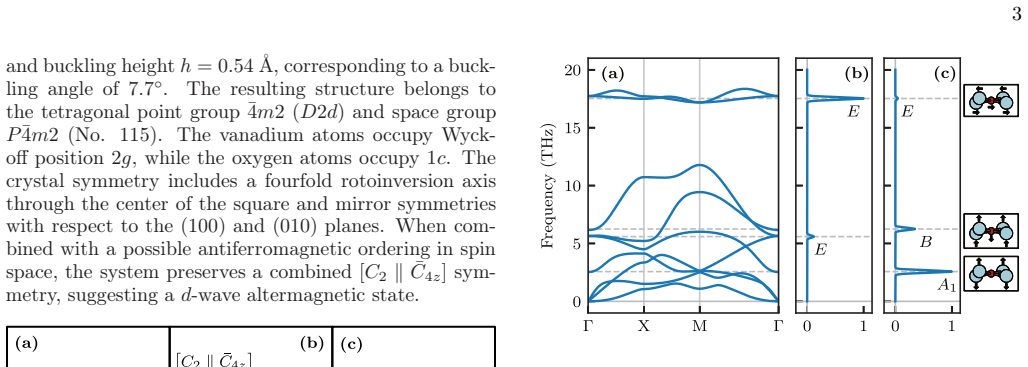
This buck- ling stabilizes the monolayer, analogous to silicene [ 70]. The relaxed structure has lattice parameter a = 4. 01 Å 3 and buckling heighth = 0. 54 Å, corresponding to a buck- ling angle of 7. 7◦. The resulting structure belongs to the tetragonal point group ¯ 4m2 (D2d) and space group P ¯ 4m2 (No. 115). The vanadium atoms occupy Wyck- off positi...
-
[2]
5 − 5. 2 0 . 0 − 5. 2 52 . 5 0 . 0
-
[3]
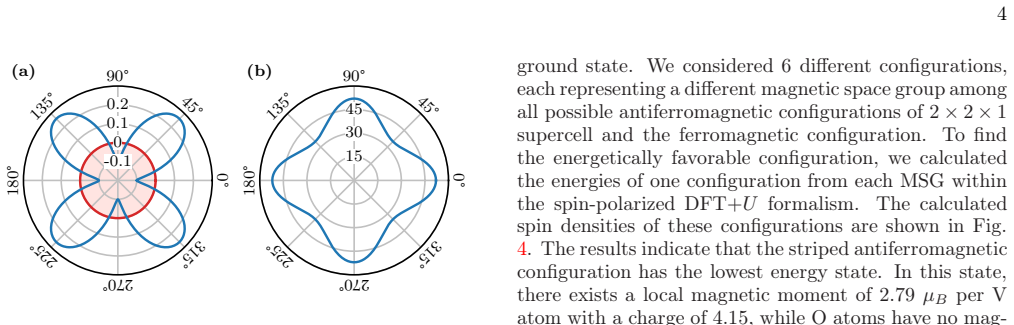
0 0 . 0 13 . 8 (N/ m), Since all eigenvalues are positive, the stiffness matrix is positive definite. Therefore, the V 2O monolayer satisfies the mechanical stability criteria. Once we obtain the ma- terial’s stiffness matrix, we can estimate several impor- tant mechanical properties. We start with the Poisson ratio, which is the transverse strain respons...
-
[4]
In this state, there exists a local magnetic moment of 2
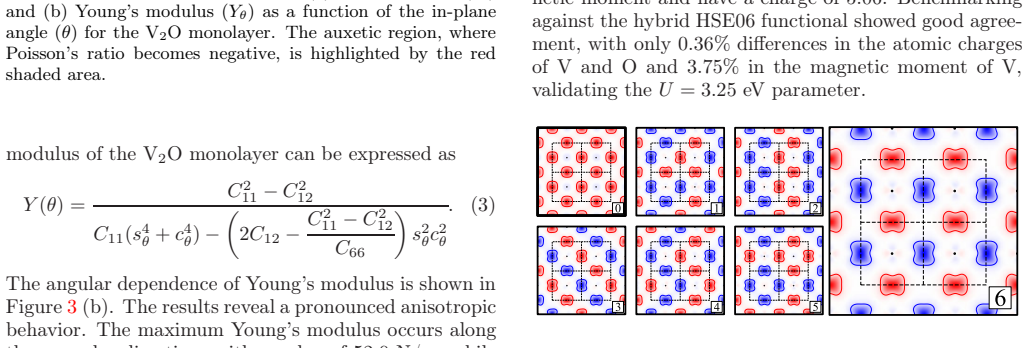
The results indicate that the striped antiferromagnetic configuration has the lowest energy state. In this state, there exists a local magnetic moment of 2. 79 µ B per V atom with a charge of 4.15, while O atoms have no mag- netic moment and have a charge of 5.06. Benchmarking against the hybrid HSE06 functional showed good agree- ment, with only 0.36% diff...
-
[5]
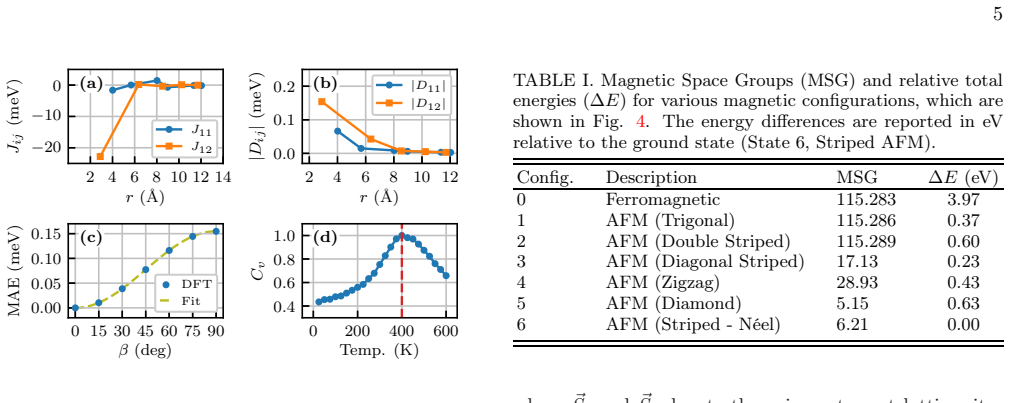
2 |Dij| (meV) (b) |D11| |D12| 0 15 30 45 60 75 90 β (deg)
-
[6]
15 MAE (meV) (c) DFT Fit 0 200 400 600 Temp. (K)
-
[7]
0 Cv (d) FIG. 5. (a) Symmetric exchange interaction parameters with respect to distance (b) Asymmetric exchange interac- tion (DMI) parameters with respect to distance (c) Magnetic anisotropy energy of V 2O. Blue markers show the results of spin-orbit interaction, including DFT +U calculations for α = 0 . Green curve shows the results of Eq. 4 for α = 0 (...
-
[8]
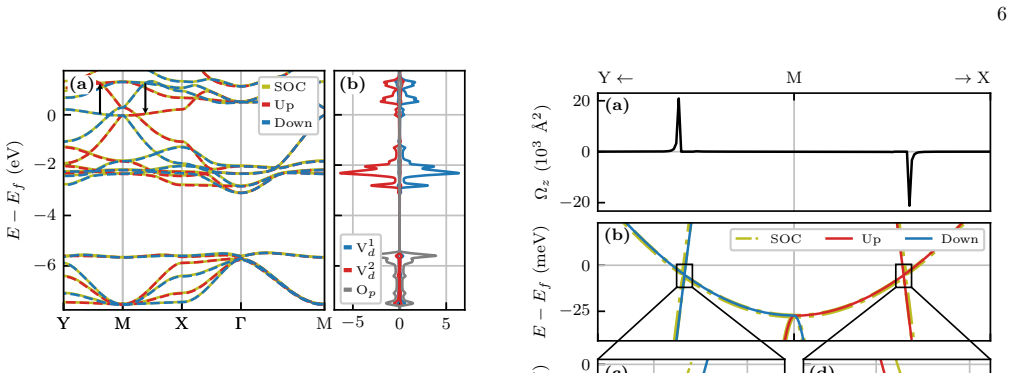
The energy differences are reported in eV relative to the ground state (State 6, Striped AFM). Config. Description MSG ∆ E (eV) 0 Ferromagnetic 115.283 3.97 1 AFM (Trigonal) 115.286 0.37 2 AFM (Double Striped) 115.289 0.60 3 AFM (Diagonal Striped) 17.13 0.23 4 AFM (Zigzag) 28.93 0.43 5 AFM (Diamond) 5.15 0.63 6 AFM (Striped - Néel) 6.21 0.00 where ⃗Si and ⃗...
-
[9]
Within the Kubo- Greenwood formalism, we can calculate the correspond- ing conductivities using the Berry curvature as follows
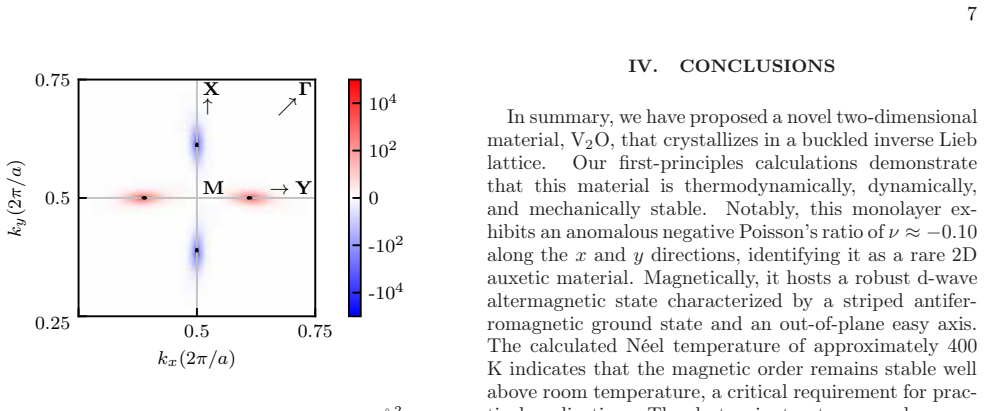
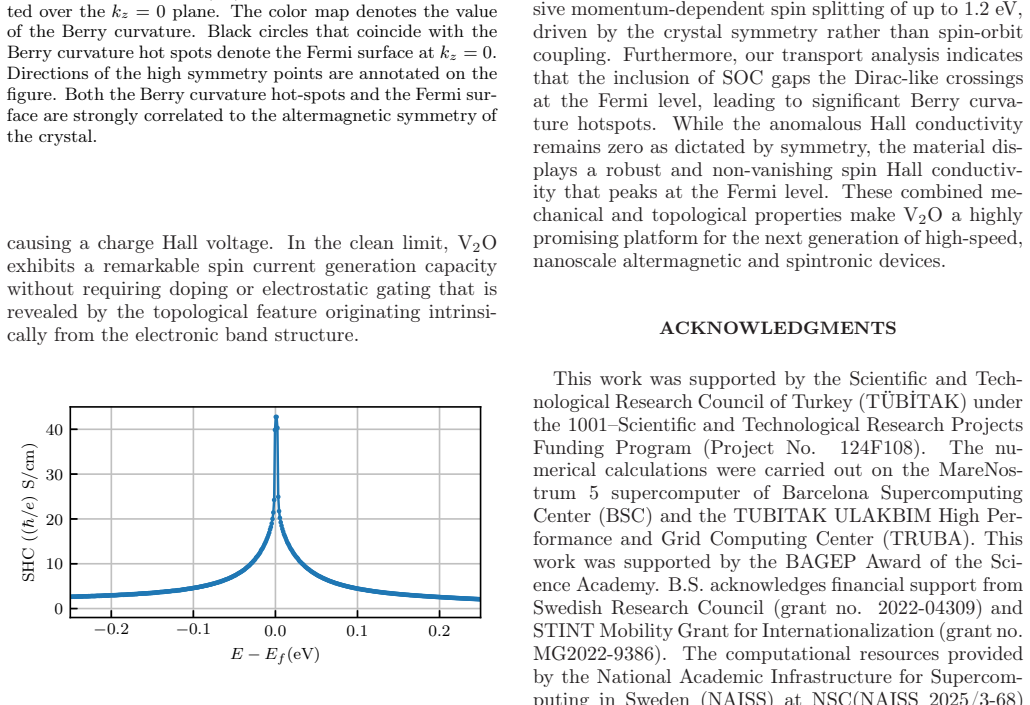
has the quadrupole structure that is consistent with the crystal symmetry, such that, Ω (kx,k y) = − Ω ( −ky,k x) (7) Considering the existence of Berry curvature hot spots in the reciprocal space, we might expect to observe Hall properties such as Anomalous Hall Effect (AHE) and Spin Hall Effect (SHE) [ 78]. Within the Kubo- Greenwood formalism, we can cal...
-
[10]
A zero AHC and a significant SHC indi- cates possibility of generating pure spin currents without 7
-
[11]
75 ky(2π/a ) Γ ր X ↑ → Y M -104 -102 0 102 104 FIG. 8. Berry curvature ( Ω z) of V 2O in the units of Å 2 , plot- ted over the kz = 0 plane. The color map denotes the value of the Berry curvature. Black circles that coincide with the Berry curvature hot spots denote the Fermi surface at kz = 0. Directions of the high symmetry points are annotated on the fi...
2022
-
[12]
N. F. Mott, The electrical con- ductivity of transition metals, Proceedings of the Royal Society of London. A. Mathematical and Physical Sciences 153, 699 (1936)
1936
-
[13]
Žutić, J
I. Žutić, J. Fabian, and S. Das Sarma, Spintronics: Fundamentals and applications, Rev. Mod. Phys. 76, 323 (2004) . 8
2004
-
[14]
M. N. Baibich, J. M. Broto, A. Fert, F. N. Van Dau, F. Petroff, P. Etienne, G. Creuzet, A. Friederich, and J. Chazelas, Giant Magnetore- sistance of (001)Fe/(001)Cr Magnetic Superlattices, Phys. Rev. Lett. 61, 2472 (1988)
1988
-
[15]
Binasch, P
G. Binasch, P. Grünberg, F. Saurenbach, and W. Zinn, Enhanced magnetoresistance in layered magnetic structures with antiferromagnetic interlayer exchange, Phys. Rev. B 39, 4828 (1989)
1989
-
[16]
Julliere, Tunneling between ferromagnetic films, Physics Letters A 54, 225 (1975)
M. Julliere, Tunneling between ferromagnetic films, Physics Letters A 54, 225 (1975)
1975
-
[17]
Slonczewski, Current-driven ex- citation of magnetic multilayers, Journal of Magnetism and Magnetic Materials 159, L1 (1996)
J. Slonczewski, Current-driven ex- citation of magnetic multilayers, Journal of Magnetism and Magnetic Materials 159, L1 (1996)
1996
-
[18]
Berger, Emission of spin waves by a magnetic multilayer traversed by a current, Phys
L. Berger, Emission of spin waves by a magnetic multilayer traversed by a current, Phys. Rev. B 54, 9353 (1996)
1996
-
[19]
Grollier, D
J. Grollier, D. Querlioz, K. Y. Camsari, K. Everschor- Sitte, S. Fukami, and M. D. Stiles, Neuromorphic spin- tronics, Nat Electron 3, 360 (2020)
2020
-
[20]
Jungwirth, X
T. Jungwirth, X. Marti, P. Wadley, and J. Wunderlich, Antiferromagnetic spintronics, Nature Nanotech 11, 231 (2016)
2016
-
[21]
Šmejkal, J
L. Šmejkal, J. Sinova, and T. Jungwirth, Beyond Con- ventional Ferromagnetism and Antiferromagnetism: A Phase with Nonrelativistic Spin and Crystal Rotation Symmetry, Phys. Rev. X 12, 031042 (2022)
2022
-
[22]
Šmejkal, J
L. Šmejkal, J. Sinova, and T. Jungwirth, Emerg- ing Research Landscape of Altermagnetism, Phys. Rev. X 12, 040501 (2022)
2022
-
[23]
L. Bai, W. Feng, S. Liu, L. Šmejkal, Y. Mokrousov, and Y. Yao, Altermagnetism: Exploring New Frontiers in Magnetism and Spintronics, Adv Funct Materials 34, 2409327 (2024)
2024
-
[24]
T. Jungwirth, J. Sinova, P. Wadley, D. Kriegner, H. Reichlova, F. Krizek, H. Ohno, and L. Sme- jkal, Altermagnetic spintronics (2025), arXiv:2508.09748 [cond-mat]
arXiv 2025
-
[25]
L. Šmejkal, R. González-Hernández, T. Jungwirth, and J. Sinova, Crystal time-reversal symmetry breaking and spontaneous Hall effect in collinear antiferromagnets, Sci . Adv. 6, 10.1126/sciadv.aaz8809 (2020)
-
[26]
Reimers, L
S. Reimers, L. Odenbreit, L. Šmejkal, V. N. Strocov, P. Constantinou, A. B. Hellenes, R. Jaeschke Ubiergo, W. H. Campos, V. K. Bharadwaj, A. Chakraborty, T. Denneulin, W. Shi, R. E. Dunin-Borkowski, S. Das, M. Kläui, J. Sinova, and M. Jourdan, Direct observa- tion of altermagnetic band splitting in crsb thin films, Nature Communications 15, 2116 (2024)
2024
-
[27]
Krempaský, L
J. Krempaský, L. Šmejkal, S. W. D’Souza, M. Ha- jlaoui, G. Springholz, K. Uhlířová, F. Alarab, P. C. Constantinou, V. Strocov, D. Usanov, W. R. Pudelko, R. González-Hernández, A. Birk Hellenes, Z. Jansa, H. Reichlová, Z. Šobáň, R. D. Gonzalez Betancourt, P. Wadley, J. Sinova, D. Kriegner, J. Minár, J. H. Dil, and T. Jungwirth, Altermagnetic lifting of Kra...
2024
-
[28]
Sødequist and T
J. Sødequist and T. Olsen, Two-dimensional altermag- nets from high throughput computational screening: Symmetry requirements, chiral magnons, and spin-orbit effects, Applied Physics Letters 124, 182409 (2024)
2024
-
[29]
J. Wang, X. Yang, Z. Yang, J. Lu, P. Ho, W. Wang, Y. S. Ang, Z. Cheng, and S. Fang, Pen- tagonal 2D Altermagnets: Material Screening and Al- termagnetic Tunneling Junction Device Application, Adv Funct Materials 36, 2505145 (2026)
2026
-
[30]
B. Pan, P. Zhou, P. Lyu, H. Xiao, X. Yang, and L. Sun, General Stacking Theory for Altermagnetism in Bilayer Systems, Phys. Rev. Lett. 133, 166701 (2024)
2024
-
[31]
Zeng and Y.-J
S. Zeng and Y.-J. Zhao, Description of two-dimensional altermagnetism: Categorization using spin group theory, Phys. Rev. B 110, 054406 (2024)
2024
-
[32]
H.-Y. Ma, M. Hu, N. Li, J. Liu, W. Yao, J.-F. Jia, and J. Liu, Multifunctional antiferromagnetic materials with giant piezomagnetism and noncollinear spin current, Nat Commun 12, 2846 (2021)
2021
-
[33]
Y. Zhu, T. Chen, Y. Li, L. Qiao, X. Ma, C. Liu, T. Hu, H. Gao, and W. Ren, Multipiezo Effect in Altermagnetic V2 SeTeO Monolayer, Nano Lett. 24, 472 (2024)
2024
-
[34]
W. Xie, X. Xu, Y. Yue, H. Xia, and H. Wang, Piezoval- ley effect and magnetovalley coupling in altermagnetic semiconductors studied by first-principles calculations, Phys. Rev. B 111, 134429 (2025)
2025
-
[35]
Y. Wu, L. Deng, X. Yin, J. Tong, F. Tian, and X. Zhang, Valley-related multipiezo effect and noncollinear spin cur - rent in an altermagnet fe2se2o monolayer, Nano Letters 24, 10534 (2024)
2024
-
[36]
Guo, X.-S
S.-D. Guo, X.-S. Guo, K. Cheng, K. Wang, and Y. S. Ang, Piezoelectric altermagnetism and spin- valley polarization in Janus monolayer Cr2SO, Applied Physics Letters 123, 082401 (2023)
2023
-
[37]
X. Chen, D. Wang, L. Li, and B. Sanyal, Gi- ant spin-splitting and tunable spin-momentum locked transport in room temperature collinear antiferromagnetic semimetallic cro monolayer, Applied Physics Letters 123, 022402 (2023)
2023
-
[38]
Brekke, A
B. Brekke, A. Brataas, and A. Sudbø, Two-dimensional altermagnets: Superconductivity in a minimal micro- scopic model, Phys. Rev. B 108, 224421 (2023)
2023
-
[39]
Dürrnagel, H
M. Dürrnagel, H. Hohmann, A. Maity, J. Seufert, M. Klett, L. Klebl, and R. Thomale, Alter- magnetic Phase Transition in a Lieb Metal, Phys. Rev. Lett. 135, 036502 (2025)
2025
-
[40]
Kaushal and M
N. Kaushal and M. Franz, Altermagnetism in Modified Lieb Lattice Hubbard Model, Phys. Rev. Lett. 135, 156502 (2025)
2025
-
[41]
P.-H. Chang, K. D. Belashchenko, and I. I. Mazin, Inverse Lieb materials: altermagnetism and more, npj Quantum Mater. 10.1038/s41535-026-00880-w (2026)
-
[42]
D. S. Antonenko, R. M. Fernandes, and J. W. F. Vender- bos, Mirror Chern Bands and Weyl Nodal Loops in Al- termagnets, Phys. Rev. Lett. 134, 096703 (2025)
2025
-
[43]
Leraand, K
K. Leraand, K. Mæland, and A. Sudbø, Phonon- mediated spin-polarized superconductivity in altermag- nets, Phys. Rev. B 112, 104510 (2025)
2025
-
[44]
K. Takahashi, C. R. W. Steward, M. Ogata, R. M. Fernandes, and J. Schmalian, Elasto-Hall conductiv- ity and the anomalous Hall effect in altermagnets, Phys. Rev. B 111, 184408 (2025) , arXiv:2502.03517 [cond-mat]
arXiv 2025
-
[45]
Xu and L
X. Xu and L. Yang, Alterpiezoresponse in Two-Dimensional Lieb-Lattice Altermagnets, Nano Lett. 25, 11870 (2025)
2025
-
[46]
Khodas, S
M. Khodas, S. Mu, I. I. Mazin, and K. D. Belashchenko, Tuning of altermagnetism by strain, Phys. Rev. B 113, 104422 (2026)
2026
-
[47]
C.-C. Wei, X. Li, S. Hatt, X. Huai, J. Liu, B. Singh, K.- M. Kim, R. M. Fernandes, P. Cardon, L. Zhao, et al. , 9 La2o3mn2se2: A correlated insulating layered d-wave al- termagnet, Physical Review Materials 9, 024402 (2025)
2025
-
[48]
Jiang, M
B. Jiang, M. Hu, J. Bai, Z. Song, C. Mu, G. Qu, W. Li, W. Zhu, H. Pi, Z. Wei, et al. , A metallic room- temperature d-wave altermagnet, Nature Physics 21, 754 (2025)
2025
-
[49]
Zhang, X
F. Zhang, X. Cheng, Z. Yin, C. Liu, L. Deng, Y. Qiao, Z. Shi, S. Zhang, J. Lin, Z. Liu, et al. , Crystal-symmetry- paired spin–valley locking in a layered room-temperature metallic altermagnet candidate, Nature Physics 21, 760 (2025)
2025
-
[50]
Zhang, P
X. Zhang, P. Jiang, L.-Y. Xu, L. Wang, L. Liu, H.- M. Huang, T. Cao, and Y.-L. Li, Giant spin splitting and anisotropic spin polarization in 2d altermagnet cr2o, Nano Letters 25, 16547 (2025)
2025
-
[51]
S.-D. Guo, Q. Luo, S.-H. Zhang, and P. Jiang, External field induced transition from altermagnetic metal to fully compensated ferrimagnetic metal in monolayer Cr 2 O, Phys. Rev. B 113, 064408 (2026)
2026
-
[52]
Liu, J.-T
M. Liu, J.-T. Sun, and S. Meng, Uncompensated Lin- ear Dichroism of Magneto-Optical Kerr Effect in a 2D Altermagnet, Adv Funct Materials 36, e21111 (2026)
2026
-
[53]
Szymanski, Z
N. Szymanski, Z. Liu, T. Alderson, N. Podraza, P. Sarin, and S. Khare, Electronic and optical properties of vanadium oxides from first principles, Computational Materials Science 146, 310 (2018)
2018
-
[54]
P. Hu, P. Hu, T. D. Vu, M. Li, S. Wang, Y. Ke, X. Zeng, L. Mai, and Y. Long, Vanadium Oxide: Phase Diagrams, Structures, Synthesis, and Applica- tions, Chem. Rev. 123, 4353 (2023)
2023
-
[55]
Kresse and J
G. Kresse and J. Hafner, Ab initio molecular dynamics for liquid metals, Phys. Rev. B 47, 558 (1993)
1993
-
[56]
Kresse and J
G. Kresse and J. Furthmüller, Efficient iterative schemes for ab initio total-energy calculations using a plane-wave basis set, Phys. Rev. B 54, 11169 (1996)
1996
-
[57]
Kresse and J
G. Kresse and J. Furthmüller, Efficiency of ab- initio total energy calculations for metals and semiconductors using a plane-wave basis set, Computational Materials Science 6, 15 (1996)
1996
-
[58]
P. E. Blöchl, Projector augmented-wave method, Phys. Rev. B 50, 17953 (1994)
1994
-
[59]
J. P. Perdew and W. Yue, Accurate and sim- ple density functional for the electronic exchange energy: Generalized gradient approximation, Phys. Rev. B 33, 8800 (1986)
1986
-
[60]
J. P. Perdew, Density-functional approximation for the correlation energy of the inhomogeneous electron gas, Phys. Rev. B 33, 8822 (1986)
1986
-
[61]
J. P. Perdew, K. Burke, and M. Ernzerhof, Gen- eralized Gradient Approximation Made Simple, Phys. Rev. Lett. 77, 3865 (1996)
1996
-
[62]
S. L. Dudarev, G. A. Botton, S. Y. Savrasov, C. J. Humphreys, and A. P. Sutton, Electron-energy-loss spec- tra and the structural stability of nickel oxide: An LSDA+U study, Phys. Rev. B 57, 1505 (1998)
1998
-
[63]
L. Wang, T. Maxisch, and G. Ceder, Oxidation ener- gies of transition metal oxides within the gga+ u frame- work, Physical Review B—Condensed Matter and Mate- rials Physics 73, 195107 (2006)
2006
-
[64]
G. C. Moore, M. K. Horton, E. Linscott, A. M. Ganose, M. Siron, D. D. O’Regan, and K. A. Persson, High- throughput determination of hubbard u and hund j val- ues for transition metal oxides via the linear response formalism, Physical Review Materials 8, 014409 (2024)
2024
-
[65]
M. K. Horton, P. Huck, R. X. Yang, J. M. Munro, S. Dwaraknath, A. M. Ganose, R. S. Kingsbury, M. Wen, J. X. Shen, T. S. Mathis, A. D. Kaplan, K. Berket, J. Riebesell, J. George, A. S. Rosen, E. W. C. Spotte- Smith, M. J. McDermott, O. A. Cohen, A. Dunn, M. C. Kuner, G.-M. Rignanese, G. Petretto, D. Waroquiers, S. M. Griffin, J. B. Neaton, D. C. Chrzan, M. A...
2025
-
[66]
J. Heyd, G. E. Scuseria, and M. Ernzerhof, Hybrid functionals based on a screened Coulomb potential, The Journal of Chemical Physics 118, 8207 (2003)
2003
-
[67]
Togo, First-principles Phonon Cal- culations with Phonopy and Phono3py, J
A. Togo, First-principles Phonon Cal- culations with Phonopy and Phono3py, J. Phys. Soc. Jpn. 92, 012001 (2023)
2023
-
[68]
A. Togo, L. Chaput, T. Tadano, and I. Tanaka, Implementation strategies in phonopy and phono3py, J. Phys.: Condens. Matter 35, 353001 (2023)
2023
-
[69]
Nosé, A unified formulation of the con- stant temperature molecular dynamics methods, The Journal of Chemical Physics 81, 511 (1984)
S. Nosé, A unified formulation of the con- stant temperature molecular dynamics methods, The Journal of Chemical Physics 81, 511 (1984)
1984
-
[70]
W. G. Hoover, Canonical dynamics: Equilibrium phase- space distributions, Phys. Rev. A 31, 1695 (1985)
1985
-
[71]
J. M. Wills, O. Eriksson, P. Andersson, A. Delin, O. Grechnyev, and M. Alouani, Full-Potential Electronic Structure Method: Energy and Fo rce Calculations Springer Series in Solid-State Sciences, Vol. 167 (Springe r Berlin Heidelberg, Berlin, Heidelberg, 2010)
2010
-
[72]
Liechtenstein, M
A. Liechtenstein, M. Katsnelson, V. Antropov, and V. Gubanov, Local spin density func- tional approach to the theory of exchange in- teractions in ferromagnetic metals and alloys, Journal of Magnetism and Magnetic Materials 67, 65 (1987)
1987
-
[73]
Eriksson, A
O. Eriksson, A. Bergman, L. Bergqvist, and J. Hellsvik, Atomistic Spin Dynamics: Foundations and Applications (Oxford university press, 2017)
2017
-
[74]
Pizzi, V
G. Pizzi, V. Vitale, R. Arita, S. Blügel, F. Freimuth, G. Géranton, M. Gibertini, D. Gresch, C. John- son, T. Koretsune, J. Ibañez-Azpiroz, H. Lee, J.- M. Lihm, D. Marchand, A. Marrazzo, Y. Mokrousov, J. I. Mustafa, Y. Nohara, Y. Nomura, L. Paulatto, S. Poncé, T. Ponweiser, J. Qiao, F. Thöle, S. S. Tsirkin, M. Wierzbowska, N. Marzari, D. Vanderbilt, I. So...
2020
-
[75]
Marzari and D
N. Marzari and D. Vanderbilt, Maximally localized gen- eralized Wannier functions for composite energy bands, Phys. Rev. B 56, 12847 (1997)
1997
-
[76]
Souza, N
I. Souza, N. Marzari, and D. Vanderbilt, Maximally lo- calized Wannier functions for entangled energy bands, Phys. Rev. B 65, 035109 (2001)
2001
-
[77]
Hjorth Larsen, J
A. Hjorth Larsen, J. Jørgen Mortensen, J. Blomqvist, I. E. Castelli, R. Christensen, M. Dułak, J. Friis, M. N. Groves, B. Hammer, C. Hargus, E. D. Hermes, P. C. Jennings, P. Bjerre Jensen, J. Kermode, J. R. Kitchin, E. Leonhard Kolsbjerg, J. Kubal, K. Kaasb- jerg, S. Lysgaard, J. Bergmann Maronsson, T. Max- son, T. Olsen, L. Pastewka, A. Peterson, C. Rost...
2017
-
[78]
V. Wang, N. Xu, J.-C. Liu, G. Tang, and W.-T. Geng, V ASPKIT: A user-friendly interface facilitating high- throughput computing and analysis using V ASP code, Computer Physics Communications 267, 108033 (2021)
2021
-
[79]
Kokalj, XCrySDen—a new program for display- ing crystalline structures and electron densities, Journal of Molecular Graphics and Modelling 17, 176 (1999)
A. Kokalj, XCrySDen—a new program for display- ing crystalline structures and electron densities, Journal of Molecular Graphics and Modelling 17, 176 (1999)
1999
-
[80]
Kokalj, Computer graphics and graphical user inter- faces as tools in simulations of matter at the atomic scale, Computational Materials Science 28, 155 (2003)
A. Kokalj, Computer graphics and graphical user inter- faces as tools in simulations of matter at the atomic scale, Computational Materials Science 28, 155 (2003)
2003
discussion (0)
Sign in with ORCID, Apple, or X to comment. Anyone can read and Pith papers without signing in.