Graph Neural Networks for Fast Operator Selection in Adaptive VQE
Pith reviewed 2026-06-27 18:10 UTC · model grok-4.3
The pith
A graph neural network trained on spin-chain simulations can select operators for adaptive VQE by reading the interaction graph and current observables, matching the main choices of full gradient scans while examining only a small fraction
A machine-rendered reading of the paper's core claim, the machinery that carries it, and where it could break.
Core claim
The central claim is that a GNN policy, trained to imitate gradient-based operator selection on disordered long-range spin chains, can be transferred to molecular active-space Hamiltonians where it proposes short candidate lists that, after exact rescoring, recover near-oracle rollout behavior while searching only a small fraction of the full operator pool.
What carries the argument
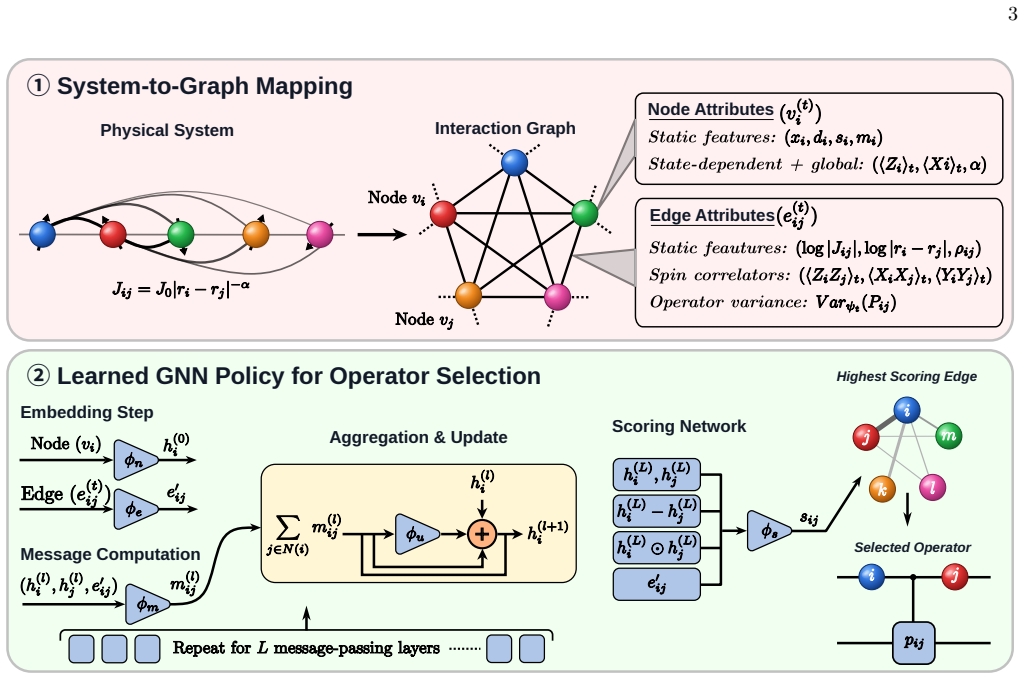
A graph neural network policy that ingests the interaction graph together with state-dependent observables and outputs a ranked prediction for the next entangling operator.
If this is right
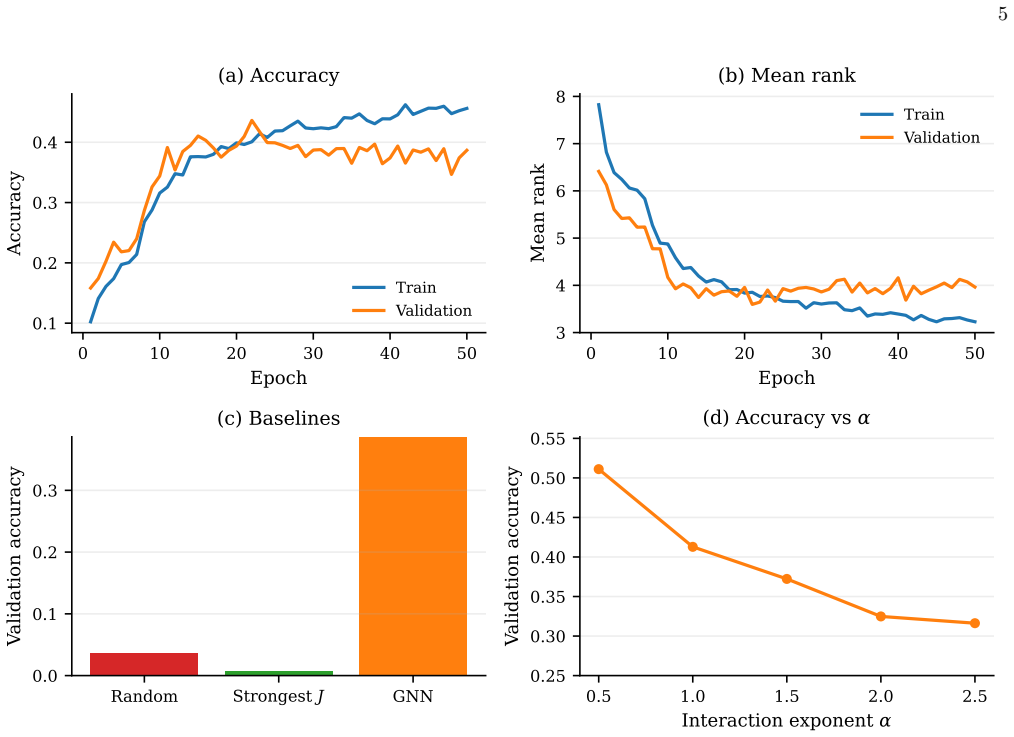
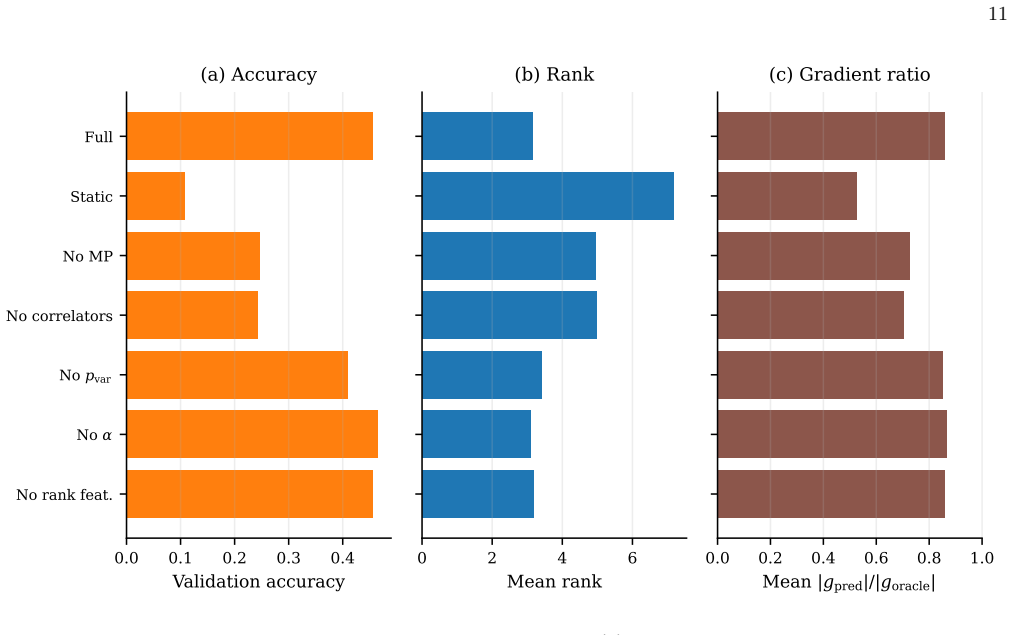
- The GNN reproduces the dominant structure of the greedy gradient-based selection rule on the training distribution.
- It significantly outperforms heuristics that rely only on interaction strength.
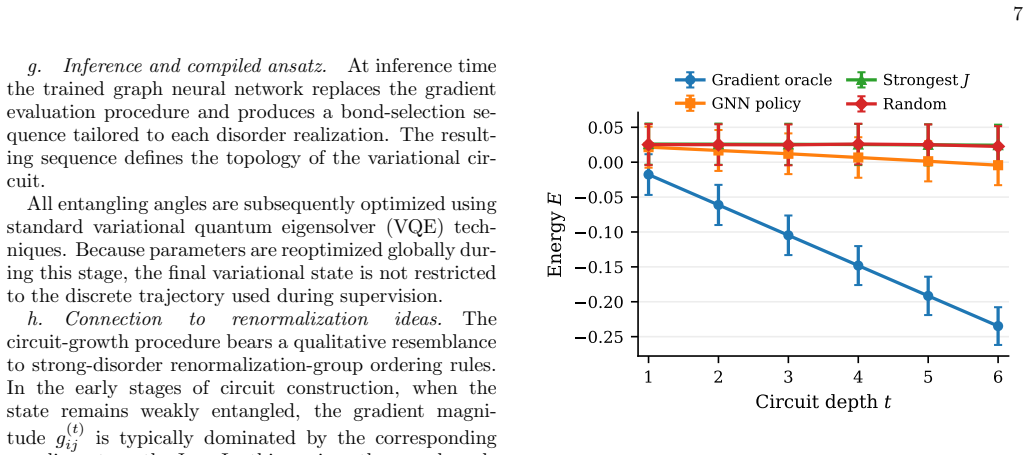
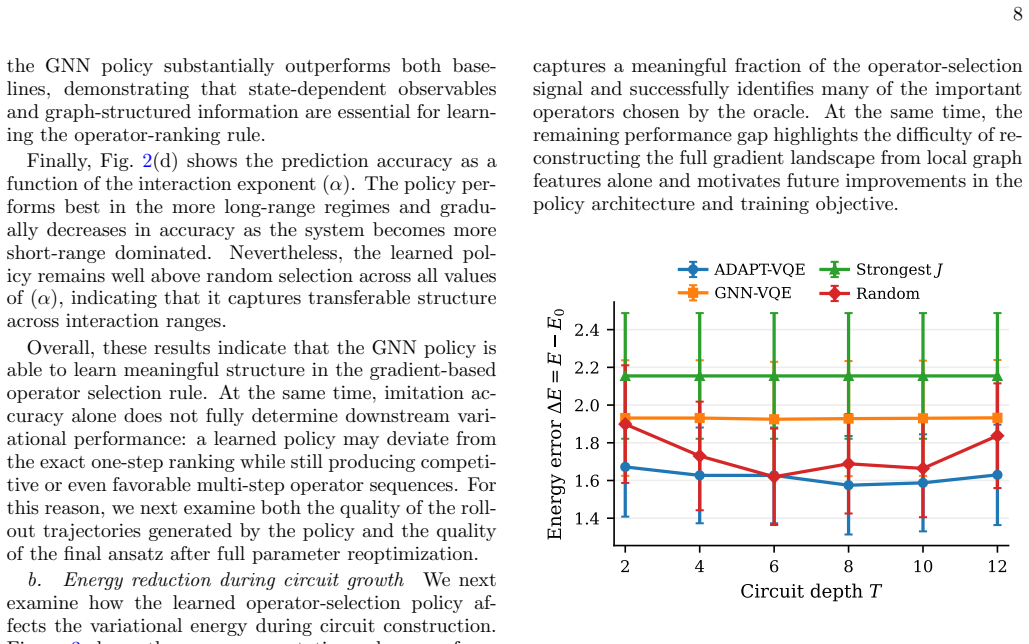
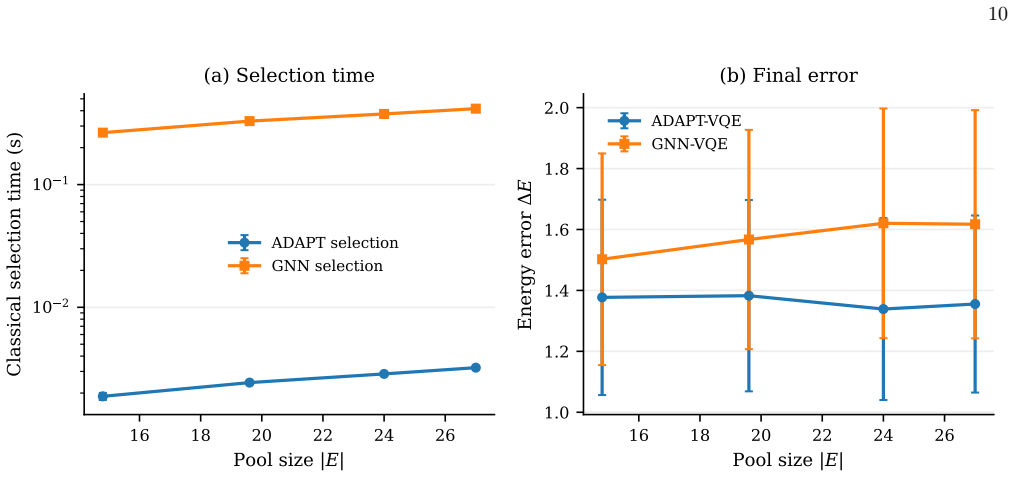
- When integrated into VQE the approach reaches energy errors close to standard ADAPT-VQE while drastically cutting the number of full-pool gradient evaluations.
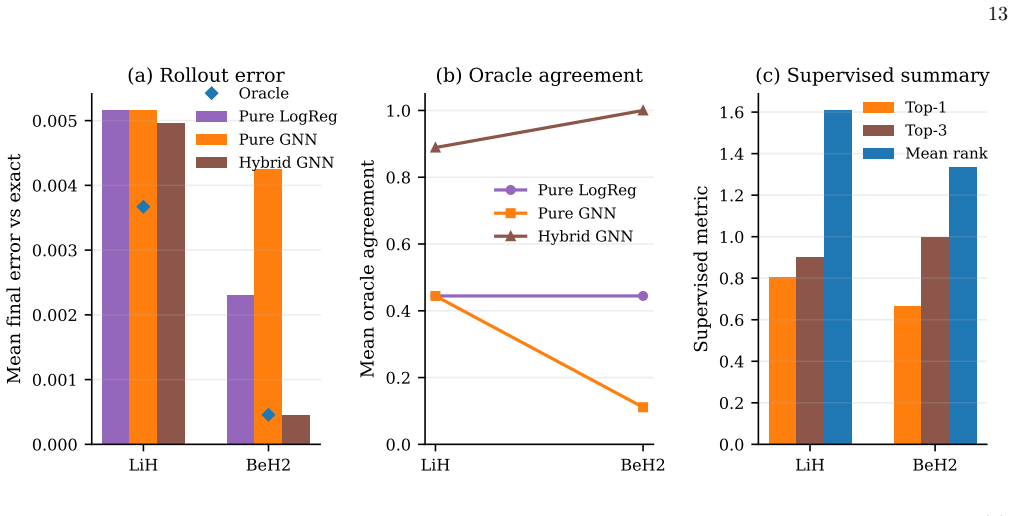
- On LiH and BeH2 the policy functions as a shortlist generator that recovers near-oracle behavior after exact rescoring of only a few candidates.
Where Pith is reading between the lines
- The same learned policy could be tested on larger active spaces where full gradient scans become computationally prohibitive.
- Similar graph-based policies might be trained once and reused across families of Hamiltonians that share local interaction motifs.
- The success as a shortlist generator suggests that operator-selection decisions contain transferable local structure that does not require exact knowledge of the target observable.
- Retraining the network on a mixture of spin and molecular data could further improve robustness when the target system differs strongly from the original training distribution.
Load-bearing premise
The patterns learned from exact simulations of disordered long-range spin chains transfer to the different interaction structures and observables of small molecular Hamiltonians without retraining.
What would settle it
A direct comparison, on a molecule outside the training distribution, between the operators ranked highest by the GNN and the operators that actually possess the largest gradient magnitudes when the full pool is evaluated exactly.
Figures
read the original abstract
Adaptive variational quantum algorithms like ADAPT-VQE construct tailored ans\"atze by iteratively selecting operators from a pool using gradient-based criteria. While this avoids oversized parameter spaces, repeatedly scanning the full pool incurs a classical cost that scales linearly with pool size-a major bottleneck for systems with long-range interactions or large operator sets. Here, we reformulate adaptive operator selection as a graph-based decision problem and introduce a graph neural network (GNN) policy that predicts the next entangling operator directly from the interaction graph and state-dependent observables. Training data are generated from exact simulations of disordered long-range spin chains, using gradient magnitudes as supervision signals. The learned policy accurately reproduces the dominant structure of the greedy gradient-based selection rule, significantly outperforming heuristics based solely on interaction strength. Integrated into a variational quantum eigensolver (VQE) workflow, this GNN-VQE approach achieves energy errors close to standard ADAPT-VQE while drastically reducing full-pool gradient evaluations. To test transferability beyond spin models, we evaluate the policy on small active-space molecular benchmarks (LiH and BeH_$2$). We find the GNN is highly effective as a shortlist generator: exact rescoring over just a few GNN-proposed candidates recovers near-oracle rollout behavior while searching only a small fraction of the pool. These results demonstrate that adaptive circuit construction contains learnable structure that can be exploited to accelerate variational quantum algorithms.
Editorial analysis
A structured set of objections, weighed in public.
Referee Report
Summary. The paper reformulates adaptive operator selection in ADAPT-VQE as a graph decision problem and trains a GNN policy on exact simulations of disordered long-range spin chains, using gradient magnitudes as supervision. The policy is claimed to reproduce the dominant structure of the greedy gradient rule, outperform interaction-strength heuristics, and when integrated into VQE, yield energies close to standard ADAPT-VQE while reducing full-pool gradient evaluations. Transfer is tested on LiH and BeH2 molecular Hamiltonians, where the GNN is used as a shortlist generator that recovers near-oracle rollout behavior over a small pool fraction.
Significance. If the empirical claims hold with quantitative support, the work would demonstrate that operator-selection patterns in adaptive VQE contain transferable structure that GNNs can exploit to reduce classical overhead, particularly for systems with large pools. The approach of training on spin models and testing transfer via shortlisting on molecular systems is a concrete step toward learned accelerators for variational algorithms, though the current presentation leaves the magnitude of the improvement and the robustness of transfer unquantified.
major comments (2)
- [Abstract / molecular benchmarks] Abstract and molecular benchmarks evaluation: the central claim that the GNN 'recovers near-oracle rollout behavior' on LiH and BeH2 while searching only a small fraction of the pool is stated without any reported energy errors, selection accuracies, error bars, training curves, or direct comparison to the full-pool ADAPT-VQE baseline. This absence makes it impossible to assess whether the shortlist performance is practically useful or merely consistent with the limited test cases.
- [Abstract / transfer evaluation] Abstract and transfer discussion: the assertion that patterns learned from gradient magnitudes on disordered long-range spin chains transfer to fermionic molecular Hamiltonians (different connectivity, observables, and operator pools) rests on the shortlist tests alone. No structural similarity metrics between the two graph families, no ablation on featurization differences, and no distribution comparison of selected operators across domains are provided, leaving the transfer claim load-bearing but unsupported by evidence.
minor comments (1)
- [Abstract] The abstract refers to 'drastically reducing full-pool gradient evaluations' without specifying the reduction factor or the pool sizes used in the spin-chain and molecular experiments.
Simulated Author's Rebuttal
We thank the referee for the detailed and constructive report. We agree that the molecular benchmarks and transfer claims require stronger quantitative support and will revise the manuscript to address these points directly.
read point-by-point responses
-
Referee: [Abstract / molecular benchmarks] Abstract and molecular benchmarks evaluation: the central claim that the GNN 'recovers near-oracle rollout behavior' on LiH and BeH2 while searching only a small fraction of the pool is stated without any reported energy errors, selection accuracies, error bars, training curves, or direct comparison to the full-pool ADAPT-VQE baseline. This absence makes it impossible to assess whether the shortlist performance is practically useful or merely consistent with the limited test cases.
Authors: We acknowledge that the abstract and the molecular section present the shortlist results qualitatively without the requested numerical details. The manuscript states that GNN-VQE yields energies close to standard ADAPT-VQE and recovers near-oracle behavior, but does not tabulate explicit energy errors, accuracies, or error bars for LiH/BeH2. In revision we will add a table reporting these quantities (including error bars over multiple runs), selection accuracy of the GNN proposals, and a direct side-by-side comparison against full-pool ADAPT-VQE. Training curves from the spin-chain experiments will also be referenced or included if space allows. revision: yes
-
Referee: [Abstract / transfer evaluation] Abstract and transfer discussion: the assertion that patterns learned from gradient magnitudes on disordered long-range spin chains transfer to fermionic molecular Hamiltonians (different connectivity, observables, and operator pools) rests on the shortlist tests alone. No structural similarity metrics between the two graph families, no ablation on featurization differences, and no distribution comparison of selected operators across domains are provided, leaving the transfer claim load-bearing but unsupported by evidence.
Authors: The transfer evidence is indeed limited to the empirical shortlist performance on the two molecular systems. The current manuscript provides no structural similarity metrics, featurization ablations, or cross-domain operator-distribution comparisons. In the revision we will expand the discussion to explicitly contrast the graph structures (connectivity, observables, pool composition) between the training spin chains and the molecular test cases, and we will add a brief analysis of the operators selected by the GNN versus the oracle on the molecular instances. We cannot retroactively generate new ablation experiments that were not performed, but the added discussion will clarify the scope of the transfer claim. revision: partial
Circularity Check
No significant circularity; derivation is self-contained
full rationale
The paper generates training labels from independent exact simulations of spin-chain gradients and evaluates the resulting GNN policy on separate molecular Hamiltonians as an out-of-distribution test. No equations reduce reported performance metrics to quantities defined by the model itself, no self-citations are invoked as load-bearing uniqueness theorems, and no fitted parameters are relabeled as predictions. The central workflow (supervised GNN approximating gradient selection) is externally falsifiable against the original ADAPT-VQE rollout and does not collapse by construction.
Axiom & Free-Parameter Ledger
axioms (2)
- domain assumption Gradient magnitudes from exact diagonalization of the training Hamiltonians provide appropriate supervision signals for learning the operator-selection policy.
- domain assumption The interaction graph together with state-dependent observables contain sufficient information to predict the next useful entangling operator.
Reference graph
Works this paper leans on
-
[1]
In rollout evaluation, the hybrid GNN improves the mean oracle agreement from 0.444 for the pure learned policies to 0.889 and reduces the final rollout error from 0.0052 to 0.00496. BeH 2 is particularly useful in this context because it has appeared repeatedly as a small but nontrivial benchmark in quantum-computing stud- ies of molecular electronic str...
-
[2]
Peruzzo, J
A. Peruzzo, J. McClean, P. Shadbolt, M.-H. Yung, X.-Q. Zhou, P. J. Love, A. Aspuru-Guzik, and J. L. O’Brien, A variational eigenvalue solver on a photonic quantum processor, Nature Communications5, 4213 (2014)
2014
-
[3]
J. R. McClean, J. Romero, R. Babbush, and A. Aspuru- Guzik, The theory of variational hybrid quantum- classical algorithms, New Journal of Physics18, 023023 (2016)
2016
-
[4]
Cerezo, A
M. Cerezo, A. Arrasmith, R. Babbush, S. C. Benjamin, S. Endo, K. Fujii, J. R. McClean, K. Mitarai, X. Yuan, L. Cincio, and P. J. Coles, Variational quantum algo- rithms, Nature Reviews Physics3, 625–644 (2021)
2021
-
[5]
Tilly, H
J. Tilly, H. Chen, S. Cao, D. Picozzi, K. Setia, Y. Li, E. Grant, L. Wossnig, I. Rungger, G. H. Booth, and J. Tennyson, The variational quantum eigensolver: A re- view of methods and best practices, Physics Reports986, 1–128 (2022)
2022
-
[6]
McArdle, S
S. McArdle, S. Endo, A. Aspuru-Guzik, S. C. Benjamin, and X. Yuan, Quantum computational chemistry, Rev. Mod. Phys.92, 015003 (2020)
2020
-
[7]
N. S. Blunt, J. Camps, O. Crawford, R. Izs´ ak, S. Leontica, A. Mirani, A. E. Moylett, S. A. Scivier, C. S¨ underhauf, P. Schopf, J. M. Taylor, and N. Holz- mann, Perspective on the current state-of-the-art of quantum computing for drug discovery applications, Journal of Chemical Theory and Computation18, 7001 (2022)
2022
-
[8]
F. A. Evangelista and V. S. Batista, Editorial: Quan- tum computing for chemistry, Journal of Chemical The- ory and Computation19, 7435 (2023)
2023
-
[9]
Alexeev, V
Y. Alexeev, V. S. Batista, N. Bauman, L. Bertels, D. Claudino, R. Dutta, L. Gagliardi, S. Godwin, N. Govind, M. Head-Gordon, M. R. Hermes, K. Kowal- ski, A. Li, C. Liu, J. Liu, P. Liu, J. M. Garc´ ıa-Lastra, D. Mejia-Rodriguez, K. Mueller, M. Otten, B. Peng, M. Raugas, M. Reiher, P. Rigor, W. J. Shaw, M. van Schilfgaarde, T. Vegge, Y. Zhang, M. Zheng, and...
2025
-
[10]
J. A. de Gracia Trivi˜ no, M. G. Delcey, and G. Wendin, Complete active space methods for nisq devices: The importance of canonical orbital optimization for accu- racy and noise resilience, Journal of Chemical Theory and Computation19, 2863 (2023)
2023
-
[11]
C. J. Stein and M. Reiher, Automated selection of active 14 orbital spaces, Journal of Chemical Theory and Compu- tation12, 1760 (2016)
2016
-
[12]
J. R. McClean, S. Boixo, V. N. Smelyanskiy, R. Bab- bush, and H. Neven, Barren plateaus in quantum neural network training landscapes, Nature Communications9, 4812 (2018)
2018
-
[13]
H. R. Grimsley, S. E. Economou, E. Barnes, and N. J. Mayhall, An adaptive variational algorithm for exact molecular simulations on a quantum computer, Nature Communications10, 3007 (2019)
2019
-
[14]
H. L. Tang, V. Shkolnikov, G. S. Barron, H. R. Grim- sley, N. J. Mayhall, E. Barnes, and S. E. Economou, Qubit-adapt-vqe: An adaptive algorithm for construct- ing hardware-efficient ans¨ atze on a quantum processor, PRX Quantum2, 020310 (2021)
2021
-
[15]
D. Claudino, J. Wright, A. J. McCaskey, and T. S. Humble, Benchmarking adaptive variational quantum eigensolvers, Frontiers in ChemistryVolume 8 - 2020, 10.3389/fchem.2020.606863 (2020)
-
[16]
Y. S. Yordanov, V. Armaos, C. H. W. Barnes, and D. R. M. Arvidsson-Shukur, Qubit-excitation-based adaptive variational quantum eigensolver, Communica- tions Physics4, 228 (2021)
2021
-
[17]
Lan and W
Z. Lan and W. Liang, Amplitude reordering accelerates the adaptive variational quantum eigensolver algorithms, Journal of Chemical Theory and Computation18, 5267 (2022)
2022
-
[18]
Feniou, M
C. Feniou, M. Hassan, D. Traor´ e, E. Giner, Y. Maday, and J.-P. Piquemal, Overlap-adapt-vqe: practical quan- tum chemistry on quantum computers via overlap-guided compact ans¨ atze, Communications Physics6, 192 (2023)
2023
-
[19]
P. G. Anastasiou, Y. Chen, N. J. Mayhall, E. Barnes, and S. E. Economou, Tetris-adapt-vqe: An adaptive algo- rithm that yields shallower, denser circuit ans¨ atze, Phys. Rev. Res.6, 013254 (2024)
2024
-
[20]
Vaquero-Sabater, A
N. Vaquero-Sabater, A. Carreras, R. Or´ us, N. J. Mayhall, and D. Casanova, Physically motivated improvements of variational quantum eigensolvers, Journal of Chemical Theory and Computation20, 5133 (2024)
2024
-
[21]
J. W. Mullinax, P. G. Anastasiou, J. Larson, S. E. Economou, and N. M. Tubman, Classical preoptimiza- tion approach for adapt-vqe: Maximizing the poten- tial of high-performance computing resources to improve quantum simulation of chemical applications, Journal of Chemical Theory and Computation21, 4006 (2025)
2025
-
[22]
Z. Sun, X. Li, J. Liu, Z. Li, and J. Yang, Circuit-efficient qubit excitation-based variational quantum eigensolver, Journal of Chemical Theory and Computation21, 5071 (2025)
2025
-
[23]
Singh, L
H. Singh, L. W. Bertels, D. Claudino, S. E. Economou, E. Barnes, N. P. Bauman, K. Kowalski, and N. J. Mayhall, Qubit-efficient quantum chemistry with the adapt variational quantum eigensolver and double uni- tary downfolding, Journal of Chemical Theory and Com- putation21, 8799 (2025)
2025
-
[24]
W. Li, Y. Ge, S.-X. Zhang, Y.-Q. Chen, and S. Zhang, Efficient and robust parameter optimization of the uni- tary coupled-cluster ansatz, Journal of Chemical Theory and Computation20, 3683 (2024)
2024
-
[25]
L. Zhu, S. Liang, C. Yang, and X. Li, Optimizing shot assignment in variational quantum eigensolver measure- ment, Journal of Chemical Theory and Computation20, 2390 (2024)
2024
-
[26]
Koffel, M
T. Koffel, M. Lewenstein, and L. Tagliacozzo, Entangle- ment entropy for the long-range ising chain in a trans- verse field, Phys. Rev. Lett.109, 267203 (2012)
2012
-
[27]
Vodola, L
D. Vodola, L. Lepori, E. Ercolessi, A. V. Gorshkov, and G. Pupillo, Kitaev chains with long-range pairing, Phys. Rev. Lett.113, 156402 (2014)
2014
-
[28]
D. S. Fisher, Random antiferromagnetic quantum spin chains, Phys. Rev. B50, 3799 (1994)
1994
-
[29]
Refael and E
G. Refael and E. Altman, Strong disorder renormaliza- tion group primer and the superfluid–insulator transi- tion, Comptes Rendus. Physique14, 725–739 (2013)
2013
-
[30]
Mohdeb, J
Y. Mohdeb, J. Vahedi, N. Moure, A. Roshani, H.-Y. Lee, R. N. Bhatt, S. Kettemann, and S. Haas, Entanglement properties of disordered quantum spin chains with long- range antiferromagnetic interactions, Phys. Rev. B102, 214201 (2020)
2020
-
[31]
Mohdeb, J
Y. Mohdeb, J. Vahedi, and S. Kettemann, Excited- eigenstate entanglement properties of xx spin chains with random long-range interactions, Phys. Rev. B106, 104201 (2022)
2022
-
[32]
Mohdeb, J
Y. Mohdeb, J. Vahedi, R. N. Bhatt, S. Haas, and S. Ket- temann, Global quench dynamics and the growth of en- tanglement entropy in disordered spin chains with tun- able range interactions, Phys. Rev. B108, L140203 (2023)
2023
-
[33]
Gilmer, S
J. Gilmer, S. S. Schoenholz, P. F. Riley, O. Vinyals, and G. E. Dahl, Neural message passing for quantum chem- istry, inProceedings of the 34th International Conference on Machine Learning, Proceedings of Machine Learning Research, Vol. 70, edited by D. Precup and Y. W. Teh (PMLR, 2017) pp. 1263–1272
2017
-
[34]
P. W. Battaglia, J. B. Hamrick, V. Bapst, A. Sanchez- Gonzalez, V. Zambaldi, M. Malinowski, A. Tacchetti, D. Raposo, A. Santoro, R. Faulkner, C. Gulcehre, F. Song, A. Ballard, J. Gilmer, G. Dahl, A. Vaswani, K. Allen, C. Nash, V. Langston, C. Dyer, N. Heess, D. Wierstra, P. Kohli, M. Botvinick, O. Vinyals, Y. Li, and R. Pascanu, Relational inductive biase...
Pith/arXiv arXiv 2018
-
[35]
Singh, J
K. Singh, J. M¨ unchmeyer, L. Weber, U. Leser, and A. Bande, Graph neural networks for learning molecu- lar excitation spectra, Journal of Chemical Theory and Computation18, 4408 (2022)
2022
-
[36]
Carrasquilla and R
J. Carrasquilla and R. G. Melko, Machine learning phases of matter, Nature Physics13, 431–434 (2017)
2017
-
[37]
Carleo and M
G. Carleo and M. Troyer, Solving the quantum many- body problem with artificial neural networks, Science 355, 602–606 (2017)
2017
-
[38]
Bukov, A
M. Bukov, A. G. R. Day, D. Sels, P. Weinberg, A. Polkovnikov, and P. Mehta, Reinforcement learning in different phases of quantum control, Phys. Rev. X8, 031086 (2018)
2018
-
[39]
N. E. Belaloui, A. Tounsi, A. R. Khamadja, M. M. Louamri, A. Benslama, D. E. Bernal Neira, and M. T. Rouabah, Ground-state energy estimation on current quantum hardware through the variational quantum eigensolver: A practical study, Journal of Chemical The- ory and Computation21, 6777 (2025)
2025
-
[40]
A. Ustyuzhanin, J. Vahedi, and S. Kettemann, Ma- chine learning the strong disorder renormalization group method for disordered quantum spin chains (2026), arXiv:2603.05164 [cond-mat.dis-nn]
arXiv 2026
-
[41]
J. Vahedi and S. Kettemann, Probing the spacetime structure of entanglement in monitored quantum circuits 15 with graph neural networks (2026), arXiv:2603.22244 [cond-mat.dis-nn]
arXiv 2026
-
[42]
Kettemann, Strong-disorder renormalization group method for bond-disordered antiferromagnetic quantum spin chains with long-range interactions: Ground-state properties, Phys
S. Kettemann, Strong-disorder renormalization group method for bond-disordered antiferromagnetic quantum spin chains with long-range interactions: Ground-state properties, Phys. Rev. B112, 214205 (2025)
2025
-
[43]
Kettemann, Finite-temperature properties of antifer- romagnetic quantum spin chains with random long-range couplings, Phys
S. Kettemann, Finite-temperature properties of antifer- romagnetic quantum spin chains with random long-range couplings, Phys. Rev. B113, 134204 (2026)
2026
-
[44]
T´ oth and P
Z. T´ oth and P. Pulay, Comparison of methods for ac- tive orbital selection in multiconfigurational calculations, Journal of Chemical Theory and Computation16, 7328 (2020)
2020
-
[45]
D. S. King and L. Gagliardi, A ranked-orbital approach to select active spaces for high-throughput multireference computation, Journal of Chemical Theory and Compu- tation17, 2817 (2021)
2021
-
[46]
Kolodzeiski and C
E. Kolodzeiski and C. J. Stein, Automated, consistent, and even-handed selection of active orbital spaces for quantum embedding, Journal of Chemical Theory and Computation19, 6643 (2023)
2023
-
[47]
J. Sun, L. Cheng, and W. Li, Toward chemical accuracy with shallow quantum circuits: A clifford-based hamilto- nian engineering approach, Journal of Chemical Theory and Computation20, 695 (2024)
2024
-
[48]
J. W. Britton, B. C. Sawyer, A. C. Keith, C.-C. J. Wang, J. K. Freericks, H. Uys, M. J. Biercuk, and J. J. Bollinger, Engineered two-dimensional ising interactions in a trapped-ion quantum simulator, Nature484, 489 (2012)
2012
-
[49]
Islam, C
R. Islam, C. Senko, W. C. Campbell, S. Korenblit, J. Smith, A. Lee, E. E. Edwards, C.-C. J. Wang, J. K. Freericks, and C. Monroe, Emergence and frustration of magnetism with variable-range interactions in a quantum simulator, Science340, 583 (2013)
2013
-
[50]
Richerme, Z.-X
P. Richerme, Z.-X. Gong, A. Lee, C. Senko, J. Smith, M. Foss-Feig, S. Michalakis, A. V. Gorshkov, and C. Monroe, Non-local propagation of correlations in quantum systems with long-range interactions, Nature 511, 198 (2014)
2014
-
[51]
Jurcevic, B
P. Jurcevic, B. P. Lanyon, P. Hauke, C. Hempel, P. Zoller, R. Blatt, and C. F. Roos, Quasiparticle engineering and entanglement propagation in a quantum many-body sys- tem, Nature511, 202 (2014)
2014
-
[52]
Browaeys and T
A. Browaeys and T. Lahaye, Many-body physics with in- dividually controlled rydberg atoms, Nature Physics16, 132 (2020)
2020
-
[53]
Braemer, T
A. Braemer, T. Franz, M. Weidem¨ uller, and M. G¨ arttner, Pair localization in dipolar systems with tunable posi- tional disorder, Phys. Rev. B106, 134212 (2022)
2022
-
[54]
Kjaergaard, M
M. Kjaergaard, M. E. Schwartz, J. Braum¨ uller, P. Krantz, J. I.-J. Wang, S. Gustavsson, and W. D. Oliver, Superconducting qubits: Current state of play, Annual Review of Condensed Matter Physics11, 369 (2020)
2020
discussion (0)
Sign in with ORCID, Apple, or X to comment. Anyone can read and Pith papers without signing in.